Joined November 2020
- Tweets 15,381
- Following 747
- Followers 23,862
- Likes 26,397
1,733 Photos and videos










Pinned Tweet
Mask is off.
Introducing Sleepwell Capital🌙
sleepwellcap.com
My name is Francisco Amador, and for the past five years, I've been building this project anonymously and now it's finally time to make it public.
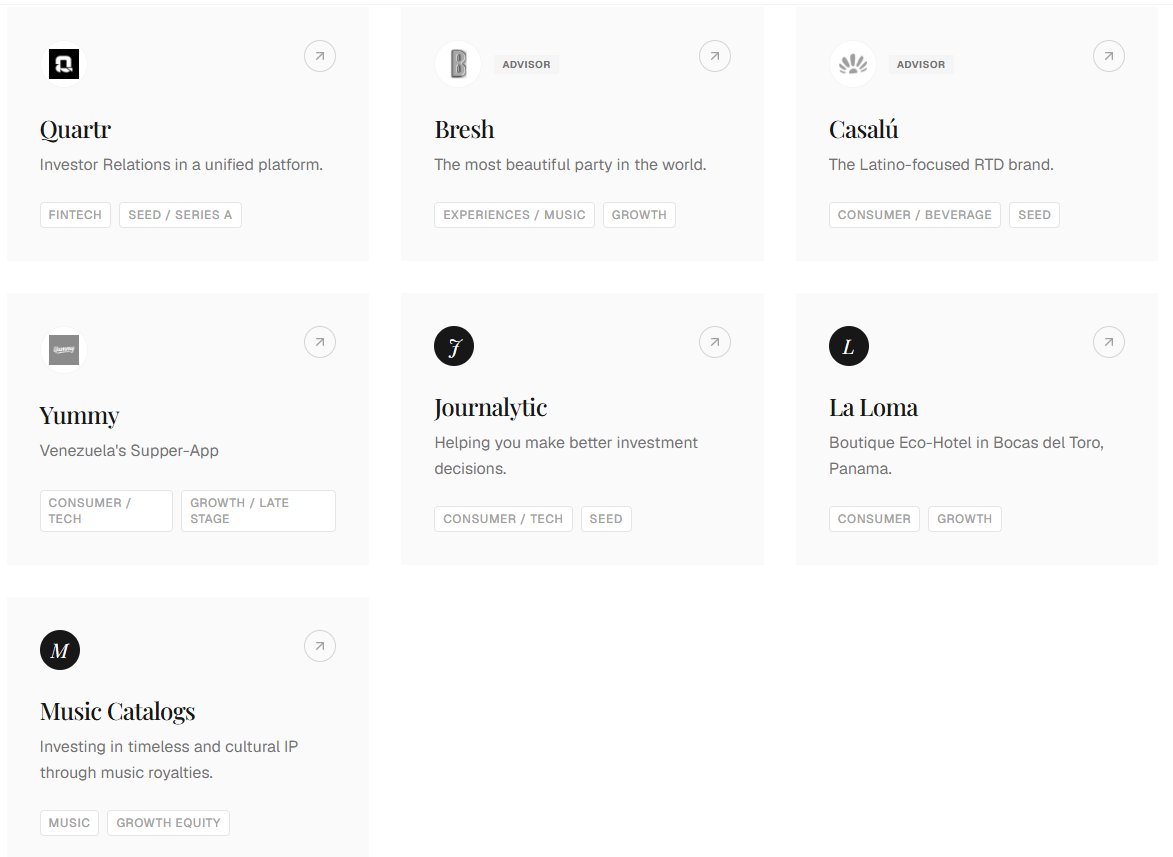
Sleepwell is a private investment vehicle and content platform focused on Consumer, Music, Tech and Experiences.
What started as an anonymous Twitter account, turned into a way to invest some personal capital and write about the things I found most interesting. More recently, it's become a platform to back exceptional founders and companies across all stages, aiming to make high conviction investments and be a thoughtful long-term partner.
It also unexpectedly grew into a large community of like-minded investors.
I owe a lot to this platform and community. I've built some incredible relationships here, and also found my dream job, which I recently transitioned out of after 4 years.
More to come soon🙏
24
16
235
63,347
If this deal goes through, it would be the only pure-play Venezuela publicly listed company today.
These are part of the assets of Swedish listed Maha Capital.

VENEZUELA | Investment firms Lionheart Capital and Keo Energy launch a Nasdaq-listed company to pursue Venezuelan oil assets.
(Financial Times)
1
8
4,392
Just made the most beautiful and aesthetic website with Claude Fable 5😍

Claude Fable 5 has been out for a couple of days. Some projects people have already built with it:
1
2
26
5,855
the never ending fear of dropping my phone into one of these:
2
1
1,431
Francisco Amador – Sleepwell 🌙 retweeted
Will be in NYC week of June 15th.
Would be great to meet thoughtful people who want to exchange perspectives on Venezuela's future and hear how you're thinking about the opportunity set. Investors, allocators, operators, entrepreneurs, journalists.
DM's open or reply.

I'm excited to share that I'm joining Arqos Capital as a Managing Director, to lead their Private Equity and Venture Capital efforts while replanting my roots in my home country – Venezuela.
I genuinely believe we’re facing a generational opportunity to rebuild and invest behind Venezuela's upcoming recovery, and few platforms are as well positioned as Arqos. The firm sits in a unique position for this stage as it has been investing in Venezuela since 2019 – a deeply contrarian decision at the time.
Over that period, Arqos has built a highly reputable asset management platform, an exceptional team, and a differentiated position in one of the most overlooked markets in the world which now has transformed into a valuable first mover advantage. Today it finds itself at the right place and at the right time.
On a personal level, this opportunity is especially meaningful. After 17 years abroad, I’m excited to reconnect with my home country and contribute, in a small way, to this long-awaited reconstruction phase while also helping build the Arqos platform.
Sleepwell Capital will remain active as a side-project focusing on selective high-conviction opportunities and a content platform, always using the same filter: looking at and talking about things that fascinate me and drive my curiosity.
This is a major (and unexpected) career transition for me after spending over 10 years as a public markets investor, but I couldn't be more excited.
1
3
3,465
Francisco Amador – Sleepwell 🌙 retweeted
I'm excited to share that I'm joining Arqos Capital as a Managing Director, to lead their Private Equity and Venture Capital efforts while replanting my roots in my home country – Venezuela.
I genuinely believe we’re facing a generational opportunity to rebuild and invest behind Venezuela's upcoming recovery, and few platforms are as well positioned as Arqos. The firm sits in a unique position for this stage as it has been investing in Venezuela since 2019 – a deeply contrarian decision at the time.
Over that period, Arqos has built a highly reputable asset management platform, an exceptional team, and a differentiated position in one of the most overlooked markets in the world which now has transformed into a valuable first mover advantage. Today it finds itself at the right place and at the right time.
On a personal level, this opportunity is especially meaningful. After 17 years abroad, I’m excited to reconnect with my home country and contribute, in a small way, to this long-awaited reconstruction phase while also helping build the Arqos platform.
Sleepwell Capital will remain active as a side-project focusing on selective high-conviction opportunities and a content platform, always using the same filter: looking at and talking about things that fascinate me and drive my curiosity.
This is a major (and unexpected) career transition for me after spending over 10 years as a public markets investor, but I couldn't be more excited.
18
1
90
26,480
I'm excited to share that I'm joining Arqos Capital as a Managing Director, to lead their Private Equity and Venture Capital efforts while replanting my roots in my home country – Venezuela.
I genuinely believe we’re facing a generational opportunity to rebuild and invest behind Venezuela's upcoming recovery, and few platforms are as well positioned as Arqos. The firm sits in a unique position for this stage as it has been investing in Venezuela since 2019 – a deeply contrarian decision at the time.
Over that period, Arqos has built a highly reputable asset management platform, an exceptional team, and a differentiated position in one of the most overlooked markets in the world which now has transformed into a valuable first mover advantage. Today it finds itself at the right place and at the right time.
On a personal level, this opportunity is especially meaningful. After 17 years abroad, I’m excited to reconnect with my home country and contribute, in a small way, to this long-awaited reconstruction phase while also helping build the Arqos platform.
Sleepwell Capital will remain active as a side-project focusing on selective high-conviction opportunities and a content platform, always using the same filter: looking at and talking about things that fascinate me and drive my curiosity.
This is a major (and unexpected) career transition for me after spending over 10 years as a public markets investor, but I couldn't be more excited.
18
1
90
26,480
Will share the journey here and always happy to chat or connect with anyone interested in Venezuela (DMs open).
Public markets coverage will continue but to a more limited extent – won’t have time to follow as many companies as I’d like to.
1
7
1,336
Francisco Amador – Sleepwell 🌙 retweeted
what is the best resource you’ve come across about portfolio construction in venture capital?
2
1
2
3,831
Francisco Amador – Sleepwell 🌙 retweeted
anyone attending the Weird Shit Investing conference in NYC?
1
1
5
4,705
“don’t ask the barber whether you need a haircut”
2
10
1,700

29 Jul 2021
“If you ask me in retrospect what was our worst mistake in the tech field, I think we were smart enough to figure out Google. Those ads worked so much better in the early days than anything else. So I would say that we failed you there.” — Munger in 2017
$GOOG ~3.5x since then
12
4
132
another 3x since this tweet. That’s a 10 bagger.
2
880
9 years after this quote Greg is pouncing on $GOOG.
What would Charlie’s reaction be?
29 Jul 2021
“If you ask me in retrospect what was our worst mistake in the tech field, I think we were smart enough to figure out Google. Those ads worked so much better in the early days than anything else. So I would say that we failed you there.” — Munger in 2017
$GOOG ~3.5x since then
4
1
17
10,492
Another sector potentially being privatized in Venezuela.
Expect many, many more to come.
The best and only way to get Venezuela exposure is through private markets.

Venezuela's legislature gives initial approval to private investment in electricity sector reuters.com/business/energy/…
2
2,257
Great thoughts on $NU selloff today after CFO transition
Jun 2

Been getting a bunch of DMs asking for my thoughts on Lago’s departure from $NU, so I figured I’d share them here.
In a vacuum, Lago’s departure is a loss. He’s well-liked and respected internally and by investors alike. He helped take the company public and did an exceptional job articulating and synthesizing Nu’s financial position, operating performance, and long-term strategy. He’ll be missed.
If you zoom out, though, the timing of this announcement is undeniably poor.
As investors who closely follow the stock know, Nu is already being heavily scrutinized for its U.S. expansion ambitions. At the same time, concerns around Brazilian credit remain front and center, especially after the Q1 credit loss allowance surprise.
Lago’s departure directly amplifies both concerns.
First, the hiring of a Canadian-American executive who will be based in the U.S. rather than Brazil reinforces the perception that management is doubling down on U.S. expansion—a topic that was already a sensitive point for investors.
Second, the more skeptical investor may interpret Lago’s departure as a key executive leaving just ahead of a major credit expansion cycle in Brazil. Fair or not, some will inevitably wonder whether he sees risks to the model that others don’t.
Given that backdrop, I’m not surprised the market has treated the news as a negative surprise. The stock market has a funny way of turning momentum into narrative, and narrative into paranoia.
What’s the other side of the argument?
Nu is clearly gearing up for international expansion, and the asymmetry of the bets it’s making is substantial. Colombia and Mexico already operate with independent finance organizations. Brazil soon will as well. Rob’s appointment appears designed to consolidate and oversee that broader global structure as the company positions itself for its next phase of growth.
The opportunity is enormous. If the U.S. strategy works, the U.S. alone could eventually represent another Nu-sized business. If it doesn’t, the downside from these investments appears relatively contained given the scale of the existing franchise.
The market’s concern is that management becomes too enamored with global expansion and loses focus on its core markets. With Revolut and others preparing for a similar battle, that concern is understandable.
This stock has never been for the faint of heart, and building a meaningful U.S. business could easily take 3–5 years, if Mexico is any guide.
But when the downside appears limited and the upside remains significant, it may be worth sticking around.
7
8,786