
Joined July 2023
- Tweets 13,550
- Following 206
- Followers 55
- Likes 317
226 Photos and videos





Just Passing By retweeted

7 May 2024
What’s happening in Gaza SHOULD radicalize you. It absolutely should.
Right now, even as its own criminality hits fever pitch, the western political-media class is fretting with increasing shrillness about young people getting “radicalized” and turned against their government by the spread of information and ideas at campus demonstrations and on TikTok.
But young people should be radicalizing right now. Everyone should.
When you see Israel rejecting a Hamas ceasefire and beginning its long-threatened assault on Rafah (the last so-called “safe zone” in Gaza), that should radicalize you.
When you see US senators assist this horrifying onslaught by publicly threatening the International Criminal Court if they dare to indict Israeli officials for war crimes, that should radicalize you.
When you see Israel shutting down Al Jazeera to quash news reporting about its criminality immediately before launching this mass atrocity, that should radicalize you.
When you see The New York Times receiving a Pulitzer Prize for its scandalously discredited, notoriously biased and widely-mocked Gaza coverage, that should radicalize you.
When you see the US president publicly supporting and encouraging violent police crackdowns against protesters opposing his genocidal actions in Gaza, that should radicalize you.
If the so-called “moderate” position of your nation’s political status quo is to accept, normalize, support and defend the sort of evil that is being inflicted upon the people of Gaza, then you should want to get as far away from that “moderate” position as possible, and you should seek the complete annihilation of that political status quo.
This obvious point is being aggressively attacked with rapidly intensifying frenzy by the empire and its lackeys.
After police violently shut down anti-genocide campus demonstrations in New York City, Mayor Eric Adams said “There is a movement to radicalize young people, and I’m not going to wait until it’s done… I’m not going to allow that to happen as the mayor of the City of New York,” as though preventing the spread of radical political opinions is something a mayor is elected to do in the United States.
NYPD Deputy Commissioner of Operations Kaz Daughtry ominously told the press that there is “some organization” who is “radicalizing our students,” and that the New York police force intends to “find out who that is.” Again, the implication being that it is the job of the police to control the spread of unauthorized political opinions.
In an article with the incredibly propagandistic headline “Anti-Israel protests infiltrated by ‘outside agitators’ who radicalize students, sow violence,” The Washington Times presented these unevidenced assertions from New York City officials as though they are established fact instead of highly convenient fiction.
In a talk at the McCain Institute on Friday, Senator Mitt Romney told Secretary of State Antony Blinken that Congress supports banning TikTok because it shares information that turns people’s opinions against Israel, saying such information has a “very, very challenging effect on the narrative.”
A new report from The Intercept reveals that congressmen Mike Lawler and Josh Gottheimer called on the FBI to investigate campus protesters at a “centrist” political group called No Labels, suggesting there these demonstrations have a nefarious support system which the federal police should look into.
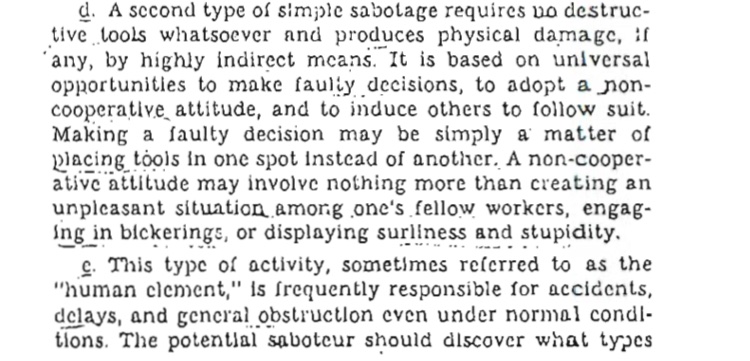
The Wall Street Journal has been losing its mind over the campus protests, posting articles with headlines like “Activist Groups Trained Students for Months Before Campus Protests” and “Rules for Campus Radicals, 2024 — A website reveals the planning and strategy behind the current college mayhem” which suggest that there is something sinister and unacceptable about these demonstrations receiving support from “longtime activists and left-wing groups.”
MSNBC’s Joe Scarborough went full Alex Jones on his show last week, telling his audience that these university protests have been happening because Qatar has “poured hundreds of millions of dollars into American universities to have a radicalizing effect on Middle Eastern studies.”
Empire managers and propagandists have been pushing the narrative that foreign governments are behind this new protest movement to radicalize young people against Washington and Israel, though as we discussed recently they humorously can’t yet manage to agree on which foreign government that is.
The imperial spinmeisters have been churning out these talking points about radicalization and nefarious support because that’s the narrative bludgeon they plan on using to stomp out the burgeoning antiwar movement the empire has created with its genocidal atrocities in Gaza. If they can establish a narrative that it is the government’s job to shut down political dissent and stop the spread of unauthorized political opinions, then they can justify doing pretty much anything to stop this movement in its tracks.
All to shut down something that absolutely SHOULD be happening. Young people SHOULD be cultivating radical political positions in response to an active genocide that’s supported by their government. An antiwar movement SHOULD be forming against the imperial murder machine as its murderousness gets more and more insane. People SHOULD be aggressively rejecting the political status quo that has allowed this nightmare to be unleashed upon humanity.
Everyone should be turning against the US-centralized empire right now. Don’t let the imperial manipulators dupe our society into believing this turn is anything but a correct and appropriate response to what the empire is doing.
92
1,239
2,974
145,699
Just Passing By retweeted

1 Apr 2024
🚨Zomi & Chef Oli's last video shows them cooking meals for Gaza's hungry in @WCKitchen.
They were killed today by Israeli warplanes in #Gaza , in disregard of international laws, echoing the daily killings of Palestinian civilians in Gaza over the past 177 days.
#GazaGenocid
509
17,057
27,088
5,989,148
Just Passing By retweeted

26 Mar 2024
“TWO OR THREE QUOTES THAT YOU USE TO PUSH PEOPLE AROUND”
In a recent debate, someone seated next to Professor Benny Morris lectured me on the impossibility that Israel systematically breaches the laws of war. It was stated that Israel only approved and launched precision attacks directed at legitimate military targets:
“I think that it’s important that when we talk about military strikes or we talk about things especially involving bombings or drone attacks, these are things that are signed off by multiple different layers of command, by multiple people involved in an operation, including intelligence gathering, including weaponeering, and they also have typically lawyers involved.” (from the official transcript)
It was further stated that the whole of my contrary evidence comprises “two or three quotes that you use to push people around.”
In 2014 Israel launched Operation Protective Edge against Gaza. Peter Maurer, president of the International Committee of the Red Cross, observed after touring the ravaged Strip, “I’ve never seen such massive destruction ever before.” According to the vagrant seated next to Professor Morris, “I think Protective Edge was 2014, but I’m just saying that the coordination in the military is pretty tight.” Was this destruction then the result of “pretty tight” precision attacks directed at military targets? An unimpeachable source definitively answers this question. Eyewitness accounts by Israeli combatants were compiled in a large dossier by Breaking the Silence, an Israeli non-governmental organization comprising former Israeli soldiers (“This is How We Fought in Gaza,” 2014). None of the hundreds of testimonies collected by this organization over more than a decade has ever been proven false, and all of them were approved for publication by the IDF censor. The leadership of Breaking the Silence is not conventionally leftist—it does not support the Boycott, Divestment and Sanctions movement, opposes criminal prosecution of Israeli officers, and prudently fudges its own findings—while most of the soldier-witnesses themselves do not even appear contrite. Here’s a tiny sample of the “pretty tight” precision attacks directed exclusively at military targets:
“Shooting to kill. This is combat in an urban area, we’re in a war zone. The saying was: ‘There’s no such thing there as a person who is uninvolved.’ In that situation, anyone there is involved.”
*
“People who look at you from the window of a house that is in your designated area—they, to put it mildly, won’t look anymore.”
*
“The inclination is to avoid taking risks—rather to destroy everything we come across.”
*
“The assumption being that the moment we went into Gaza, anyone who dared poke his head out was a terrorist. . . , you are allowed to open fire.”
*
“The idea was, if you spot something—shoot. . . . Whether it posed a threat or not wasn’t a question, and that makes sense to me. If you shoot someone in Gaza it’s cool, no big deal. . . . They made it clear that there were no uninvolved civilians.”
*
“When we left after the operation, it was just a barren stretch of desert. . . . We spoke about it a lot amongst ourselves, the guys from the company, how crazy the amount of damage we did there was. I quote: ‘Listen man, it’s crazy what went on in there,’ ‘Listen man, we really messed them up,’ ‘Fuck, check it out, there’s nothing at all left . . . , it’s nothing but desert now, that’s crazy.’”
*
“I remember that the level of destruction looked insane to me.”
*
“The formal rules of engagement—I don’t know if for all soldiers—were, ‘Anything still there is as good as dead. Anything you see moving in the neighborhoods you’re in is not supposed to be there. The Palestinian civilians know they are not supposed to be there. Therefore whoever you see there, you kill.’ The commander [gave the order] ‘Anything you see in the neighborhoods you’re in, anything within a reasonable distance, say between zero and 200 meters—is dead on the spot. No authorization needed.’ . . . The working assumption states—and I want to stress that this is a quote of sorts: that anyone located in an IDF area, in areas the IDF took over—is not [considered] a civilian. That is the working assumption. We entered Gaza with that in mind, with an insane amount of firepower.”
*
“The instruction was: ‘Anyone you identify in the area—you shoot.’”
*
“It all looked like a science fiction movie . . . serious levels of destruction everywhere. . . . Everything was really in ruins. And non-stop fire all the time.”
*
“The instructions are to shoot right away. Whoever you spot—be they armed or unarmed, no matter what. The instructions are very clear. Any person you run into, that you see with your eyes—shoot to kill. It’s an explicit instruction.”
*
“I remember it, all the tanks were standing in a row, and I personally asked my commander: ‘Where are we firing at?’ He told me: ‘Pick wherever you feel like it.’”
*
“Before the entrance on foot to Gaza, a crazy amount of artillery was fired at the entire area. . . . Before a tank makes any movement it fires, every time. Those guys were trigger happy, totally crazy. Those were their orders, I’m certain of it, there’s no chance anybody would just go around shooting like that.”
*
“The explosions’ effects cause major amounts of damage, but that doesn’t interest anyone. ‘Use it, use it, explosives can’t be taken back,’ the platoon commander says, ‘I don’t want to leave explosives on me.’”
*
“I don’t really remember what was discussed in terms of formal instructions before we entered, and after we entered nobody really cared about the formal instructions anyway. That’s what we knew. Every tank commander knew, and even the simple soldiers knew,
that if something turns out to be not OK, they can say they saw something suspicious. They’ve got backup. They won’t ever be tried.”
*
“Our view was of the center of the Strip. Let’s say it was a real fireworks display. From a distance it looked pretty cool. . . . If you looked through a night vision scope you saw crazy wreckage, it was a real trip.”
*
“You’re shooting at anything that moves—and also at what isn’t moving, crazy amounts. . . . It also becomes a bit like a computer game, totally cool and real.”
*
“There were no rules of engagement. If you see anyone in that area, that person is a terrorist.”
*
“They went in just to destroy stuff. Just to purposely destroy stuff.”
*
“The rules of engagement were very, very lax. I wouldn’t say that they shot anything that moved—but they didn’t request authorization to fire either. There was no such thing as requesting authorization. Just fire.”
*
“That’s how it was, really—every tank just firing whatever it wanted to. And during the offensive, no one shot at us—not before it, not during it, and not after it. I remember that when we started withdrawing with the tanks, I looked toward the neighborhood, and I could simply see an entire neighborhood up in flames, like in the movies. Columns of smoke everywhere, the neighborhood in pieces, houses on the ground, and like, people were living there, but nobody had fired at us yet. We were firing purposelessly.”
*
“It was total destruction in there—the photos on line are child’s play compared to what we saw there in reality. . . . I never saw anything like it.”
*
“We were firing purposelessly all day long. Hamas was nowhere to be seen. . . . And the rules of engagement were pretty easy-going—I was shocked when I first heard them.”
*
“Everything is a suspicious spot. This is Gaza, you’re firing at everything.”
*
“They explained what you do if you see a civilian. They explained that that’s the way it is in combat. It was shoot to kill immediately if you see stuff. . . . Really, they did say, ‘If you see someone—shoot him.’”
*
“If it looks like a man, shoot. It was simple: You’re in a motherfucking combat zone. A few hours before you went in the whole area was bombed, if there’s anyone there who doesn’t clearly look innocent, you apparently need to shoot that person.”
*
“The unfathomable number of dead on one of the sides, the unimaginable level of destruction, the way militant cells and people were regarded as targets and not as living beings—that’s something that troubles me.”
*
“It’s destruction on a whole other level. . . . We just couldn’t believe it.”
*
“The briefing on rules of engagement was [to open first at], ‘Anything you think you should [open fire at]. . . . Anyone you spot that you can be positive is not the IDF.’ The only emphasis regarding rules of engagement was to make sure you weren’t firing at IDF forces, but other than that, ‘Any person you see.’ From the very start they told us, ‘Shoot to kill.’”
*
“The air force carries out an insane amount of strikes in Gaza during an operation like ‘Protective Edge.’”
*
“Shells are being fired all the time. Even if we aren’t actually going to enter: shells, shells, shells. A suspicious structure, an open area, a field, a place where a tunnel shaft could be—fire, fire, fire.”
***
If “these are things that are signed off by multiple different layers of command, by multiple people involved in an operation, including intelligence gathering, including weaponeering, and they also have typically lawyers involved,” if “the coordination in the military is pretty tight”—then, doesn’t that, on the contrary, PROVE that Israel has premeditatedly, systematically and egregiously breached the laws of war?
***
The collection fittingly concludes with this testimony:
“You leave Gaza and the most obvious question is, ‘Did you kill anybody?’ What can you do—even if you’ll meet the most left-wing girl in the world, eventually she’ll start thinking, ‘Did you ever kill somebody, or not.’ And what can you do about it, most people in our society consider that to be a badge of honor. So everybody wants to come out of there with that feeling of satisfaction.”
318
2,291
6,771
385,289

Just Passing By retweeted

31 Jan 2024
All Coburg residents must evacuate on foot to Dandenong by 5am. When you leave, your homes will be demolished. If you stay you will be killed
39
56
417
28,757
Just Passing By retweeted

2 Jan 2024
John Pilger (1939-2023) to CIA officer: What right do you have to do what you do in other countries?
CIA officer: National security interests
Pilger: The people you do it to have no say
CIA officer: Well that’s just tough
56
659
1,072
47,667
Just Passing By retweeted

30 Nov 2023
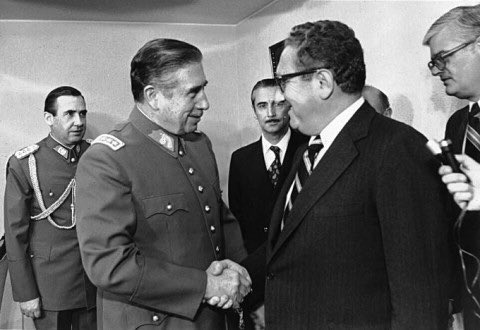
Henry Kissinger dead at 100, a detail of his crimes in Chile🇨🇱:
Following the Democratic election of Marxist-Leninist President Salvador Allende, US President Nixon and Secretary of State Kissinger sought to sabotage Chilé and destroy the government from day one.
Eight days after Allende's election, Kissinger initiated discussion on the telephone with CIA director Richard Helm's about a preemptive coup in Chile. "We will not let Chile go down the drain," Kissinger declared. "I am with you," Helms replied. Their conversation took place three days before President Nixon, in a 15-minute meeting that included Kissinger, ordered the CIA to "make the economy scream," a direct order to punish the people of Chile🇨🇱 for choosing socialism. Nixon named Kissinger as the supervisor of the covert efforts to keep Allende from being inaugurated.
Kissinger lobbied President Nixon to reject the State Department's recommendation that the US seek a modus vivendi with Allende. In an eight-page secret briefing paper, Kissinger wrote to Nixon that "the election of Allende as president of Chile poses for us one of the most serious challenges ever faced in this hemisphere" and "your decision as to what to do about it may be the most historic and difficult foreign affairs decision you will make this year." Not only were a billion dollars of U.S. investments at stake, Kissinger reported, but what he called "the insidious model effect" of his democratic election. There was no way for the US to deny Allende's legitimacy, Kissinger noted, and if he succeeded in peacefully reallocating resources in Chile in a socialist direction, other countries might follow suit. "The example of a successful elected Marxist government in Chile would surely have an impact on, and even precedent value for, other parts of the world, especially in Italy; the imitative spread of similar phenomena elsewhere would in turn significantly affect the world balance and our own position in it."
After Pinochet’s successful coup and the murder of Allende, Kissinger helped give the fascist regime economic, military and diplomatic support, with Pinochet brought under Operation Condor. A CIA plan for continental fascism in Latin America to crush communism, socialism and trade union movements, and roll in disastrous neoliberalism.
Kissinger in 1976 told Pinochet that his regime was a victim of leftist propaganda on human rights. "In the United States, as you know, we are sympathetic with what you are trying to do here," Kissinger told Pinochet. "We want to help, not undermine you. You did a great service to the West in overthrowing Allende."
12
226
339
18,138
Just Passing By retweeted

20 Nov 2023
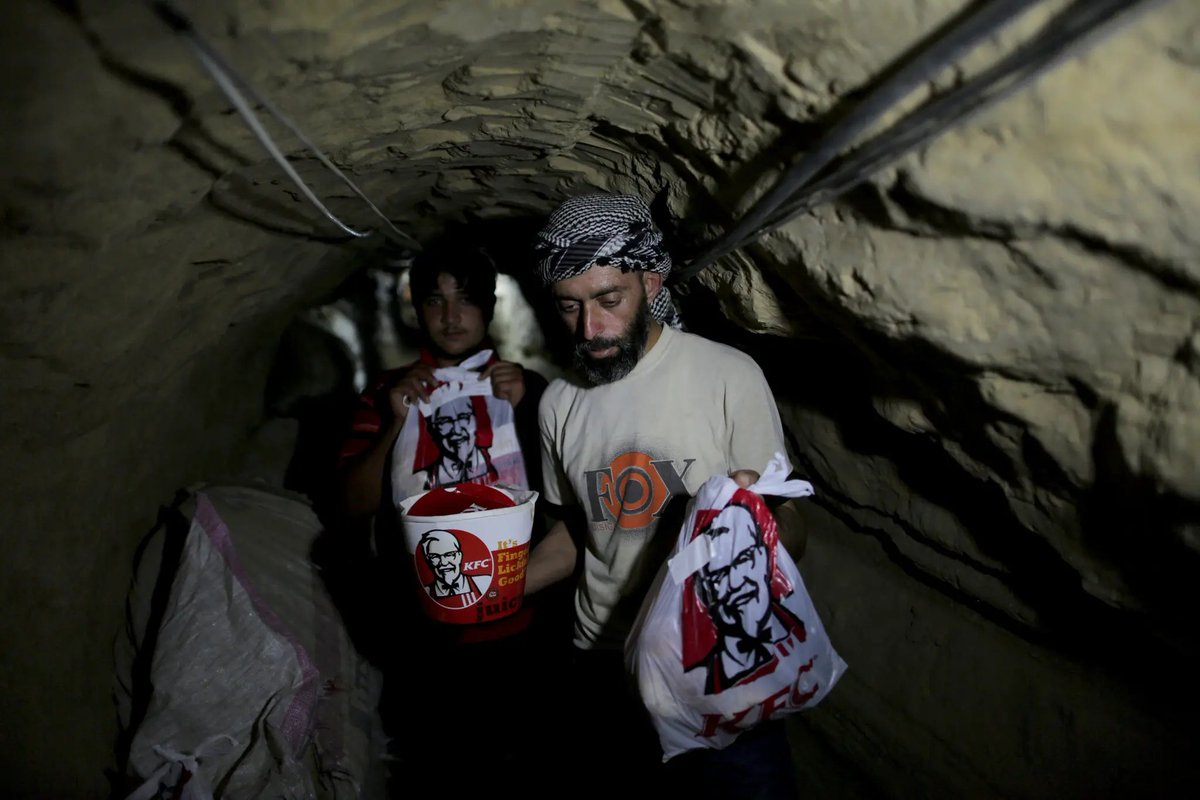
Fun fact: Gaza's tunnel industry thrived b/c of Israel's siege (2006-present) & one of the earliest uses was to smuggle KFC from Egypt🧵
We were literally being starved to near death until the 1st smuggling tunnel brought in Twinkies, crisps & biscuits, all were banned by Israel
594
10,969
36,447
3,517,935