Analysis of the Current Nikkei 225 Market Activity
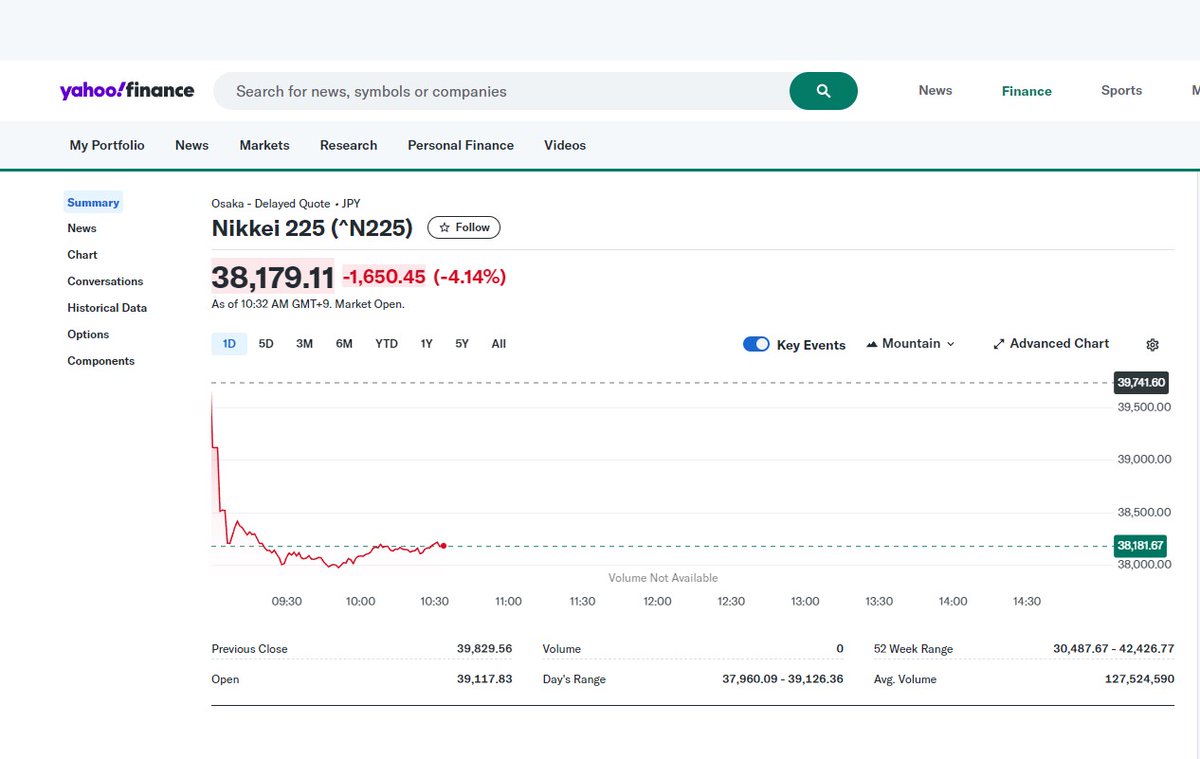
The Nikkei 225 index experienced a sharp decline of 4.25% today, reflecting a drop of 1,693.24 points to 38,136.32
This marks one of the most severe daily losses seen in recent years and can be attributed to several interrelated global financial factors. A closer look reveals that the root cause lies in the rapid appreciation of the Japanese yen, triggered by recent monetary policy changes from the Bank of Japan (BoJ).
1, Interest Rate Hike by the Bank of Japan: Last week, the BoJ unexpectedly raised its benchmark interest rate from 0% to 0.25%, breaking a long-standing policy of near-zero or negative interest rates. This move was aimed at stabilizing inflation expectations and managing the growing concerns about currency depreciation. However, this rate hike has had unintended consequences for the global financial system due to the unwinding of the "yen carry trade."
2, Impact of the Yen Carry Trade: The yen carry trade is a strategy where global investors borrow in yen (due to the previously low borrowing costs) and invest in higher-yielding assets around the world, such as U.S. stocks, emerging market bonds, and even cryptocurrencies. With the yen strengthening rapidly, these positions have become increasingly unprofitable, leading to massive deleveraging and forced liquidations. This unwinding has created a "liquidation cascade," further exacerbating the downward pressure on the Nikkei 225.
3, Global Contagion and Investor Sentiment: The sharp decline in Japan's stock market has not occurred in isolation. Other Asian indices, such as South Korea’s KOSPI and Taiwan’s TAIEX, also experienced significant losses as a result of this systemic risk event. The rising volatility in Asian markets has spread to European markets and even U.S. futures, reflecting heightened investor anxiety across the board.
Future Outlook and Market Expectations:
1, Short-term Risks: In the near term, the primary risk is continued appreciation of the yen, which could lead to further margin calls and accelerated sell-offs. If the yen strengthens beyond critical resistance levels (e.g., 140 yen/USD), it could trigger a new wave of selling pressure on Japanese equities. This will likely result in more losses for large Japanese exporters like Toyota, Sony, and other multinational corporations that are sensitive to currency fluctuations.
2, Potential Stabilization Factors:
Bank of Japan Intervention: There is a possibility that the BoJ may step in to intervene if the currency volatility persists. Such intervention could take the form of either direct currency market action or a reversal of the rate hike to avoid destabilizing financial markets further.
Global Policy Responses: The U.S. Federal Reserve’s stance will be critical. If the Fed signals a dovish pivot or indicates more accommodative monetary policy, it could ease some of the pressure on the yen, thereby providing relief to Japanese stocks.
3, Medium to Long-term Projections: The Nikkei 225’s future will largely depend on global macroeconomic stability and the BoJ’s monetary policy direction. If the BoJ successfully manages to stabilize the currency without spooking the market, Japanese equities could potentially rebound. However, any further tightening could exacerbate the problem and lead to a prolonged downturn.
Additionally, geopolitical uncertainties, such as ongoing tensions in the Middle East and concerns about a potential U.S. recession, will add to market volatility and make forecasting more complex. Therefore, risk management and defensive strategies will be crucial for institutional investors navigating these turbulent waters.
Summary
The current sell-off in the Nikkei 225 is not just a localized event but a symptom of broader systemic financial stress. While the immediate future appears challenging, with potential for further downside, a coordinated response from global central banks could mitigate some of the adverse effects. Until clarity emerges on both U.S. and Japanese policy fronts, markets are likely to remain highly volatile.
#Nikkei225 #JapanMarket #YenCarryTrade #BankOfJapan #GlobalMarkets #FinancialAnalysis #Forex #MarketVolatility #InvestmentStrategy
ALT Analysis of the Current Nikkei 225 Market Activity
The Nikkei 225 index experienced a sharp decline of 4.25% today, reflecting a drop of 1,693.24 points to 38,136.32
This marks one of the most severe daily losses seen in recent years and can be attributed to several interrelated global financial factors. A closer look reveals that the root cause lies in the rapid appreciation of the Japanese yen, triggered by recent monetary policy changes from the Bank of Japan (BoJ).
1, Interest Rate Hike by the Bank of Japan: Last week, the BoJ unexpectedly raised its benchmark interest rate from 0% to 0.25%, breaking a long-standing policy of near-zero or negative interest rates. This move was aimed at stabilizing inflation expectations and managing the growing concerns about currency depreciation. However, this rate hike has had unintended consequences for the global financial system due to the unwinding of the "yen carry trade."
2, Impact of the Yen Carry Trade: The yen carry trade is a strateg