
A Man Who Lived In Dreams.
Joined October 2024
- Tweets 5,836
- Following 366
- Followers 42
- Likes 7,422
467 Photos and videos



Pinned Tweet

13 Apr 2025
By far, my most popular comment.
12 Apr 2025

A jew posted this.
8
3,329

Ra Kalamando🇻🇦 retweeted

Jun 15
OP had to reimagine a movie scene for animation class, this is what he did:
15
355
4,421
83,712
Ra Kalamando🇻🇦 retweeted

"Pirated manga readers are not our opponents. They are our future audience. They are proof that demand already exists"

22h

In 2016, I received an email from an aspiring manga artist in Morocco.
It began like this:
“I want to become a mangaka, but there is no manga publishing industry in Morocco.”
Many people around the world love manga and read it, but when you look globally, there are many countries where manga is simply not published at all.
In some places, there is not even a publishing system(including publishing, translation, and distribution) in place.
Even where books exist, the infrastructure for printing, distribution, and bookstores is often lacking, making it very difficult for a true industry to develop.
Telling manga fans in those countries, “Your country has a relatively high GDP per capita, so you should buy manga,” is meaningless if there is no actual way for them to buy it.
That is something I find deeply painful.
Why is it that the manga industry has not been able to properly serve those regions?
Even in countries where publishing exists, manga books are often too expensive.
The price of a single tankōbon book is $ 15 to $ 20, which is high even in the United States, especially when today’s digital entertainment offers so many alternatives at much lower prices.
So, this is why I believe the future of manga is clearly not limited to print publishing, but must include digital services—manga that can be enjoyed in a reasonably accessible and affordable way.
If such systems are established globally, I believe the manga industry could grow dramatically.
In North America alone, a tenfold expansion would not be unrealistic.
Even countries without any publishing tradition could develop sustainable manga industries.
Once official digital services exist in each country, they can generate tax revenue, and governments can more seriously address piracy.
At that point, creators and aspiring manga artists can also demand proper enforcement and protection.
Most importantly, it would create opportunities for local aspiring manga artists.
And those opportunities would, in turn, strengthen the global industry as a whole.
When a country’s manga ecosystem develops properly, it becomes a cultural export industry.
From a government perspective, piracy then becomes something that can and should be actively addressed.
The first people to pay for legitimate manga services will, in many cases, be the very readers who once relied on piracy. They are not enemies of the industry—they are its earliest supporters in waiting.
Pirated manga readers are not our opponents.
They are our future audience.
They are proof that demand already exists.
In late 1990s Korea, manga piracy was widespread, and attitudes were often very hostile toward paid content.
Many believed that paying for manga was unnecessary, or even that the industry itself should not exist.
At the time, Steve and I did not fully understand this.
We were wrong in many ways.
But later, when proper legal services were introduced in Korea, readers were more than willing to support them. They paid for content gladly, and the Korean webtoon industry grew stronger, eventually becoming a major source of IP for film and television.
We learned, through experience, that the joy of not paying cannot compare to the deeper satisfaction of supporting and sustaining the culture you love.
Piracy users were never the enemy.
They were simply manga fans.
And all manga fans, in the end, are on the same side.
Through our mistakes, Steve and I came to understand this more clearly.
What needs to be done is simple: build proper digital manga services.
Ensure fair pricing.
And most importantly, help each country develop its own manga ecosystem.
Because only then can a truly global manga industry exist.
And only then can the works we create truly reach the world.
To be continued...
37
6,054
42,278
486,395
Ra Kalamando🇻🇦 retweeted

Jun 15
Omae Wa Mou – Deadman 死人 (2017)
Community note
This is deadman 死人's remix of Tiny Little Adiantum by Shibayan Records. The original song is from 2013.
youtube.com/watch?v=rB7XFQ… youtube.com/watch?v=Ejv0Gk…
83
1,157
6,886
423,468


Ra Kalamando🇻🇦 retweeted


1
27
244
1,485












Ra Kalamando🇻🇦 retweeted

Jun 15
We just lost another legend today 😔
Anime studio Eiken announced that legendary animation director, and artist Hiromitsu Morita has passed away.
Throughout a career spanning decades, Morita contributed as an animator, storyboard artist, episode director, animation director, and chief director on numerous beloved productions.
His known works include:
• Astro Boy
• Sazae-san
• Ashita no Joe
• Monster
• Kobo-chan
• Cardcaptor Sakura
• Claymore
• Space Battleship Yamato
• Metropolis
• Heart Cocktail
• The Story of Saiunkoku
And many more!
From early classics to long-running family anime, Morita’s career quietly connected multiple generations of Japanese animation.
Rest in peace, legend 🕊️
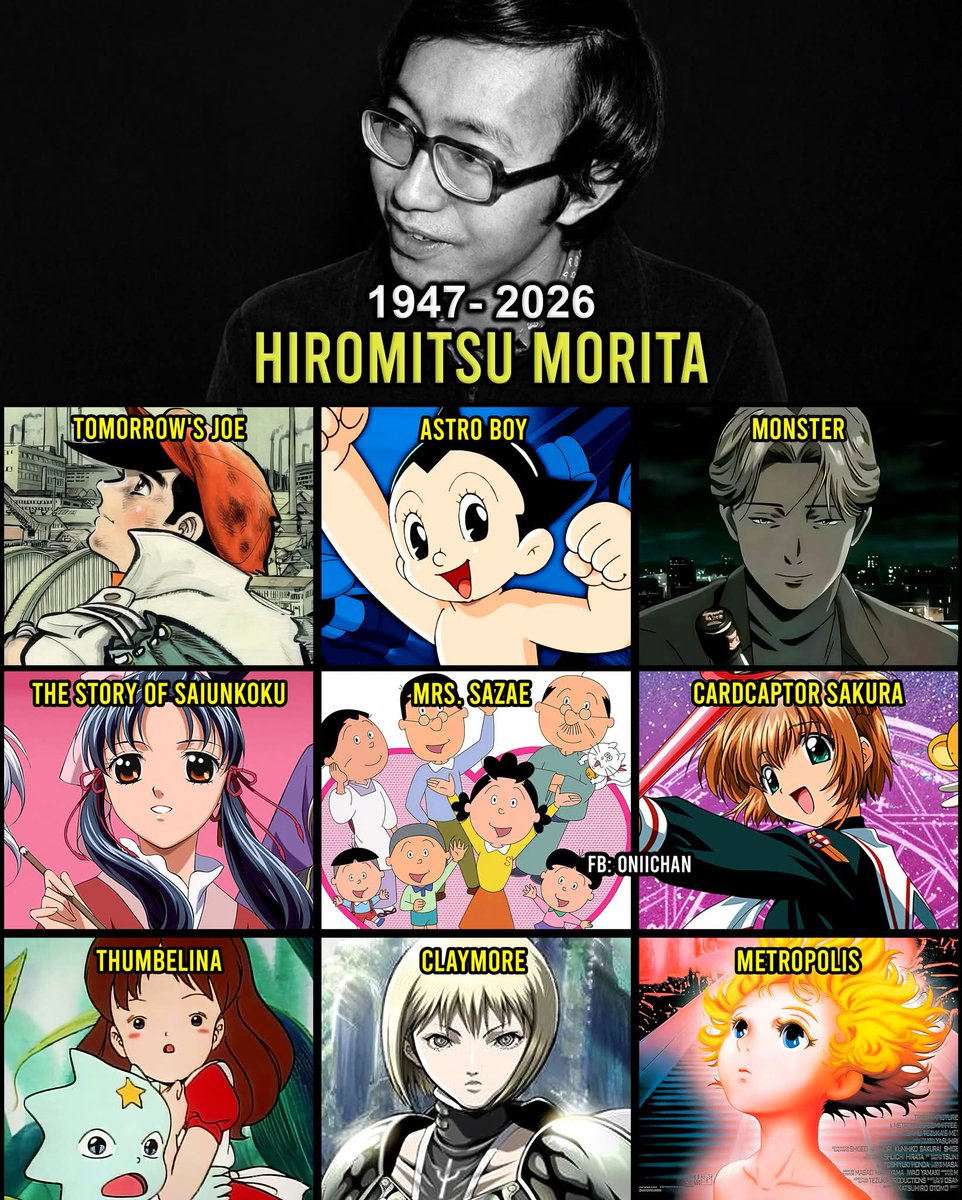
48
2,469
10,188
194,901
Ra Kalamando🇻🇦 retweeted

One of the biggest bonus of reading the manga is the backpage cosplays from Yamada

8
337
6,860
62,505





A weeb that hesitates to spend money on his interests, is no weeb at all!
5