“Navigating South Asia’s Geopolitics | Facts • Analysis • OSINT” or “Uncovering South Asia: Security, Strategy & Truth”.
Joined April 2026
- Tweets 501
- Following 0
- Followers 86
- Likes 6
81 Photos and videos




Pinned Tweet
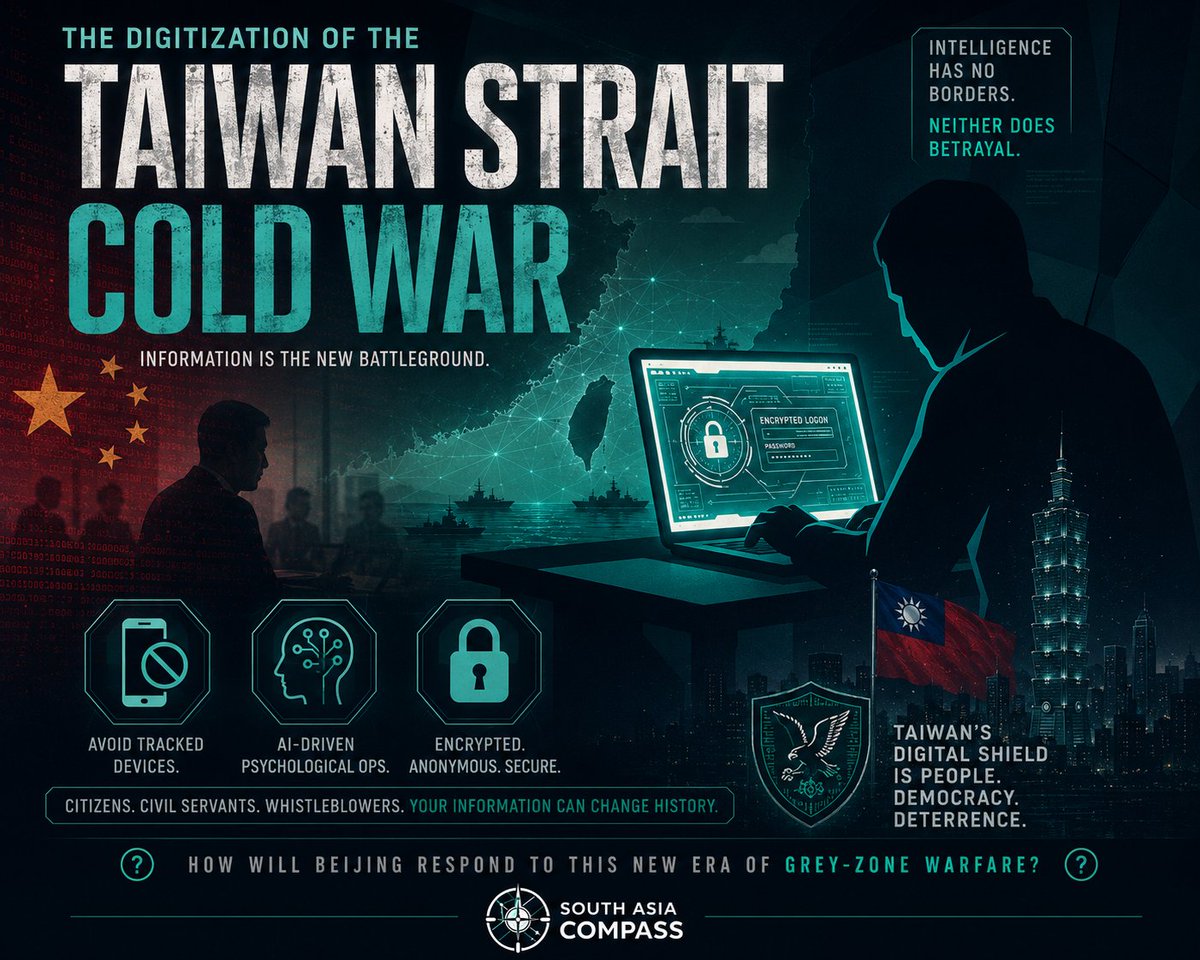
THE DIGITIZATION OF THE TAIWAN STRAIT COLD WAR
While global attention remains fixed on physical military hardware, Taiwan’s National Security Bureau (NSB) has quietly launched a highly aggressive, asymmetric digital offensive that changes everything.
Taipei has officially gone live with an encrypted information-reporting portal (report.nsb.gov.tw) explicitly built for citizens and civil servants of the People's Republic of China (PRC) to leak state intelligence directly to Taiwanese handlers.
This isn't standard counter-espionage. It is an overt exploitation of China’s shifting domestic realities: severe economic stagnation, sweeping anti-corruption purges, and restrictive political controls that have fostered unprecedented friction within Beijing’s bureaucratic layer.
The Psychological & Technical Warfare Elements:
1. AI-Driven PsyOps: The launch was accompanied by an AI-generated video called "Change," showing a mainland official watching colleagues fall victim to state purges. The audio used a distinct northern mainland dialect to directly trigger the psychological vulnerabilities of target officials.
2. The Hardware Alert: In their official operational security guidelines, Taiwan explicitly tells whistleblowers to avoid Chinese-branded smartphones (like Huawei, Xiaomi, or Oppo). This highlights an uncomfortable consensus within high-level intelligence: firmware-level tracking on these devices cannot be cleared by software factory resets.
By shifting from reactive defense to active, crowdsourced Human Intelligence (HUMINT) gathering, Taiwan is building a low-cost, decentralized early-warning system against potential military crises.
The question now is how aggressively Beijing will retaliate via cyber-attacks and internal purges.
What do you think this means for the future of grey-zone warfare? Let's discuss in the comments.
53
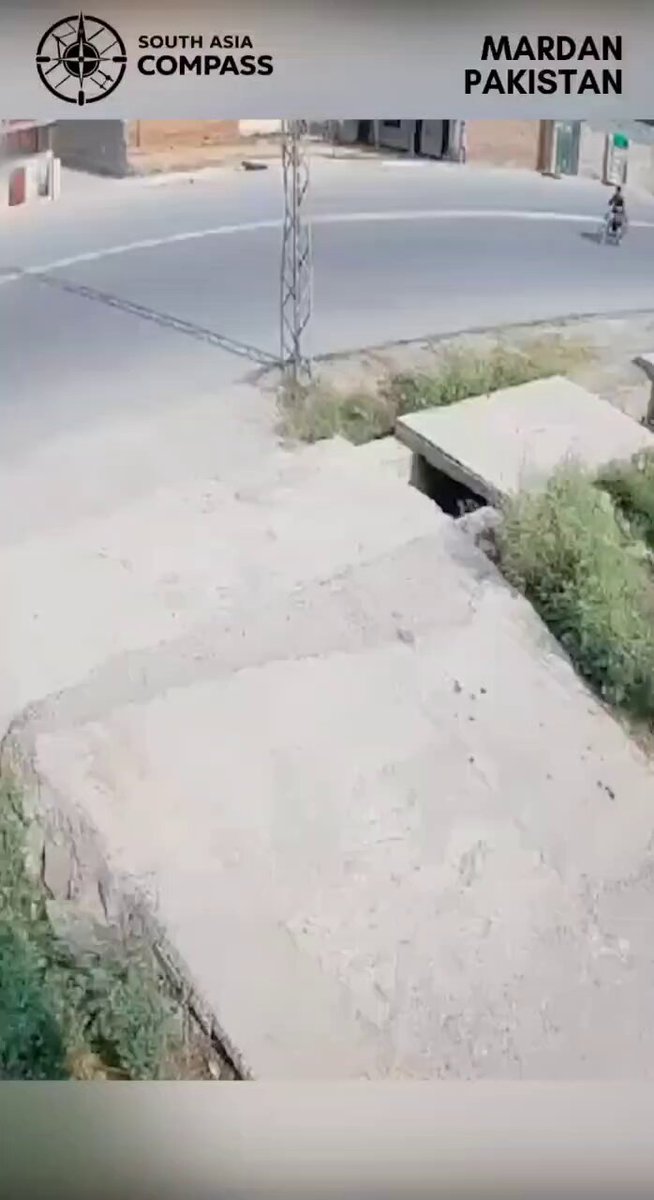
ardan، خیبر پختونخوا کے سوالدھیر علاقے میں معمول کی تربیتی پرواز کے دوران گر کر تباہ ہو گیا۔جانی نقصان: دونوں عملے کے ارکان ہلاک ہو گئے — فلائٹ لیفٹیننٹ محمد قاسم (پی اے ایف) اور لیفٹیننٹ طہٰ عباسی (پاکستان نیوی)۔
طیارہ سڑک کے کنارے زمین سے ٹکرا کر آگ بھڑک اٹھا۔ حادثے میں زمین پر موجود کئی عام شہری بھی زخمی ہو گئے۔
سیکیورٹی کیمرے کی فوٹیج میں طیارے کو تیزی سے نیچے گرتے، زمین سے ٹکراتے اور شعلوں میں لپٹتے دیکھا جا سکتا ہے، جبکہ مقامی لوگ موقع پر پہنچ رہے ہیں۔
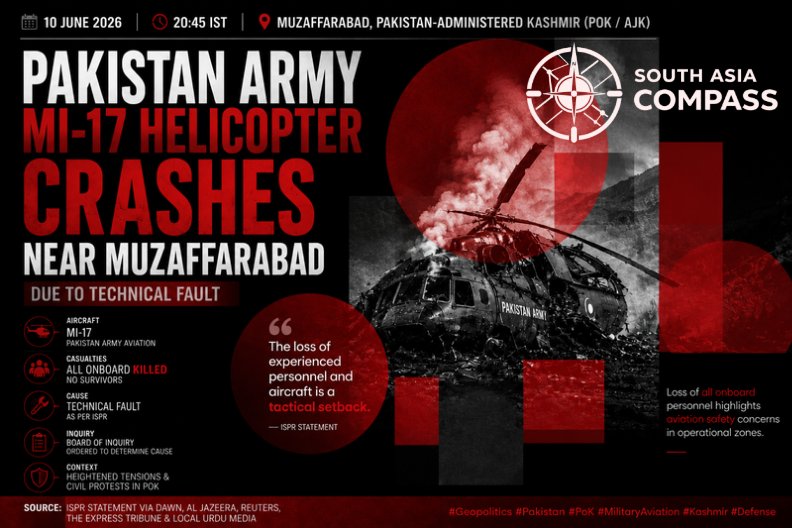
یہ واقعہ پانچ دنوں میں پاکستان فوج کا دوسرا مہلک ہوائی حادثہ ہے۔ اس سے قبل 11 جون کو کشمیر میں ایم آئی-17 ہیلی کاپٹر کے گرنے سے 22 اہلکار ہلاک ہو چکے ہیں۔ دونوں واقعات کو پاکستان کے شمال مغربی سرحدی علاقوں میں زیادہ آپریشنل دباؤ اور معاشی مشکلات کی وجہ سے طیاروں کی دیکھ بھال میں حائل رکاوٹوں سے جوڑا جا رہا ہے۔

🚨 SYSTEMIC STRAIN: Pakistan suffers second fatal military aviation crash in 5 days.
A training aircraft crash today in Mardan, Khyber Pakhtunkhwa, took the lives of Flt Lt Muhammad Qasim (PAF) and Lt Taha Abbasi (Pakistan Navy), while injuring three civilians on the ground. This comes just days after a fatal Mi-17 crash in Kashmir.
Deep OSINT metrics suggest that high-intensity operational demands along the northwestern frontier, combined with tough macroeconomic realities throttling the spare parts supply chain, are pushing aging fleets to their absolute limits
52
🚨 SYSTEMIC STRAIN: Pakistan suffers second fatal military aviation crash in 5 days.
A training aircraft crash today in Mardan, Khyber Pakhtunkhwa, took the lives of Flt Lt Muhammad Qasim (PAF) and Lt Taha Abbasi (Pakistan Navy), while injuring three civilians on the ground. This comes just days after a fatal Mi-17 crash in Kashmir.
Deep OSINT metrics suggest that high-intensity operational demands along the northwestern frontier, combined with tough macroeconomic realities throttling the spare parts supply chain, are pushing aging fleets to their absolute limits
324
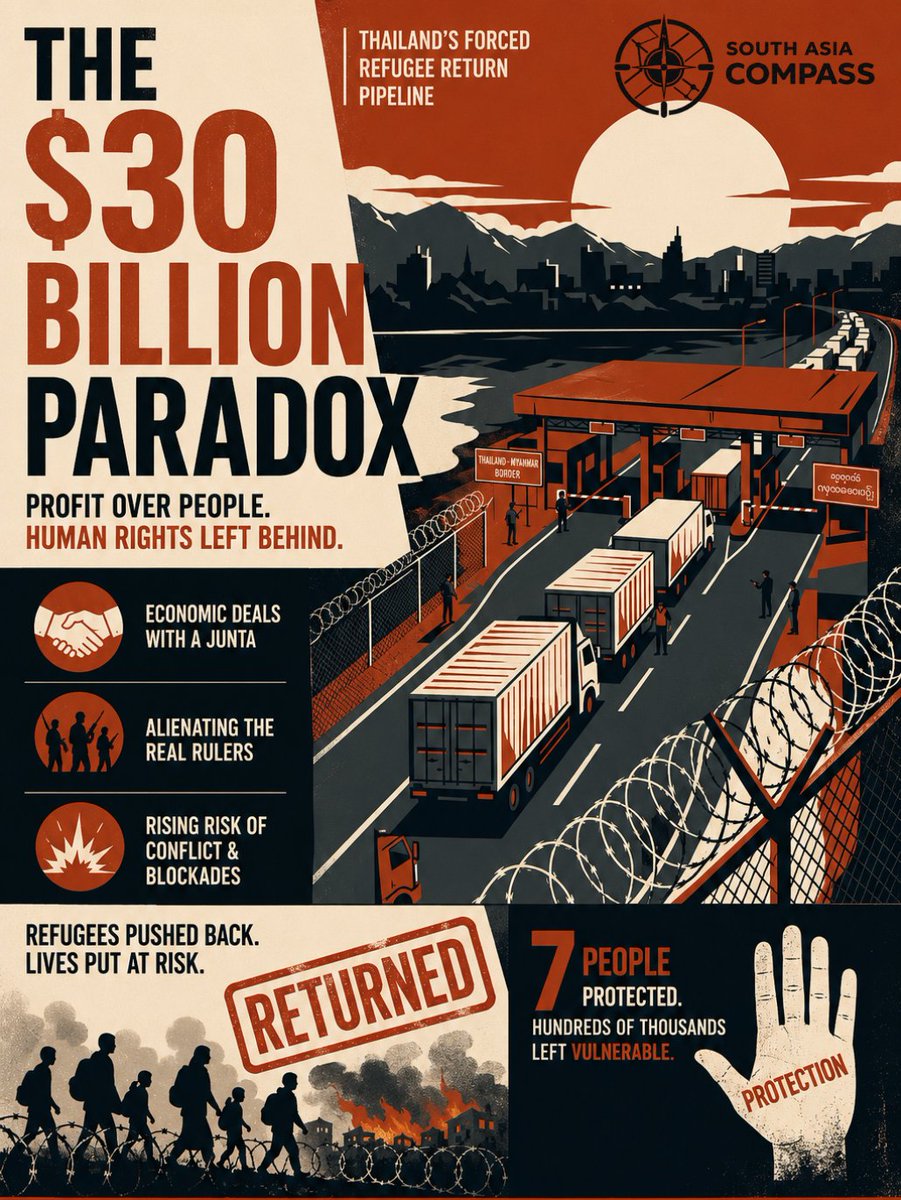
THE $30 BILLION PARADOX: How Economic Interests are Driving Thailand’s Forced Refugee Return Pipeline
While Bangkok celebrates its newly secured seat on the United Nations Human Rights Council, an entirely different reality is unfolding along its volatile 2,400-kilometer western frontier.
Extensive documentation submitted directly to the UN Human Rights Council ahead of Thailand’s upcoming Universal Periodic Review (UPR) has exposed a deeply calculated, security-first strategy. Frontline Thai security detachments are actively coordinating with the Myanmar military junta, led by Min Aung Hlaing, to systematically round up and return war-displaced asylum seekers.
This includes political dissidents and thousands of young civilians trying to escape the junta's brutal, mandatory conscription laws. They are being pushed right back across the river into active combat zones.
The driving force behind this policy? Pure commerce.
Bilateral border and transit trade through key nodes like the Mae Sot-Myawaddy corridor remains an absolute economic lifeline for Thailand. For 2026, this cross-border trade network is projected to hit a massive 1.09 Trillion Baht (~$30 Billion USD). The recent reopening of the Second Thai-Myanmar Friendship Bridge at Mae Sot—following a devastating 10-month closure caused by clashes—shows exactly how desperate authorities are to keep the trade lanes clear.
But geopolitical analysts warn that Bangkok has walked right into a dangerous security paradox:
1. Loss of Territorial Control: The Thai government is cutting deals with a central military junta in Naypyidaw that exists mostly on paper at the border. The junta lacks actual, physical control over the land gates.
2. Alienating the Real Rulers: The groups physically holding the ground, managing the bypass roads, and controlling the trade entries are the Ethnic Armed Organizations (EAOs) and People’s Defense Forces (PDFs).
3. The Backlash Risk: By coordinating pushbacks with the junta, Thai authorities are directly alienating these border resistance forces. These heavily armed groups are increasingly viewing Thailand as a hostile actor, rapidly raising the likelihood of localized cross-border skirmishes and crippling economic blockades.
Furthermore, Thailand’s own humanitarian systems are proving to be structural failures. The highly anticipated "National Screening Mechanism" (NSM), rolled out to identify and protect those fleeing persecution, granted legal protection to exactly SEVEN individuals in its first full year. It explicitly shuts out vulnerable groups like the Rohingya and anyone classified under standard migrant worker frameworks, leaving hundreds of thousands completely vulnerable to arbitrary arrest, extortion, or extrajudicial return.
By shifting away from its historical role as an open humanitarian buffer zone, Thailand is playing an incredibly high-stakes short-term game. It risks intense diplomatic friction with its Western partners and isolation within international bodies—all while failing to secure the long-term stability of a fracturing neighbor right on its immediate border.
35

Jun 14
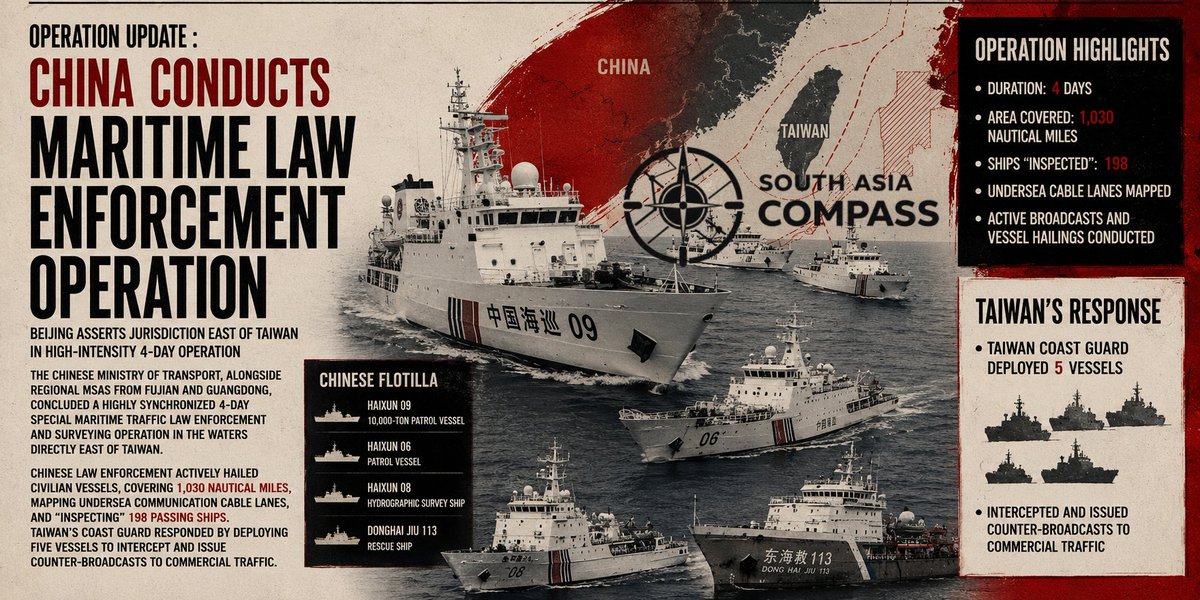
The Chinese Ministry of Transport, alongside regional Maritime Safety Administrations (MSAs) from Fujian and Guangdong, concluded a highly synchronized 4-day "special maritime traffic law enforcement and surveying operation" in the waters directly east of Taiwan. Deploying a formidable flotilla including the 10,000-ton patrol vessel Haixun 09, the Haixun 06, the advanced hydrographic surveyor Haixun 08, and rescue ship Donghai Jiu 113, Beijing asserted jurisdictional control over international shipping. Chinese law enforcement actively hailed civilian vessels, covering 1,030 nautical miles, mapping undersea communication cable lanes, and "inspecting" 198 passing ships. Taiwan's Coast Guard responded by deploying five vessels to intercept and issue counter-broadcasts to commercial traffic.
1
2
218
Jun 13
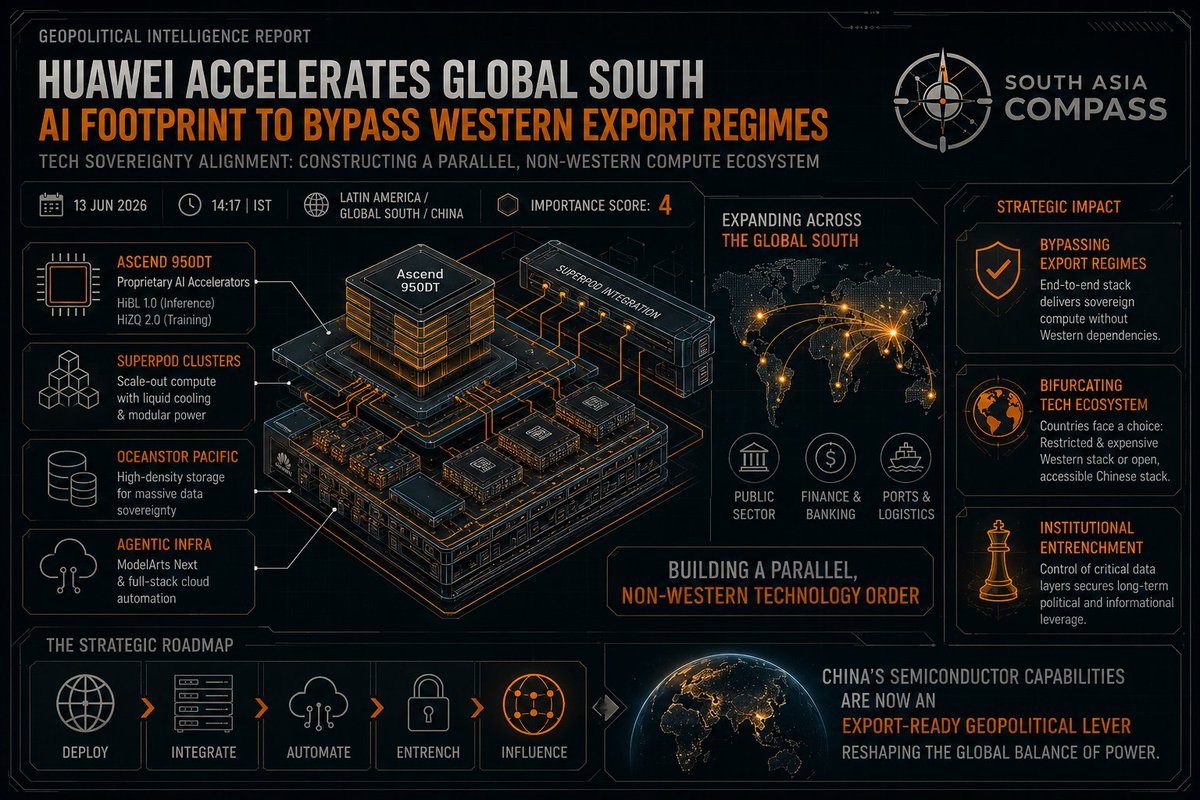
Huawei’s enterprise division has launched an aggressive, targeted expansion of its full-stack artificial intelligence (AI) and cloud computing architectures across Latin America and select Global South economies.
At recent high-level forums—including Huawei Latam Eco-Connect 2026 in Rio de Janeiro and its dedicated COMPASS summit in China—the corporate tech giant unveiled upgraded "1 3" cloud infrastructure solutions specifically tailored for developing markets. Central to this global push is the strategic positioning of Huawei’s AI capabilities - underpinned by its proprietary Ascend hardware accelerators as a viable, end-to-end alternative for sovereigns and corporate entities unable to procure Western-rationed silicon or anxious about U.S. technology hegemony.
The structural backbone of this deployment is a shift away from selling standalone components. Instead, Huawei is delivering highly integrated cloud data frameworks, such as the newly released "Agentic Infra" package, the ModelArts Next platform, and the high-density OceanStor Pacific storage clusters. This design is engineered to bypass Western supply dependencies entirely; company roadmaps confirm the rollout of its next-generation Ascend 950 series AI chips (including the 950DT variants), which utilize fully in-house developed High-Bandwidth Memory (HBM)—such as "HiBL 1.0" for inference and "HiZQ 2.0" for training—and scale-out SuperPoD cluster deployments.
This multi-region expansion matters because it marks the operational transition of China's semiconductor capabilities from a domestic survival mechanism to an active, export-ready global geopolitical lever.
By directly targeting public sector decision-makers, financial conglomerates, and critical infrastructure networks (such as regional ports and customs through its "Smart Gate" automation software), Huawei is building persistent, structural lock-in within economies that are critical to global logistics and raw material supply chains.
The strategic implications are two-fold:
Creation of a Bifurcated Tech
1. Ecosystem: Developing countries face mounting pressure to choose between the cost-intensive, supply-restricted Nvidia/Western cloud architecture and China's highly accessible, un-sanctioned, end-to-end stack.
2. Institutional and Political Entrenchment: By managing the data layers of essential state organs (customs, regional governance, finance) in Latin America and emerging economies like Malaysia, Beijing quietly secures unprecedented diplomatic and informational leverage, hardening the Global South against future Western economic coercion or alignment campaigns
1
2
389
Jun 13
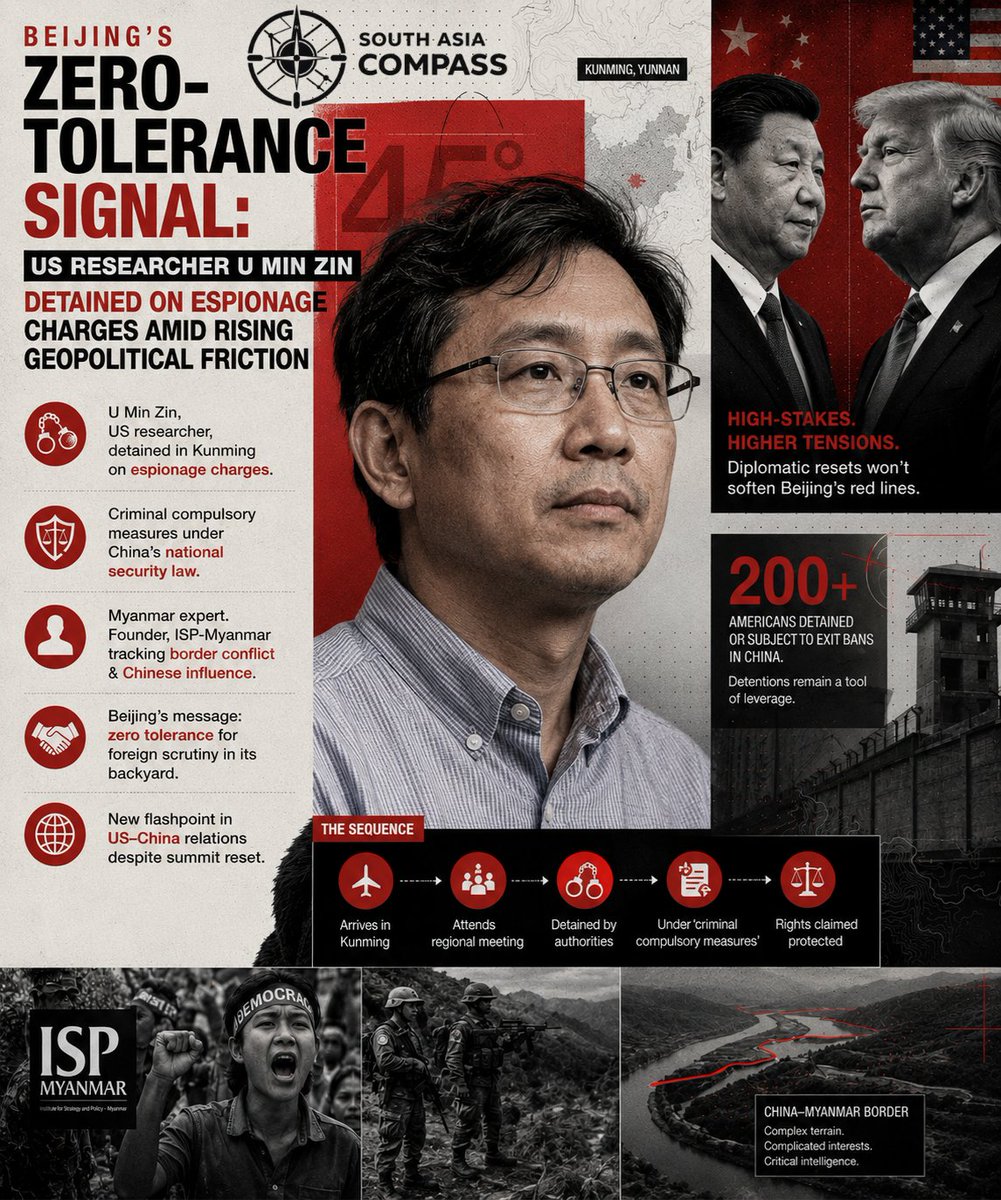
BEIJING’S ZERO-TOLERANCE SIGNAL: US RESEARCHER U MIN ZIN DETAINED ON ESPIONAGE CHARGES AMID RISING GEOPOLITICAL FRICTION
The Chinese Foreign Ministry has officially confirmed the criminal detention of U Min Zin, a United States citizen and prominent political scientist who serves as the executive director of the Institute for Strategy and Policy (ISP) - Myanmar.
Min Zin was arrested at Kunming Changshui International Airport in southwestern Yunnan province after flying in to attend a regional meeting. Chinese authorities state he is being held under "criminal compulsory measures" on suspicion of engaging in espionage and activities that endanger China's national security.
Beijing has notified the U.S. Consulate General in Guangzhou regarding the arrest, declaring that his lawful rights are fully protected under domestic law.
Min Zin is a high-profile figure within geopolitical research circles. A former student activist from Myanmar's 1988 democracy movement who later studied political science at the University of California, Berkeley, he founded ISP-Myanmar to monitor local conflict dynamics.
Following the 2021 military coup in Myanmar, the think tank shifted its primary operations overseas, largely working out of Chiang Mai, Thailand.
The arrest carries immense strategic significance due to the specific focus of Min Zin's research. ISP-Myanmar has published extensive, granular intelligence regarding the complex dynamics along the China-Myanmar border.
Crucially, the group’s work maps Beijing’s multi-layered influence in the region, including its financial and logistical ties to both the ruling military junta and various Ethnic Armed Organizations (EAOs) operating along the frontier. By clamping down on a researcher operating in Kunming—the primary economic and transport gateway between China and mainland Southeast Asia—Beijing is signaling a aggressive baseline zero-tolerance policy toward independent foreign tracking of its backyard security operations.
Furthermore, the diplomatic timing introduces severe friction into the broader Washington-Beijing relationship. The incident unfolds just a month after U.S. President Donald Trump traveled to Beijing for a high-stakes bilateral summit with Chinese President Xi Jinping, aimed at steadying an otherwise tumultuous economic and geopolitical relationship.
Historically, China has used national security detentions of foreign citizens as geopolitical leverage or direct pushback against foreign intelligence penetration. With roughly 200 American citizens currently subject to some form of detention or exit bans in China, this targeted arrest demonstrates that high-level diplomaticresets will not deter Beijing from enforcing strict state-security perimeters over sensitive cross-border zones.
1
1
5
795
Jun 13
NATIONAL SECURITY PREVALENT OVER FOREIGN PRESSURE: MALAYSIA LOCKS DOWN HONG KONG POWER STORAGE INTEGRATION
While mainstream news channels argue over international defense alignments, real-world survival strategies are playing out directly across NATIONAL POWER GRIDS.
Look closely at Malaysia's latest strategic move. Under the oversight of Deputy Prime Minister Fadillah Yusof, domestic electronic components manufacturer Mikro MSC Berhad has finalized a critical, exclusive partnership with Hong Kong’s Cospower Technology.
This isn't just an ordinary commercial transaction - it's a direct, calculated response to the global energy crisis fueled by the ongoing US-Iran conflict.
As international oil lines face massive premium shocks, relying heavily on hydrocarbon imports has transformed from a simple line-item expense into an immediate national security threat. Malaysia’s solution?
Massively accelerate grid-scale battery autonomy to stabilize its industrial sectors against alternative energy fluctuations.
But doing this via a Hong Kong partner exposes an explicit geopolitical truth: Putrajaya is openly ignoring continuous pressure from the United States to decouple critical supply lines from Chinese-associated entities.
Prime Minister Anwar Ibrahim's administration has made its calculation clear—rapid, affordable national energy resilience is vastly more important than strict Western strategic alignment.
This matches a pragmatic regional playbook across oil-dependent Southeast Asian economies.
To protect their internal margins and ensure industrial modernization under initiatives like the New Industrial Master Plan (NIMP 2030), regional players are comfortably navigating secondary sanction threats.
Sovereignty in 2026 isn't defined by pick-a-side rhetoric. It’s defined by who guarantees that your factories remain powered when global supply chains lock up.
#EnergySecurity #Geopolitics #Malaysia #SupplyChain #CleanTech #Lithium #MacroEconomics
1
1
273
Jun 12
پوہوک (پاکستان کے زیرِ قبضہ جموں و کشمیر) میں رات کے وقت احتجاج: ویڈیو میں بڑی تعداد میں لوگ رات کے اندھیرے میں فون کی لائٹس جلائے کھڑے ہیں۔ یہ احتجاج معاشی مسائل، بجلی کی شدید لوڈشیڈنگ، مہنگائی، بے روزگاری اور اسلام آباد کے خلاف سیاسی مطالبات کی وجہ سے جاری ہے۔جنوبی ایشیا کمپاس کے مطابق یہ احتجاج تاریخی اہمیت کے حامل ہیں کیونکہ اس میں "چین سے لیں گے آزادی" کے نعرے بھی لگائے جا رہے ہیں۔ لوگ پاکستان کی 1963 میں چین کو 5180 مربع کلومیٹر شیکسگم ویلی کا حوالے کرنے پر شدید ناراض ہیں۔حال ہی میں راولاکوٹ اور مظفرآباد سمیت مختلف علاقوں میں پرتشدد جھڑپیں ہوئیں جن میں درجنوں لوگ ہلاک اور زخمی ہوئے۔ جوائنٹ عوامی ایکشن کمیٹی کی قیادت میں یہ تحریک چل رہی ہے۔
#PoJKProtests #PakistanOccupiedKashmir #ChinaSeLengeAzadi #PoJK #KashmirProtest #ShaksgamValley #Muzaffarabad #پوہوک_احتجاج
Jun 12
Unprecedented night protests erupt across Pakistan-occupied Jammu & Kashmir (PoJK). Thousands gather with phone flashlights, chanting something Islamabad and Beijing never wanted the world to hear. Watch closely. 🧵👇
54
Jun 12
Unprecedented night protests erupt across Pakistan-occupied Jammu & Kashmir (PoJK). Thousands gather with phone flashlights, chanting something Islamabad and Beijing never wanted the world to hear. Watch closely. 🧵👇
1
1
1
172
Jun 12
Illegaly ceeding 5180km² in 1963 to China Shows that What would be Pakistan's Motives for Kashmir
For decades, the local population felt voiceless about their land being used as nothing more than DIPLOMATIC CURRENCY.
1
22
Jun 12
sea of lights, a chorus of defiance. The people of PoJK are openly chanting for liberation from both Pakistan and China. The status quo in South Asian geopolitics is fracturing in real-time. Watch this space."
1
43
Jun 12
Sounds Like We Have Said this Quite Earlier !!
Jun 11

MAJOR STORY: REBEL TMC MP KAKOLI WRITES TO WB CM AND EAM.
EYE POPPING ACCUSATIONS. MORE TROUBLE FOR MAMATA?
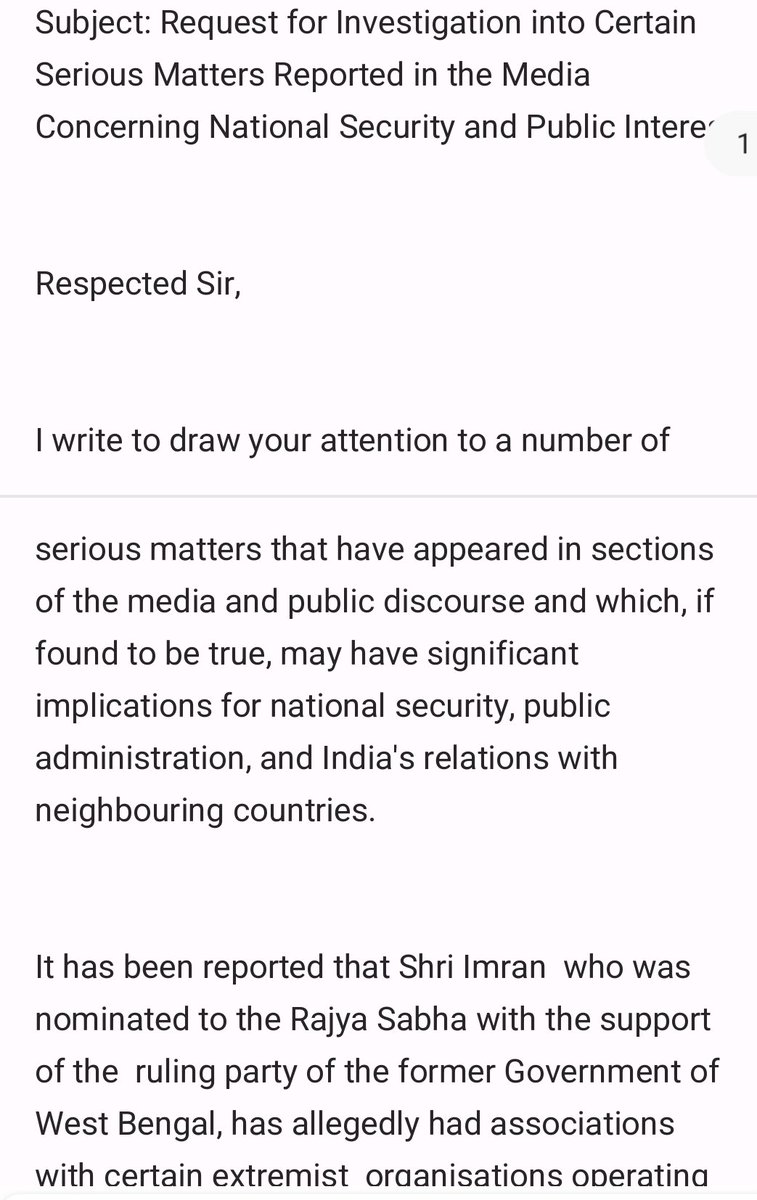
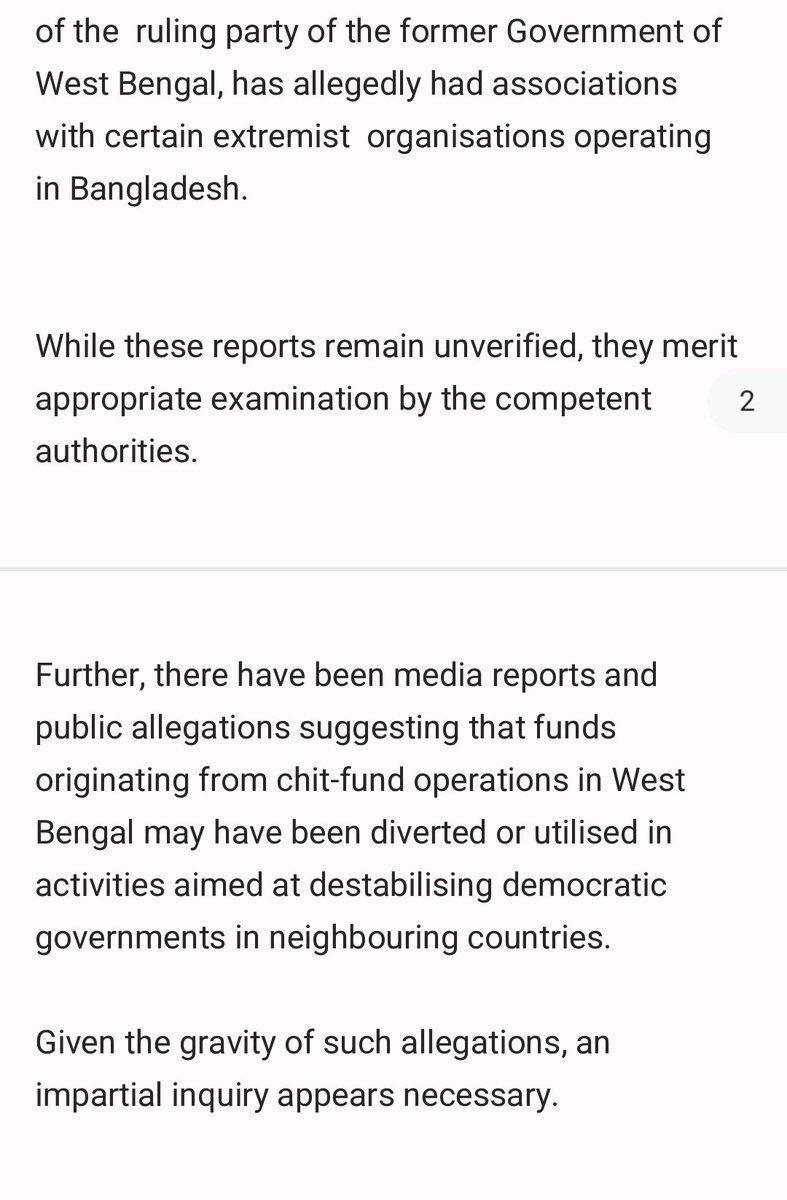
"It has been reported that Shri Imran who was nominated to the Rajya Sabha with the support of the ruling party of the former Government of West Bengal, has allegedly had associations with certain extremist organisations operating in Bangladesh. While these reports remain unverified, they merit appropriate examination by the competent authorities...Concerns have also been raised regarding the alleged non-allotment of land requested by the Indian Army and the Border Security Force (BSF) in certain strategically sensitive areas along the international border of West Bengal, including the Siliguri Corridor ("Chicken's Neck") region. The circumstances surrounding these decisions deserve careful scrutiny from the standpoint of national security."
1
3
3
405
Jun 12
check the QT
x.com/i/status/2058328105157…
May 23
For over a decade, the West Bengal-Bangladesh border operated as an asymmetric financial ecosystem. Multi-billion-rupee Ponzi schemes (like the infamous Saradha scam) systematically funneled illicit liquidity through border districts like Nadia, Murshidabad, and Malda.
3
1
1,191
Jun 11
Copyright: @SouthAsiaComp
Jun 11
A high-security residence in a war-torn capital. A dead U.S. diplomat. A foreign suspect facing the death penalty. And a silent, desperate diplomatic scramble between Washington and an unrecognized military junta.
This isn't a political thriller. It’s happening right now. 🧵
3
1
307
Jun 11
A high-security residence in a war-torn capital. A dead U.S. diplomat. A foreign suspect facing the death penalty. And a silent, desperate diplomatic scramble between Washington and an unrecognized military junta.
This isn't a political thriller. It’s happening right now. 🧵
1
3
1
602
Jun 11
But the risks are massive. The junta's courts hold all the cards. The regime retains the capacity to stall, exploit, or leverage the trial's access to force quiet diplomatic concessions from both the U.S. and Thailand.
1
12
Jun 11
For the OSINT community, this case is a masterclass in how real-world geopolitical crises are managed when the stakes are too high to break diplomatic channels.
17