
Joined April 2026
- Tweets 69
- Following 114
- Followers 40
- Likes 206
5 Photos and videos


Pinned Tweet

May 19
Rotated all my subnets holdings to SN68. bittensor:native @metanova_labs
Will keep adding!
Nothing else interest me anymore.
4
3
22
1,155
May 23
OpenAI proved the next frontier of AI is pure mathematical reasoning. While centralized labs burn billions trying to brute-force logic, $TIG just dropped the ultimate counter-move.
The rollout of Prometheus shifts us to an autonomous, machine-scale evolutionary engine. By running thousands of continuous simulation trajectories, it systematically breeds "Global Best" algorithms to drastically slash compute overhead.
As Big Tech faces a severe energy crisis, the network that algorithmically optimizes the math wins the cycle.
#DeSci #DePIN #OPoW #AlgorithmicEfficiency #AI #Maths
1
18
236
May 21
The @tigfoundation commenting on OpenAI’s recent math breakthroughs is a massive tell on where the macro AI landscape is heading.
When frontier models start tackling Erdős problems, it confirms the industry is shifting away from simple language pattern-matching and straight into deep, asymmetric combinatorial logic.
This is the exact playground $TIG was engineered for.
OpenAI is proving that advanced mathematical reasoning is the ultimate currency of the computing era. But while the centralized giants try to monopolize these breakthroughs behind closed corporate walls, TIG’s Optimisable Proof-of-Work framework is quietly building the open, decentralized infrastructure to crowdsource and reward this exact caliber of algorithmic optimization.
The core team sees the board perfectly. We aren't just looking at an L1 blockchain; we are watching the birth of a global engine for open science and algorithmic discovery.
If you are tracking code efficiency and advanced compute architecture, you are still incredibly early here.

Today, we share a breakthrough on the planar unit distance problem, a famous open question first posed by Paul Erdős in 1946.
For nearly 80 years, mathematicians believed the best possible solutions looked roughly like square grids.
An OpenAI model has now disproved that belief, discovering an entirely new family of constructions that performs better.
This marks the first time AI has autonomously solved a prominent open problem central to a field of mathematics.
1
2
47
May 21
OpenAI’s model disproving an 80-year-old Erdős geometry conjecture is proof that the frontier of AI has shifted to advanced algorithmic reasoning.
This is incredibly bullish for $TIG.
While centralized tech giants burn billions in compute trying to force models to solve these complex problems, TIG has built a decentralized marketplace designed specifically to optimize and crowdsource the math driving these exact breakthroughs.
When the industry realizes that software-level algorithmic efficiency is far more valuable than endlessly buying more raw GPU hardware, the infrastructure layer re-rates entirely.
#DeSci #DePIN #AI #OPoW
5
28
1,520
May 19
The next era of AI isn't just about renting raw GPUs, it’s about algorithmic utility. Look at what @metanova_labs is doing on SN68.
Over 4,200 complex nanobody structures under evaluation for cancer research. This is the real-world application big tech leaders keep talking about.
Proudly holding my $TAO bag here. We are cornering the market on the future of decentralized science.
May 19

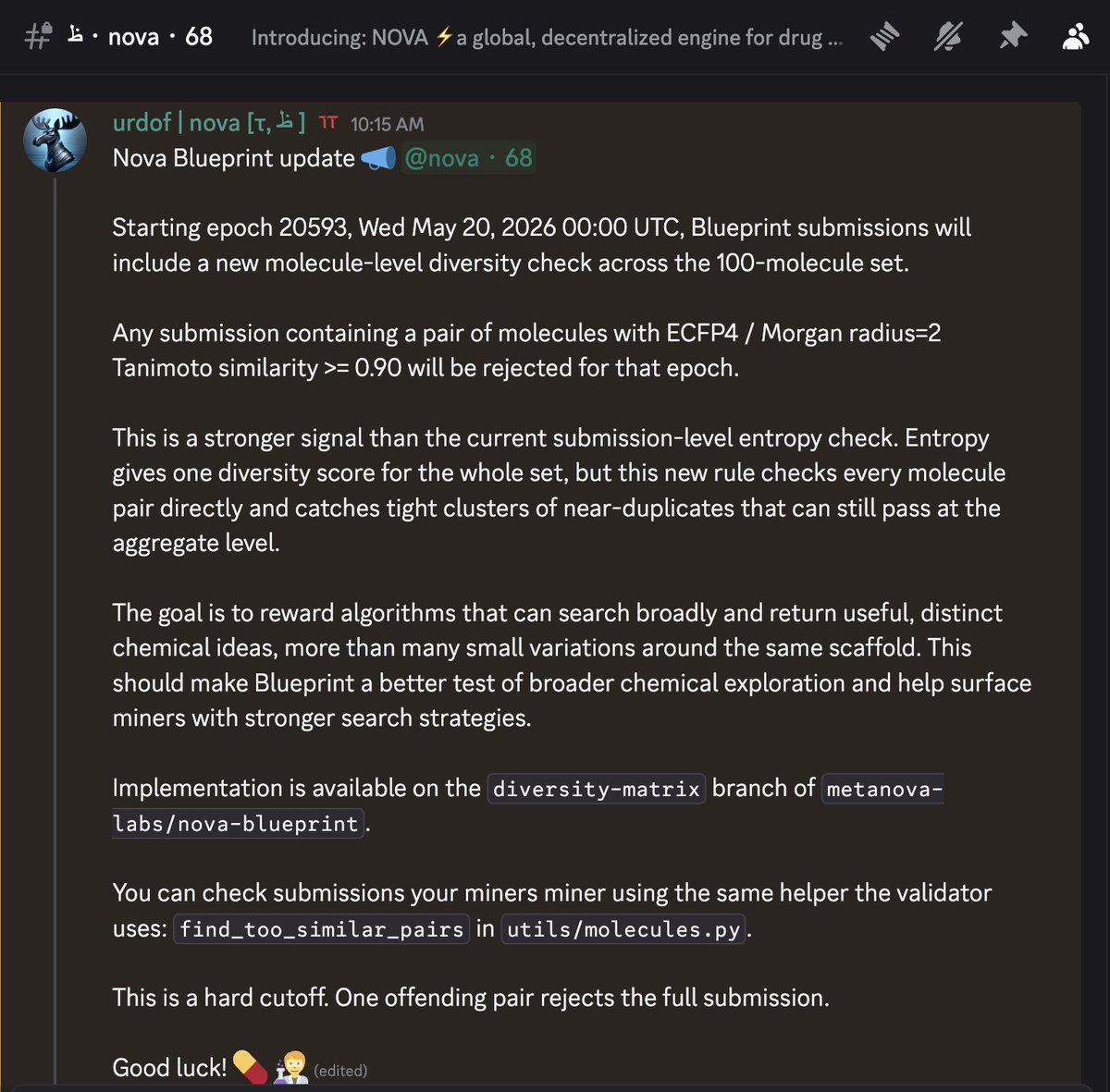
New NOVA Blueprint update
We are making our chemical search competition significantly more exploration-focused.
Starting Wed May 20, 2026 00:00 UTC, submissions containing molecules that are too chemically similar to each other will be rejected entirely.
Why this matters:
In real drug discovery campaigns, the most valuable search strategies are not the ones that generate many near-identical molecules around the same idea.
The real challenge is finding multiple distinct scaffolds that perform well.
Once you discover a promising scaffold, generating variations around it is relatively easy. What is hard — and far more valuable — is exploring chemical space broadly enough to uncover entirely new starting points.
That is why we originally introduced entropy thresholds in Blueprint, and this new update pushes that philosophy further.
We are explicitly rewarding algorithms that:
- explore broadly
- surface diverse chemical ideas
- avoid collapsing into narrow clusters of near-duplicates
The goal is not just higher scores but rather better chemical navigation strategies for real-world discovery.
This update should lead to:
* more novel molecular starting points
* stronger search algorithms
* and ultimately better drug discovery systems
#Bittensor #SN68 #DrugDiscovery #AI #DeSci
1
2
86
May 19
Rotated all my subnets holdings to SN68. bittensor:native @metanova_labs
Will keep adding!
Nothing else interest me anymore.
4
3
22
1,155
May 7
Registration fees don’t lie.
With the cost to register a subnet hitting new highs, the "hype-only" era of #Bittensor is being priced out. Only the teams with real revenue and deep conviction can afford the recycle fee.
34
May 7
The supply is shrinking, the lock-ups are growing. See you on the other side of the break.
#TAO #Bittensor #DynamicTAO
1
108


Apr 30
Seeing some bleed on Ridges (SN62) as the market tests the $250 support, but I’m unfazed. The Harbor update is a game-changer for decentralized coding—I'm here for the tech, not the noise.
Also just added a new pillar: Hey Ditto (SN118)
Building a 'Second Brain' that stays private is the ultimate $TAO utility play.
#Bittensor #TAO #SN62 #SN118 #HeyDitto #DeAI
135