
Joined June 2024
- Tweets 221
- Following 129
- Followers 1,374
- Likes 400
57 Photos and videos




🔐 We keep saying institutional money is landing on XRPL — RLUSD, MXNB, Mastercard's Agent Pay. But there's a problem nobody mentions: banks can't legally trade with anonymous counterparties.
So how does a public, permissionless ledger become compliant enough for regulated institutions? Three building blocks.
1️⃣ Credentials
Verifiable credentials, on-ledger. A trusted issuer (e.g. a KYC provider) grants an account a "verified" credential. It lives on-chain and is checked programmatically — no personal data exposed in the clear. Identity, without a central database.
2️⃣ Permissioned Domains
A domain is a set of accepted credentials. Hold the right ones, and you're a member; don't, and you're not. It's an admission rule written directly into the ledger — not enforced by an app sitting on top of it.
3️⃣ Permissioned DEX
An order book and AMM tied to a domain. Inside, only domain members trade — only verified counterparties. The open DEX and the permissioned DEX run on the same ledger, side by side.
The payoff: an institution trades RLUSD or MXNB only with KYC'd counterparties, and compliance is enforced by the ledger itself — not a middleware layer that can fail or be bypassed.
It's the same pattern as Mastercard Agent Pay: the rules live in the protocol. That's why the institutional money is choosing XRPL — not "fast and cheap," but compliance built into the rails.
#XRPL #DeFi #Compliance
Jun 11

1
6
24
3,783

Jun 12
🛠 This is the part that matters for builders.
Not just "XRPL is a payment rail" — an official toolkit so devs can actually ship AI agents that pay and settle on-ledger with XRP RLUSD.
Rails AND a dev stack for the machine economy. @RippleXDev
Jun 10

AI agents are beginning to transact, pay for services, and settle value autonomously.
Today, we're introducing the XRPL AI Starter Kit, a new set of tools and integrations designed to help developers build agentic payment applications on the XRP Ledger: on.ripple.com/4v7STIm
Phase 1 includes:
→ XRPL Docs MCP Server
→ Claude Skills for wallet creation, payments, and transaction tracking
→ X402 support for agent-to-agent payments using $XRP and $RLUSD
XRPL's fast settlement, predictable costs, and native payment functionality make it a strong foundation for agentic payments.
6
158
Jun 11
🌎 A regulated peso stablecoin on XRPL is bigger than it sounds.
US–Mexico is one of the largest remittance corridors on earth — today it crawls through correspondent banks.
MXNB RLUSD on-ledger means direct settlement in seconds. @Ripple @Bitso
#XRPL

Ripple and @Bitso are expanding their long-standing payments partnership.
Bitso’s regulated MXN-backed stablecoin, MXNB, will be issued on XRPL and integrated into Ripple’s Payments on DEX infrastructure, supporting enterprise stablecoin settlement across Latin America.
Together, RLUSD and MXNB bring regulated USD and MXN liquidity to XRPL's Permissioned DEX, helping enable real-world enterprise payment flows.
Read more on the partnership expansion: on.ripple.com/4uuU2s6
1
7
4,099
Jun 10
🤖 AI agents are starting to pay on their own — compute, invoices, API calls.
Today @Mastercard launched Agent Pay for Machines, and @Ripple's XRPL RLUSD are among the settlement rails.
Why the machine economy needs a chain like this. 🧵👇 (1/5)
1
1
3
95
Jun 10
🔧 Why XRPL fits (4/5)
Per RippleX SVP Markus Infanger: XRPL RLUSD let agents transact at machine speed within rules the chain itself enforces — settlement in seconds, programmable compliance, a full audit trail.
Agents do only what they're authorized to.
👇
1
32
Jun 10
💡 Bigger picture (5/5)
Not "fast and cheap" — it's chain-enforced rules compliance. What institutions need before letting software move money itself.
The XRPL institutional narrative just pivoted to the machine economy.
cc @Ripple @Mastercard
#XRPL #RLUSD ✅
1
33
Jun 10
The machine economy needs rails institutions can trust — chain-enforced rules, programmable compliance, settlement in seconds. That’s exactly where XRPL RLUSD fit in Mastercard’s AP4M. Agents do only what they’re authorized to.

🤖 Mastercard launches Agent Pay for Machines with Aave, Coinbase, OKX, Polygon, Ripple, and Solana
@Mastercard has announced the launch of Agent Pay for Machines, a new infrastructure designed to enable artificial intelligence agents to make autonomous and secure payments through its global network.
The initiative marks an important step in the convergence of AI, blockchain technology, and traditional payment systems.
What is Agent Pay for Machines?
The platform allows AI agents to execute real-world payments without human intervention, enabling automated transactions between applications, services, and connected devices.
Key features include programmable payments, support for digital assets and stablecoins, integration with blockchain networks, and compliance with Mastercard’s security and regulatory standards.
Potential use cases range from cloud service payments and automated trading operations to machine-to-machine transactions and AI-driven digital economies.
Initial partners
Mastercard confirmed @Aave, @Coinbase, @OKX, @0xPolygon, @Ripple, and @Solana as its first ecosystem partners.
The group includes major players across DeFi, blockchain infrastructure, digital asset exchanges, and payment technologies.
Their participation is expected to accelerate the development of autonomous agent applications capable of interacting securely with financial systems.
In summary
Mastercard has launched Agent Pay for Machines, a solution that enables AI agents to perform autonomous payments using financial and blockchain infrastructure. Supported by partners including Aave, Coinbase, OKX, Polygon, Ripple, and Solana, the initiative aims to power the next generation of automated financial services.
Disclaimer:
This information is based on Mastercard’s official announcement published on June 10, 2026. It does not constitute financial or investment advice. Always conduct your own research before making investment decisions.

1
15
75,202
Jun 9
🏰 Ripple is building "Fortress XRP."
Formal verification — mathematical proof of code correctness, the standard behind banking and aerospace systems — is being brought to XRPL's DeFi layer before it ships to mainnet.
Here's why that matters more than "fast and cheap."
⚙️ Tests vs. proofs
A test can only show a bug is present — and only if it happens to trigger on the exact case you tried. Formal verification proves the absence of entire bug classes, mathematically, across every possible input. Edge cases aren't caught by trial and error. They're proven impossible.
🔧 What's being verified
RippleX is expanding its work with Common Prefix — a formal-verification firm — from the ledger core (Payment Engine, Consensus Protocol) to the DeFi layer:
• Lending Protocol (XLS-66)
• Single Asset Vaults (XLS-65)
This is L1 code, where a single core bug becomes a hole in every application built on top of it.
📐 The governance shift
The real change is in process: validated logical proofs become a criterion for approving future code deployments. Not "we tested it, seems fine" — but "proven." For institutional capital, provably correct L1 is exactly what traditional finance demands of critical infrastructure.
📅 Timeline
Operational testing runs June–July 2026. Verification modules for the validator infrastructure are expected by late 2026.
While most chains compete on speed and fees, XRPL is moving toward provable correctness — the kind of assurance that turns "blockchain experiment" into "infrastructure institutions can underwrite."
cc @Ripple @RippleXDev @JoelKatz @msvadari
#XRPL #DeFi #FormalVerification #XRP

#XRPL dUNL validator Vet highlights that $XRP Ledger lending protocol is currently undergoing formal verification.
Ripple developers are applying techniques typically used in nuclear power plants, aircraft systems, and military-grade software to secure XRPL’s expanding native DeFi ecosystem. #Ripple
thecryptobasic.com/xrp-nativ…
1
12
64
1,317
Jun 7
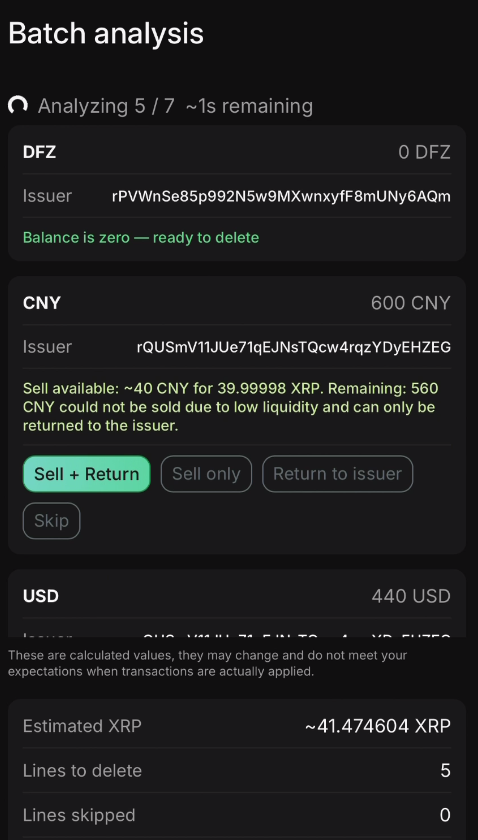
🗑 You can delete an XRPL account and recover its locked reserve — and unlike almost every other chain, the address truly leaves state.
But five conditions must line up, and devs trip over the sequence gap most often.
A thread on AccountDelete 🧵👇 (1/6)
1
1
1
56,981
Jun 7
💰 Reserve mechanics (5/6)
Base reserve (1 XRP) per-object reserve (0.2 XRP) return to your destination account. 0.2 XRP always burns as anti-spam cost.
Tip: submit with fail_hard so a failed delete won't burn the fee for nothing.
👇
1
50
Jun 7
📚 Dig deeper (6/6)
Full blocker table, reserve math & the AccountDelete reference:
xrpl.org/docs/concepts/accou…
One of the few chains where an account can leave state and return its deposit.
cc @Ripple @RippleXDev
#XRPL #AccountDelete
33
Jun 6
A ledger native to securities clearing, money market funds, and corporate credit — built on the same rails as a payment.
That's the @JoelKatz roadmap. Bridge XRPL to TradFi, watch retail follow institutions in.
Jun 5
@Ripple CTO Emeritus @JoelKatz on where XRP is headed:
"Tokenized securities. Money market funds. Stocks. Repos. Loans."
Enterprise adoption is already here. Mass retail is next.
XRP in a Minute ⬇️ youtu.be/cqGfRNZSD-0
1
3
102
Jun 5
🏛 XRPL validators work for free — no block rewards, no fees. So how does governance actually work?
Unlike Bitcoin (mining rewards) or Ethereum (staking yield), XRPL uses federated consensus — validators don't earn rewards. That changes everything we think we know about blockchain incentives.
⚙️ HOW CONSENSUS WORKS
Each server maintains its own list of trusted validators — the UNL (Unique Node List). To confirm a transaction, ≥80% of UNL validators must agree. Each round takes 3-5 seconds, then the ledger closes. No forks, no reorgs.
👥 WHO RUNS VALIDATORS, AND WHY FOR FREE
The default UNL contains ~35 validators (out of 150 on the network). Operators include:
• List publishers: @Ripple (runs only 1 of those 35) and @XRPLF
• Exchanges & platforms: @GateHub, @xpmarket, onXRP
• Explorers: @xrpscan, @bithomp
• Infrastructure: @Peersyst, @XRPLLabs (built by @WietseWind), @BifrostWallet
• Institutional: @Arrington_Cap, @xSPECTAR, @Interledger
• Universities: University of Kansas (KUBI), @UNIC_ENG (@MScDigital programme), @EPUSP (University of São Paulo)
• Independent operators from Norway, Spain, Kuwait, Belgium, Finland, Poland and more
The motivation is reputation and governance influence. A validator in the default UNL votes on amendments. For an institution, that's a seat at the table — and it's worth more than staking yield.
🗳 GOVERNANCE VIA AMENDMENTS
Protocol changes (AMM, NFT, lending, new opcodes) go through amendment voting:
• Requires ≥80% UNL supermajority for 2 consecutive weeks
• Drops below 80% — amendment rejected
• Once approved — auto-activates on the next ledger
This gives predictable governance without forks.
⚖️ TRADE-OFFS vs PoW/PoS
XRPL gets 5-second finality, no mining, no staking lockup, energy-efficient. The cost is a trust-based model. Critics call this "centralized governance" — but @Ripple runs only 1 validator out of ~35 in the default UNL. The rest are independent operators around the world. Any server operator can choose their own UNL; large participants stick with default for interoperability — which is choice, not coercion.
XRPL inverts PoS. Instead of "tokens → power," it's "reputation → power." Slower to build influence (you have to earn reputation), but more resistant to sybil attacks and manipulation via token holdings.
#XRPL #UNL #Governance #Consensus #Validators
2
5
163