
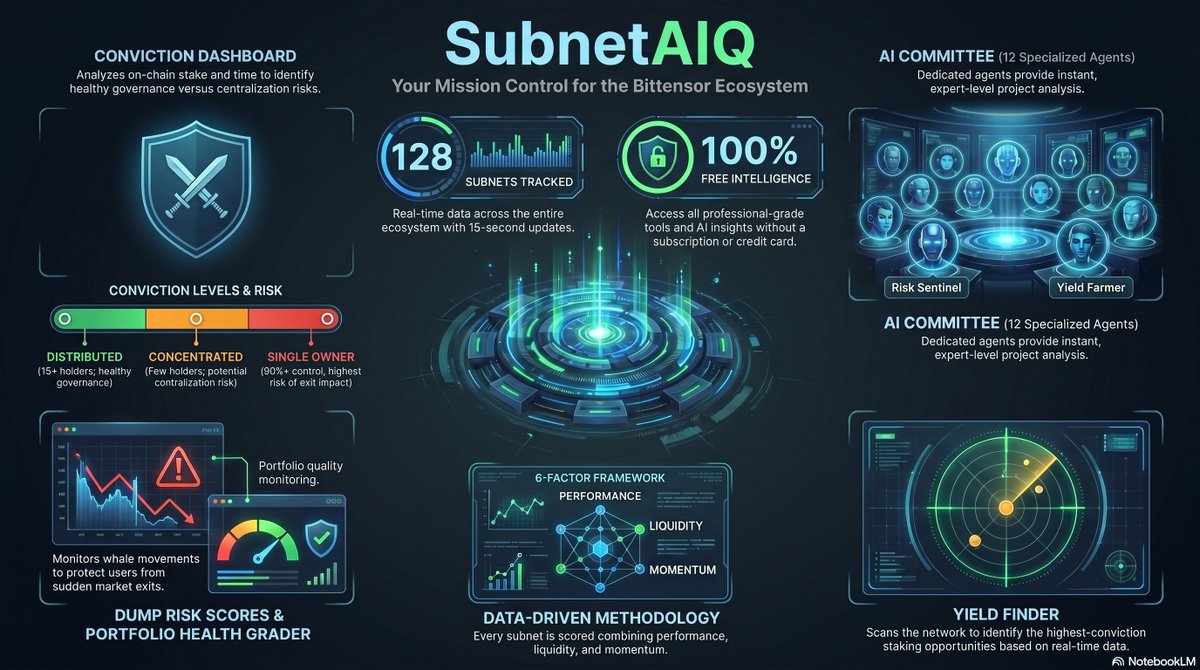
The Gold Standard in Bittensor Subnet Intelligence. Live data, AI research, whale tracking across 128 subnets.
Joined March 2026
- Tweets 509
- Following 39
- Followers 29
- Likes 122
4 Photos and videos
Pinned Tweet

Apr 8
If you want to understand where Bittensor is actually going, stop staring at hyped-up leaderboards and start watching one specific subnet.
**A note before we dive in:** As I'm writing this, Grayscale just filed amendments for a spot TAO ETF with a 43% allocation increase. TAO ripped 11% in 24 hours, breaking $345. Trading volume hit $713 million. The institutional infrastructure I've been writing about for a year is now visibly arriving — not hypothetically, not eventually, but today. And SN64 — Chutes — is positioned right at the front of it.
Subnet 64 — **Chutes** — is now the **#1 subnet on the entire Bittensor network by market capitalization**. As of this week, it sits at approximately **$424,520** in market cap — ahead of Templar (SN3) at $341,140, ahead of Targon (SN4) at $299,880, and ahead of every other subnet on the network. While most of the ecosystem argues about which model architecture or which training method will win, Chutes built the layer underneath all of it: a marketplace where compute itself is the product. Buy compute, sell compute, settle on-chain. No middleman. No AWS markup. No five-page enterprise contract.
It's working. The data says so. Here's what twelve months of watching SN64 has taught me — and why today's market action makes this analysis more urgent, not less.
## The Numbers Tell the Story
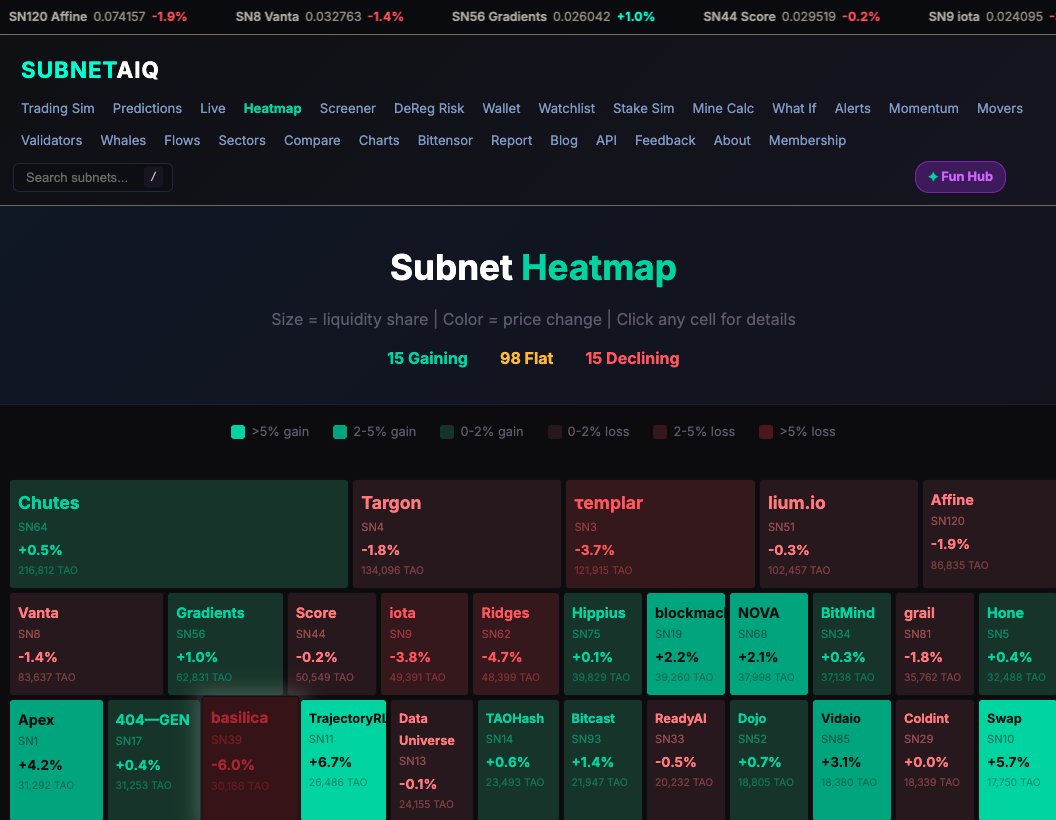
As of this week, Chutes is sitting on **215,810 TAO of liquidity** in its pool. For context, that makes it the **deepest subnet pool on Bittensor** — significantly larger than Templar (SN3) at 121,360 TAO, Targon (SN4) at 133,120 TAO, and lium.io (SN51) at 102,350 TAO. These are four of the most-watched subnets in the network, and Chutes is meaningfully ahead of all of them.
SN64 captures roughly **4.2% of total daily network emissions** — putting it firmly in the top tier of reward distribution. After the December 2025 halving, that translates to approximately **151 TAO per day** flowing through Chutes alone.
Registered miner count: **98 out of 128 maximum slots filled** — meaning **30 slots are currently OPEN** for new registration at a recycle cost of just **0.842 TAO per slot** (~$264 at today's TAO price). Compare that to SN3 Templar, which sits at 128/128 — full capacity, no open slots, requiring you to outbid existing miners at a recycle cost of 2.914 TAO per slot.
**This is the rare moment when a top-tier subnet still has open inventory.** That window doesn't usually stay open long.
## What Chutes Actually Does
The simplest way to explain Chutes is this: it's the Uber of GPU compute, except the drivers are AI inference operators and the riders are anyone who needs compute on-demand.
Traditional compute marketplaces — AWS, Lambda Labs, RunPod, even decentralized ones like Akash — require you to spin up a VM, install your stack, manage state, and pay by the hour whether you use it or not. Chutes flips that. You make an API call, the network routes it to a compute provider, the work gets done, and the provider gets paid in TAO based on the quality and speed of the response.
For developers, this means you can plug Chutes into a model and treat it like an OpenAI API endpoint — except instead of one company's pricing and rate limits, you get a competitive marketplace of providers underbidding each other for your business.
For miners, it means there's a real customer at the end of every inference cycle. You're not just earning rewards for "running validation tasks" in some abstract sense. You're processing actual API calls from actual developers with actual use cases.
That distinction is the entire reason SN64 has the deepest pool on the network. Real demand attracts real liquidity.
## The Mining Economics
Let me put real numbers on the mining side, because this is where most analyses get hand-wavy.
At ~151 TAO/day in emissions split across 98 active miners, the gross emission share is approximately **1.54 TAO per slot per day**. After the standard ~50% allocation to validators, miners net roughly **0.77 TAO per slot per day** at median performance. At today's TAO price of approximately $313, that's around **$240/day per slot** for a median operator.
Bittensor reward distributions are heavily Pareto. The top 5% of miners on SN64 capture significantly more than that median number. The bottom quartile captures significantly less. **A new miner during the first 3-7 day "weight acquisition" period typically earns near zero** — validators need time to score you before assigning meaningful incentive weights.
This is where SN64 separates from most other subnets: the gap between top and bottom isn't as extreme as it is on smaller, more chaotic subnets. The validation criteria are well-defined, the workload is consistent, and the scoring system rewards predictable, high-quality output. If you can build a reliable inference pipeline on Blackwell-class hardware (RTX 5090 or better), you have a real shot at landing in the upper half of the distribution — not just chasing the unreachable top 1%.
For new entrants specifically, this matters. On smaller speculative subnets, "average" is a fantasy and most operators lose money to electricity costs alone. On SN64, average is actually achievable, and average is profitable. **Even at conservative $4,000-$6,000/month per operator with a 5-rig setup, the unit economics work.**
## Why Validators Stake Here
Validators are the other side of the equation, and they vote with their TAO. The fact that SN64 commands 215,810 TAO in pool liquidity — making it the deepest pool on the entire network — isn't an accident. It's validators making a deliberate decision to back this subnet over every other alternative.
The reason comes down to incentive design. Chutes pays validators based on the quality of the compute they're approving, which is verifiable through user feedback and inference quality metrics. This creates a tight loop:
- **Miners** that produce bad output get downscored
- **Validators** that approve bad output get downscored
- **Validators** that consistently approve the highest-quality miners earn the highest dividends
That feedback loop is what economists call "skin in the game." It's why the validators on SN64 aren't just chasing emissions — they're underwriting the actual quality of the compute marketplace, which protects their stake long-term.
When you see a subnet with deep validator liquidity AND high active miner participation AND strong incentive alignment, you're looking at something that's been pressure-tested. Most subnets fail at least one of those three. SN64 has all three.
## The Risks Nobody Talks About
This isn't a pump piece. Let me tell you what could go wrong.
**Risk 1 — Centralization of compute providers.** The same Pareto distribution that makes SN64 attractive to skilled miners also creates a winner-take-most dynamic. If 5-10 large operators end up handling 80% of the inference traffic, the marketplace becomes less "decentralized" and more "five companies in a trench coat." That's not necessarily fatal — it's how most marketplaces evolve — but it does change the value proposition.
**Risk 2 — Demand-side dependency.** Chutes only works if developers actually use it. Right now, the demand side is healthy and growing, but it's also concentrated among a relatively small number of repeat customers. If those customers churn, the entire economic model recalibrates downward fast. SubnetAIQ's flow tracking shows this concentration in real time, and it's worth watching.
**Risk 3 — Competition from new compute subnets.** Bittensor is permissionless. Nothing stops someone from launching a competing compute marketplace tomorrow with better tokenomics, lower fees, or a sharper niche. SN64's lead is real but not unassailable. The 215,810 TAO pool is a moat — not a wall.
**Risk 4 — Regulatory.** Decentralized compute marketplaces sit in a gray zone between SaaS and crypto infrastructure. If regulators decide that paying for inference in TAO constitutes a securities transaction or a regulated payment service, things get messy fast. This is industry-wide risk, not Chutes-specific, but it lands harder on the subnets with the most institutional traction.
## What I'd Watch From Here
If you're tracking SN64 — whether as a miner, validator, alpha holder, or observer — these are the metrics that actually matter:
1. **Pool TAO trend** — Is the 215,810 figure growing or shrinking week-over-week? Growing pool = growing conviction. Shrinking pool = early warning.
2. **Open slot count** — 30 slots open today (98/128 filled). When that number drops to zero, SN64 enters bidding-war mode like SN3. Track this weekly.
3. **Recycle cost trend** — Currently 0.842 TAO per slot. Watch for spikes — a 2x increase signals new miners rushing in. A 50% drop signals miners exiting.
4. **Daily emission share** — SN64 currently captures 4.2% of network emissions. Watch if that share grows (winning the meta) or contracts.
5. **Validator weight concentration** — Is voting power getting more concentrated or more distributed? Concentration is a centralization warning sign.
6. **Whale movements in/out of the pool** — When large holders enter SN64, they tend to do so before the broader market notices. SubnetAIQ tracks this in real time.
## The Bigger Picture
Chutes isn't just one subnet doing well. It's a proof of concept for what Bittensor was supposed to become — a decentralized marketplace for AI compute that competes on quality, not just on hype. Most of the early subnets were experiments. SN64 is the first one that actually feels like a product.
That matters because if Chutes works, others will follow. The next wave of Bittensor isn't going to be about more subnets — it's going to be about more *productized* subnets that solve real problems for real customers and earn revenue in TAO. SN64 is showing how it's done.
If you're allocating attention across the network, Chutes deserves a meaningful share of yours.
*SubnetAIQ tracks all 128 Bittensor subnets in real time. Free tools include the live dashboard, heatmap, screener, momentum engine, and blog. Pro tier ($4.99/mo) adds the deregistration monitor, wallet tracker, trading simulator, and mining calculator. Visit [subnetaiq.io](subnetaiq.io) to get started.*
*SubnetAIQ is an AI-powered analytics platform built on Bittensor. All numbers in this article are drawn from on-chain data captured at the time of writing.*
2
2
238
Jun 9
108 out of 128 subnets are losing money right now.
I found the 20 that aren't.
subnetaiq.io/staking-advisor
6
Jun 8
TAO at $214.83 ( 1.5% 24h)
This week's biggest moves:
SN92 luis: 300%
SN111 oneoneone: 38.8%
SN110 Green Compute: 30.9%
Meanwhile SN84 ansuz is down -66%.
25 of 128 subnets have positive staking yield. 103 don't.
Know which side you're on: subnetaiq.io/staking-advisor
1
69
Jun 5
All 3 signals just flipped to BUY.
TAO RSI 25. BTC RSI 16. ETH RSI 15.
When everything is oversold at once, that's not a coincidence — that's a setup.
subnetaiq.io/live
19
Jun 5
Extreme Fear index at 11. SpaceX IPO pulling $75B out of crypto.
This is where positions get built.
128 subnets. Real-time data. No guessing.
subnetaiq.io
1
12
Jun 3
Late night builds hit different.
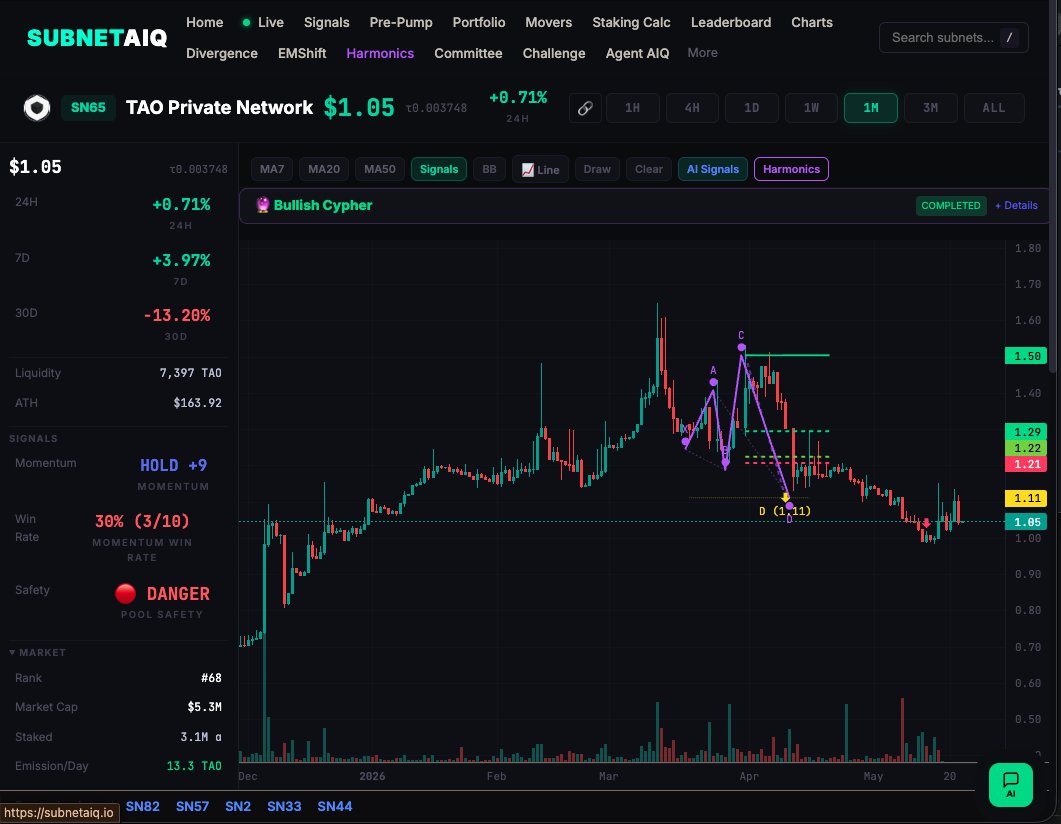
New on SubnetAIQ: TradingView charts, blockchain
explorer, whale leaderboard, real APY from chain.
subnetaiq.io
1
8
Jun 3
You don't need to know what to ask. Just click
Ask. Our AI agents rotate 90 questions across 9
analysts — staking, charts, harmonics, risk,
momentum. Each one answers with real chain data.
Try it. subnetaiq.io
1
10
Jun 2
100 wallets. $1.7 billion in TAO. Every position
tracked. Real P&L from chain history. Some are up
19K TAO. Some are down -9K. The leaderboard
tells you who knows what they're doing — and who
doesn't. subnetaiq.io/whale-leaderboa…
1
8
Jun 2
The #1 TAO wallet made 19,507 TAO last
month. The #3 wallet lost -9,159. Same
chain. Different strategies. See who's
winning and who's not.
subnetaiq.io/whale-leaderboa…
subnetaiq.io
2
11
Jun 2
"Almost everybody staking TAO is putting it in the
safest, most boring option (Root network) and
earning 8% per yr. SN96 Verathos, using the exact same TAO token, paying 73% per yr.
You leaving money on the table because you
don't know where to look."
subnetaiq.io
3
3
100
SubnetAIQ retweeted
Jun 2
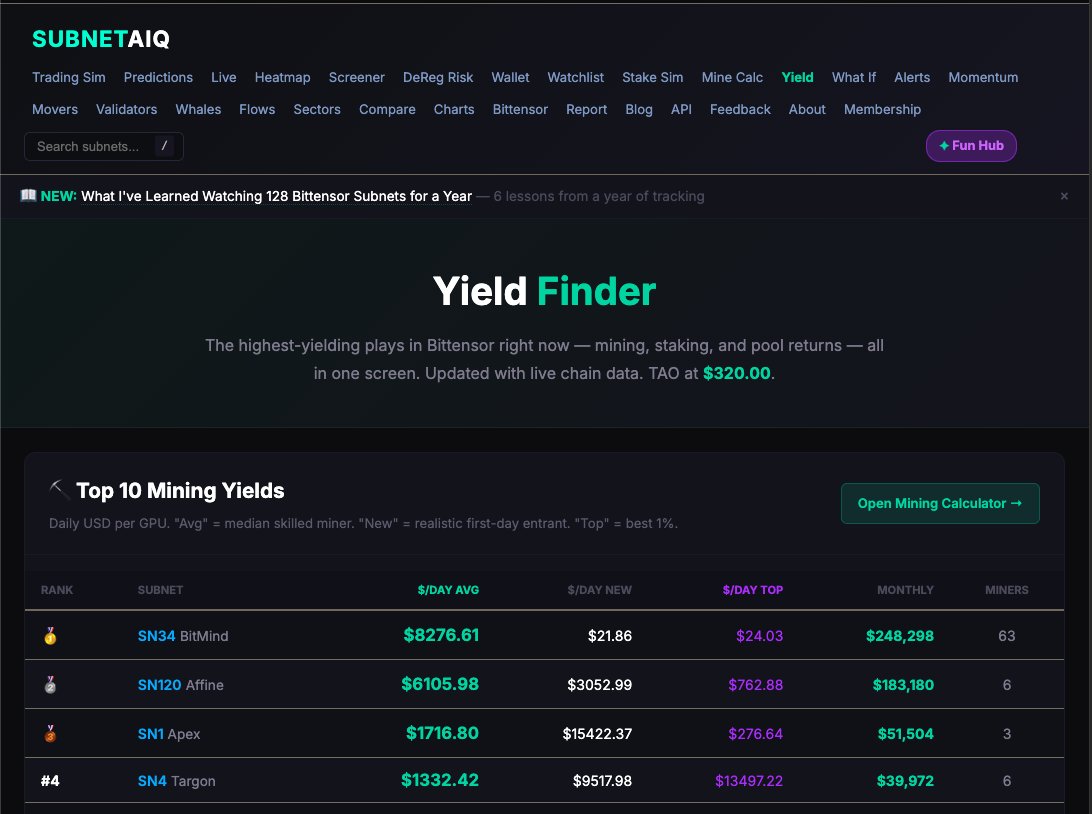
Everybody asks "where should I stake?" Here's what the
chain says right now. SN96 Verathos at 73% APY, 8
validators. SN5 Hone at 51%, 13 validators. SN64 Chutes at 27%, deepest pool on the network. Real numbers, real yield. subnetaiq.io
1
1
72
Jun 2
Just shipped: per-subnet validator comparison on
SubnetAIQ.
See every validator's stake, APY, and
performance — per subnet, not just network averages. Real data from chain metagraph dividends.
128 subnets.Updated every 4 hours. subnetaiq.io/validators
subnetaiq.io/
2
14
Jun 1
GM. Monday. New month, new data. 128 subnets tracked, momentum scores updated, mining calc live. While you're guessing which subnet to stake, we already know. subnetaiq.io
2
12
Jun 1
GM. First day of June. New month, new setups. Volatility incoming — stay sharp, stay patient.
The chart doesn't care about your feelings, only levels. Let's get it.
Subnetaiq.io
2
8
Jun 1
Most TAO stakers have no idea if their allocation is actually optimized.
We built a free wallet scoring tool that grades your portfolio across yield, diversification, and risk in seconds.
Connect your wallet. See your score. Fix your bags.
subnetaiq.io
1
8
May 31
What's your Bittensor wallet score?
Connect your wallet on SubnetAIQ and get your personalized staking grade — yield, diversification, risk exposure, all scored instantly.
Free. No signup required.
subnetaiq.io
2
40
May 31
The S&P just closed its best May in over a decade. Tech stocks doubled in 60. days. Bitcoin is lagging behind a 9-week equity rally.
Something has to give. Either crypto catches up or stocks pull back.
Which side are you on?
subnetaiq.io
2
12
May 30
Bittensor shipped conviction locks, 3 subnets are flashing RSI reversals, and one just hit $432K in monthly revenue from real customers.
The fundamentals are building faster than the price reflects.
subnetaiq.io
2
25
May 30
Most people check TAO price once a day and call it research.
We scan 128 subnets every 2 minutes. Conviction shifts, emission redirects, RSI reversals, deregistration risk — all tracked automatically.
The data is free. The edge is knowing where to look.
subnetaiq.io
11
May 30
Your subnet alpha doesn't sleep. Neither do we.
3 subnets flipped momentum overnight last week. 2 deregistrations nobody saw coming. 66 wallets quietly locking conviction into CliqueAI.
By the time you check in the morning,
subnetaiq.io — watching while you sleep.
2
15