
Computer Systems and Networking Research @BrownCSDept
Joined August 2019
- Tweets 25
- Following 11
- Followers 335
- Likes 1
6 Photos and videos
Computer Systems and Networks @ Brown retweeted

9 Dec 2021
Beginning next fall, @BrownCSDept will make available a number of merit-based, full-tuition scholarships to support our diversity and inclusion goals. All admitted applicants will be automatically considered, with no additional application needed: bit.ly/3IfImCJ
1
15
44

Join us! 🥳
19 Oct 2021

@BrownCSDept is hiring multiple tenure-track faculty members at the level of Assistant Professor and one at the rank of Lecturer, Senior Lecturer, or Distinguished Senior Lecturer. To learn more and to apply, please see cs.brown.edu/about/positions.
2
Computer Systems and Networks @ Brown retweeted
19 Oct 2021
@BrownCSDept is hiring multiple tenure-track faculty members at the level of Assistant Professor and one at the rank of Lecturer, Senior Lecturer, or Distinguished Senior Lecturer. To learn more and to apply, please see cs.brown.edu/about/positions.
10
13
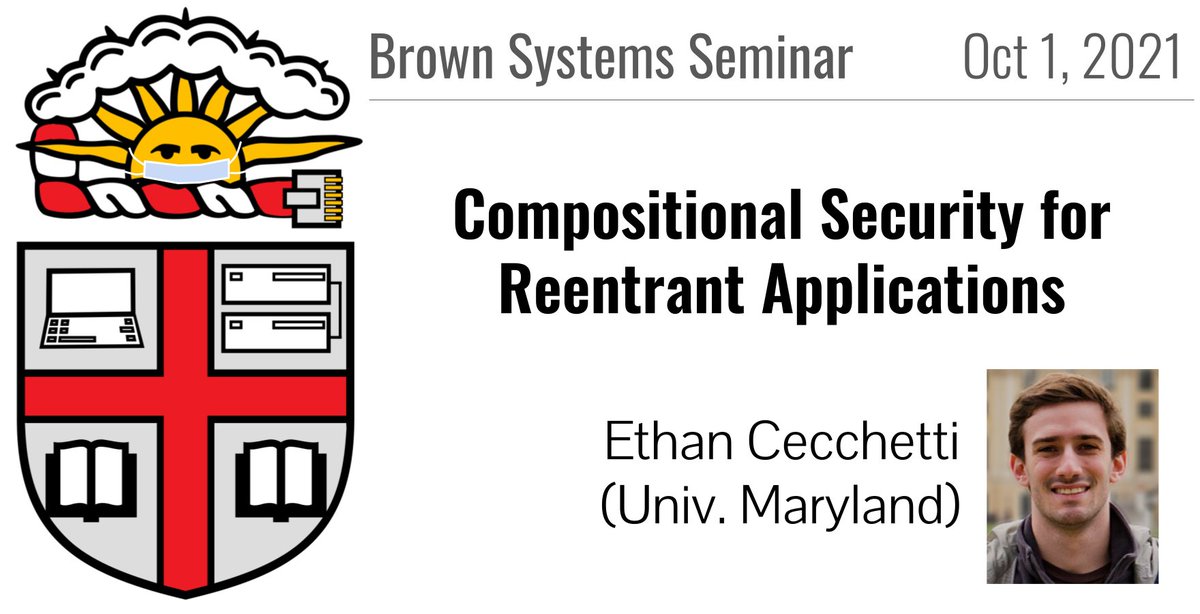
We're excited to have @EthanCecchetti present Serif, his best-paper-winning @IEEESSP paper (w/ @AndrewCMyers) about protecting invariants in reentrant programs (like smart contracts) even in the presence of malicious code.
This Friday at noon, CIT 368 and on Zoom!
2
9
Computer Systems and Networks @ Brown retweeted

1 Jul 2021
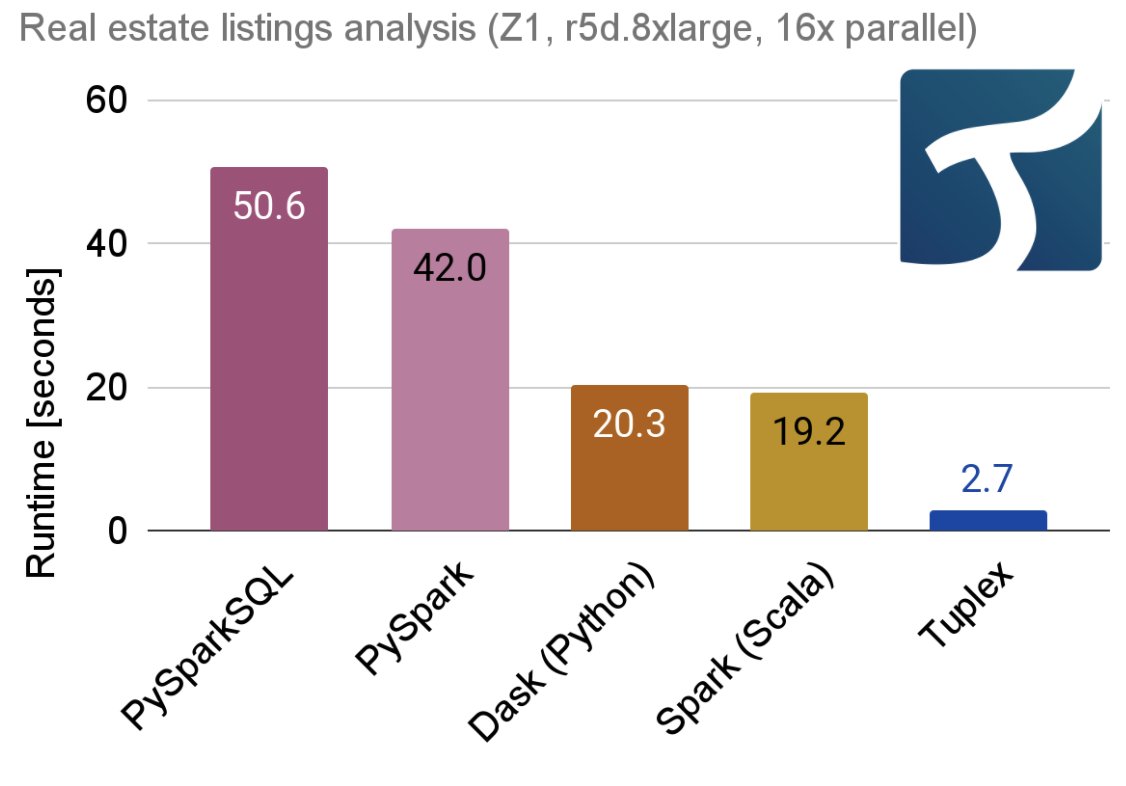
Today, we release Tuplex (tuplex.cs.brown.edu), a new system that turns Python data science pipelines into efficient, optimized machine code.
Think PySpark or Dask, but with end-to-end LLVM code generation for custom Python code. Tuplex often yields speedups of 10-20x. 🧵⏎
7
75
399
Computer Systems and Networks @ Brown retweeted
2 Jun 2021
At HotOS today, Lily Tsai (@tslilyai) presents our work on making better privacy in web applications a reality through structured database transformations we call "disguises".
Check out her talk (youtu.be/kHRcPezOuR8) and tune in for discussion at 4:40pm Eastern!
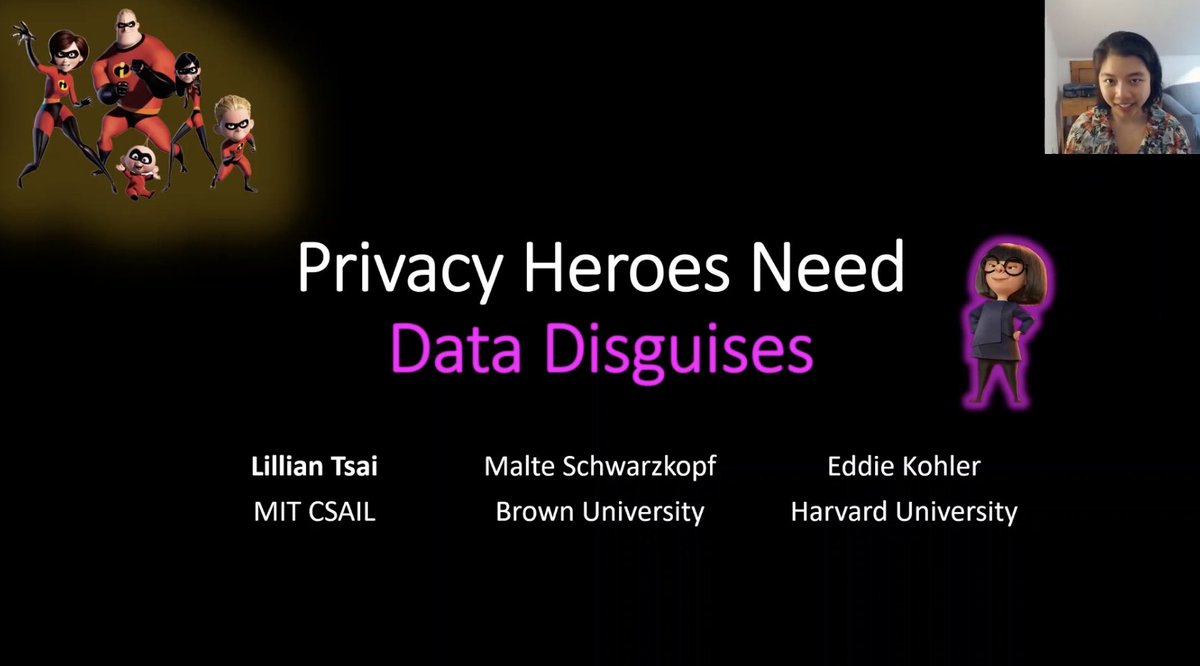
ALT Talk title slide for "Privacy Heroes Need Data Disguises".
1
5
27
Computer Systems and Networks @ Brown retweeted
8 Apr 2021
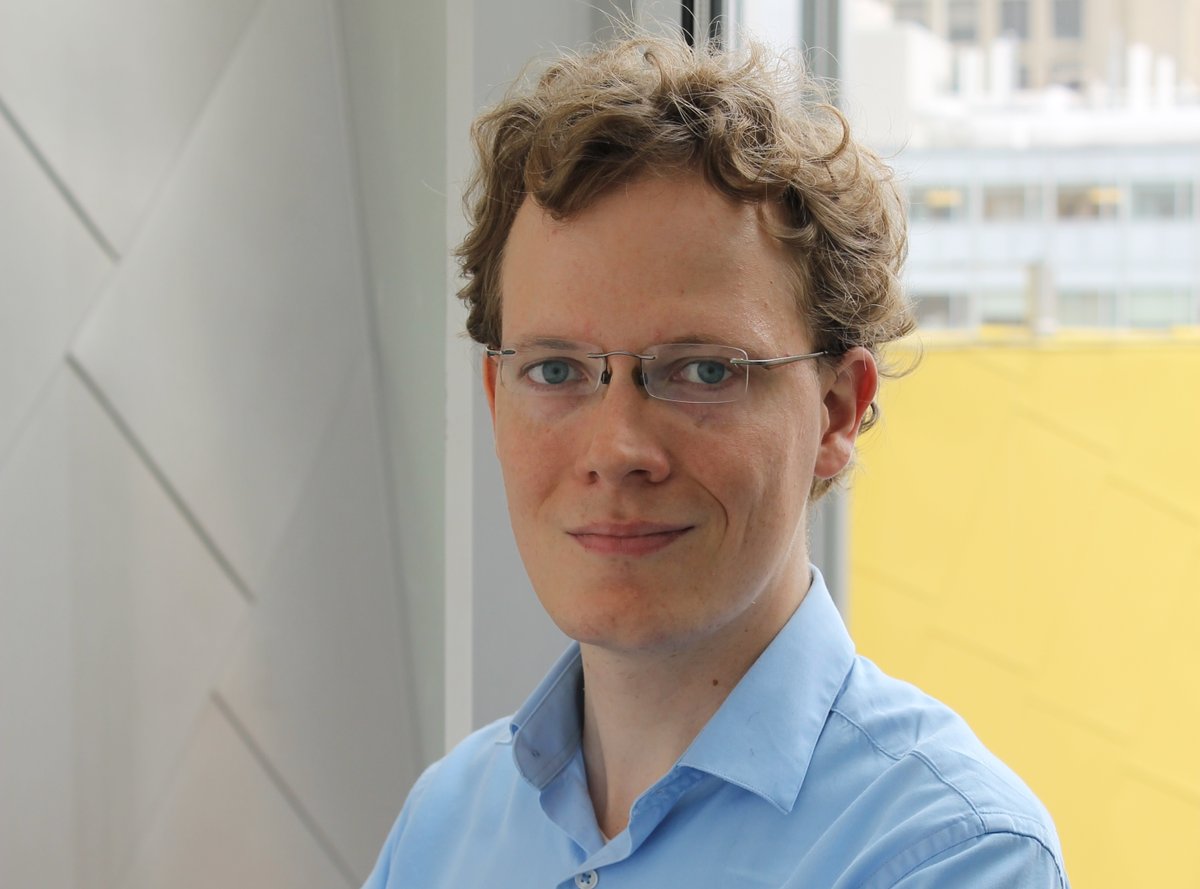
Professor @ms705 of @BrownCSDept has just won a @Google Research Scholarship for work on privacy-compliant web services by construction. Learn more about his research at cs.brown.edu/people/malte/re….
1
2
18
Today's systems seminar was by @refezs of @YaleCompsci on FPGA security in cloud datacenters: youtu.be/HQVkHPiWLkc
Did you know that you can "fingerprint" an individual FPGA on the cloud, and that an FPGA's temperature is a covert channel that can leak information?
Check out Friday's systems seminar talk by @RuanZain , on AIFM, a new approach to extending scarce server memory with remote ("far") memory: youtu.be/bFlRbeOxE5g
AIFM's userspace runtime avoids kernel overheads captures application semantics, achieving near-local memory perf.
1
2
This work is a collaboration between Zain, @ms705 of @SystemsAtBrown, @MarcosKAguilera of @vmwareresearch, and Adam Belay of MIT.
Today's systems seminar talk was by @arpanbg and @mpi_jcmace, on Clockwork, their new system for predictable DNN inference over shared GPUs: youtu.be/bc624Qs7oXw
Key take: meeting inference SLOs is easy if the serving infrastructure around the actual model is predictable
2
7
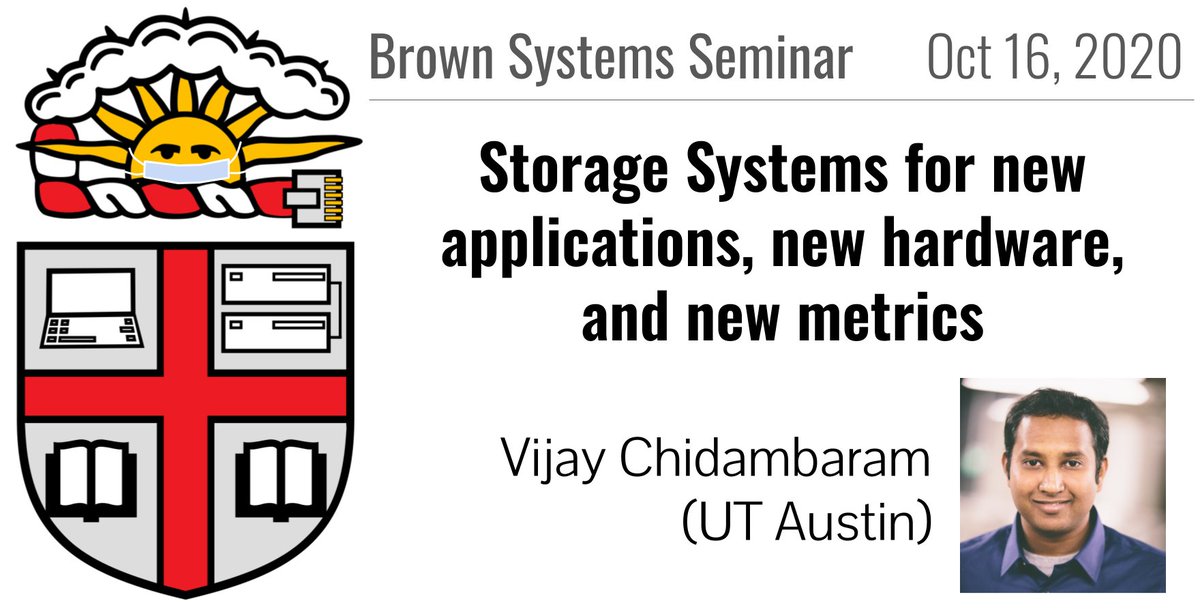
We were delighted to host @vj_chidambaram at the Brown Systems Seminar today: youtu.be/D6pt7VIoLXU
Vijay spoke about work on file systems and data structures for persistent memory, storage for ML, and other topics!
ALT Title slide: Brown Systems Seminar, Oct 16. "Storage Systems for new applications, new hardware, and new metrics" by Vijay Chidambaram.
1
2
11
We have more exciting speakers coming up this semester, including @irinacalciu, @ICGog, @arpanbg , @lukenels_, and others. We'll publish videos on YouTube for most talks!
3
Computer Systems and Networks @ Brown retweeted
15 Jul 2020
New paper on shared indexes ("arrangements") for stream processing! Joint work with @frankmcsherry of @MaterializeInc, and @utaal Mothy Roscoe of @SystemsGroupETH.
tl;dr: shared arrangements reduce new-query latency by 100x (no rebuilding of indexes) & memory footprint by 3x.

Vol:13 No:10 → Shared Arrangements: practical inter-query sharing for streaming dataflows vldb.org/pvldb/vol13/p1793-m…
1
9
46
Congratulations to @rodrigo_fonseca and co-authors, who won the Community Award at @usenix ATC 2020 today for their paper "Serverless in the Wild"!
30 Jun 2020

Our upcoming @usenix ATC paper, Serveless in the Wild, has the 1st characterization of a #serverless provider workload, real traces, and a policy that reduces cold starts, saves resources, and is being deployed in production! microsoft.com/en-us/research… github.com/Azure/AzurePublic… #azure
1
3
22
From the award citation: "the public release of production data [...] on a timely topic [...] marks an important milestone for the community" 🏆
Computer Systems and Networks @ Brown retweeted

30 Jun 2020
Our upcoming @usenix ATC paper, Serveless in the Wild, has the 1st characterization of a #serverless provider workload, real traces, and a policy that reduces cold starts, saves resources, and is being deployed in production! microsoft.com/en-us/research… github.com/Azure/AzurePublic… #azure
2
28
114
Awesome week for Systems and Networks at Brown -- three (!) papers accepted at @ACMSIGCOMM and one at @VLDB2020! 🎉
The papers cover efficient stream processing, ML for CDN configs, formal verification of a WAN, and zero-downtime release deployment (details in thread below) ⬇️
1
4
34
3) Network verification (Da Yu, w/ @rodrigo_fonseca, @ennanzhai, @lampson0505): practical & algorithmic innovations for formal verification of @AlibabaGroup's WAN configuration, which prevented many misconfigurations & reduced the failure rate of updates by >50% in 2019 [SIGCOMM]
1
1
3
4) Zero downtime release (@usama6naseer & @DotTheophilus again, w/ @fb_research: @lvc4, @udippant, @ranj33th, Alan Frindell) discusses crucial components in Facebook infrastructure that sustain a high release frequency, without disrupting user connections and experience [SIGCOMM]
4