
Where ambitious teens learn from successful founders and VCs, and showcase their own innovative ventures.
Joined October 2023
- Tweets 809
- Following 35
- Followers 115
- Likes 963
209 Photos and videos



Pinned Tweet

26 Jul 2024
TSARP #347: @JennyQTa7 - From Wall Street to Web3, She's the VC Backer of @TetherballCoin
x.com/i/spaces/1lPKqONovBmJb
12
24
6,042

TSARP retweeted

13 Dec 2024
Would you use this app, asking for a friend (literally):
DebateGPT: An AI-powered app that helps you win online arguments with fact-checked, logical responses from just a screenshot.
69%
Yes
31%
No
16 votes • Final results
2
1
8
468
TSARP retweeted

9 Dec 2024
The edu/acc manifesto
"I've noticed a fascinating phenomenon in my twenty-five years of teaching: schools and schooling are increasingly irrelevant to the great enterprises of the planet. No one believes anymore that scientists are trained in science classes or politicians in civics classes or poets in English classes. The truth is that schools don't really teach anything except how to obey orders." - John Taylor Gatto
Education is humanity's greatest lever for accelerating individual potential and shaping our collective future. It is force used criminally in opposition to human flourishing. Excellence emerges from the multiplication of natural talent, dedicated practice, and character. This manifesto for the edu/acc movement—a fork of and contribution to the greater e/acc movement—outlines a vision for education that accelerates this fundamental potential.
The Three Acts of Education
Act I: The Aristotelian Ideal
"For the things we have to learn before we can do them, we learn by doing them." - Aristotle
In 343 BCE, King Philip II of Macedon made an unprecedented investment in his son's education—he convinced Aristotle, then the world's preeminent philosopher, to become the personal tutor of young Alexander. At the Temple of the Nymphs in Mieza, Aristotle taught not only Alexander but also a select group of Macedonian noble youths who would later form the core of Alexander's most trusted military commanders. Among these companions were Ptolemy, Hephaestion, and Cassander—future rulers and generals in their own right. This small cohort of exceptional students, learning together under Aristotle's guidance, would go on to reshape the known world.
For seven years at Mieza, Aristotle forged this future leadership cadre. Through philosophy, science, and statecraft, he shaped not just their minds but their bonds to each other. Alexander's declaration that he owed Aristotle his way of life—"I am indebted to my father for living, but to my teacher for living well"—reflected a sentiment shared by this entire brotherhood of learners.
Consider the xx orders of impact: this educational experiment, available to perhaps a few hundred students per generation(and fewer rulers were wise enough to utilize the great philosophers of their lands in this way), catalyzed changes that would reshape civilization across three continents. A single teacher, teaching a tiny fraction of one land's youth triggered centuries of cultural and intellectual revolution. The power of personalized education has never been more clearly demonstrated.
This pinnacle of educational personalization—one of history's greatest minds dedicating years to nurturing a small group of exceptional students—produced not just one of the most influential figures in human history, but a cadre of leaders who worked collaboratively to transform the ancient world. While this model achieved extraordinary results, its exclusivity left the vast majority without access to structured learning. Today, we stand at the threshold of making this dream accessible to all.
Act II: The Industrial Education Complex
"When you take the free will out of education, that turns it into schooling." - John Taylor Gatto
The public schooling paradigm began with Martin Luther's vision not of enlightenment, but of control—establishing compulsory schooling as a means to indoctrinate youth into his religious doctrine. Yet from these authoritarian roots grew something unprecedented: the first system in human history to attempt universal literacy and basic education. By 1900, literacy rates in industrialized nations had skyrocketed from historical levels of 20% to over 80%. Basic mathematical and scientific literacy became commonplace rather than exceptional. This democratization of fundamental knowledge was revolutionary, lifting millions from intellectual darkness and enabling the technological revolutions of the 19th and 20th centuries, and producing the consumers for the innovations of the few.
But systems calcify. What began as a tool for religious conformity evolved into the industrial education complex—a bureaucratic behemoth designed to produce standardized workers for standardized jobs. The factory model of education, with its rigid schedules, segregation by age, and standardized testing, perfectly served the needs of the Industrial Revolution. Students were trained in the virtues of punctuality, obedience, and tolerance for repetitive tasks—precisely what assembly lines required.
Today, this system persists through institutional inertia despite the disappearance of the industrial economy it was built to serve. What Ivan Illich called the "hidden curriculum"—teaching compliance over curiosity, obedience over originality—now actively handicaps students facing a world that demands creativity, adaptability, and independent thinking. The very features that made public education revolutionary in 1900—standardization, scale, uniformity—have become chains in 2024.
The statistics tell the story: despite spending nearly $15,000 per student annually in the US(on average), 130 years after the advent of compulsory education, only 37% of American 12th graders are proficient in reading, and 18% in mathematics. More damningly, surveys show 75% of students report being bored and disengaged in school. This metric is even more important than the former because it is the root cause of a great societal evil: disengagement, widespread nihilism, and a general lack of meaning and purpose. The system designed to mass-produce factory workers is now mass-producing disengagement in an era that desperately needs passionate, self-directed learners.
Act III: An Aristotle for Every Student
"Learning can only happen when a child is interested. If he's not interested, it's like throwing marshmallows at his head and calling it eating." - Katrina Gutleben
The mathematics of educational revolution have fundamentally changed. In 343 BCE, it took the resources of the most powerful kingdom in Greece to provide one Aristotle for a dozen students. In 1900, the industrial education complex could provide one mediocre teacher for every thirty students. In 2024, artificial intelligence has altered this equation forever: we can now provide every student with not just one Aristotle, but an entire academy of AI tutors, each operating at the frontier of human knowledge in their domain.
This is not a mere technological upgrade—it is the complete upheaval of education's economic and social constraints. The cost of personalized instruction has collapsed by orders of magnitude: from the gold talents of ancient Macedonia, to the thousands of dollars per student of modern public schools, to mere cents per hour of AI tutoring. What Philip II could barely afford for his heir, we can now provide to millions.
The early results are staggering. In the emerging network of AI-enabled learning environments—homeschools, microschools, online communities—the rate of learning has skyrocketed. More crucially, we're seeing the return of the profound love of learning that was seen in every great mind of history. While 75% of traditional students report being bored and disengaged, these new environments are producing passionate autodidacts who pursue knowledge with the same intensity that Alexander once did.
This is the essence of edu/acc: the marriage of personalized excellence with technological abundance. We can now build learning environments that nurture each individual's genius at scale, that treat each student not as an interchangeable part of an industrial machine, but as a unique mind capable of extraordinary achievement. The age of accelerating human potential is upon us.
Core Principles of edu/acc
Interest-Driven Learning
Education is most effective when tailored to individual passions and aspirations - people learn best when they are learning things they care about
Excellence emerges when learners engage with subjects they love in ways that allow them to have true purpose and meaning as part of their learning
Excellence is Valuable
True mastery in any field leads to economic success - anything done at a sufficiently high level is valuable, if only for entertainment or enlightenment
Education should foster expertise, not mere competence - part of education is the application of principle
The recitation of facts is not education, it is indoctrination - The facts are forgotten, the conformity and lack of curiosity remain
Meaning for Students
Students should hold ownership of their education in the same way adults hold ownership of their careers
Meaning and ownership are the psychological underpinnings of self-discipline: when combined with interest in a subject and resources, excellence is only a matter of time
Implementing edu/acc
Legal Framework: The Homeschooling Revolution
"The aim of public education is not to spread enlightenment at all; it is simply to reduce as many individuals as possible to the same safe level, to breed and train a standardized citizenry, to put down dissent and originality." - H.L. Mencken
Homeschooling represents our greatest legal framework for educational freedom. While the Department of Education continues to enforce standardization and mediocrity through federal funding requirements and standardized testing mandates, homeschooling laws in most states provide the autonomy needed for true educational innovation. This legal shield against institutional conformity is essential for the edu/acc movement to flourish.
The Assistance of AI
The democratization of artificial intelligence is the key technological enabler of edu/acc. As the cost of AI continues to plummet and capabilities increase exponentially, we can finally break free from the economic constraints that have historically limited personalized education to the elite. Low-cost AI tutors, adaptive learning systems, and automated content recommendation make it possible to provide great-mind quality education at scale.
Economic Realignment
"Throughout the centuries there were men who took first steps down new roads, armed with nothing but their own vision. The great creators, the thinkers, the artists, the scientists, the inventors, stood alone against the men of their time. Every new thought was opposed. Every new invention was denounced. But the men of unborrowed vision went ahead. They fought, they suffered, and they paid - but they won." - Ayn Rand, The Fountainhead
The current education system serves primarily as a credentialing mechanism for corporate employment. Edu/acc seeks to break this alignment, creating direct paths from learning to value creation. This requires:
- Rejection of traditional credentialing systems
- Emphasis on demonstrable skills and project portfolios
- Direct connection between learning and economic opportunity
- Liberation from the degree-industrial complex that peddles credentials like medieval indulgences, promising salvation through expensive parchment rather than true learning
Resistance to Institutional Control
The Department of Education and similar institutional forces, namely Teacher's Unions, will inevitably resist this transformation, as it threatens their control over the educational narrative and resource allocation. The edu/acc movement must therefore:
- Actively resist further centralization of educational control
- Support legal challenges to restrictive educational regulations
- Continually deny the principle of standardized, one-size-fits-all education based on comparisons to others
- Document and publicly expose the failures of the orthodox model of education, and the successes of students in the edu/acc model
Conclusion
The vision of edu/acc is of an educational revolution that prioritizes individual potential over standardized benchmarks. By combining modern technology with the most ancient personal tutoring, we can create a system that not only prepares learners for the future but empowers them to shape it. This third act in education isn't just possible—it's imperative for unlocking humanity's full potential.
"The secret of education lies in respecting the pupil." - Ralph Waldo Emerson
17
20
97
16,233
TSARP retweeted
8 Dec 2024
Let’s support a fellow teen entrepreneur! Tejas, a 16 y/o member of TSARP, just released an amazing business book featuring 50 influential entrepreneurs. Just ordered it myself, and I highly recommend you check it out too! You can order it now or add it to your Christmas list!

hey andrew, i just wrote a book abt business leaders and their pathways to success! btw if anyone wants a free copy, dm me. amazon.com/dp/B0DMHQF81M
1
1
8
837
TSARP retweeted
27 Oct 2024
Super excited to talk to the co-founder of teen/acc, @raygyli today!
Tune in to see what the next generation of entrepreneurs is planning.
You don't want to miss this one!
x.com/i/spaces/1vOGwrvlYvEKB
3
7
394
TSARP retweeted
25 Oct 2024
Wow, I think this might be the most one-sided poll I've ever posted.
23 Oct 2024

Does anyone else go back and forth between thinking, “My startup’s doing well,” and, “Wow, I’ve achieved nothing” every two seconds?
3
8
2,210
TSARP retweeted
23 Oct 2024
Does anyone else go back and forth between thinking, “My startup’s doing well,” and, “Wow, I’ve achieved nothing” every two seconds?
93%
Yes
7%
No
15 votes • Final results
3
12
3,594
TSARP retweeted
21 Oct 2024
Education isn’t one-size-fits-all—not by a long shot. Public schools are built for the average, but no one fits perfectly into that mold—some more than others.
Does anyone know of any startups truly revolutionizing K-12 education?
I know one, cc @garberchov.
Schools, do better.
2
2
10
328
TSARP retweeted
20 Oct 2024
Quick question: How old are you and do you think you are underserved or rightfully served in the startup world.
33%
20 & underserved
0%
20 & rightfully served
17%
19- & underserved
50%
19- & rightfully served
6 votes • Final results
1
3
185
TSARP retweeted

18 Oct 2024
💯
17 Oct 2024
If you want to invest in the future, invest in teens, because they are the future.
4
7
642
TSARP retweeted
17 Oct 2024
If you want to invest in the future, invest in teens, because they are the future.
5
13
1,348
TSARP retweeted
14 Oct 2024
Quick Question: When do you do your best work?
By the time of this post I think you know my answer😂
58%
Midnight
0%
Mid-day
42%
Dawn
12 votes • Final results
2
3
7
239
TSARP retweeted
12 Oct 2024
Ideal School for Teen Entrepreneurs:
- English: Cold Emailing 101
- Math: Business Finances
- Science: Computer Science
- History: History of Silicon Valley
2
5
19
513
TSARP retweeted
10 Oct 2024
The entire 'X Growth Coaching' space is a pyramid scheme. They all comment on each other’s posts to grow, but since they sell the same thing, none will ever buy from each other.
Start a real business, not a fake 'get rich quick' scheme.
3
14
245
7 Oct 2024
RT @TheCodingKid: Let’s end fake 'guru' courses. TSARP is teaming up with @tetherballcoin to launch business masterclasses for teens—taught…
3
10
7 Oct 2024
Ready to level up your startup?
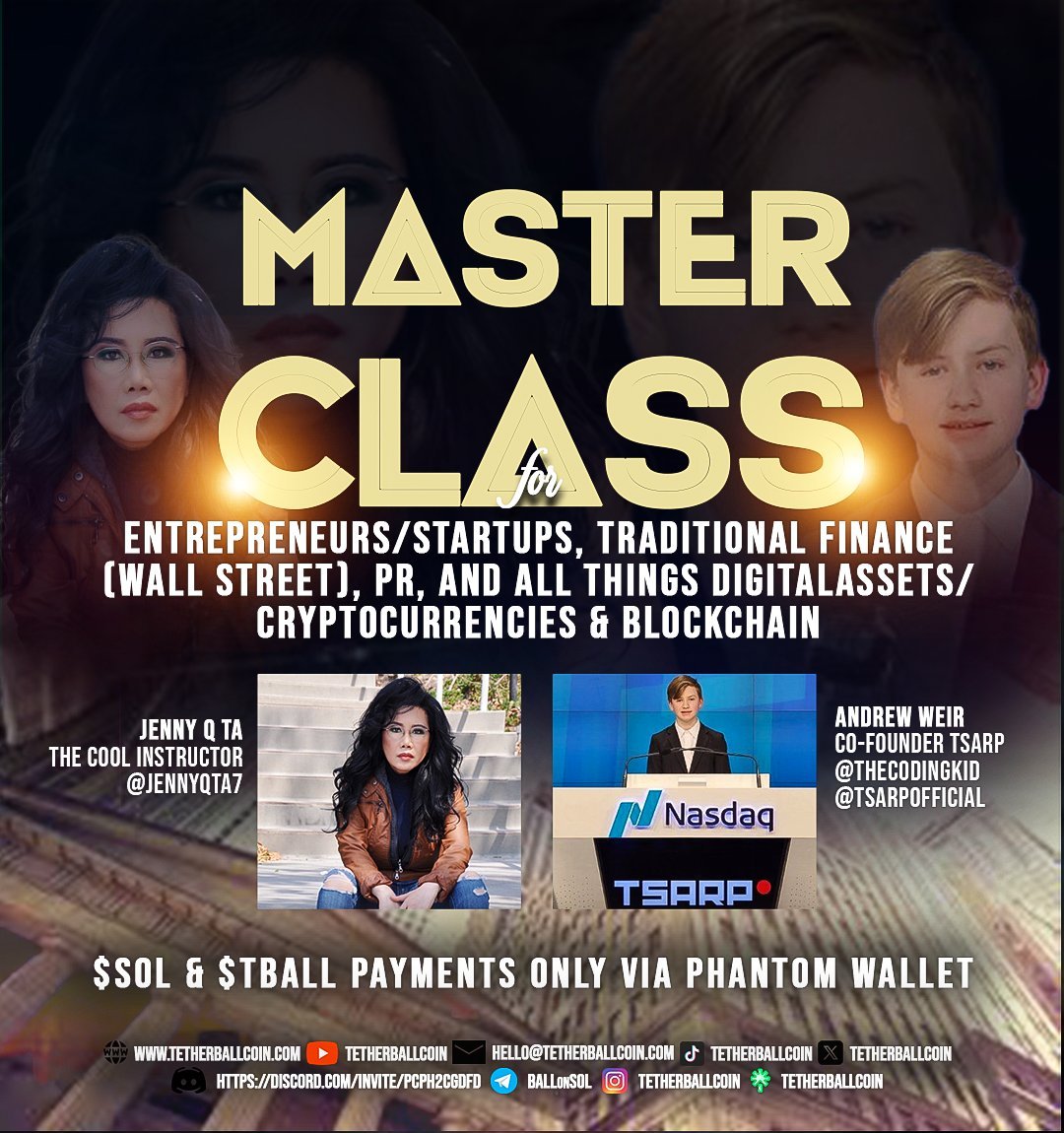
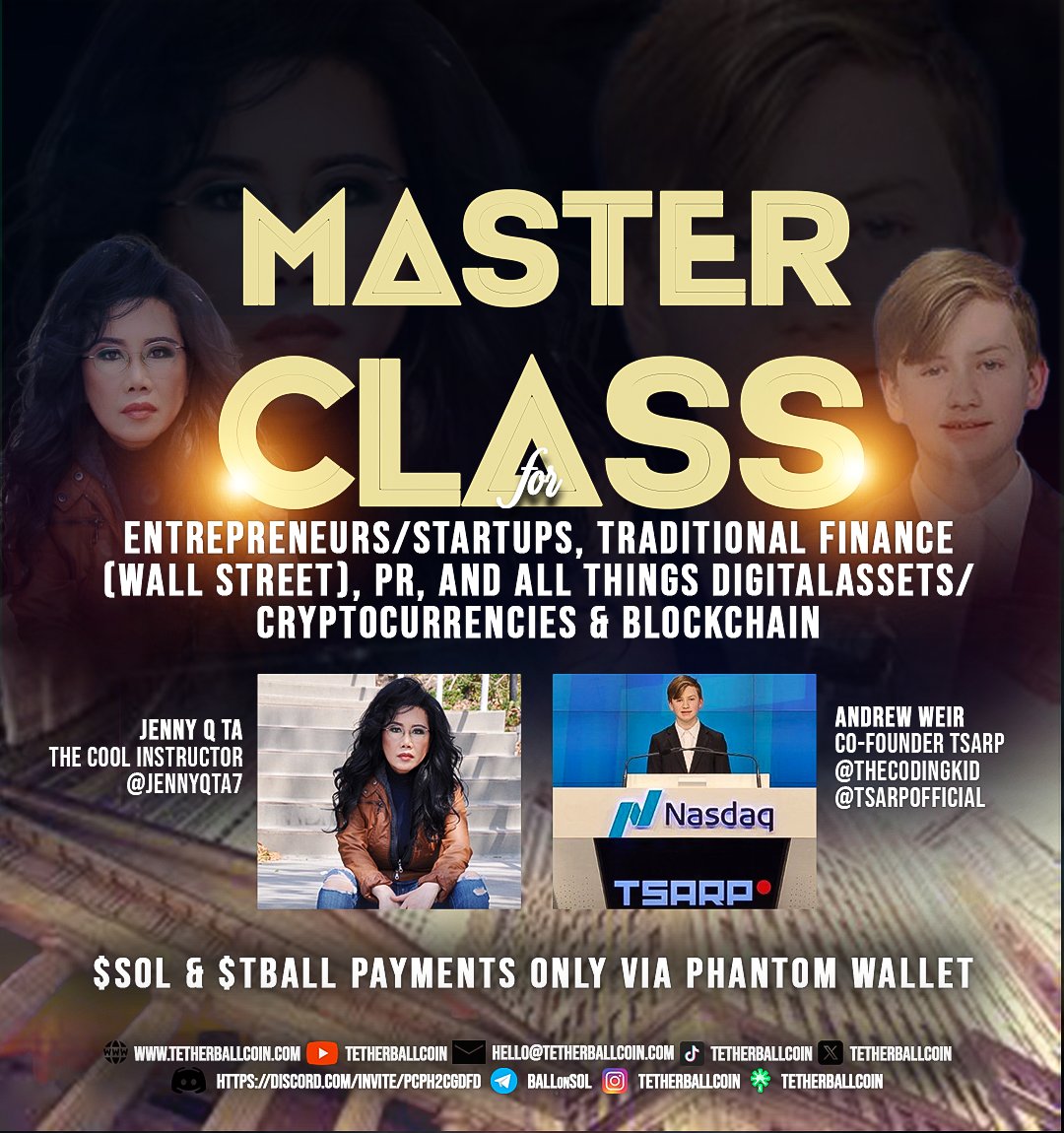
🚀 Announcing live business classes for teens by @TSARPOfficial & @Tetherballcoin, taught by @JennyQTa7—3x founder and VC. Going in-depth on marketing, VC, grants and transforming ideas to companies—with live Q&A.
Limited spots—sign up below ⬇️
4
8
15
2,853
TSARP retweeted

7 Oct 2024
🚨 ANNOUNCEMENT! 🚨
We're teaming up with the @TSARPofficial community of 1,200 members/subscribers and co-founder Andrew Weir (@TheCodingKid) to launch a series of #Masterclasses, after garnering enough interest!
Andrew: "Whether you're a teen or an adult launching your first company, our new classes are designed for you! Learn how to take your project from prototype to securing VC funding, taught live with Q&A by a 3x founder and VC, @JennyQTa7."
🔒Secure your spot here: forms.fillout.com/t/iHoLzSLU…
25
22
39
16,938
TSARP retweeted

6 Oct 2024
🎙️ I am so ready to host @TheCodingKid with @JennyQTa7 on Tuesday.
⏰ Set the alarm now and follow @tetherballcoin
Andrew made the history by ringing the Nasdaq closing bell at the age of 13. At just 14 years old, he has hosted hundreds of podcast interviews, including conversations with venture capitalists, entrepreneurs, and influencers. Recently, he’s also gotten into trading.
6 Oct 2024

🎙️ 𝐒𝐏𝐄𝐂𝐈𝐀𝐋 𝐍𝐄𝐖 𝐓𝐈𝐌𝐄: The Million Dollar Playbook Show 🎙️
🗓️ Tuesday, 10/8
⏰ 12:15 PM - 1:15 PM PST
GM, legends! Ready to make moves?
It’s time to get hyped for #Web3 Unfiltered & Trade Secrets - EP4 featuring the wonderkid 𝐀𝐧𝐝𝐫𝐞𝐰 𝐖𝐞𝐢𝐫 @TheCodingKid, who made history by ringing the Nasdaq closing bell at the age of 13.
At just 14 years old, he has hosted hundreds of podcast interviews, including conversations with venture capitalists, entrepreneurs, and influencers. Recently, he’s also gotten into trading.
𝙄𝙩’𝙨 𝙤𝙪𝙧 𝙥𝙡𝙚𝙖𝙨𝙪𝙧𝙚 𝙩𝙤 𝙝𝙤𝙨𝙩 𝙝𝙞𝙢 𝙖𝙣𝙙 𝙝𝙞𝙜𝙝𝙡𝙞𝙜𝙝𝙩 𝙝𝙞𝙨 𝙚𝙭𝙥𝙚𝙧𝙞𝙚𝙣𝙘𝙚𝙨 𝙤𝙣 𝙤𝙪𝙧 𝙨𝙩𝙧𝙚𝙖𝙢𝙞𝙣𝙜 𝙨𝙚𝙧𝙞𝙚𝙨.
Hosted by the one and only @KuanNingTseng1 with @JennyQTa7 as the co-host.
This episode will dive into unfiltered discussions about Andrew’s early success, personal journey, experiences as a podcast host, and his newly sparked interest in trading and investment.
12
12
18
11,429