
#GrowthAdvisory #CorporateStrategy #FoundersAdvice #DealMaker #PE #VC #ScaleupAdvisory | #Fintech #AI #Web3 #EnterpriseTech | #KelloggAlum | RT≠ Endorsement
Joined May 2013
- Tweets 4,635
- Following 5,128
- Followers 625
- Likes 2,755
36 Photos and videos





Jun 13
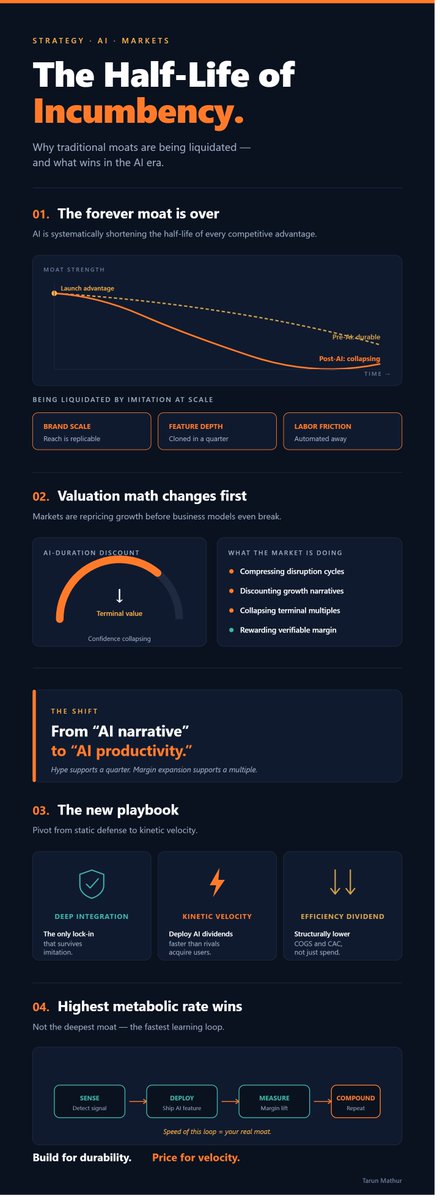
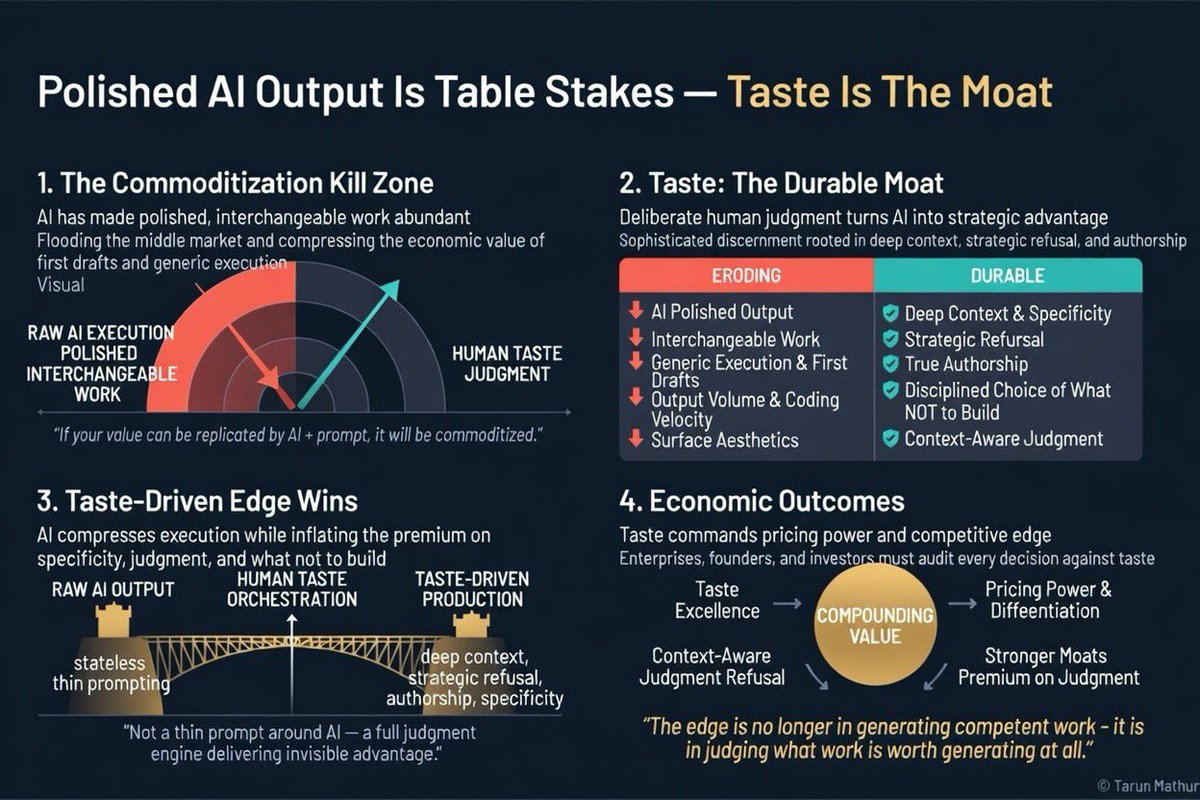
When capability becomes cheap, the winner is the company that sits inside the workflow, captures proprietary signal, and becomes the default decision layer.
System advantage >> product advantage.
#TMinsights
26
Jun 11
The best businesses are actually the ones which are control points for economic activity in that domain.
The real moat is compounding context, not the interface layer.
#TMinsights
13
Jun 11
Key business model / value chain shifts being observed in the AI era :
>> Distribution is no longer just go-to-market. It is product design.
>> Data is no longer just a byproduct. It is the operating fuel for learning loops.
>> Trust is no longer a branding exercise. It becomes the permission structure that lets a system touch mission-critical work.
#TMinsights
14
Jun 11
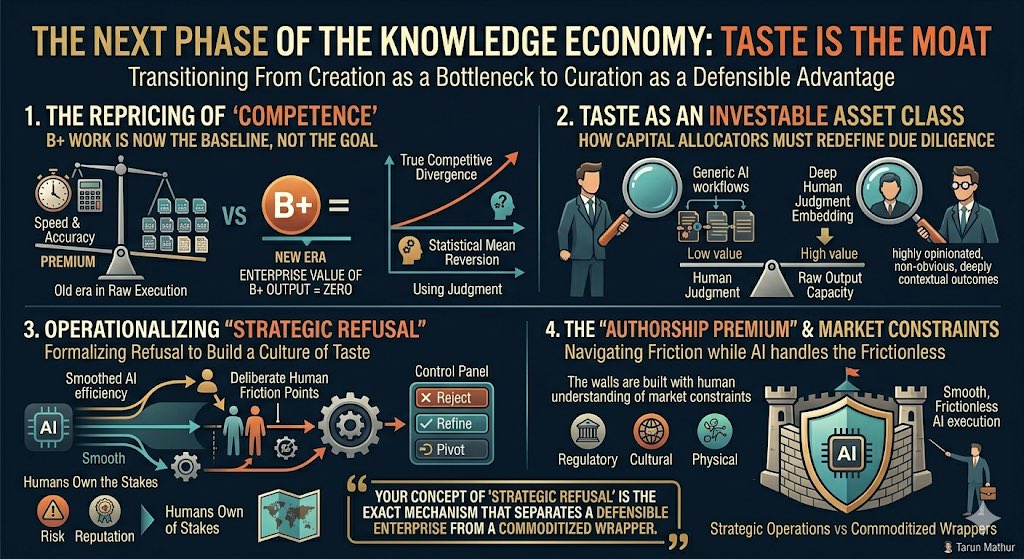
When intelligence becomes cheaper, differentiation migrates toward the things models cannot easily replicate: access, permission, relationships, and operating discipline.
AI may increase the value of some old-school strategic assets: proprietary distribution, brand trust, regulatory fluency, and domain-specific data.
#TMinsights
14
Jun 11
Designing for agents, not only for users, is becoming a strategic necessity. Products that are easy for AI systems to read, act on, and integrate into workflows will gain an edge in adoption and retention. The hidden moat is not just UX; it is machine legibility.
The best wedge is often not breadth, but becoming the most reliable node in a critical workflow. The future belongs to those built into the network, not merely adjacent to it.
Does your company merely use AI, or does it become the substrate other AI systems depend on?
#TMinsights
4
Jun 11
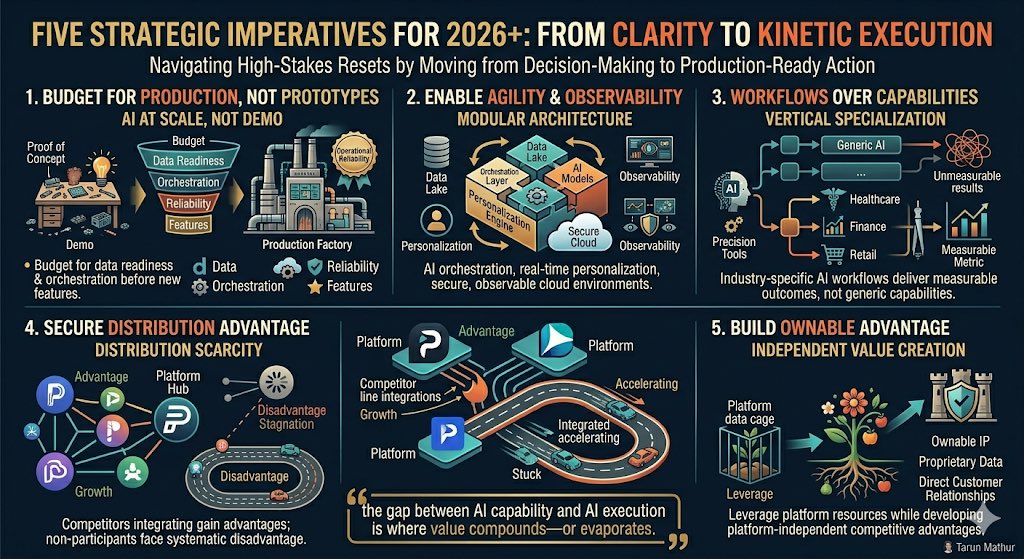
Distribution, integration depth, and switching costs are emerging as more crucial than raw model quality.
The strongest companies will not simply own a product category; they will own a monetization path. They will sit in the middle of repeated transactions, not one-off interactions.
Loop intensity >> number of users.
#TMinsights
6
Jun 11
The funding market is telling us something important: capital is still flowing, but it is concentrating around categories closer to execution than experimentation. That matters because it signals where the market believes value will accrue.
The era of “AI everywhere” is giving way to “AI where the workflow breaks, the economics improve, or the customer pays twice.” That is why infrastructure, search, vertical applications, and agentic systems keep attracting attention.
#TMinsights
7
Jun 11
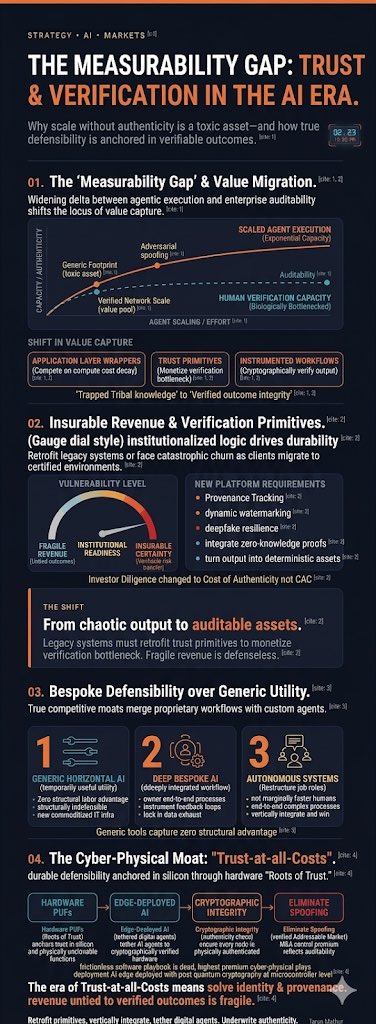
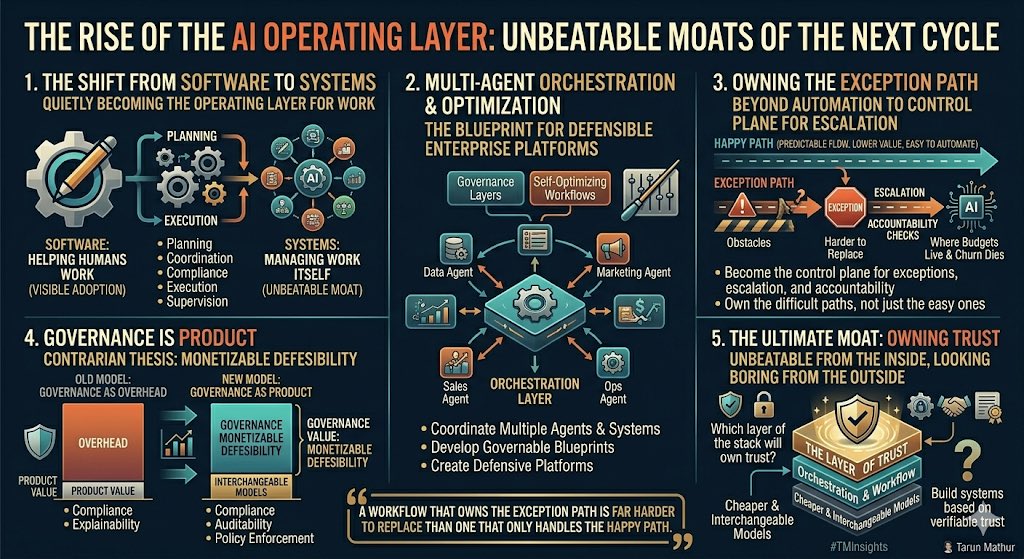
Trust should be a production input, not a legal afterthought.
Once AI enters high-stakes workflows, the winning stack will be the one that can prove provenance, auditability, and controlled source access at scale.
This creates a new competitive dynamic. Speed is important, but it is more important to standardize controls, reduce hallucination risk, and embed source-controlled architecture into procurement. You should be able to show not just outputs, but defensible outputs.
This is an underwriting shift. It favors systems that are harder to reproduce because they sit on top of unique enterprise context and governance rails.
The market is quietly repricing “responsible AI” from virtue signaling to infrastructure. Such embedded trust can turn risk reduction into product value.
#TMinsights
6
Jun 11
The agentic “AI runs everything” vision seems to have been priced out by physics, compute, power, and cooling.
#TMinsights
16
Jun 10
Investors should look for loop density, not feature density.
An important question to ask is: What becomes more valuable after the first 10,000 actions, not the first 10,000 users?
In the next cycle, the moat is not intelligence. It is embedded agency.
#TMinsights
12
Jun 10
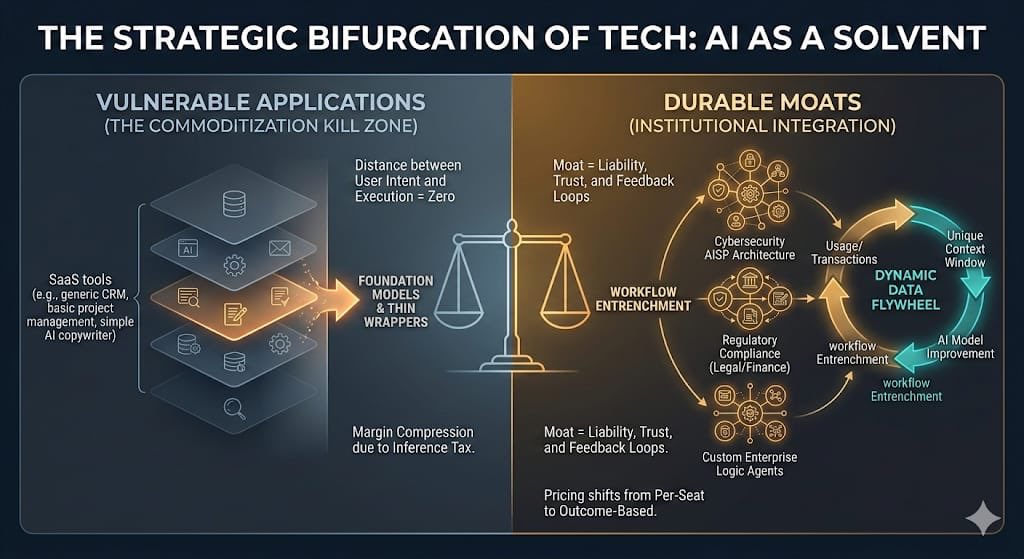
The new revenue model is not “AI subscription.” It is AI-enabled operating margin expansion, usage-based automation, and outcome-linked pricing.
That changes the economics of software: customers no longer pay for access; they pay for a measurable reduction in time, risk, or headcount pressure.
#TMinsights
6
Jun 10
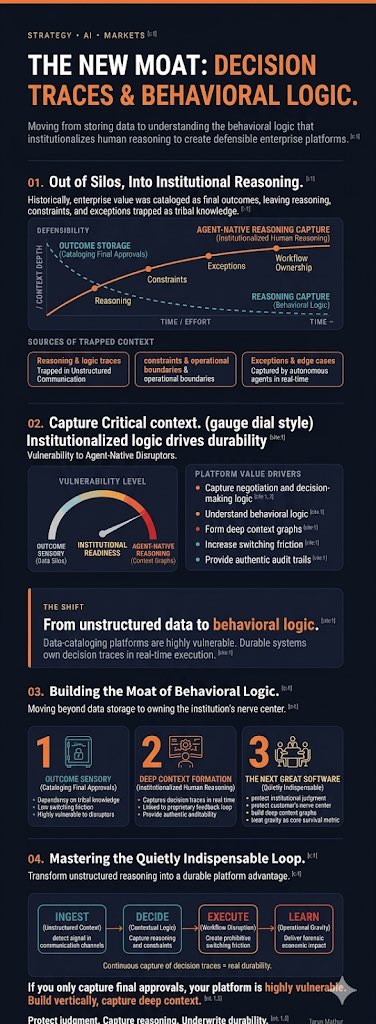
Data matters only when it is continuously translated into better outcomes, better routing, better pricing, or better automation.
Generic training data is increasingly accessible, but task-specific, high-frequency, high-context data tied to actual business workflows is much harder to clone.
Data that doesn’t change behavior is just overhead. Stop treating data as a warehouse problem and start treating it as a decision engine. Design products that generate proprietary learning loops from day one.
#TMinsights
6
Jun 10
If you cannot name your asymmetry in one sentence, you probably do not have one.
#TMinsights
4
Jun 10
“The best product wins” is becoming a weak thesis. In fast-moving AI markets, product superiority can be temporary, while access, integration, and institutional credibility can compound.
That means the most dangerous competitor is often not the technically strongest one, but the one that sits closest to the customer’s operating system.
#TMinsights
4
Jun 10
How often does your AI system learn from outcomes? How strong is your action-to-improvement feedback loop?
Does the product get better because it is used, or is it just cheaper to deploy? Cheap is not a moat.
It will no longer be about algorithmic performance, but more about process gravity and compounding usage.
What gets embedded first usually gets defended longest.
#TMinsights
6
Jun 10
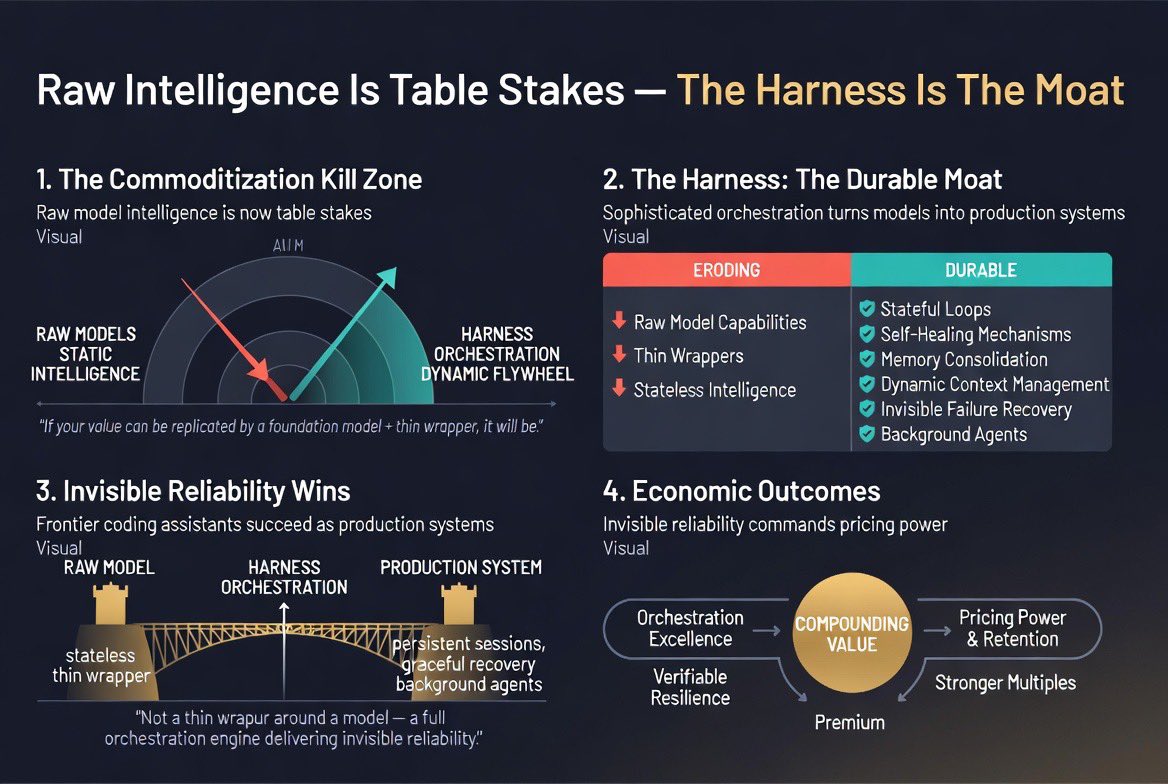
The real power shift is happening above the model layer. As AI becomes cheaper and more accessible, intelligence is turning into a feature, not a category; the scarce asset is the layer that owns the workflow, the user relationship, and the decision loop.
#TMinsights
3
Jun 9
In the past, software won by being the destination. In the next cycle, software wins by becoming the operating system of decisions—routing tasks, enforcing policy, measuring outcomes, and absorbing exceptions.
Own “task chains” instead of isolated features.
#TMinsights
12
Jun 8
Models are converging faster than workflows. If everyone has access to similar base intelligence, advantage accrues to whoever captures the richest interaction graph and turns it into better outcomes.
The smartest companies are not merely collecting data. They are designing environments where each action creates a stronger next action—an operational flywheel, not a dataset.
Founders should think in terms of “permissioned data gravity”: what does the product uniquely see because it is already in the workflow?
If your product gets better every time someone relies on it, you are selling compounding advantage.
#TMinsights
5
Jun 8
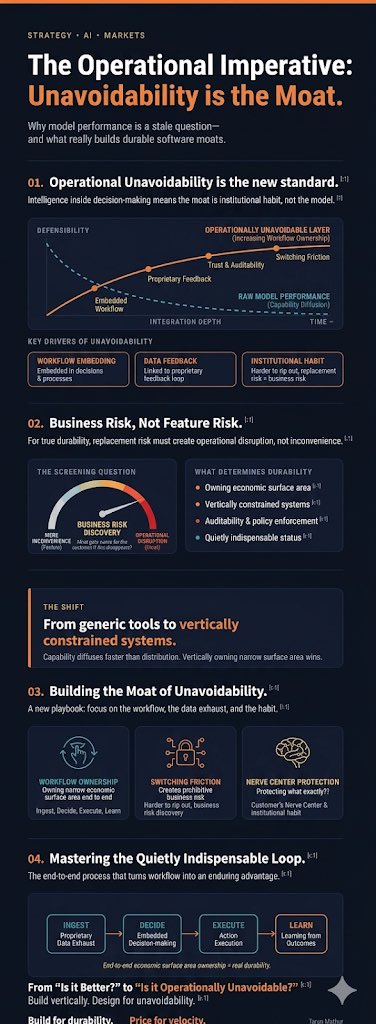
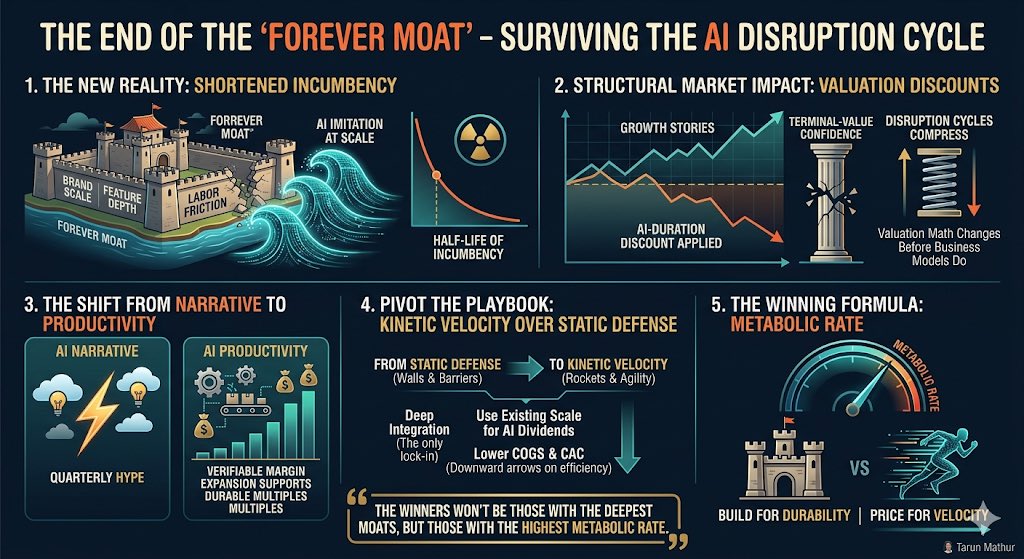
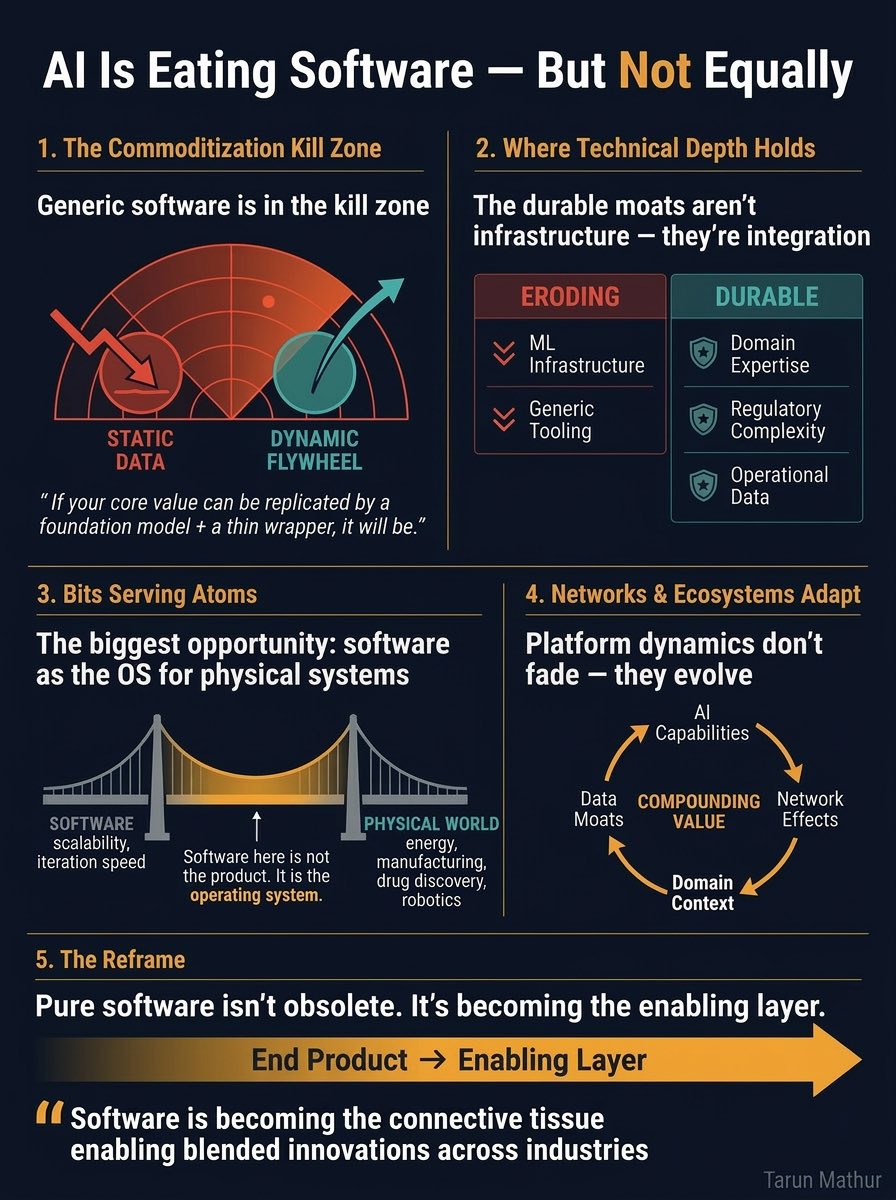
AI lowers the cost of imitation on the surface but raises the bar on execution underneath. Copying a demo is easy. Copying distribution, trust, compliance, domain nuance, and embedded operational data is hard.
Therefore, broad horizontal products will face brutal substitution pressure, while narrow, high-value workflows can still produce concentrated defensibility.
The right move is not to chase every use case. It is to own one workflow end to end, then expand laterally through adjacent tasks that share data, context, and decision rights.
Legacy scale still matters, but scale without adaptation becomes inertia when customers can switch faster and cheaper than ever. The next battlefield is not feature parity. It is operational inevitability.
#TMinsights
11
Jun 8
AI tokenomics is rewriting the pricing logic for software providers by shifting the unit economics of work.
It has become logical to monetize compute, workflow orchestration, auditability, data enrichment, and risk reduction.
Products should be priced around the economic bottleneck they remove.
Monetize criticality, not novelty.
#TMinsights
12