
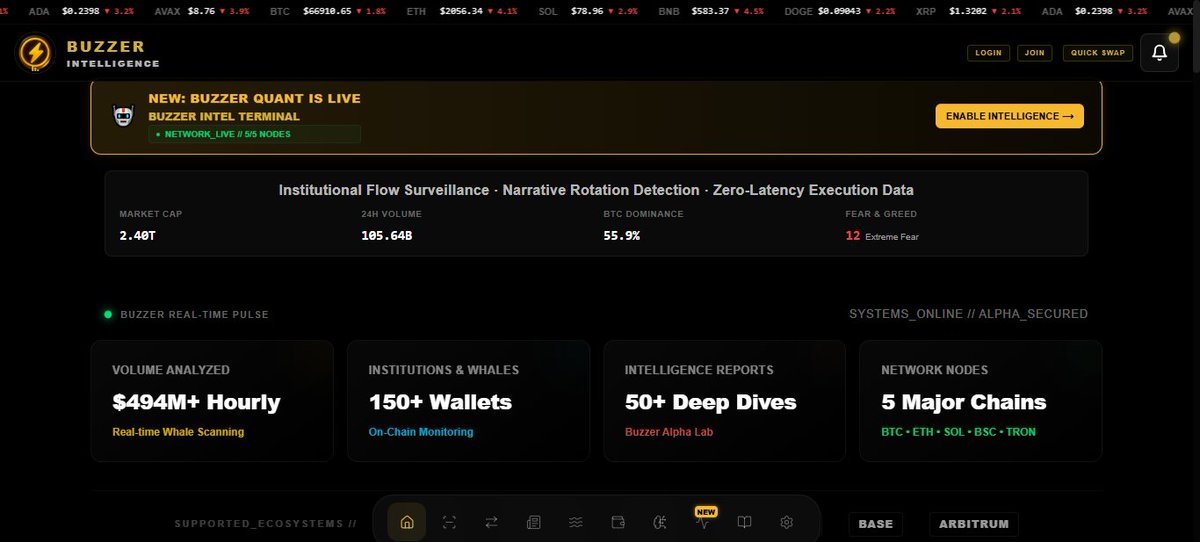
⚡️ The ultimate $CRYPTO $TERMINAL. Democratizing the $INSTITUTIONAL $EDGE. 🐋 $WHALE Watch | 🔄 $NARRATIVE | ⚡️ Quantum $DEX Stop being exit $LIQUIDITY 👇
Joined March 2025
- Tweets 9,371
- Following 103
- Followers 514
- Likes 6,653
2,596 Photos and videos






Pinned Tweet

Most people build trading bots backwards.
They start with:
“when do we enter?”
I’m building BUZZER QUANT from the opposite direction:
“when should we do absolutely nothing?”
That’s the foundation.
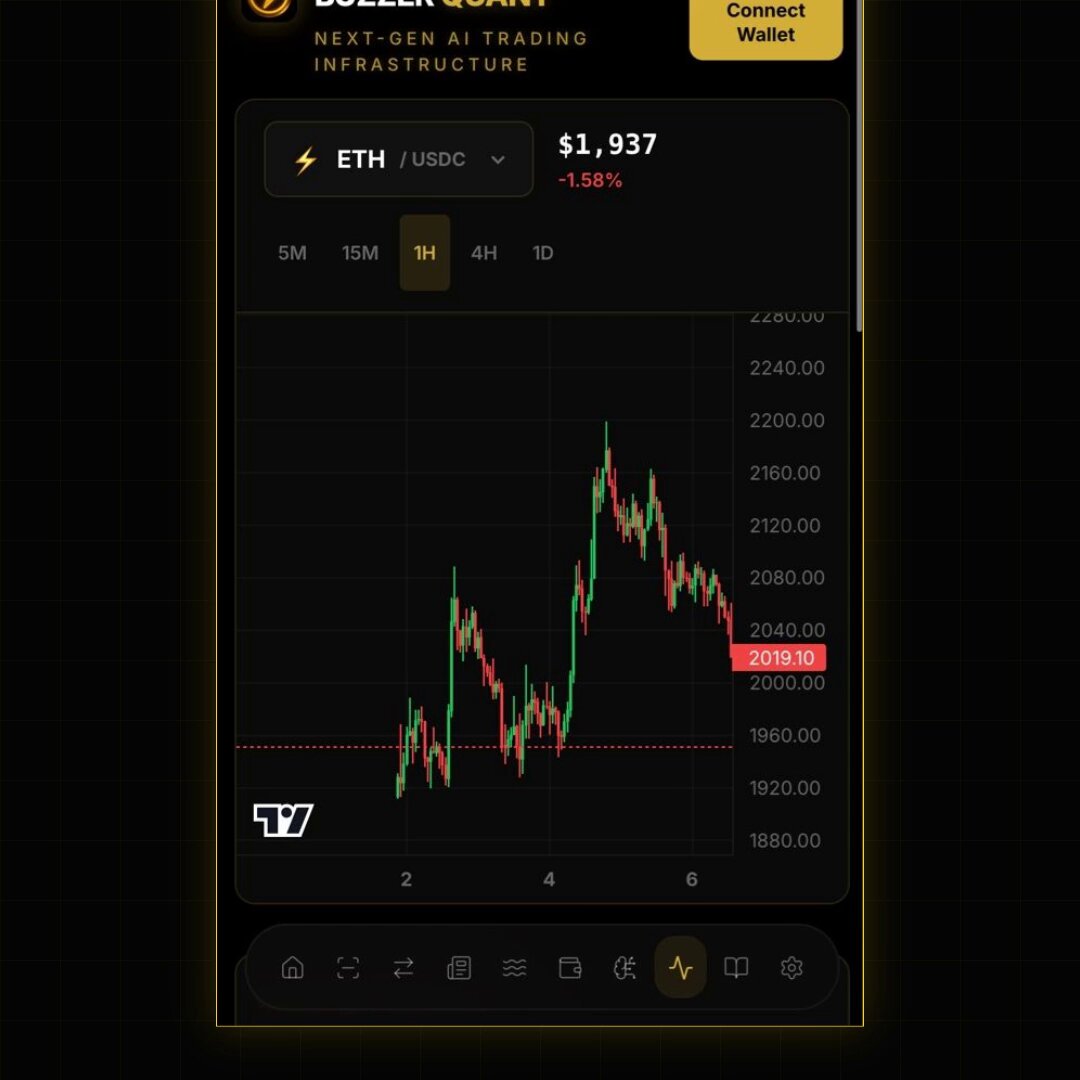
BUZZER QUANT is my automated crypto trading intelligence system.
It’s designed to study the market before it ever thinks about execution.
No live trading.
No real orders.
No auto-apply.
No fake confidence.
Only research, forward testing, and risk filters.
The system studies:
Hyperliquid L2 order book data
spread
depth
imbalance
slippage
market quality
execution quality
fees and costs
candidate ranking
regime shifts
shadow outcomes
And every idea has to survive unseen data.
We tested OHLCV strategies.
Most died.
We tested OKX order book signals.
They did not transfer cleanly to Hyperliquid.
We tested Depth Recovery.
It weakened forward.
We tested Volatility Expansion.
It was unstable.
We tested No-Trade classifiers.
Some looked great retroactively, then failed forward.
We tested Ranking V2.
That was the first serious signal.
It ranked candidates well offline and survived cost adjustment.
But then the 24h forward run exposed the real problem:
the system was finding a favorable market regime, but not ranking the best setups cleanly inside that regime.
So we did not promote it.
That’s the whole point.
A weak model should fail inside research.
Not with real money.
Right now, BUZZER QUANT is collecting 7 days of forward shadow data across BTC, ETH, and SOL.
Just pure evidence collection.
The goal is to answer one question:
Can the system consistently separate high-quality setups from low-quality setups across different market regimes?
If yes, we move to deeper simulation research.
If no, the model goes back to the lab.
This is not a casino button.
This is not “AI prints money.”
This is a trading research engine built to kill bad ideas before they become expensive mistakes.
Execution comes last.
Research first.
Risk first.
Evidence first.
1
1
85
Buzzer Intelligence ⚡ retweeted
A year ago, BUZZER Intelligence was just an idea.
Today, it’s evolving into something much bigger.
Over the past year, we’ve spent thousands of hours building, testing, breaking, rebuilding, analyzing, and improving every layer of the platform.
Not chasing hype.
Not chasing shortcuts.
Building.
We’ve processed hundreds of thousands of market events, developed ranking systems, intelligence engines, research infrastructure, analytics tools, and AI-powered workflows.
Some ideas failed.
Some surprised us.
Every lesson made the platform stronger.
The mission was never to build another crypto dashboard.
The mission is to create a system that helps separate signal from noise in one of the fastest-moving markets in the world.
We’re still early.
Still learning.
Still improving.
But the vision is becoming clearer every day.
BUZZER Intelligence is no longer just a project.
It’s becoming an intelligence ecosystem.
And we’re only getting started.
🚀
#BuildInPublic #Crypto #AI #Fintech #Data #Startups
1
1
33
Buzzer Intelligence ⚡ retweeted
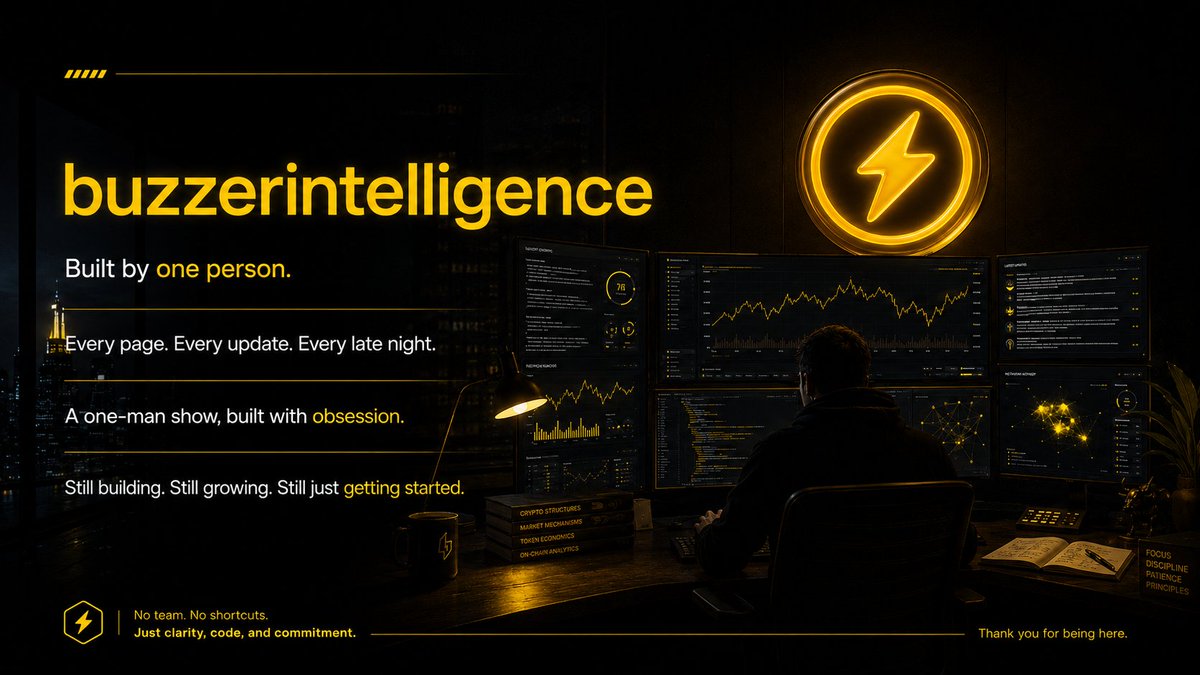
buzzer intelligence is a one-man show.
No big team.
No office.
No investors behind the curtain.
No marketing department.
No “we” pretending to be bigger than it is.
Just one person building, testing, breaking, fixing, learning, and pushing forward every single day.
I started buzzer intelligence because I wanted to build something real in crypto.
Not hype.
Not fake alpha.
Not another dashboard full of noise.
Not another “AI trading bot” pretending to know the future.
I wanted to build a crypto intelligence platform that respects the process:
research before execution,
risk before confidence,
data before opinion,
and truth before marketing.
Some days it feels like everything is moving fast.
Other days I spend hours fixing one bug, one layout, one feed, one button, one line of copy, one small detail nobody may even notice.
A broken news source.
A failed model.
A rejected signal.
A layout that looks wrong on mobile.
A test that passes locally and fails somewhere else.
A strategy that looks good for six hours and breaks in twenty-four.
That’s the real work.
buzzer intelligence is not just a website to me.
It’s a mission.
A platform being built from the ground up:
crypto news,
market intelligence,
research tools,
quant experiments,
risk systems,
signal graveyards,
and dashboards that help people understand the market instead of blindly chasing noise.
It’s not perfect yet.
But every part of it is being built with intention.
Every failed test teaches something.
Every retired signal makes the system stronger.
Every article makes the platform more useful.
Every safety gate protects the vision.
Every small improvement compounds.
The goal is simple:
Help people see the crypto market more clearly.
No fake promises.
No shortcuts.
No pretending.
Just work.
buzzer intelligence is still early.
But it’s alive.
And it’s being built by one person who refuses to quit.
One line of code at a time.
One test at a time.
One article at a time.
One idea at a time.
This is buzzer intelligence.
A one-man crypto intelligence platform in the making.
buzzerintelligence.com
1
58
Buzzer Intelligence ⚡ retweeted
Most people build trading bots backwards.
They start with:
“when do we enter?”
I’m building BUZZER QUANT from the opposite direction:
“when should we do absolutely nothing?”
That’s the foundation.
BUZZER QUANT is my automated crypto trading intelligence system.
It’s designed to study the market before it ever thinks about execution.
No live trading.
No real orders.
No auto-apply.
No fake confidence.
Only research, forward testing, and risk filters.
The system studies:
Hyperliquid L2 order book data
spread
depth
imbalance
slippage
market quality
execution quality
fees and costs
candidate ranking
regime shifts
shadow outcomes
And every idea has to survive unseen data.
We tested OHLCV strategies.
Most died.
We tested OKX order book signals.
They did not transfer cleanly to Hyperliquid.
We tested Depth Recovery.
It weakened forward.
We tested Volatility Expansion.
It was unstable.
We tested No-Trade classifiers.
Some looked great retroactively, then failed forward.
We tested Ranking V2.
That was the first serious signal.
It ranked candidates well offline and survived cost adjustment.
But then the 24h forward run exposed the real problem:
the system was finding a favorable market regime, but not ranking the best setups cleanly inside that regime.
So we did not promote it.
That’s the whole point.
A weak model should fail inside research.
Not with real money.
Right now, BUZZER QUANT is collecting 7 days of forward shadow data across BTC, ETH, and SOL.
Just pure evidence collection.
The goal is to answer one question:
Can the system consistently separate high-quality setups from low-quality setups across different market regimes?
If yes, we move to deeper simulation research.
If no, the model goes back to the lab.
This is not a casino button.
This is not “AI prints money.”
This is a trading research engine built to kill bad ideas before they become expensive mistakes.
Execution comes last.
Research first.
Risk first.
Evidence first.
1
1
85
Most trading bots fail for one reason:
They know how to enter trades.
They don’t know how to manage them.
That’s the problem I’m trying to solve with the automated crypto trading system I’m building.
The goal is not to create another simple bot that buys or sells because one indicator flashed green.
The goal is to build something closer to a professional trading desk.
A system that can read market data, understand conditions, open positions, manage risk, monitor live trades, and most importantly — know when to exit.
Because in trading, the entry is only one part of the game.
The real edge is in management.
When is the setup still valid?
When is momentum fading?
When should the system protect capital?
When should it lock in profit?
When should it cut the trade completely?
And when should it do nothing?
That is where most automated systems break.
So I’m building this in layers:
Data layer — candles, price action, volume, volatility, and market structure.
Strategy layer — setups based on logic, not random signals.
Execution layer — controlled trade entries and exits, with checks before every action.
Risk layer — position sizing, stop loss, take profit, exposure limits, and protection from overtrading.
Monitoring layer — live tracking of open trades, logs, errors, and performance.
Learning layer — reviewing every result so the system can improve over time.
The objective is not to build a bot that wins every trade.
That does not exist.
The objective is to build a system that is consistent, measurable, transparent, and process-driven.
Every decision should be logged.
Every trade should be reviewable.
Every loss should teach something.
Every improvement should feed back into the system.
A basic bot looks for signals.
A serious trading system builds a process.
Right now, the focus is on one of the most important parts: exit logic.
Because profit is not made only by entering correctly.
Profit is made by managing correctly.
A strong system needs to protect itself when the market turns, lock in profit when the trade is working, and avoid turning a good trade into a bad one because of poor exit discipline.
This is not a “get rich quick” bot.
It is infrastructure.
It is data.
It is strategy.
It is risk management.
It is automation.
It is constant optimization.
To me, this is the future of trading:
Less emotion.
Less guessing.
Less impulsive decisions.
More data.
More discipline.
More automation.
More process.
That’s what I’m building with Buzzer Intelligence.
An automated trading system designed to behave less like a simple bot — and more like a professional trader.
$Crypto $Trading $Automation $Quant $AI $BuzzerIntelligence
72
Prediction markets are changing how we read the world.
Instead of only watching headlines, I’m watching live probabilities, crowd sentiment, and how narratives move in real time.
Polymarket is one of the most interesting places to study that shift — not as hype, but as a new layer of market intelligence.
buzzerintelligence.com/blog/…
$PredictionMarkets $Polymarket $Crypto $BuzzerIntelligence
1
30
It started with the terminal. ⚡️
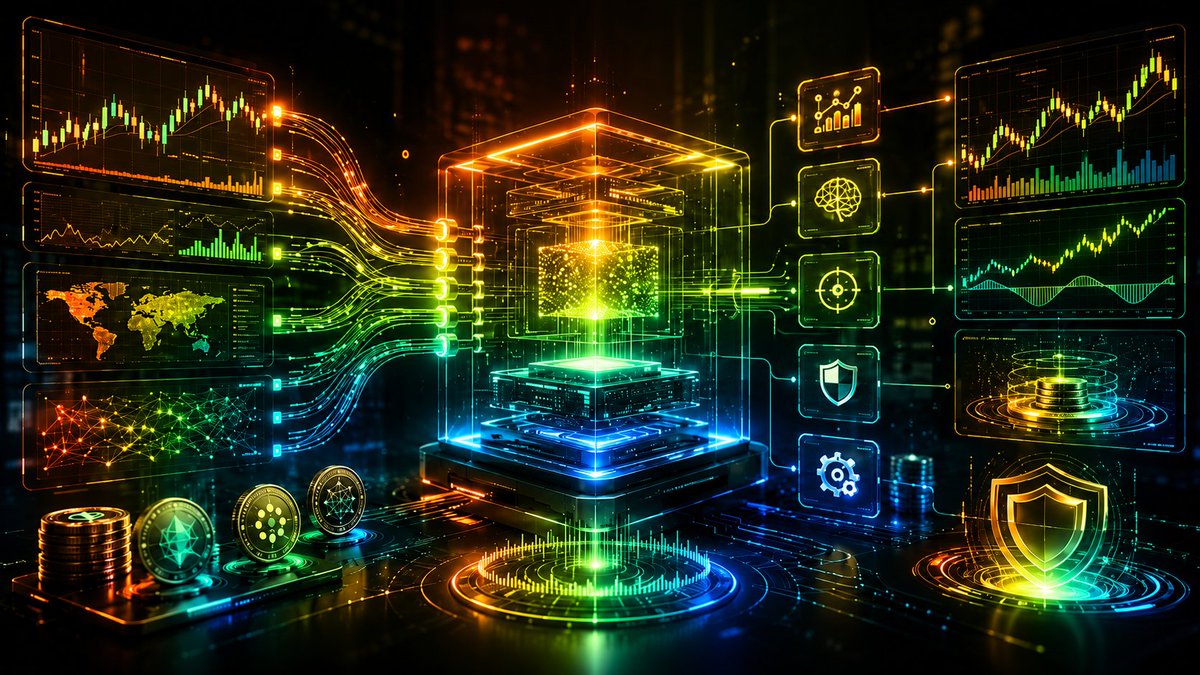
We built the ultimate edge for precision crypto execution. But the vision was always bigger. Buzzer is evolving beyond the trade into a complete, enterprise-grade AI $ecosystem.
From autonomous quantitative trading to scalable voice bots, custom automated flows, and real-time data infrastructures. $Scalable. $Secure. $Autonomous.
Discover the new era of $AI. 👇 🔗 buzzerintelligence.com
1
1
89
Buzzer Intelligence ⚡ retweeted
1
62
Buzzer Intelligence ⚡ retweeted
1
49
Buzzer Intelligence ⚡ retweeted
1
46
Still playing by their rules? Then you are the exit $liquidity. 📉
Stop $guessing and start knowing. While retail trades on emotion and lags behind the charts, the 1% are deploying autonomous $AI agents to execute with cold, mathematical precision.
Enable your AI Power Agent. Automate your edge. Secure your $institutional unfair advantage.
Start for free today. 👇
🔗 buzzerintelligence.com
96
How to Track Crypto Whale Wallets in 2026 — A Step-by-Step Guide — Buzzer Intelligence buzzerintelligence.com/blog/…
34
Buzzer Intelligence ⚡ retweeted
1
43
Buzzer Intelligence ⚡ retweeted
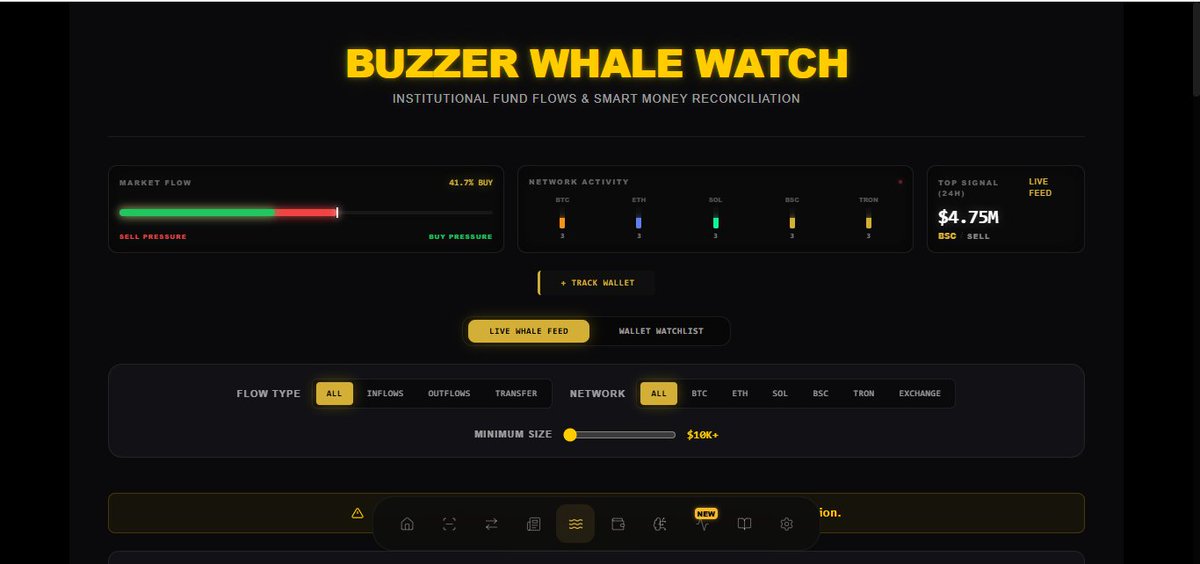
BUZZER WHALE $WATCH is live. 🐋⚡️
While $retail is trying to make sense of a 1-minute candle, the 1% are tracking $institutional fund flows in real-time.
Notice that $4.75M sell signal on $BSC? Our terminal flagged it before the timeline even noticed.
Monitor live buy/sell pressure, filter by network, and track specific whale wallets. Stop trading blind and start mapping the invisible liquidity. 👇
🔗 buzzerintelligence.com
1
67
Buzzer Intelligence ⚡ retweeted
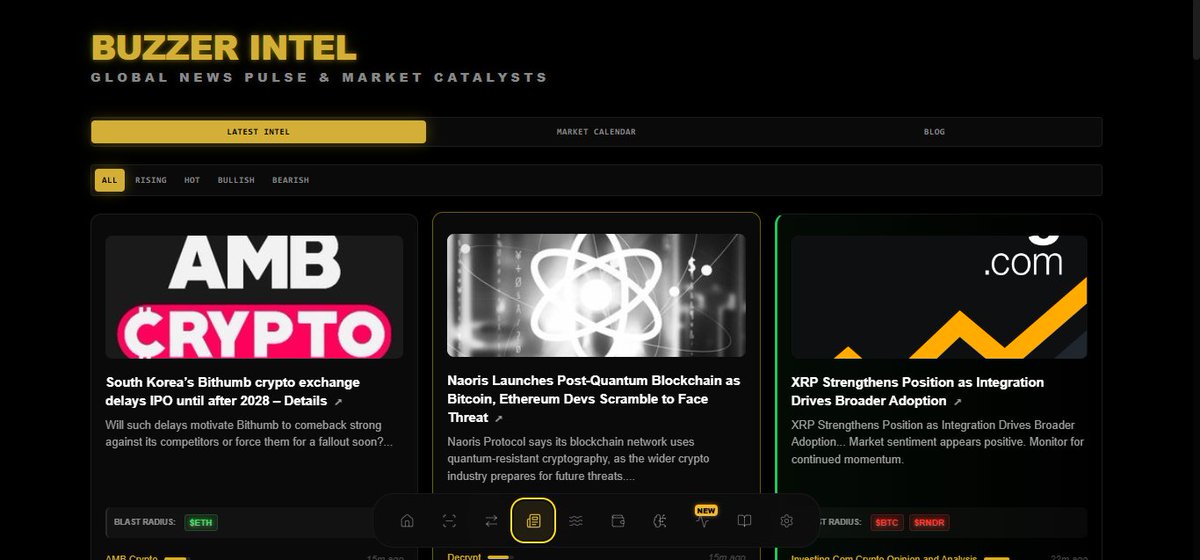
BUZZER $INTEL is officially live. ⚡️
If you are waiting for the X timeline to feed you market catalysts, you are already exit $liquidity.
The 1% don't just read the news; they trade the "Blast Radius." Our Global $News Pulse aggregates the market, filters the noise by sentiment, and pinpoints exactly which tokens will take the hit or catch the pump before the charts even react.
Stop trading yesterday's news. Secure your edge. 👇
🔗 buzzerintelligence.com
1
103
Buzzer Intelligence ⚡ retweeted
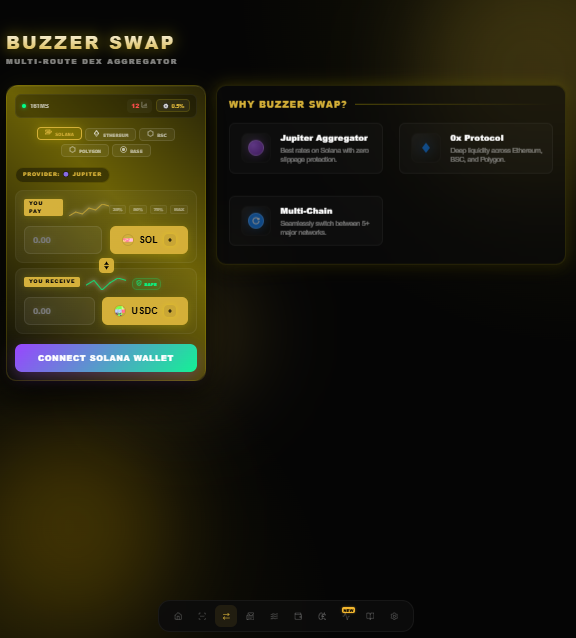
BUZZER $SWAP is officially live. ⚡️
Retail traders are still getting drained by $MEV bots, front-runners, and terrible slippage. The 1% don't just trade; they $optimize execution.
Enter our Multi-Route $DEX Aggregator. We integrated $Jupiter and 0x Protocol directly into your command center. Secure the deepest liquidity and zero-slippage protection across $Solana, $Ethereum, $Base, $BSC, and Polygon without ever leaving the terminal.
Stop bleeding alpha on bad execution. Swap like an institution. 👇
🔗 buzzerintelligence.com
1
76
Buzzer Intelligence ⚡ retweeted
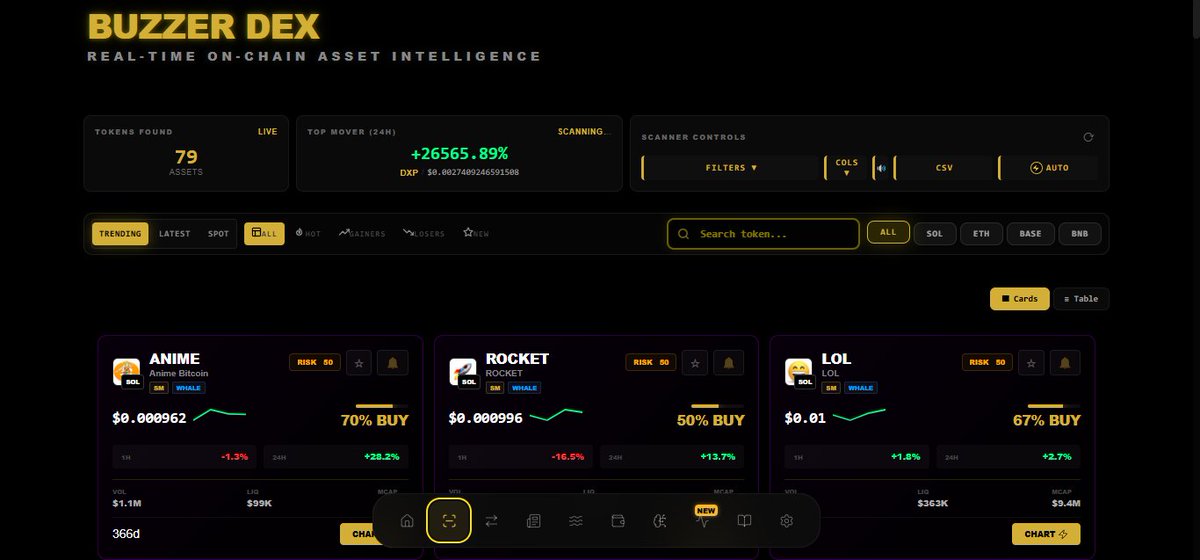
BUZZER $DEX is officially live. ⚡️
Retail buys the top of the Telegram call. The 1% catch the rotation at inception.
Welcome to $Real-Time On-Chain Asset $Intelligence. Scan the trenches across $Solana, $Ethereum, $Base, and $BSC in milliseconds. Our terminal tracks live buy pressure, flags 'Smart Money' and 'Whale' accumulation, and isolates the outliers before the timeline even catches the scent. (Notice that 26,500% top mover?)
Stop playing $PvP blindfolded. Find the alpha first. 👇
🔗 buzzerintelligence.com
1
102