
Commodities Strategist @ Physical Commodity Trader | Energy, Metals & Minerals, Ag & Ag Inputs | Basis, Curves, Freight, Flows | Views my own
Joined December 2019
- Tweets 32
- Following 0
- Followers 9
- Likes 1
14 Photos and videos
Pinned Tweet

Most commodity research is financial: charts, positioning, sentiment.
The Physical View reads them through cost curves, basis, forward curves, spreads, freight, quality differentials, and flows.
Different signal. Usually leading.
This account writes that view. 🧵
1
45
The Hormuz blockade is lifting and the strait goes toll-free, so the tanker war-risk premium finally starts to come off. Slowly though. ADNOC sees full flows only by 2027, the threat board still reads severe, Iran keeps charging tolls. Forward rates lower, not collapsing.
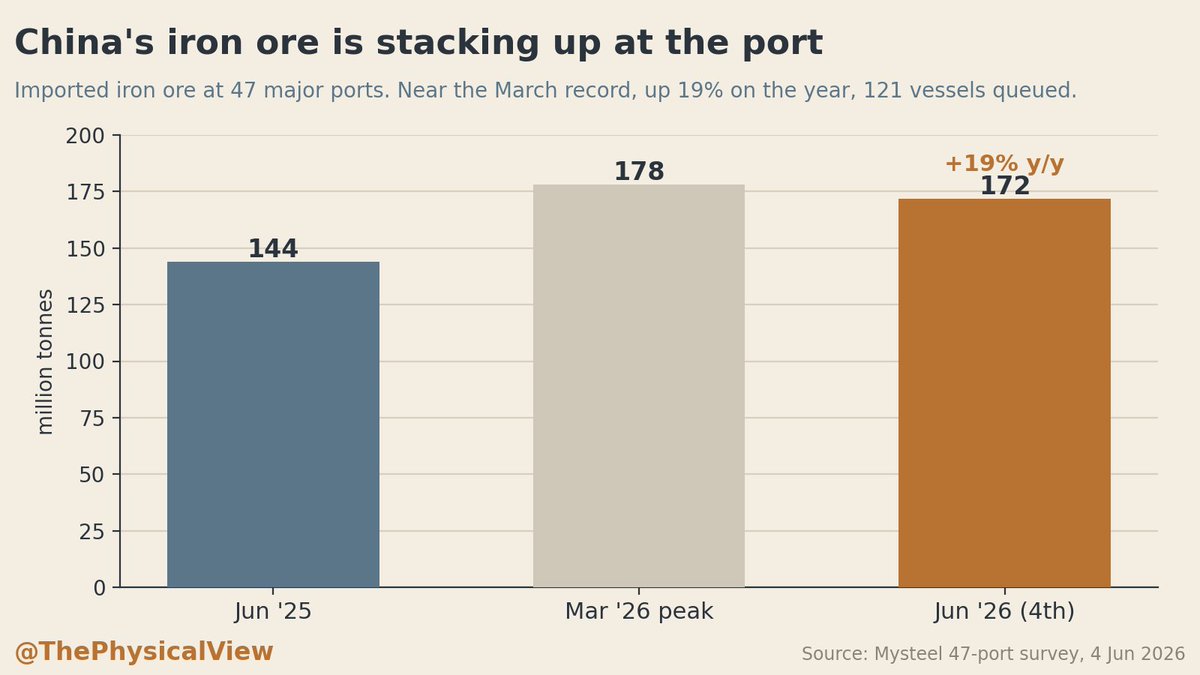
Dry freight has the opposite problem, and the deal does nothing for it. The Baltic dry index sank to 2,720 Monday, a five-week low, off its 2.5-year high of 3,227. The driver is China sitting on a near-record ore pile and drawing from it instead of chartering fresh cargoes, the summer lull on top. A peace deal in the Gulf doesn't put a single capesize back to work.
Two freight markets sitting heavy for opposite reasons. The wet one deflates as the war-risk drains over the coming months. The dry one stays down because mills are working off the pile, not the berth, and no Gulf deal changes that. When they meet it's the tanker grinding down to the cape, not the cape climbing to the tanker. Watch the freight.
27
Monday morning and wake up to a Deal announced, as was widely expected. Signing on Friday, blockade lifted, strait "reopens." Brent's sub-$80 this morning, from the mid-$80s Friday.
The screen's trading a signature. Barrels don't move on a signature.
Signing is Friday, not today. Then 60 days of talks. Then someone clears the mines out of Hormuz, restarts the idled fields, repairs the hit facilities, re-rates war risk on every hull. None of that is a press release. And Israel's already striking Lebanon before the ink's dry. April's ceasefire broke too.
So oil's selling off on the reopen, fair enough. But cheaper oil here doesn't mean safer oil. Going from "deal announced" to crude actually transiting a de-mined strait" is weeks, and plenty can break along the way.
Watch the cargo, not the headline. If Brent-Dubai EFS and prompt sour stay bid while flat price bleeds, the cargo market hasn't bought the deal yet.
A sharp move back up isn't off the table. Right now nobody's paying up for that risk. Signing a deal and actually opening the strait are two very different things. #oott
20
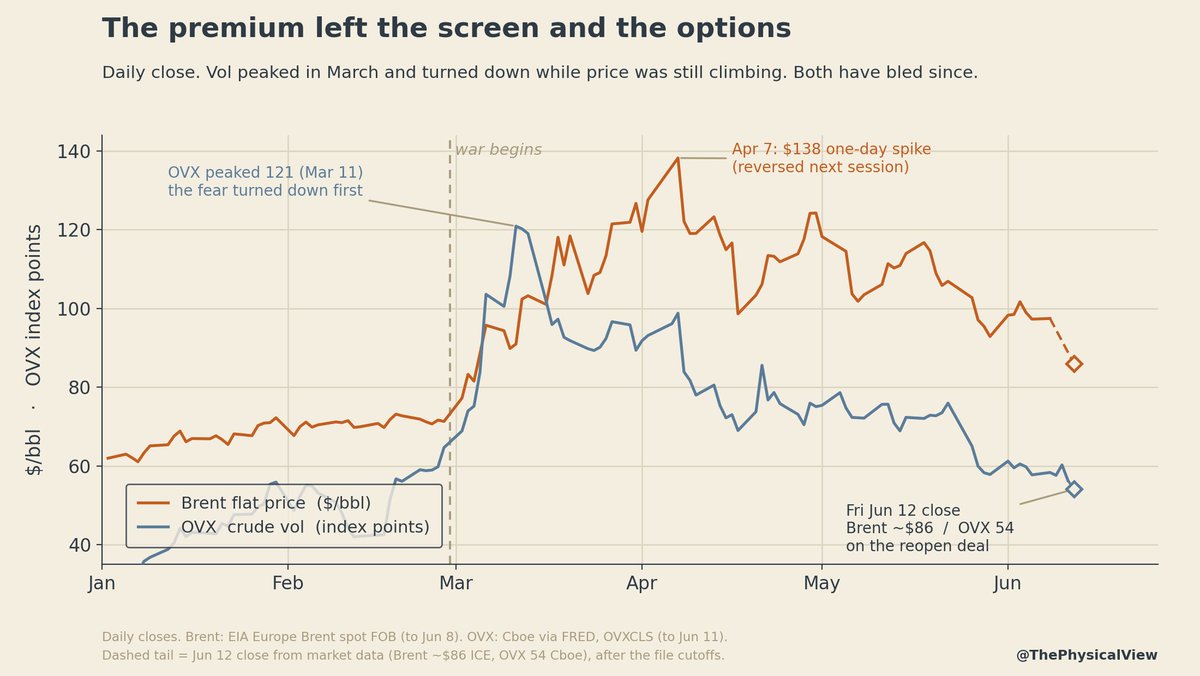
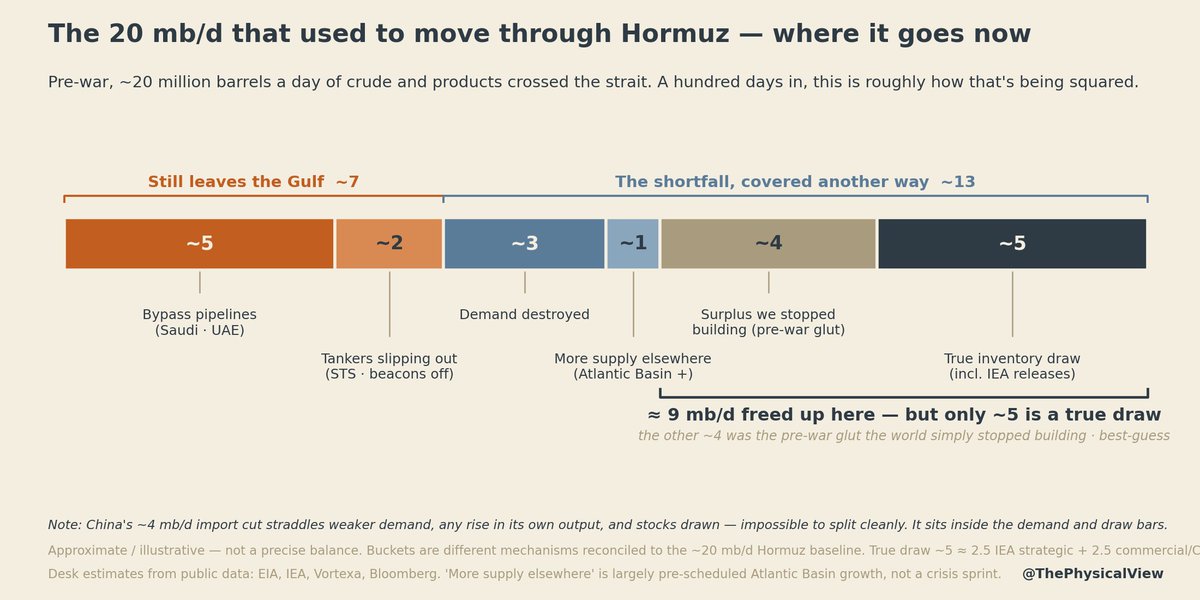
(1/10) Largest oil supply shock on record. A hundred days in, Brent is near $85 and fell 5% Friday on a draft deal to reopen Hormuz.
Two serious camps read this completely differently. One says fade it. One says the spike is still coming.
Both deserve a fair hearing. Then I will tell you where I land.
Weekend 🧵 #oott
1
57
(9/10) My call. 60/40 the balance desks. The deal lands, the glut returns, prices grind lower into 2027.
But notice what just happened. The whole market has leaned one way, into a signing that can still fail. The upside protection got sold. So the cheapest risk in oil right now is a broken deal, and almost nobody is paid for it.
If the skew re-inverts, that is the deal wobbling, and you will see it there before the screen.
1
6
(10/10) Net. The shortage is real, the cushion is real, and the screen is calm because both are true at once.
You can print money. You cannot print molecules. But you also cannot fight a strait that reopens.
So it comes down to a race between the reopen and the cushion. Trade that race, not the headline. And watch the skew, not the screen. #oott
6
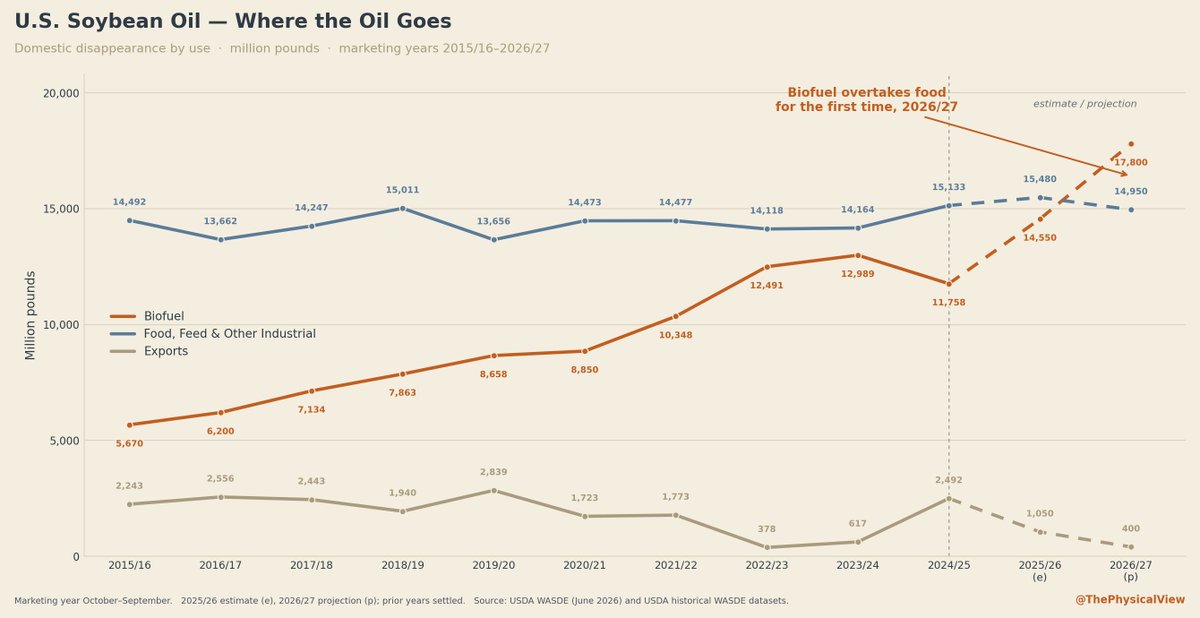
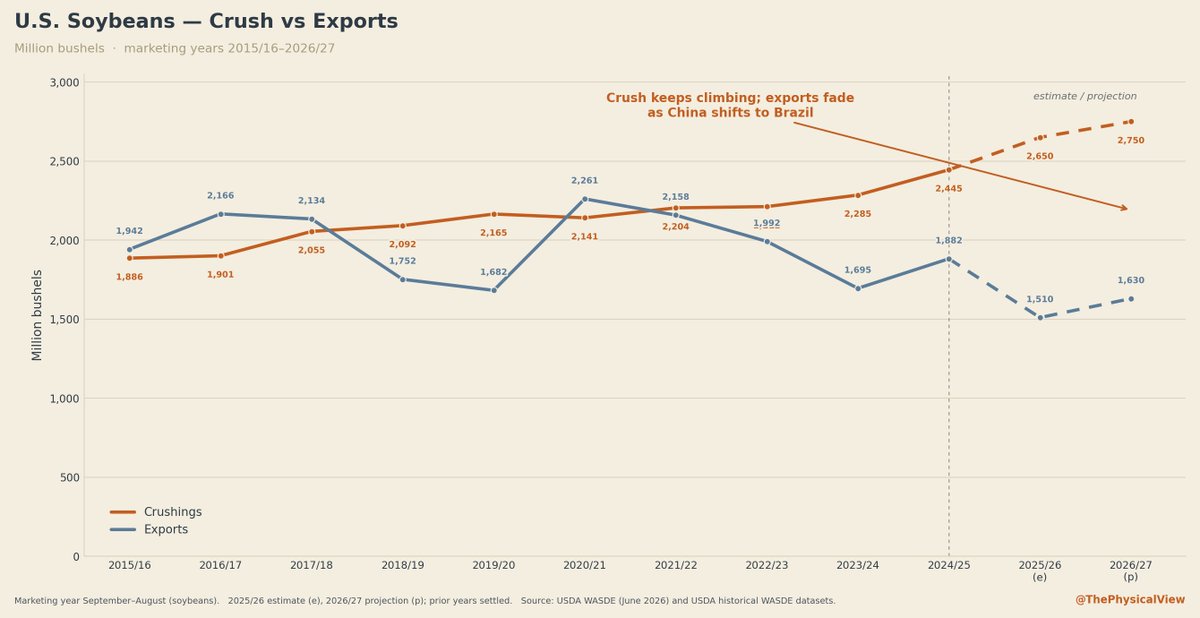
Buried in the recent USDA WASDE report, one line almost nobody pulled out: for the first time, more US soybean oil is going to the diesel tank than to food. The soybean has quietly become an energy crop. But that's only one panel of a bigger picture. The whole bean is being rewired by policy.
Beans down, oil home, meal out.
A thread on what's actually happening to the US soybean complex. 🧵
1
29
Oil home.
Why is the US crushing this hard? For the oil. Renewable diesel mandates under the EPA's Renewable Fuel Standard set the volume, and the 45Z tax credit only rewards fuel made from North American feedstock, which shut imported Chinese used cooking oil and Brazilian / Australian tallow out of the pool. That mandated demand lands on domestic soybean oil. The result: 17.8bn lbs of it going to biofuel, now larger than all food, feed and industrial use combined, with oil exports cut to a record low near 400m lbs. The oil stays home and goes into the fuel tank.
1
37
Meal out.
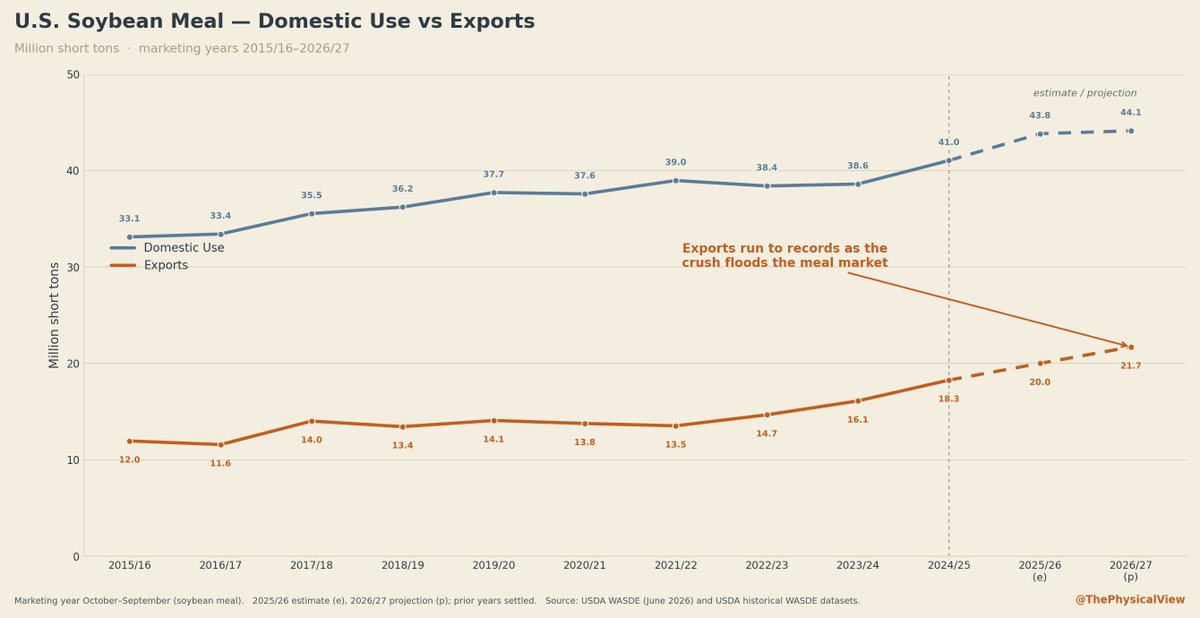
Here's the catch in the chain. Crush a record pile of beans for their oil and you produce a wall of meal as the byproduct, far more than US livestock can eat. So it has to leave. Soybean meal exports are running to records, around 21.7m short tons and climbing, up from roughly 12m a decade ago, pushed straight into Argentina and Brazil's backyard.
So the complex now keeps the oil home for diesel, ships the surplus meal abroad, and sells fewer whole beans. Beans down, oil home, meal out. The US soybean changed jobs. #soybeans #oatt
20
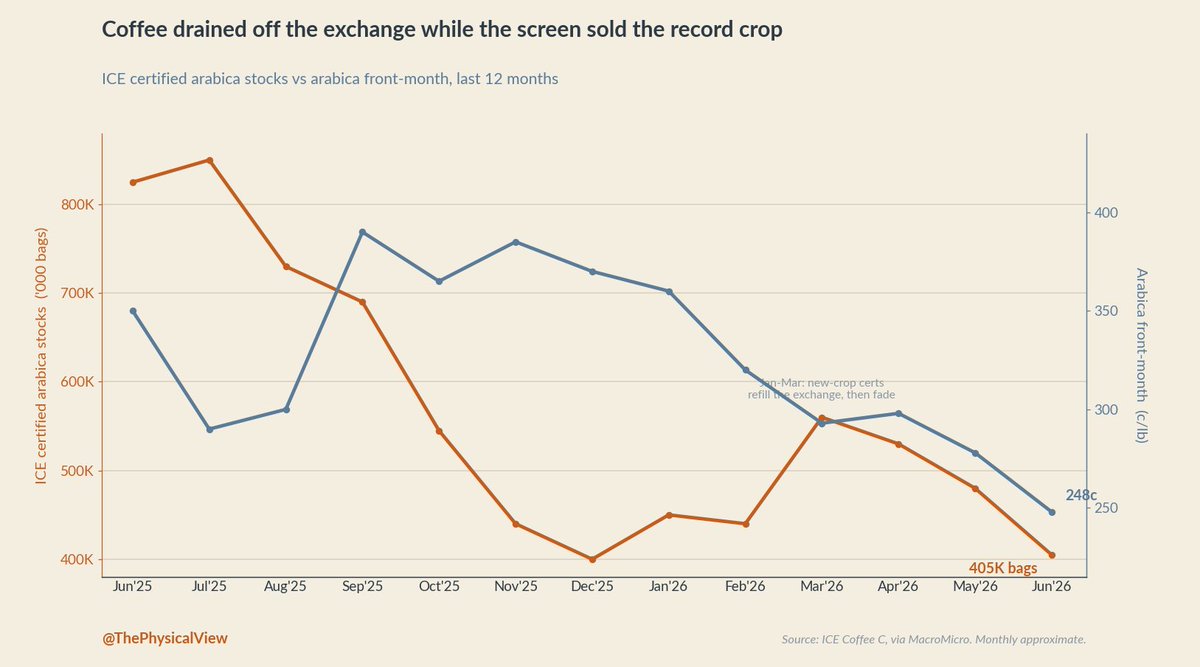
Coffee's down about 30% over the past year. The story everyone repeats: Brazil has a record crop coming, so sell it.
Two problems with selling it today.
One, the crop is barely a quarter picked. 23% done by June 2, slower than last year's 28%. The beans people are short aren't in a warehouse yet.
Two, there's less coffee around right now than the price suggests. Exchange stocks are down to about 412,000 bags, the lowest in roughly two years, and still falling. And buyers are paying more for coffee today than for coffee three months out. That's a shortage signal, not a glut.
The record crop is real. It's also months from being picked, dried, graded and shipped. You can be right on the year and still get squeezed this month.
Trade the calendar, not the headline price.
10