Joined May 2016
- Tweets 34,461
- Following 2,875
- Followers 2,122
- Likes 34,837
1,258 Photos and videos




David R retweeted

23h
Trading vs. Holding: A Tale of Two Friends
I went to a party last weekend and had a deep conversation with two old friends.
Roughly the same age, education, and ambition.
Completely different outcomes.
Mark (not real name) was always trading.
Stocks. Real estate. Crypto. Oil. Options. Private deals.
Whatever was moving, Mark wanted in.
Every time I saw him, he had a new angle, a new thesis, a new story.
And the stories were great.
Mark had endless stories: the condo he flipped, the stock he nailed, the crypto he sold near the top, the private deal that almost changed everything.
Then there was John (not real name).
Quiet. Calm.
Same wife. Same house. Same business. Same strategy.
Buy good assets.
Hold them.
Improve them.
Let time work.
Mark was chasing everything.
John was compounding several high quality assets.
At dinner, someone asked:
“So who actually did better?”
Mark smiled:
“I made a lot of money.”
John smiled:
“I kept mine.”
That was the lesson.
Listen to the tense.
Mark’s wealth was always somewhere else.
A story from the past.
A thesis about the future.
Never in the present.
Never in the account.
John’s wealth was just there.
Boring. Permanent. Real.
Trading gives you stories.
Holding the right assets gives you wealth.
The dinner table rewards the exact behavior that destroys net worth.
Mark was rich in narrative.
John was rich in net worth.
Only one compounds.
Because compounding has one requirement:
You have to stay.
Every switch resets the clock.
Mark had been at year one of something his entire life.
John was at year twenty of one thing.
That is the whole game.
Then I saw it everywhere.
Mark traded houses, stocks, businesses, and, sadly, relationships too.
Eventually, how you do money becomes how you do life.
Mark was always comparing, optimizing, and convinced the next move would fix the last one.
He was not a bad guy.
He was just running one algorithm on everything:
“The next one will be better.”
But every trade is a small divorce from where you already are.
Do it enough times and nothing has time to grow not your portfolio, marriage, reputation, or self.
John understood something quieter:
The best things in life are not meant to be flipped.
Great businesses, marriages, reputations, assets, and lives are protected.
The real money was never in switching.
It was in holding the right thing long enough for compounding to become unfair.
Activity feels smart.
Patience looks boring.
But over decades, boring buries brilliant.
The richest guy in the room is rarely the one with the best stories.
It is usually the one who stopped selling his best asset.
Which is exactly why $BTC is so hard.
The hard part was never buying it.
The hard part is becoming the kind of person who can hold it long enough for the thesis to play out.
Lesson:
Own the right asset(s).
Hold it long enough.
Let time do the compounding.
Your job is really not to interrupt the compounding.

7
8
75
2,114
David R retweeted

Jun 13
Coinbase CEO Brian Anderson has heavily invested into New Limit (newlimit.com).
David Sinclair's (Harvard anti-aging researcher) biggest venture is Life Biosciences (lifebiosciences.com).
Both of these are using AI to reiterate in the design of models investigating the deployment of Yamanaka factors for human longevity.
Sinclair's lab is now conducting the first clinical trial in humans (ER-100). They are confident it will work (based on animal models).
"Partial Epigenetic Reprogramming" makes cells revert to their youthful state (reverses aging).
Search Yamanaka factors in AI..
1
92
David R retweeted
Jun 10
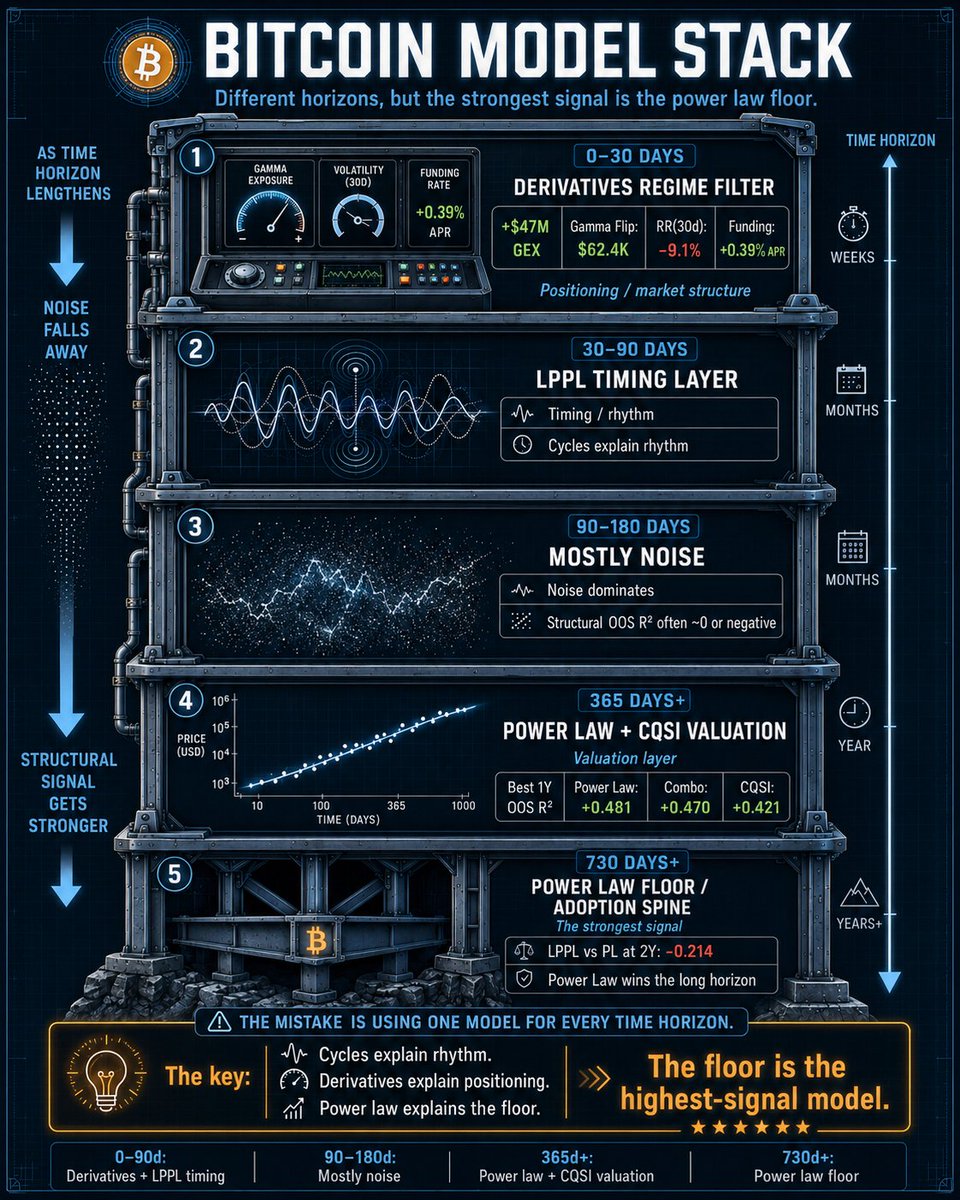
Bitcoin’s Model Stack: Different Horizons, but the Strongest Signal Is the Power Law Floor
The mistake is using one model for every time horizon.
0–90d:
Derivatives LPPL timing
90–180d:
Mostly noise
365d :
Power law Cycle Quality Signal Index (CQSI) valuation
730d :
Power law floor
Key:
Cycles explain rhythm.
Derivatives explain positioning.
CQSI explains valuation compression.
Power law explains the floor, R^2 ~99.5%
The floor is the highest-signal model.
3
5
43
2,344
David R retweeted
Jun 7
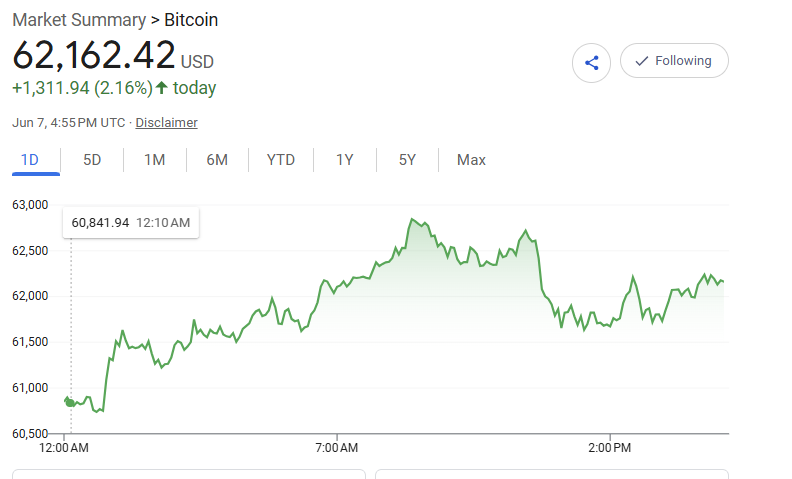
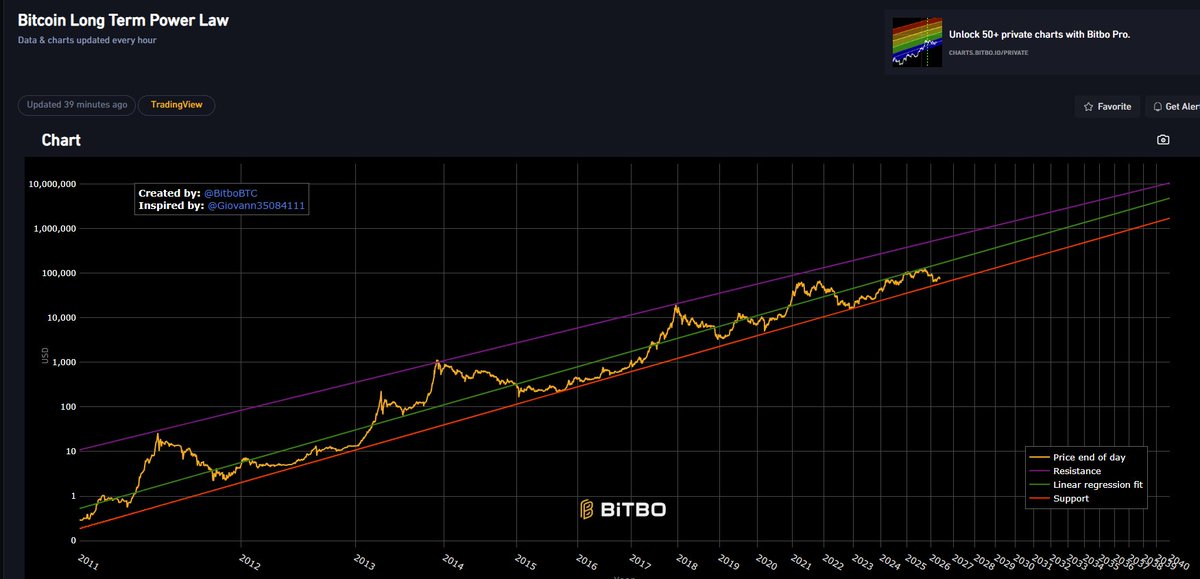
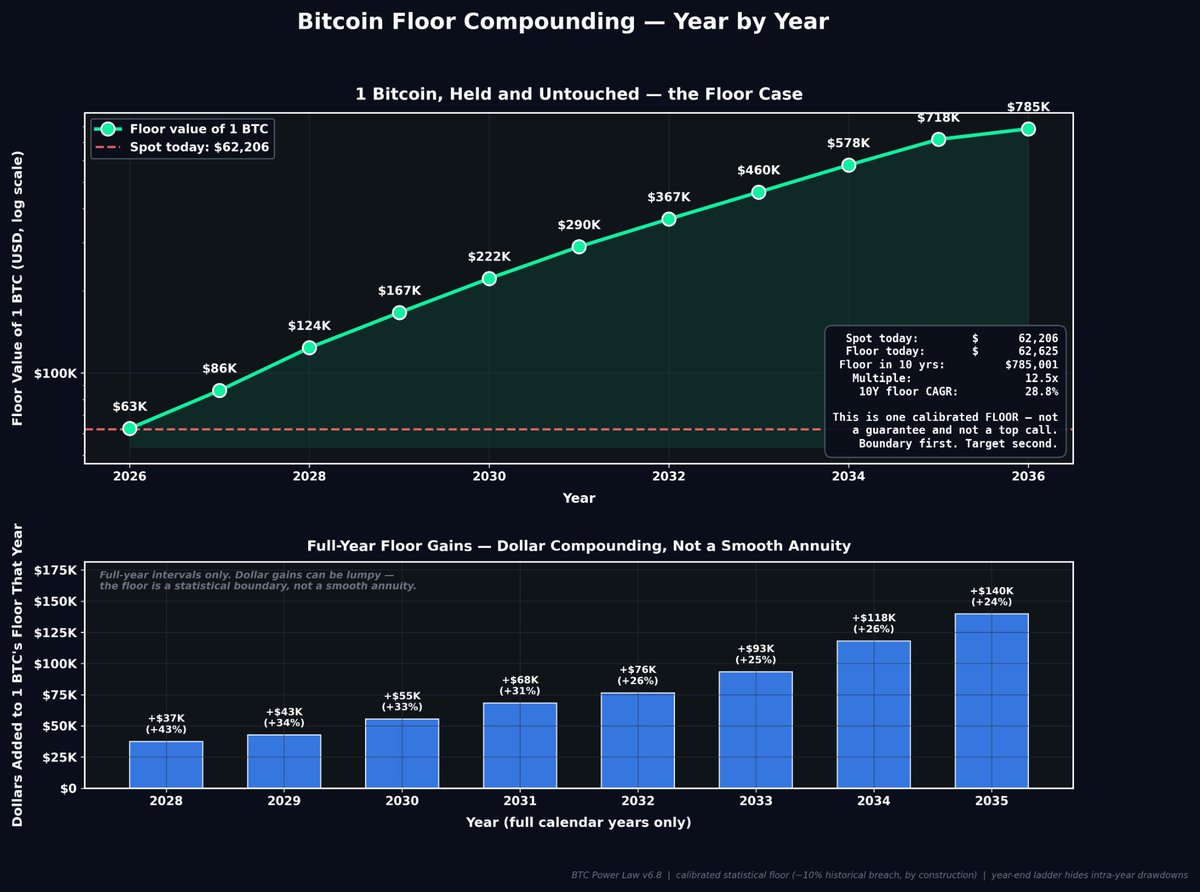
Bitcoin’s floor is compounding while people argue about the bottom.
Spot: $62.2K
P-10 floor today: $62.6K
10-year floor: $785K
12.5x / 28.8% CAGR
This chart shows the only thing that matters:
Downside stress today
vs.
long-term floor compounding.
8
38
249
24,484
David R retweeted
Jun 6
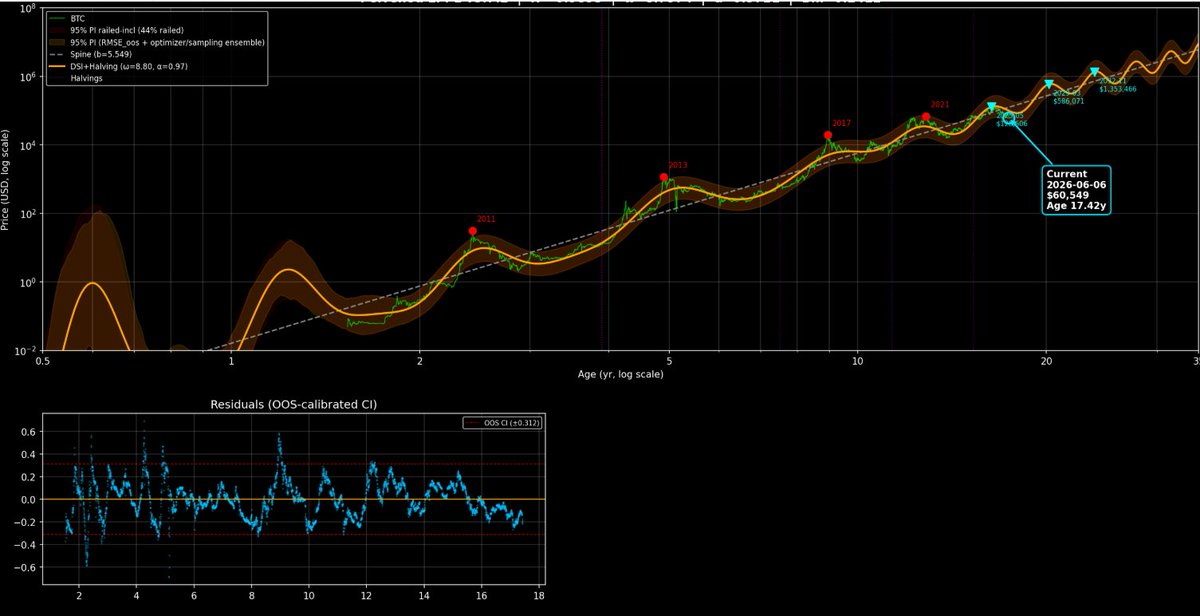
Bitcoin is not dropping because the adoption trend broke.
That interpretation is wrong.
The model decomposes BTC into layers:
Adoption power-law spine: ~$125K
LPPL model value: ~$99K
Spot: ~$60.5K
The long-term trend is still rising.
The cycle layer is weak, but not broken.
The real hit is the residual / macro state.
Residual multiplier: ~0.61×
That means BTC is trading at only ~61% of its cycle-adjusted model value.
The structure says higher.
The timing says weak.
The residual says stress.
That is why price is bleeding.
This is not adoption failure.
It is a liquidity / macro / residual discount sitting on top of cycle pressure.
The power law explains the trend.
LPPL explains the timing.
The residual explains the gap.
Graph below:
The power-law trend is not collapsing.
The gap between price and trend is widening.
Going Forward:
The longer price stays below the rising trend without the trend breaking, the more the setup shifts from trend failure to stored $100K to $130K mean-reversion energy.
13
15
109
5,136
David R retweeted

Jun 6
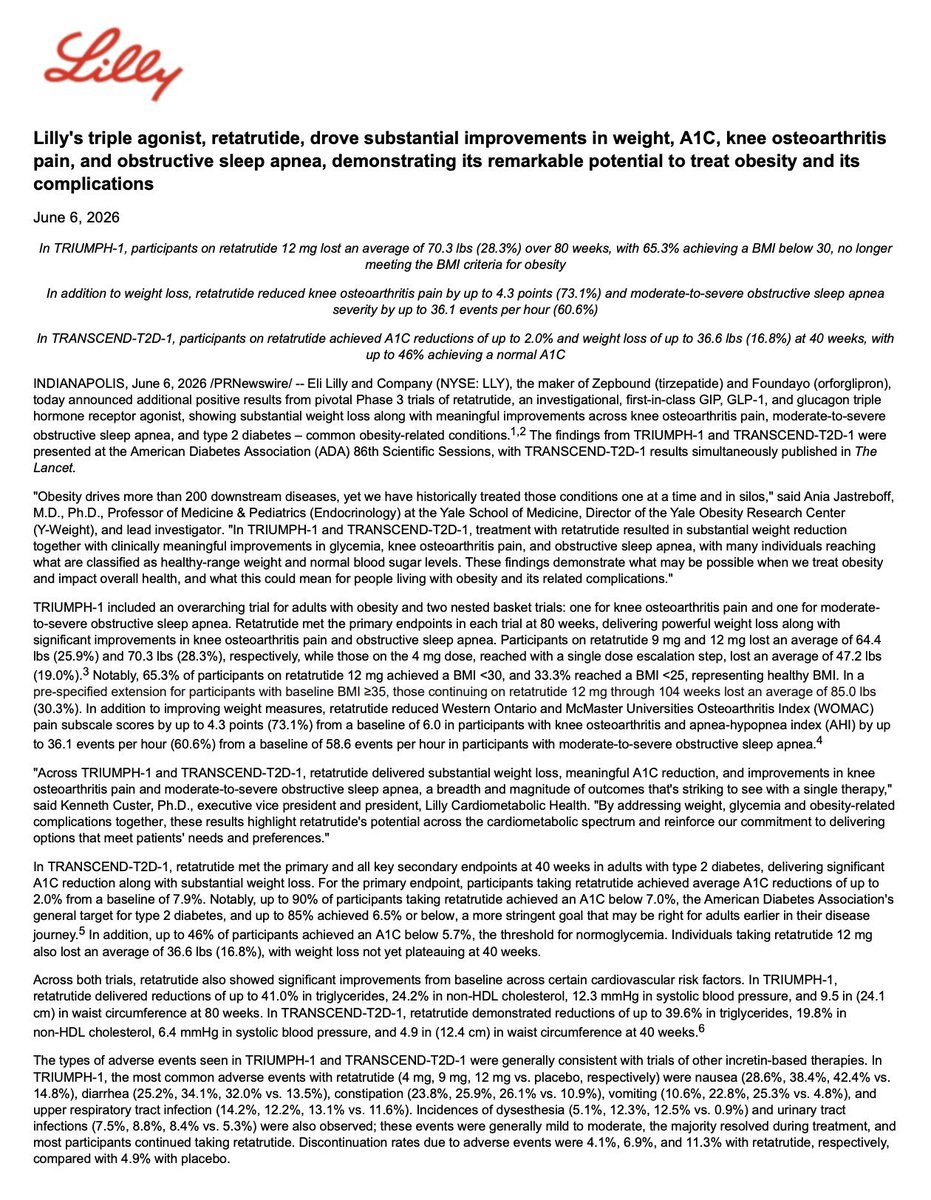
Retatrutide additional phase 3 results are out, and the data keeps getting better:
- 28.3% bodyweight lost on 12mg over 80 weeks (70.3 lbs)
- 30.3% at 104 weeks in higher-BMI patients (85 lbs)
- 65.3% dropped below the obesity BMI threshold
- Knee osteoarthritis pain reduced by up to 75.8% (1 in 8 patients are fully pain-free)
- Obstructive sleep apnea significantly improved
- Major drops in triglycerides (41%), non-HDL cholesterol (24.2%), and blood pressure
- A1C fell up to 2.0% and weight down 16.8% in diabetic patients, in just 40 weeks
For those that are unfamiliar, retatrutide now has Phase 3 data showing it reaches well beyond weight loss.
It directly treats the complications that have historically required entirely separate medications.
This is becoming a new category of medicine, and the data is only getting stronger.
35
96
909
90,956
David R retweeted

Jun 5
1,067
1,503
8,402
1,778,702
David R retweeted
May 30
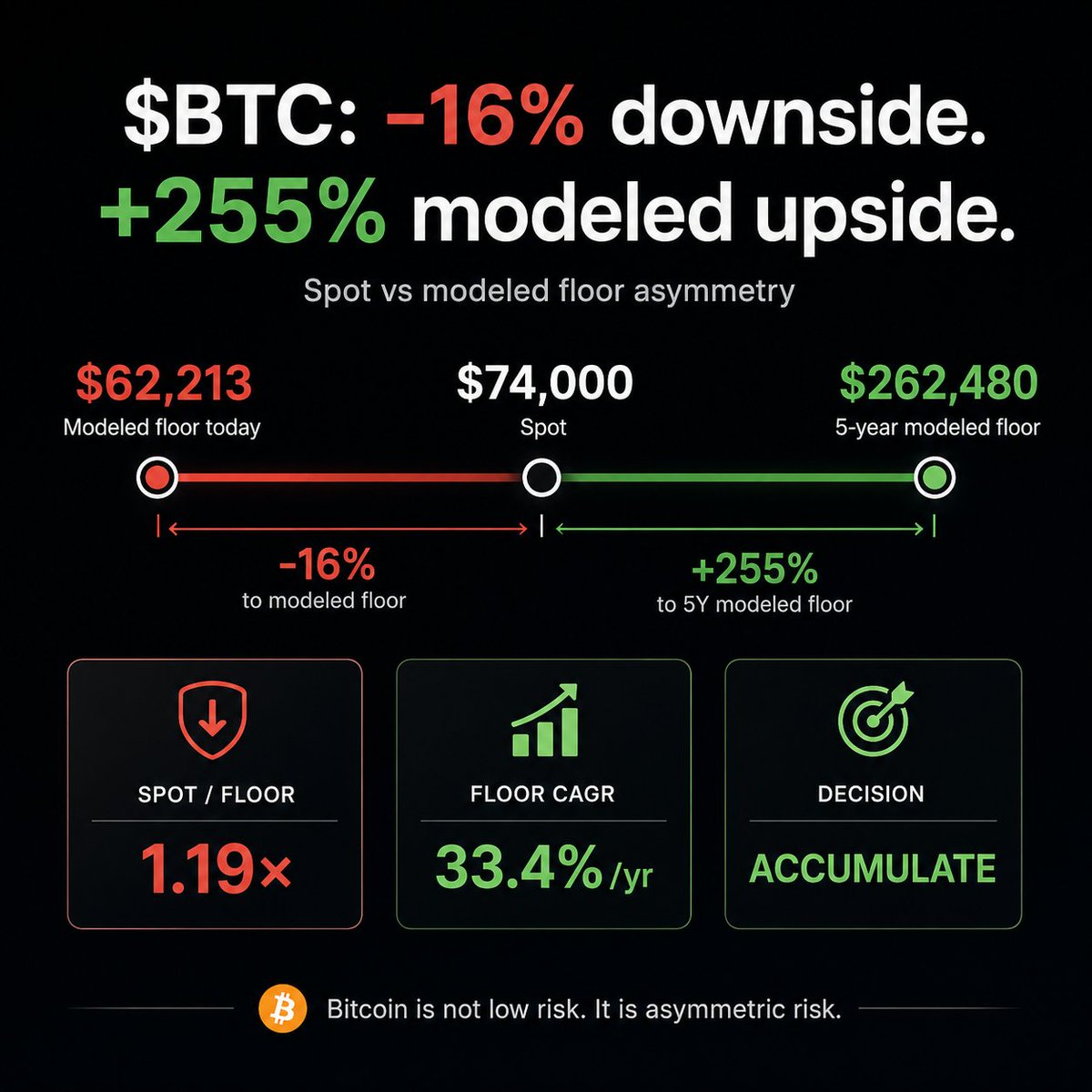
$BTC: -16% downside. 255% modeled upside.
Spot: $74K
Modeled floor: $62K
5-year modeled floor: $262K
Downside to floor: -16%
Upside to 5Y floor: 255%
Spot/floor: 1.19×
Floor CAGR: ~33%/yr
Decision: accumulate
Why?
Because the model is not pricing “low risk.”
It is pricing asymmetric risk.
The risk is waiting while the floor compounds.
#DYOR
18
16
133
4,674
David R retweeted
May 29
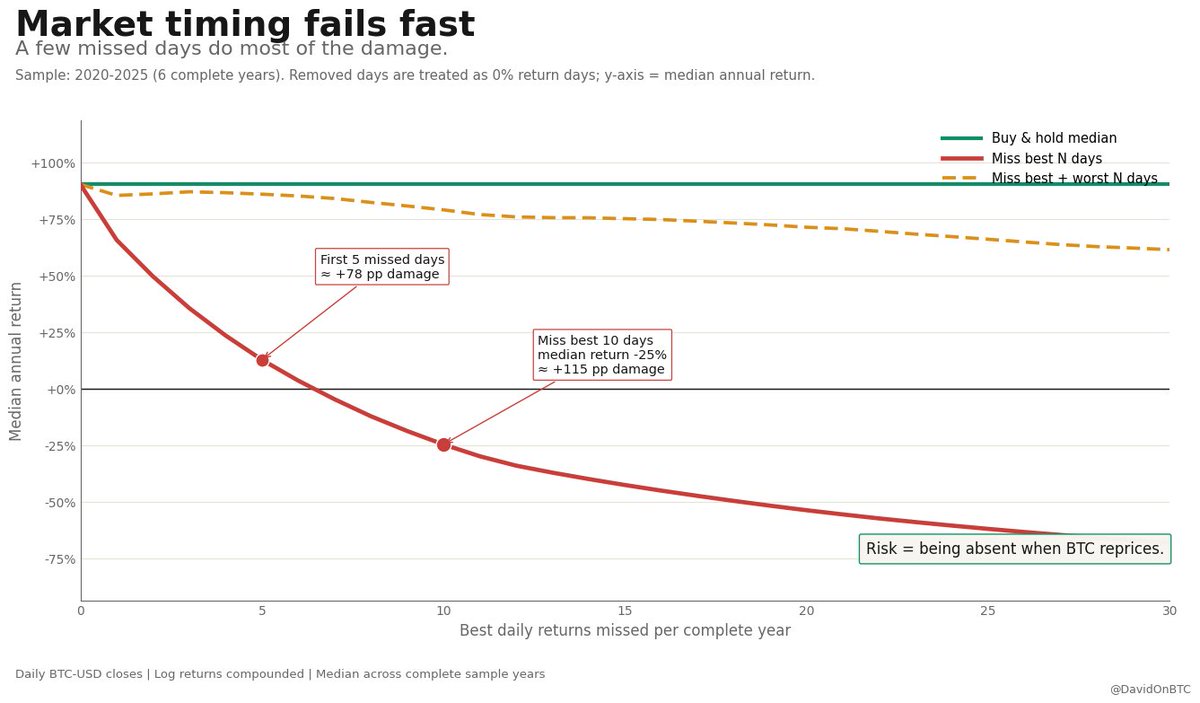
Missing Bitcoin’s best 10 days turned 90% into -25%.
2020–2025 data:
Buy & hold median annual return: 90%
Miss the best 5 days: ~78 percentage points of damage
Miss the best 10 days: -25% median return
Total damage: ~115 percentage points
2
20
1,601
May 28
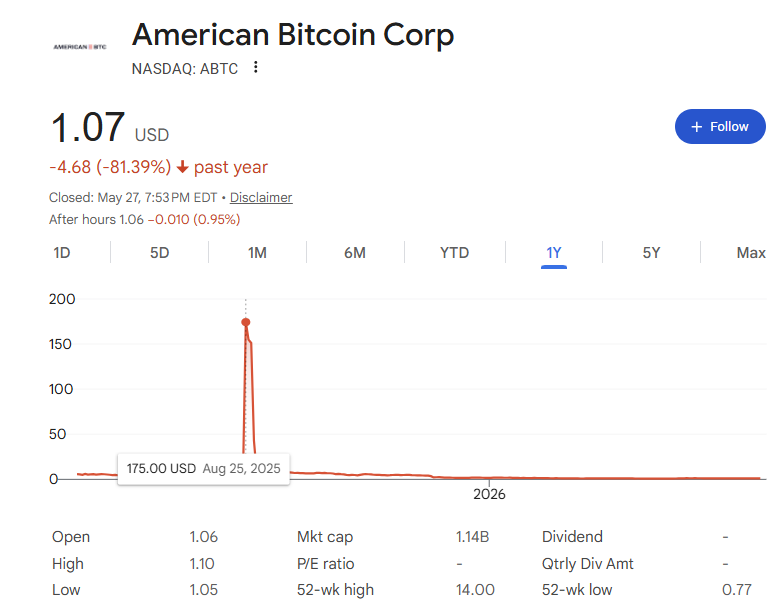
Who bought American Bitcoin @ $175.00?
MAGA supporters? Ouch..
(currently trading about 1.00, > 99% loss of value)
2
73

My G
May 27

Guys I put my heart and soul into this pod cast! I really think you guys are going to like it! It’s available on Spotify and Apple podcast! Scroll down and take a listen!!! Please let me know what you guys think!
I’m a proud ambassador of @genbtc_ !!!
Dirty Hands Clean Money!!! Save the Bloodline!
generationbtc.substack.com/p…

2
3
28
803

David R retweeted

May 22
When people blame resurgent inflation on tariffs or the war, they ignore the far bigger culprit: Trump’s Big, Beautiful Bill. Of all the damage Trump and Republicans have done to fuel inflation, nothing comes close to that ugly bill. That’s why @RepThomasMassie voted against it.
154
352
2,612
67,855
David R retweeted

May 18
This isn't AI, it's the Huajiang Canyon Bridge in Guizhou, China, the world's highest bridge at 625 meters above the river beneath it.
It features a man-made waterfall created by diverting karst spring water discovered during tunnel construction.
893
5,137
32,109
4,545,635