
Joined September 2009
- Tweets 55,172
- Following 3,298
- Followers 1,209,316
- Likes 17,218
22,788 Photos and videos

Pinned Tweet

MORE: An “open” strait under Iranian management is not a return to the pre-war status quo and would mean that Iran has accomplished a key war aim. ⬇️
Iranian Foreign Affairs Minister Abbas Araghchi discussed the strait at length and noted that it is under Iranian and Omani sovereignty and that both countries will collect fees after the MoU. Iran will also manage the strait. Araghchi rejected the term “tolls” but defended Iran charging “service“ fees for passage through the strait, which is effectively an attempt to rebrand Iran’s protection racket as legal administration. Araghchi added that Iran would provide safe passage through the strait for civilian vessels but create separate arrangements for military vessels.
This system of management is at odds with both US policy and long-established maritime legal precedent. US President Donald Trump has repeatedly said, for example, that the strait must be open with no fees or Iranian management. A US official told Reuters that the agreement would “open” the strait, but an “open” strait under Iranian management would be very detrimental to US interests, as ISW-CTP has previously argued in @brian_cartr's essay in the post below.
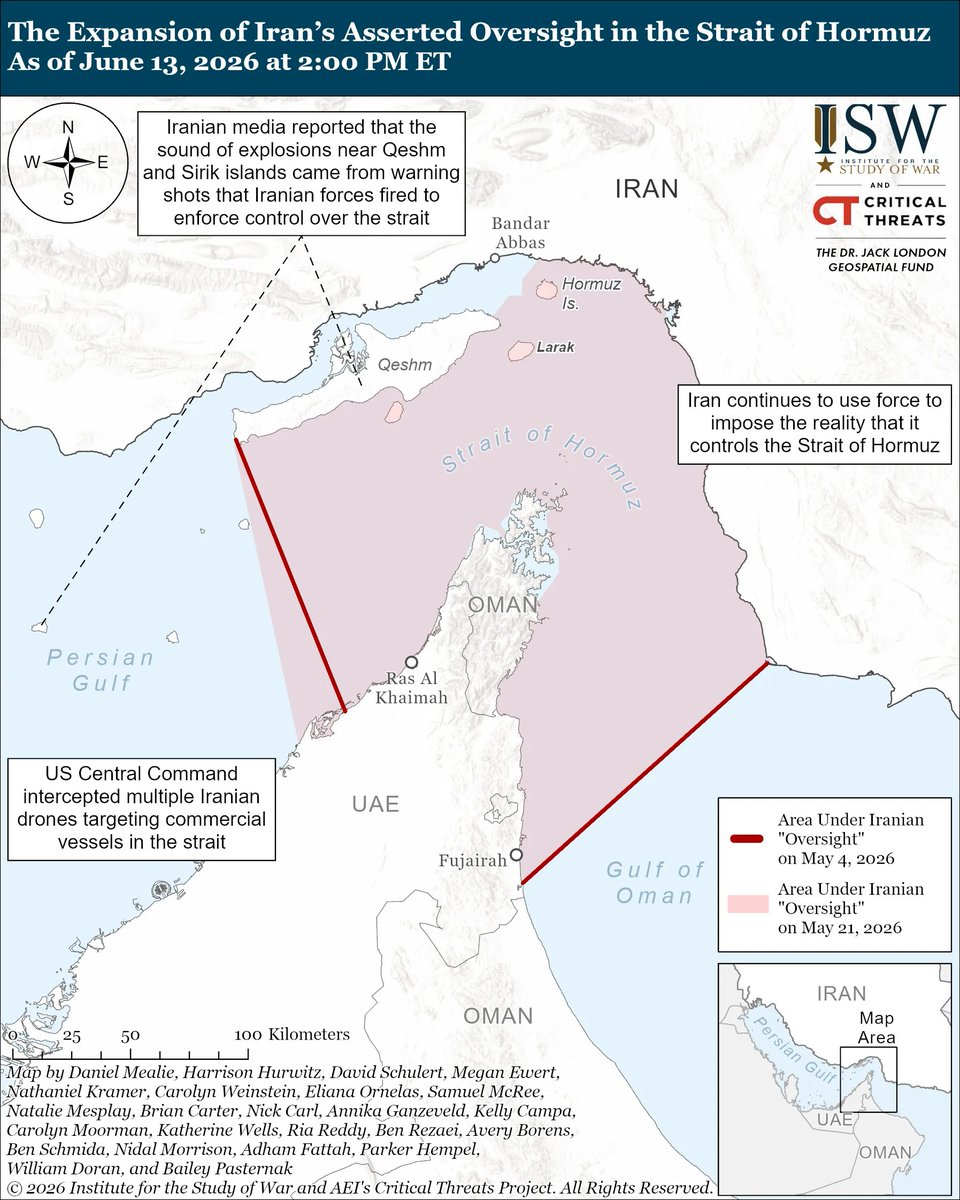
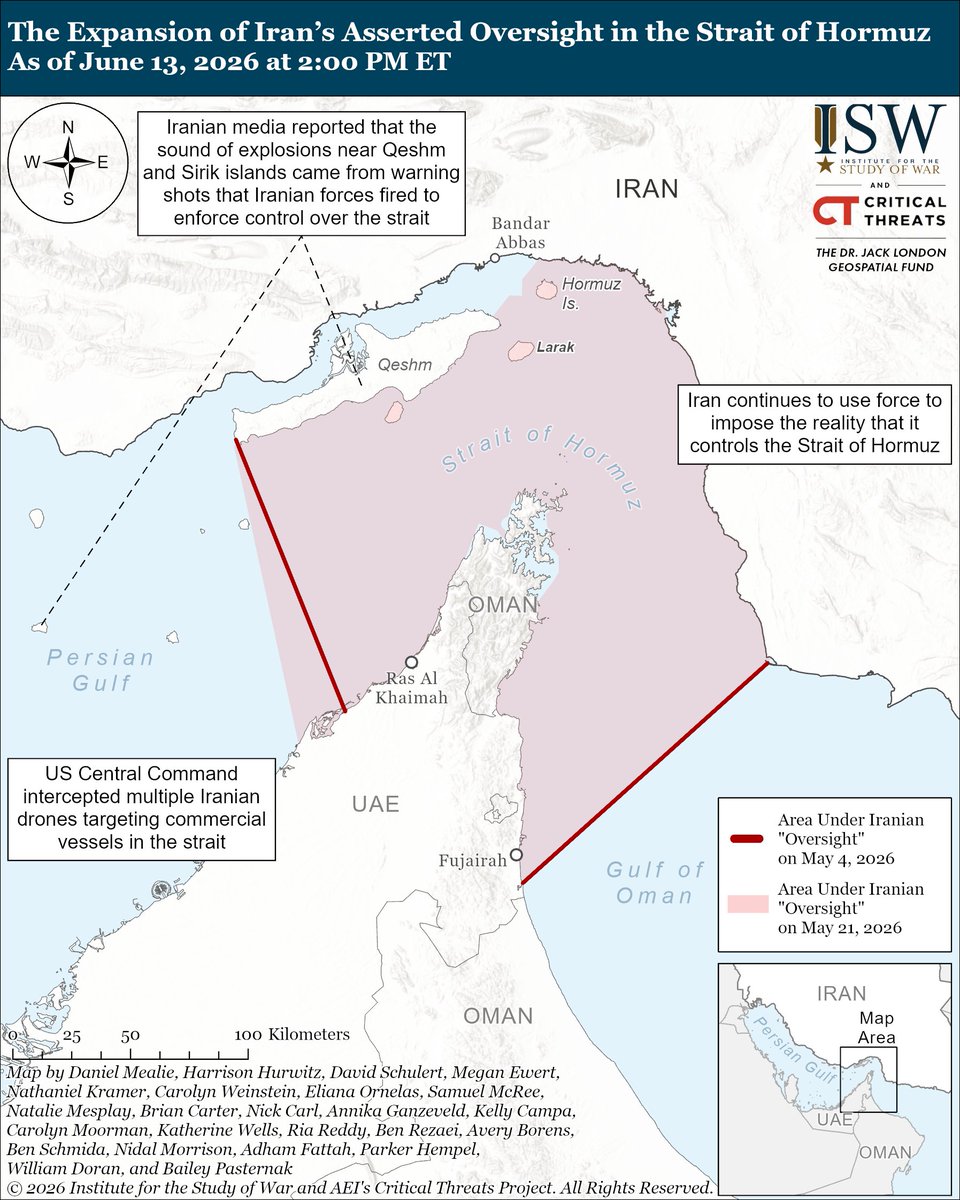
Iran also continues to use force in an attempt to impose the reality that it controls the Strait of Hormuz. US Central Command (CENTCOM) reported on June 12 that US forces intercepted multiple Iranian drones targeting commercial vessels in the strait. Iranian media separately reported explosions near Qeshm and Sirik islands and said the sounds came from warning shots that Iranian forces fired to enforce control over the strait.

NEW: Iranian statements regarding the contents of the US-Iran memorandum of understanding (MoU) indicate that some terms of the agreement are at odds with stated US positions on the Strait of Hormuz in recent months. The agreement has two parts: a first stage that deals with an “end to the war” on all fronts, a resumption of traffic in the Strait of Hormuz, and economic benefits for Iran, including reconstruction funds, sanctions relief, release of frozen funds, and an end to the US blockade. The second stage would deal with the nuclear issue and “one or two other [unspecified] issues.”
Other Key Takeaways:
Iran is likely attempting to structure the MoU and the phasing of a final agreement to reduce US leverage before later negotiations over the nuclear program. Iran is attempting to access at least some of its frozen assets early in the MoU process, for example, which would give it some economic relief before nuclear talks begin.
Iranian media appears to be portraying a possible MoU as a tactical pause in the war rather than a final settlement. The Ghalibaf-affiliated Khorasan outlet argued on June 13 that the emerging agreement only aims to end the current war and does not resolve the underlying issues between Iran and the United States.
Iranian Foreign Affairs Minister Abbas Araghchi’s readout of the MoU is largely consistent with IRGC-affiliated media’s readout of the latest possible agreement, which may indicate a growing consensus among Iranian regime leaders on Iran’s red lines for negotiations. That Araghchi’s June 12 readout and IRGC media’s account of the latest US-Iran MoU are very similar suggests that Vahidi or elements close to him may have successfully driven consensus on their preferred policy outcomes.
18
107
261
105,913
3/ Iranian Foreign Affairs Minister Abbas Araghchi’s readout of the MoU is largely consistent with IRGC-affiliated media’s readout of the latest possible agreement, which may indicate a growing consensus among Iranian regime leaders on Iran’s red lines for negotiations.
2
7
29
17,974
2/ Iran is likely attempting to structure the MoU and the phasing of a final agreement to reduce US leverage before later negotiations over the nuclear program.
Iranian media appears to be portraying a possible MoU as a tactical pause in the war rather than a final settlement.
1
11
38
18,752
MORE: Other issues—like when Iran can access frozen funds and how much it will be able to access—remain issues in negotiations as well.
There also appear to be some disagreements between Iran and the United States over the Iranian nuclear program, but it is unclear what specific disagreements exist.
MORE: An “open” strait under Iranian management is not a return to the pre-war status quo and would mean that Iran has accomplished a key war aim. ⬇️
Iranian Foreign Affairs Minister Abbas Araghchi discussed the strait at length and noted that it is under Iranian and Omani sovereignty and that both countries will collect fees after the MoU. Iran will also manage the strait. Araghchi rejected the term “tolls” but defended Iran charging “service“ fees for passage through the strait, which is effectively an attempt to rebrand Iran’s protection racket as legal administration. Araghchi added that Iran would provide safe passage through the strait for civilian vessels but create separate arrangements for military vessels.
This system of management is at odds with both US policy and long-established maritime legal precedent. US President Donald Trump has repeatedly said, for example, that the strait must be open with no fees or Iranian management. A US official told Reuters that the agreement would “open” the strait, but an “open” strait under Iranian management would be very detrimental to US interests, as ISW-CTP has previously argued in @brian_cartr's essay in the post below.
Iran also continues to use force in an attempt to impose the reality that it controls the Strait of Hormuz. US Central Command (CENTCOM) reported on June 12 that US forces intercepted multiple Iranian drones targeting commercial vessels in the strait. Iranian media separately reported explosions near Qeshm and Sirik islands and said the sounds came from warning shots that Iranian forces fired to enforce control over the strait.
2
31
85
34,156
MORE: An “open” strait under Iranian management is not a return to the pre-war status quo and would mean that Iran has accomplished a key war aim. ⬇️
Iranian Foreign Affairs Minister Abbas Araghchi discussed the strait at length and noted that it is under Iranian and Omani sovereignty and that both countries will collect fees after the MoU. Iran will also manage the strait. Araghchi rejected the term “tolls” but defended Iran charging “service“ fees for passage through the strait, which is effectively an attempt to rebrand Iran’s protection racket as legal administration. Araghchi added that Iran would provide safe passage through the strait for civilian vessels but create separate arrangements for military vessels.
This system of management is at odds with both US policy and long-established maritime legal precedent. US President Donald Trump has repeatedly said, for example, that the strait must be open with no fees or Iranian management. A US official told Reuters that the agreement would “open” the strait, but an “open” strait under Iranian management would be very detrimental to US interests, as ISW-CTP has previously argued in @brian_cartr's essay in the post below.
Iran also continues to use force in an attempt to impose the reality that it controls the Strait of Hormuz. US Central Command (CENTCOM) reported on June 12 that US forces intercepted multiple Iranian drones targeting commercial vessels in the strait. Iranian media separately reported explosions near Qeshm and Sirik islands and said the sounds came from warning shots that Iranian forces fired to enforce control over the strait.
NEW: Iranian statements regarding the contents of the US-Iran memorandum of understanding (MoU) indicate that some terms of the agreement are at odds with stated US positions on the Strait of Hormuz in recent months. The agreement has two parts: a first stage that deals with an “end to the war” on all fronts, a resumption of traffic in the Strait of Hormuz, and economic benefits for Iran, including reconstruction funds, sanctions relief, release of frozen funds, and an end to the US blockade. The second stage would deal with the nuclear issue and “one or two other [unspecified] issues.”
Other Key Takeaways:
Iran is likely attempting to structure the MoU and the phasing of a final agreement to reduce US leverage before later negotiations over the nuclear program. Iran is attempting to access at least some of its frozen assets early in the MoU process, for example, which would give it some economic relief before nuclear talks begin.
Iranian media appears to be portraying a possible MoU as a tactical pause in the war rather than a final settlement. The Ghalibaf-affiliated Khorasan outlet argued on June 13 that the emerging agreement only aims to end the current war and does not resolve the underlying issues between Iran and the United States.
Iranian Foreign Affairs Minister Abbas Araghchi’s readout of the MoU is largely consistent with IRGC-affiliated media’s readout of the latest possible agreement, which may indicate a growing consensus among Iranian regime leaders on Iran’s red lines for negotiations. That Araghchi’s June 12 readout and IRGC media’s account of the latest US-Iran MoU are very similar suggests that Vahidi or elements close to him may have successfully driven consensus on their preferred policy outcomes.
18
107
261
105,913
2/ Special Report: How Iran Hopes to Control the Strait of Hormuz: It’s Not Just About Fees x.com/TheStudyofWar/status/2…
NEW | Special Report: How Iran Hopes to Control the Strait of Hormuz: It’s Not Just About Fees
One of Iran’s primary objectives in the current negotiations is to secure its sovereignty over the Strait of Hormuz. This objective is more important for Tehran than securing fees from merchant vessels as they transit the Strait.
Iran likely sees two paths to controlling the strait. First, Iranian control could be officially recognized by the United States through an agreement. Second, Iran could maintain the current situation by firing missiles or drones (or credibly threatening to do so) at ships that fail to heed Iranian demands related to transiting the strait.
Iran’s scheme to extract large fees for safe transit through the strait will likely fail, absent a major change in the appetite among shipping companies for risking sanctions. But the failure of the fee scheme does not ipso facto result in a failure of Iran’s scheme to control the strait.
The strait will not “return to normal” without either a deal that ends Iranian control or a US-led military operation that forces the strait open to prevent Iranian control. The US and the world should not allow Iran to impose a new reality on this critical international waterway. If negotiations do not lead rapidly to an agreement to reopen the strait under the previous, internationally recognized transit scheme, then it will unfortunately be necessary to resort to force.
1
13
38
30,289
NEW: Iranian statements regarding the contents of the US-Iran memorandum of understanding (MoU) indicate that some terms of the agreement are at odds with stated US positions on the Strait of Hormuz in recent months. The agreement has two parts: a first stage that deals with an “end to the war” on all fronts, a resumption of traffic in the Strait of Hormuz, and economic benefits for Iran, including reconstruction funds, sanctions relief, release of frozen funds, and an end to the US blockade. The second stage would deal with the nuclear issue and “one or two other [unspecified] issues.”
Other Key Takeaways:
Iran is likely attempting to structure the MoU and the phasing of a final agreement to reduce US leverage before later negotiations over the nuclear program. Iran is attempting to access at least some of its frozen assets early in the MoU process, for example, which would give it some economic relief before nuclear talks begin.
Iranian media appears to be portraying a possible MoU as a tactical pause in the war rather than a final settlement. The Ghalibaf-affiliated Khorasan outlet argued on June 13 that the emerging agreement only aims to end the current war and does not resolve the underlying issues between Iran and the United States.
Iranian Foreign Affairs Minister Abbas Araghchi’s readout of the MoU is largely consistent with IRGC-affiliated media’s readout of the latest possible agreement, which may indicate a growing consensus among Iranian regime leaders on Iran’s red lines for negotiations. That Araghchi’s June 12 readout and IRGC media’s account of the latest US-Iran MoU are very similar suggests that Vahidi or elements close to him may have successfully driven consensus on their preferred policy outcomes.
8
55
195
111,951
2/ Iran Update June 13: isw.pub/IranUpdate061326
10
23
20,418
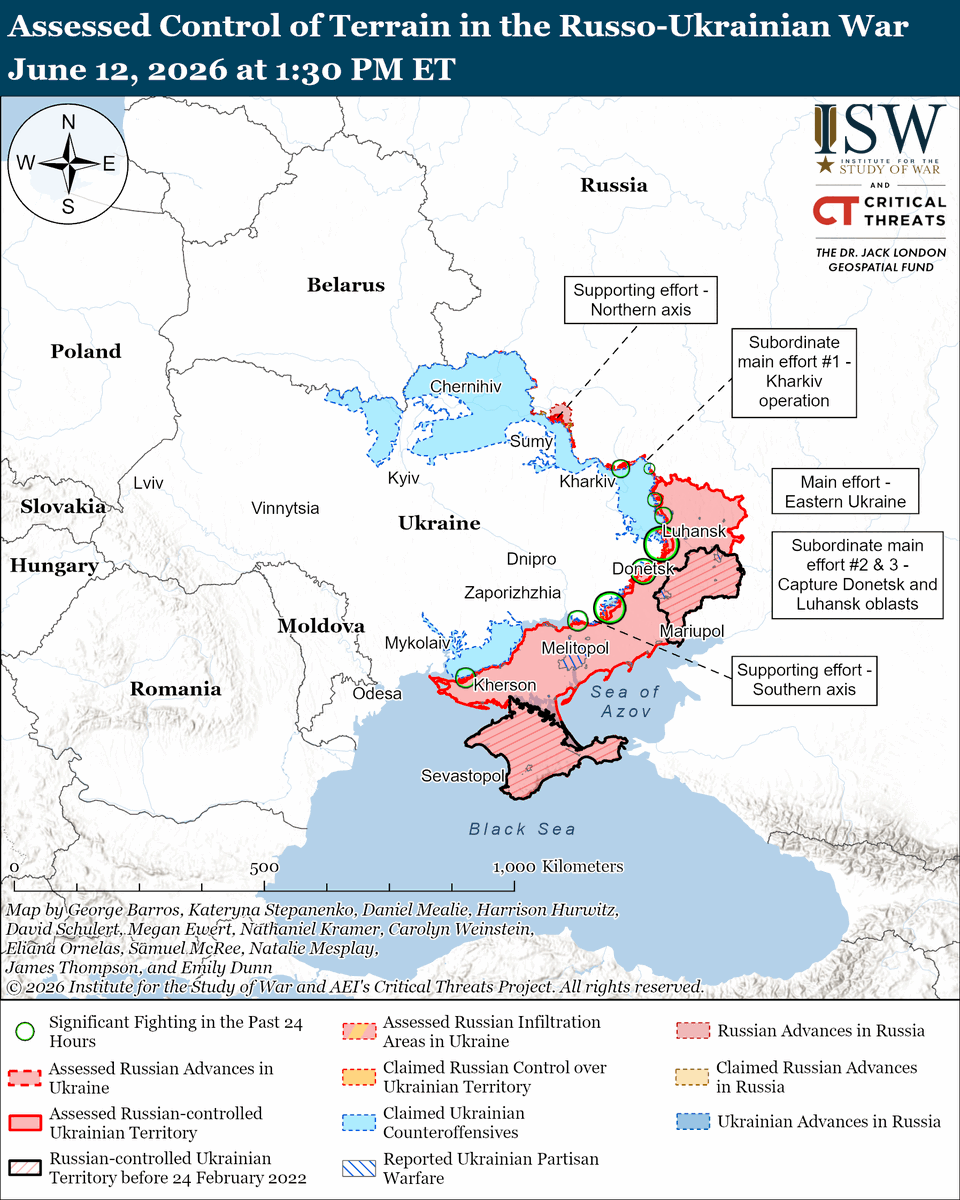
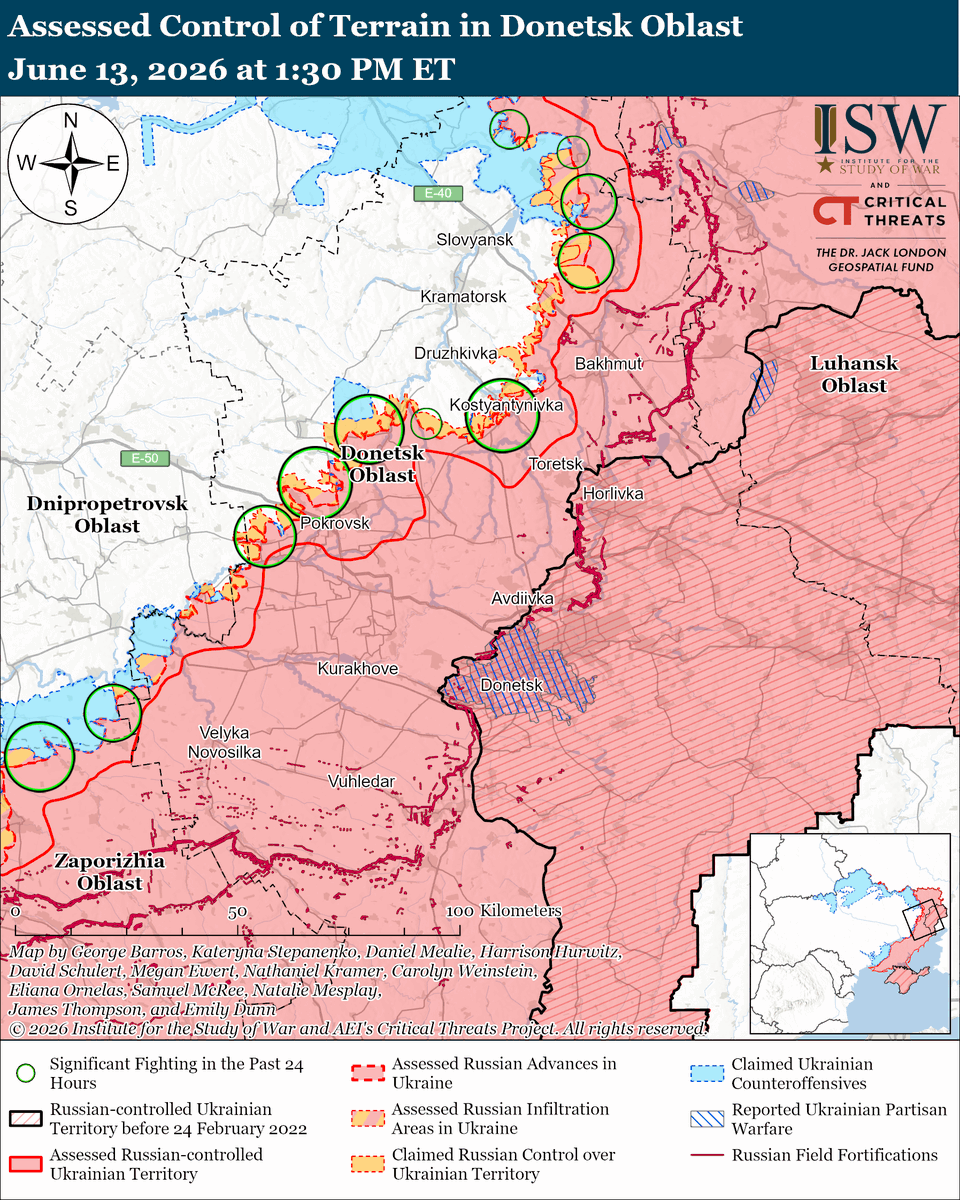
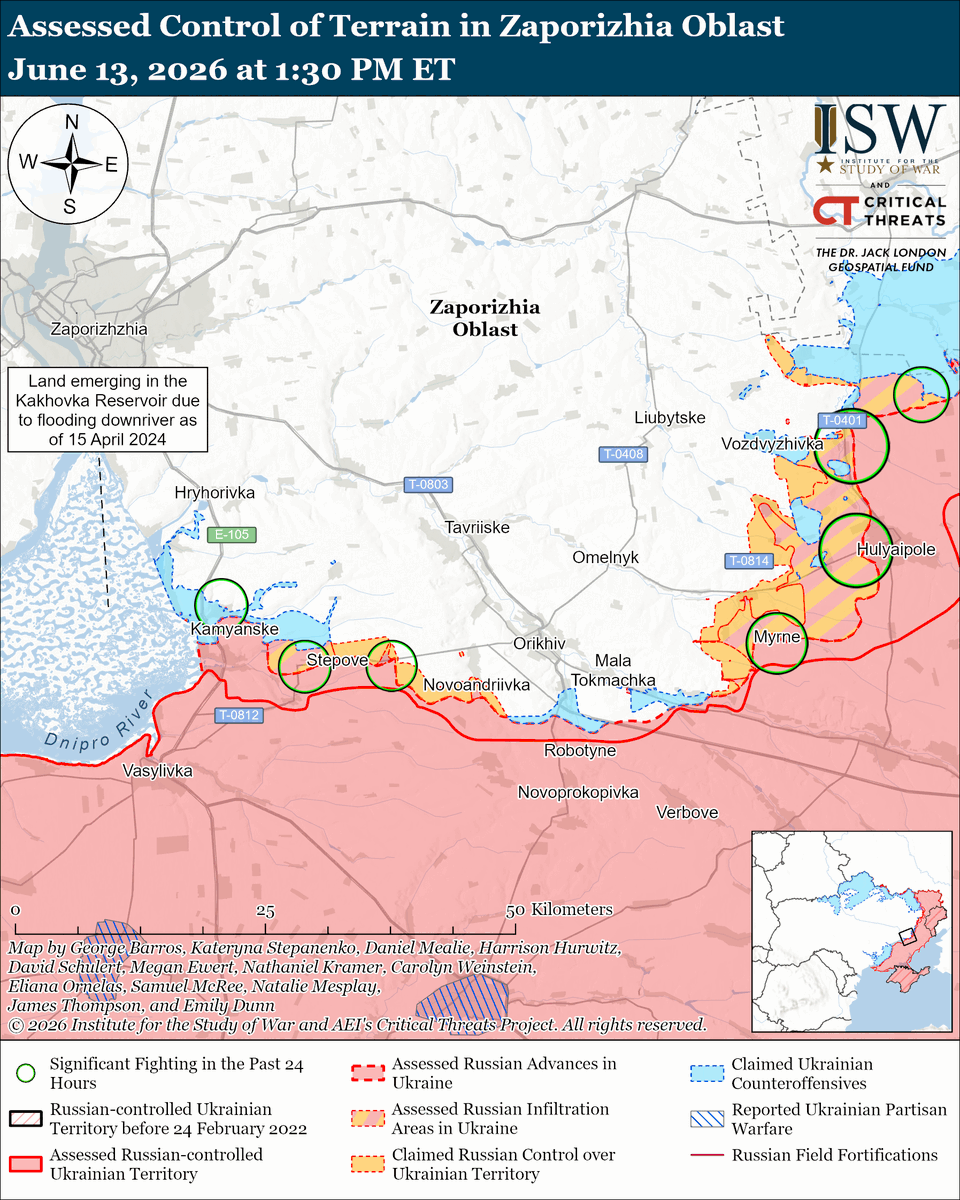
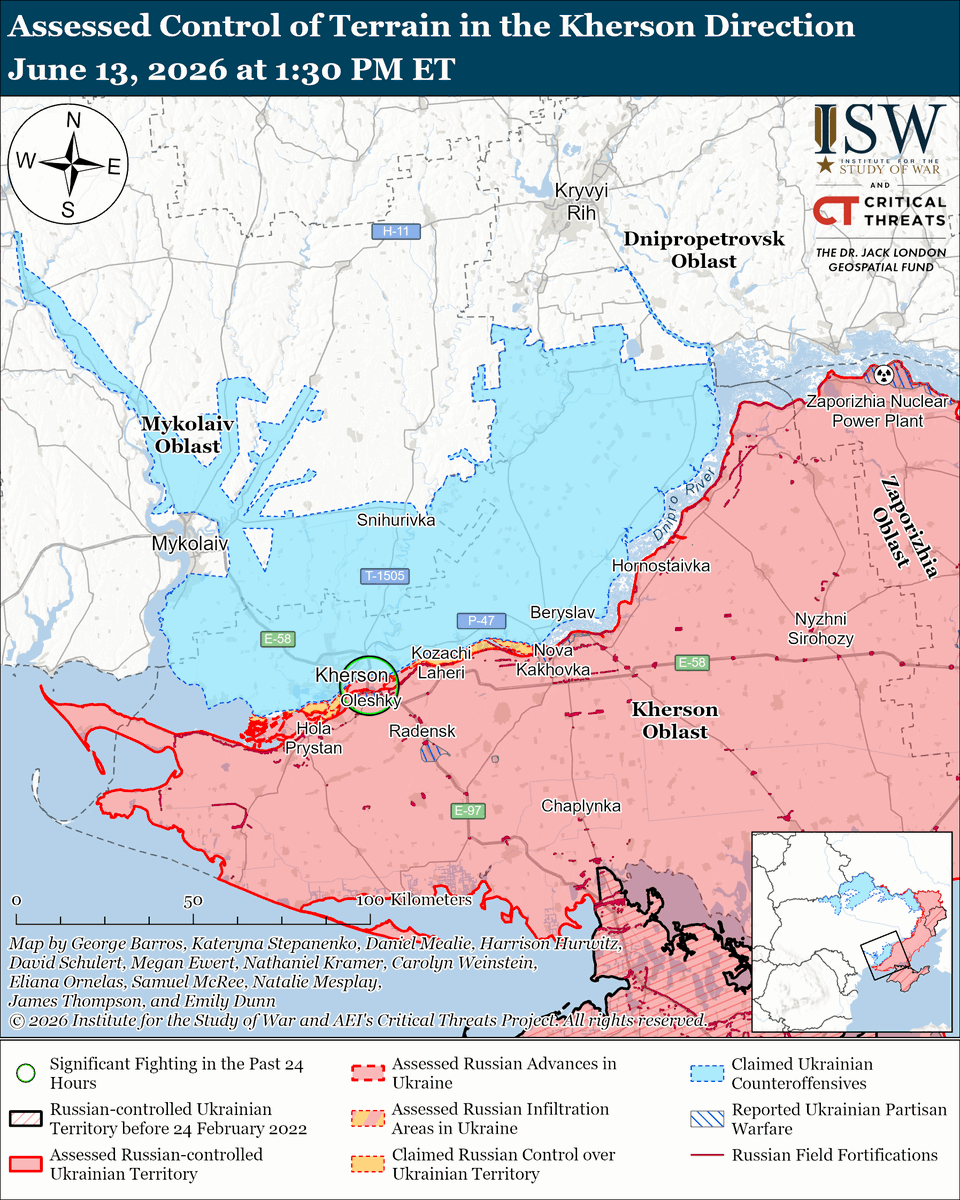
NEW: Russian forces are increasing the production rate and modernization of their ballistic missiles and drones. Available information suggests that Russia’s monthly missile production surpasses the US’s monthly PAC-3 Patriot air defense interceptor missile production.
Other Key Takeaways:
Russia’s increasingly large and diverse strike packages highlight the critical importance of Western assistance in bolstering Ukraine’s air defense capabilities.
Russia is reportedly increasing its military spending even as Russian revenues decrease.
Unknown actors attempted to assassinate a former Donetsk People’s Republic (DNR) official with an improvised explosive device (IED) on June 12.
Neither Ukrainian nor Russian forces advanced on June 13.
Russian forces launched 118 drones against Ukraine overnight. Ukrainian forces struck energy and military infrastructure in Russia overnight.
8
113
444
35,874
Institute for the Study of War retweeted
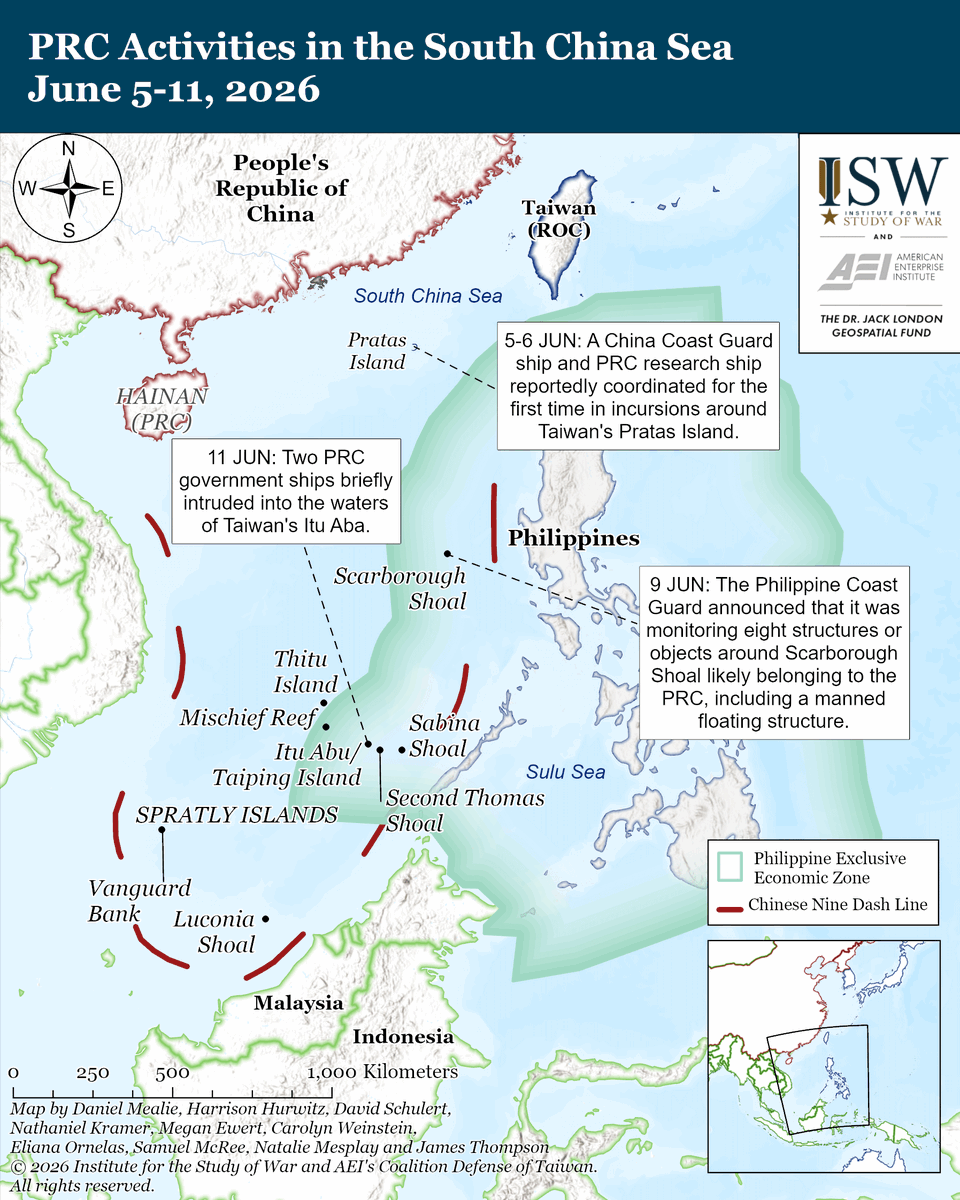
NEW: CCP General Secretary Xi Jinping met with WPK General Secretary Kim Jong Un from June 8 to 9 in Xi’s first visit to Pyongyang since 2019. Xi’s calls for closer cooperation between the PRC and North Korea and likely tacit acceptance of North Korea’s nuclear status reflect PRC efforts to maintain positive relations with North Korea amid closer alignment between Pyongyang and Moscow.
Other Key Takeaways:
KMT Chairwoman Cheng Li-wun finished her US visit on June 12. Cheng met with US policy makers and academics and espoused standard KMT talking points and some rhetoric reminiscent of PRC statements.
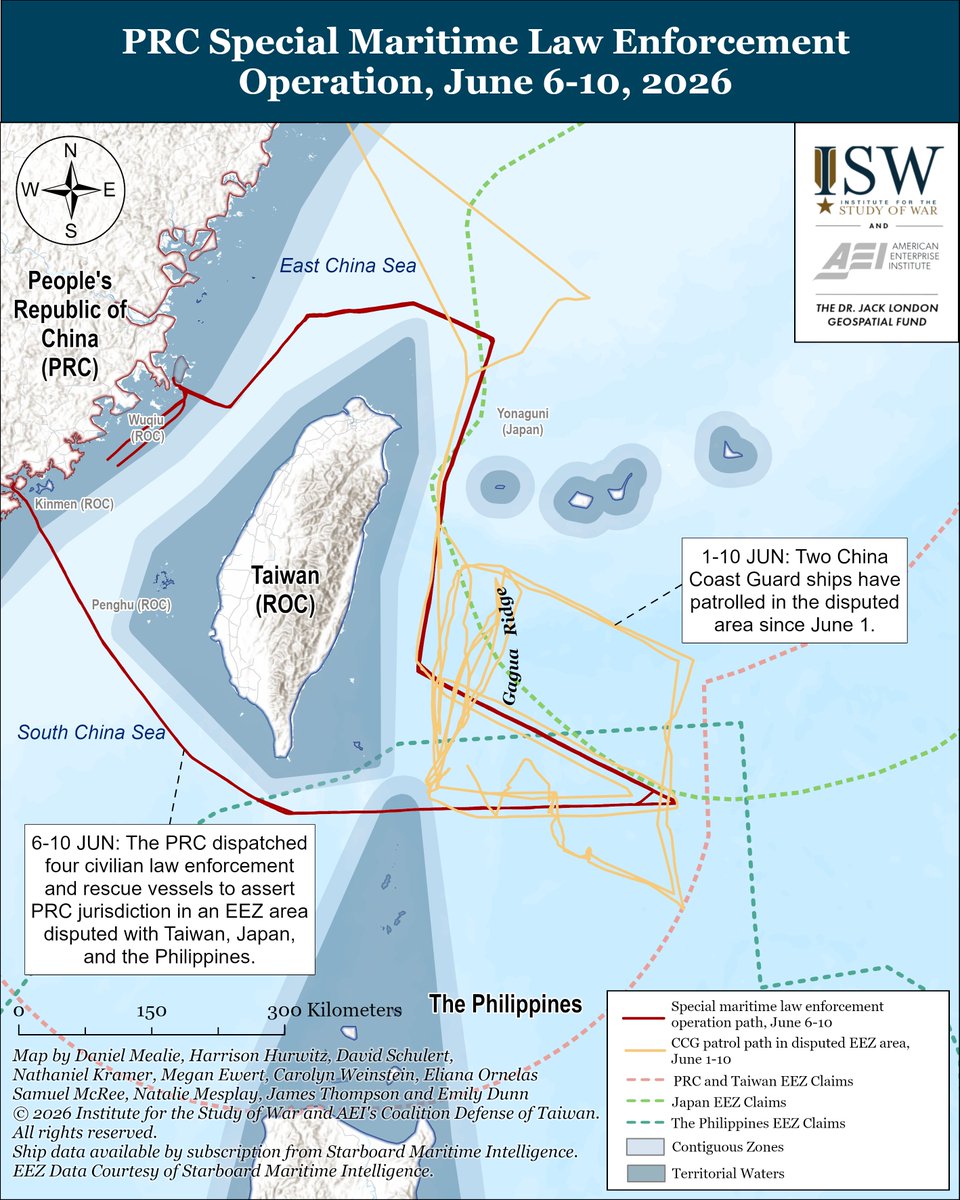
The PRC MoT conducted a “special maritime law enforcement operation” east of Taiwan from June 6 to 10 to assert PRC jurisdiction over the disputed waters, contesting Japanese-Philippine talks to delimit their overlapping EEZ claims. The exercise was likely intended to reinforce PRC claims over Taiwan and to exercise PRC A2AD operations.
6
68
232
61,446
NEW | Recent statements by Iranian and US officials suggest that Iran and the United States are still at odds over the Strait of Hormuz. The United States has repeatedly clarified that its position is that Iran cannot control or charge fees or tolls in the Strait of Hormuz. Iranian Foreign Affairs Minister Abbas Araghchi said that Iran will seek to levy fees on traffic in the Strait of Hormuz and administer the strait.
A US official speaking to Reuters said that the deal meets Trump’s “core objectives” and that Iran would “open” the strait in return for the US releasing frozen Iranian assets and waiving sanctions on oil exports.
Trump previously rejected a plan under which Oman and Iran would charge a joint toll for ships passing through the Strait of Hormuz. It is unclear how a toll differs from a fee, and Iranian management of an international waterway would represent a major change in long-established maritime legal precedent.
16
76
240
49,773
ISW-CTP will provide more analysis on the latest in Iran talks in our June 13 update this evening. Our latest analysis is available here: isw.pub/IranUpdate061226
1
8
32
22,921
Institute for the Study of War retweeted
NEW: Russian forces may launch an Oreshnik intermediate-range ballistic missile at Ukraine in the next 24 to 48 hours.
Other Key Takeaways:
Russian President Vladimir Putin continued to posture Russian military strength during Russia’s June 12 Russia Day holiday while also acknowledging some of the battlefield setbacks Russian forces have faced in recent months.
A Russian State Duma Deputy from the Communist Party criticized the Kremlin and the broader Russian war-waging strategy ahead of Russia Day, contradicting the Kremlin's narrative.
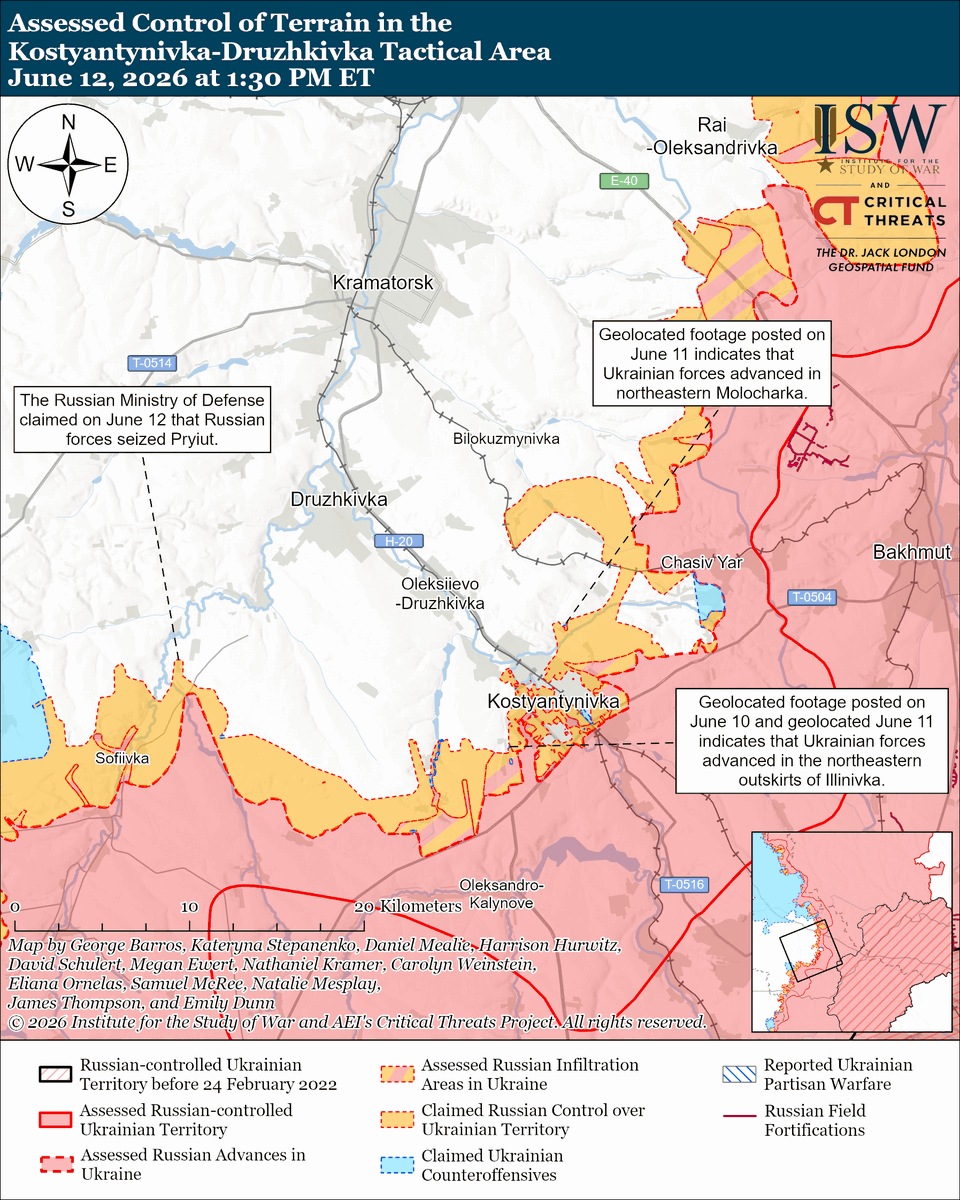
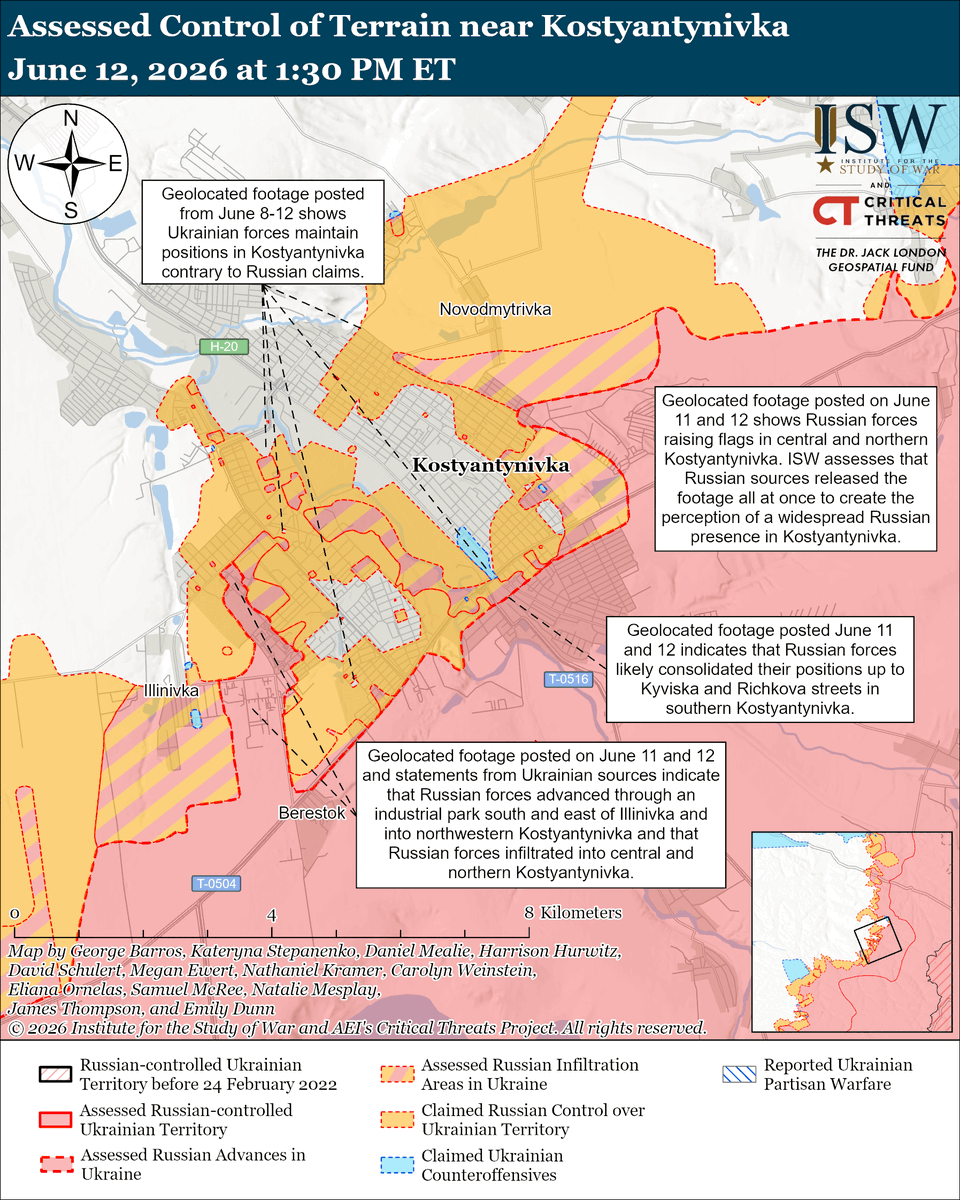
Russian sources released several pieces of footage showing Russian forces operating in Kostyantynivka as part of a deliberate cognitive warfare effort to exaggerate the Russian presence in the city. Russian forces continue to make tactical gains within Kostyantynivka and Ukraine’s ability to defend the southeastern sections of the city is deteriorating, however.
Russian forces continue making tactical gains in Kostyantynivka — Russia’s assessed main effort for the Spring-Summer 2026 offensive — and have likely consolidated some tactical positions within the city beyond infiltration. These gains have taken Russian forces a long time to achieve and have come at a great cost.
Russian forces will likely make tactical gains in Kostyantynivka in Summer 2026 but remain unlikely to achieve a rapid operational breakthrough against the Fortress Belt writ large.
Russia is building at least five long-range drone launch sites in western Russia close to the border with Belarus likely to support drone strikes against Ukraine, possibly by exploiting Belarusian airspace.
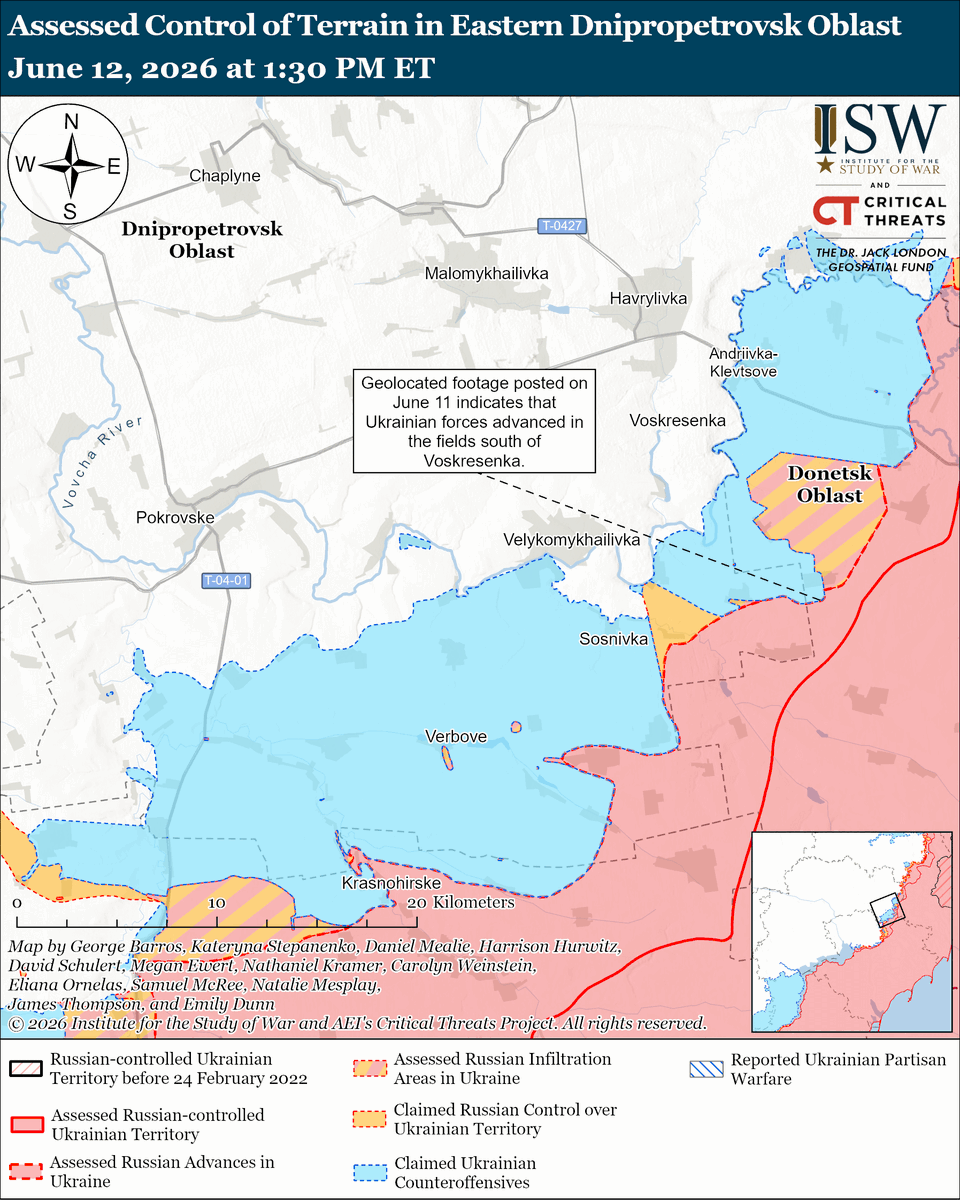
Ukrainian forces recently advanced in the Kostyantynivka-Druzhkivka tactical area and in the Oleksandrivka direction.
Ukrainian forces struck Russian oil infrastructure on the night of June 11 and 12. Russian forces launched 117 drones against Ukraine overnight.
13
141
564
68,886
Institute for the Study of War retweeted
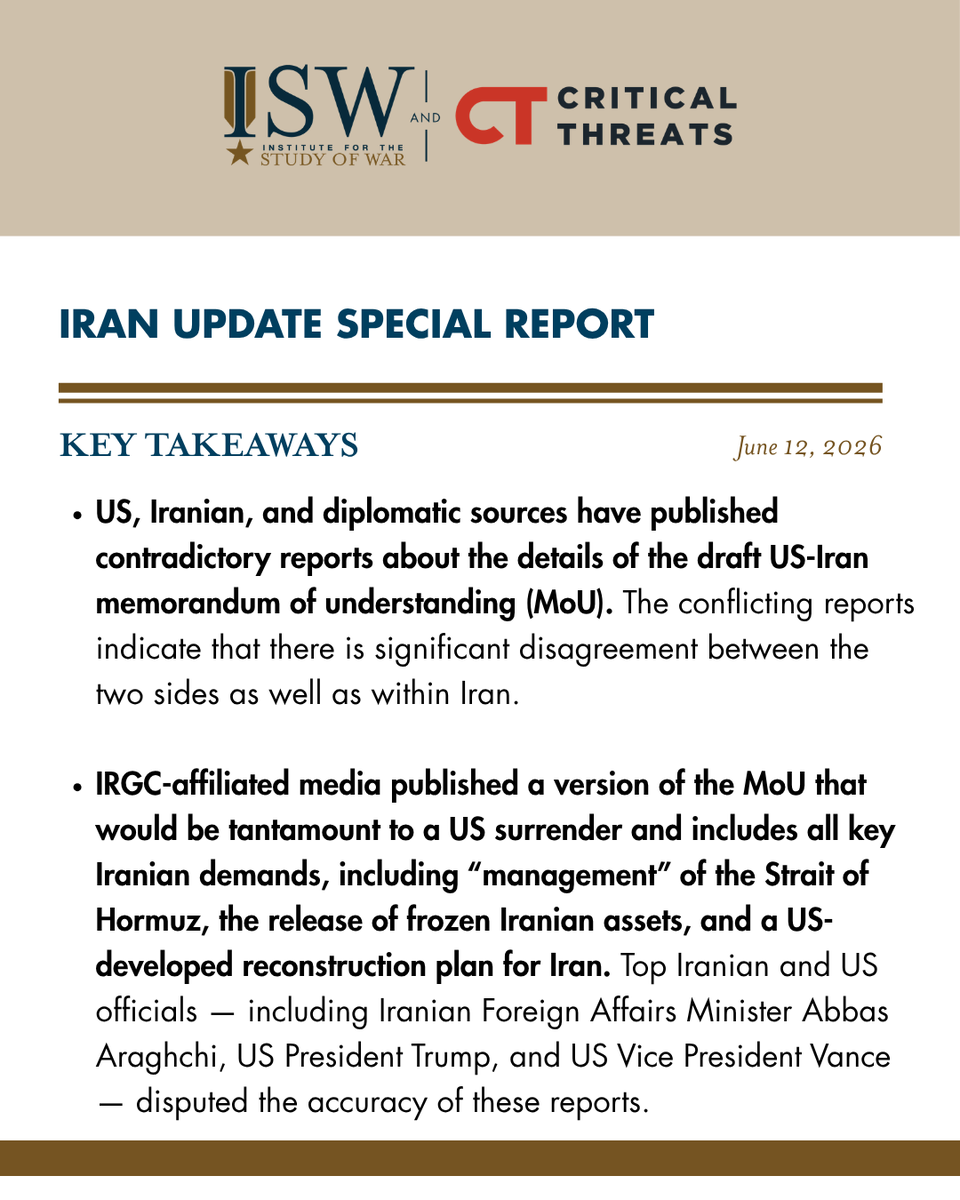
NEW: Persistent internal disagreements remain among Iranian regime leaders over the concessions that the regime should accept in negotiations with the United States. Islamic Revolutionary Guards Corps (IRGC) Commander Major General Ahmad Vahidi and his inner circle appear to continue to seek an agreement that meets Iranian maximalist demands and would be tantamount to a US surrender. Other Iranian officials appear to have disputed a draft memorandum leaked by IRGC-linked and state media.
Other Key Takeaways:
Conflicting US and Iranian accounts of the MoU suggest that the United States and Iran remain far apart on several core issues, however. It remains unclear whether these public statements accurately reflect each side’s negotiating position or the contents of the agreement, given competition between the IRGC and the formal negotiating team.
Iranian statements and Iran’s continued use of force and coercion in the Strait of Hormuz indicate that the regime remains unwilling to relinquish its claims to control over the waterway. Any US-Iran agreement must require Iran to abandon efforts to establish long-term authority over the strait. Iranian forces continue to employ coercive measures to force vessels to transit through Iran’s illegal traffic separation scheme and comply with its protection racket.
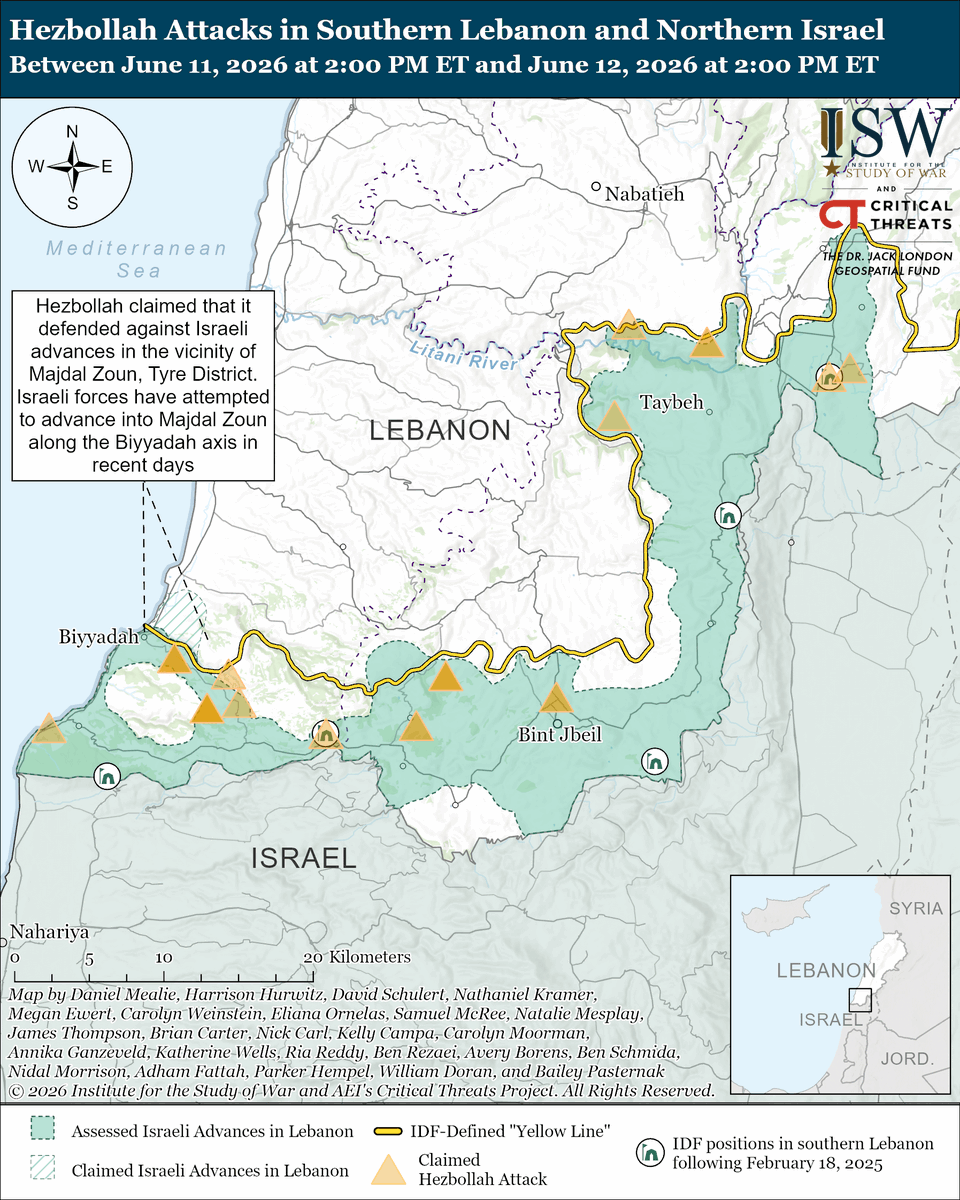
Hezbollah’s efforts to decentralize its military structure may be enabling the group to conduct more effective defenses of specific areas in southern Lebanon than it was able to muster in Fall 2024. The IRGC reportedly reorganized Hezbollah’s C2 system starting in late 2024, and the shift towards unit independence and mobility would theoretically enable Hezbollah fighters to execute more effective defenses against Israeli advances in several sectors across southern Lebanon.
“IRGC-linked” figures acting on Iran’s behalf reportedly warned unspecified Iranian-backed Iraqi militia leaders to resist surrendering militia weapons to the Iraqi state in the days after Iraqi Prime Minister Ali al Zaydi’s successful formation of a new government in May 2026. Iran’s reported opposition to Iraqi militia disarmament at this time conflicts with several other reports that Iran has encouraged some Iraqi militias to end their kinetic operations in exchange for solidifying Iranian-backed Iraqi control over the Iraqi state, however.
13
109
271
62,084
NEW: Russian forces may launch an Oreshnik intermediate-range ballistic missile at Ukraine in the next 24 to 48 hours.
Other Key Takeaways:
Russian President Vladimir Putin continued to posture Russian military strength during Russia’s June 12 Russia Day holiday while also acknowledging some of the battlefield setbacks Russian forces have faced in recent months.
A Russian State Duma Deputy from the Communist Party criticized the Kremlin and the broader Russian war-waging strategy ahead of Russia Day, contradicting the Kremlin's narrative.
Russian sources released several pieces of footage showing Russian forces operating in Kostyantynivka as part of a deliberate cognitive warfare effort to exaggerate the Russian presence in the city. Russian forces continue to make tactical gains within Kostyantynivka and Ukraine’s ability to defend the southeastern sections of the city is deteriorating, however.
Russian forces continue making tactical gains in Kostyantynivka — Russia’s assessed main effort for the Spring-Summer 2026 offensive — and have likely consolidated some tactical positions within the city beyond infiltration. These gains have taken Russian forces a long time to achieve and have come at a great cost.
Russian forces will likely make tactical gains in Kostyantynivka in Summer 2026 but remain unlikely to achieve a rapid operational breakthrough against the Fortress Belt writ large.
Russia is building at least five long-range drone launch sites in western Russia close to the border with Belarus likely to support drone strikes against Ukraine, possibly by exploiting Belarusian airspace.
Ukrainian forces recently advanced in the Kostyantynivka-Druzhkivka tactical area and in the Oleksandrivka direction.
Ukrainian forces struck Russian oil infrastructure on the night of June 11 and 12. Russian forces launched 117 drones against Ukraine overnight.
13
141
564
68,886
NEW: Persistent internal disagreements remain among Iranian regime leaders over the concessions that the regime should accept in negotiations with the United States. Islamic Revolutionary Guards Corps (IRGC) Commander Major General Ahmad Vahidi and his inner circle appear to continue to seek an agreement that meets Iranian maximalist demands and would be tantamount to a US surrender. Other Iranian officials appear to have disputed a draft memorandum leaked by IRGC-linked and state media.
Other Key Takeaways:
Conflicting US and Iranian accounts of the MoU suggest that the United States and Iran remain far apart on several core issues, however. It remains unclear whether these public statements accurately reflect each side’s negotiating position or the contents of the agreement, given competition between the IRGC and the formal negotiating team.
Iranian statements and Iran’s continued use of force and coercion in the Strait of Hormuz indicate that the regime remains unwilling to relinquish its claims to control over the waterway. Any US-Iran agreement must require Iran to abandon efforts to establish long-term authority over the strait. Iranian forces continue to employ coercive measures to force vessels to transit through Iran’s illegal traffic separation scheme and comply with its protection racket.
Hezbollah’s efforts to decentralize its military structure may be enabling the group to conduct more effective defenses of specific areas in southern Lebanon than it was able to muster in Fall 2024. The IRGC reportedly reorganized Hezbollah’s C2 system starting in late 2024, and the shift towards unit independence and mobility would theoretically enable Hezbollah fighters to execute more effective defenses against Israeli advances in several sectors across southern Lebanon.
“IRGC-linked” figures acting on Iran’s behalf reportedly warned unspecified Iranian-backed Iraqi militia leaders to resist surrendering militia weapons to the Iraqi state in the days after Iraqi Prime Minister Ali al Zaydi’s successful formation of a new government in May 2026. Iran’s reported opposition to Iraqi militia disarmament at this time conflicts with several other reports that Iran has encouraged some Iraqi militias to end their kinetic operations in exchange for solidifying Iranian-backed Iraqi control over the Iraqi state, however.
13
109
271
62,084
Iran Update Special Report, June 12, 2026: isw.pub/IranUpdate061226
14
36
23,224
NEW: CCP General Secretary Xi Jinping met with WPK General Secretary Kim Jong Un from June 8 to 9 in Xi’s first visit to Pyongyang since 2019. Xi’s calls for closer cooperation between the PRC and North Korea and likely tacit acceptance of North Korea’s nuclear status reflect PRC efforts to maintain positive relations with North Korea amid closer alignment between Pyongyang and Moscow.
Other Key Takeaways:
KMT Chairwoman Cheng Li-wun finished her US visit on June 12. Cheng met with US policy makers and academics and espoused standard KMT talking points and some rhetoric reminiscent of PRC statements.
The PRC MoT conducted a “special maritime law enforcement operation” east of Taiwan from June 6 to 10 to assert PRC jurisdiction over the disputed waters, contesting Japanese-Philippine talks to delimit their overlapping EEZ claims. The exercise was likely intended to reinforce PRC claims over Taiwan and to exercise PRC A2AD operations.
6
68
232
61,446
2/ China & Taiwan Update, June 12, 2026: isw.pub/ChinaTaiwanUpdate061…
8
32
24,485