Economics professor at George Mason Univ. Author of Cheating, Left Turn. Recovering political scientist.
Joined June 2011
- Tweets 10,704
- Following 1,600
- Followers 13,635
- Likes 96
288 Photos and videos
Tim Groseclose retweeted

Jun 11
Cultural anthropology has jumped the rails. At its best, it revealed how primitive societies worked. Today, with some exceptions, anthropologists romanticize folkways and superstitions. They have abandoned scholarship to preach primitivism.
Jun 10

MIT's Department of Anthropology elevates indigenous oral tradition above DNA evidence as Western Science surrenders to other ways of knowing.
MIT Anthropology Department Digs Its Grave Deeper
babblingbeaver.com/2026/06/1…
17
47
341
20,721

She trusted the New York Times with her account of her abuse at the hands of Graham Platner. She paid the price.

I bucked all advice from my friends (and resisted my conservative bias) and decided to fully trust the Times journalists.
As they left my home they asked that I not talk to any other outlets and I insisted then and repeatedly over the following weeks that I would keep my word and only share this story with them.
But then the weeks dragged on. They kept coming back to us saying the editors needed more. I needed to go on the record (okay). We need more screenshots (okay). I met every bench mark they set, eager to provide more sources or evidence as needed.
After the story went up I began to ask them … wait, where are the stories from the other women? Where are their accusations of sexual assault? Why am I the focus? Why are there 11 paragraphs dedicated to detailing my work history (more than has been published about Graham’s by far)?
Why does it say “nobody could corroborate” when I offered them sources that COULD corroborate?
Why did they include an out of context quote from a friend joking “do not call Graham” after I called off my wedding? (Because she knew I would never).
Where were the screenshots they’d said they would use? Or the mention that I’d supported local democrats and that most of my family (and husband) are liberal?
The editors said it was too much, they explained.
The Times also failed to include any mention that I DID confide in multiple friends through the years that Graham had been abusive — long before he was running for office. Those friends confirm they told the Times so.
It dawned on me that this really was a set up all along. The journalists I trusted who convinced me to share a story I never wanted to tell methodically delayed and twisted this into a gift to the Platner campaign. Violating the trust of his victims. Shattering the trust I placed in them with the most vulnerable story of my life.
And at the end of my call with them I reluctantly accepted their insistence that this was still a powerful story and that I had done a brave thing. And I thanked them for all the hard work they had put into it.
Still fawning after all these years.
174
1,700
9,769
426,808

May 26
Here's the post by Alex (@ATabarrok) on Marginal Revolution (@MargRev). Describes our paper on the Coase Conjecture. "A Beautiful Theory Falls to Ugly Data." marginalrevolution.com/margi…
3
380
May 25
If you’re an economics major--or just want to consider yourself an educated person--you should know what the Coase Conjecture is.
One of its key insights is that, under certain conditions, a monopolist must “compete against future versions of himself,” which in turn could cause him to set price equal to marginal cost—i.e. to act as if he is in a perfectly competitive market.
Alex Tabarrok (@ATabarrok) and I have recently published a paper (onlinelibrary.wiley.com/doi/…) on the topic. Our main conclusion is that, although a brilliant idea, it doesn’t seem to hold in practice. Stay tuned for a summary of the paper, which Alex will post on Marginal Revolution (@MargRev).
Why doesn’t the Conjecture work in practice? A brilliant, yet under-appreciated, explanation is the “outside options” model of Simon Board and Marek Pycia. It can be illustrated with the following example.
Suppose a publisher wants to sell a particular book, which has marginal costs of $1.00. There are 300 potential customers, all of whom are willing to buy at most one copy. Customer 1 values the book at $1.10; customer 2 values the book at $1.20; and so on, such that customer 300 values the book at $31.00. For simplicity, suppose that if a customer is indifferent between buying and not buying—say, because the price exactly equals the amount she values the book—then she buys.
Next, let us add Board and Pycia's innovation to the model. This is that each customer has an “outside option.” As the authors explain, the outside option could be a substitute, say a different book. But it could also be something else, such as (i) borrowing the book from a library or a friend or (ii) engaging in another activity such as watching television. Let us assume that, if a customer chooses her outside option, then she exits the market—that is, she will never buy the book that the publisher is selling (Board and Pycia, however, consider other versions of their model in which they relax this assumption).
An implication of the Board-Pycia model is that, even if the customers value their outside option at an infinitesimally small degree, then this can overturn many classic Coase Conjecture conclusions. To illustrate, suppose customers value their outside option at just one penny.
Now suppose that the model has an equilibrium similar to the standard Coase-type model. (We show that this leads to a contradiction.) First, suppose that the seller adopts a “skimming” strategy in equilibrium—that is, in the first round it sets a relatively high price, then gradually lowers the price as more and more customers buy and leave the market. Second, suppose that the market clears in a finite number of rounds, T ; that is, in period T the seller sets price (just) small enough to make the lowest-valuing customer buy (and consequently no sales take place afterward). Third, suppose that T >= 2; that is, it takes at least two periods for the market to clear.
We now show that the last property, T >= 2, cannot hold in the Board-Pycia model. To see why, suppose that the game has reached period T, and the seller chooses a price to clear the market. If so, it optimizes by choosing a price that makes customer 1 indifferent between buying and not buying. This price equals $1.09. (Note that it gives the customer a surplus of one penny [= $1.10–$1.09], which equals the value of her outside option).
Now consider customer 1's decision in the first round. She foresees that her consumer surplus from buying the book will be at most one penny, and that this surplus would not be realized until a future period. Due to discounting, she prefers to take her outside option immediately, so she exits the market in the first round.
Since customer 1 has exited, customer 2 is now the lowest-valuing customer. This means that in period T the publisher's profit-maximizing strategy is now to set the price so that customer 2 is indifferent between buying and not. That price is $1.19.
But, like customer 1, customer 2 can foresee the publisher's strategy. She anticipates that her consumer surplus will be at most one penny and it will only come in round T. Accordingly, she realizes that she is best off exercising her outside option in the first round. By repeating this reasoning, one can show that in equilibrium no customer makes a purchase after the first round.
Thus, this reveals that the assumption that T >= 2 cannot be correct. Instead, as Board and Pycia show, the only equilibrium is one in which all trading takes place in the first round—that is T=1. In this equilibrium, the publisher chooses the static-monopoly price in the first round. Customers with valuations at or above this price purchase the book, while those with lower valuations choose their outside option and exit (Although no customers remain after the first round, in future rounds the publisher continues to set the price equal to the initial, static-monopoly price, thus justifying the lower-valuing customers deciding to exit the market in the first round).
Crucially, this equilibrium persists even as the discount factor approaches one. Thus, the model does not produce the Coase Outcome.
Importantly, Board and Pycia show that the Coase result is knife-edge. That is, even if customers’ preferences for their outside option are infinitesimally small, the Coase result still disappears.
1
5
33
5,434
Tim Groseclose retweeted

May 24
David Attenborough narrates the Gaza Flotilla activists getting absolutely humbled at a Spanish airport ✈️🦍🇪🇸
Entitled rodents meet Spanish security mammals.
Nature is healing.
Enjoy the documentary. 📺
725
4,323
20,402
716,959
Tim Groseclose retweeted

May 24
Jeff Bezos: "If we ran Amazon the way New York City runs their school system, packages would take 6 weeks to arrive, we would charge you a $100 delivery fee and when the package did finally arrive, it would have the wrong item in it."
536
889
11,798
1,818,749
Tim Groseclose retweeted

May 22
This is one of the most beautiful essays I have ever read.
May 22

I almost hesitate to promote this, because it wasn't really intended to be a piece. I just sort of sat down and it came out. Maybe someone else out there has the same type of day today, and it'll speak to them.
realclearpolitics.com/articl…
32
78
1,063
259,963
Tim Groseclose retweeted

May 23
Bravo for posting this lecture by your advisor, the late Thomas Cover, who was a good friend and a supporting colleague (we even sang and played the guitar together in one conference). Unfortunately, I've never met Claud Shannon, but I have a copy of his Master thesis (1936) where he is introducing Boolean Algebra. Bravo.
May 23

Bravo Anthropic for naming its AI program "Claude."
Possibly THE highlight of my time at Stanford was interactions with my advisor, Thomas Cover, who could be called a protege of Shannon.
Here's a great video of Cover when he won the Shannon Prize.
youtube.com/watch?v=UCDHUheT…
4
37
7,530
Tim Groseclose retweeted

May 23
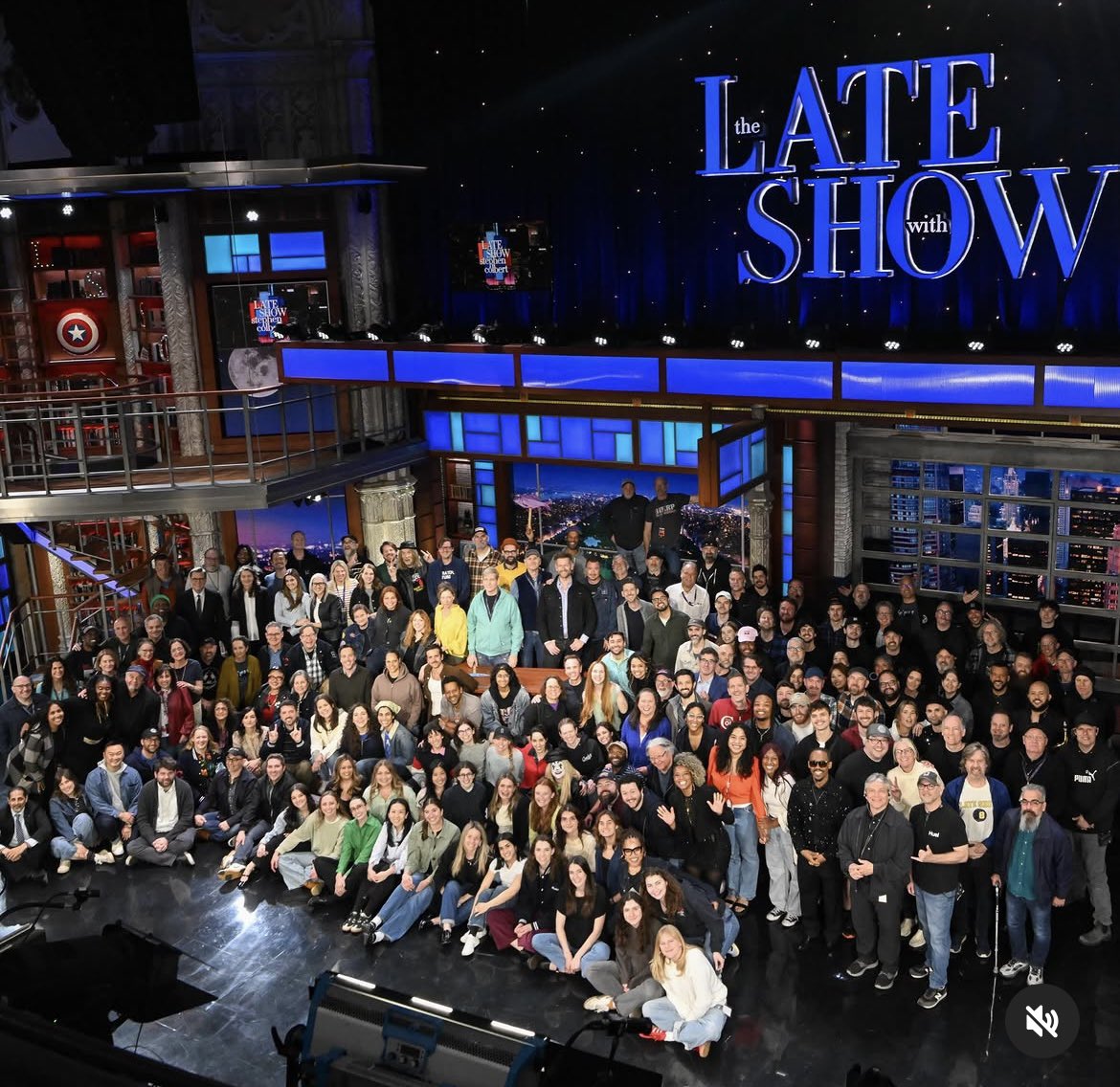
And it’s the reason they were canceled. That head count is more than most decent sized businesses. For 3 jokes a night, at best.
May 22

One of the great group shots of "The Late Show" staff posing on stage:
3,264
6,527
54,861
3,008,761
Tim Groseclose retweeted

May 23
We did this for four years. Does that bother anyone
May 22

2018. Senator Kamala Harris on Colbert's show pretending like she had seen evidence of Trump colluding with Russia.
This is what they turned late night TV into. Clown show.
708
4,402
29,456
941,397
Tim Groseclose retweeted

May 23
I never know whether to be angry or amused by posts like this. Fortunately, a lot of the replies are spot on. The show’s self-awareness of its characters defects was a central part of its charm.
I will add one of few true things that Freud said: “Sometimes a cigar is just a cigar.” Seinfeld was funny.
99
44
1,031
140,965

Tim Groseclose retweeted

May 21
CBS News said there was no evidence of fraud.
The NYT said the Somali community was being targeted
CNN said there was "little evidence."
Tim Walz said it was “white supremacy” to expose fraud
Today: $90M busted and 15 charged.
IT WAS ALL FRAUD AND THEY KNEW.
4,067
50,652
237,741
2,427,263
Tim Groseclose retweeted
May 11
By criticizing @bariweiss hiring decision, the Guardian editors reveal their own employment criterion: If you think the Jewish people deserve a homeland you are out -- the rest shows up in their coverage. @MelanieLatest @guardian
May 11

Believing the Guardian has a right to exist is delusional - i want these sham political rags out of print and out of buisness
3
17
169
5,100
Tim Groseclose retweeted

May 7
People generally nod their head in agreement that there exists a Military Industrial Complex with a financial interest in endless wars. At this point we should also agree there's a Homeless Industrial Complex with deep financial interests in perpetuating homelessness
101
467
2,421
38,402
Tim Groseclose retweeted
May 8
Watched another episode of Ken Burns's American Revolution last night. I'm about halfway through. The social media reaction to the series is interesting, and illustrates what I see as the merits of X over some alternatives.
I initially read posts with complaints about wokeness and had no problem believing them, given Burns's track record. But then I saw pushback from posters whom I know to be as irritated by wokeness as I am and whose judgment I respect, and yet they were saying that the series was terrific.
And they were right. I thought I knew a lot about the Revolution, but I've been learning all sorts of new things, especially in the accounts of battles (brilliant use of maps to show what went on, for example). The portrayals of Washington, Jefferson, et al., are not seriously contaminated by posturing about slave owners and more often make subtle and illuminating points about the problems they faced during the War.
I'm not completely exonerating the Burns' mentality. I've wondered in the past whether the abundant female and minority commentators featured in his documentaries were really experts or were there for cosmetic reasons. I started checking CVs for this series and, as I suspected, many of the women and minorities are academics but have not published anything about the Revolutionary War. They were not selected because they turned up in a search for the top Revolutionary Era scholars. OTOH, their commentaries haven't had any obvious howlers, and often sound perceptive, so I can't say they are dragging down the historical trustworthiness of the series.
I do wonder if Shelby Foote and others who were sympathetic to the South would get as much screen time as they got in Burn's first famous product, The Civil War, if Burns remade it in the 2020s. Kinda doubt it. But the fact remains that The Revolutionary War is (I think) wonderful, and I wouldn't have known that if not for conservatives who do not feel at home on Facebook or Bluesky but are active on X.
65
44
732
42,584
Tim Groseclose retweeted

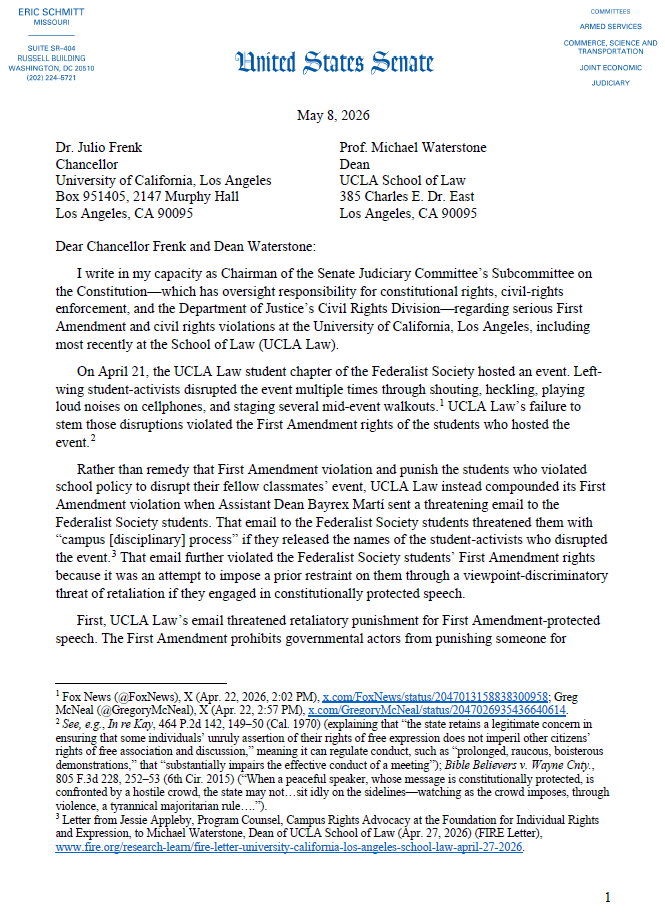
UCLA Law let leftist students disrupt an event hosted by conservative students, and then threatened the conservatives for exposing the incident.
That's unacceptable—and illegal.
As Chairman of the Subcommittee on the Constitution, I'm investigating.
x.com/YitZionist/status/2046…
Apr 21

Truly abhorrent and unimaginable behavior today at the @FedSocUCLA event that hosted a @DHSgov lawyer. Leftist students repeatedly disrupted the event, yelled profanities, shouted, made their phones ping incessantly, and eventually stormed out to a rally that violated all time, place, and manner restrictions. These students can’t handle @FedSoc event about the law, but will remain students at @UCLA_Law and
eventually be admitted to the Bar. It is a damning indictment on higher education that students behave so despicably.
151
1,896
6,571
124,925
Tim Groseclose retweeted

May 9
Every attempt to shut down campus speech should trigger an independent investigation asking two questions:
1) Did administrators do anything to stop the censorship?
2) Did administrators do anything to encourage, excuse, or facilitate it?
Students are responsible for their own actions. But the deeper scandal is administrative complicity.
In a healthy university, the answer to right-wing demands to fire a professor would be: “No way.” And the answer to left-wing attempts to shut down a speaker would be: “Not on my watch.”
Does that sound fanciful? At this point, probably. Because it has become hard to imagine administrators actually acting this way.
The dirty little secret is that too many of them have enabled this for years. Some are hired into ideological jobs built around policing speech, running BRTs, and managing “harm” rather than protecting open inquiry. Sometimes the damage comes through omission: refusing to punish obvious censorship. Sometimes it comes through commission, as at Stanford Law School several years ago, when administrators actively helped the shutdown along. Here, it looks like a combination of both.
So yes, blame the students. They are adults, not infants or automatons. But look squarely at the administrators who are supposed to defend academic freedom and freedom of speech—and who too often undermine those values instead.
We have long since passed the stage where tolerated—and often facilitated—shutdowns and shoutdowns can be treated as somehow distinct from university policy. If campuses allow, and especially if they facilitate, the systematic silencing of locally unpopular points of view, that should not be treated as some weird tragic coincidence. They have the power to stop it. They don’t.
Worse, they often train students to think like censors and then protect them when they act that way. Until universities prove otherwise, the systematic shutting down of unpopular voices on campus should be understood as formal—or at least semi-formal—university policy.
May 8

.@Google's chief scientist and lead for Gemini AI came to UC Berkeley to give a scientific lecture on modern AI research.
He wasn’t there to debate Gaza or Google contracts, but protesters disrupted the event anyway, and within 10 minutes, it was shut down.
20
178
909
72,341
Tim Groseclose retweeted

May 8
anti-Israel activists at Cornell accused the University President of running over 2 students with his car.
The President disputed this account and said they were trying to prevent him from leaving.
The full video is out now. Obvious who was lying.
183
600
5,244
321,663
Tim Groseclose retweeted

May 8
No, AOC, the American Revolution was NOT “against the billionaires of their time.”
It was against a large, distant, overly intrusive government that recognized no limits over its own authority to tax, regulate, and eat out the substance of the citizens it claimed to serve.
May 8

"The American Revolution was against the billionaires of their time" - AOC
Community note
Robert Morris, considered the richest man in America at the time, used his own personal wealth to finance much of the American Revolution. The American Revolution was not against the billionaires as AOC claims when the richest man was funding the war.
x.com/i/status/20529…
constitutioncenter.org/signers/robert…
rmu.edu/about/history/…
en.wikipedia.org/wiki/Robert_Mo…
3,880
8,757
37,791
819,969