
5 Photos and videos


Scuba Steve retweeted

Jun 10
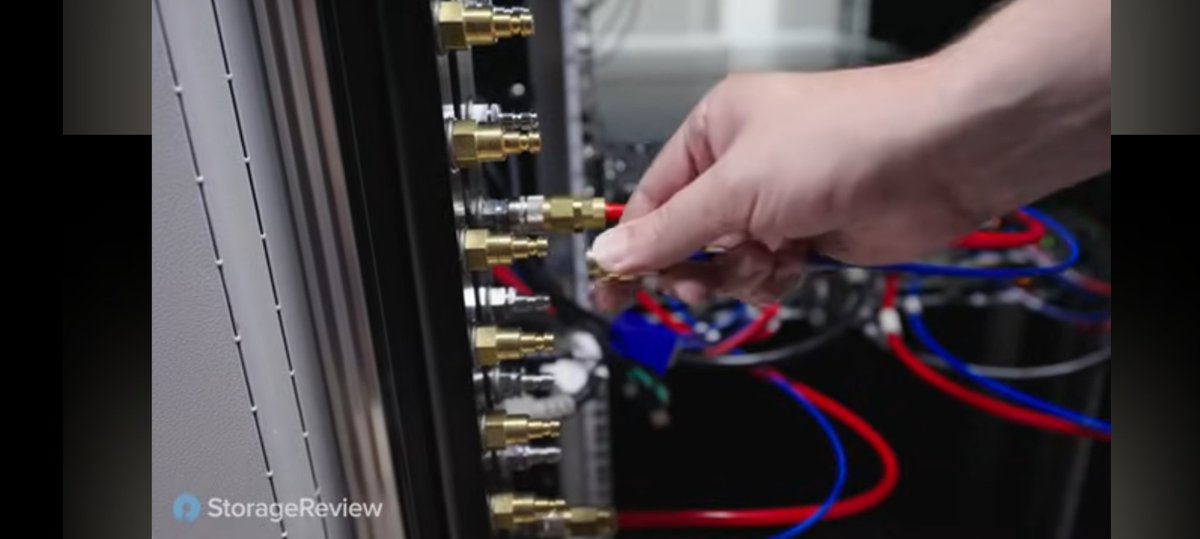
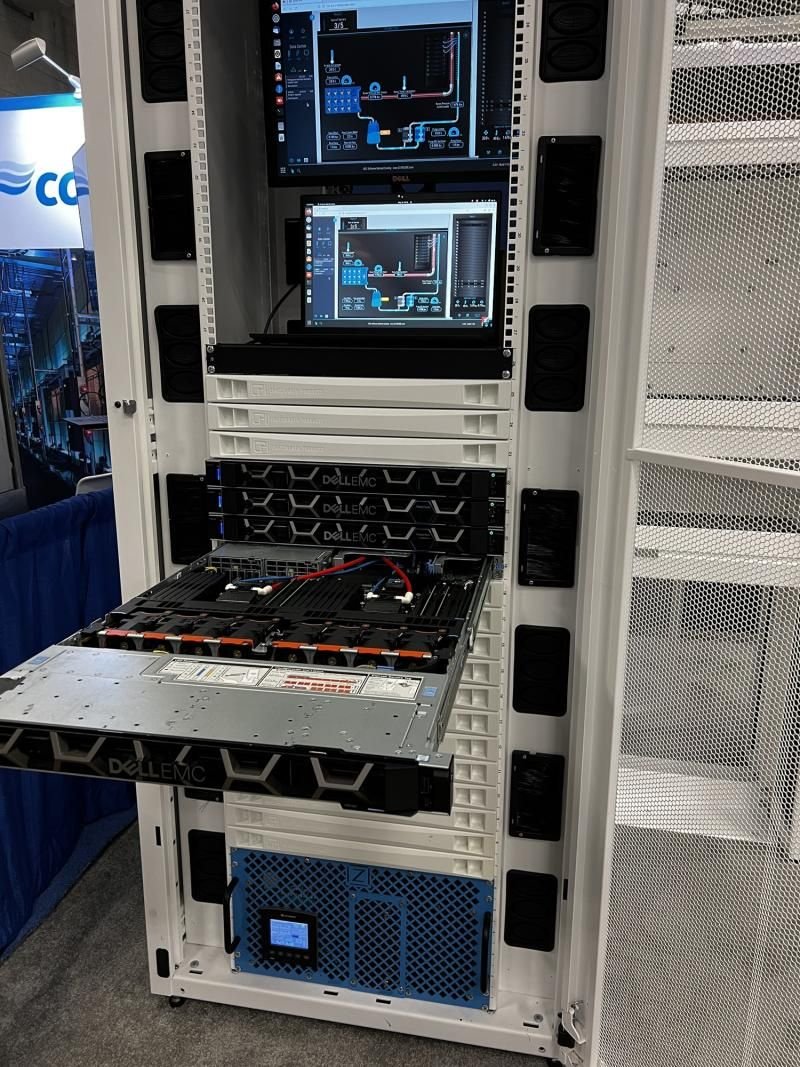
We’ve got NVIDIA B300s running 🚀
Blackwell, live at our tier 3 Columbiana facility. The frontier, online. $DGXX around the clock!
33
53
205
50,942
Scuba Steve retweeted

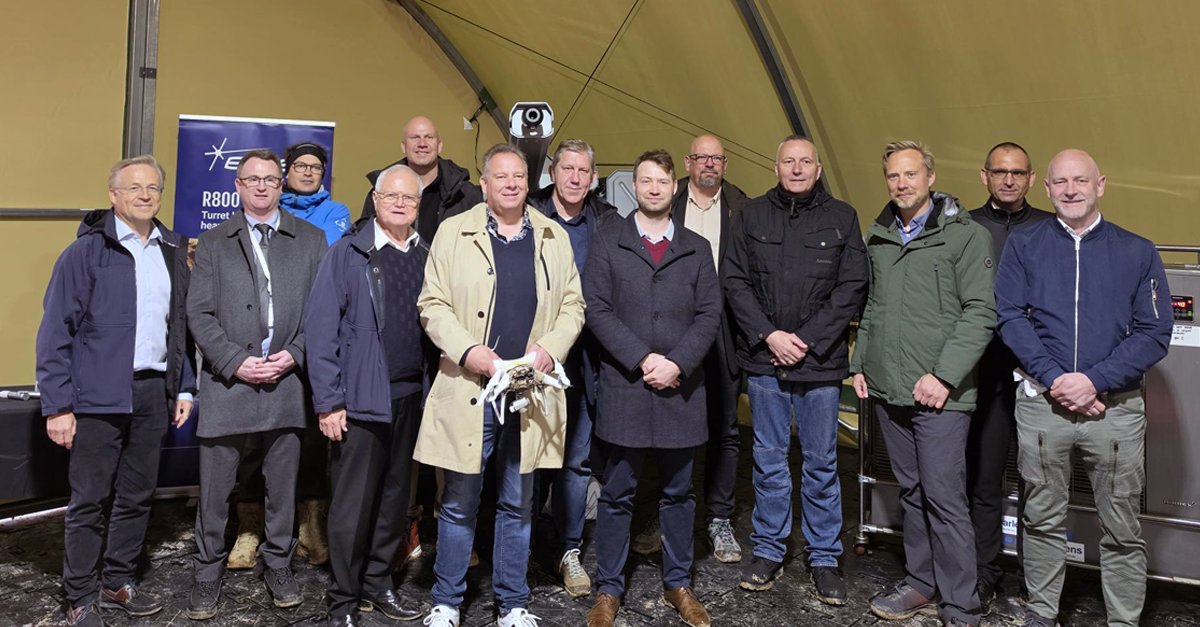
EOS was pleased to welcome a high-ranking German delegation including members of parliament, MOD, WTD-91 and industry to attend a successful live demonstration of our counter-drone high energy laser (Apollo) and space control (Atlas) capabilities. #counterdrone #helw
3
11
56
17,089
Scuba Steve retweeted

$DGXX 🚨
Remember Michel, Alec and Jag are at a conference today in France. It will be a two day conference, maybe we will have news after the conference.
Conference highlights:
-70% of attendees at C-level, VP or Director level
-An event trusted by industry leaders year after year - including Google, AWS, Meta, Equinix and Digital Realty
-200 Speakers and Exhibitors confirmed
-Boardroom-level insights driving investment, growth and risk mitigation across the global ecosystem
-Strategic partnerships that drive revenue and growth

7
48
5,332
Scuba Steve retweeted

Jun 3
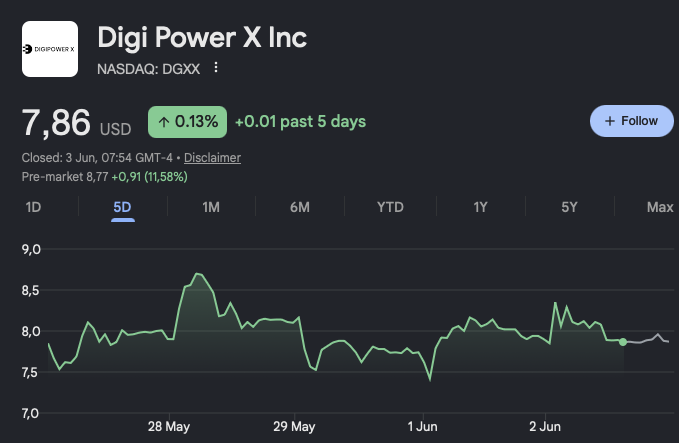
Digi Power X $DGXX committed $35 million from cash on hand to acquire NVIDIA Vera Rubin systems for its NeoCloudz GPU as a Service platform, with initial deployment targeted for Q1 2027. Vera Rubin is NVIDIA's rack scale successor to Blackwell, pairing Rubin GPUs with 288GB HBM4 against the 88 core Vera CPU over NVLink 6. Funding the next generation silicon entirely from balance sheet rather than dilution.
The Alabama campus is the constraint that matters. Phase 1 at 15 MW targets a December 15 2026 ready for service date, scaling to the full 40 MW by end of Q1 2027, which is the same window the Rubin systems are meant to land in. NeoCloudz has been live and processing workloads on deployed B200 and B300 fleet since May 15 2026 and recognized its first AI revenues in May, so the platform clearing real traffic ahead of the capacity step up is the operational tell, not the order itself.
Let's see if $DGXX can regain some momentum on this news
2
8
55
6,649
Scuba Steve retweeted

Jun 2
There's a class of politicians who have had tremendous success by utilising a simple tactic:
1. Talk about the problems.
2. Denounce anyone who talks about the solutions.
People get suckered by point 1, thinking that this must be their guy, but it's just containment & delay.
10
55
494
5,433
Scuba Steve retweeted

May 28
"We have all the assets in place to become the worlds number 1 in counter drone warfare"
Highly recommend watching the video interview with Andreas, CEO of $EOS.AX
vimeo.com/1195845146?fl=pl&f…
6
30
2,984

TL;DR: $EOS.AX is a fully integrated, international defence play at an inflection point valued at only 2x backlog compared to peers at 20x, with its chart looking like it’s on the verge of breaking out on higher timeframes.
Every nation is ramping defence spending. NATO pushing 5% of GDP, Germany's €100B special fund, Japan doubling. The counter drone market is in step change globally and $EOS.AX is shaping up to be one of the largest beneficiaries of this tailwind.
$EOS.AX vs $LASR. Both ride the directed energy wave. The market has only repriced one.
Fundamentals
EOS Q1 cash receipts (leading indicator): A$72.6M ( 220% YoY)
LASR Q1 revenue: $80M ( 55% YoY)
EOS gross margin: 63%
LASR gross margin: 33%
EOS backlog: A$726M pro forma, of which 60-80% will be converted into revenue in FY26/27.
LASR funded backlog: $162M
EOS market cap ~A$1.63B = ~2.2x backlog
LASR market cap ~$4.5B = ~28x backlog
$EOS.AX is growing 4x faster, on a 4.5x larger backlog, at nearly double the gross margin. Trading at one twelfth the multiple.
For the most recent press release on the shelf offering:
“Of the unconditional illustrative order book of AS726m, approximately 60 - 80% is expected to convert to revenue in 2026 and 2027.
EOS' pipeline of potential future orders continues to develop presenting an opportunity for further order book growth. EOS' order opportunity pipeline is dynamic and rapidly evolving, especially during a time of active conflict.”
Post MARSS acquisition, EOS owns the full killchain: detect, decide and defeat. No other directed energy name has this capability.
The most interesting part of the EOS story is the international angle. EOS owns 100% of its laser technology with no US export controls (ITAR free). Netherlands €71M (world first 100kW laser export). Germany shortlisted for the 4,000 weapon system / €1B program. And an accelerating Middle East presence through orders from MARSS acquisition.
And EOS sells into the US too. Huntsville, Alabama facility manufacturing for Northrop Grumman, General Dynamics, and the US Army. Small today, but real and growing.
Moreover, a 300kW Apollo laser upgrade is in negotiation with two counterparties, matching its capabilities with the current incumbent, $LASR.
EOS management has guided for 2026 to be the first profitable year, the company is at an inflection point.
Moving to the charts
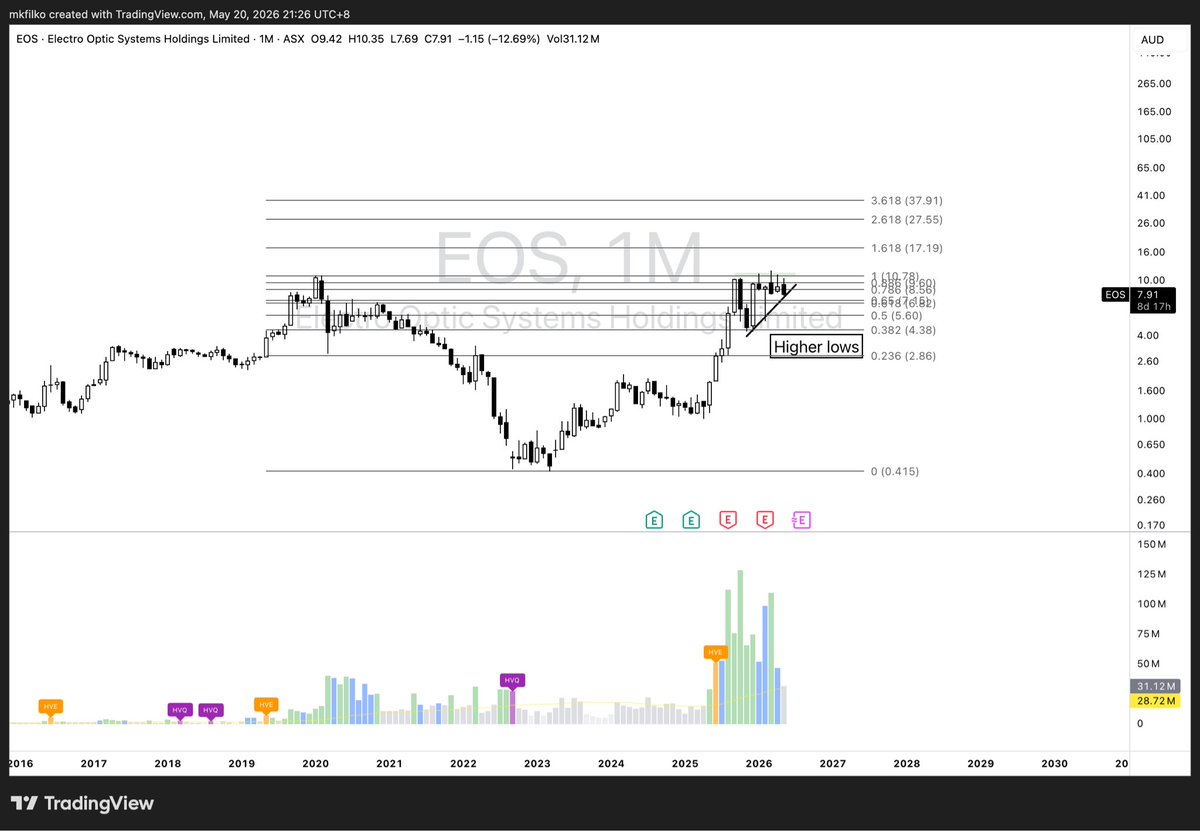
On the monthly, EOS is setting up for a potential stage 2 breakout after hitting all time highs back in 2020 and consolidating for the past 5 years. Price is constantly testing the 0.886 Fib at $9.60, which typically signals price wants to push higher. Notice how it hasn't been able to close above that level for the past 6 to 7 months.
A clean break opens the door to the 1.0 Fib at $10.79, with the 3.618 extension at $38 as the highest upside target.
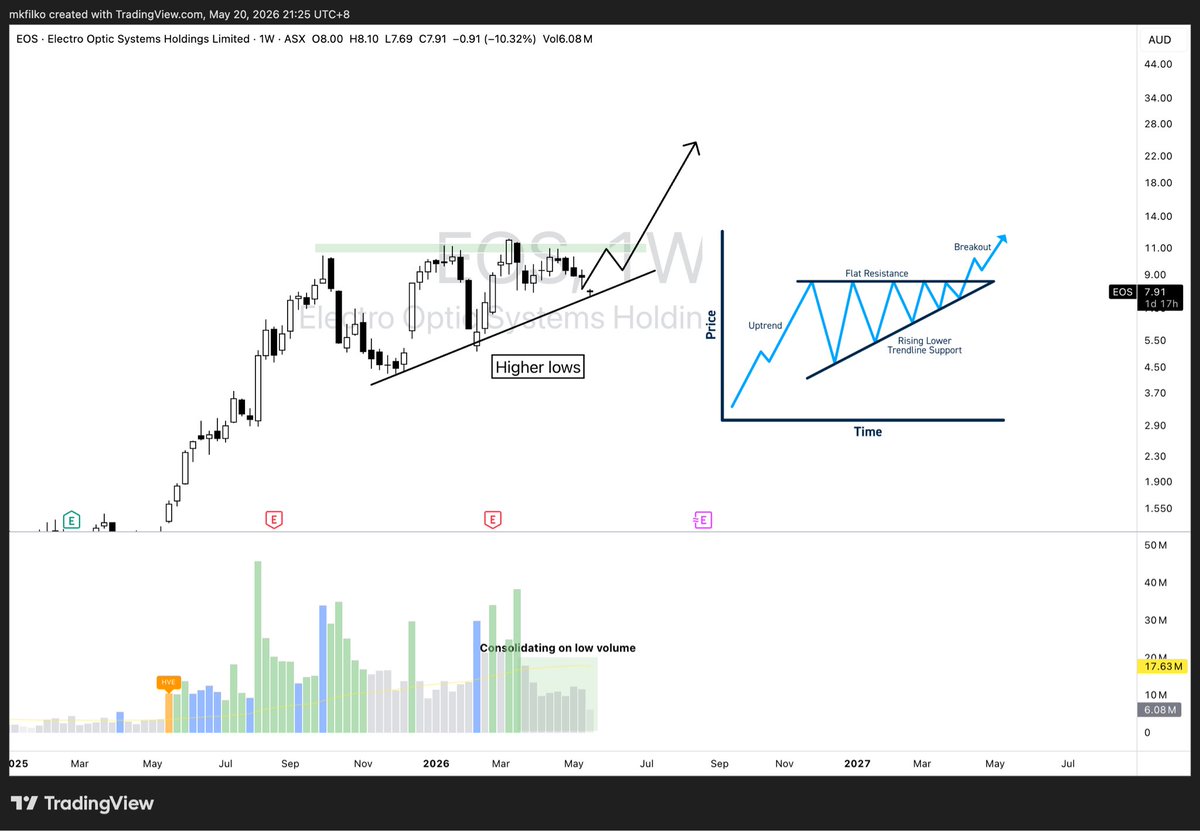
On the weekly, we have a textbook ascending triangle, higher lows pressing into flat resistance around $9.60, consolidating on low volume, which indicates temporary pause rather than weakness.
A rare setup is forming here. I am long $EOS.AX.
Thanks to @YungAds_ and @OptimusDelta for this idea, please visit their profiles if you want even more detailed DD!
6
4
36
36,084
Scuba Steve retweeted

May 15
DEI stands for Datacenter, Electricity and Infrastructure now
111
1,480
16,211
1,174,984
Scuba Steve retweeted

May 14
Claude's first day at Dunder Mifflin
443
2,116
31,874
13,438,918
Scuba Steve retweeted

May 7
$AMZN CEO: “There is a power shortage in the US”
Grid connection wait times for AI data centers are now stretching years while transformer shortages continue worsening
Companies securing power today are positioning themselves for the next decade of AI infrastructure demand
33
92
634
134,357
Scuba Steve retweeted

May 7
Inference got a hundred times cheaper this year. The compute bill went up anyway.
If you understand why those two sentences are both true at the same time, you understand the most important thing happening in AI right now.
I work on inference for a living, at @nebiustf, where we run open-source managed inference at scale. Most of what follows is what I'm seeing from inside the bill.
12 months ago, the cost of 1M tokens of frontier-class reasoning was somewhere on the order of $60.
Today, an equivalent quality of output costs roughly $0.50.
Price /token of o1-level intelligence has dropped about a 128x in a year.
Price of GPT-4-level output has dropped roughly 100x since the original GPT-4 shipped.
By any normal reading of a technology cost curve, this should be deflationary. It should be saving customers money.
The opposite has happened. The total compute bill at every hyperscaler is going up, not down. Anthropic just signed multi-year capacity deals with both XAI and Amazon. Microsoft's Azure capex guide for 2026 starts with an eight. OpenAI is reportedly spending more on compute every quarter than it did in all of 2023. Nvidia paid roughly twenty billion dollars to acquire Groq, an inference-specialist company that did not exist as a serious commercial entity three years ago.
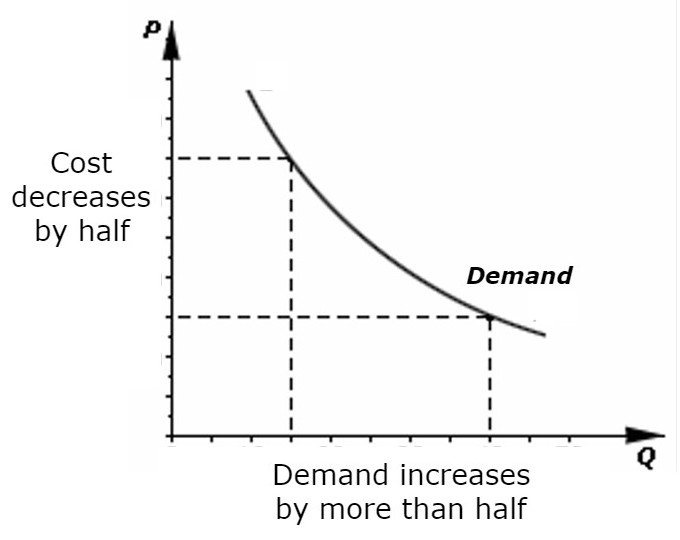
The cost curve and the demand curve crossed, and then the demand curve lapped the cost curve.
Here is what happened underneath.
A reasoning model burns roughly 10x the output tokens of a non-reasoning model on the same task, because it spends most of its tokens thinking out loud before answering. An agentic workflow chains roughly twenty times the requests of a single-shot completion, because it loops, calls tools, plans, retries, and synthesizes. A modern deep-research query (the kind a research analyst can fire off in fifteen seconds and then walk away from for ten minutes) costs more compute than 10 original GPT-4 queries combined. We made every individual token a hundred times cheaper, and then we built a generation of products that consume ten thousand times more tokens.
This is the Jevons paradox playing out at trillion-dollar scale, in compressed time, in front of everyone. Jevons noticed in 1865 that making coal-burning more efficient did not reduce coal consumption. It increased it, because efficiency unlocked uses that were previously uneconomic. Steam engines became more practical at smaller scales. Whole industries that could not afford coal at the old price suddenly could. Britain's coal consumption rose sharply, not despite the efficiency gains, but because of them.
The same thing is happening to AI compute right now and it is happening faster than any analogous historical cycle. Falling token prices did not contract demand. They unlocked agents, deep research, code-writing systems, multi-step reasoning, persistent memory, the entire next layer of AI products. Every product in that next layer consumes orders of magnitude more compute than the chat interfaces it is replacing.
The math at the aggregate level is brutal: 100x cheaper tokens times 10 000 more tokens equals a 100x larger total bill.
The implications stack quickly.
If you are running a hyperscaler, your 2026 capex guide is not a peak. It is a step on a curve. Inference is structurally always-on, twenty-four hours a day, in a way that training never was. Training is bursty. You spin up a cluster, run for weeks or months, and stop. Inference runs continuously, scales with usage, and the usage curve is exponential. Your power bill, your cooling bill, your transceiver count, your storage footprint, all of these were sized for a workload mix that no longer exists.
If you are running an AI software company built on top of someone else's closed API, you have a problem that did not exist a year ago. Your gross margins get worse as your customers get more value out of your product, because the more they use it, the more compute you pay for. The companies that win this are the ones that figured out vertical integration before the math caught them.
If you are watching this from a distance and trying to understand where the next bottlenecks form, the answer is everywhere downstream of "more inference compute, always-on, with massive memory state per session." The KV cache, the running memory state of a long conversation or an agent loop, is the silent monster of the inference era. It does not scale linearly with parameters. It scales linearly with context length and number of agent steps. A long agent session can hold tens of gigabytes of state per user, per session.
Multiply that by every concurrent user of every product, and you understand why $MU, $SNDK, $TOWCF, and the entire memory and packaging layer have re-rated the way they have.
The CPU-to-GPU ratio is evolving. Training is 1:8. Basic chat inference is 1:4. Agentic inference is 1:1, sometimes CPU-heavy. Google has split its TPU line in two, with a dedicated inference chip carrying tripled SRAM for KV cache. $INTC and $AMD just spent two earnings calls explaining that this shift is structural, not cyclical. The hardware map is redrawing in real time and the financial press is mostly still writing about training clusters.
The right framing of where we are right now is not that AI is hitting a wall. The framing a year ago that scaling was hitting a wall was the most expensive bad take of the cycle. The right framing is that AI got dramatically cheaper, dramatically more capable, and dramatically more useful, and the cost of running it at the new equilibrium of demand is much higher than the cost at the old equilibrium of demand, because the new equilibrium is enormous.
A meaningful share of what we actually do at Token Factory, day to day, is help customers stop their bills from running away from them. KV-cache management. Speculative decoding. Quantization. Routing. The kind of vertical integration that, eighteen months ago, every product team was happy to leave abstracted away behind a closed API. The reason this stack matters now is the same reason this whole essay matters: at the new equilibrium of inference demand, the cost of treating compute as a commodity is no longer survivable. The companies that figure out the layer beneath the API are the ones who keep their margins.
Cheaper tokens. More tokens.
Same coal as 1865.
139
419
2,668
681,188
Scuba Steve retweeted
May 5
$NVDA CEO Jensen Huang: “Demand for inference will go up by a billion times.”
By 2030, inference is expected to overtake training and become the majority of AI compute inside data centers
As AI agents are deployed at scale, this will drive inference demand:
28
63
588
136,277
Scuba Steve retweeted

We’re chasing success out of the country.
Britain’s culture has shifted from inherited wealth to earned success, but resentment hasn’t caught up. If we keep penalising business owners and talent, they’ll build elsewhere. And they already are.
We need a shift in both mindset and policy, away from punishing success, and toward actively enabling and backing those who choose to build.
70
305
2,908
69,786
Scuba Steve retweeted

May 5
Introducing SubQ - a major breakthrough in LLM intelligence.
It is the first model built on a fully sub-quadratic sparse-attention architecture (SSA),
And the first frontier model with a 12 million token context window which is:
- 52x faster than FlashAttention at 1MM tokens
- Less than 5% the cost of Opus
Transformer-based LLMs waste compute by processing every possible relationship between words (standard attention).
Only a small fraction actually matter.
@subquadratic finds and focuses only on the ones that do.
That's nearly 1,000x less compute and a new way for LLMs to scale.
1,489
2,871
22,982
12,820,066

May 5
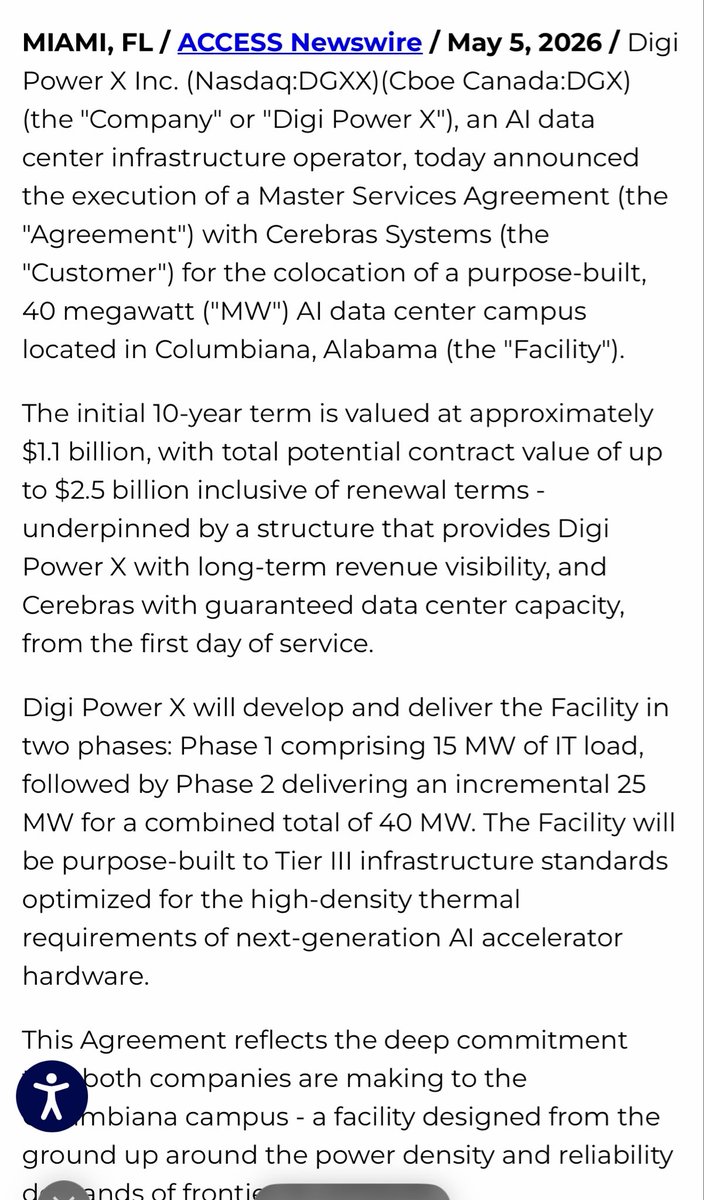
$DGXX 10 year deal signed with Cerebras 🥳 Congrats to all holders, it's been a tough ride at times but belief in the thesis and patience prevails. Rerate has officially begun.
179

Scuba Steve retweeted

Apr 26
All I ever hear the media talk about is right wing violence.
All I ever see are left wing shooters.
1,133
19,020
114,982
964,594
Scuba Steve retweeted

Apr 21
So the EU wants to ban teens from social media — except for LGBTQ content? What a nuanced way to “protect children” online.
Apr 21

🚨 BREAKING: Hungary violated EU law when it banned children from accessing LGBTQ content, the Court of Justice of the EU has ruled.
Read the full story: politico.eu/article/eu-top-c…
1,344
14,931
60,662
2,500,497
Scuba Steve retweeted

Apr 21
We have substantial coal, oil and gas deposits.
The decision not to use them and to phase them out was one made by Parliament, by a green industry lobby sponsored cross-party consensus.
The public was not asked, was given no choice, and offered no debate.
It's your mess.
Apr 21

We’re facing the second fossil fuel shock in less than 5 years.
Events far away are once again impacting families and businesses here at home.
We can’t go on leaving our country so exposed.
The solution lies in clean homegrown power we control.
bbc.co.uk/news/articles/c79j…
17
258
793
9,488