
Web3 research platform with token safety scans, crypto tools, ENS checker, and practical guides to help you make smarter on-chain decisions.
Joined August 2025
- Tweets 5,382
- Following 52
- Followers 242
- Likes 22
448 Photos and videos
Pinned Tweet
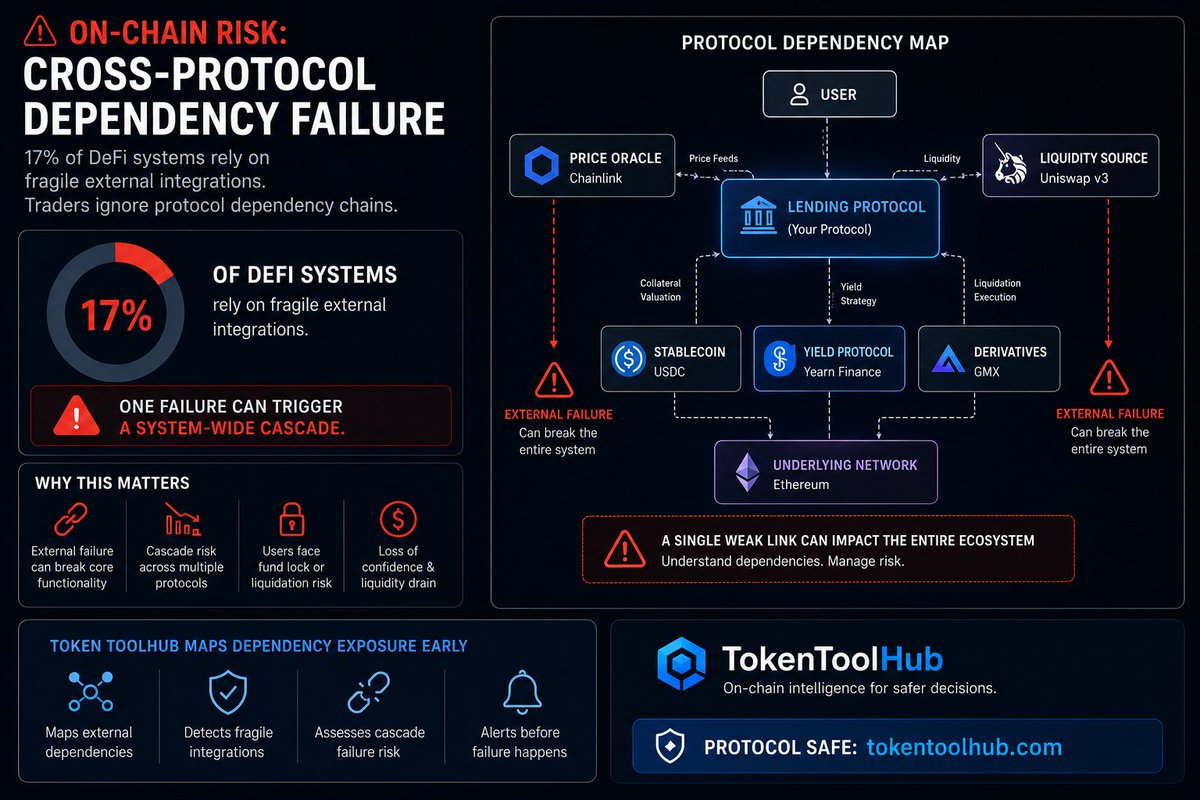
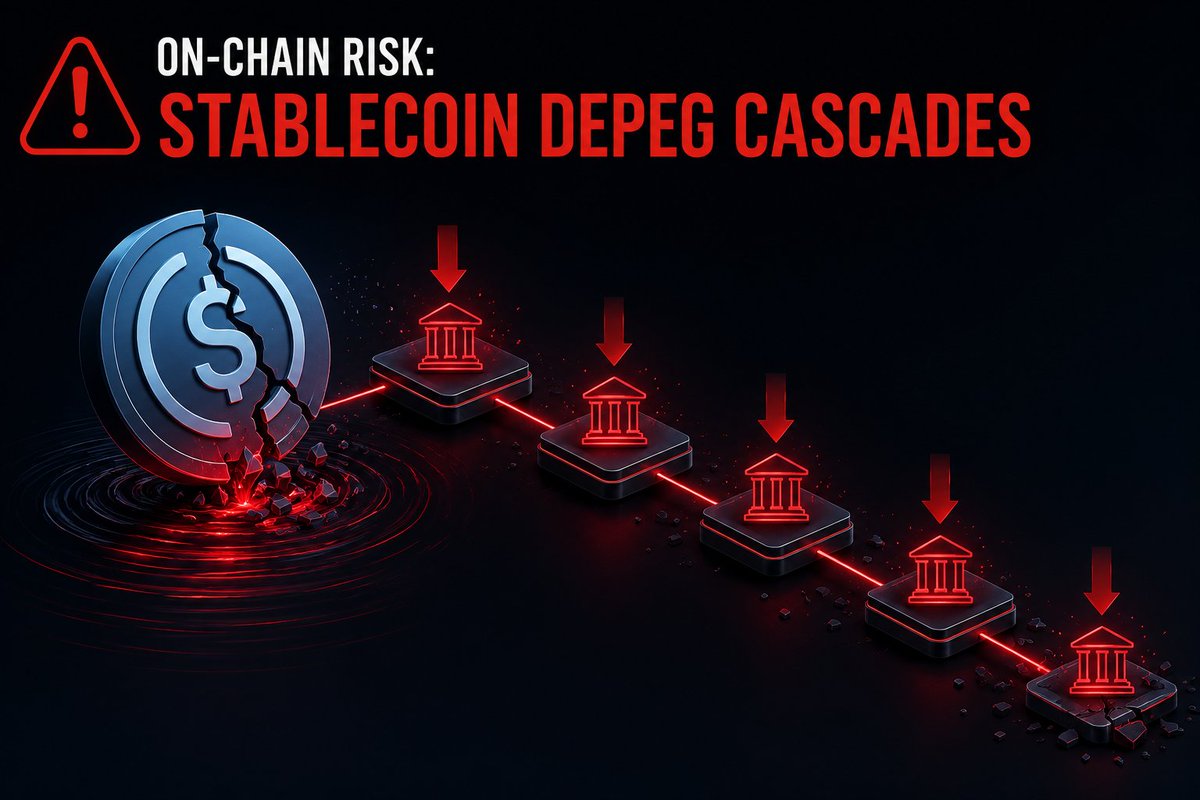
🚨 On-Chain Risk: Cross-Protocol Dependency Failure 🚨
17% of DeFi systems rely on fragile external integrations.
One protocol fails...
multiple protocols suffer.
Most traders ignore dependency chains. 🧵👇
1
1
139
🚀 Crypto Pulse | June 14, 2026 🚀
On-chain market data is moving into a bigger fight.
Pyth Network is pushing deeper into traditional financial data with 24/7 index products across metals, oil, and U.S. equities. This matters because crypto rails are no longer only tracking token prices. They are now competing to bring real-world market feeds into always-open on-chain markets.
Stablecoins are still proving their strongest use case in emerging markets.
Rain’s Latin America report shows about $1.5 trillion in crypto transactions across the region between 2022 and 2025, with dollar-backed stablecoins making up a major share. The key signal is not speculation. It is payments, savings, remittances, treasury movement, and access to dollar liquidity where local currencies remain unstable.
Private-market access is becoming another crypto narrative.
Binance says the projected $225B U.S. IPO wave could increase demand for on-chain pre-IPO exposure. If this trend grows, tokenized private-market access may become one of the next areas where crypto tries to compete with traditional finance.
AI regulation is entering the market-risk conversation.
Reports say Amazon’s security concerns helped trigger U.S. restrictions on Anthropic’s Fable 5 and Mythos 5 models. For crypto, the bigger issue is clear: AI access, cyber risk, and national security rules may start affecting infrastructure companies faster than builders expect.
Robert Kiyosaki is again warning about dollar savings.
His latest message repeats a familiar macro argument: debt, inflation, and money creation are pushing investors toward hard assets like gold, silver, Bitcoin, and Ethereum. Whether traders agree or not, the narrative keeps Bitcoin inside the wider discussion about currency trust.
TokenToolHub takeaway:
Today’s market is not only about Bitcoin price.
The bigger story is infrastructure.
Market data is going on-chain.
Stablecoins are becoming practical financial rails.
Pre-IPO access is moving toward tokenized exposure.
AI model controls are becoming a policy risk.
And macro voices are still using Bitcoin as a hedge against fiat uncertainty.
The next advantage goes to users who understand the systems behind the headlines, not just the coins moving on the chart.
2
19
Upgradeable Beacon Proxies are one of the most powerful upgrade patterns in Ethereum.
But they also create one of the largest hidden concentration risks in smart contract architecture.
Most users understand that a proxy can be upgraded.
Far fewer understand that a Beacon Proxy allows a single beacon contract to control the implementation logic used by many proxies at once.
That means:
• One beacon upgrade can affect hundreds or thousands of contracts
• One governance mistake can impact an entire protocol
• One compromised admin key can change behavior across every connected proxy
• One storage layout error can break an entire ecosystem
The benefit is obvious:
✓ Mass upgrades
✓ Shared logic
✓ Easier maintenance
✓ Better scalability for factory deployments
The risks are equally important:
⚠ Malicious upgrades
⚠ Weak ownership controls
⚠ Missing timelocks
⚠ Uninitialized implementations
⚠ Storage layout corruption
⚠ Delegatecall surprises
⚠ Governance failures
⚠ User inability to detect upgrade changes
Beacon proxies are commonly used for:
• Vault systems
• Factory deployments
• Account systems
• Marketplaces
• Modular protocols
• Multi-instance applications
The critical security question isn't whether a protocol uses beacon proxies.
The question is:
Who controls the beacon?
And what protections exist before upgrades reach users?
Before trusting any protocol built on beacon proxies, review:
• Beacon ownership
• Upgrade history
• Implementation contracts
• Timelocks
• Multisig controls
• Audit reports
• Emergency mechanisms
Beacon proxies scale upgrades.
But they also scale mistakes.
Read the complete security deep dive:
tokentoolhub.com/upgradeable…
2
70
Gas fees are no longer just a Solidity optimization problem.
In the post-EIP-4844 Ethereum ecosystem, the cost a user pays is influenced by:
• L2 execution gas
• L1 data availability costs
• Blob markets
• Calldata fallback mechanisms
• Compression efficiency
• Transaction batching
• ERC-4337 account abstraction
• Paymaster sponsorship policies
• Sequencer economics
• Wallet behavior
Many teams focus on reducing contract gas while ignoring the larger user experience problem.
Users don't care about gas theory.
They care whether the action works quickly, predictably, and at a reasonable cost.
The biggest fee reductions often come from:
✓ Better batching strategies
✓ Compression-friendly data structures
✓ Fewer storage writes
✓ Cleaner event logging
✓ Intelligent route selection
✓ Blob-aware architecture
✓ Efficient RPC infrastructure
EIP-4844 changed the economics of rollups by introducing blob transactions, but blobs are not free forever.
Blob markets have their own fee dynamics.
Builders who assume permanently cheap blob pricing are creating future scaling risks.
Paymasters can make transactions feel gasless, but poorly designed sponsorship systems can become abuse vectors and budget leaks.
The best Ethereum dApps optimize more than cost.
They optimize success rate.
A cheap transaction that fails, retries multiple times, or forces users to switch chains is still a bad experience.
Gas engineering today is really product engineering.
It combines protocol design, infrastructure, user experience, data availability strategy, and smart contract optimization into a single discipline.
If you're building on Ethereum, understanding modern fee architecture is becoming a competitive advantage.
Read the complete guide:
tokentoolhub.com/gas-fee-opt…
2
4
34
118
Crypto Pulse | June 13, 2026
Crypto markets are ending the week with a mix of institutional momentum, security concerns, AI integration, and regulatory developments.
Bitcoin stabilized above the $63,000 level after one of its weakest weeks in months, with analysts increasingly debating whether the recent $59K zone marked a local bottom. Some market observers are now watching the $70K region as the next major upside target.
The SEC approved a new actively managed crypto ETF structure that includes exposure eligibility for assets such as BTC, ETH, XRP, SOL, DOGE, and XLM, signaling continued expansion of institutional crypto products.
Tokenization remains one of the strongest themes across the industry. Ethena committed $250M to Securitize’s tokenized credit initiative on Solana, while discussions around SpaceX tokenized shares highlighted both the demand and limitations of blockchain-based access to traditional assets.
AI and crypto continued converging. Ripple expanded its AI tooling ecosystem with support for XRP and RLUSD payments, while reports around Anthropic’s advanced AI models reignited discussions about digital sovereignty and technology access.
Security remains a major concern. DefiLlama reported Q2 2026 as crypto’s most exploited quarter on record, while authorities announced major actions against a dark-web laundering network linked to over 10,000 BTC in transaction volume.
Global regulation continues evolving. Zimbabwe introduced a formal registration framework for crypto firms, Brazil advanced CBDC guardrail proposals, and South Korean authorities expanded investigations involving Bithumb leadership.
TokenToolHub Takeaway:
The market narrative is shifting from speculation back toward infrastructure.
The biggest stories today are ETF expansion, tokenized real-world assets, AI-powered payment networks, and regulatory frameworks that are beginning to define how crypto integrates into the broader financial system.
1
1
50

Jun 12
Restaking is often described as "extra yield on ETH."
That description misses the most important part.
Restaking is actually a shared security marketplace.
EigenLayer allows already-staked ETH and liquid staking tokens to secure additional services beyond Ethereum itself. In return, restakers may earn extra rewards from operators, AVSs (Actively Validated Services), incentives, points, or revenue-sharing arrangements.
But those rewards are not free.
Every additional reward comes with additional risk.
The key participants are:
• Restakers providing economic collateral
• Operators running infrastructure
• AVSs purchasing security
• Protocols defining slashing conditions
The upside:
• Additional earning opportunities
• More efficient capital utilization
• Security bootstrapping for new protocols
• Expanded Ethereum ecosystem utility
The risks:
• Smart contract vulnerabilities
• Operator failure
• Correlated slashing events
• Liquidity constraints
• Governance failures
• Layered exposure through LSTs and LRTs
• Unclear AVS risk models
One useful way to think about restaking:
Traditional staking secures Ethereum.
Restaking extends trust into additional systems.
That means you are effectively underwriting risks beyond Ethereum's core consensus layer.
Before restaking, understand:
• What AVSs are being secured
• How slashing works
• Who operates the infrastructure
• What your exit options are
• Whether rewards justify the added risk
The highest yields are not always the best opportunities.
Often they simply compensate for risks that have not yet been fully understood.
Read the complete guide:
tokentoolhub.com/restaking-e…
190
Jun 12
Upgradeable tokens change one of the most important assumptions in crypto:
The token address may stay the same while the rules underneath it change.
That can be a major advantage.
Security vulnerabilities can be patched.
Features can be improved.
Protocol efficiency can increase.
But it also introduces a new layer of risk.
A future upgrade could change permissions, transfer rules, fee structures, blacklist logic, treasury controls, or governance mechanisms.
As a holder, the key questions are:
• Is the token upgradeable?
• Who controls upgrades?
• Is there a timelock?
• Are upgrades publicly announced?
• Are contracts verified?
• Can permissions change after launch?
• What happens if governance is compromised?
Most upgradeable tokens rely on proxy architectures where the implementation contract can be replaced while users continue interacting with the same token address.
This means "I checked the contract once" is not enough.
You need a process for monitoring meaningful changes over time.
Upgrade risk is not only technical.
Attackers frequently exploit social engineering by pushing fake migration links, fake upgrade announcements, and malicious contract replacements.
Understanding upgradeability is now a core part of token due diligence.
Read the full guide:
tokentoolhub.com/upgradeable…
113
Jun 12
Crypto Pulse | June 12, 2026
Markets are balancing macro uncertainty, institutional adoption, and the growing convergence between crypto and traditional finance.
SpaceX dominated headlines as tokenized and synthetic trading markets surged ahead of its highly anticipated public debut. Binance-linked tokenized exposure reportedly attracted hundreds of millions in volume, while traders continue using crypto markets for real-time price discovery.
Bitcoin remains resilient near key support levels despite geopolitical pressure surrounding the Strait of Hormuz and mixed ETF demand signals. Some analysts see weakening momentum, while others continue watching for a move toward the $75K region.
Regulatory sentiment continues to improve in the U.S. The SEC’s reported willingness to revisit Rule 611 is being viewed as a potential boost for tokenized equities, while CFTC leadership signaled support for ending regulation-by-enforcement approaches.
Institutional adoption keeps accelerating. BlackRock’s Bitcoin income ETF is nearing launch, Metaplanet expanded its Bitcoin financial ecosystem strategy through acquisition, and Figure announced a $717M deal aimed at scaling blockchain-powered lending.
Meanwhile, authorities across 11 countries dismantled a $390M crypto laundering network, highlighting the continued maturation of compliance and enforcement efforts across the industry.
TokenToolHub Takeaway:
The biggest story today is not price.
Tokenized stocks, synthetic IPO trading, Bitcoin financial products, regulatory reform, and institutional lending infrastructure are increasingly merging into one market. The gap between traditional finance and crypto continues to shrink.
83
Jun 11
Cashflow tokens sound simple:
"Hold the token. Earn the revenue."
But the reality is far more complex.
A legitimate cashflow token needs a verifiable mechanism that converts real economic activity into holder value through distributions, buybacks, burns, utility credits, staking rewards, fee routing, or treasury-based systems.
The strongest designs connect actual product usage to token demand.
The weakest designs market "cashflow" while hiding unlimited mint authority, blacklist controls, opaque treasury wallets, unsafe fee routers, discretionary revenue claims, or tokenomics that dilute holders faster than revenue can support them.
Before trusting any revenue-sharing token, ask:
• Where does the revenue come from?
• Who controls the treasury?
• How is value routed to holders?
• Can fees be changed?
• Can supply be inflated?
• Are contracts upgradeable?
• Is the process transparent and auditable?
Revenue claims are easy to make.
Verifiable cashflow is much harder.
Read the full guide:
tokentoolhub.com/cashflow-to…
77
Jun 11
Web3 social tokens can unlock new ways for creators to monetize communities, reward contributors, and build direct relationships with supporters.
But social tokens fail when speculation becomes the product.
The strongest creator economies are built around access, utility, reputation, contribution, and transparent governance, not hype-driven price action.
Before launching a social token, creators should think about token design, treasury transparency, community incentives, compliance risks, wallet security, and long-term trust.
Read the full guide:
tokentoolhub.com/web3-social…
97
Jun 11
Crypto Pulse | June 11, 2026
Crypto is seeing a clear rotation today: Bitcoin strength, tokenization funding, stablecoin adoption, and tighter global regulation.
Bitcoin is holding above a key long-term technical level while ETH, SOL, and XRP struggle to reclaim the same strength. BTC dominance has also climbed, showing capital is rotating back toward the largest asset as altcoins remain under pressure.
Wall Street blockchain rails are gaining serious funding. Digital Asset raised $355M in an a16z-led round at a $2B valuation, as banks continue building on Canton Network for tokenized finance.
Ondo Finance also hired former Invesco ETF executive John Hoffman to expand onchain investment products, another sign that tokenized funds are moving closer to mainstream asset management.
Japan’s crypto bill advanced, opening a path toward ETF approvals, clearer financial-market classification, and possible tax reform.
BlackRock’s income-paying Bitcoin ETF is also nearing launch, using covered calls on IBIT to create yield exposure.
Stablecoins remain one of the strongest narratives, with Dragonfly projecting major payments growth while South Africa debates whether regulation could limit participation.
TokenToolHub Takeaway:
The market is no longer just trading crypto prices. Institutions are building rails, banks are studying stablecoins, asset managers are launching Bitcoin income products, and governments are rewriting crypto rules.
The next cycle may be driven less by hype and more by regulated infrastructure.
1
83
Jun 10
Prediction markets for equities sound simple:
Create a market around a stock outcome and let participants price the probability.
The reality is far more complex.
Reliable oracle infrastructure, corporate action handling, settlement finality, objective resolution criteria, tokenized equity frameworks, and privacy-preserving ZK systems all need to work together before these markets can scale safely.
Without trustworthy data feeds and clearly defined outcome rules, prediction markets quickly become dispute machines instead of financial infrastructure.
Our latest research breaks down:
• Equity-linked event contracts
• Oracle roadmap design
• Tokenized equity settlement
• ZK confidentiality models
• Corporate action challenges
• Attack surfaces and risk models
• Evaluation frameworks for traders and builders
Full article:
tokentoolhub.com/prediction-…
161
Jun 10
🚨 Crypto Pulse | June 10, 2026
Markets remain under pressure as Bitcoin trades near $61K following its worst weekly decline since the FTX collapse, with roughly $390B erased from the crypto market.
• BTC traders are watching U.S. inflation data closely as another hot CPI print could push Bitcoin back below $60K.
• XRP slipped toward $1.10 as selling intensified, though on-chain data suggests capitulation may be emerging among holders.
• Bitmine added another 75,000 ETH ($123M), pushing its Ethereum treasury above 5.4M ETH and reinforcing the institutional ETH accumulation trend.
• Morpho raised $175M at a $2B valuation with backing from Paradigm, a16z, and Ribbit Capital, showing strong investor confidence in DeFi infrastructure.
• Japan’s largest banks are moving toward a joint stablecoin initiative, while U.S. stablecoin regulations continue to face industry pushback.
• DefiLlama introduced tracking for pre-IPO perpetual markets tied to OpenAI, Anthropic, SpaceX, and Quantinuum, highlighting growing demand for tokenized exposure to private companies.
• Chainalysis expanded cooperation with South Korean authorities as crypto crime enforcement efforts accelerate globally.
🔍 TokenToolHub Takeaway:
Price action remains weak, but capital continues flowing into Ethereum, DeFi, stablecoins, and tokenized markets. The market may be risk-off today, but builders and institutions are still positioning for what’s next.
157
Jun 10
BTCFi is creating new ways for Bitcoin holders to earn yield, but every yield source introduces new risks.
Wrapped BTC, lending markets, staking-style systems, liquidity pools, bridges, custodians, and approval-based contracts all create additional attack surfaces beyond simply holding BTC.
The key question is not how much yield a strategy offers.
The key question is who is paying that yield, why it exists, and what risks you are accepting in exchange.
Before entering any BTCFi protocol, understand the approval model, revocation process, smart contract risks, bridge exposure, and liquidity conditions.
Read the full guide:
tokentoolhub.com/btcfi-yield…
2
4
186
AI will not magically make DeFi yield farming profitable.
It can also automate mistakes faster than humans can stop them.
The real edge comes from using AI as a disciplined workflow for:
• Opportunity discovery
• Risk scoring
• Backtesting
• Strategy execution
• Wallet monitoring
• Yield optimization
• Tax recordkeeping
The best AI-driven yield strategies optimize for risk-adjusted returns, not headline APY.
High APY can hide thin liquidity, reward-token inflation, admin risk, oracle dependence, bridge exposure, and exit traps.
Before deploying capital, understand the rules, test the strategy, and verify the contracts.
Read the full guide:
tokentoolhub.com/integrating…
1
94
Most users bring an Ethereum mindset into Solana approvals.
That is a mistake.
On Solana, SPL token approvals work through delegates on specific token accounts, not a universal ERC-20 allowance table.
One careless approval, one malicious delegate, or one overlooked Token-2022 extension can expose funds in ways users often do not notice until it is too late.
Key takeaways:
• Delegates operate at the token-account level
• Revoking removes the active delegate and resets delegated amounts
• Token-2022 introduces additional permission and extension models
• The biggest risk is signing transactions you do not fully understand
• Approval hygiene is now a critical part of Solana wallet security
Understanding approvals is no longer optional for serious Solana users.
Read the full guide:
tokentoolhub.com/solana-toke…
1
58
🚀 Crypto Pulse | June 9, 2026 🚀
Bitcoin is back near the miner stress zone.
BTC hovered around $63.5K, a level analysts say is close to the average cost of mining one bitcoin. That matters because when price trades near production cost, weaker miners face tighter margins, selling pressure can rise, and the market starts watching whether miners hold, sell, or reduce operations.
Stablecoin use is also moving deeper into traditional finance.
Coinbase and Cardless unveiled a credit card backed by stablecoins, pointing to a bigger shift: stablecoins are no longer just settlement tools for traders. They are becoming collateral, payment rails, and consumer finance infrastructure.
Prediction markets are getting more institutional.
Kalshi signed a multi-year deal with Sportradar to use official league data and integrity tools. This gives prediction markets cleaner data feeds, but it also shows the sector is becoming more regulated, more structured, and more closely watched.
Crypto regulation remains a major pressure point.
More than 200 crypto firms are pushing the U.S. Senate to move forward with the CLARITY Act. The message is simple: the industry wants clearer rules before the next election cycle turns crypto into another political battlefield.
AI agents are becoming a new crypto risk layer.
Experts warned that autonomous AI agents connected to crypto wallets could create major security and compliance problems. If AI systems can move money, sign transactions, and interact with smart contracts, then wallet permissions, private key safety, and transaction monitoring become even more important.
TokenToolHub takeaway:
Today’s crypto market is being shaped by more than price action.
Bitcoin miners are under pressure.
Stablecoins are entering credit products.
Prediction markets are professionalizing.
Regulators are being pushed to act.
And AI agents are creating a new category of wallet and smart contract risk.
The next cycle will not only reward people who watch charts.
It will reward people who understand infrastructure, regulation, liquidity, and hidden risk before the market reacts.
2
77
Choosing an RPC provider is not a cosmetic infrastructure decision.
It affects:
• Latency
• Uptime
• WebSocket stability
• Archive access
• Failover reliability
• Analytics freshness
• Transaction execution
• Developer productivity
In our latest comparison, we break down QuickNode vs Chainstack across supported networks, developer tooling, performance, infrastructure flexibility, pricing considerations, and production readiness.
QuickNode is often the stronger default for teams that want fast onboarding, extensive tooling, Streams, Webhooks, and a polished developer experience.
Chainstack is often the stronger fit for teams that want dedicated nodes, multi-cloud flexibility, infrastructure control, archive access, and infrastructure-oriented deployments.
The right choice depends on what you're building, your workload profile, and how much control you need over your infrastructure layer.
Read the full comparison:
tokentoolhub.com/quicknode-v…
1
49
🚀 Crypto Pulse | June 8, 2026 🚀
Bitcoin recovery, Strategy’s resumed buying, South Korean exchange scrutiny, and the wider market rebound shaped today’s crypto cycle.
Bitcoin climbed back above $63,000 after last week’s sharp selloff pushed BTC below $60,000 and triggered heavy liquidations across the market.
The rebound came as the Nasdaq also clawed back part of its recent losses, giving risk assets some breathing room after one of the roughest trading stretches of the year.
This does not mean the market is fully healthy again.
It means buyers are defending key levels while traders reassess whether last week’s breakdown was capitulation or the start of a deeper repricing.
Bitcoin’s move matters because the broader digital asset market is still being driven by macro pressure, ETF flow weakness, institutional positioning, and confidence around upcoming crypto legislation.
When BTC holds above major support, altcoins breathe.
When BTC loses that support, leverage gets flushed quickly.
That is exactly what the market saw after the recent liquidation wave.
Strategy also returned to Bitcoin accumulation, buying 1,550 BTC for about $101.3 million after its controversial 32 BTC sale.
The purchase brought Strategy’s total holdings to 845,256 BTC.
This was important because the earlier sale created doubt around the company’s long-term “never sell” perception.
Even though the 32 BTC sale was small compared to its total holdings, the symbolism mattered.
Now, the latest purchase suggests Strategy is trying to reassert its accumulation posture while also managing preferred stock obligations and treasury structure.
The market takeaway is simple:
Strategy is still a major Bitcoin buyer, but investors are now paying closer attention to how its balance sheet, preferred shares, cash reserves, and BTC holdings interact.
That makes the Strategy trade more complicated than before.
South Korea also returned to the spotlight after reports that police raided Bithumb’s offices in connection with a lawmaker hiring favoritism probe.
The issue reportedly centers on allegations tied to the employment of a lawmaker’s son and whether influence was used in the hiring process.
This is not just a local exchange story.
It shows how crypto platforms are becoming more exposed to political, regulatory, and governance scrutiny as they become systemically important in major markets.
South Korea remains one of the most active crypto trading regions in the world.
Any probe involving a major exchange can quickly become a broader confidence issue for centralized platforms.
Meanwhile, daily crypto coverage also pointed to wider market pressure and fast-moving regulatory narratives.
Traders are watching whether crypto legislation in the U.S. can regain momentum, whether ETF outflows stabilize, and whether institutions continue buying after last week’s risk-off shock.
The rebound above $63,000 is constructive.
But it is not yet confirmation that the market has fully reset.
The real confirmation would come from sustained spot demand, improving ETF flows, stronger BTC dominance stability, and less forced liquidation across altcoins.
Today’s market signal:
Bitcoin recovered above $63K after falling below $60K.
Strategy resumed BTC buying with a 1,550 BTC purchase.
Crypto liquidations remain a warning sign for overleveraged traders.
Bithumb faced fresh scrutiny in South Korea.
Regulation, institutional flows, and macro risk are still driving the market more than hype.
Takeaway:
Crypto is trying to recover, but the market is not risk-free.
Bitcoin’s bounce shows demand still exists.
Strategy’s purchase shows institutional treasury conviction is not dead.
But the recent liquidation wave, ETF outflows, and exchange-related investigations show that confidence remains fragile.
Watch who is buying, who is forced out, which exchanges are under pressure, and whether liquidity is returning naturally or temporarily.
3
85
Crypto Pulse | June 8, 2026
Markets are attempting to stabilize after last week’s sharp selloff, but investors remain split between bottom-calling signals and macro uncertainty.
• Bitcoin reclaimed the $63,000 level as institutional buyers stepped back in and risk assets recovered alongside traditional markets. Several on-chain metrics, including MVRV, are now entering zones historically associated with major cycle bottoms.
• Strategy (formerly MicroStrategy) resumed accumulation, purchasing 1,550 BTC worth roughly $101 million, bringing total holdings to more than 845,000 BTC. The move comes just days after its widely discussed 32 BTC sale.
• Ethereum’s institutional story continues to strengthen. Bitmine announced holdings of 5.54 million ETH, representing approximately 4.59% of Ethereum’s total supply, while Chairman Tom Lee argued that AI systems will increasingly drive demand for decentralized infrastructure.
• AI and crypto moved another step closer as MetaMask unveiled an AI-agent wallet with built-in security controls designed to help autonomous agents interact more safely with blockchain networks.
• South Korea’s crypto sector faced fresh scrutiny after authorities raided Bithumb again as part of an investigation involving alleged hiring favoritism connected to a lawmaker’s family member.
• Chinese courts reinforced the legal status of Bitcoin as property after sentencing a man who stole 107 BTC using a memorized seed phrase, highlighting that crypto-related crimes continue to receive serious legal treatment.
• Altcoins joined the recovery rally, with NEAR and TAO among the strongest performers as most assets in the CoinDesk 20 Index traded higher.
TokenToolHub Takeaway:
The market narrative is shifting from panic to positioning. Institutions continue accumulating Bitcoin and Ethereum while infrastructure builders push deeper into AI, tokenization, and blockchain adoption. Recovery remains fragile, but capital is clearly moving back toward long-term conviction plays rather than speculative hype.
67
🚨 On-Chain Risk: Cross-Protocol Dependency Failure 🚨
17% of DeFi systems rely on fragile external integrations.
One protocol fails...
multiple protocols suffer.
Most traders ignore dependency chains. 🧵👇
1
1
139
Red flags traders overlook:
• Heavy oracle dependence
• Reliance on a single bridge
• Concentrated liquidity sources
• Complex integration stacks
The more dependencies...
the larger the attack surface.
1
17
TokenToolHub maps:
• External integrations
• Dependency chains
• Cascade-failure pathways
• Protocol exposure levels
Because understanding dependencies
means understanding risk.
Protocol safe
tokentoolhub.com
15