
The trust engine behind a new class of messaging, payments, and culture apps. Msgs that unlock value - without spam, friction, or extraction. Built on Hedera.
Joined December 2025
- Tweets 52
- Following 36
- Followers 28
- Likes 41
1 Photos and videos
Pinned Tweet

24 Dec 2025
Messaging apps assume trust. Payment apps avoid it. Culture platforms extract it.
We built the missing layer that lets conversations safely unlock actions, payments, and value. TrustMesh is the engine for a new class of msging, pymnts, and culture apps - where trust is native.
3
11
276
TrustMesh treats privacy not as a feature, but as infrastructure.
1
1
46

Before money ever changes hands, a subtler currency is exchanged... and that currency is trust.
1
2
87
The question isn’t who are you, it’s what trust has been explicitly granted to you, by whom, and in what context.
1
1
52

I didn’t go into the Hedera hackathon planning to build “a trust protocol.”
I went in with a vague frustration:
Smart people. Real work.
Zero proof that actually travels outside the room.
Somewhere between coffee no. 3 and a broken demo, that frustration got a name.
1
1
5
60
Trust isn’t a vibe. It’s a system.
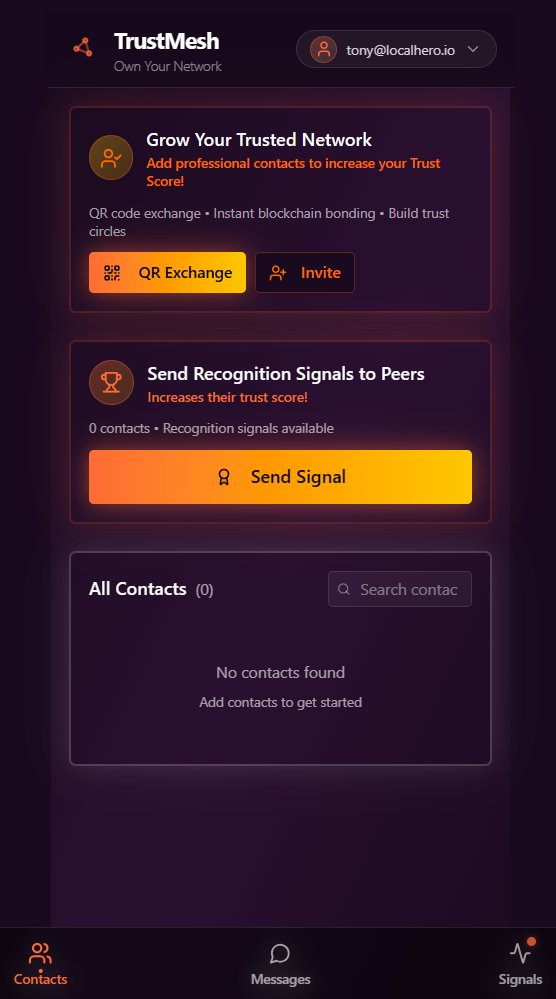
Introducing TrustMesh: a bounded, research-grade trust protocol built on @Hedera ...designed for messaging, payments, and real-world coordination.
hol.org/blog/2025-12-3-trust…
5
10
378
🧵 Thread: How TrustMesh Uses HCS Standards
(1 by 1)
TrustMesh didn’t invent a new universe of standards.
It uses Hedera Consensus Service (HCS) where it fits and proposes extensions where real gaps exist.
Here’s the breakdown 👇
Ref: hol.org/docs/standards/
@HashgraphOnline
Standards | Hashgraph Online
Comprehensive collection of Hashgraph Consensus Standards (HCS)
hol.org 1
4
7
179
Put together, this forms a layered trust stack:
- Discoverability (HCS-2)
- Identity (HCS-22)
- Profiles (HCS-11)
- Relationships (HCS-3 pattern)
- Trust authority (HCS-23)
- Behavior signals (HCS-5)
1
1
3
45
TrustMesh shows that HCS can support not just data anchoring, but trust computation — without centralization.
That’s what we were walking through in yesterday's XSpace.
x.com/hashpack/status/200926…
Jan 8

PACK THE MIC 🎤
Catch you guys, later on today as we have the pleasure to host a hackathon specialist @tonycamero!
Portable reputation, trust staking and more.
See you then!
x.com/i/spaces/1ynJOMqWZNZKR
1
3
59
HCS-3: Recursion Pattern (Contacts)
Important clarification:
HCS-3 is not a contacts standard.
TrustMesh uses its recursion semantics to model durable relationship edges in a standards-aligned way.
1
25
HCS-23 (Proposed): Trust Allocation
This is the missing primitive.
It captures:
- Who vouches for whom
- With scarcity
- With revocability
Trust becomes computable, not symbolic.
25