
philosopher / nerd / collector / alchemist — busy building the future 🇳🇱 🇧🇷 🇺🇸
Joined December 2022
- Tweets 1,208
- Following 1,081
- Followers 1,137
- Likes 759
152 Photos and videos













VIPete retweeted

May 19
A new way to manage stocks, crypto, and prediction markets.
💬 Build your strategy with our chat-to-strategy interface.
🎯 Choose entries and exits based on your setup.
🧪 Dry-run and backtest to find leverage and arbitrage.
📈 Use 200 live market indicators.
🤖 Deploy agents, monitor progress, and start or pause anytime.
📊 Analyze and fine-tune with our chat-to-portfolio agents
Early access: truetrader.ai
2
1
8
762

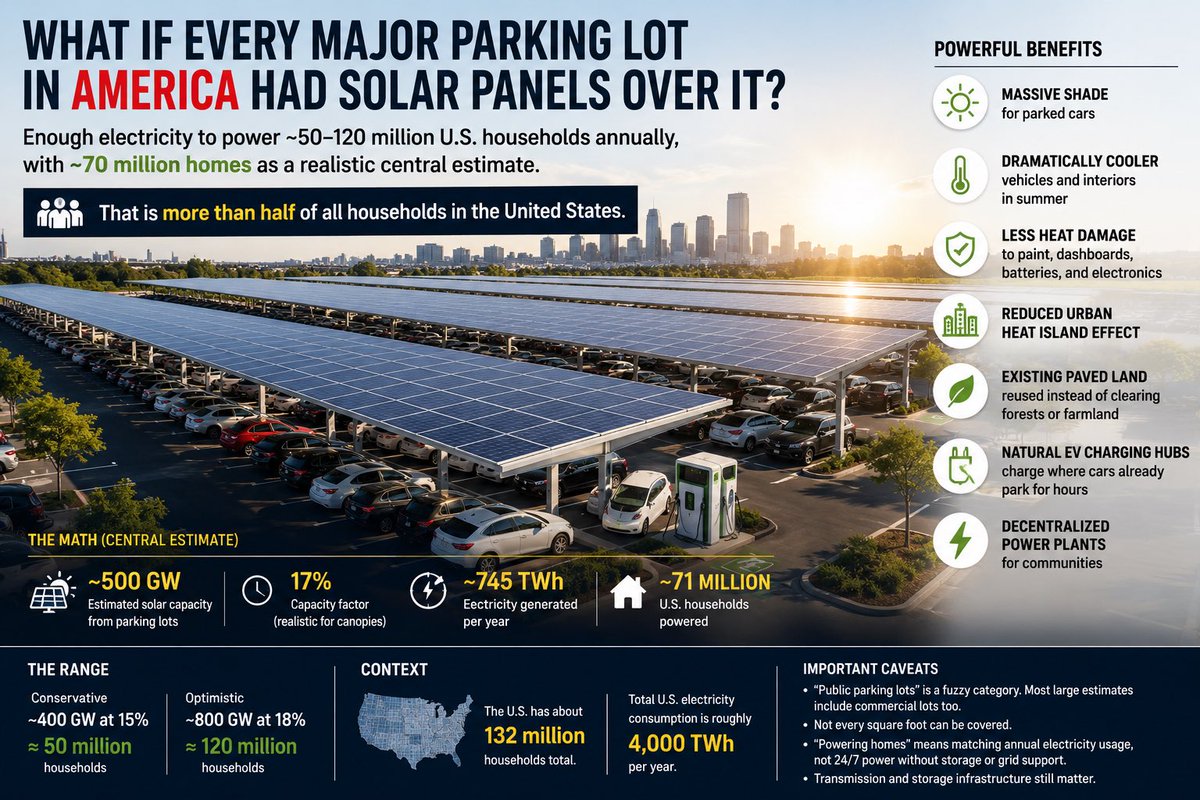
What if every major parking lot in America had solar panels over it?
The result would be enormous:
Enough electricity to power roughly 50–120 million U.S. households annually, with ~70 million homes as a realistic central estimate.
That is more than half of all households in the United States.
Here’s the math:
America has an immense amount of paved parking space. Multiple studies estimate that covering U.S. parking lots with solar canopies could provide somewhere between ~400 GW and 800 GW of installed solar capacity.
A reasonable middle-ground estimate:
~500 GW of parking-lot solar.
Solar panels do not generate at maximum output all day. In the U.S., solar averages roughly a 15–18% capacity factor depending on location and panel orientation. Parking canopies are somewhat constrained compared to ideal utility-scale solar farms, so using ~17% is realistic.
500 GW × 8,760 hours/year × 17%
≈ 745 TWh of electricity annually.
The average American household uses about 10,500 kWh per year.
745 TWh ÷ 10,500 kWh
≈ 71 million households powered.
Conservative case:
~400 GW at 15% efficiency
≈ 50 million households.
Optimistic case:
~800 GW at 18%
≈ 120 million households.
For context:
The U.S. has about 132 million households total.
This would not power the entire country. Total U.S. electricity consumption is roughly 4,000 TWh/year. But it would still represent one of the largest distributed energy systems ever built.
And the side benefits are arguably just as interesting:
• Massive amounts of shade for parked cars in hot states like Arizona, Texas, Nevada, and Florida.
• Dramatically cooler vehicle interiors during summer.
• Less heat damage to paint, dashboards, batteries, and electronics.
• Reduced urban heat island effect across large paved areas.
• Existing paved land gets reused instead of clearing forests or farmland for solar farms.
• Parking lots could become natural EV charging hubs, allowing cars to charge directly where they already sit for hours.
• Shopping centers, offices, airports, stadiums, and transit hubs could effectively become decentralized power stations.
Important caveats:
• “Public parking lots” is a fuzzy category. Most large estimates include commercial lots too: malls, offices, stadiums, airports, retail centers, etc.
• Not every square foot can be covered due to driving lanes, setbacks, trees, irregular geometry, and structural spacing.
• “Powering homes” here means matching annual electricity usage, not providing uninterrupted 24/7 power without batteries or grid support.
• Transmission and storage infrastructure would still matter enormously.
Still, the scale is difficult to ignore:
America already paved an energy surface roughly the size of a small state, and most of it sits in direct sunlight every day.
3
1
244

Jorge, my hero!
25 Jul 2025

Add our AI Workhorse to your team and become office rock stars!
1
3
674
VIPete retweeted

22 Jul 2025
We’re proud to unveil the latest addition to the Paal AI ecosystem: PaaLLM-0.5🧠🤖
A Web3-native language model, purpose-built to understand decentralized systems, token economies, and the culture of on-chain communities.
It ranks #1 in accuracy across crypto-native benchmarks
🧵

74
174
819
149,632
Another milestone reached with @PaalMind 💪 Always building, always improving, always growing!
3 Jul 2025

Thank you for 100,000 on @X ! 👥🤝
We're just getting started with new AI products, deeper integrations, and innovative solutions on the horizon.
Our ecosystem is strong and continues to grow, fueled by confidence in our vision.
The future is only expanding. 🚀
#PAALmily
4
2
25
690