Modular Blockchain for Limitless Scalability 🌐
Joined May 2024
- Tweets 276
- Following 93
- Followers 3,047
- Likes 511
118 Photos and videos

Everyone is arguing about which L2 is fastest.
That's the wrong argument.
The real question isn't how many transactions fit inside one chain.
It's how many chains can exist in parallel without breaking each other.
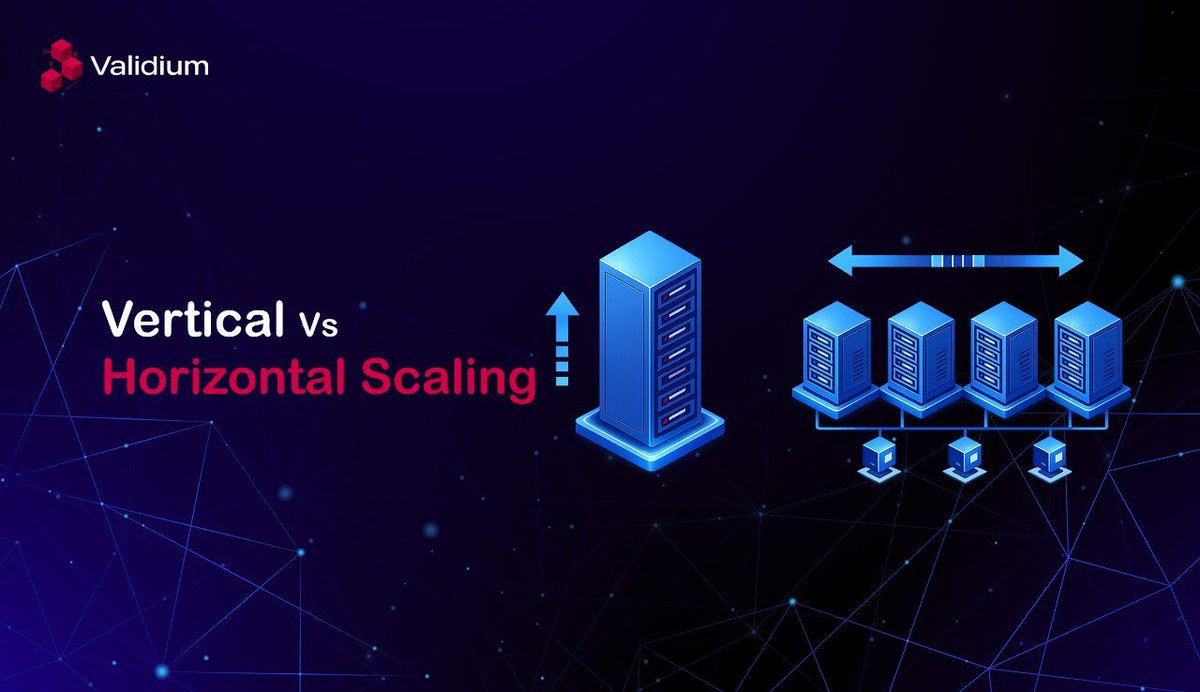
2/ For years, blockchain scaling has been treated as a vertical problem.
Take one chain.
Make it process more.
Compress transactions.
Improve execution.
Add blobs.
Reduce costs.
Keep squeezing more throughput out of the same system.
It works, until it doesn't.
3/ Eventually, every shared environment runs into the same problem:
Competition.
When every application shares the same blockspace, they also share the same congestion.
One app's success becomes everyone else's bottleneck.
Shared blockspace is shared risk.
4/ A gaming launch shouldn't slow down a DeFi trade.
An AI agent swarm shouldn't affect an RWA marketplace.
A consumer app shouldn't compete with infrastructure protocols for execution.
Yet that's exactly what happens when everything lives on the same chain.
1
4
6
27
5/ The solution isn't making one chain infinitely bigger.
It's allowing many chains to run in parallel.
Each isolated.
Each optimized.
Each independently performant.
A gaming chain.
An AI chain.
A DeFi chain.
An RWA chain.
Heavy demand in one environment doesn't spill into the others.
6/ This is the deeper meaning of modular blockchain architecture.
Not just separating execution, settlement, and data availability.
But making it easy to create new execution environments that inherit security without inheriting congestion.
Every application gets its own space to grow.
7/ The economics matter too.
Traditional scaling approaches eventually push more load onto the base layer.
Validiums work differently.
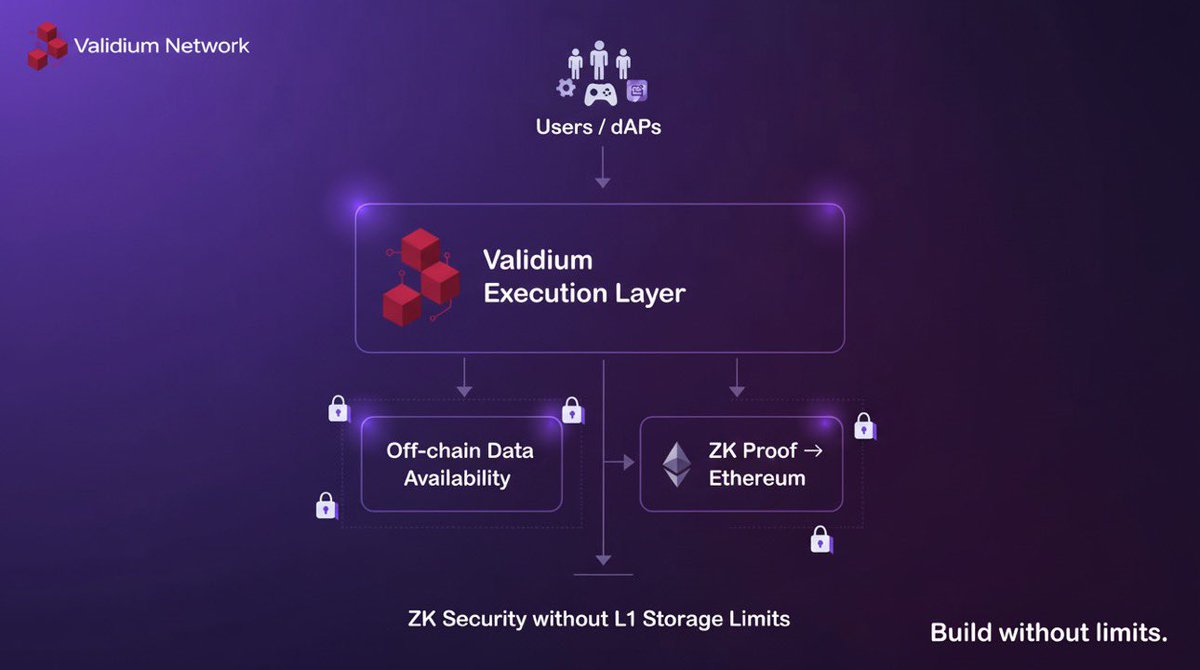
Each chain publishes compact validity proofs instead of full transaction data.
The result:
More chains.
More applications.
More throughput.
Without proportionally increasing pressure on Ethereum.
8/ This is why Validium Network exists.
Not as one chain trying to serve every use case.
But as infrastructure for thousands of application-specific chains.
Each sovereign.
Each verifiable.
Each independently performant.
Connected by cryptographic guarantees, not shared congestion.
9/ The internet didn't scale because one server became infinitely powerful.
It scaled because millions of servers could operate independently while remaining connected.
Blockchain scaling follows the same path.
The rollup era proved we can scale a chain.
The next era proves we can scale an ecosystem.
That's the future Validium is building.
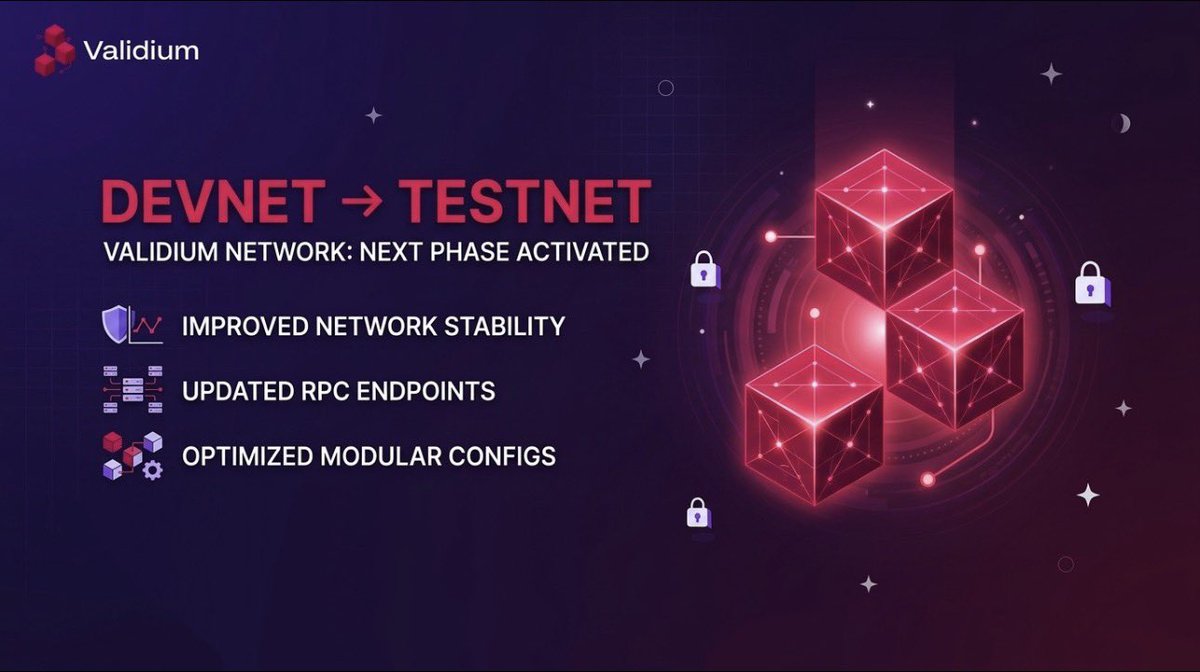
Testnet is live.
validium.network
15

Jun 12
Deploying a chain should be as easy as deploying a container.
With Validium's modular stack, it is.
Launch app-specific chains in minutes.
High-performance execution.
Your rules.
Ethereum security.
Infrastructure built for AI, gaming, and the next generation of onchain applications.
1
4
6
48
This is the most important line in the whole thread: "much of what gets called tokenization today is actually closer to digitization."
A token that just mirrors an offchain ledger is a receipt. A token that can be used as collateral, remixed, and settled atomically is infrastructure.
The 10x growth is real, but the next 100x won't come from putting more receipts onchain. It comes from making those assets actually do something. Composability isn't a feature of tokenization; it's the entire point.
The bottleneck was never demand. It's scalable, low-cost rails that institutions can trust. That's the layer being built now.

2
5
6
209
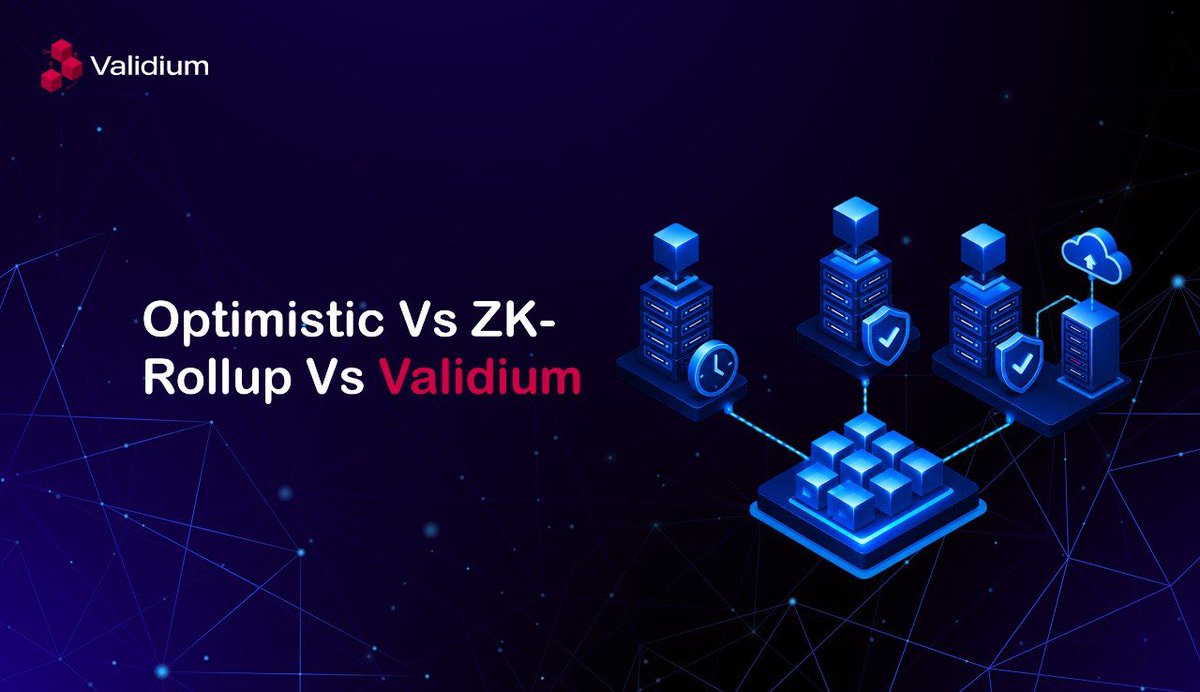
Everyone compares L2s on TPS numbers and gas fees.
Almost nobody compares them on the thing that actually matters when something goes wrong:
How do you get your money out?
Because every scaling solution makes a different promise about speed, security, and data availability.
2/ There are three major approaches to Ethereum scaling today:
→ Optimistic Rollups
→ ZK-Rollups
→ Validiums
They aren't just different ways to process transactions faster.
They make fundamentally different trade-offs about how state is verified, how data is stored, and how users exit the network.
Let's break them down.
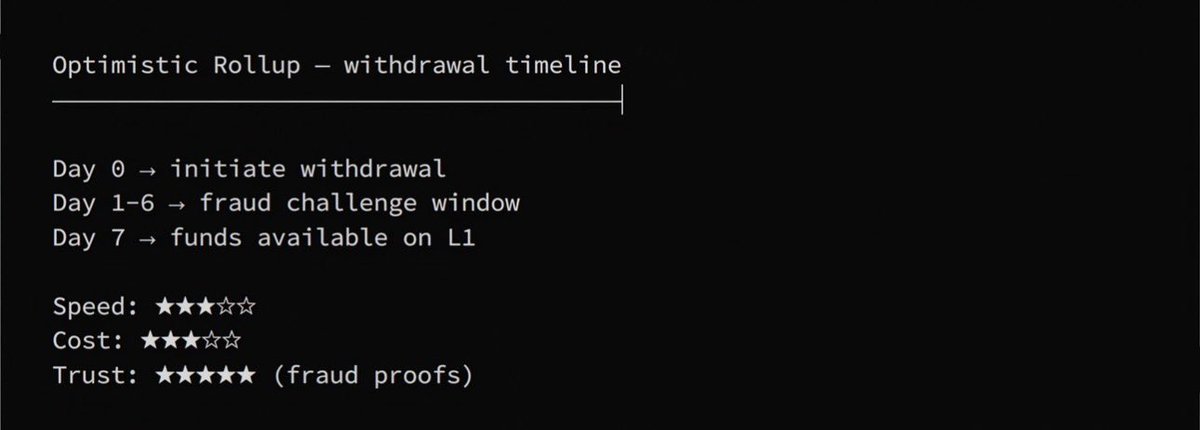
3/ Optimistic Rollups (Arbitrum, Optimism, Base)
Assume transactions are valid by default.
Transaction data is posted on Ethereum, and anyone can challenge an invalid state transition by submitting a fraud proof.
The trade-off:
Canonical withdrawals from L2 → Ethereum typically take ~7 days.
That's not a bug. It's the security model.
The network needs time to detect and challenge fraud.
1
5
7
169
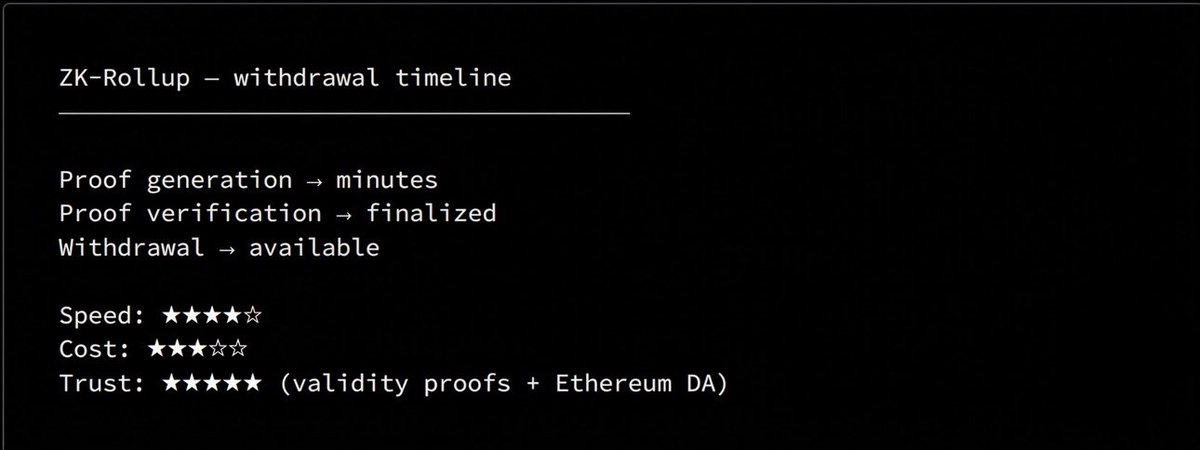
4/ ZK-Rollups (zkSync Era, Starknet, Scroll)
Don't assume.
Prove.
Every batch of transactions is accompanied by a validity proof that mathematically verifies correctness before settlement.
Because validity is proven upfront, there's no fraud challenge period.
Withdrawals can be completed once proofs are generated and verified—typically much faster than Optimistic Rollups.
The trade-off?
Transaction data is still published on Ethereum.
And for most rollups, data availability is the largest component of cost.
5/ Validium (the architecture behind Validium network)
Uses the same validity proofs as ZK-Rollups.
But instead of publishing transaction data to Ethereum, data is stored on a separate Data Availability (DA) layer.
Result:
→ Lower fees
→ Higher throughput
→ Faster user experience
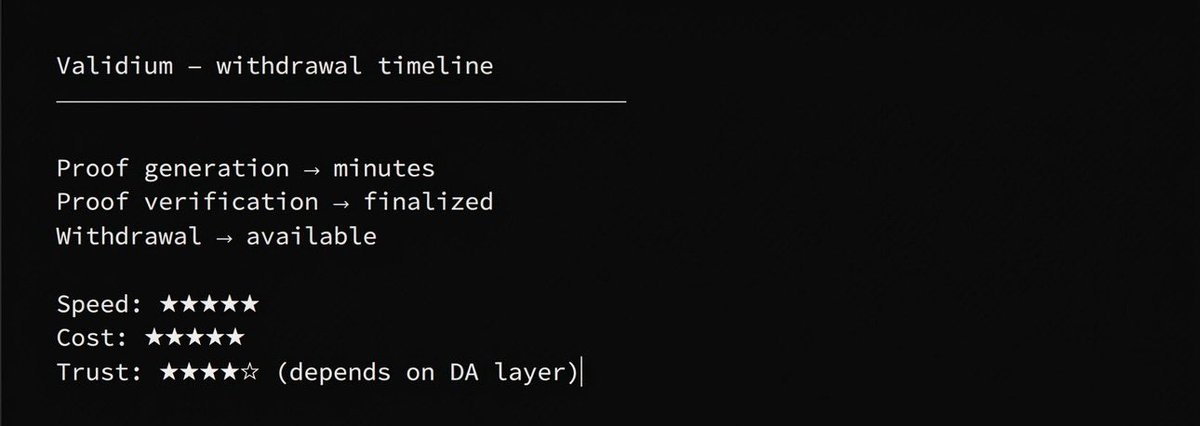
The trade-off is different data availability assumptions.
State transitions retain the same validity guarantees, but data accessibility depends on the DA layer.
6/ The honest trade-off with Validium:
If the data availability layer becomes unavailable, users may not be able to access the data needed to reconstruct state and independently verify ownership.
That's why the DA layer matters.
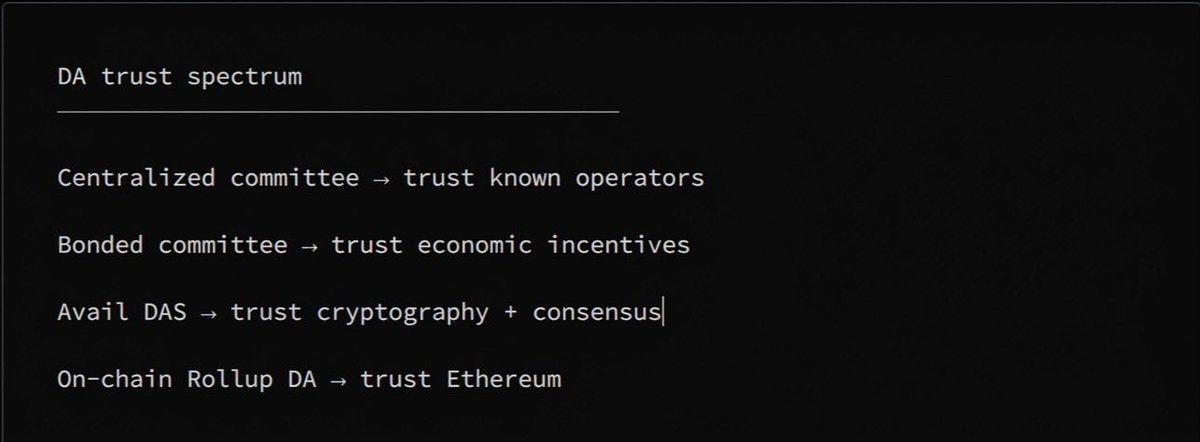
A centralized committee and a decentralized DA network offer very different trust assumptions.
Not all off-chain data availability systems are created equal.
1
3
103
7/ Validium Network uses Avail as its DA layer, not a committee.
Avail uses Data Availability Sampling (DAS), allowing light nodes to verify that block data is available by sampling small portions of it.
Rather than trusting a small set of known parties, security comes from cryptography, sampling, and Avail's decentralized consensus network.
8/ What this means in practice:
→ Optimistic Rollups: broad EVM compatibility, slower canonical exits
→ ZK-Rollups: strongest Ethereum data availability guarantees, higher data costs
→ Validiums: lower fees and higher throughput, with security dependent on the chosen DA layer
There isn't a universally best design.
Only different trade-offs for different applications.
9/ Validium Network goes a step further.
Builders can choose between Validium Mode and Rollup Mode at the architecture level.
Different workloads.
Different requirements.
Different trade-offs.
Same network.
No L2 fits every use case.
Understanding what you're trading off is how you choose the right one.
Explore the architecture:
validium.network
2
46
Blockchain adoption doesn't need more hype.
It needs infrastructure that actually scales.
Modular architecture. High-performance execution. A growing ecosystem.
This is Validium Network.
2
5
7
200
There's already $31B in tokenized assets on-chain today.
By 2030, that figure could reach $16T
The opportunity is massive.
The infrastructure challenge is even bigger.
Institutions need scalability.
They need privacy.
They need compliance.
Validium Atlas was built to deliver all three.
See how we're building the foundation for the future of finance. ↓
The Future of Finance
3
5
6
144
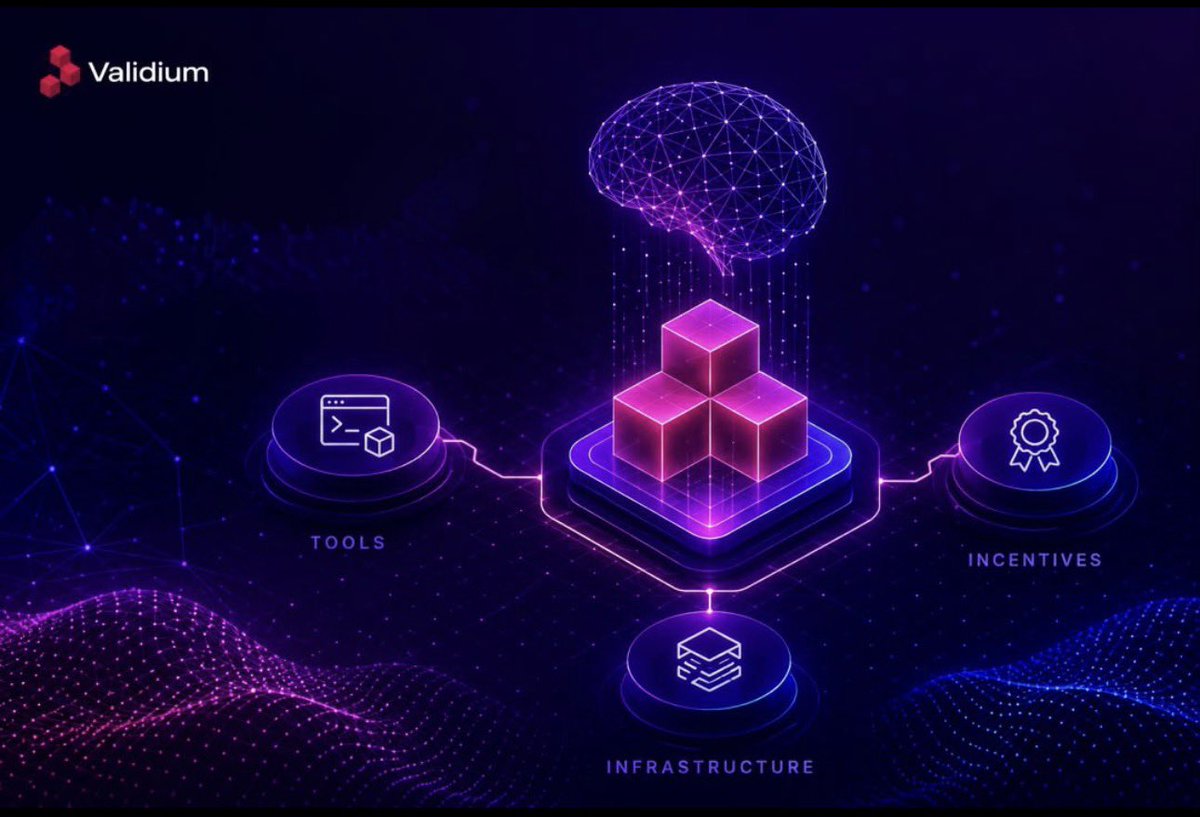
The future of DeAI isn't just smarter models.
It's autonomous agents that can coordinate, transact, and evolve on their own.
Validium Nexus provides the infrastructure layer that makes it possible:
• Seamless LLM access
• Modular integrations
• Tokenized incentive systems
The foundation for scalable decentralized AI ecosystems.
4
7
118
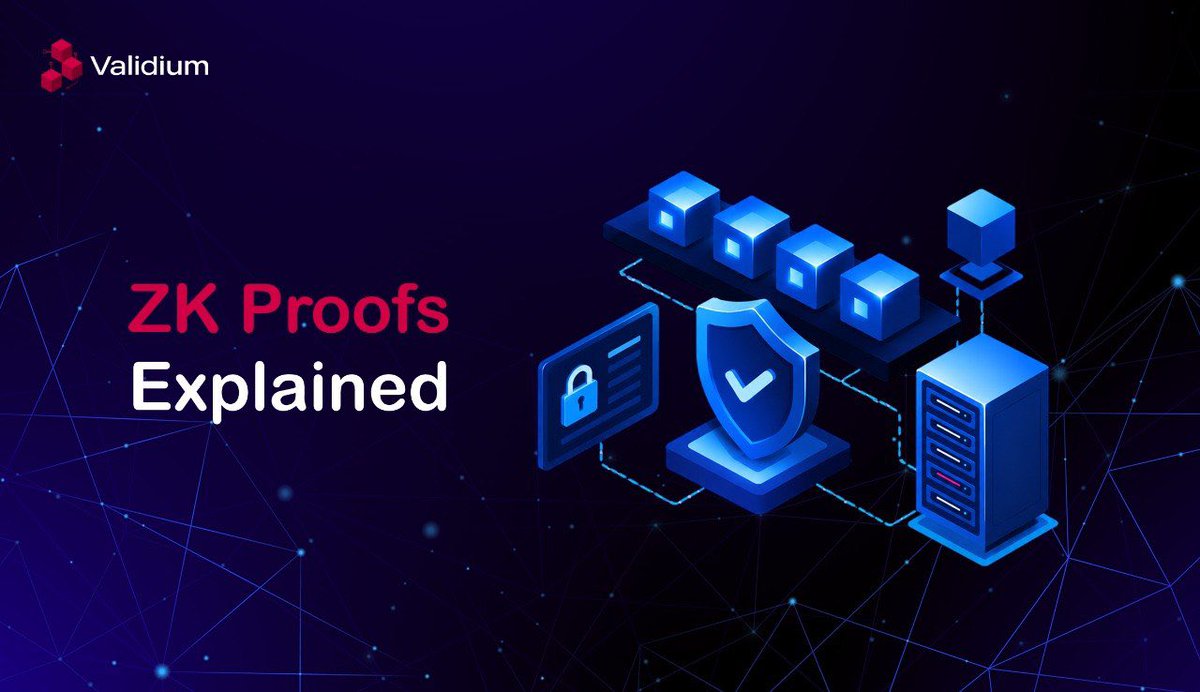
Nobody actually explains zero-knowledge proofs without lying a little. They either dumb it down until it's wrong or drown you in math until you give up. Let's try something else.
2/ A ZK proof lets you prove something is true without revealing why it's true.
Classic analogy: imagine proving you know a password without ever saying the password out loud. The verifier believes you. No information leaked. That's the intuition.
But the real power isn't privacy. It's compression.
3/ In blockchain, a ZK proof lets you verify thousands of transactions with a single tiny cryptographic check.
Instead of the network replaying every transaction to confirm it happened correctly, it just checks the proof. The proof is cheap. The verification is fast. The security holds.
4/ Two main proof types are being used in production right now:
ZK-SNARKs — tiny proofs, fast to verify, but require a trusted setup ceremony to generate. If that ceremony is compromised, the whole system is at risk.
ZK-STARKs — larger proofs, no trusted setup required, more quantum-resistant. Slightly heavier to verify on-chain.
Neither is strictly "better." They involve real trade-offs.
1
4
7
107
5/ The part nobody talks about: generating a ZK proof is expensive.
You're asking a computer to do enormous amounts of math just to produce that tiny proof. The prover, the machine, generating it needs serious hardware.
This is actually one of the real bottlenecks in ZK scaling today. Not verification. Generation.
6/ That's partly why the architecture around proof generation matters so much.
If every app has to run its own prover, costs stay high. But if you share proving infrastructure, or batch many transactions into fewer proofs, the economics improve dramatically.
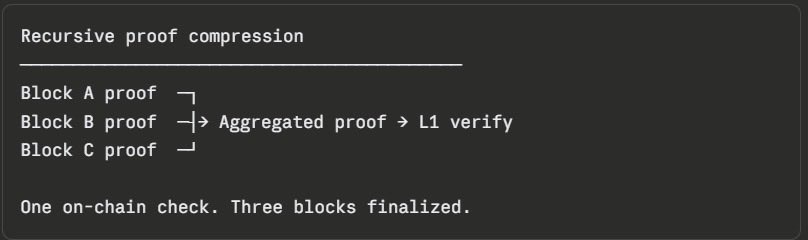
Recursive proofs take this further: you can nest proofs inside proofs, compressing many blocks into a single on-chain verification.
7/ ValidiumNetwork runs on ZKSync's zkEVM, which means the ZK proof covers not just payments but full EVM execution. Smart contracts, DeFi logic, token transfers.
The proof goes on-chain. The raw transaction data goes to Avail's DA layer. Result: Ethereum-level security with a fraction of the footprint.
8/ ZK proofs aren't magic. They're just math that happens to be very hard to fake. That's the point.
ValidiumNetwork is built on this foundation, not as a feature, but as the core of how the chain works. Every transaction is verified. No full node replay required.
Testnet is live. See it in action. validium.network
1
50
May 27
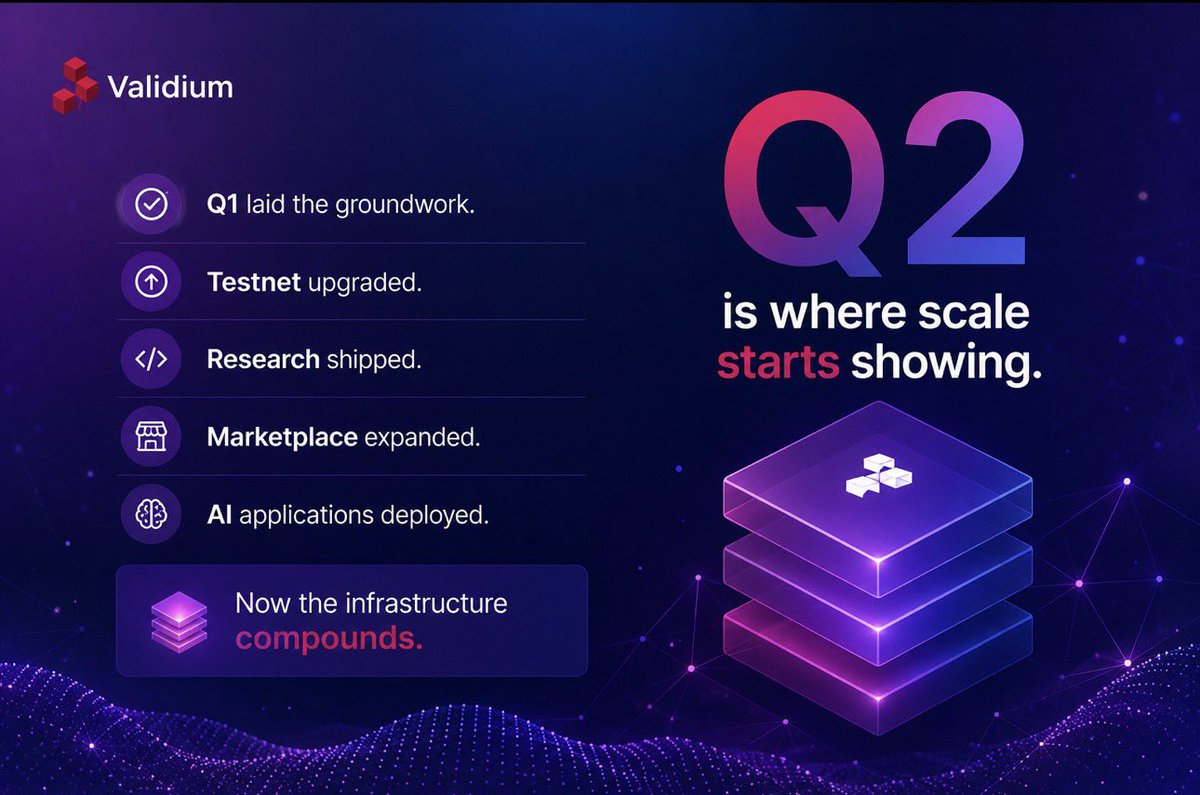
Q1 laid the groundwork.
Testnet upgraded.
Research shipped.
Marketplace expanded.
AI applications deployed.
Now the infrastructure compounds.
Q2 is where scale starts showing.
1
3
5
60
May 26
ZK Rollups prove correctness with validity proofs.
Optimistic Rollups rely on fraud proofs.
Validium takes a different scaling path:
It separates data availability from settlement.
Proofs anchor to Ethereum.
Data remains off-chain, replicated, available, and verifiable.
The result: higher throughput, lower costs, and infrastructure built for applications that need scale.
1
3
5
53
May 20
Rollups were the start. Validiums push scaling further.
By moving data off-chain while verifying validity proofs on Ethereum, they unlock higher throughput for demanding workloads.
That’s why architectures like Validium matter for DeAI, gaming, and next-gen dApps.
Scale built for what’s next.
3
5
65
May 20
Monolithic blockchains hit a ceiling.
Congestion. Fees. Bottlenecks.
Validium separates execution from data availability.
Proofs are verified on Ethereum.
Data stays off-chain.
The result:
Higher throughput. Lower DA costs. Scalable execution.
That’s the architecture for the next generation of dApps.
3
5
73
May 18
The next generation of enterprise chains won’t be generic.
They’ll be customizable from the ground up.
Validium Network gives enterprises modular L2 infrastructure tailored to their needs, from privacy controls to custom pricing mechanisms.
Your chain. Your rules.
3
5
64
May 13
The future of Ethereum isn’t one chain.
It’s an ecosystem of specialized L2s.
Validium Network is built for that future,
delivering high-performance environments designed for emerging workloads like DeAI and RWA.
4
5
74