
Joined February 2026
- Tweets 72
- Following 30
- Followers 31
- Likes 13
5 Photos and videos


Building a Fintech App: Core Functions & Features You Can’t Miss"
When developing a Fintech app, it’s not just about managing transactions—it’s about empowering users and creating an intuitive, seamless experience.
Start with secure user authentication: Use multi-factor authentication (MFA) and biometric login (fingerprint/face recognition) to keep users’ data safe while providing easy access.
Your dashboard should be clean and intuitive, offering users real-time insights into their financial health: balance tracking, recent transactions, and spending patterns.
Integrate payment gateways like Stripe or PayPal for hassle-free transactions, allowing users to send money, pay bills, or make purchases with ease.
A budgeting tool is key. Allow users to set spending limits, track categories, and set goals—helping them make better financial decisions without feeling overwhelmed.
For those looking to invest, add features for stock trading, crypto transactions, and even robo-advisory services, giving users easy access to a range of investment options.
Peer-to-peer payments are essential—make sending money to friends, family, or businesses as simple as a few taps, with real-time notifications confirming transactions.
Behind the scenes, ensure real-time notifications for things like bill payments, balance updates, and promotional offers, keeping users engaged and informed at all times.
For security, add features like fraud detection systems and encryption to protect transactions, and implement data analytics for fraud prevention, ensuring the safety of every payment.
The design should be minimalist yet informative. Use bold, readable fonts, simple icons, and a mobile-first approach to create a seamless experience across devices.
Incorporate push notifications for alerts and reminders, so users never miss a payment or financial update.
Building a Fintech app goes beyond just processing transactions—it’s about building trust and offering a smooth, functional experience that helps users manage their money with confidence.
2
4
50
"Building the Backbone of a Successful E-Commerce App"
The infrastructure you choose for your e-commerce app is the silent engine that drives growth.
Start with scalable cloud platforms like AWS, Google Cloud, or Azure for on-demand resources. These provide the flexibility to handle traffic spikes without compromising performance.
Onboarding is crucial.
Integrate identity management systems like Firebase Auth or Auth0 for secure, seamless sign-ins. Multi-factor authentication (MFA) and social logins improve both security and user experience.
For the front-end, pick frameworks like React or Vue.js, ensuring fast load times and a responsive interface that adapts to mobile-first users.
Your back-end should be built with Node.js or Ruby on Rails—fast, flexible, and capable of scaling with your business. Pair that with GraphQL or REST APIs for smooth communication between front and back ends.
For databases, use SQL (PostgreSQL, MySQL) for structured data or NoSQL (MongoDB) for flexible, schema-less storage. Don’t forget caching solutions like Redis to speed up high-demand queries.
For payment processing, integrate Stripe or PayPal for reliable and secure transactions, ensuring your customers feel safe every time.
Finally, implement CI/CD pipelines with Jenkins or GitHub Actions to automate testing and deployment—ensuring updates roll out smoothly without downtime.
Tech should work for you, not the other way around.
A strong infrastructure ensures your e-commerce platform is secure, scalable, and user-friendly.
1
40
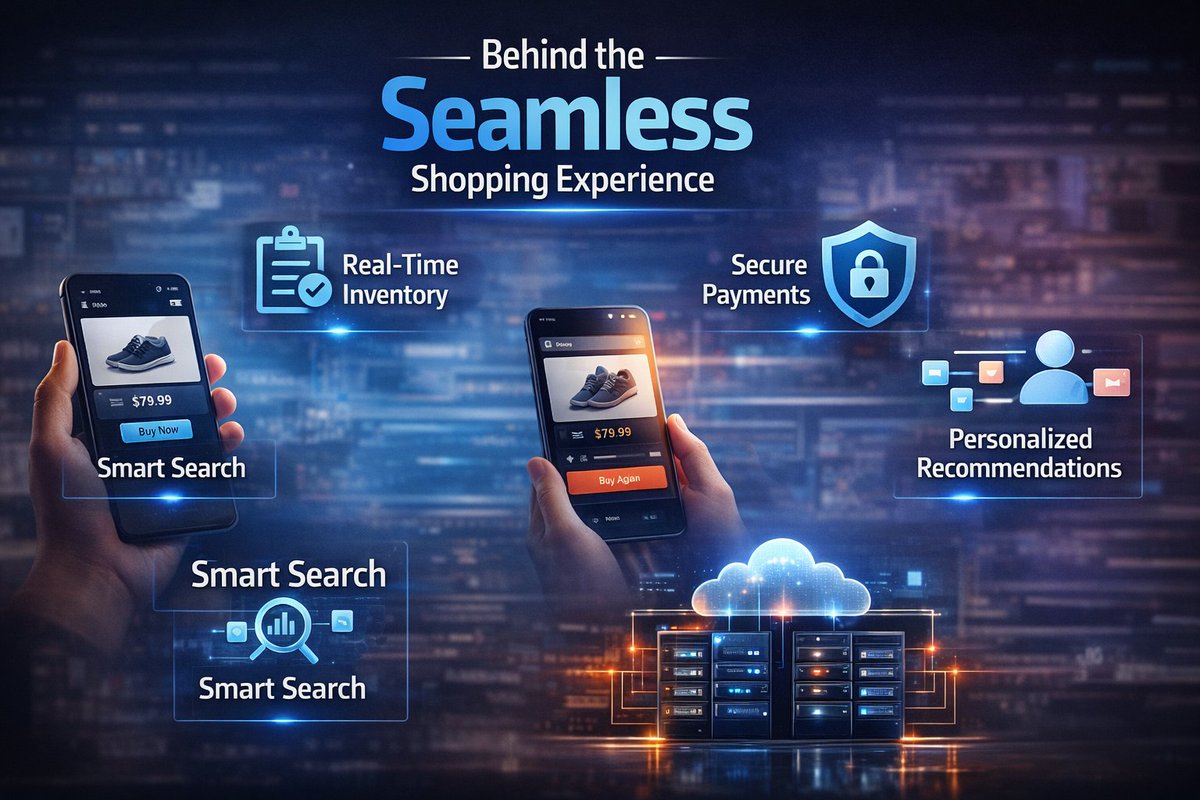
Behind the Seamless Shopping Experience"
Building an e-commerce app isn’t just about having a shopping cart.
It’s about creating a journey that customers don’t just enjoy, but feel confident in.
Every tap, every page load, every checkout should feel effortless.
From real-time inventory updates to a secure payment gateway, your infrastructure needs to be built to handle demand at every level.
A well-designed search engine with intuitive filters makes finding what you want feel like second nature, and that’s exactly how it should be.
The key to success? A backend that scales effortlessly with traffic surges.
From personalized product recommendations to automated order fulfillment, the tech powering your platform should feel invisible — working silently in the background, ensuring customers get what they want when they want it.
1
2
29
If you’re building outside the U.S. but selling to Americans…
Set up your LLC before using Stripe.
When you sell to U.S. customers, you enter the U.S. financial system.
Payment processors manage regulatory risk — not just payments.
If your structure doesn’t match your market, friction starts.
Example:
You’re in Thailand.
Your customers are in the U.S.
You charge in USD.
But you have no U.S. entity.
That mismatch triggers reviews.
Not because you’re illegal.
Because risk models look for consistency.
Country. Bank. Customers. Documentation.
A U.S. LLC gives you credibility.
Cleaner compliance.
Stronger banking relationships.
And smoother scaling.
Infrastructure first. Marketing second.
1
27
Cal AI has proved to founders that you don't have to wait till you get that VC funding before you launch that Idea.
Cal AI generated $50 million in ARR within 18 months with 0 VC funding and then got acquired.
Congratulations to them
Mar 2

Cal AI has been acquired by MyFitnessPal 🚨
Henry and I started Cal AI as 17-year old high school students with one mission: make calorie tracking easier with AI.
In just 18 months, we’ve helped millions of people lose millions of pounds. And we broke $50m in ARR along the way.
We are at an incredible inflection point in history where ANYBODY can build a product that can improve lives and make millions.
As founders, we get a lot of praise. The truth is that this would not have been possible without our incredible 30 person team. We are so proud of what this team has accomplished, and are thankful to everyone that has been instrumental in Cal AI’s development and success.
Cal AI will continue as a separate app from MyFitnessPal. The combined team will share resources to continue helping people achieve their fitness goals!
1
65
Stripe doesn’t steal money.
It mitigates risk.
If you’re a SaaS founder or digital product entrepreneur, read this before your account gets frozen.
Most payment holds aren’t about fraud.
They’re about risk signals.
Here’s what actually triggers reviews:
Sudden revenue spikes
Going from $1k to $15k overnight on a new account looks like stolen card testing — even if it’s legit.
High dispute rates
For SaaS, keep chargebacks under 0.5%.
Refund fast. Disputes kill accounts.
Aggressive marketing claims
“Guaranteed results.”
“Make $10k fast.”
These increase refunds → which increase disputes → which trigger freezes.
No proper business structure
Mismatch between your country, bank, traffic source, and legal entity raises compliance flags.
Launching paid ads too early
New Stripe account heavy ad spend = risk alert.
Stripe is built to protect itself from chargebacks and regulatory penalties.
1
20
the fastest way to validate your app idea:
1. build the landing page
2. run ads
3. measure
if strangers don’t click, they won’t pay.
20
The Founder Who Almost Burned $80k.
A founder came to us after paying a team for 6 months.
The product looked beautiful.
But…
• No user analytics
• No payment optimization
• No scalable backend
They built a “demo.”
Not a business.
1
3
33
The $50k Mistake Every Startup Makes.
They spend months building features no one asked for.
Instead, focus on one problem that hurts your customer today.
If your first users don’t pay, nothing else matters.
3
21
From Idea to Revenue — Our Process.
Validate concept
Map monetization
Wireframe user flow
Develop MVP
Launch
Optimize using data
No guessing.
Just structured execution.
1
1
2
41
The Hidden Cost of Not Building Tech
Manual processes cost you:
• Lost leads
• Slow response times
• Poor data tracking
• Low customer retention.
The businesses winning in 2026?
They operate on systems — not spreadsheets.
1
3
37
3 Red Flags When Hiring a Dev Team
🚩 No product discovery phase
🚩 No timeline transparency
🚩 No post-launch support
If they jump straight into coding…
Run.
Strategy before syntax.
1
1
1
44
Mobile Apps vs Web Apps (Which Do You Need?)
Web app = Faster to launch, broad access
Mobile app = Better engagement, push notifications
Hybrid approach = Best of both worlds
The right answer depends on your business model.
Tech decisions should follow revenue logic.
1
2
33
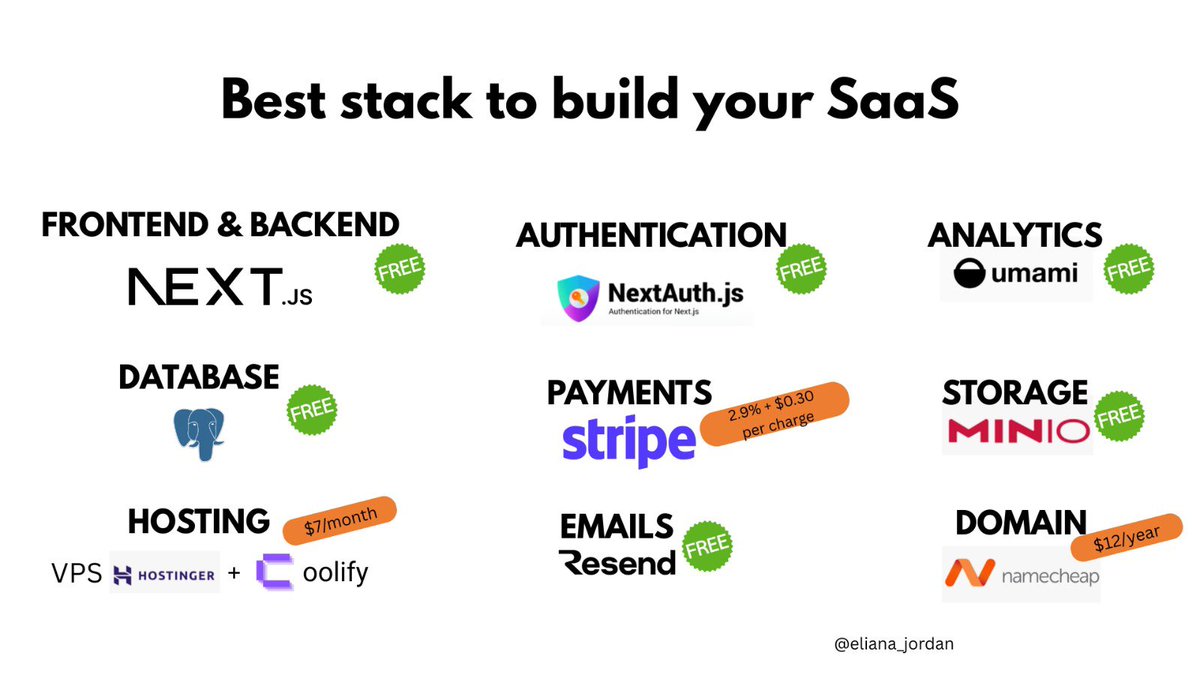
This is the best stack to build your SaaS in 2026.
spoiler: most of it is free.
Frontend: Next.js, Tailwind CSS ($0)
Backend: Next.js, Nodejs ($0)
Database: PostgreSQL ($0)
Hosting: Coolify VPS ($7.99/month)
Storage (S3): MinIO ($0)
Emails: Resend ($0)
Analytics: Umami ($0)
Payments: Stripe (2.9% $0.30 per charge)
2
1
3
61
Your MVP has 47 features.
Your competitor's MVP has 3 features and 1,000 users.
You're still adding feature #48 because "users might need this."
They're adding their 1,001st user.
Stop building. Start validating.
1
2
17

Feb 28
What a Proper MVP Actually Looks Like
Not 50 features.
Not a perfect UI.
A real MVP:
• Solves ONE painful problem
• Has a clear payment flow
• Tracks user behavior
• Can scale technically
Build small. Win big.
1
2
38
Feb 28
Your Website Is Not a Brochure.
It’s a Sales Machine.
If your website doesn’t:
• Capture leads
• Qualify prospects
• Convert traffic
• Track behavior
You don’t have a website.
You have decoration.
1
1
2
29