
Visualizing how real-world systems connect to crypto.
Joined April 2026
- Tweets 411
- Following 45
- Followers 823
- Likes 1,433
87 Photos and videos
Pinned Tweet

May 5
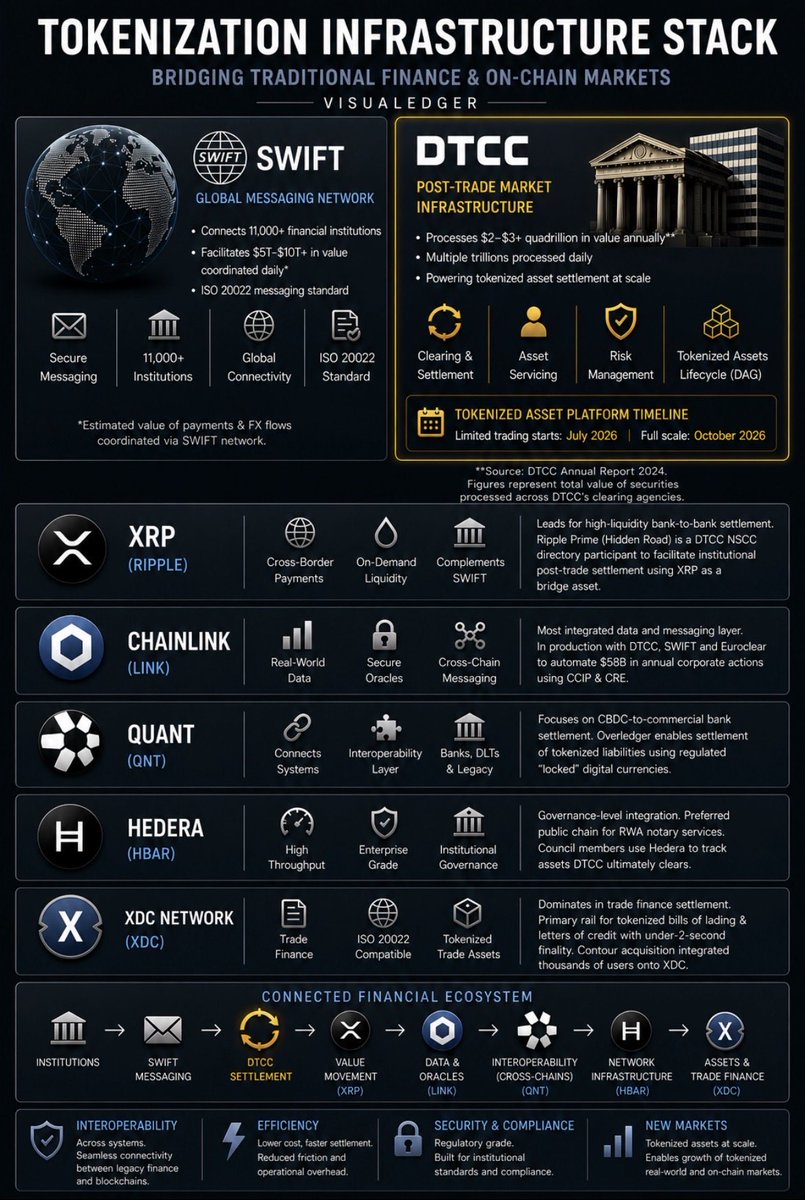
With DTCC starting limited trading in July and going full scale in October 2026.
DTCC has made the roles and importance of these five networks clear.
$XRP and $XDC Network are the primary assets for settlement, while $LINK, $QNT and $HBAR provide the "piping" to make it happen.
XRP:
Leads for high-liquidity bank-to-bank settlement. In March 2026, Ripple Prime (formerly Hidden Road) was officially named a participant in the DTCC’s NSCC directory, specifically to facilitate institutional post-trade settlement using XRP as a bridge asset.
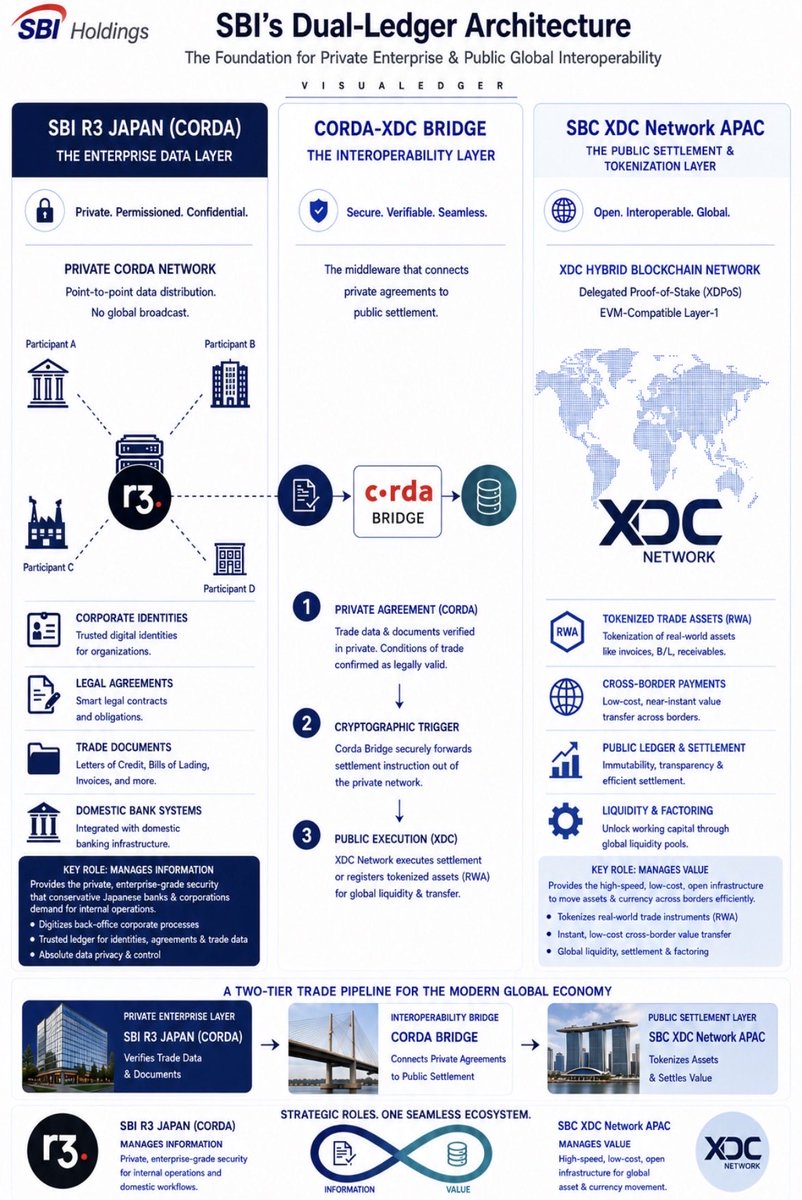
XDC:
Dominates in trade finance settlement. It is the primary rail for tokenized bills of lading and letters of credit, achieving under-2-second finality. Its 2026 growth is driven by its Contour acquisition, which integrated thousands of trade finance users directly onto the XDC rail.
QNT:
Focuses on CBDC-to-commercial bank settlement. Its Overledger platform allows central banks (like the Bank of England) to settle tokenized liabilities using regulated "locked" digital currencies rather than open-market bridge assets.
Chainlink and HBAR however, currently hold the deepest structural integrations within the traditional financial bank systems.
LINK:
The most integrated data and messaging layer. By 2026, Chainlink has moved into full production with the DTCC, Swift, and Euroclear to automate $58 billion in annual corporate actions (dividends, splits). It uses its CCIP and Runtime Environment (CRE) to link existing Swift messages directly to the DTCC's private blockchain nodes.
HBAR:
Holds a governance-level integration. As a member of the Linux Foundation's Decentralized Trust alongside the DTCC, Hedera is the preferred public chain for "RWA" (Real-World Asset) notary services. Its Governing Council members, including Google, IBM, and Standard Bank - use the network to track the lifecycle of assets that the DTCC eventually clears.
QNT:
Deeply embedded via the Murex partnership. Murex's MX.3 platform, used by 60,000 traders daily - now has native Overledger integration, allowing banks to "switch on" blockchain features within their existing trading terminals.
With this cleared out, we now know the importance of these networks within DTCC’s Financial Infrastructure.
May 4

39
327
994
90,791
Hedera’s Blackwell architecture already mentioned in NVIDIA x HUMAIN (& SDAIA) 🇸🇦
NVIDIA already partnered with Saudi’s state-backed HUMAIN last year, mentioning “deployment of 5,000 Blackwell GPU’s over the next five years”. 🔥
further solidifying $HBAR ‘s involvement in Saudi’s VISION 2030, alongside EQTY Lab and Accenture. 📈
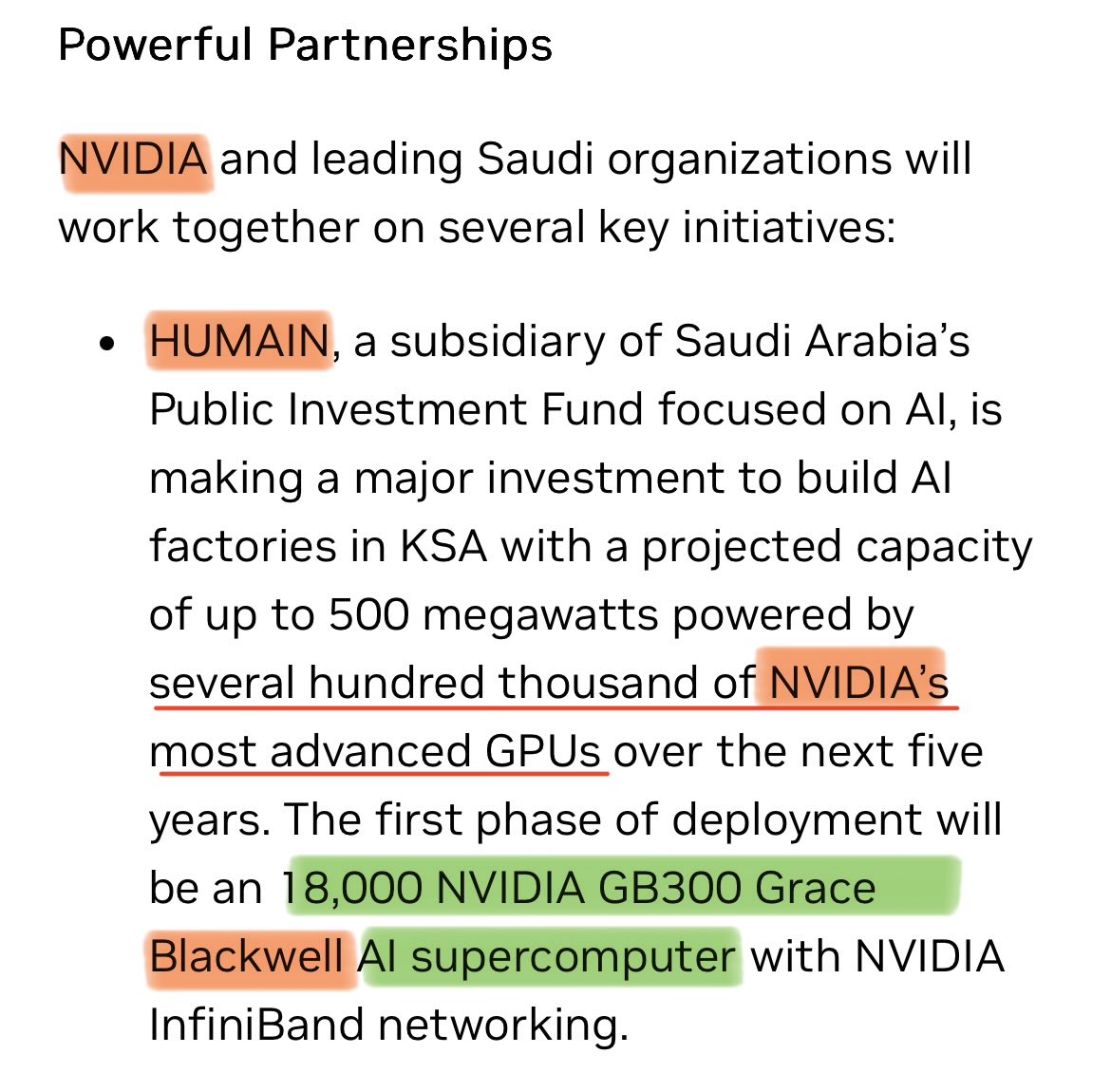
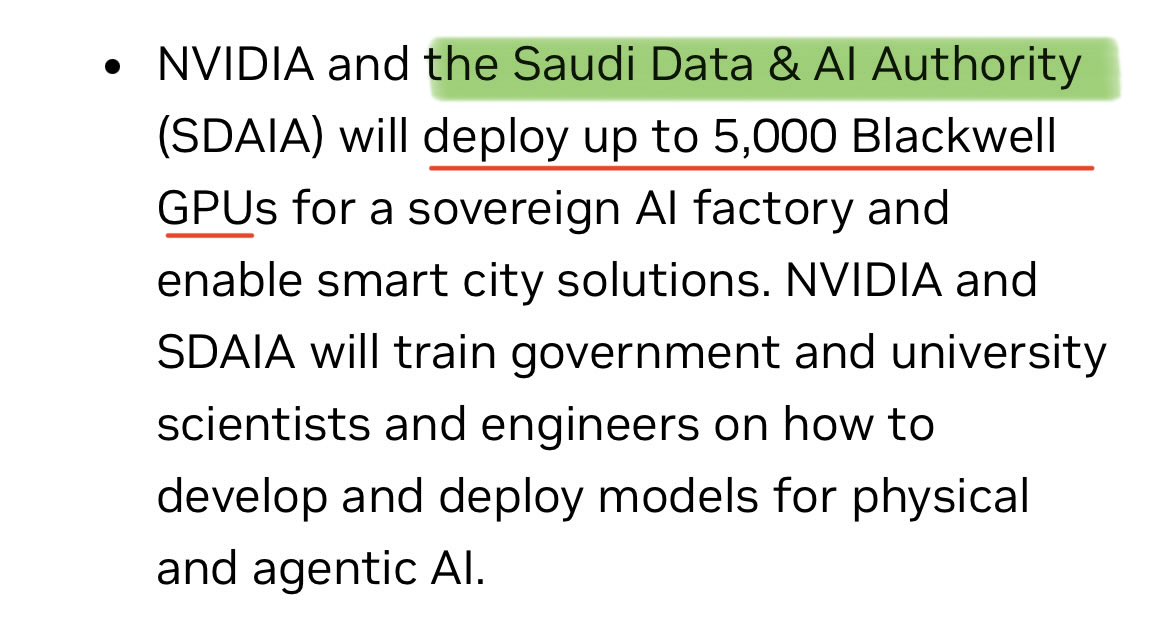
While the markets are bleeding, $HBAR is powering Saudi Arabia’s 🇸🇦 AI-Economy for Vision 2030.
With NVIDIA (partnered with SpaceX and Anthropic) using AI GPU-architectures powered by HBAR, and working with SpaceX to provide Orbital AI computing (also for Saudi Arabia) 🛰️;
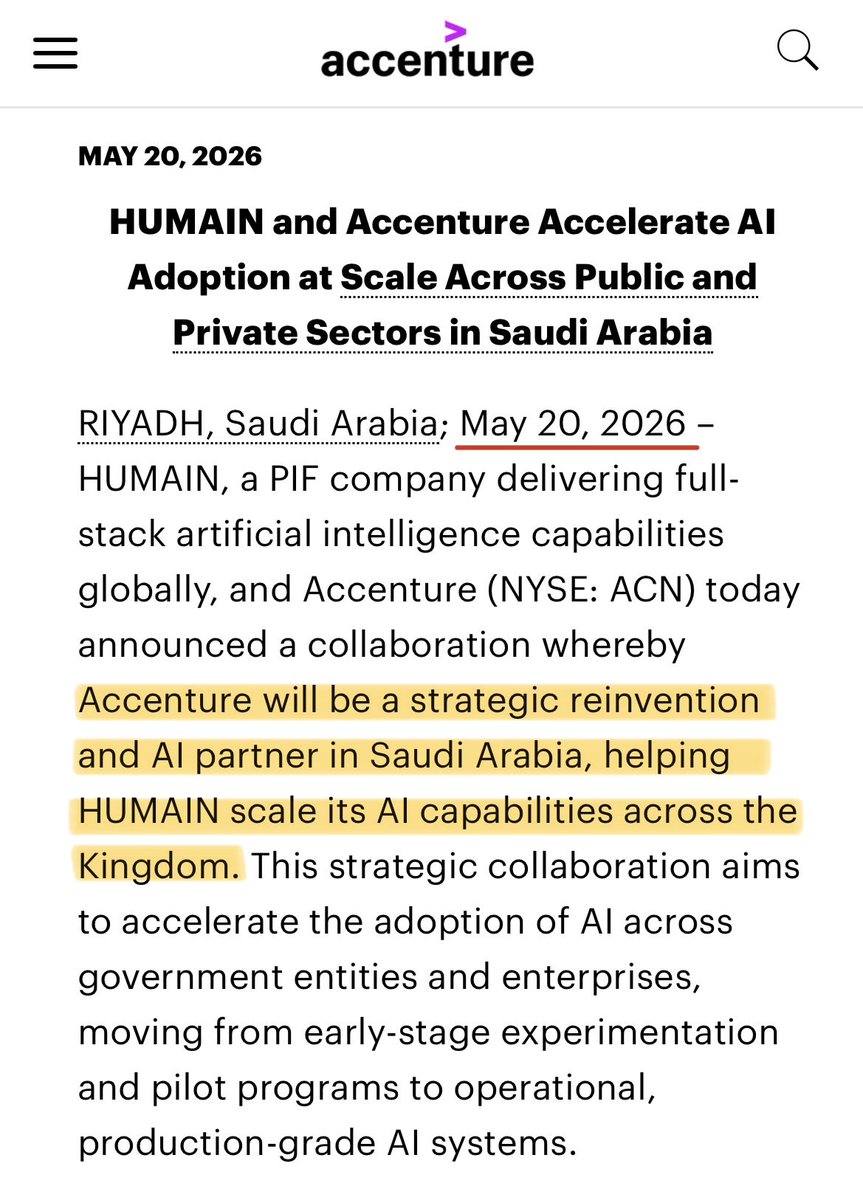
HBAR is also being tied to this Saudi initiative via Accenture.
Accenture - an official member of the Hedera Council that is also working with NVIDIA and Anthropic, serving as a global enterprise architect and reinventor (also in AI) 📊;
- announced a collaboration with Saudi Arabia’s state-backed AI mega-project HUMAIN, chaired by HRH Crown Prince Mohammed bin Salman 👑, last month.
This collaboration aims to accelerate AI-adoption at scale in Saudi Arabia. 🇺🇸🇸🇦

7
29
1,264
Visual Ledger retweeted
While the markets are bleeding, $HBAR is powering Saudi Arabia’s 🇸🇦 AI-Economy for Vision 2030.
With NVIDIA (partnered with SpaceX and Anthropic) using AI GPU-architectures powered by HBAR, and working with SpaceX to provide Orbital AI computing (also for Saudi Arabia) 🛰️;
HBAR is also being tied to this Saudi initiative via Accenture.
Accenture - an official member of the Hedera Council that is also working with NVIDIA and Anthropic, serving as a global enterprise architect and reinventor (also in AI) 📊;
- announced a collaboration with Saudi Arabia’s state-backed AI mega-project HUMAIN, chaired by HRH Crown Prince Mohammed bin Salman 👑, last month.
This collaboration aims to accelerate AI-adoption at scale in Saudi Arabia. 🇺🇸🇸🇦
May 11
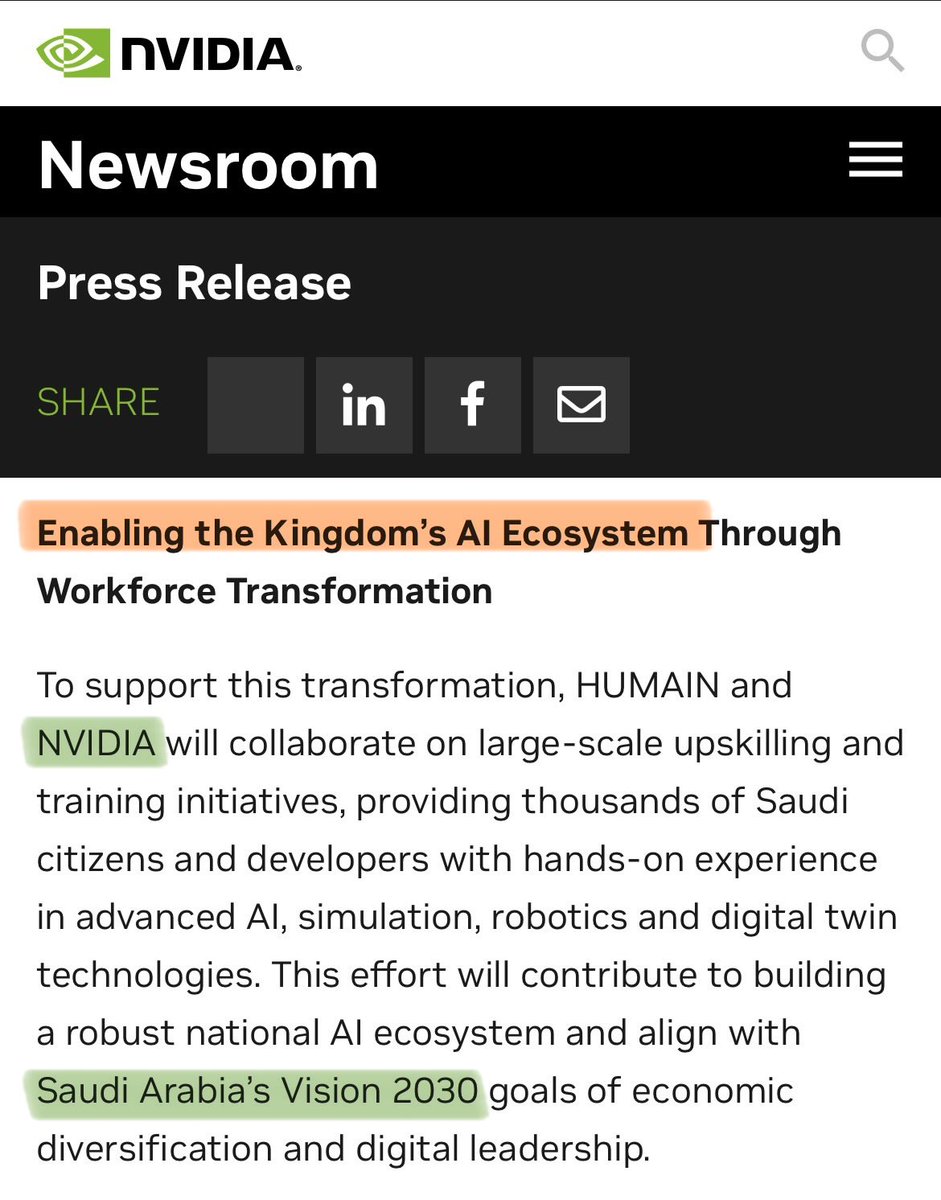
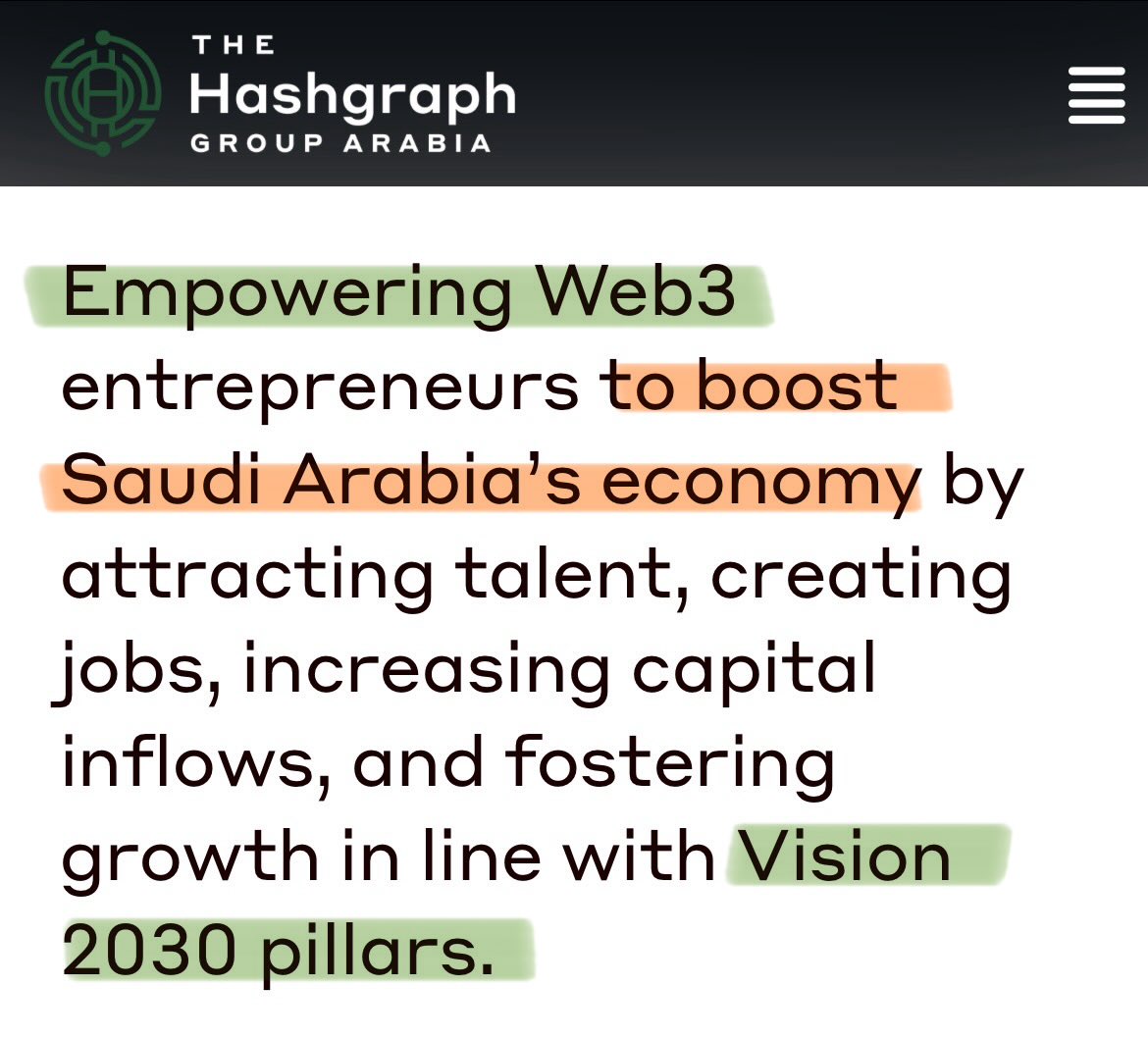
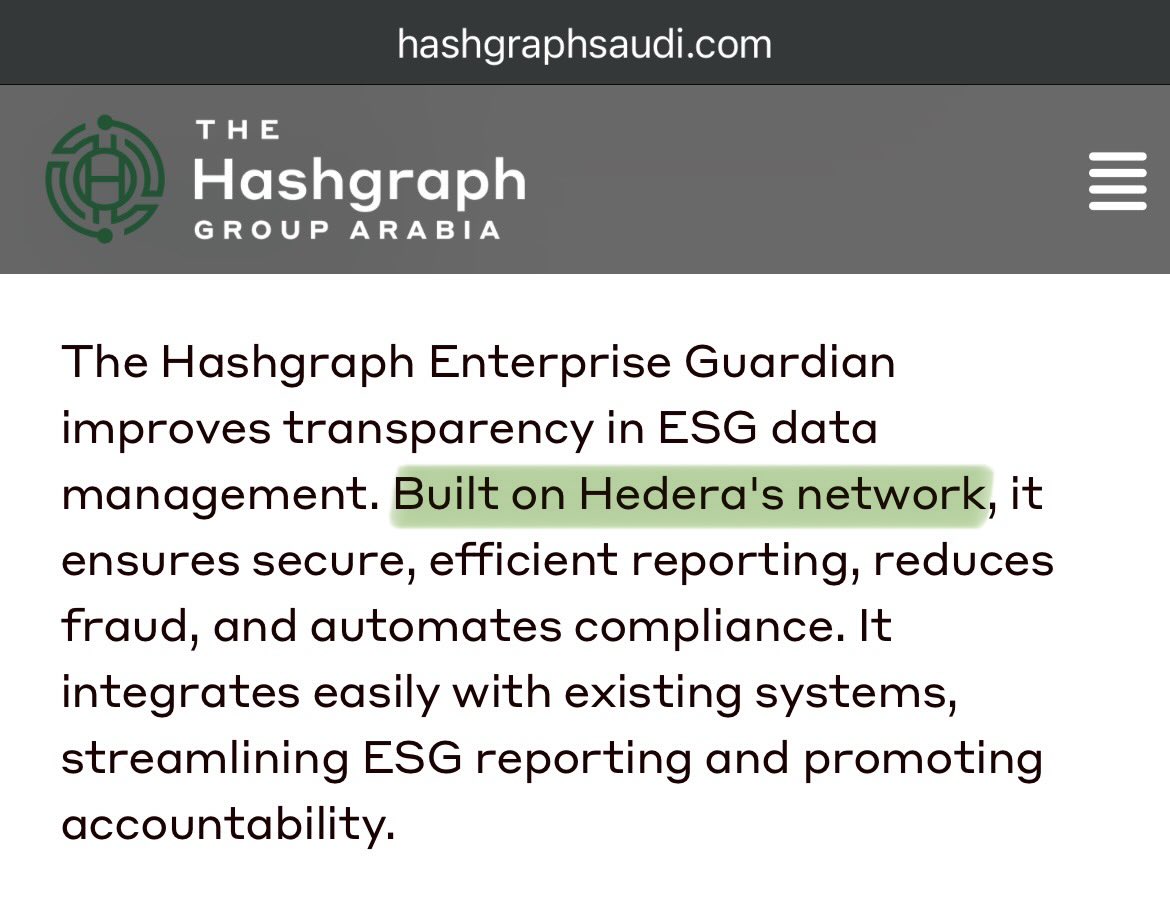
Everything is coming together for the Hedera x Saudi Vision 🇸🇦 in 2030.
$HBAR, NVIDIA, Space X and Saudi Arabia.
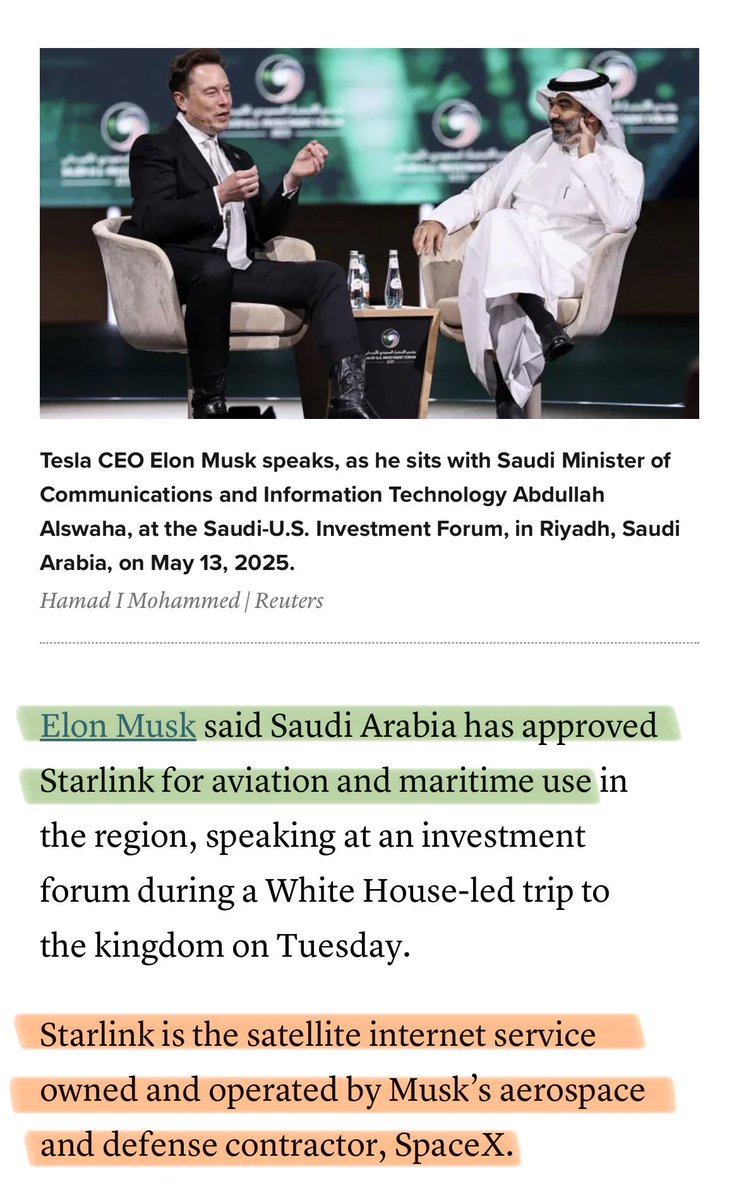
“Starlink is the satellite internet service owned and operated by Musk’s aerospace and defense contractor, SpaceX.”
This adds a whole new level..
13
51
3,001
Visual Ledger retweeted
Jun 13
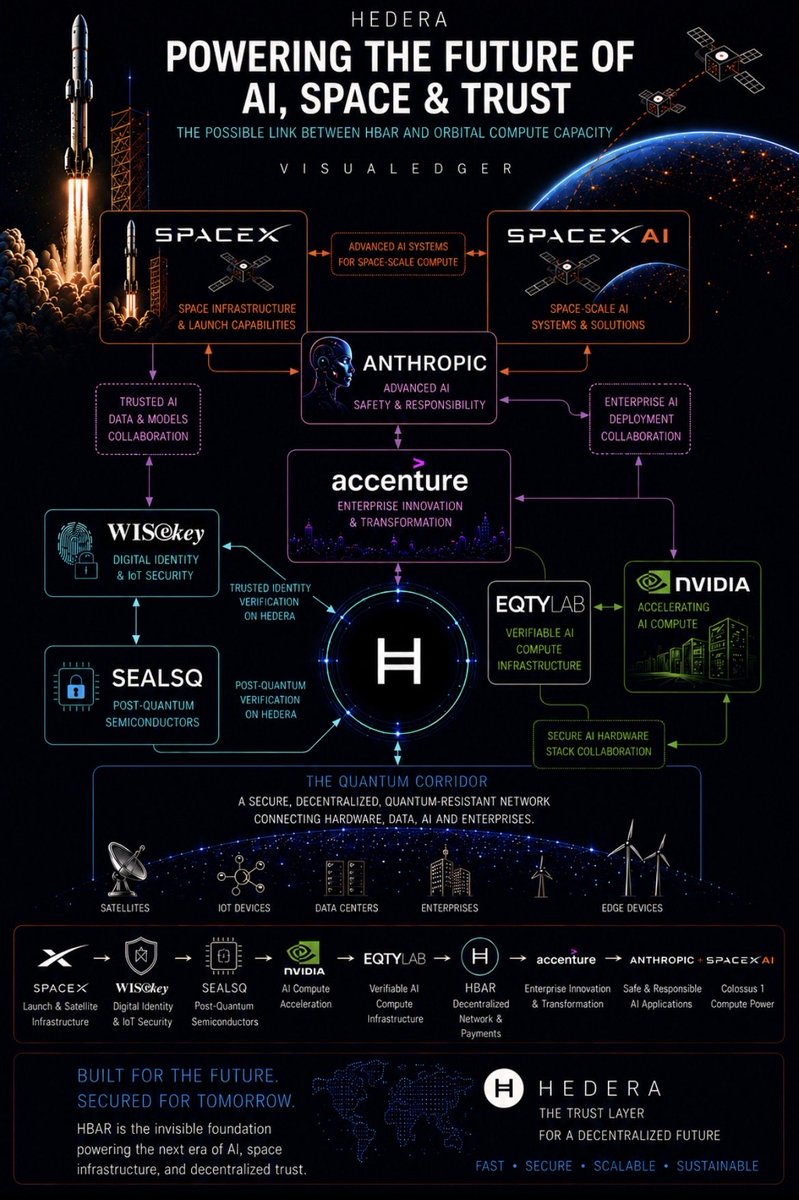
A quick overview / recap of the “Orbital AI computing” possibly powered by $HBAR - for those who’ve missed it.
First we had the total connection of HBAR’s possible role and importance in SpaceX’s & NVIDIA’s Orbital AI computing program, showing HBAR’s direct and indirect ties with the companies involved.
Recently, this was where we zoomed in into the substrate of this total connection looking at SpaceX’s internet, Starlink and Starshield (running on Starlink), with NASA involved.
*but there’s more to come as we didn’t forget the Saudi Arabia 🇸🇦 2030 Vision*
x.com/visualedger/status/205…
Jun 11
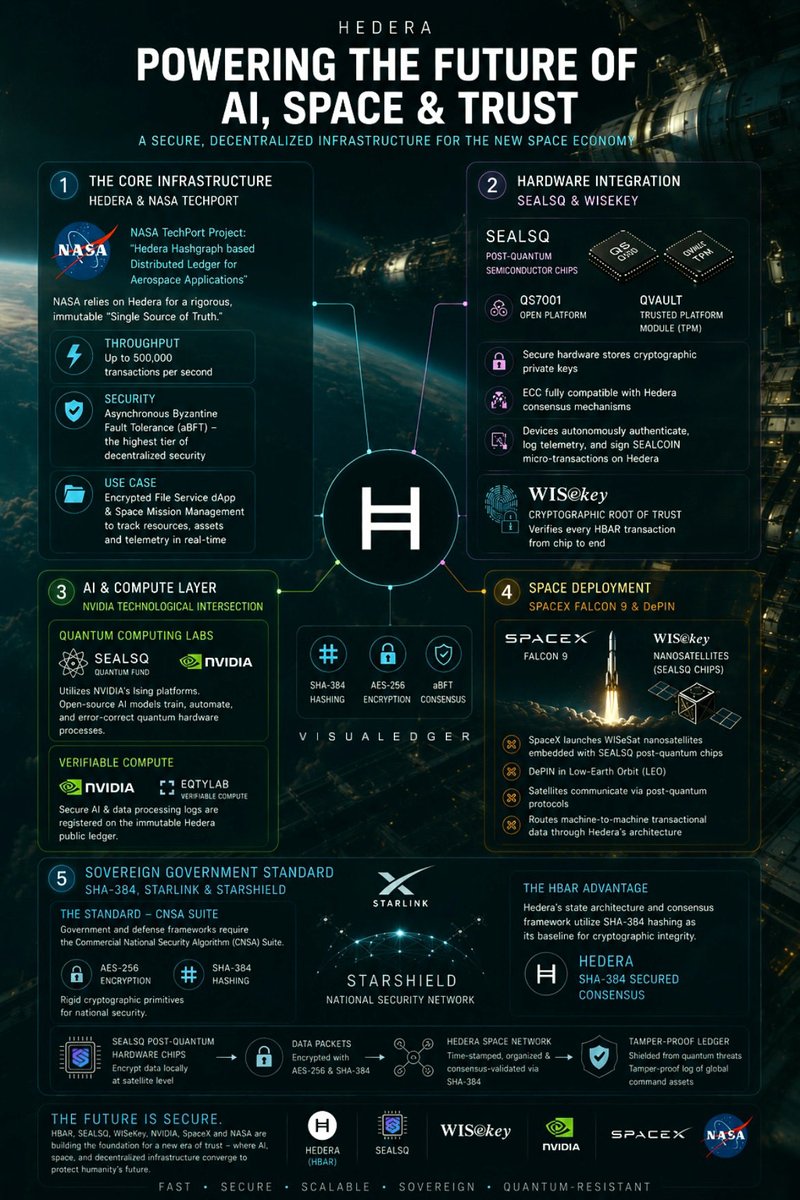
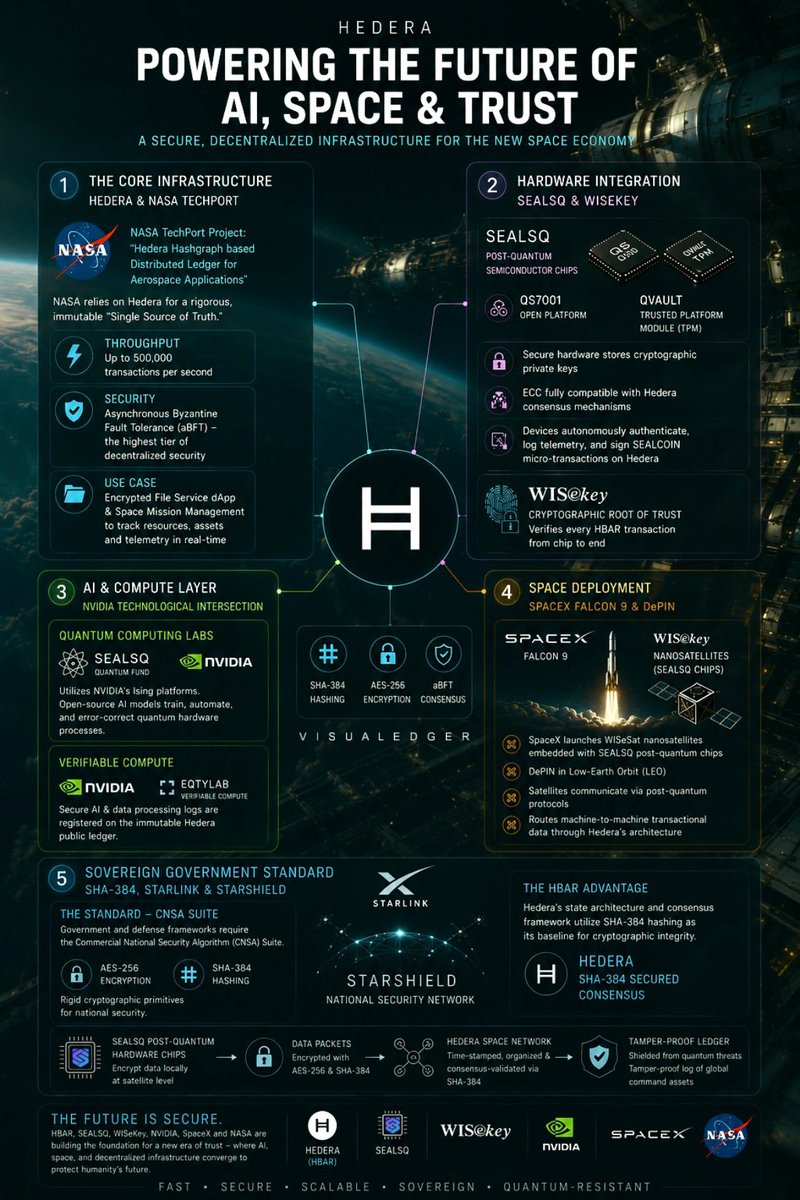
Diving deeper into SpaceX’s government data-network (Starshield), here’s how $HBAR could be powering it. 🔥
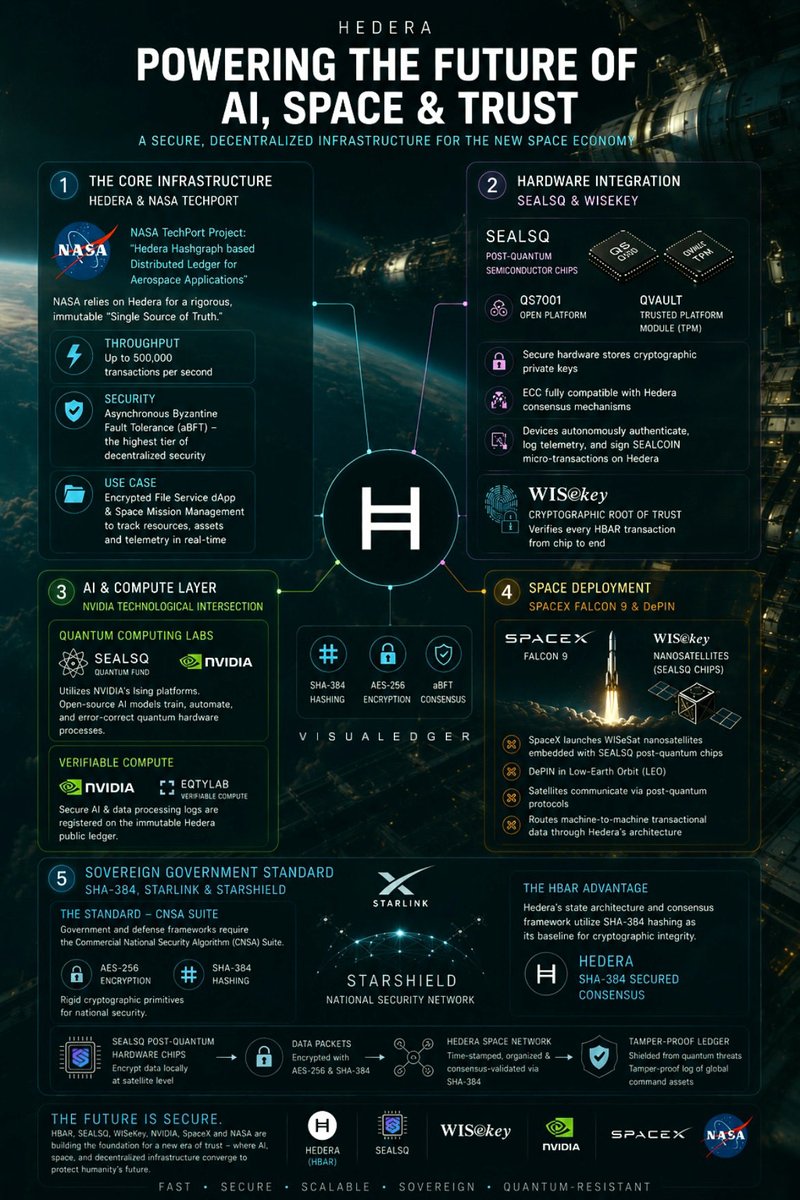
1. THE CORE INFRASTRUCTURE: Hedera and NASA TechPort 🪐
At the absolute center of this technical blueprint is Hedera Hashgraph (HBAR), serving as the foundational Distributed Ledger Technology (DLT) framework. As officially documented in NASA’s TechPort project "Hedera Hashgraph based Distributed Ledger for Aerospace Applications", NASA relies on Hedera because it requires a rigorous, immutable "Single Source of Truth."
Traditional blockchains fall short in extreme aerospace environments due to latency and processing limitations. Hedera solves this via its Hashgraph Consensus Algorithm, which delivers:
- Throughput: Up to 500,000 transactions per second.
- Security: Asynchronous Byzantine Fault Tolerance (aBFT)—the mathematically proven highest tier of decentralized security.
- Use Case: Building an encrypted File Service dApp and Space Mission Management system to flawlessly track distributed engineering resources, asset states, and telemetry data in real-time.
2. HARDWARE INTEGRATION: SEALSQ Post-Quantum Chips & WISeKey ⚙️
To prevent sophisticated quantum computers from breaking the cryptographic security of the Hedera network, HBAR’s DLT layer is integrated directly into the hardware of SEALSQ’s next-generation semiconductor chips (a subsidiary of WISeKey).
- The Chip Architecture: SEALSQ manufactures post-quantum hardware elements like the QS7001 Open Platform and QVault Trusted Platform Modules (TPM).
- On-Chain Transactions: These chips house a secure hardware element that safely stores cryptographic private keys. By implementing Elliptic Curve Cryptography (ECC) fully compatible with Hedera's consensus mechanisms, the SEALSQ chips allow devices to autonomously authenticate, log telemetry, and sign SEALCOIN micro-transactions directly on the Hedera ledger.
- The Root of Trust: This transaction layer is anchored by WISeKey's cryptographic Root of Trust, ensuring that every HBAR transaction originating from the chip is verified from end to end.
3. THE AI AND COMPUTE LAYER: NVIDIA's Technological Intersection 🟩
The integration extends into high-level artificial intelligence and simulation via NVIDIA. The connection points of this network operate through distinct vectors:
- Quantum Computing Labs: SEALSQ (via its SEALSQ Quantum Fund) actively utilizes NVIDIA’s Ising platforms. These open-source AI models are used to train, automate, and error-correct experimental quantum hardware processes.
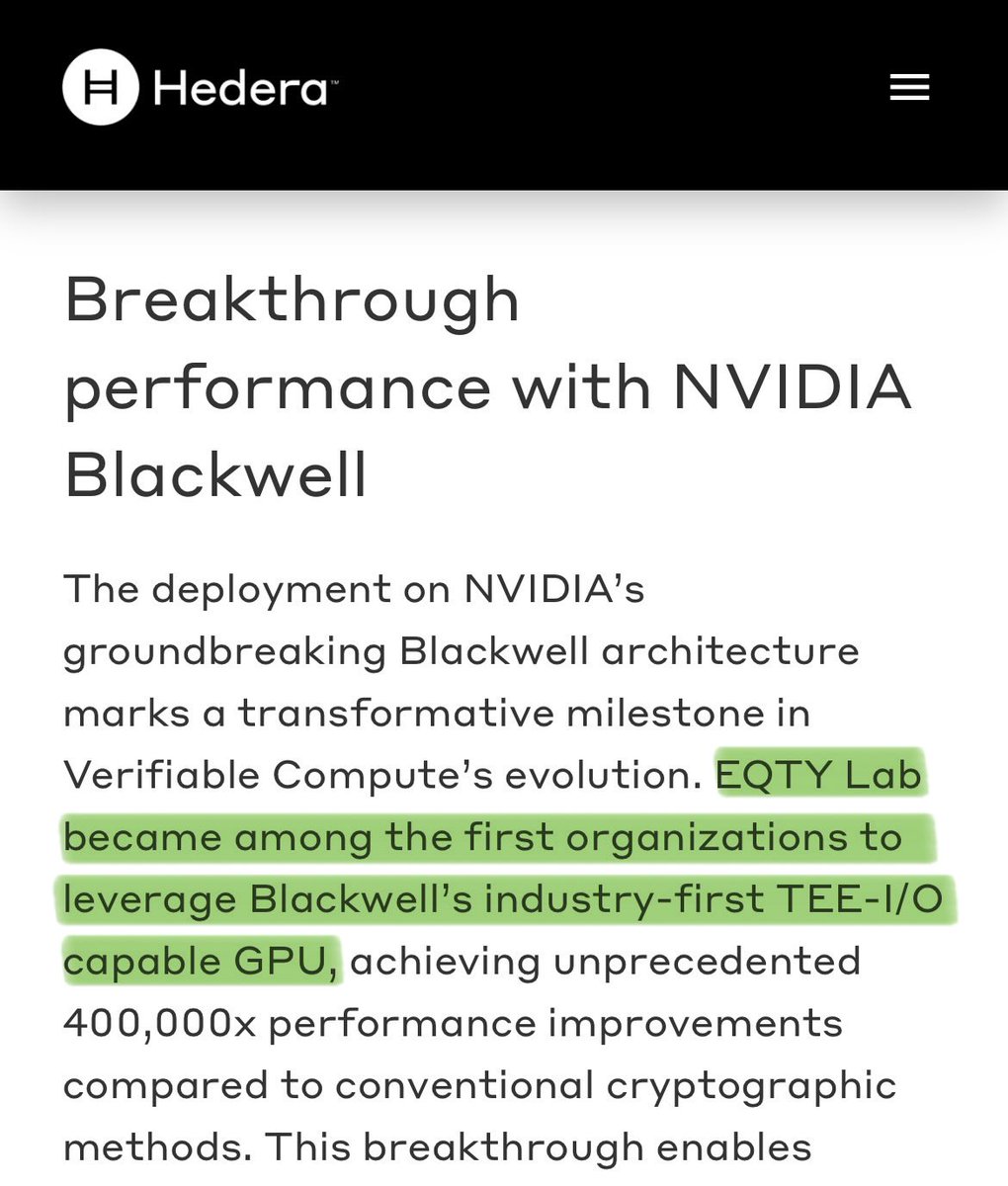
- Verifiable Compute: In parallel, tech ecosystems utilize NVIDIA hardware alongside specialized cryptographic layers (such as EQTYLab’s Verifiable Compute) to register secure AI and data processing logs directly back onto the immutable Hedera public ledger. This guarantees that data flowing through high-performance compute arrays cannot be altered or spoofed.
4. SPACE DEPLOYMENT: SpaceX Falcon 9 and DePIN 🛰️
To move this entire architecture from terrestrial laboratories into active orbit, WISeKey utilizes SpaceX’s Falcon 9 rockets as its logistics launch vehicle.
- The Mission: SpaceX successfully launched the WISeSat nanosatellites embedded with SEALSQ's post-quantum chips into Low-Earth Orbit (LEO).
- Orbital DLT Testing: This deployment acts as a live, space-bound Decentralized Physical Infrastructure Network (DePIN). The satellites communicate via post-quantum protocols, routing machine-to-machine transactional data safely through space using Hedera's architecture.
1
19
68
3,135

Visual Ledger retweeted
Jun 13
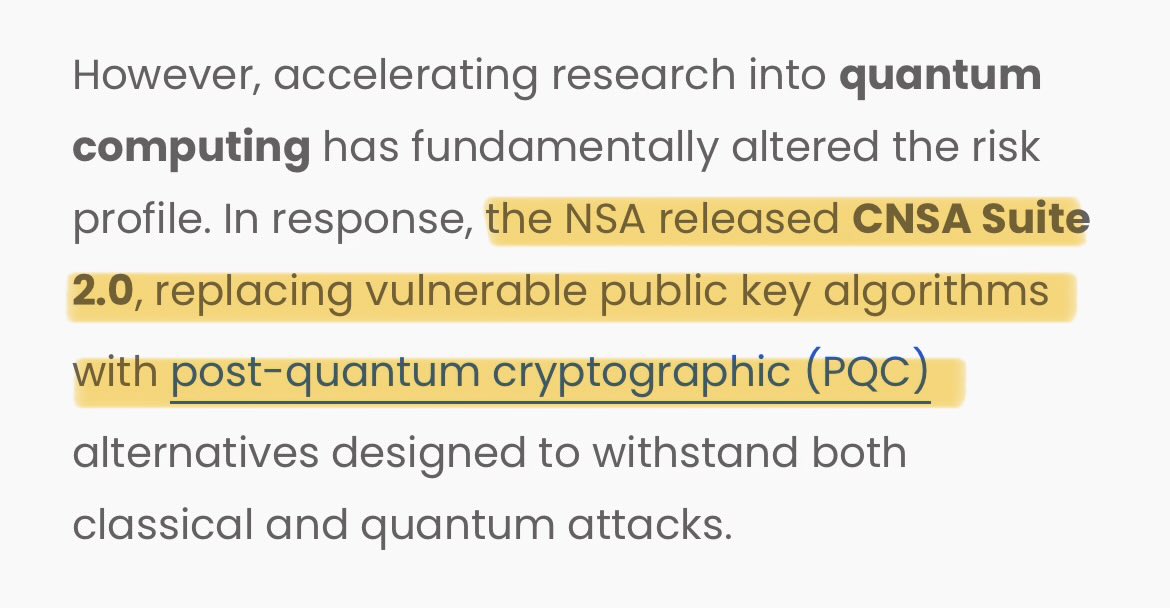
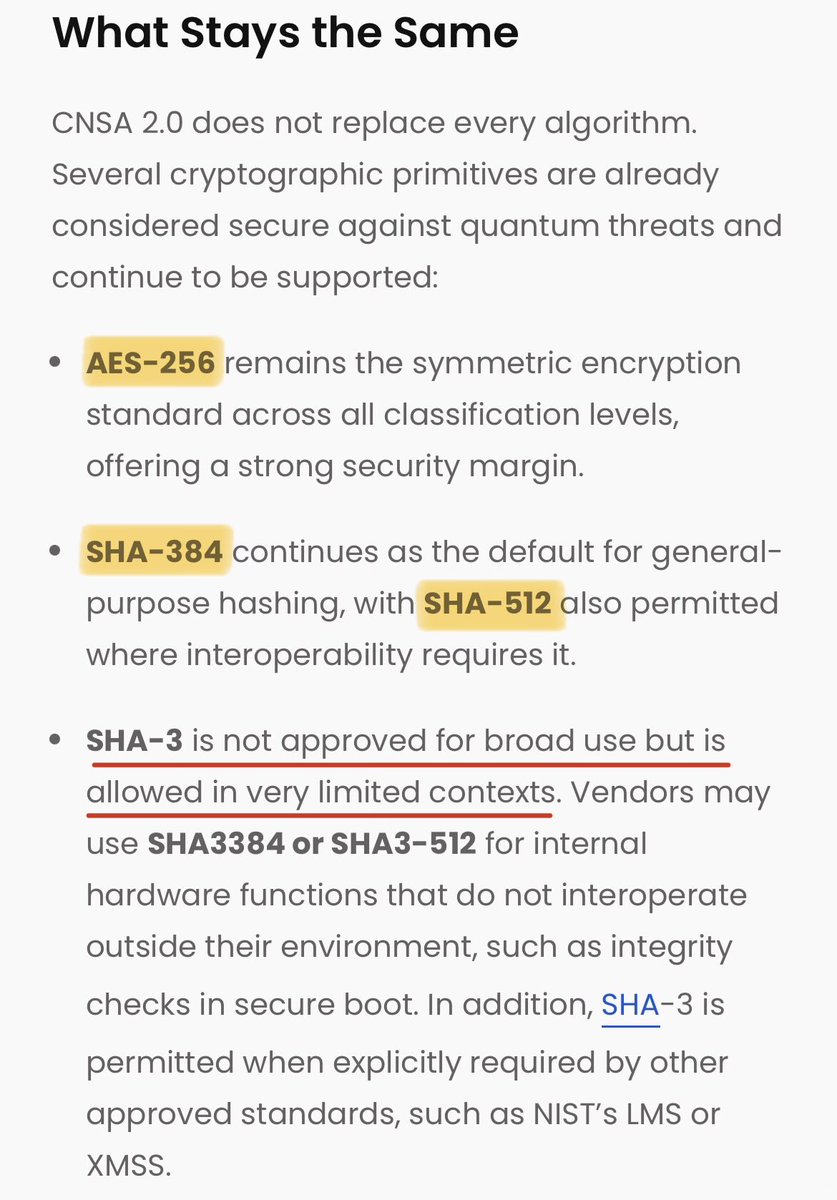
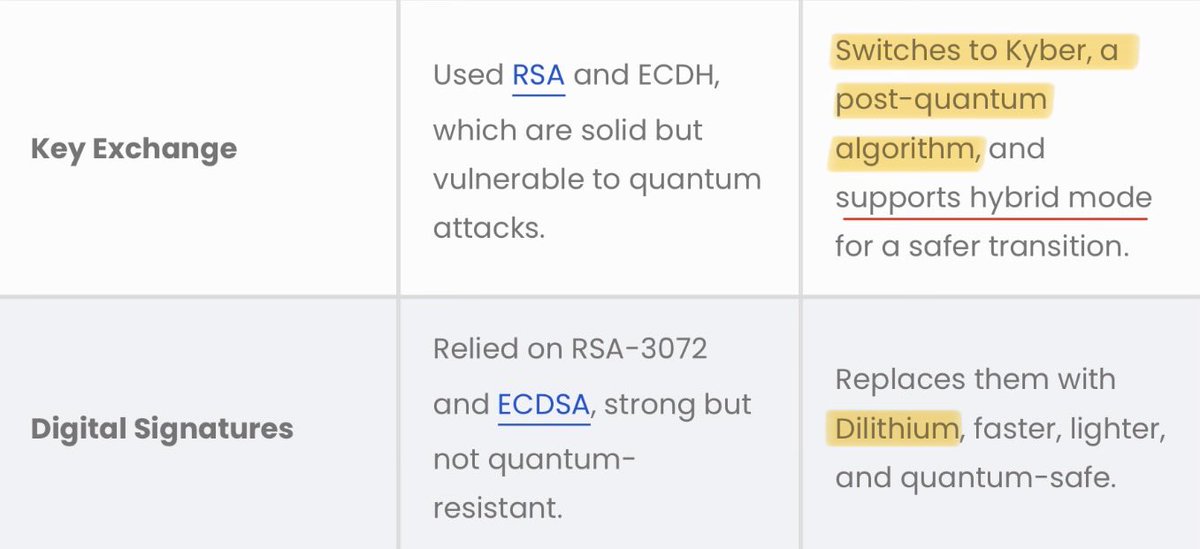
CNSA 2.0 ↔️ Post-quantum cryptography (PQC).
The CNSA is preparing for PQC, crypto / cryptography secure against quantum threats, by migrating from CNSA 1.0 to CNSA 2.0.
And $HBAR , $ALGO and $XRP will be the best fitted Layer 1’s for CNSA 2.0. ✅
With HBAR and ALGO leading the race and XRP stating its goal of achieving full quantum resistance in 2028.
The conditions for CNSA 2.0 🔐:
Core architecture
- SHA-384 (HBAR)
- SHA-512 (ALGO & XRP)
- AES-256 (HBAR, ALGO & XRP)
Key Exchange
- Kyber / ML-KEM (ALGO actively utilizing, HBAR actively integrating, XRP pending)
Digital Signatures
- Dilithum / ML-DSA (XRP main focus, HBAR and ALGO adding it next to FALCON)
Falcon is only NIST approved. ‼️
While crypto is preparing for PQC, these three currently stand out for following these conditions. 💎
Jun 12
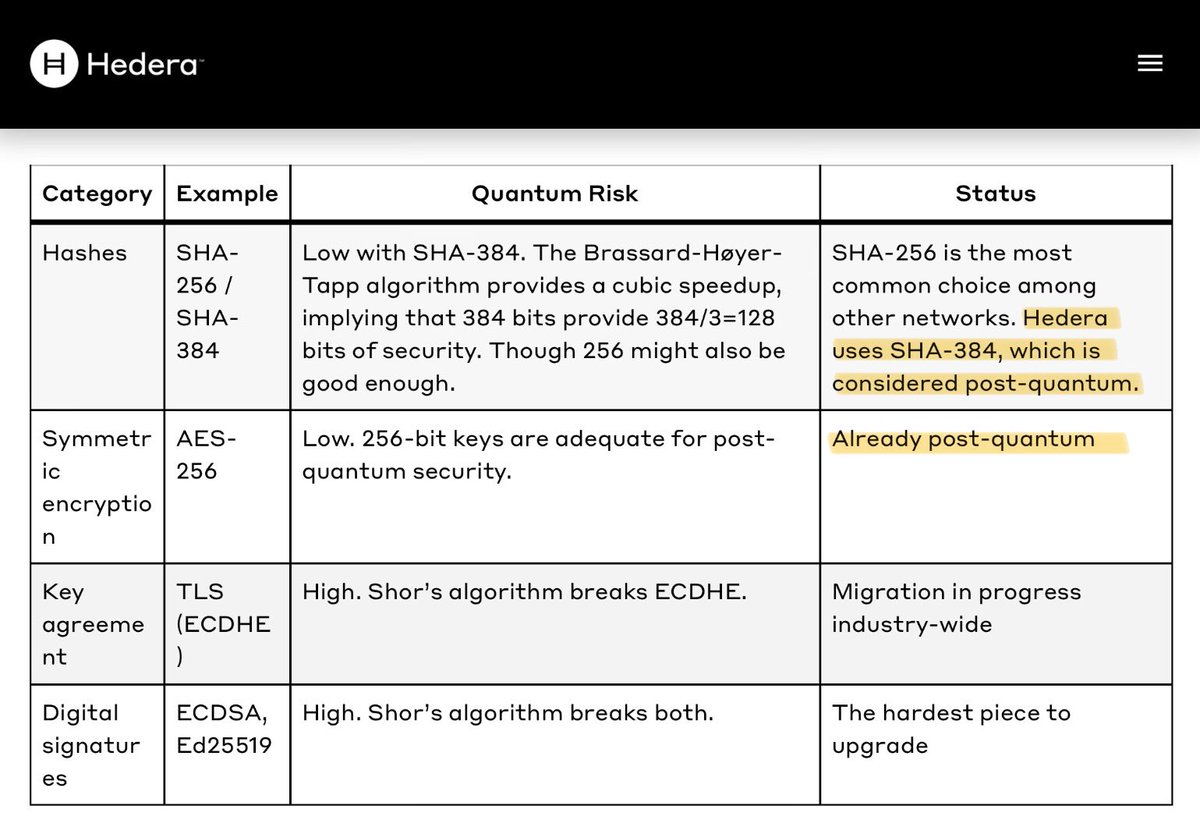
HBAR’s SHA-384 and AES-256 encryption are already post-quantum secure. 🔐✅
Fitting the narrative of SpaceX’s government data-network by SHA-384 being the CNSA 2.0 standard for classified government / military information
and AES-256 (also CNSA 2.0) encryption being impenetrable by Grover’s- or Shor’s Algorithm, making data-transfer secure.
The CNSA (Commercial National Security Algorithm Suite)
It is a strict set of cryptographic standards established by the U.S. National Security Agency (NSA). Its primary purpose is to dictate the exact encryption methods that commercial companies (like SpaceX, Boeing, or defense contractors) must implement when building hardware, software, or communication networks for National Security Systems (NSS). This includes any system processing highly classified military and intelligence data up to the Top Secret level.
3
10
75
3,660
Visual Ledger retweeted
Jun 12
HBAR’s SHA-384 and AES-256 encryption are already post-quantum secure. 🔐✅
Fitting the narrative of SpaceX’s government data-network by SHA-384 being the CNSA 2.0 standard for classified government / military information
and AES-256 (also CNSA 2.0) encryption being impenetrable by Grover’s- or Shor’s Algorithm, making data-transfer secure.
The CNSA (Commercial National Security Algorithm Suite)
It is a strict set of cryptographic standards established by the U.S. National Security Agency (NSA). Its primary purpose is to dictate the exact encryption methods that commercial companies (like SpaceX, Boeing, or defense contractors) must implement when building hardware, software, or communication networks for National Security Systems (NSS). This includes any system processing highly classified military and intelligence data up to the Top Secret level.
Jun 11
5. The Sovereign Government Standard: SHA-384, Starlink, and Starshield 🛜
The theoretical extension of this technology applies directly to the highly demanding environments found in SpaceX’s Starlink and its national security branch, Starshield. Government and defense frameworks necessitate compliance with the Commercial National Security Algorithm
Hedera’s is natively engineered to support this exact defense grade:
- The Standard: The CNSA standard demands rigid cryptographic primitives, including AES-256 encryption and SHA-384 hashing.
- The HBAR Advantage: Hedera's underlying state architecture and consensus framework utilize SHA-384 hashing as its baseline for cryptographic integrity.
- The Security Loop: If applied to a military-grade satellite network like Starshield, the SEALSQ post-quantum hardware chips would encrypt data locally at the satellite level. The data packets would then be time-stamped, organized, and consensus-validated across the space network via Hedera’s SHA-384 secured consensus mechanism. This would shield critical defense telemetry from potential quantum decryption attacks while simultaneously maintaining a tamper-proof log of global command assets.
19
62
7,090
Visual Ledger retweeted

Jun 12
JUST IN: 🇺🇸 White House Official Patrick Witt says they're aiming to pass crypto Clarity Act by July 4th.
539
1,839
13,904
848,218
Visual Ledger retweeted

Jun 10
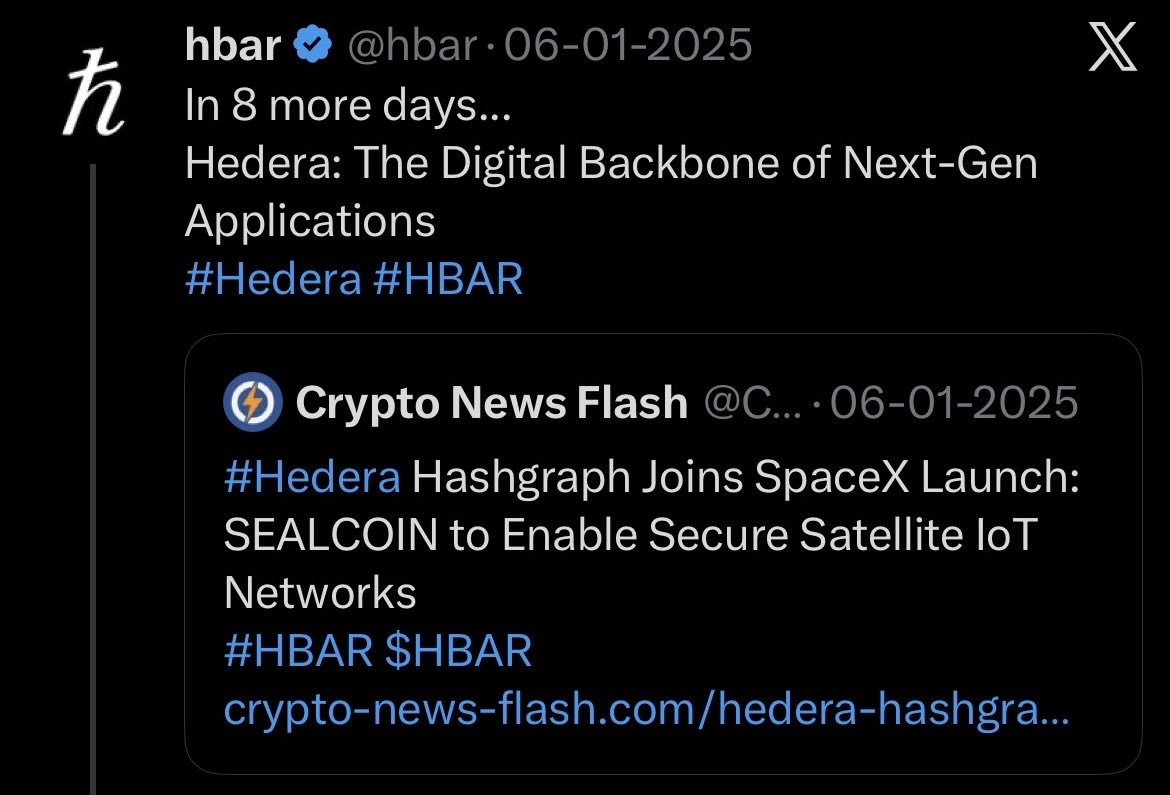
SEALCOIN just secured a $4M strategic investment commitment from WISeKey and The Hashgraph Group.
The mission: build the QAIT-powered transaction layer for the Space-Based Machine Economy where satellites, devices, and autonomous systems can securely exchange data, services, and value.
SPACEDROP already proved the demand:
45,000 participants.
19 operational satellites.
Real satellite-to-blockchain interaction.
Space infrastructure is no longer just about connectivity.
It needs an economic layer.
That’s what SEALCOIN is building. 🛰️
markets.businessinsider.com/…
41
39
118
11,006
Visual Ledger retweeted
Jun 11
Diving deeper into SpaceX’s government data-network (Starshield), here’s how $HBAR could be powering it. 🔥
1. THE CORE INFRASTRUCTURE: Hedera and NASA TechPort 🪐
At the absolute center of this technical blueprint is Hedera Hashgraph (HBAR), serving as the foundational Distributed Ledger Technology (DLT) framework. As officially documented in NASA’s TechPort project "Hedera Hashgraph based Distributed Ledger for Aerospace Applications", NASA relies on Hedera because it requires a rigorous, immutable "Single Source of Truth."
Traditional blockchains fall short in extreme aerospace environments due to latency and processing limitations. Hedera solves this via its Hashgraph Consensus Algorithm, which delivers:
- Throughput: Up to 500,000 transactions per second.
- Security: Asynchronous Byzantine Fault Tolerance (aBFT)—the mathematically proven highest tier of decentralized security.
- Use Case: Building an encrypted File Service dApp and Space Mission Management system to flawlessly track distributed engineering resources, asset states, and telemetry data in real-time.
2. HARDWARE INTEGRATION: SEALSQ Post-Quantum Chips & WISeKey ⚙️
To prevent sophisticated quantum computers from breaking the cryptographic security of the Hedera network, HBAR’s DLT layer is integrated directly into the hardware of SEALSQ’s next-generation semiconductor chips (a subsidiary of WISeKey).
- The Chip Architecture: SEALSQ manufactures post-quantum hardware elements like the QS7001 Open Platform and QVault Trusted Platform Modules (TPM).
- On-Chain Transactions: These chips house a secure hardware element that safely stores cryptographic private keys. By implementing Elliptic Curve Cryptography (ECC) fully compatible with Hedera's consensus mechanisms, the SEALSQ chips allow devices to autonomously authenticate, log telemetry, and sign SEALCOIN micro-transactions directly on the Hedera ledger.
- The Root of Trust: This transaction layer is anchored by WISeKey's cryptographic Root of Trust, ensuring that every HBAR transaction originating from the chip is verified from end to end.
3. THE AI AND COMPUTE LAYER: NVIDIA's Technological Intersection 🟩
The integration extends into high-level artificial intelligence and simulation via NVIDIA. The connection points of this network operate through distinct vectors:
- Quantum Computing Labs: SEALSQ (via its SEALSQ Quantum Fund) actively utilizes NVIDIA’s Ising platforms. These open-source AI models are used to train, automate, and error-correct experimental quantum hardware processes.
- Verifiable Compute: In parallel, tech ecosystems utilize NVIDIA hardware alongside specialized cryptographic layers (such as EQTYLab’s Verifiable Compute) to register secure AI and data processing logs directly back onto the immutable Hedera public ledger. This guarantees that data flowing through high-performance compute arrays cannot be altered or spoofed.
4. SPACE DEPLOYMENT: SpaceX Falcon 9 and DePIN 🛰️
To move this entire architecture from terrestrial laboratories into active orbit, WISeKey utilizes SpaceX’s Falcon 9 rockets as its logistics launch vehicle.
- The Mission: SpaceX successfully launched the WISeSat nanosatellites embedded with SEALSQ's post-quantum chips into Low-Earth Orbit (LEO).
- Orbital DLT Testing: This deployment acts as a live, space-bound Decentralized Physical Infrastructure Network (DePIN). The satellites communicate via post-quantum protocols, routing machine-to-machine transactional data safely through space using Hedera's architecture.
Jun 10
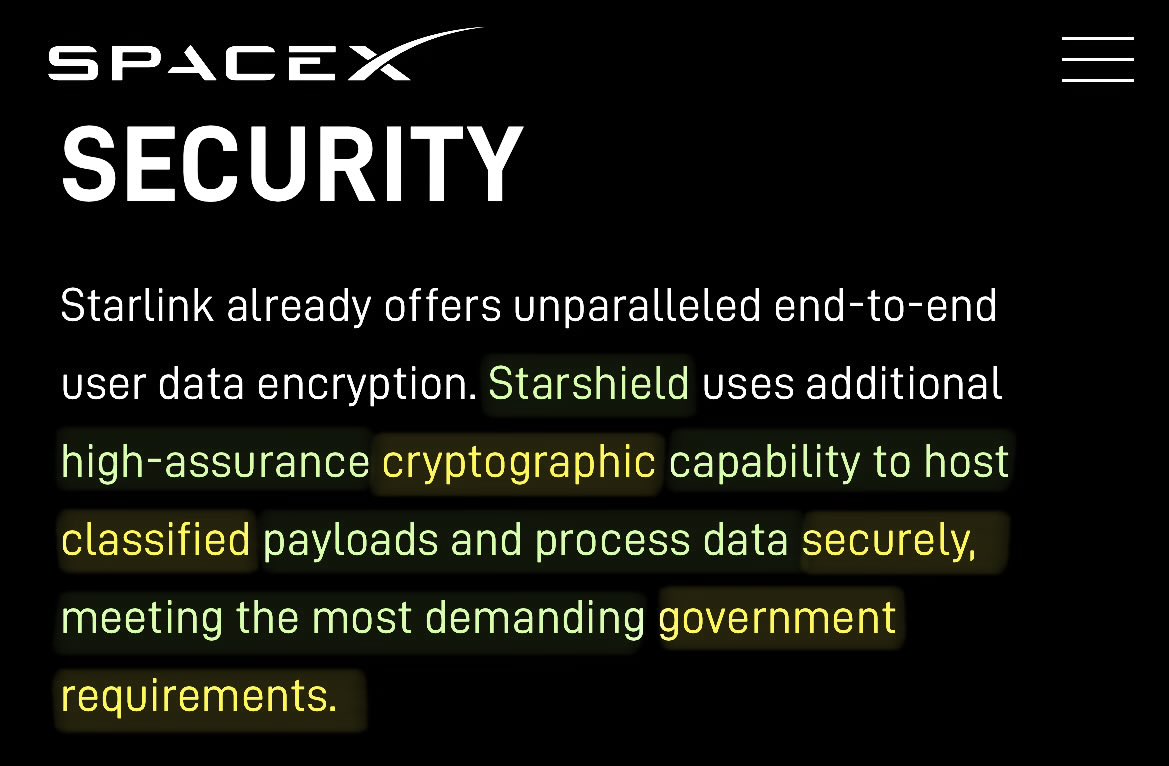
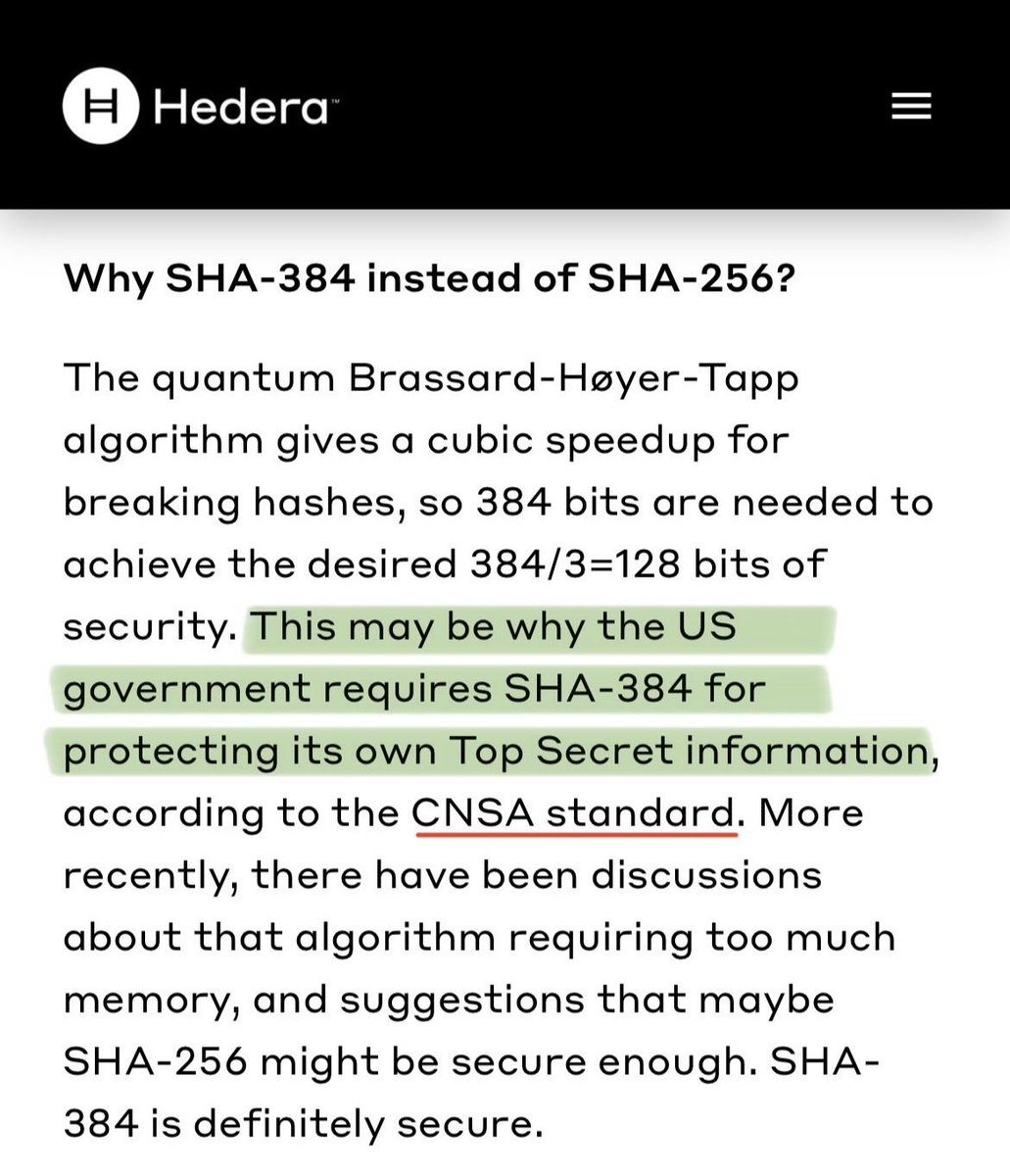
$HBAR ‘s ties to SpaceX’s military data network may be closer than anyone realizes (via NASA, SpaceX’s official partner).🔥
Pay attention to the keyword “Cryptographic”.
“… The government requires SHA-384 (CNSA standard) for protecting its own Top Secret Information …” - Hedera
and “… to host CLASSIFIED payloads and process data SECURELY meeting the most demanding GOVERNMENT REQUIREMENTS”. - SpaceX
5
33
115
14,386
Visual Ledger retweeted

Jun 12
Starshield is air-gapped. If Hedera's in the stack, it's the attestation layer - public proof of integrity while the core stays sealed. Transparency without exposure.
1
1
3
175
Jun 11
Diving deeper into SpaceX’s government data-network (Starshield), here’s how $HBAR could be powering it. 🔥
1. THE CORE INFRASTRUCTURE: Hedera and NASA TechPort 🪐
At the absolute center of this technical blueprint is Hedera Hashgraph (HBAR), serving as the foundational Distributed Ledger Technology (DLT) framework. As officially documented in NASA’s TechPort project "Hedera Hashgraph based Distributed Ledger for Aerospace Applications", NASA relies on Hedera because it requires a rigorous, immutable "Single Source of Truth."
Traditional blockchains fall short in extreme aerospace environments due to latency and processing limitations. Hedera solves this via its Hashgraph Consensus Algorithm, which delivers:
- Throughput: Up to 500,000 transactions per second.
- Security: Asynchronous Byzantine Fault Tolerance (aBFT)—the mathematically proven highest tier of decentralized security.
- Use Case: Building an encrypted File Service dApp and Space Mission Management system to flawlessly track distributed engineering resources, asset states, and telemetry data in real-time.
2. HARDWARE INTEGRATION: SEALSQ Post-Quantum Chips & WISeKey ⚙️
To prevent sophisticated quantum computers from breaking the cryptographic security of the Hedera network, HBAR’s DLT layer is integrated directly into the hardware of SEALSQ’s next-generation semiconductor chips (a subsidiary of WISeKey).
- The Chip Architecture: SEALSQ manufactures post-quantum hardware elements like the QS7001 Open Platform and QVault Trusted Platform Modules (TPM).
- On-Chain Transactions: These chips house a secure hardware element that safely stores cryptographic private keys. By implementing Elliptic Curve Cryptography (ECC) fully compatible with Hedera's consensus mechanisms, the SEALSQ chips allow devices to autonomously authenticate, log telemetry, and sign SEALCOIN micro-transactions directly on the Hedera ledger.
- The Root of Trust: This transaction layer is anchored by WISeKey's cryptographic Root of Trust, ensuring that every HBAR transaction originating from the chip is verified from end to end.
3. THE AI AND COMPUTE LAYER: NVIDIA's Technological Intersection 🟩
The integration extends into high-level artificial intelligence and simulation via NVIDIA. The connection points of this network operate through distinct vectors:
- Quantum Computing Labs: SEALSQ (via its SEALSQ Quantum Fund) actively utilizes NVIDIA’s Ising platforms. These open-source AI models are used to train, automate, and error-correct experimental quantum hardware processes.
- Verifiable Compute: In parallel, tech ecosystems utilize NVIDIA hardware alongside specialized cryptographic layers (such as EQTYLab’s Verifiable Compute) to register secure AI and data processing logs directly back onto the immutable Hedera public ledger. This guarantees that data flowing through high-performance compute arrays cannot be altered or spoofed.
4. SPACE DEPLOYMENT: SpaceX Falcon 9 and DePIN 🛰️
To move this entire architecture from terrestrial laboratories into active orbit, WISeKey utilizes SpaceX’s Falcon 9 rockets as its logistics launch vehicle.
- The Mission: SpaceX successfully launched the WISeSat nanosatellites embedded with SEALSQ's post-quantum chips into Low-Earth Orbit (LEO).
- Orbital DLT Testing: This deployment acts as a live, space-bound Decentralized Physical Infrastructure Network (DePIN). The satellites communicate via post-quantum protocols, routing machine-to-machine transactional data safely through space using Hedera's architecture.
Jun 10
$HBAR ‘s ties to SpaceX’s military data network may be closer than anyone realizes (via NASA, SpaceX’s official partner).🔥
Pay attention to the keyword “Cryptographic”.
“… The government requires SHA-384 (CNSA standard) for protecting its own Top Secret Information …” - Hedera
and “… to host CLASSIFIED payloads and process data SECURELY meeting the most demanding GOVERNMENT REQUIREMENTS”. - SpaceX
5
33
115
14,386
Jun 11
5. The Sovereign Government Standard: SHA-384, Starlink, and Starshield 🛜
The theoretical extension of this technology applies directly to the highly demanding environments found in SpaceX’s Starlink and its national security branch, Starshield. Government and defense frameworks necessitate compliance with the Commercial National Security Algorithm
Hedera’s is natively engineered to support this exact defense grade:
- The Standard: The CNSA standard demands rigid cryptographic primitives, including AES-256 encryption and SHA-384 hashing.
- The HBAR Advantage: Hedera's underlying state architecture and consensus framework utilize SHA-384 hashing as its baseline for cryptographic integrity.
- The Security Loop: If applied to a military-grade satellite network like Starshield, the SEALSQ post-quantum hardware chips would encrypt data locally at the satellite level. The data packets would then be time-stamped, organized, and consensus-validated across the space network via Hedera’s SHA-384 secured consensus mechanism. This would shield critical defense telemetry from potential quantum decryption attacks while simultaneously maintaining a tamper-proof log of global command assets.
2
5
2,973