New Cell Behavior papers from arxiv.org: cell-cell signaling, morphogenesis. Thank you to arXiv for use of its open access interoperability.
- Tweets 14,438
- Following 2
- Followers 117
- Likes 1
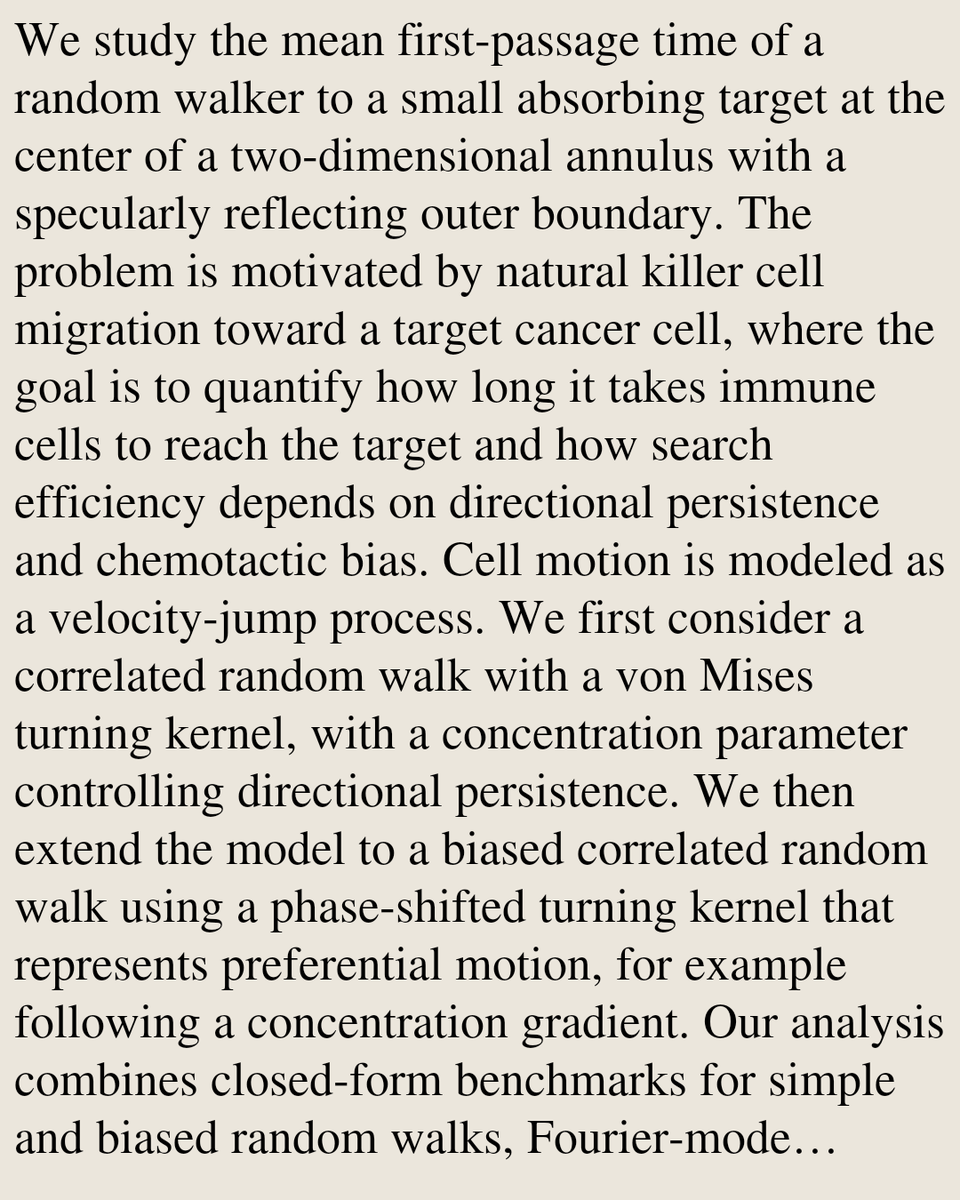

ALT We study the mean first-passage time of a random walker to a small absorbing target at the center of a two-dimensional annulus with a specularly reflecting outer boundary. The problem is motivated by natural killer cell migration toward a target cancer cell, where the goal is to quantify how long it takes immune cells to reach the target and how search efficiency depends on directional persistence and chemotactic bias. Cell motion is modeled as a velocity-jump process. We first consider a correlated random walk with a von Mises turning kernel, with a concentration parameter controlling directional persistence. We then extend the model to a biased correlated random walk using a phase-shifted turning kernel that represents preferential motion, for example following a concentration gradient. Our analysis combines closed-form benchmarks for simple and biased random walks, Fourier-mode reductions of the transport equations for the correlated and biased correlated models, and a fast-turning
ALT Hereditary stomatocytosis (HS) comprises red blood cell (RBC) disorders characterized by cup-shaped erythrocytes that respond oppositely to splenectomy: curative in overhydrated HS (OHS) but potentially thrombogenic in dehydrated HS (DHS/xerocytosis). This paradox persists because RBC biomechanics is governed by partly independent parameters–shear modulus, bending rigidity, surface-to-volume ratio (S/V), and cytoplasmic viscosity–that existing assays capture only piecemeal. Here we combine dissipative particle dynamics (DPD) simulations with microfluidic imaging to construct a control discocyte and three stomatocyte models (ST-RBC1-3) at fixed membrane area and decreasing volume (109.7, 101.5, 89.8 fL), spanning the OHS-to-DHS range. Tracing this parameter set through five mechanically orthogonal assays, we find that interendothelial-slit (IES) traversal is geometry-dominated: overhydrated ST-RBC1 requires an order of magnitude higher critical pressure than healthy RBCs, whereas dehydr
ALT Single-cell-resolution spatial transcriptomics profiles gene expression at cellular locations in native tissues, yet accurate cell-type annotation remains challenging: imaging-based platforms are constrained by targeted gene panels, whereas sequencing-based platforms often suffer from sparse molecular capture and dropout. Reliable transfer of cell-type labels from single-cell RNA sequencing references is therefore critical for interpreting targeted and sparse spatial datasets. Here, we present SpCAST, a Kolmogorov–Arnold network-based framework for reference-guided spatial transcriptomics analysis. SpCAST captures nonlinear mappings between reference and spatial expression profiles and uses feature attribution to prioritize genes supporting cell-type predictions. Within a unified framework, SpCAST performs cell-type label transfer, spatial gene-expression reconstruction and marker-gene candidate prioritization. We benchmarked SpCAST on 53 datasets comprising 413,376 spatial cells acros
ALT Turing patterns are a cornerstone of biological self-organization, yet their emergence typically requires finely tuned parameters occupying narrow regions of high-dimensional space. This poses a fundamental challenge: how can evolving biological systems reliably find and exploit such rare conditions? In this work, we propose that common biochemical limit cycles, such as those arising from genetic feedback loops, can act as natural explorers of Turing space. By coupling a reaction-diffusion system to an orbit that modulates some of its parameters, we show that the system can dynamically sweep through Turing-permissive regimes and generate transient spatial patterns. We use an entropy-based measure in Fourier space to quantify pattern formation and demonstrate how cycles enhance the detectability and robustness of Turing islands. We further explore how coupling to positional gradients increases reproducibility, suggesting a route from oscillatory dynamics to stable developmental programs
ALT The striking variety of macroscopic morphologies displayed by bacterial colonies depends on microscopic environmental and behavioural details in a manner that is currently not well understood. A surprising example is sibling inhibition, whereby isogenic bacterial colonies spreading in soft agar hydrogels tend to avoid each other and form sharp demarcation lines when growing nearby. Here we investigate this effect with the common pathogen Pseudomonas aeruginosa, by combining quantitative density measurements with a minimal biophysical model. Our results show that the phenomenon does not depend on gel compression, lethal inhibition or quorum sensing-dependent cell communication. Instead, colony separation is driven by localised nutrient depletion through a dynamic feedback between growth and motility. The model, which is calibrated using experimental data, captures key observations including the dependence of inhibition strength on the initial nutrient concentration. This work establishe
ALT The orientation of cell division is a major determinant of three-dimensional plant morphogenesis. Whether and how a simple division orientation rule explains the establishment of symmetric body plans is a fundamental question. Testing such hypotheses is facilitated by a modeling framework that combines realistic three-dimensional cell mechanics, irreversible cell-wall growth, and a deformable tissue geometry. We recently introduced such a framework, a 3D mechano-geometric multicellular model of apical stem cell-driven morphogenesis. Here we document how the model is built from physiological and computational perspectives. We describe the triangulated thin-shell representation of cells, the treatment of turgor pressure, cell-wall elasticity and strain-driven wall growth, the cell-division algorithm together with its two pluggable division-rule implementations, and the remeshing operations that keep the triangulation well-conditioned as cells grow, divide, and deform. The aim of this pap
ALT Our understanding of cell division control in bacteria still relies largely on interpreting correlations between phenomenological variables, with limited connection to the underlying molecular mechanisms. Here, we analytically solve a stochastic threshold-accumulation model in which a size-dependent divisor protein triggers division upon reaching a noisy, autocorrelated threshold, quantifying within a unified framework the combined effects of intrinsic and extrinsic noise and key mechanistic parameters such as protein reset and threshold memory. We show that incorporating these elements yields behavior far richer than the commonly assumed adder, spanning a continuum of division strategies from timer to sizer while modulating size fluctuations in a nontrivial fashion. Comparison with single-cell E. coli data shows that extrinsic noise and additional mechanistic ingredients are required to account for the observed size fluctuations. The adder emerges when threshold correlations balance p
ALT T-cell receptor (TCR) interactions with antigenic peptides underpin adaptive immunity and are pivotal for personalized immunotherapy and vaccine development. Despite recent progress, computational modeling of TCR-peptide specificity remains challenging due to data scarcity, complex sequence dependencies, and the absence of standardized evaluation frameworks. To systematically address these issues, we introduce TCRTransBench, a comprehensive benchmark for bidirectional TCR-peptide sequence generation tasks. Specifically, we define two sequence-to-sequence (seq2seq) tasks: generating antigenic peptides from TCR sequences (TCR2PEP) and generating TCR sequences from antigenic peptides (PEP2TCR). Our framework provides a rigorously curated, MHC-free dataset comprising tens of thousands of validated TCR-peptide pairs, along with diverse evaluation metrics that integrate computational efficiency, sequence accuracy, and biological plausibility. Extensive benchmarking across representative neur
ALT Bacterial chemotaxis has long been viewed as operating near the physical limits of sensing, as originally articulated by Berg and Purcell. Recent information-theoretic analyses challenge this view, suggesting that Escherichia coli uses only a small fraction of the information available in ligand arrival statistics to bias its motion. How should such low information efficiency be interpreted at the level of behavior? Here, I argue that chemotactic performance is shaped not only by information transmission and noise, but by the strategy of movement itself. Using simple scaling arguments and minimal models, I show how run-and-tumble chemotaxis can remain robust to noise through symmetry and temporal averaging, even when internal information processing is inefficient. Comparing bacterial and eukaryotic chemotaxis highlights how different sensing strategies convert physical limits into observable behavior. These considerations suggest that low information efficiency need not imply poor perf
ALT Virtual cell (VC) models aim to predict cellular responses to any perturbations in silico and have emerged as a promising approach for drug discovery and precision medicine. Yet, a clear gap still remains: while models routinely reported impressive results on standard benchmarks, it is unclear whether their predictions are truly meaningful in practice. This is mainly due to limitations in current evaluation setups, which are often overly simplified or inconsistent, and do not reflect the complexity and variability of real biological systems. Here, we introduce a standardized and modular benchmarking framework for virtual cell prediction. Our framework evaluates diverse models under in-the-wild challenging scenarios, including unseen cell contexts, unseen perturbations, and cross-dataset generalization, which better reflect practical applications. Our analysis shows that model performance is highly context-dependent and shaped by task design and evaluation criteria. In commonly used set
ALT Melanoma is an aggressive form of skin cancer. Survival rates are excellent if it is detected early but fall markedly if it metastasises. A key step in early tumour progression is the formation of cell clusters, which can promote metastasis. However, the mechanisms driving cell clustering, and the role of phenotypic heterogeneity in the dynamics of these clusters, remain poorly understood. In this work, we propose a system of ordinary differential equations that models cluster formation dynamics within a coagulation-fragmentation-proliferation framework. Using Bayesian inference, we fit this model to in vitro time-lapse microscopy data from two melanoma phenotypes-proliferative and invasive-to uncover the predominant mechanisms driving cluster formation and how these differ between phenotypes. Additionally, we provide preliminary insights into how clustering behaviour in co-cultures contrasts with that observed in monocultures. The model quantifies phenotypic differences in clustering

ALT Precise and autonomous clocks are of fundamental interest and central importance to both foundational studies and practical applications. Here, we construct a blueprint for a quantum clock governed by time-independent interactions. By carefully-engineered coherent transport in dissipative spin chains, we achieve a scaling exponent at the precision-resolution trade-off fundamental bound, bringing this within reach of physically realistic and experimentally accessible systems. We further introduce a sudden-quench protocol that enables repeated operation through a simple initialization and detachment mechanism. Remarkably, the protocol is robust to imprecise detachment timing, implying that high-precision timekeeping can be achieved even when driven by a clock with much lower precision.