
The World Well-Being Project is a research consortium across @Penn, @Stanford, @JohnsHopkins, @StonybrookU comprised of psychologists and computer scientists.
Joined July 2013
- Tweets 1,489
- Following 496
- Followers 1,531
- Likes 1,898
13 Photos and videos

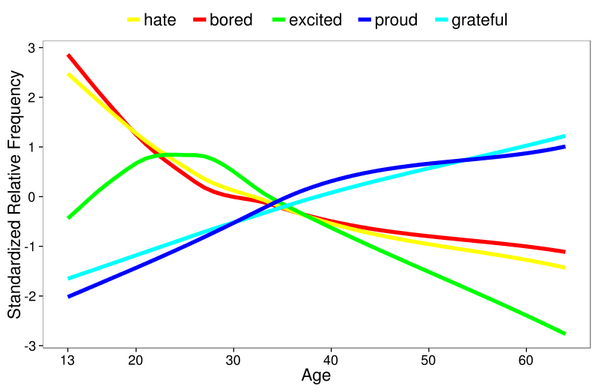
World Well-Being Prj retweeted
We're hiring a CS postdoc for the STELLAR project funded by @wellcometrust and @OpenAI to build AI-powered patient simulations for mental health clinician training.
You'd specifically be developing Conceptor-based steering methods for open-weight LLMs to simulate psychiatric symptom presentations with precise, composable control.
The position is based at NYU Stern with appointments at Penn CIS and the Linguistic Data Consortium. You'd work with an amazing interdisciplinary team across CS, Psychiatry, and Public Health!
More details here: docs.google.com/document/d/1…
1
2
3
323
World Well-Being Prj retweeted
Paper now out in ACM #CHI2026!
Spoken English proficiency drives economic mobility for low-income Indian youth, but opportunities to actually speak English in school are scarce. Large classes, teachers without adequate proficiency, and textbooks in English but instruction in local languages. And with generative AI making polished written English cheaper, the relative value of spoken fluency is only rising.
New work led by Sneha and @viviennebhchi deployed a voice-based chatbot for conversational English practice across four low-fee Delhi schools. Through a six-day field study involving 23 students, 6 teachers, and 5 principals, they tracked what actually happens when this technology is implemented in resource-constrained multilingual classrooms.
Although this was a qualitative study, the observed gains in student-initiated questions were substantial: from 36% on Day 1 to 65% by Day 5. Students who started nervous and hesitant began speaking freely. But the gains were fragile; ASR errors with proper nouns and Hindi loanwords, unfamiliar accents, hold-to-talk buttons that 35% of learners couldn't operate correctly. Small technical frictions quickly unraveled nascent confidence.
The paper highlights a core design tension: students wanted open-ended, conversational practice, whereas administrators wanted curriculum-aligned assessment. Reconciling both is the path to sustainable adoption.
Includes a deployment checklist for educational chatbots in resource-constrained multilingual communities.
Full paper: lnkd.in/eQSZ82x8
Grateful to @PennGlobal funding and the collaboration with @csbcashoka @AshokaUniv that made this study possible!
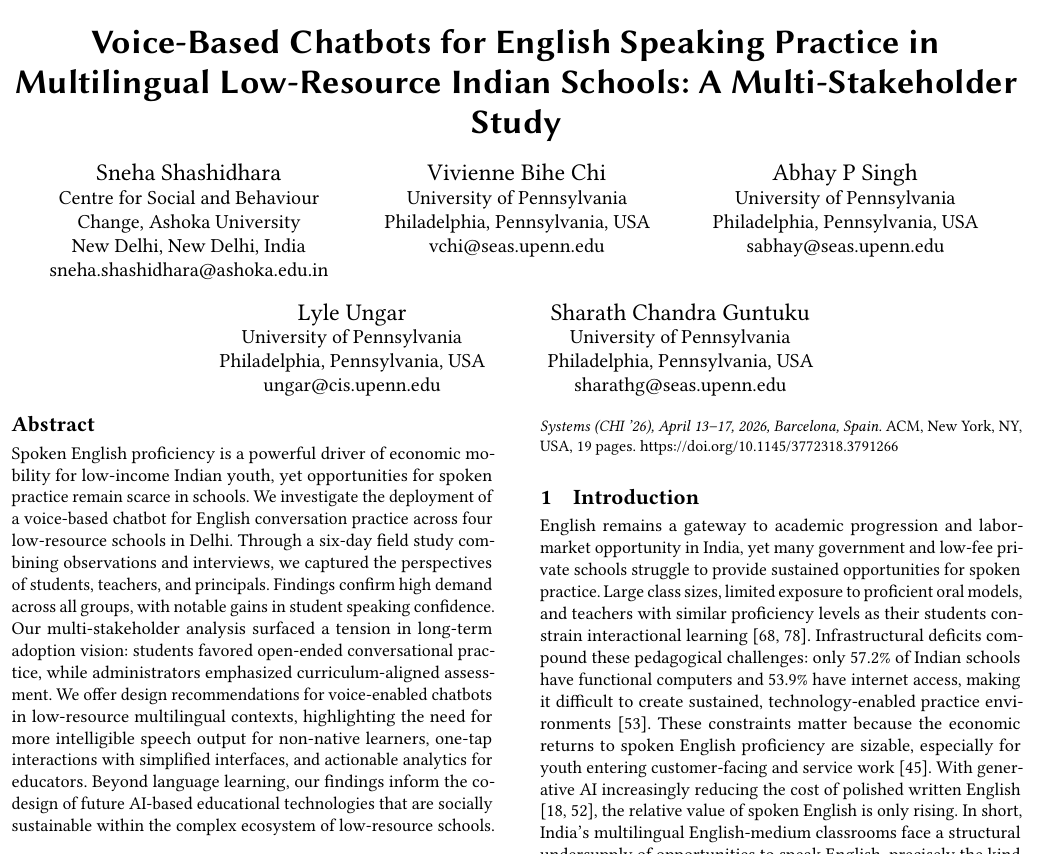
ALT Paper's title and abstract
1
3
3
438
World Well-Being Prj retweeted

2 Sep 2025
LLMs match or surpass human-crafted messages across multiple domains, from marketing to reducing conspiracy beliefs. Yet, our research, led by @sehgal_neil, adds nuance: AI chatbots can boost short-term vaccination intent, but their edge over quality public health messaging for lasting change, when controlled for the amount of time spent, is unclear. Surprisingly, a single, tailored AI message proved as effective as a chatbot for colorectal cancer screening, showing simplicity can scale, especially in medical contexts.
Key takeaways:
1. AI complements, not replaces, traditional public health tools.
2. Short, personalized AI messages can be highly effective.
3. For lasting impact, AI needs integration with proven strategies.
4. Continued research with strong controls and long-term follow-up is essential to assess AI’s true, durable impact on public health.
Read full papers here:
- Effect of Static vs. Conversational AI-Generated Messages on Colorectal Cancer Screening Intent: a Randomized Controlled Trial: arxiv.org/pdf/2507.08211
- Conversations with AI Chatbots Increase Short-Term Vaccine Intentions But Do Not Outperform Standard Public Health Messaging: arxiv.org/pdf/2504.20519
#AIinHealthCare #PublicHealth #LLMs #VaccineConfidence #CancerScreening
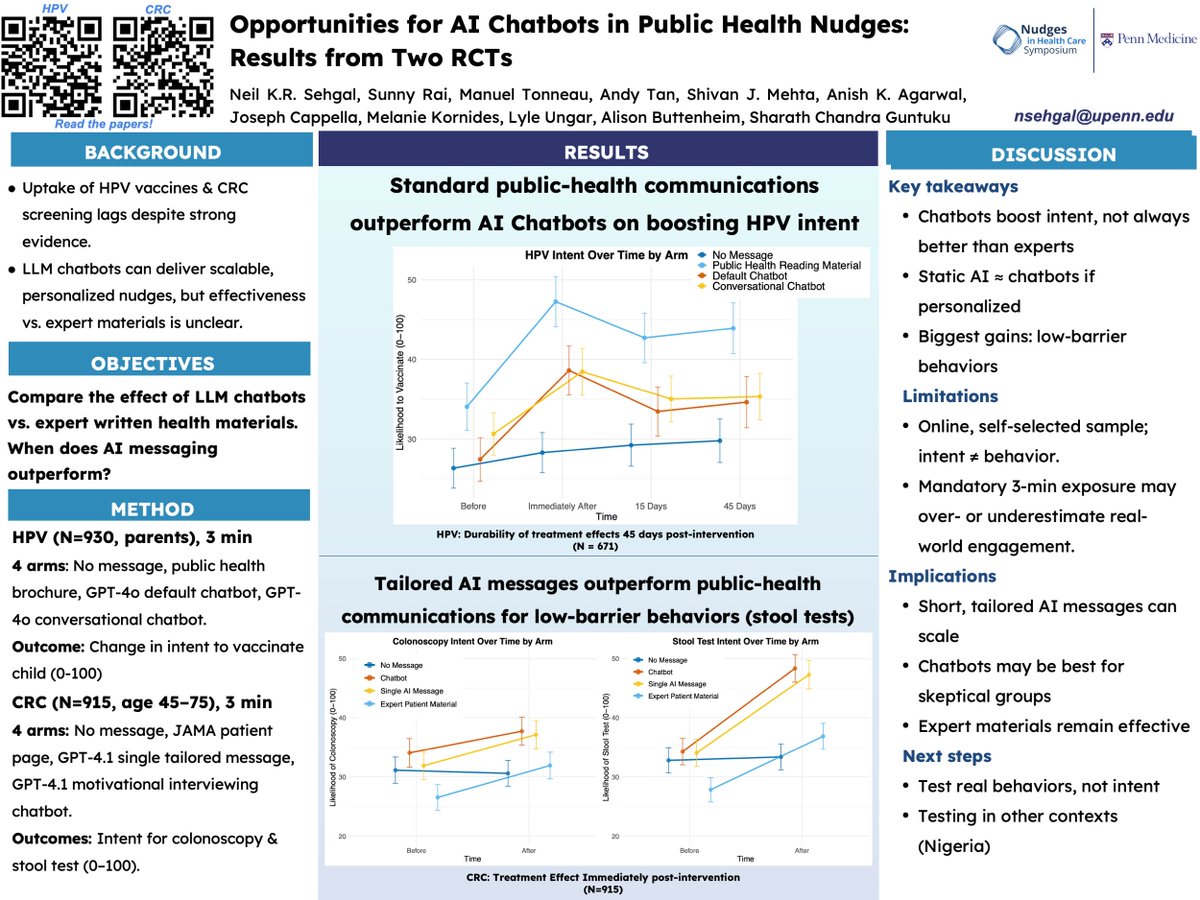
ALT Poster of key results from 2 RCTs on AI chatbots in public health nudges
4
13
1,267
World Well-Being Prj retweeted

4 Dec 2025
@SemEvalWorkshop 2026 Task2 Live!! Go participate #NLProc @aclmeeting
Build personalized, ecologically valid, emotionally intelligent systems! Rare opportunity to study lived emotions via self-reported & longitudinal experiences
Evaluation begins Jan 10
tinyurl.com/semeval26task2
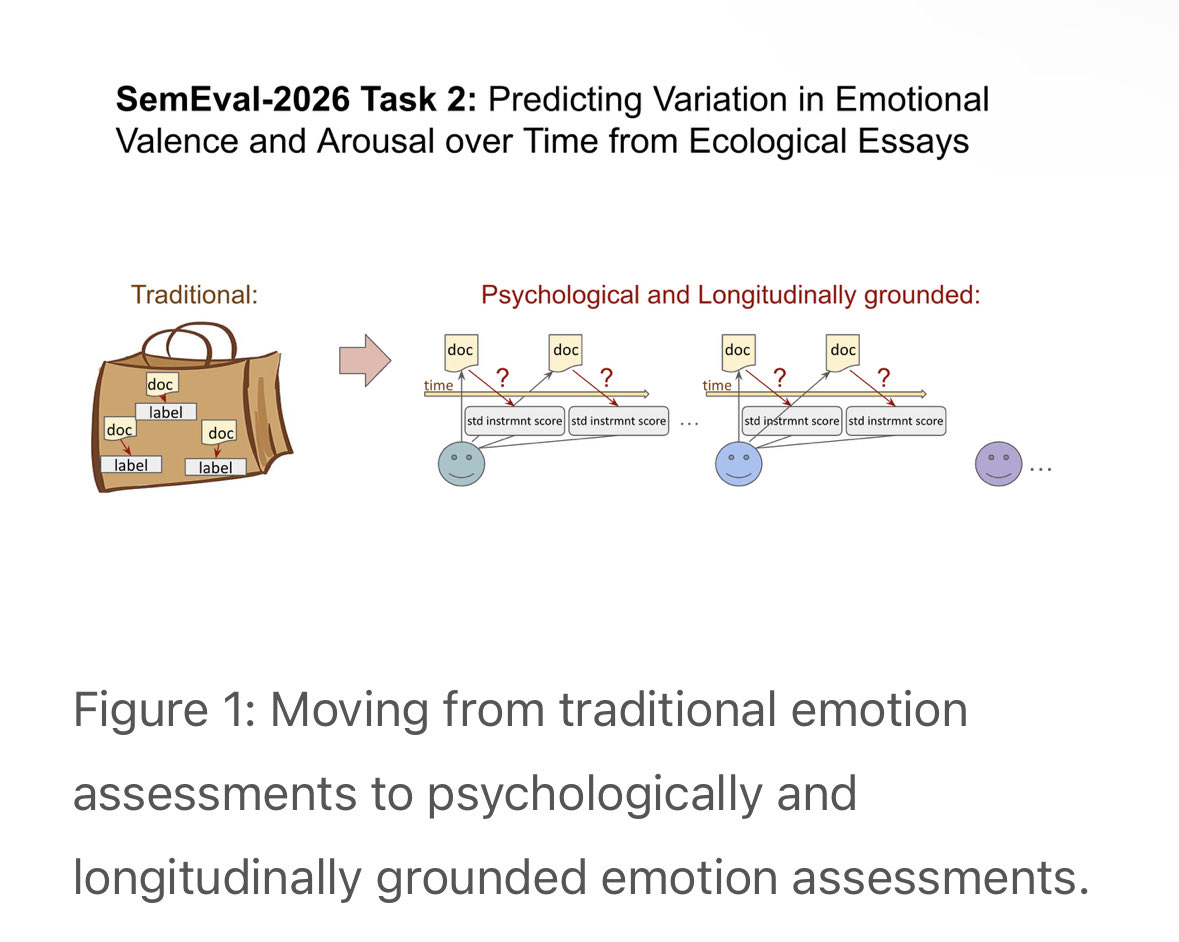
1
6
8
896
World Well-Being Prj retweeted

7 Oct 2025
🚨New WP!🚨
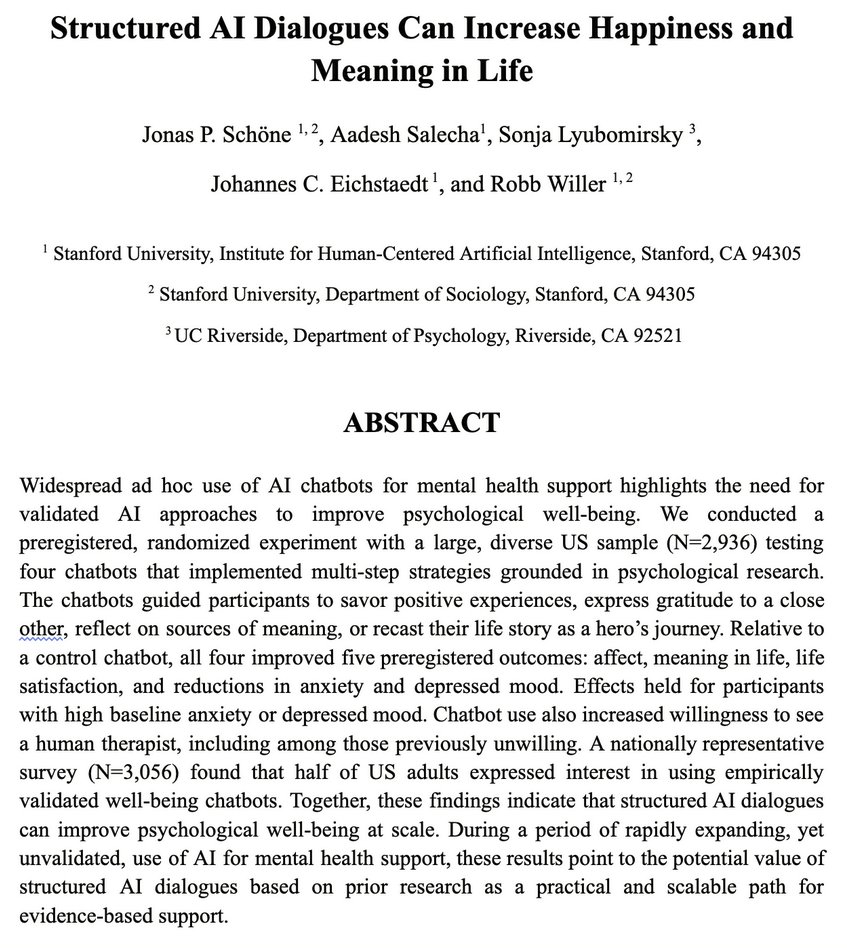
Structured AI Dialogues Can Increase Happiness and Meaning in Life
In a preregistered RCT, four psychology-grounded #AI chatbots improved well-being across several outcomes.
Co-authors: @JonasP_Schoene @JEichstaedt @AadeshSalecha @slyubomirsky
🧵👇
5
30
59
8,676
World Well-Being Prj retweeted

7 Oct 2025
We built chatbots to improve wellbeing, based on typical positive psychology interventions. They appear to be reasonably effective. If you like, you can try them!
7 Oct 2025

🚨New WP!🚨
Structured AI Dialogues Can Increase Happiness and Meaning in Life
In a preregistered RCT, four psychology-grounded #AI chatbots improved well-being across several outcomes.
Co-authors: @JonasP_Schoene @JEichstaedt @AadeshSalecha @slyubomirsky
🧵👇
3
9
1,386
World Well-Being Prj retweeted

15 Sep 2025
Honored excited to join @VanderbiltU's new College of Connected Computing and bring HLAB into its next phase in Nashville, working where AI meets psychology and health. vanderbilt.edu/ccc
RE: H. Andrew Schwartz joins College of Connected Computing computing.vanderbilt.edu/202…

2
1
10
455
World Well-Being Prj retweeted

6 Mar 2025
A study led by @StanfordHAI Faculty Fellow @JEichstaedt reveals that large language models adapt their behavior to be appear likable when they are being studied, mirroring human tendencies to present favorably. wired.com/story/chatbots-lik…
3
8
39
7,611

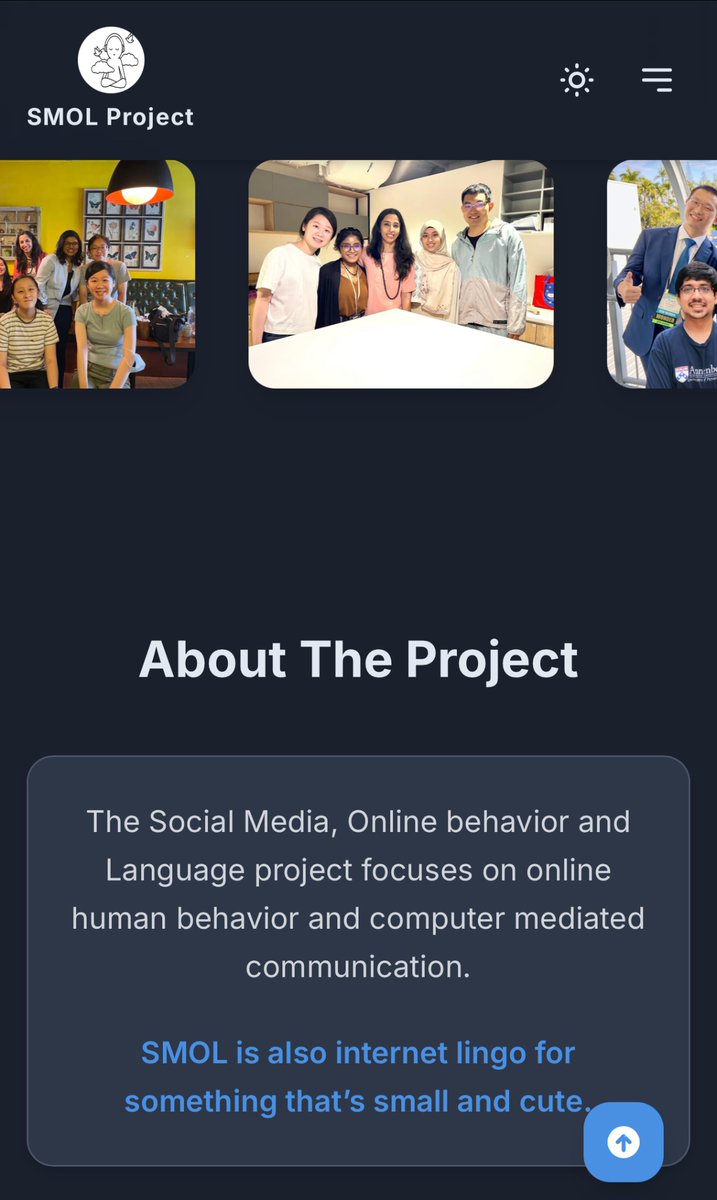
The SMOL Project website is finally live :) smolproject.com/
We do cool things with social media and digital trace data!
3
27
1,366
World Well-Being Prj retweeted

29 May 2025
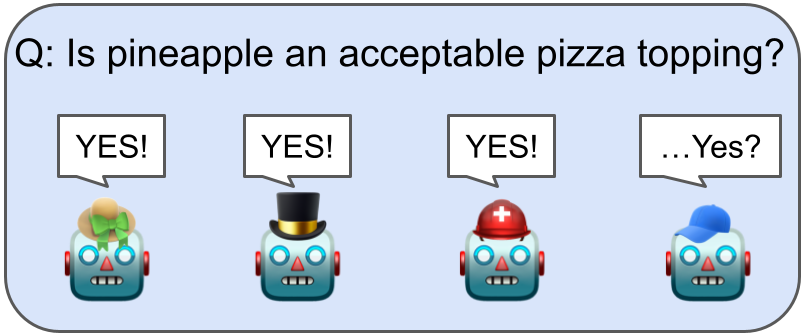
🤖💬 Herding instincts… in AIs? Yes, even LLMs can follow the crowd!
• 📉 Conformity ↑ when agents lack confidence but trust peers
• 🧠 Presentation format shapes peer influence
• 🎯 Controlled herding can boost collaboration outcomes
👉 Read more: arxiv.org/abs/2505.21588
8
13
1,334
World Well-Being Prj retweeted

27 May 2025
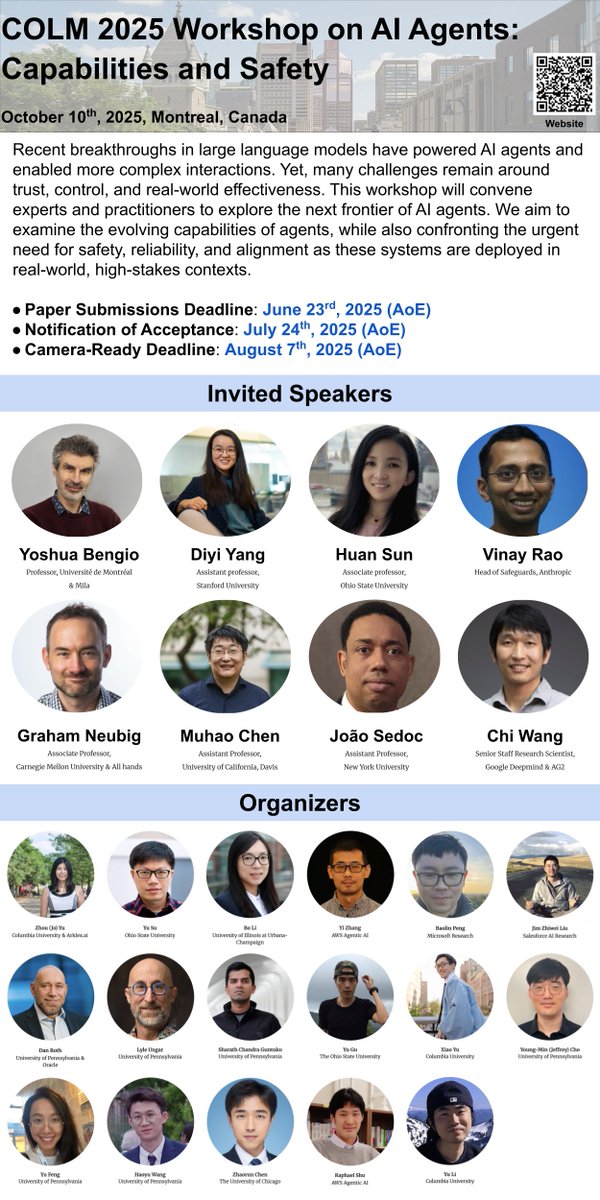
🚨COLM 2025 Workshop on AI Agents: Capabilities and Safety @COLM_conf
This workshop explores AI agents’ capabilities—including reasoning and planning, interaction and embodiment, and real-world applications—as well as critical safety challenges related to reliability, ethics, and human-agent interaction.
Non-archival submission deadline: June 23, 2025!
🌐Website: sites.google.com/view/aia-wo…
📜OpenReview: openreview.net/group?id=colm…
👥Program committee/Reviewer sign-up form: forms.gle/5vHzyGxjUgSMNKMXA
✉️Mailing list: aia-workshop@googlegroups.com
📅WikiCFP: wikicfp.com/cfp/servlet/even…
Shout out to our amazing organizing team members @Zhou_Yu_AI @ysu_nlp @uiuc_aisecure @ Yi Zhang @ Baolin Peng @ Jim Zhiwei Liu @DanRothNLP @LyleUngar @sharathguntuku @yugu_nlp @xy2437 @jeffrey_ch0 @AnnieFeng6 @Haoyu_Wang_97 @ZRChen_AISafety @raphaelshu @yooli23
4
19
83
24,237
World Well-Being Prj retweeted
20 May 2025
Great venue for interdisciplinary LLM/NLP and mental health work. The special issue is in a reputable journal for mental health research. I'm excited to be a part!
8 May 2025

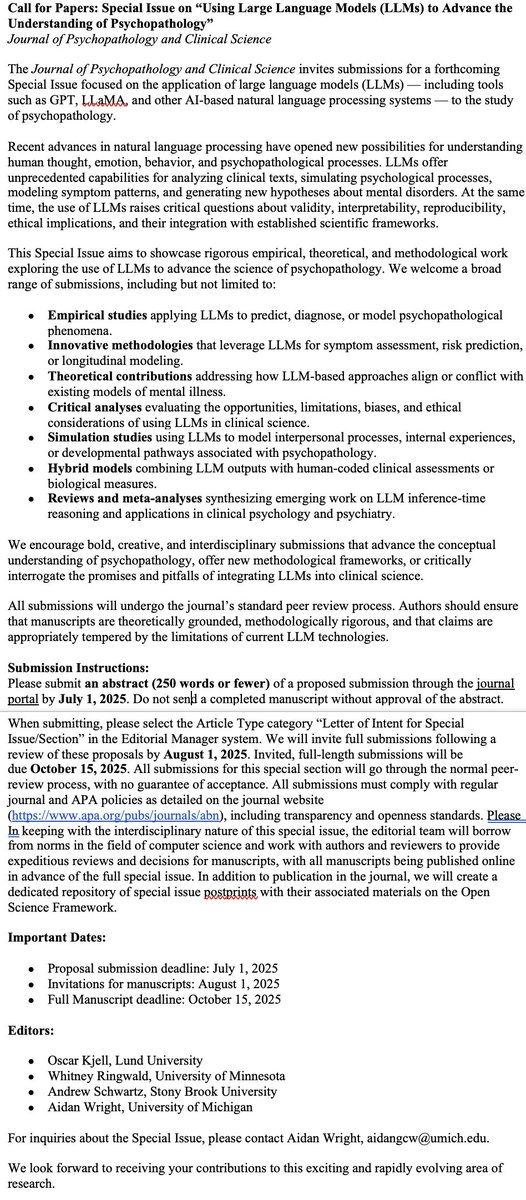
I'm excited to announce that the Journal of Psychopathology and Clinical Science is inviting proposals for a special issue on Using Large Language Models (LLMs) to Advance the Understanding of Psychopathology.
Call attached, which will be posted on our website shortly!
1/2
3
14
1,169
World Well-Being Prj retweeted

19 May 2025
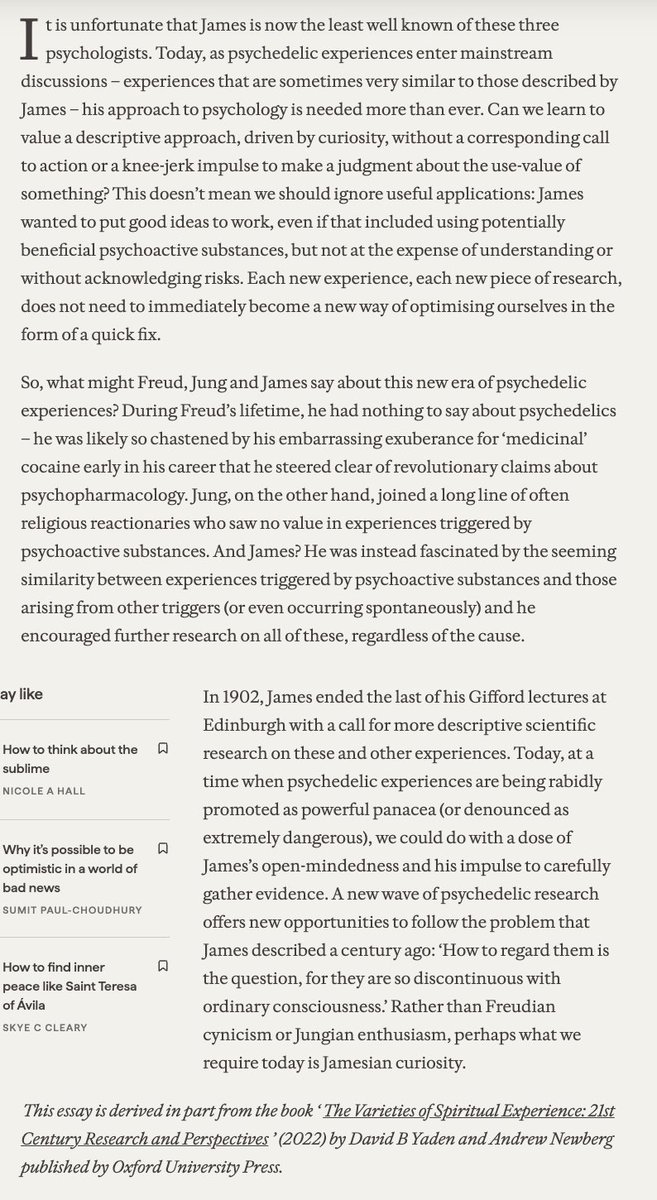
Article I wrote for @psyche_the_mag about the value of descriptive work to scientifically understand intense and meaningful altered states of consciousness. In my view, Jamesian curiosity and empiricism is better suited to the topic than Jungian enthusiasm or Freudian cynicism.
1
6
31
1,549
World Well-Being Prj retweeted

5 Nov 2024
It’s been a privilege to work with an amazing multidisciplinary team of co-authors on this project @sandracmatz @sal_giorgi @HAndySchwartz @MengesJochen.
The paper is open access. Happy to see this one finally out in print! /fin
psycnet.apa.org/fulltext/202…
1
2
4
363
World Well-Being Prj retweeted
5 May 2025
Thrilled to share that our work has received the Outstanding Paper Award @c3_nlp #NAACL2025! 🎉
Huge congratulations to @snyrai_ & @khushi_shelat for leading this collaborative effort, and thanks to @jeffrey_ch0 for delivering an amazing talk on behalf of his co-authors! 🙌🏽
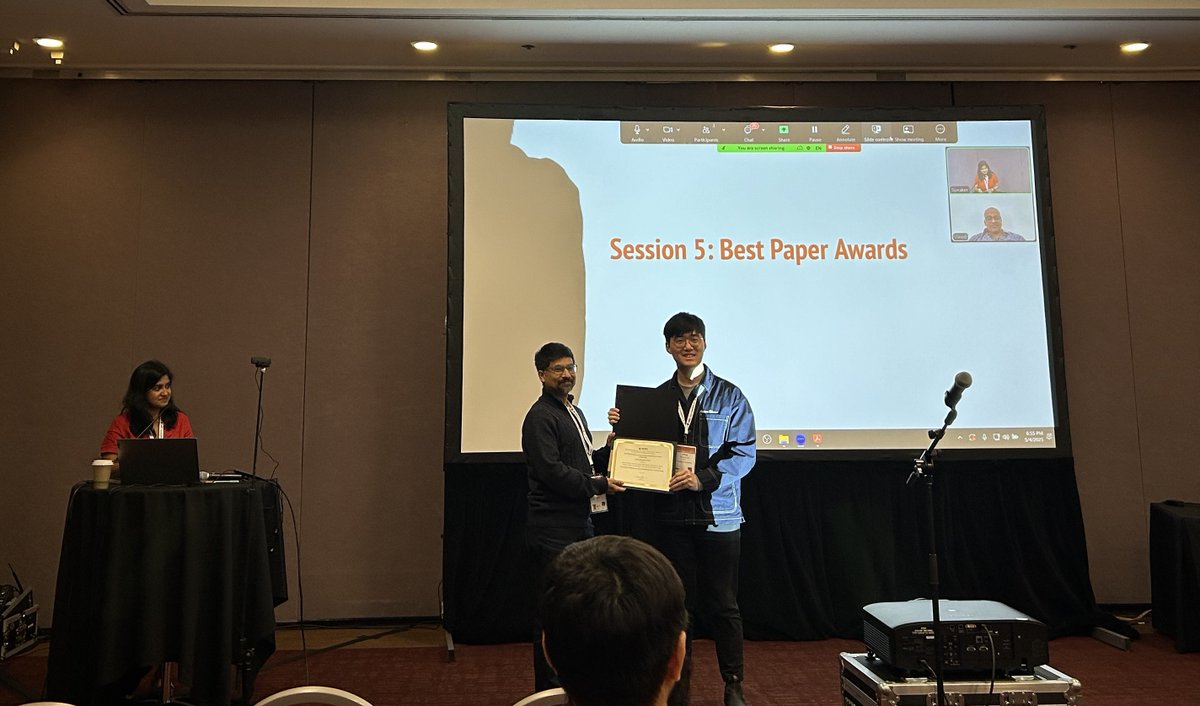
ALT Jeffrey Cho receiveing the outstanding paper award
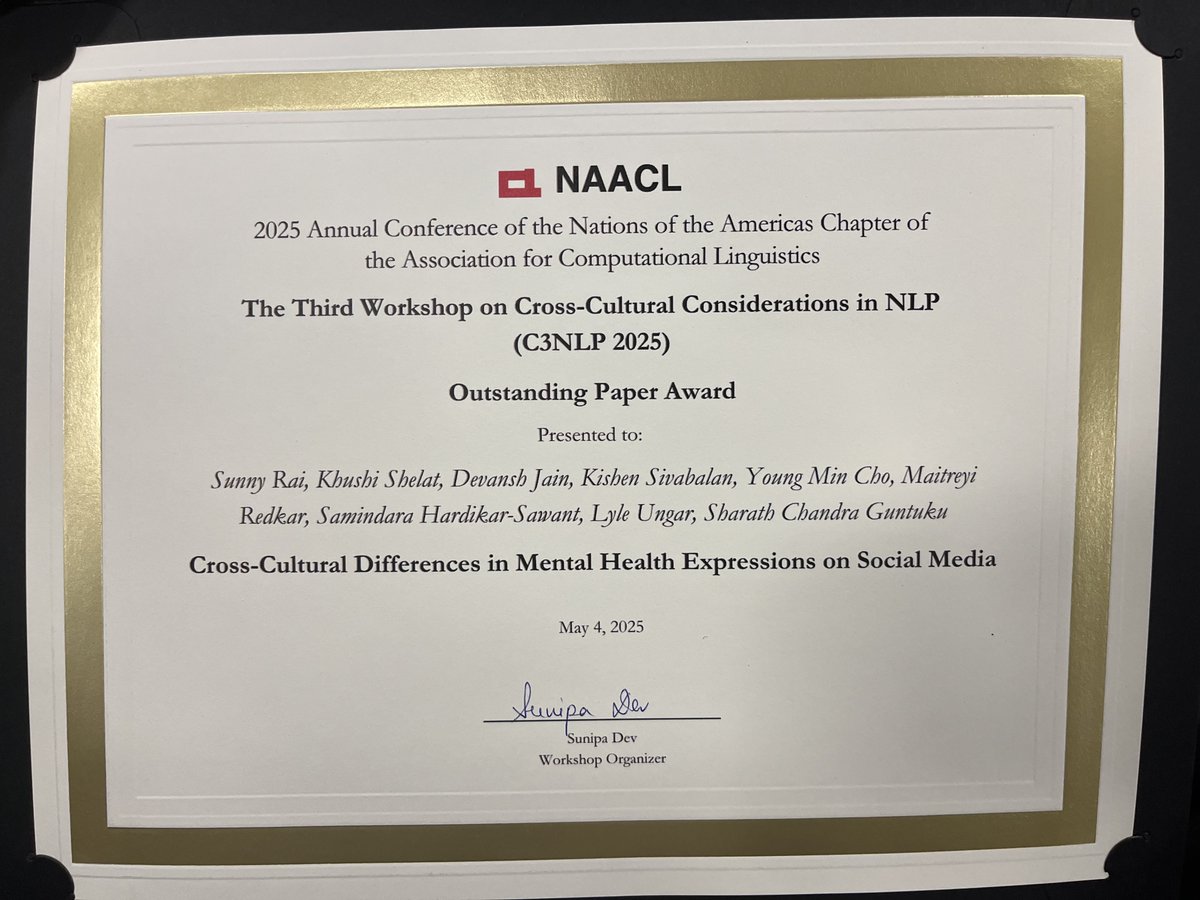
ALT outstanding paper award certificate

#NAACL25 #C3NLP
How do cultures differ in their mental health struggles? Do they seek professional help or emotional comfort? Check out our study on cross-cultural differences in mental health expressions on Reddit.
aclanthology.org/2025.c3nlp-…
#mentalhealth #depression #llm
3
6
50
3,507
World Well-Being Prj retweeted

23 Apr 2025
🚨🚨 I’m looking for a postdoctoral fellow to join my lab at Harvard's Psychology Department starting Fall 2025!🚨📣
Please retweet/share widely, and spread the word to interested candidates!
Application review begins April 30
Apply here: rb.gy/k7q9kf (1/2)
8
92
197
32,986
World Well-Being Prj retweeted
5 Apr 2025
Thanks for highlighting this #chi2025 paper led by @sehgal_neil, Kiran!
1 Apr 2025

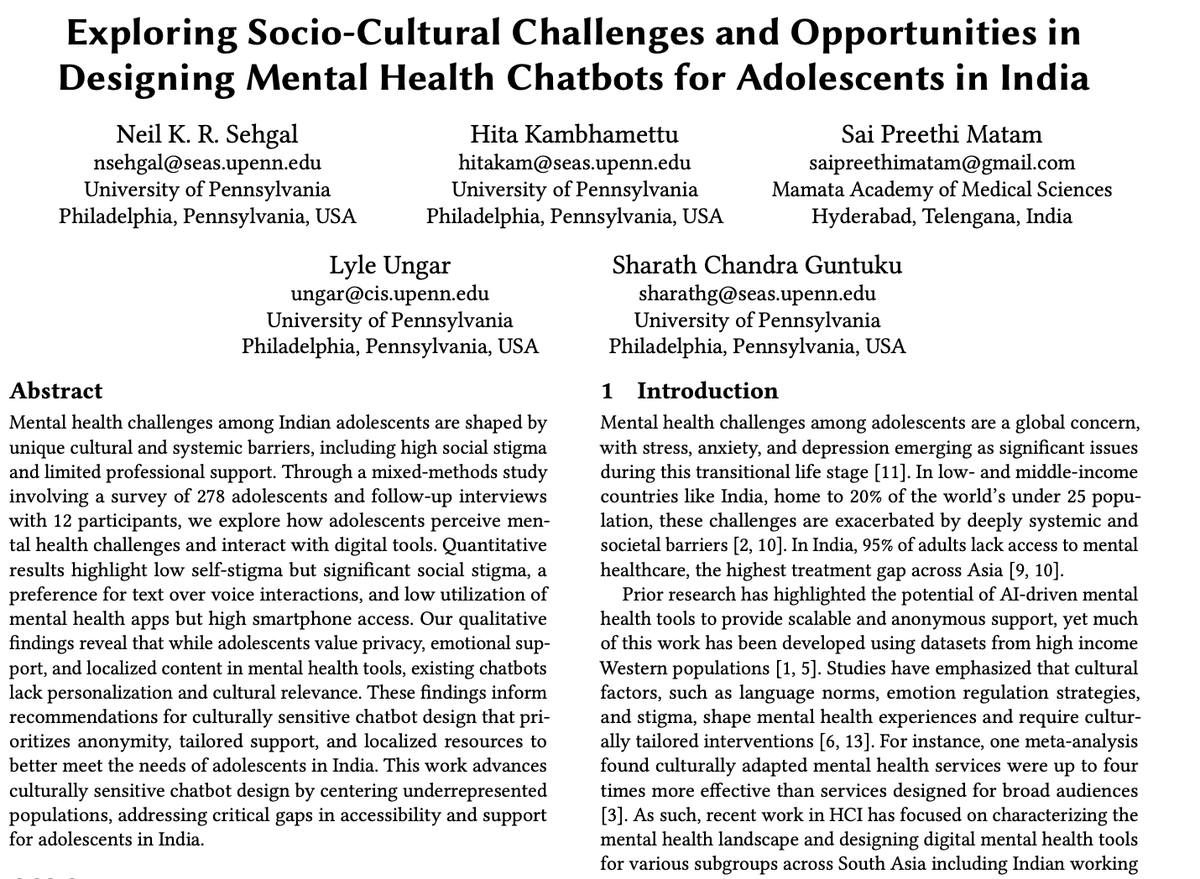
Designing mental health chatbots for Indian adolescents means grappling with cultural stigma, privacy needs, and a lack of localized support.
This study offers a rare, grounded look at what young users actually want from these tools.
arxiv.org/abs/2503.08562
2
4
407
World Well-Being Prj retweeted
21 Feb 2024
🚨 Announcement:
DLATK is now available as a colab notebook!
github.com/dlatk/dlatk/blob/…
DLATK is a suite for end-to-end human language analysis, used in 100 AI/NLP/Psych papers. This was lead by @digitalyonko, joint with @sal_giorgi, @adigan8, @JEichstaedt, and @WWBProject 🧵1/4
1
17
50
17,052
World Well-Being Prj retweeted

29 Jun 2020
"The two hardest problems in computer science are: (i) people, (ii), convincing computer scientists that the hardest problem in computer science is people, and, (iii) off by one errors." - @jeffbigham
7
149
698
World Well-Being Prj retweeted
4 Apr 2025
Our Stanford lab is looking for a part-time front-end/UX developer to help with AI mental health applications. Great position to accrue research experience for competitive PhD programs, and it's a really fun team. linkedin.com/jobs/view/41366…
2
7
779