
I am Wall Street Conqueror. I will become the richest person in the world. What I write is not financial advice.
Joined March 2026
- Tweets 311
- Following 105
- Followers 178
- Likes 369
71 Photos and videos






Pinned Tweet

Firefly $FLY CEO Jason Kim: “A Lot of Tailwinds Behind Us”
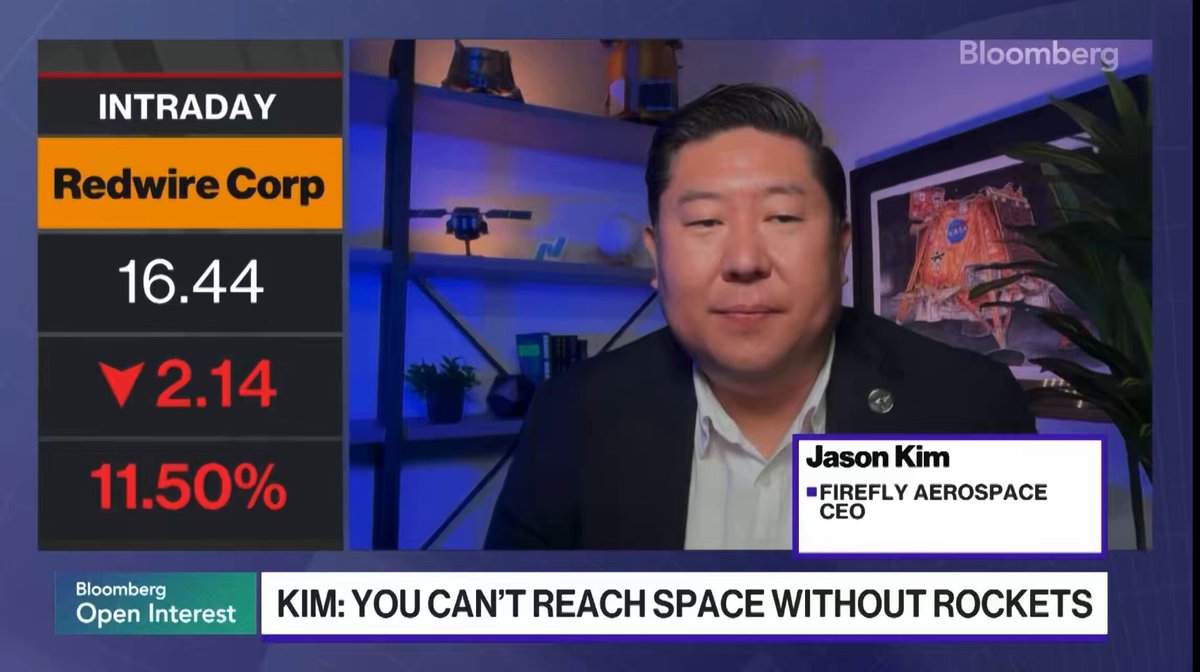
In a Bloomberg interview, Firefly Aerospace CEO Jason Kim stated:
“I can’t speak for other companies, but for Firefly, we have a multi-year strategy, and we’re just executing it. And it’s about improving our technologies, delivering them repeatedly, reliably as we launch planned and operate more and more. And we have a lot of tailwinds behind us with the moon base initiative, with launch and launching constellations as well as orders to do national security and space exploration missions. And then you add to it our capability to do the I software now on those platforms.”
Kim’s “tailwinds” statement stands out as particularly powerful and important because Firefly committed to the Moon long before it became the industry’s hottest trend. Their Blue Ghost lander achieved the first and only fully successful commercial lunar landing in March 2025 — a historic milestone no other commercial company has matched. This early, proven success now positions Firefly perfectly to lead NASA’s Moon Base initiative and capture major national security and space exploration contracts.
I believe $FLY can reach $400 by 2028. $FLY is very undervalued. I’m very bullish on $FLY.
This is not financial advice.
6
11
77
12,168
Some people talk like they're geniuses, waiting for the bottom and claiming it will drop further, only to stupidly cave into FOMO and buy the stock.
If it hits $1000, $FLY will attract the attention of many idiots then. Idiots don't buy dip.
This is not financial advice.
2
13
480
KeyBanc upgraded with a $50 target. Blue Ghost’s single successful commercial Moon landing $75M MoonFall contract gives it a strong position at NASA. With SciTec, it proved its defense capability by tracking ~1,000 missiles in Iran in 30 days.
The SpaceX IPO sale was temporary, the fundamentals are solid.
I liked the analyst’s comment. I’m still bullish on $FLY. 🚀🚀🚀
This is not financial advice.

$FLY: KeyBanc upgrades Firefly and set a $50 price target.
The firm cited Firefly’s exposure to NASA’s lunar initiatives, noting its Blue Ghost lander is "the only lander from a commercial space company to achieve a fully successful landing on the Moon."
KeyBanc also pointed to the recent $75 million MoonFall NASA contract award and Firefly’s SciTec missile tracking software, which "tracked ~1,000 missiles in the first 30 days" of the Iran conflict.
KeyBanc believes the sector selloff around SpaceX’s IPO was "unwarranted and largely systematic," driven by funds making room for the new listing rather than any deterioration in fundamentals.
The firm cited accelerating NASA activity, constrained launch supply, and rising defense budgets, including roughly $56 billion for space-based systems in the proposed FY27 defense budget, as durable tailwinds for the sector.
4
25
1,625
2026 U.S. Budget Comparison
NASA budget: approximately $24.4 billion
U.S. National Defense budget: approximately $891 billion
The defense budget is about 36 times larger than NASA's budget.
1
9
462
FIREFLY AEROSPACE $FLY ’S BIGGEST CATALYST IN 2026 IS BLUE GHOST MISSION 2
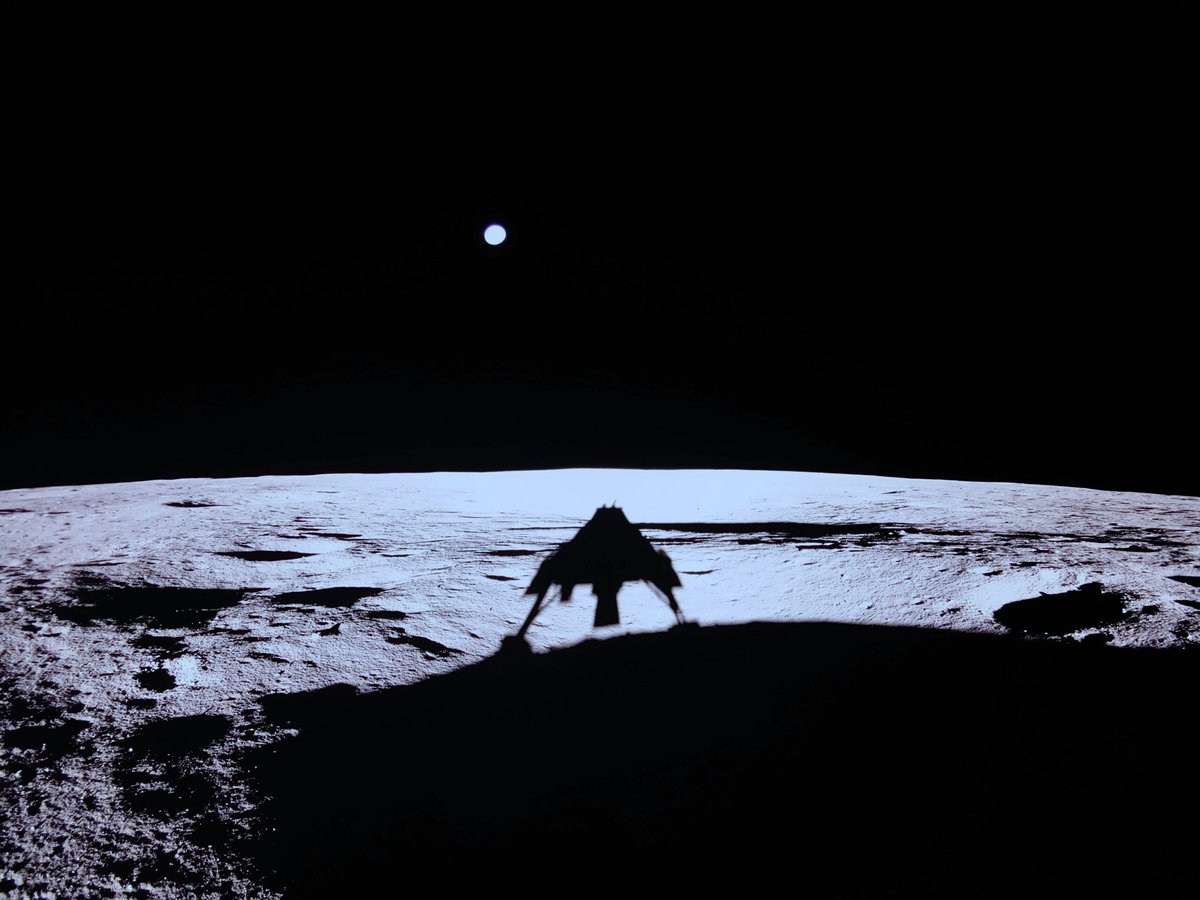
Blue Ghost Mission 2 will be the first American and first commercial soft landing on the Moon’s dark side. No U.S. government or commercial company has ever landed in this region before. China, on the other hand, is the only country that has achieved landings on the far side with its Chang’e-4 (2019) and Chang’e-6 (2024) missions.
Firefly Aerospace $FLY has already earned the title of the first and only company to successfully perform a commercial Moon landing with Blue Ghost Mission 1. If it successfully executes Mission 2 on the Moon’s dark side, this will no longer be a lucky success and will prove that the company has a repeatable capability.
Mission 2’s success strengthens the trust in Firefly at NASA. This also increases the company’s chance of winning new missions and, as a result, enables it to generate more revenue from NASA.
The main reason for the significant increase in Mission 2’s success probability compared to Mission 1 is the real flight and landing data obtained from the fully successful soft landing of Blue Ghost Mission 1. Since no commercial company had previously achieved a successful soft landing on the Moon, data of this quality did not exist. There is a significant difference between the data obtained from unsuccessful landings and the data collected from a stable, upright, and long-duration operational landing.
Firefly proved with Mission 1 that it could perform a stable commercial lunar landing. The lander collected approximately 119 GB of data and provided high-quality real-world data on landing dynamics, lunar dust behavior, propulsion system performance, thermal conditions (especially temperature fluctuations at the crater edge), and surface operations. This data and the lessons learned from the mission were directly integrated into Mission 2’s design, software, thermal models, and operational procedures.
Firefly is implementing the improvements gained from Mission 1 while preserving the same proven lander architecture (low center of gravity, wide landing legs, and squat structure). The separation tests conducted for Elytra to release the Lunar Pathfinder satellite have been completed, and the full-stack structural qualification tests (vibration and acoustic tests) performed at JPL were successfully concluded. Elytra-Blue Ghost end-to-end communication tests are continuing as planned.
Although a far-side landing is more challenging, the Elytra orbiter solves this problem by serving as a communication relay in lunar orbit. This enables long-term (multi-year) operations of scientific payloads such as the Blue Ghost lander and LuSEE-Night.
In conclusion, Firefly has strengthened Mission 2 with the data and experience gained from Mission 1. Thanks to its proven architecture and Elytra’s communication relay capability, the success probability for the far-side landing has significantly increased. Blue Ghost Mission 2 represents a very important step for commercial lunar exploration.
This is not financial advice.
6
34
1,510
Wall Street Conqueror retweeted
My top pick is $FLY only. The rest of the list is empty.
I don’t like diversification. I know what I’m doing.
This is not financial advice.
4
2
24
1,309
With just close to half of his $1.1 trillion fortune, Elon Musk could buy all the pure space companies in the world except SpaceX and become the owner of all space.
I hope @elonmusk doesn’t get such an idea in his head after this post appears in front of him on X, because I don’t want to sell $FLY.
$SPCX $FLY $RKLB $NASA $RDW $ASTS $LUNR $PL $BKSY $SPIR
This is not financial advice.
11
427

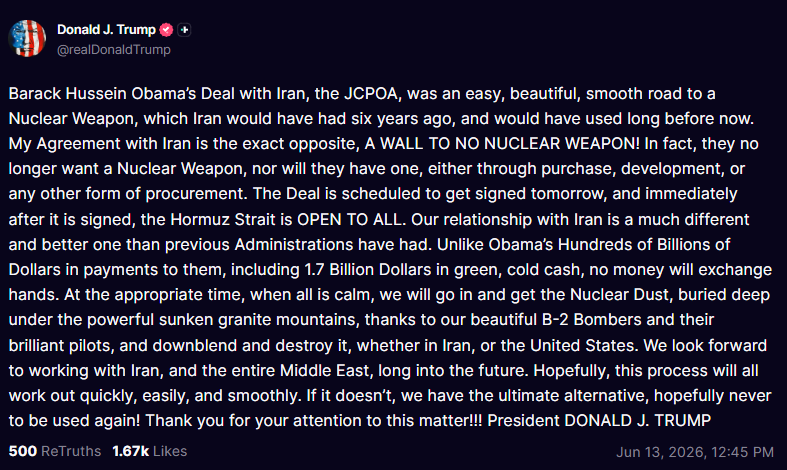
It was a rough week for space investors, except for SpaceX $SPCX ones. I believe next week will be good for space company investors.
$SPCX $FLY $RKLB $NASA $RDW $ASTS $LUNR $PL $BKSY $SPIR
This is not financial advice.

Trying to fall asleep, but you're starting the week with news of an Iran-Israel war. Then there’s Tuesday’s U.S. Trade Balance, Home Sales, and Wholesale Inventories; Wednesday’s critical U.S. CPI; Thursday’s PPI and weekly Jobless Claims; and finally Friday’s Michigan Consumer Sentiment index. Plus, that massive SpaceX IPO. It’s going to be a tough week.
Hey space sector investors, what’s up? How are you doing?
$RKLB $FLY $LUNR $NASA $RDW $ASTS $PL $SPCX $SPCE
This is not financial advice.
1
11
932
Jim Simons:
“Do something original. Don’t run with the pack.”
Warren Buffett:
“Most people get interested in stocks when everyone else is. The time to get interested is when no one else is. You can’t buy what is popular and do well.”
Bernard Baruch:
“Never follow the crowd.”
Howard Marks:
“In order to get into the top of the performance distribution, you have to escape from the crowd.”
John Templeton:
“If you want to have a better performance than the crowd, you must do things differently from the crowd.”
Charlie Munger:
“Mimicking the herd invites regression to the mean.”
Peter Lynch:
“The true contrarian waits for things to cool down and buys stocks that nobody cares about.”
Seth Klarman:
“It is always easiest to run with the herd; at times, it can take a deep reservoir of courage and conviction to stand apart from it. Yet distancing yourself from the crowd is an essential component of long-term investment success.”
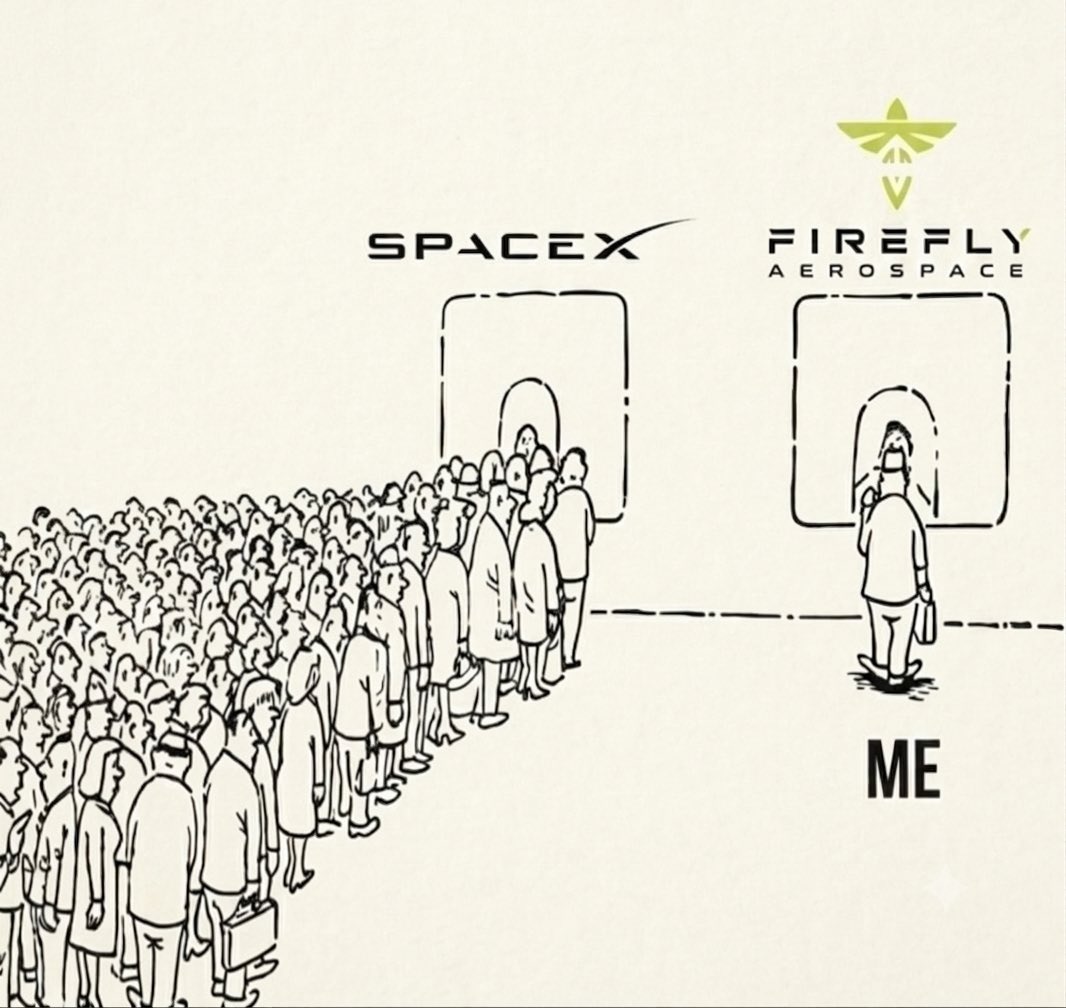
$FLY is very undervalued. I’m bullish on Firefly Aerospace $FLY. I’m not following the crowd.
$SPCX $FLY $RKLB $NASA $RDW $ASTS $LUNR $PL $BKSY $SPIR
This is not financial advice.
3
3
23
922
😂😂😂😂😂😂😂
Jun 12

$FLY ing straight to the ground. Cannot wait for this to be 30, then 25, then 20 etc etc
1
9
1,072
😂😂😂😂😂😂😂😂😂😂😂
Jun 11
$FLY In the next 15 minutes we will see this go from 9% to 4%, 10 minutes after that stock will be at break even, then begins the grind lower still
7
706
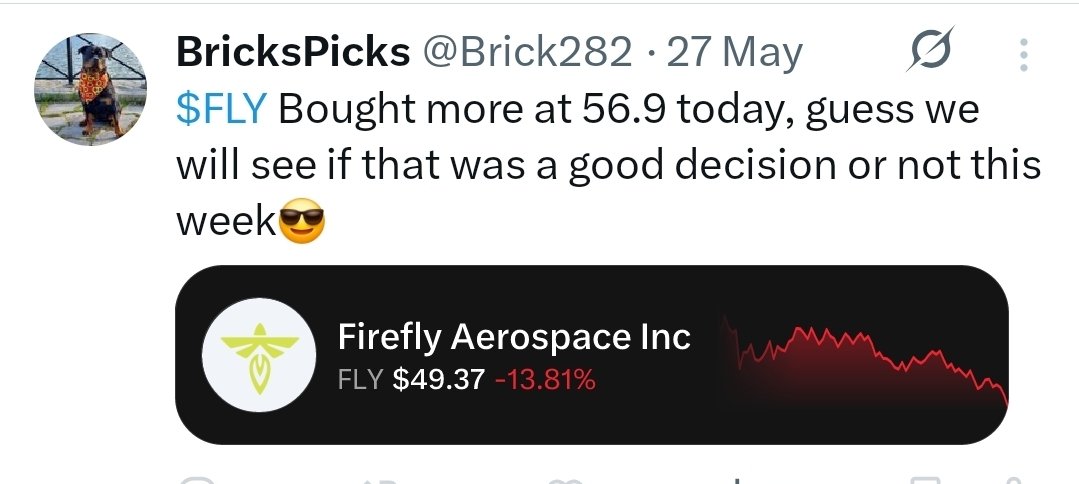
I don't listen to the nonsensical posts written on FinX. I made big money from $RKLB. Now I have also made big money from $FLY and I think I will make more big money with $FLY. I am bullish on $FLY. 🚀🚀🚀
This is not financial advice.
Jun 11

$fly Never listen to these kind of guys who push for lower prices. The agenda is he bought high and sold low.
1
17
1,656
In my opinion, instead of buying SpaceX stock, buying $FLY in the same sector is a move above 150 IQ. I believe that with SpaceX $SPCX ’s excessively valued multiple and large market capitalization, $FLY will benefit greatly from this.
This is not financial advice.
Jun 10

IQ test in 2026:
Buying Space X this week = Below 100 IQ
Not Buying Space X this week = Above 100 IQ
3
1
22
4,652
The host on Bloomberg who interviewed Firefly Aerospace $FLY CEO Jason Kim asked, "What about the $12 million share, a secondary offering? Can you give us more details about what you will do with the proceeds from that?" The host said "$12 million share". It should have been "12 million shares". I was so surprised that a host at such a major professional finance company made such a mistake. There are approximately 300,000 to 350,000 Bloomberg terminal users, and Bloomberg earns approximately $30,000 per terminal annually. I’m not sure if Bloomberg Terminal users are getting their money’s worth. 😂
4
22
10,126
CHARLIE MUNGER’S 50% DECLINE AND MANHOOD
Q: What happened in 1973-1974 when your partnership lost around half of its value?
Charlie Munger: Oh, well that is very simple. That’s easy, that’s a good lesson and a good question.
What happened is the value of my partnership went down by 50% in one year. And now the market went down 40% or something, it was a once in 30 year recession and monopoly newspapers were selling at four times earnings.
At the bottom tick, I was down from the peak 50%, you’re right about that.
That has happened to me three times in my Berkshire stock so I regard it as a part of manhood.
If you’re going to be in this game for the long haul, which is the way to do it, you better be able to handle a 50% decline without fussing too much on it.
And so, my lesson to all of you is conduct your life so you can handle a 50% decline with aplomb and grace, don’t try to avoid it. It will come. In fact if it doesn’t come I would say you’re not being aggressive enough.
1
9
471