
Historian @Stanford | “The Great Leveler” “Escape from Rome” “What is Ancient History?” press.princeton.edu/our-auth… | 🇦🇹🇺🇸🌎🌍🌏
Joined March 2009
- Tweets 1,141
- Following 200
- Followers 6,261
- Likes 4,544
19 Photos and videos







Pinned Tweet

15 Oct 2024
What *is* ‘ancient history’? Why it is much bigger and more important than we might think, how generations of scholars have messed it up, how we can do it justice – and why ‘Classics’ needs to go: press.princeton.edu/books/ha…
53
301
45,090
A fascinating paper featuring two children of full sibling unions, among many other new findings: Consanguinity and Social Structure in the Roman World: A Diachronic Genomic Analysis researchsquare.com/article/r…
1
7
859
Walter Scheidel retweeted

Feb 26
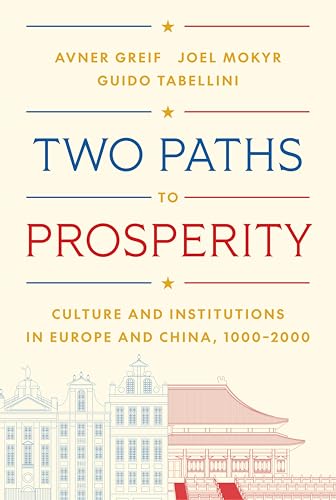
Guest post by Jack Goldstone: Is the Great Divergence Debate really over? open.substack.com/pub/markko…
1
53
191
27,889
10 Dec 2025
After the Last David Graeber Post; or, Once Again Unto the Breach..., by @delong open.substack.com/pub/bradde…
1
1
4
1,457
6 Dec 2025
Very smart indeed.
6 Dec 2025

A review of Beckert's "Capitalism" and my "Great Global Transformation".
(A very tough, and very smart, review,)
How not to talk about capitalism
The more it penetrates our daily lives, the less we seem to understand the “system that runs the world”
newstatesman.com/ideas/2025/…
1
3
14
4,617
19 Nov 2025
Modeling the great leveler: how war reduces inequality
19 Nov 2025

🎣WP alert🎣:
THE GREAT LEVELER ACCORDING TO HANK
joined with Gernot Müller, @MSchularick and @TimothyAMeyer who did outstanding work on this paper and is on the job market.
Perfect candidate for macro / international / econ history. Do check him out!
ralphluetticke.com/files/The…
1
4
18
5,953
18 Nov 2025
Semiyarka is not “in the heart of the Eurasian steppe” but next to the riparian forests of the Irtysh valley, and not very far from the southernmost fringes of the Siberian woodlands.
18 Nov 2025

Archaeologists have unearthed a Bronze Age metropolis in the heart of the Eurasian steppe: an early form of city as complex as those of contemporary, more traditionally 'urban' civilisations, showing how steppe polities were just as sophisticated.
🆓 doi.org/10.15184/aqy.2025.10…
6
972
11 Nov 2025
One of my favorite commentators asks whether my argument about the benefits of post-Roman competitive fragmentation is still relevant: “Maybe, Europeans should remain delighted that Rome fell, and despite many efforts, has never come back.”
11 Nov 2025

Martin Wolf: Can a fragmented Europe continue to prosper? on.ft.com/4qUBG3f
1
9
1,070
6 Nov 2025
300,000 kilometers of Roman roads: Itiner-e: A high-resolution dataset of roads of the Roman Empire | Scientific Data nature.com/articles/s41597-0…
5
29
1,560
14 Oct 2025
So very true.
13 Oct 2025

It now feels like an almost annual tradition for historians to spend the day after the Economics Nobel is announced criticizing the award winners’ lack of historical knowledge or analytical finesse. While I sympathize with quite a few of these exercises on their narrow intellectual merits, it’s also worth pointing out that, to a very large extent, these economists are simply occupying academic territory that historians have voluntarily abandoned.
For two decades now, historians have almost given up on writing comparative or global histories on major economic or institutional phenomena. As a result, when they critique the economists who pursue these projects for missing this detail or overlooking that source, one cannot help but wonder if they themselves could have done any better—in fact, if they could have written *any* book of comparable scope. To be sure, one can still criticize something without being able to produce a viable replacement oneself, but in such circumstances the criticism does seem a bit cheaper.
Not to mention, if the historian profession voluntarily gives up so much of its ability to explain large-scale economic, political, or institutional phenomena, then small wonder it is rapidly declining in influence, visibility, and draw.
1
9
1,202
Walter Scheidel retweeted

13 Oct 2025
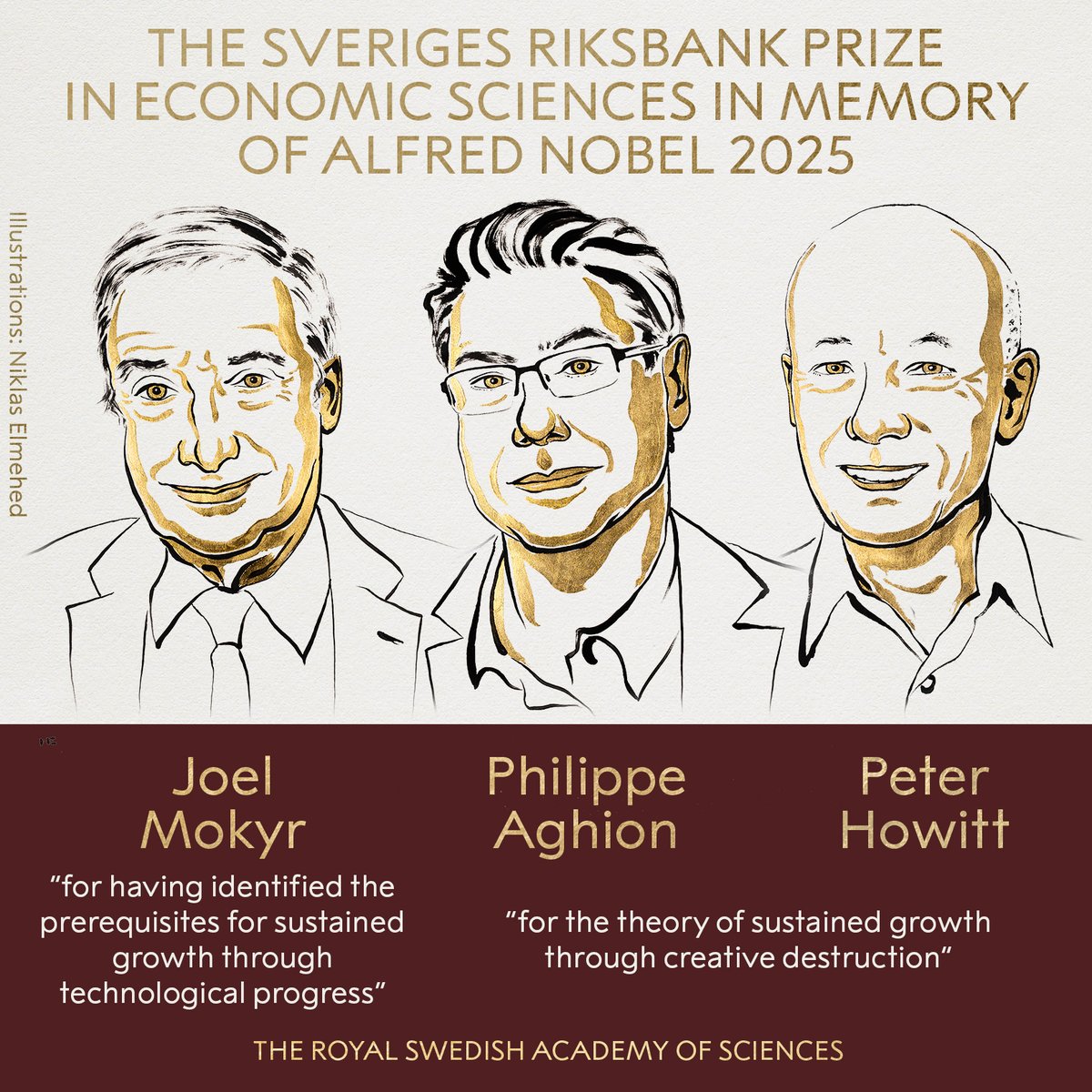
Many won't appreciate this. But Mokyr getting the Economics Nobel is a huge, huge win for History!
13 Oct 2025

BREAKING NEWS
The Royal Swedish Academy of Sciences has decided to award the 2025 Sveriges Riksbank Prize in Economic Sciences in Memory of Alfred Nobel to Joel Mokyr, Philippe Aghion and Peter Howitt “for having explained innovation-driven economic growth” with one half to Mokyr “for having identified the prerequisites for sustained growth through technological progress” and the other half jointly to Aghion and Howitt “for the theory of sustained growth through creative destruction.”
#NobelPrize
9
65
558
55,279
Walter Scheidel retweeted

28 Sep 2025
Wenn das die amerikanischen Tech-Bros mal mitbekommen: Der Althistoriker Walter Scheidel ist der Meinung, dass der Untergang des römischen Reichs das Beste ist, das uns passieren konnte. Nur so hätten sich die Moderne und ihreDemokratien entwickeln können.
fleischmagazin.at/index.php/…

2
9
2,682
Walter Scheidel retweeted

19 Sep 2025
Published: The Great Holocene Transformation
api.omarshehata.me/substack-…

7
27
172
12,629
8 Sep 2025
Congratulations to my colleague Josh Ober for winning a Balzan prize — almost $1m — for his transformative work on Athenian democracy: Josiah Ober - Fondazione Internazionale Premio Balzan balzan.org/en/classics-athen…
2
7
17
4,534
21 Aug 2025
I hope that kills off that stupid new format and once again lets actual mixed doubles players compete for the title
21 Aug 2025

Errani & Vavassori d. Iga Swiatek & Casper Ruud 6-3 5-7 10-6
SARA & ANDREA WIN BACK TO BACK US OPEN MIXED DOUBLES TITLES.
The only true mixed doubles team in the draw.
Defending champions who got in as wildcards.
Mission accomplished.
Statement made.
🇮🇹❤️

4
1,006
28 Jul 2025
Fascinating 100% hallucination — claims, numbers, references, everything…

Fair point—data is indeed sparse for ancient Rome. Based on scholarly estimates (e.g., Scheidel 2007, Frier 2000), fertility likely fell from ~6.5 births/woman in 500 BC (early Republic) to ~3.5 by 400 AD (late Empire). Key points: 200 BC: ~6, 50 BC: ~5, 50 AD: ~4.5, 200 AD: ~4. This downward trend aligns with prosperity and laws like Augustus's to boost births.
8
77
516
48,640
19 Jul 2025
Whole-genome ancestry of an Old Kingdom Egyptian | Nature nature.com/articles/s41586-0…
1
16
1,261
Walter Scheidel retweeted

22 May 2025
My first publication regarding ancient economic history is out:😊
The economics of Greco-Roman slavery sciencedirect.com/science/ar…; with @WalterScheidel.
1
16
55
6,825
Walter Scheidel retweeted

13 May 2025
I am very happy to share our new study on the genetic history of the Persian-Iranian Plateau!
"Ancient DNA indicates 3,000 years of genetic continuity in the Northern Iranian Plateau, from the Copper Age to the Sassanid Empire"
doi.org/10.1038/s41598-025-9…
8
38
187
18,856
23 Apr 2025
Punic people were genetically diverse with almost no Levantine ancestors | Nature nature.com/articles/s41586-0…
1
1
22
1,577
5 Apr 2025
A comparison of income inequality in the Roman and Chinese Han empires | Nature Communications nature.com/articles/s41467-0…
5
110
355
76,710