
Welcome to the parishes of Glendermott & Strathfoyle in the Diocese of Derry which are more commonly known as the 'Waterside Parishes'.
Joined April 2017
- Tweets 7,356
- Following 86
- Followers 285
- Likes 0
616 Photos and videos
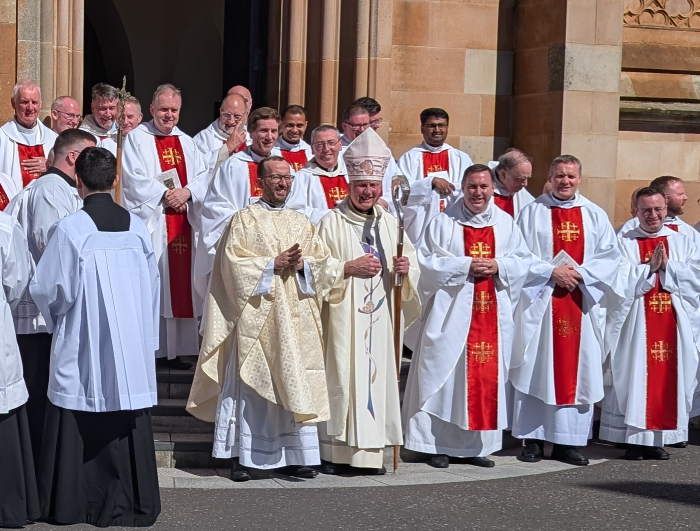


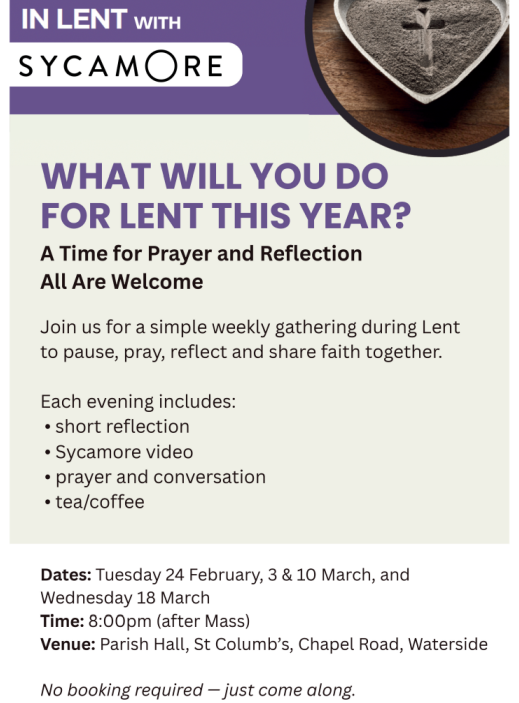







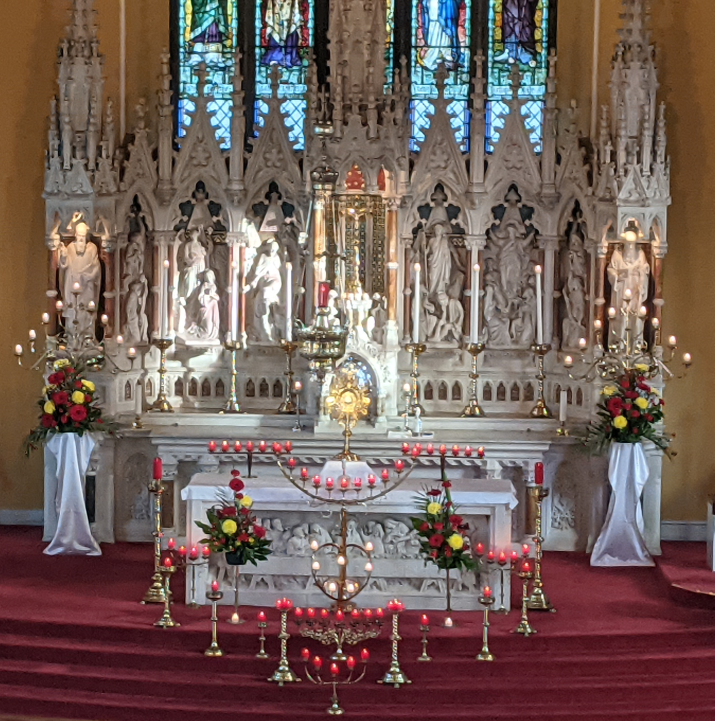





Congratulations to newly ordained Father Stephen. A day of great joy for our parish.
watersideparish.net/ordinati…
1
3
29
1,010
Waterside Parish retweeted

Jun 14
Gospel of the Day (Matthew 9,36-38.10,1-8)
At the sight of the crowds, his heart was moved with pity for them because they were troubled and abandoned, like sheep without a shepherd.
Then he said to his disciples, "The harvest is abundant but the laborers are few;
so ask the master of the harvest to send out laborers for his harvest."
Then he summoned his twelve disciples and gave them authority over unclean spirits to drive them out and to cure every disease and every illness.
The names of the twelve apostles are these: first, Simon called Peter, and his brother Andrew; James, the son of Zebedee, and his brother John;
Philip and Bartholomew, Thomas and Matthew the tax collector; James, the son of Alphaeus, and Thaddeus;
Simon the Cananean, and Judas Iscariot who betrayed him.
Jesus sent out these twelve after instructing them thus, "Do not go into pagan territory or enter a Samaritan town.
Go rather to the lost sheep of the house of Israel.
As you go, make this proclamation: 'The kingdom of heaven is at hand.'"
Cure the sick, raise the dead, cleanse lepers, drive out demons. Without cost you have received; without cost you are to give."
vaticannews.va/en/word-of-th…
34
288
1,087
14,311
Waterside Parish retweeted

Jun 13
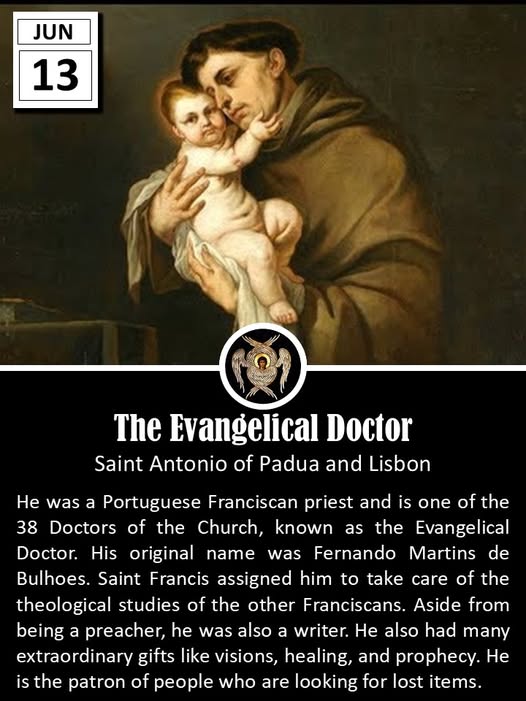
St. Anthony of Padua was one of the most beloved figures of the medieval church, a Franciscan friar whose life combined deep learning, powerful preaching, and a reputation for miracles that endures to this day. Born Fernando Martins in Lisbon, Portugal, around 1195, he entered the Augustinian order as a young man and showed early promise as a scholar. In 1220, inspired by the martyrdom of five Franciscan missionaries in Morocco, he joined the Franciscans, took the name Anthony, and set out to preach the Gospel in North Africa. Illness forced him homeward, but a storm diverted his ship to Sicily and then Italy, where he would spend the rest of his short life.
Anthony quickly earned a reputation as an eloquent and effective preacher. He traveled through northern Italy and southern France at a time when the Albigensian heresy threatened Catholic teaching. His sermons drew huge crowds, and he had a gift for making complex theology understandable to ordinary people. Legend says that when heretics refused to listen, he once preached to fish by the sea, and the fish rose to the surface as if attentive. Whether or not the story is literal, it captures the popular memory of a man whose words seemed to reach every creature.
Beyond preaching, Anthony became known for his care for the poor and his defense of justice. He worked to reform the clergy and opposed usury, urging lenders to return ill-gotten gains. Miracles were attributed to him even in his lifetime: the most famous tells of a man who doubted the real presence of Christ in the Eucharist. Anthony asked the skeptic to bring his mule; when the animal knelt before the consecrated host instead of eating oats, the doubter converted. Another well-known tale involves a stolen book. Anthony prayed, and the thief returned it, giving rise to his later role as patron of lost and stolen items.
Anthony died in Padua on June 13, 1231, at the age of thirty-five or thirty-six. He was canonized less than a year later by Pope Gregory IX, an unusually swift recognition of his holiness. Today his basilica in Padua remains a major pilgrimage site, and his feast day on June 13 is celebrated with special devotion across the Catholic world. Devotees still invoke him with the simple prayer, “Tony, Tony, look around, something is lost and must be found.”
St. Anthony of Padua remains a model of gentle yet forceful faith: a scholar who spoke to the unlearned, a preacher who defended the vulnerable, and a saint whose kindness continues to draw people eight centuries after his death.
7
64
234
3,391
Reverend Stephen Baxter, a native son of our parish will be ordained to the priesthood by Bishop Donal McKeown on Sunday, 14th June at 3:00pm in St Columb’s Church. All welcome.
watersideparish.net/ordinati…
2
3
38
1,984
Waterside Parish retweeted
Jun 13
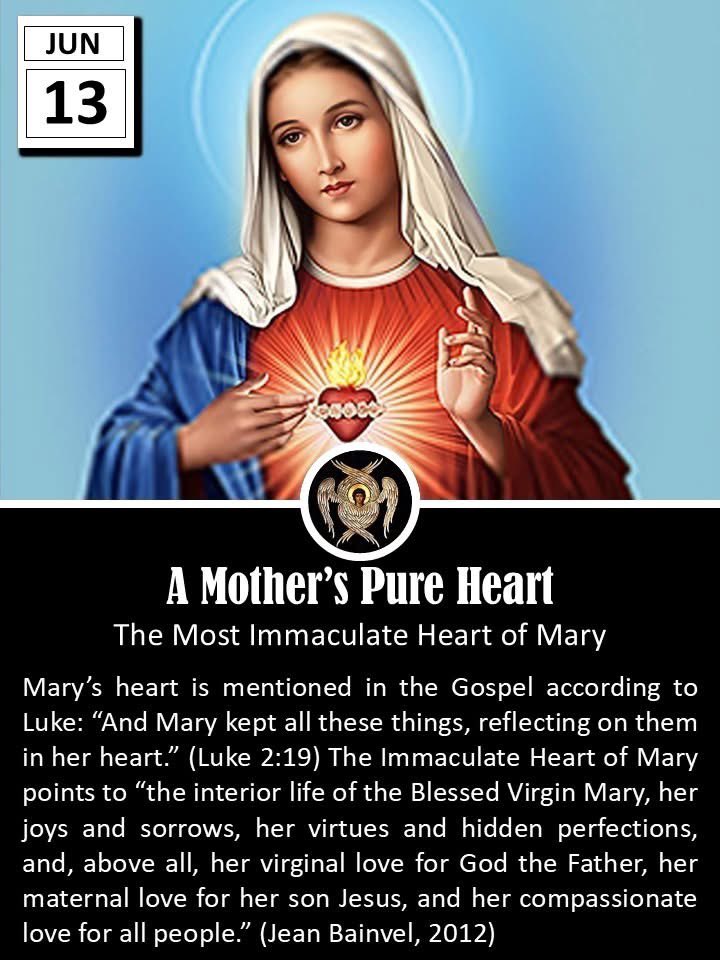
The Memorial of the Immaculate Heart of Mary holds a cherished place in the liturgical calendar of the Catholic Church, inviting the faithful to contemplate the profound interior life of the Virgin Mother. Celebrated on the Saturday following the Solemnity of the Sacred Heart of Jesus, this observance directs attention to Mary’s heart as a symbol of her perfect love for God and her maternal compassion for humanity. It underscores the unity between the hearts of Jesus and Mary, emphasizing themes of purity, obedience, and intercession that have shaped Christian devotion for centuries.
The roots of this feast trace back to the seventeenth century, when Saint John Eudes promoted devotion to the hearts of Jesus and Mary as complementary expressions of divine love. Yet its formal integration into the universal calendar came later, influenced significantly by the apparitions at Fatima in 1917. There, the Virgin Mary appeared to three shepherd children and requested devotion to her Immaculate Heart as a means of reparation for sins and a path to world peace. Pope Pius XII responded to these messages by instituting the feast in 1944, during a time of global conflict, thereby linking it to prayers for the conversion of souls and the triumph of good over evil. Subsequent popes, including Saint John Paul II, reinforced this devotion, seeing in Mary’s heart a model for the Church’s own mission of mercy and fidelity.
At its core, the Immaculate Heart represents Mary’s sinless purity, preserved from original sin from the moment of her conception, and her total surrender to God’s will. Unlike the Sacred Heart of Jesus, which reveals the divine love of the Redeemer, the Immaculate Heart embodies the human response of perfect discipleship.
In our age marked by so much spiritual fragmentation, today’s Memorial calls us to emulate Mary’s interior disposition, fostering deeper union with Jesus Christ through prayer, penance, and apostolic zeal.
9
132
479
4,813
Waterside Parish retweeted
Jun 12
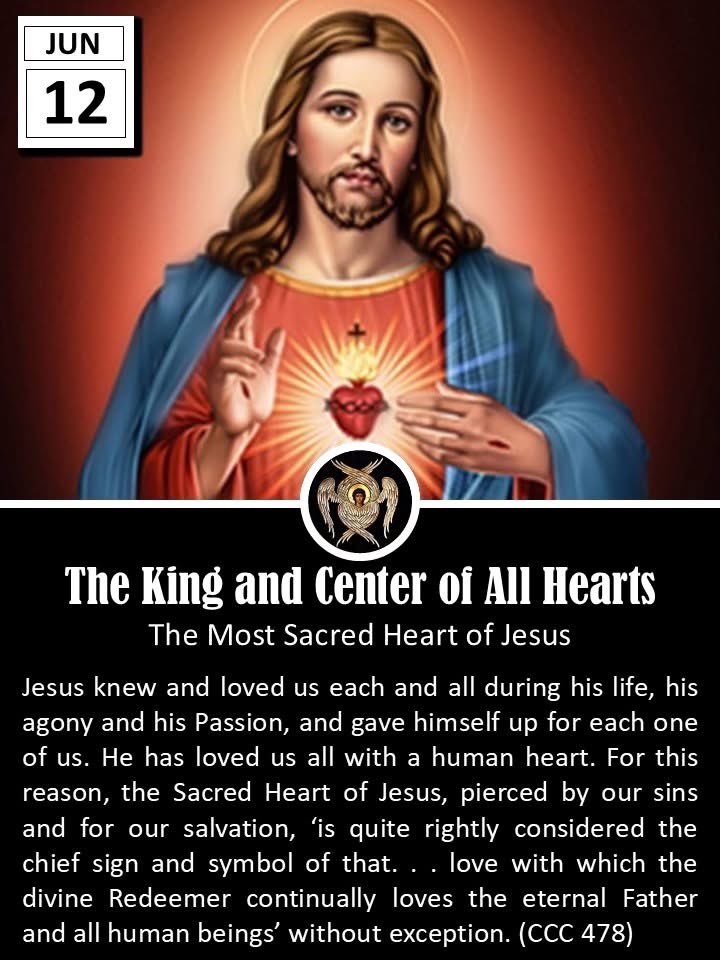
The Solemnity of the Sacred Heart of Jesus is a significant feast, celebrated annually on the Friday following the second Sunday after Pentecost, typically in June. This devotion honors the profound love of Jesus Christ, symbolized by His Sacred Heart, which represents His divine and human compassion for humanity. The feast encapsulates themes of mercy, redemption, and the boundless love of God, inviting believers to reflect on Christ’s sacrifice and to respond with love and devotion.
The devotion to the Sacred Heart originated in the Middle Ages but was formalized through the visions of St. Margaret Mary Alacoque, a French nun, in the 17th century. Between 1673 and 1675, Jesus appeared to her, revealing His heart as a symbol of His infinite love and asking for a feast to be established in its honor. He emphasized acts of reparation for humanity’s sins and the practice of receiving Holy Communion on the First Fridays of each month. This message resonated deeply, leading to the spread of the devotion across the Church.
The Solemnity itself was instituted by Pope Clement XIII in 1765 and extended to the universal Church by Pope Pius IX in 1856. It is marked by special Masses, prayers, and devotions, such as the Litany of the Sacred Heart and the Act of Reparation. The imagery of the Sacred Heart—often depicted with flames, a cross, and thorns—symbolizes Christ’s burning love, His crucifixion, and the suffering He endured for humanity’s salvation.
Theologically, the Sacred Heart underscores the reality of the Incarnation: Jesus, fully divine and fully human, loves with a Heart that feels deeply. It calls Catholics to reciprocate this love through prayer, charity, and a life of holiness. In a world often marked by division and indifference, the Solemnity of the Sacred Heart serves as a reminder of Our Lord’s unwavering love and an invitation to reciprocate that love by making reparation for sin, and the practice of charity.
3
129
471
6,210
Waterside Parish retweeted

Jun 11
I just play it on repeat since yesterday:
"Hello Pope Leo XIV, I'm Renzo, I'm six years old.
I'd like to ask you a few questions."
Renzo, a little a boy from the poor neighborhood of Barcelona, stole the show yesterday at St. Augustine's parish, a place where Pope Leo admitted he "feels at home."
Renzo in the sweetest way ever asked those questions to the pope:
Do you like soccer?
When you were little, did you want to be Pope?
Why are my mom and dad worried?
Why does my dad have so many jobs?
Why do bad things happen to some people and not to others? Whose fault is it?
Why are there so many people living on the streets? Does no one see them? Does no one help them?
How can we help if the world is so big?
Does God want there to be poor and rich?
Why are there so many lonely grandparents, if they are so important?
And one last question ... Must we always forgive?
What pope Leo answered the boy was really moving.
"Regarding whether I like football, I confess that I play tennis and I enjoy it very much, but I also appreciate football; in fact, during my years as bishop in Peru, I liked to follow how some local teams were doing; and now, as Pope, I have also received football clubs and sports groups," the pope said, adding that "sport is important because it helps us grow up healthy in body and mind."
He said that as World Cup unfolds, "many will be watching the matches. Football reminds us of something we must not forget: life is not a race to show off alone, but a path we learn to travel together."
"Whoever doesn't know how to pass the ball, even if they have talent, hasn't yet understood the game. And whoever doesn't know how to live with others and for others hasn't yet understood life."
Answering whether he wanted to be Pope when he was little, the pope said: "Well, Renzo, I don't think so. I don't think I ever thought about it."
"But I can tell you something: from a young age, I felt the desire to dedicate my life to God. I didn't yet know exactly how or where the Lord would lead me. Over time, I discovered that Jesus was calling me to follow him as a priest, and that this path led through the Order of Saint Augustine."
"But this isn't just true for me," he said. "Every child is a dream of God. You are too. God desires the happiness of all and wants us, from childhood and throughout our lives, to have a heart like that of children (cf. Mt 18:3): capable of trusting, full of kindness; he wants us to be his friends and not turn away from him. Therefore, more important than asking oneself whether one will be a priest, doctor, teacher, parent, or anything else, is asking oneself whether one wants to be a friend of Jesus. Because friendship with Jesus gives us joy, sets us free, and helps us to see, step by step, the vocation and the path that God has planned for each of us."
Answering the point on injustices in the world, Pope Leo told the boy that "through the life of Jesus Christ, God shows us that, although there is suffering, he never abandons any of his children, because he has prepared for us an eternal joy where there will be no more sadness or pain. Let us have confidence, Jesus is with us, he helps us and accompanies us, and gives us strength to go through the difficult moments we may encounter in life."
Stressing that grandparents play a crucial role in families, the pope said: "Let us not allow loneliness and abandonment to become normalized in the lives of older adults. That is a very sad thing. Let's have our hearts open to all of them."
On forgiveness, he told Renzo and those gathered: "It does not mean forgetting by force, as if nothing had happened. Forgiveness means not letting hatred become the master of our hearts ... our willingness to forgive is a condition for the forgiveness we receive from God."
Video: Vatican Media
33
1,046
5,395
241,911
Waterside Parish retweeted
Jun 12
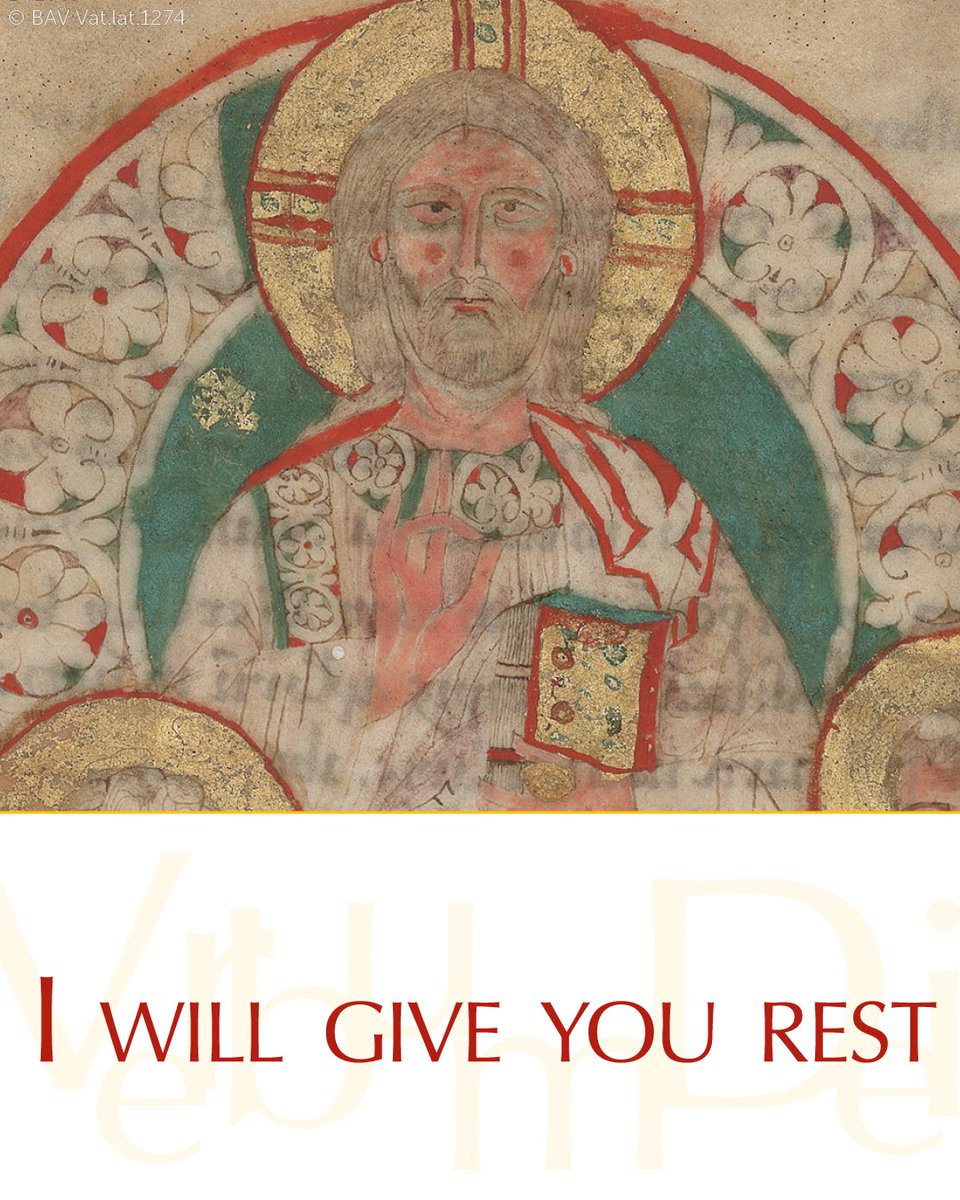
Gospel of the Day (Matthew 11,25-30)
At that time Jesus exclaimed, "I give praise to you, Father, Lord of heaven and earth, for although you have hidden these things from the wise and the learned you have revealed them to the childlike.
Yes, Father, such has been your gracious will.
All things have been handed over to me by my Father. No one knows the Son except the Father, and no one knows the Father except the Son and anyone to whom the Son wishes to reveal him."
"Come to me, all you who labor and are burdened, and I will give you rest.
Take my yoke upon you and learn from me, for I am meek and humble of heart; and you will find rest for yourselves.
For my yoke is easy, and my burden light."
vaticannews.va/en/word-of-th…
36
307
1,253
15,337
Waterside Parish retweeted
Jun 10
Gospel of the Day (Matthew 5,17-19)
Jesus said to his disciples: "Do not think that I have come to abolish the law or the prophets. I have come not to abolish but to fulfill.
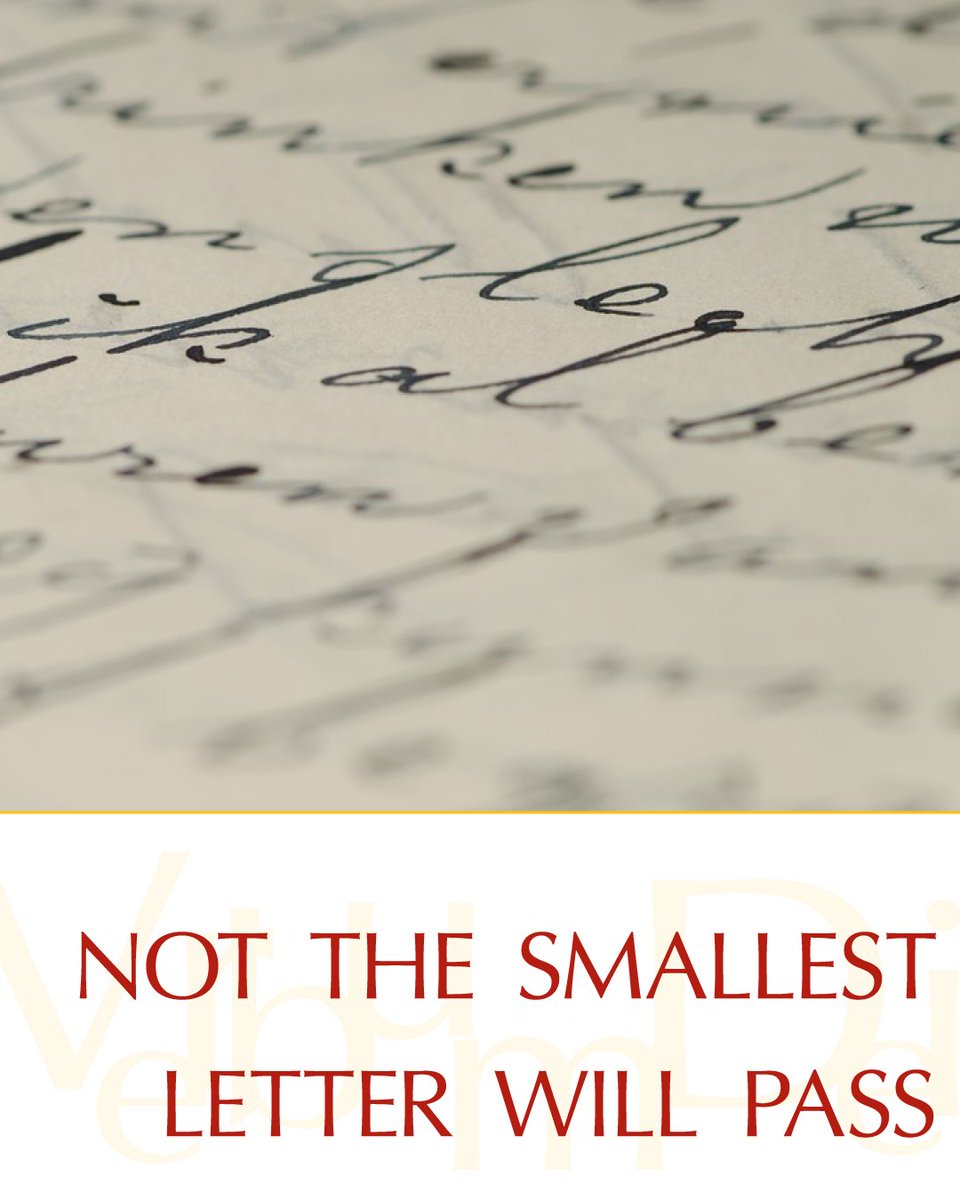
Amen, I say to you, until heaven and earth pass away, not the smallest letter or the smallest part of a letter will pass from the law, until all things have taken place.
Therefore, whoever breaks one of the least of these commandments and teaches others to do so will be called least in the kingdom of heaven. But whoever obeys and teaches these commandments will be called greatest in the kingdom of heaven."
vaticannews.va/en/word-of-th…
46
255
975
13,777
Waterside Parish retweeted
Jun 8
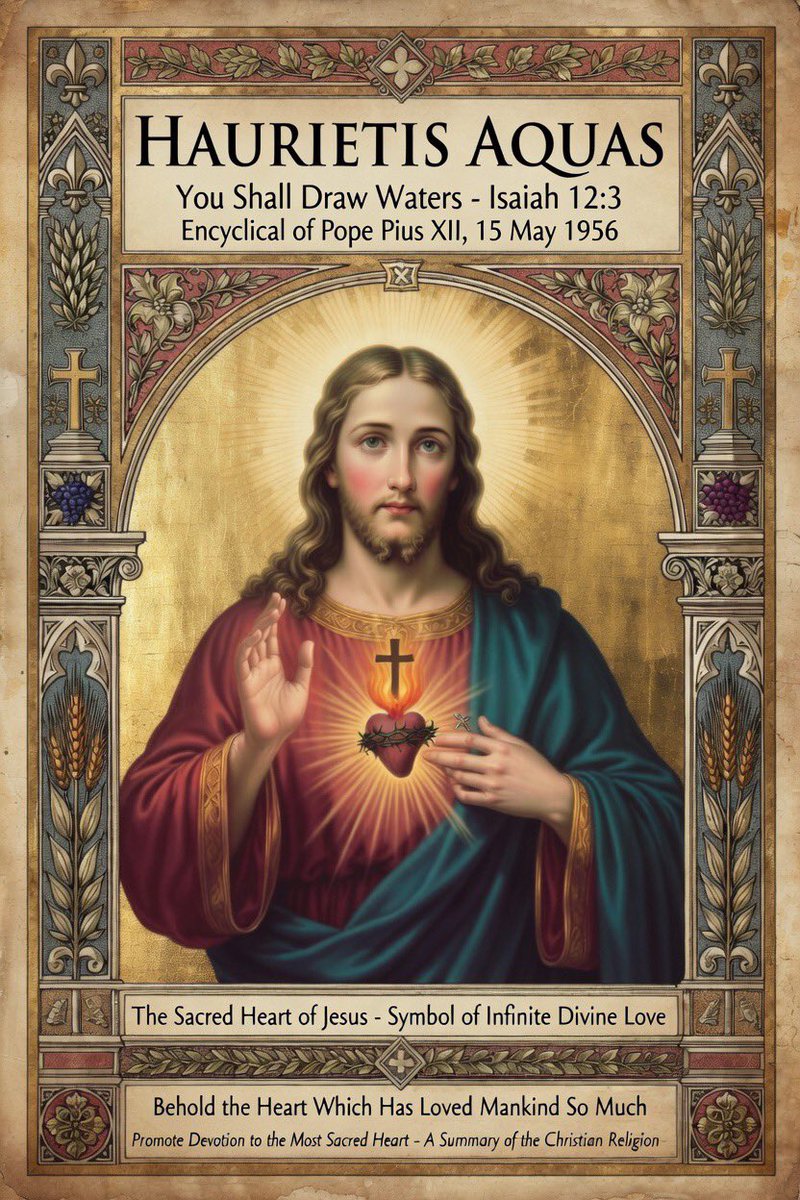
Pope Pius XII issued the encyclical Haurietis Aquas, meaning “You Shall Draw Waters,” on May 15, 1956. This document serves as a comprehensive affirmation and theological exposition of devotion to the Sacred Heart of Jesus, presenting it as a central and profound element of Catholic spirituality rather than a marginal practice. Drawing its title from the prophet Isaiah, the encyclical invites the faithful to draw deeply from the wellsprings of salvation manifested in Christ’s heart, emphasizing its enduring relevance for personal holiness and the life of the Church.
At its core, the encyclical grounds this devotion in the mystery of the Incarnation. It portrays the Sacred Heart as the physical heart of Jesus Christ, hypostatically united to the divine Person of the Word. This symbol encapsulates the threefold love of Christ: His infinite divine love as the Son of God, His spiritual love as the God-man, and His sensible human affections. Pius XII explains that honoring the Sacred Heart constitutes true worship of Christ Himself, fostering a deeper understanding of divine redemption and the boundless mercy extended to humanity.
The encyclical traces the historical and scriptural foundations of this devotion across both the Old and New Testaments, highlighting passages that reveal God’s compassionate love. It connects these roots to the living tradition of the Church and acknowledges the significant role of private revelations, particularly those granted to Saint Margaret Mary Alacoque in the seventeenth century. While affirming the importance of such revelations, Pius XII underscores that the devotion rests primarily on solid doctrinal and liturgical bases, integrating it fully into the Church’s official worship.
Spiritually, Haurietis Aquas presents devotion to the Sacred Heart as a comprehensive summary of the Christian religion. It encourages complete consecration to Christ, the practice of reparation for sins, and the fulfillment of the greatest commandments to love God and neighbor. The encyclical addresses potential objections, refuting notions that the devotion is overly sentimental, optional, or theologically inferior. Instead, it positions the practice as a powerful means of spiritual renewal, capable of drawing abundant graces amid the challenges of the modern era.
In its pastoral dimension, Pope Pius XII calls upon bishops and the faithful to promote this devotion with renewed vigor. He envisions it as a source of strength for the Church and society, capable of inspiring virtue, unity, and a more authentic Christian witness.
Ultimately, Haurietis Aquas stands as an enduring invitation to encounter the redeeming love of Christ through His Sacred Heart, offering a pathway to deeper union with God and the transformation of the world through grace. The full text remains accessible on the Vatican website for those seeking a complete reading.
Link to the encyclical: papalencyclicals.net/pius12/…
1
36
113
2,411
Waterside Parish retweeted
Jun 9
The Crown of Thorns Which Surrounds the Sacred Heart
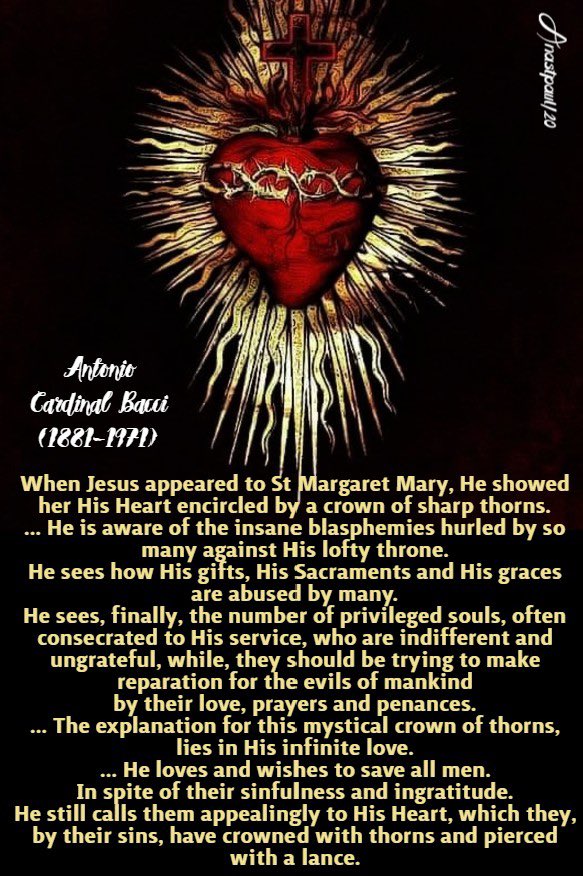
1. When Jesus appeared to St. Margaret Mary, He showed her His Heart encircled by a crown of sharp thorns. What was the significance of this? In Heaven Jesus is happy and cannot suffer any more. The Angels, Saints and the whole of creation sing a hymn of unceasing praise in His honour. Nevertheless, He sees the immense tide of sin which surges forth from the human race which He redeemed by His Precious Blood, a redemption now made futile by many. He is aware of the insane blasphemies hurled by so many against His lofty throne. He sees how His gifts, His sacraments and His graces are abused by many. He sees, finally, the number of privileged souls, often consecrated to His service, who are indifferent and ungrateful while they should be trying to make reparation for the evils of mankind by their love, prayers and penances. The explanation for this mystical crown of thorns lies in His infinite love. He does not suffer any more, because He cannot suffer, but He still has an immense love for all men, even for sinners and for those who are lukewarm and ungrateful. He loves and wishes to save all men. In spite of their sinfulness and ingratitude, He still calls them appealingly to His Heart, which they by their sins have crowned with thorns and pierced with a lance.
This is a mystery of love which we cannot properly understand. Only a man who loves Jesus fervently can even have the slightest understanding of it. If we sincerely love the divine Heart of Jesus, we shall realise that these sharp thorns which once pierced His Heart in Gethsemane and on Calvary were caused by our sins. Then we shall do our best to make a generous return for such love and to make reparation, even with grave sacrifice, for the offences which are still being committed by men against the loving Heart of the Redeemer.
2. There are many ways of showing our love for the Sacred Heart of Jesus and of making reparation for our sins and for the sins of mankind. We can console ourselves with the reflection that by these acts of love and reparation we are removing the thorns which encircle the Heart of Jesus. The simplest ways of doing this are by prayers, ejaculations, and expressions of love directed towards the adorable Heart of our Redeemer; and by visits to Jesus in the Blessed Sacrament. In silence and recollection before the Tabernacle we shall feel the Heart of Jesus beating with love and shall offer in return for His infinite love the affection of our poor hearts.
We can also receive Holy Communion in reparation. When Jesus is in us and we are in Jesus, it will be easier and more pleasant to offer Him our love and expiation. We can make reparation also by practicing the devotion of the First Fridays of the month. This pious practice, so pleasing to the Heart of Jesus, aims at being a mass offering of love and reparation for the sins of the entire human race.
3. We can also make reparation by voluntary penances or at least by offering up our daily sufferings in a spirit of loving generosity. But the course most pleasing of all to the Sacred Heart is the continual imitation of His outstanding virtues in such a way as to become living reproductions of our adorable Redeemer.
"Sacred Heart of Jesus, convert poor sinners." (Antonio Cardinal Bacci)
5
104
412
5,192
Waterside Parish retweeted
Jun 9
Gospel of the Day (Matthew 5,13-16)
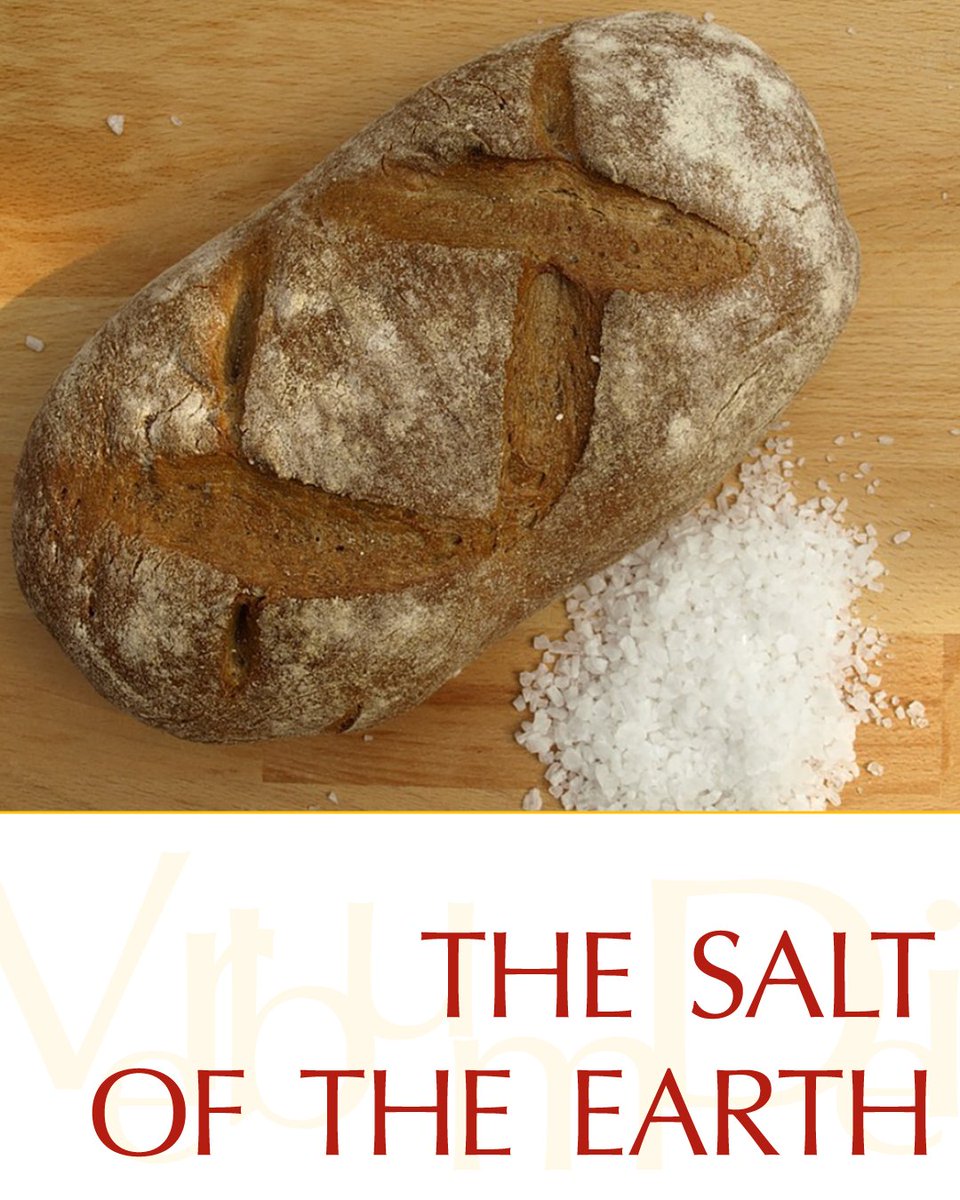
Jesus said to his disciples: "You are the salt of the earth. But if salt loses its taste, with what can it be seasoned? It is no longer good for anything but to be thrown out and trampled underfoot.
You are the light of the world. A city set on a mountain cannot be hidden.
Nor do they light a lamp and then put it under a bushel basket; it is set on a lampstand, where it gives light to all in the house.
Just so, your light must shine before others, that they may see your good deeds and glorify your heavenly Father."
vaticannews.va/en/word-of-th…
58
314
1,259
16,128
Waterside Parish retweeted
Jun 8
In what will certainly become one of the most fundamental speeches of his pontificate, Pope Leo XIV told the Spanish Parliament, before receiving a 7-minute standing ovation: "The defense of human life is neither a partisan issue nor a confessional interest: it is a goal of civilization."
"If life ceases to be recognized as a fundamental value, what future can our societies have?" he said, speaking to a gathering of politicians, many supporting abortion and euthanasia.
"Can a community that casts into the shadows the unborn child, the elderly, the sick, those who suffer in silence, or those who depend entirely on the care of others be called fully just?"
"Every human life must be recognized and safeguarded from conception to its natural end, in every circumstance of its existence. When this certainty is obscured, the most vulnerable are the first victims, and the law loses its deepest meaning: to serve and protect every person."
"For this reason, the moral greatness of a nation is manifested, above all, in its capacity to accompany, protect and love those lives that are most fragile," he said, repeating what John Paul II emphasized decades ago.
Starting his speech he commented that Church's is the "message offered in the spirit of service to the human person."
"When the Church addresses anything concerning public life, she does so while respecting the proper mission of institutions and the legitimate responsibility of those who have received the mandate to legislate," Pope Leo said, emphasizing "the Church offers a reflection born of the desire to serve the common good."
He hailed Spain as country that "has known how to view the human being as more than just a cog in the social, economic or political order. It has recognized the human being as a creature open to truth, endowed with freedom, and driven by a thirst for eternity that no temporal reality can quench -- in a word, as someone whose dignity takes precedence over all utility and to whose service legislative action is subject."
He said it was Catholic orders that "helped to shape a legal and moral consciousness capable of remembering that authority always entails responsibility and that every human being must be recognized as a subject of rights and duties."
"That aspiration continues to resonate today: that dignity, justice and the common good should be the measure of social relations, both at the national and international levels."
Referring multiple times to his "Magnifica Humanitas" encyclical, he said: "When the common good ceases to be a shared horizon, public action runs the risk of fragmenting into partial interests, incapable of safeguarding what belongs to all."
"In this context, the family — the primary human reality and the natural foundation of the community — takes on particular importance," Pope Leo said.
"The family will always be the first school of humanity, where one learns, before anywhere else, the basic grammar of living together: welcoming life, caring for others, forgiving, serving and belonging."
"Human life can never be treated as a commodity," the pope said.
"A law does not attain its true greatness merely by having been formally enacted; it attains it when, in addition to being valid in form, it can stand before the dignity of the person and pass that test without shame."
"I invite you, then, to lift your gaze to the world around you, not to turn away from reality, but to remember that every decision by public authorities affects real people, especially those who have less power to make their voices heard."
"The expanse of one’s vision consists precisely in looking more deeply at what is at stake in every public decision. This is why, alongside technical solutions and legal reforms, a moral renewal is also needed."
Video: Vatican Media
(fragment of speech follows)
72
1,448
5,351
242,947
Waterside Parish retweeted
Jun 8
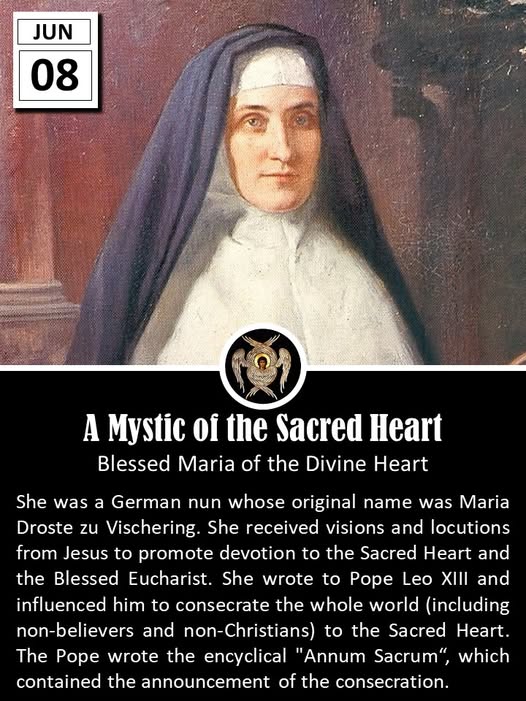
Blessed Maria of the Divine Heart, born Maria Droste zu Vischering on September 8, 1863, in Münster, Germany, emerged from a noble Catholic family as a figure of profound spiritual influence in the late nineteenth century. The daughter of Count Clemens Droste zu Vischering and Countess Helen von Galen, she grew up in an environment shaped by deep faith amid the challenges of the Kulturkampf, which tested Catholic loyalty in Prussia. From an early age, Maria displayed a sensitive conscience and a growing attraction to religious life, though health struggles, including a bout of pneumonia during her schooling with the Sisters of the Sacred Heart, marked her youth and deepened her reliance on prayer.
In 1888, at the age of twenty-five, she entered the Congregation of Our Lady of Charity of the Good Shepherd in Münster, taking the religious name Sister Mary of the Divine Heart. The order focused on the care of troubled and marginalized young women, a mission that resonated with her compassionate spirit. She embraced a life of sacrifice, often repeating that the most abandoned souls were her greatest treasures. Transferred to the convent in Porto, Portugal, she served as superior while enduring chronic illness with remarkable patience and joy. It was in this period that her interior life flowered through mystical experiences centered on the Sacred Heart of Jesus.
In repeated visions, Christ urged her to petition Pope Leo XIII for the consecration of the entire world to His Sacred Heart. Despite her humility and physical frailty, Sister Maria obeyed, writing letters to the Holy Father that conveyed the divine request with clarity and fervor. Pope Leo XIII, moved by these appeals and after careful discernment, fulfilled the petition on June 11, 1899, in an encyclical that he later described as the greatest act of his pontificate. Three days earlier, on June 8, 1899, at the age of thirty-five, Sister Maria had died peacefully in Porto, her mission accomplished. Pope Leo XIII himself attributed a miraculous healing to her intercession.
Her legacy endures as a bridge between personal devotion and the universal Church. Beatified by Pope Paul VI on November 1, 1975, Blessed Maria of the Divine Heart is remembered as a patron of priests and devotees of the Sacred Heart. Her life illustrates how quiet obedience, rooted in love for Christ, can shape the spiritual direction of an age, calling souls across generations to entrust themselves fully to the merciful Heart that burns with charity for humanity.
21
98
1,680
Waterside Parish retweeted
Jun 8
Gospel of the Day (Matthew 5,1-12)
When Jesus saw the crowds, he went up the mountain, and after he had sat down, his disciples came to him.
He began to teach them, saying:
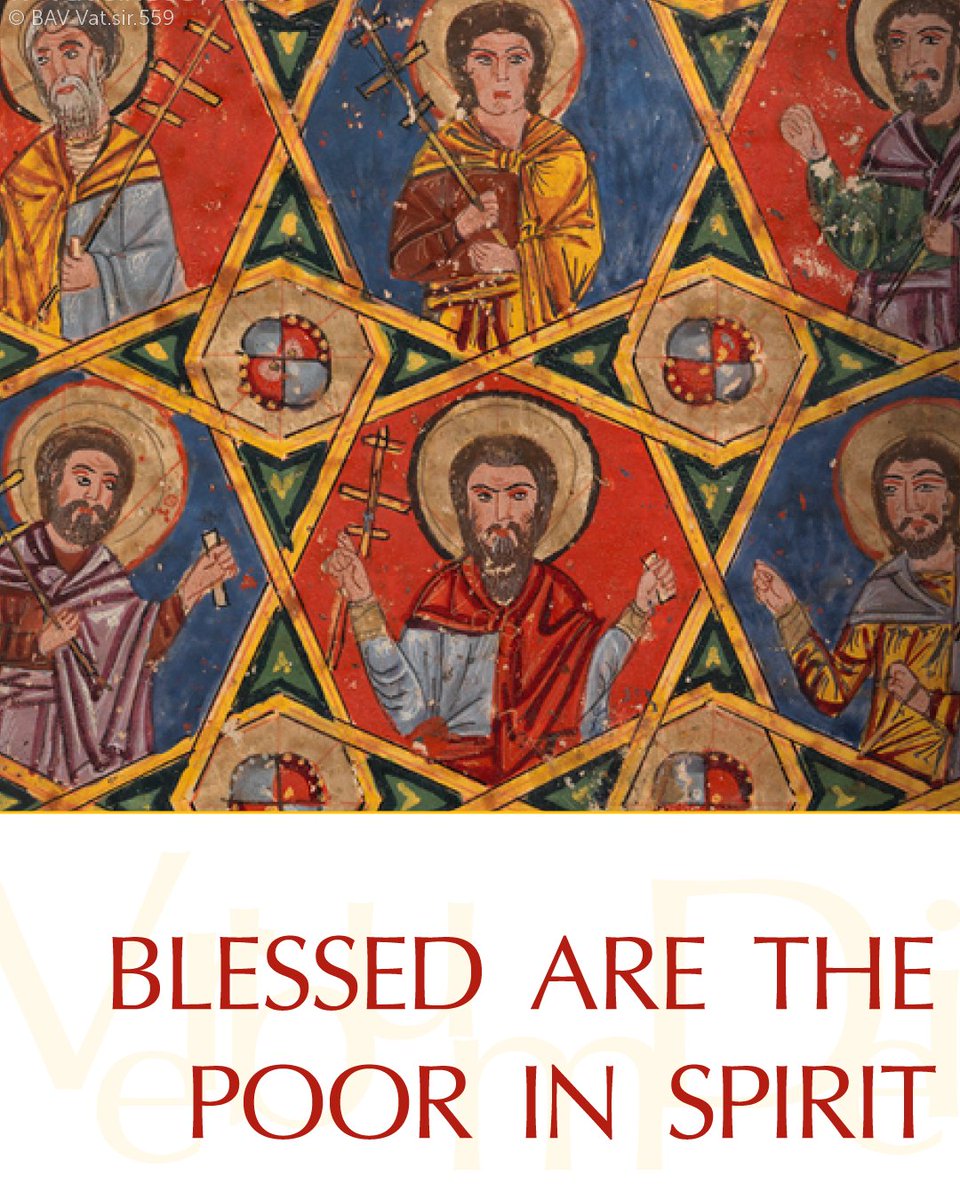
"Blessed are the poor in spirit, for theirs is the kingdom of heaven.
Blessed are they who mourn, for they will be comforted.
Blessed are the meek, for they will inherit the land.
Blessed are they who hunger and thirst for righteousness, for they will be satisfied.
Blessed are the merciful, for they will be shown mercy.
Blessed are the clean of heart, for they will see God.
Blessed are the peacemakers, for they will be called children of God.
Blessed are they who are persecuted for the sake of righteousness, for theirs is the kingdom of heaven.
Blessed are you when they insult you and persecute you and utter every kind of evil against you (falsely) because of me.
Rejoice and be glad, for your reward will be great in heaven."
vaticannews.va/en/word-of-th…
41
370
1,378
17,667
Waterside Parish retweeted
Jun 7
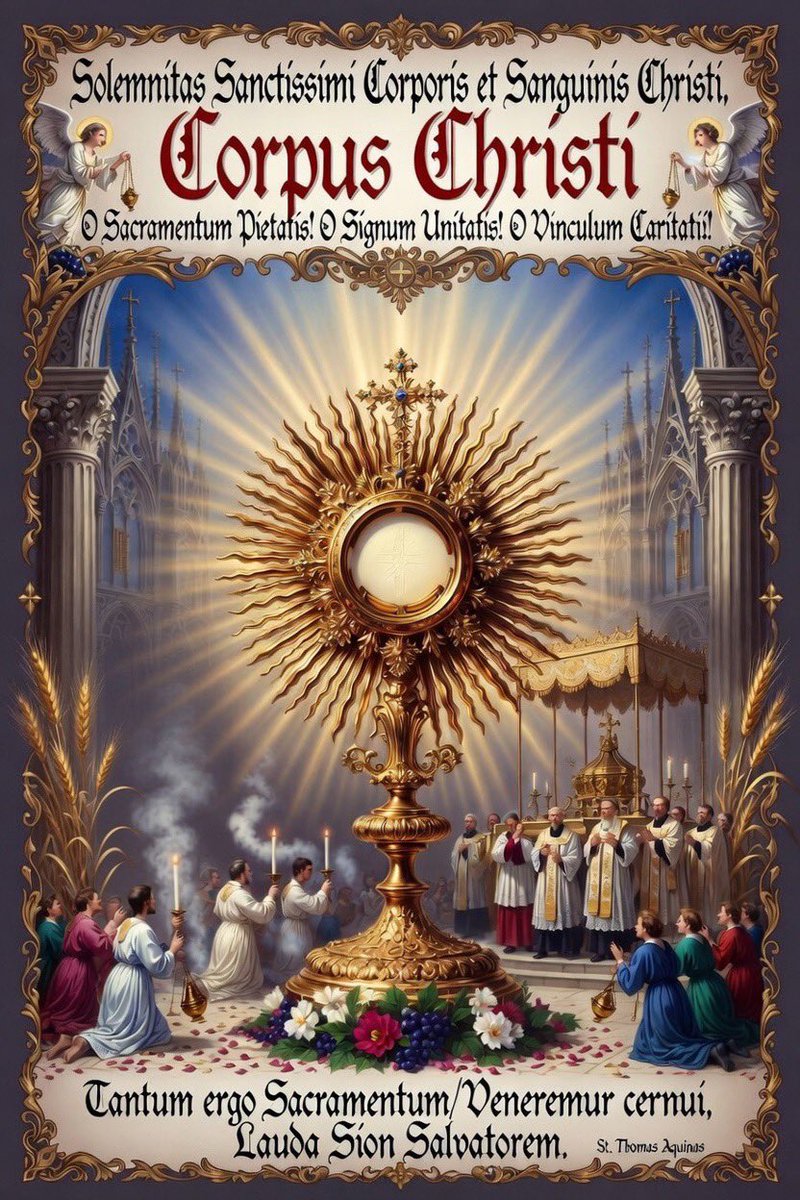
The Solemnity of Corpus Christi was inaugurated for the universal Church in 1264 AD. The circumstances that led to this are surrounded by coincidence. St. Juliana, a nun in the diocese of Liege, Belgium, had a vision of Our Lord requesting a feast in honor of the Blessed Sacrament.
When she revealed this request, many ridiculed her, including members of her own order and even Church theologians. But she did have one great advocate in Fr. Jacques Pantaleon, who was Archdeacon of Liege. Through his efforts the feast began to be celebrated in that diocese.
Now comes the coincidence! This priest was appointed papal legate to Germany and later was installed as Patriarch of Jerusalem. The story does not stop there, for he was elected to the Chair of St. Peter as Pope Urban IV in 1261. Three years later he directed that the feast of Corpus Christi be celebrated throughout the whole Church.
Pope Urban commissioned the great Dominican scholar and theologian, St. Thomas Aquinas, to compose the texts for the Mass and the Divine Office for the new feast. The splendor, depth and devotion of the prayers and hymns of St. Thomas have enriched the liturgy with some of its most beautiful pieces. They are still sung today and admired for their profound spiritual meaning.
One of the hymns, Panis Angelicus (The Bread of Angels), is known and cherished widely, especially in the musical setting composed by Cesar Franck (1890). Another hymn by St. Thomas, Pange Lingua Gloriosi (Sing, my tongue, the Savior's Glory), contains two stanzas, beginning with Tantum Ergo (Down in adoration falling), which are sung all over the world at every Benediction service. The best rendition of this music has remained the Gregorian chant. The last stanzas of another hymn by St. Thomas are also sung frequently at Benediction. The hymn is Verbum Supernum Prodiens (The Word from Heaven now Proceeding) and the section chosen from it begins with the words O Salutaris Hostia (O Saving Victim),
Then there is the sequence for the Mass: Lauda, Sion, Salvatorem (Praise, O Sion, your Redeemer), in which St. Thomas calls to mind in remarkable language the great truths of Christ's revelation and the Church's teaching about the Eucharist. (anonymous)
In addition, St. Thomas composed the Adoro Te Devote (Devoutly I adore you), and the verse: O Sacrum Convivium: O sacred banquet in which Christ is received: the memory of his Passion is recalled, the soul is filled with grace, and to us is given the pledge of future glory. Alleluia.
8
84
331
3,968
Waterside Parish retweeted
Jun 7
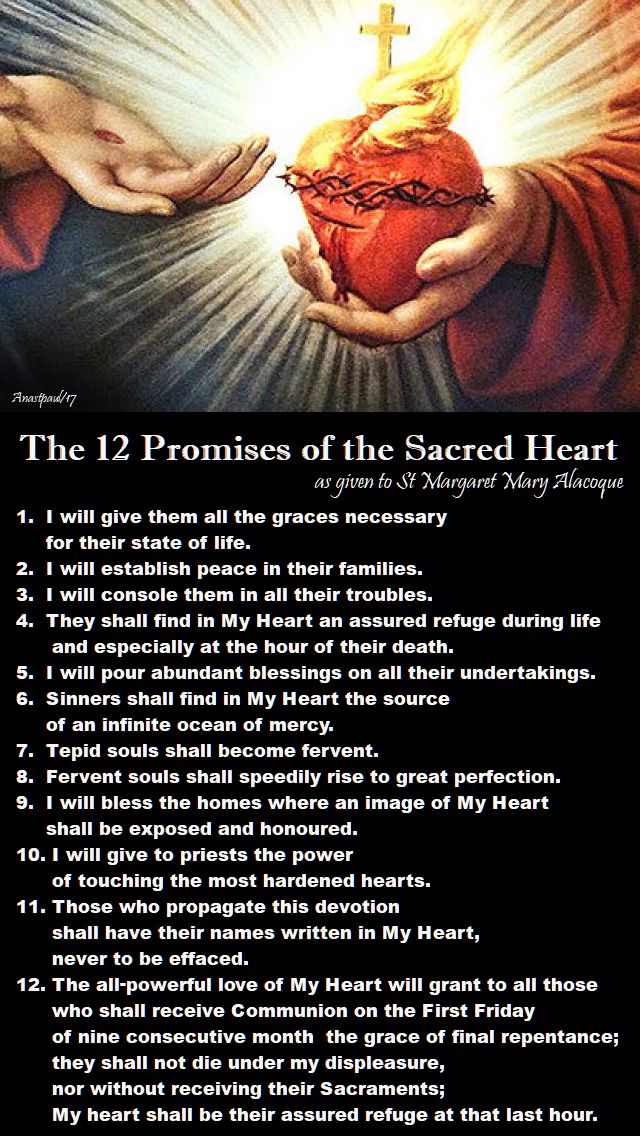
The Promises Made to Those Who Practise Devotion to the Sacred Heart
1. When Jesus appeared to St. Margaret Mary Alacoque and commanded her to propagate the worship of His Sacred Heart, He promised very special blessings to those who would be truly devoted to His Sacred Heart and spread this devotion among others. “I will give them all the graces necessary for their state in life... consolation in all their troubles... peace in their families... blessings on all their undertakings.”
These promises are an inducement to us to love Jesus and to spread devotion to His Sacred Heart.
Our Divine Saviour is not content with having loved us so much during His mortal life and given us His Precious Blood, the Blessed Eucharist, and His most holy Mother for our salvation. He sees that His infinite love is not returned as it ought to be and seems to exercise a gentle pressure in order to compel us to love Him.
“Behold this Heart which has so loved men that It spared nothing... to prove to them Its love. And in return I receive from the greater part of men nothing but ingratitude, by the contempt, irreverence, sacrileges and coldness with which they treat Me in this Sacrament of Love.”
“I thirst, I burn with a consuming desire for men’s love, and I find none to quench this thirst, according to My wish, by making any return of love.”
Who could fail to feel the force of this appeal?
2. The promises made by Jesus to those who are truly devoted to His Sacred heart are a new proof of His infinite love and mercy. However, if anyone were to cultivate devotion to the Sacred Heart merely to gain His benefits, and to think more of his own spiritual and temporal advantage than of Jesus, he would display a niggardly spirit quite unworthy of Our Lord’s favour.
The worship of the Sacred Heart could degenerate into a kind of utilitarian egoism undeserving of the name of devotion. Pious practices could become cold and formal, and degenerate into sentimentality tinged with superstition. There is nothing to prevent us asking the Sacred Heart for graces and favours which we need. In fact we should do so, for it is He Who has made these promises to us and is eager to fulfil them because He loves us. But we should be generous with Jesus in return for His infinite generosity towards us. We should love Him because He is so worthy of our love. Our love should be expressed not only in prayers and outward forms but in a deep personal transformation which will make us more like Jesus. True love transforms and unites two hearts. Let us love Jesus and we shall live with Jesus, through Jesus, and in Jesus. His love will effect in us the miracle which it produces in St. Paul. “To me to live is Christ.” (I Phil. 1, 21)
3. Sweet Heart of Jesus, make me love You more and more. (Antonio Cardinal Bacci)
7
83
286
4,443
Waterside Parish retweeted
Jun 7
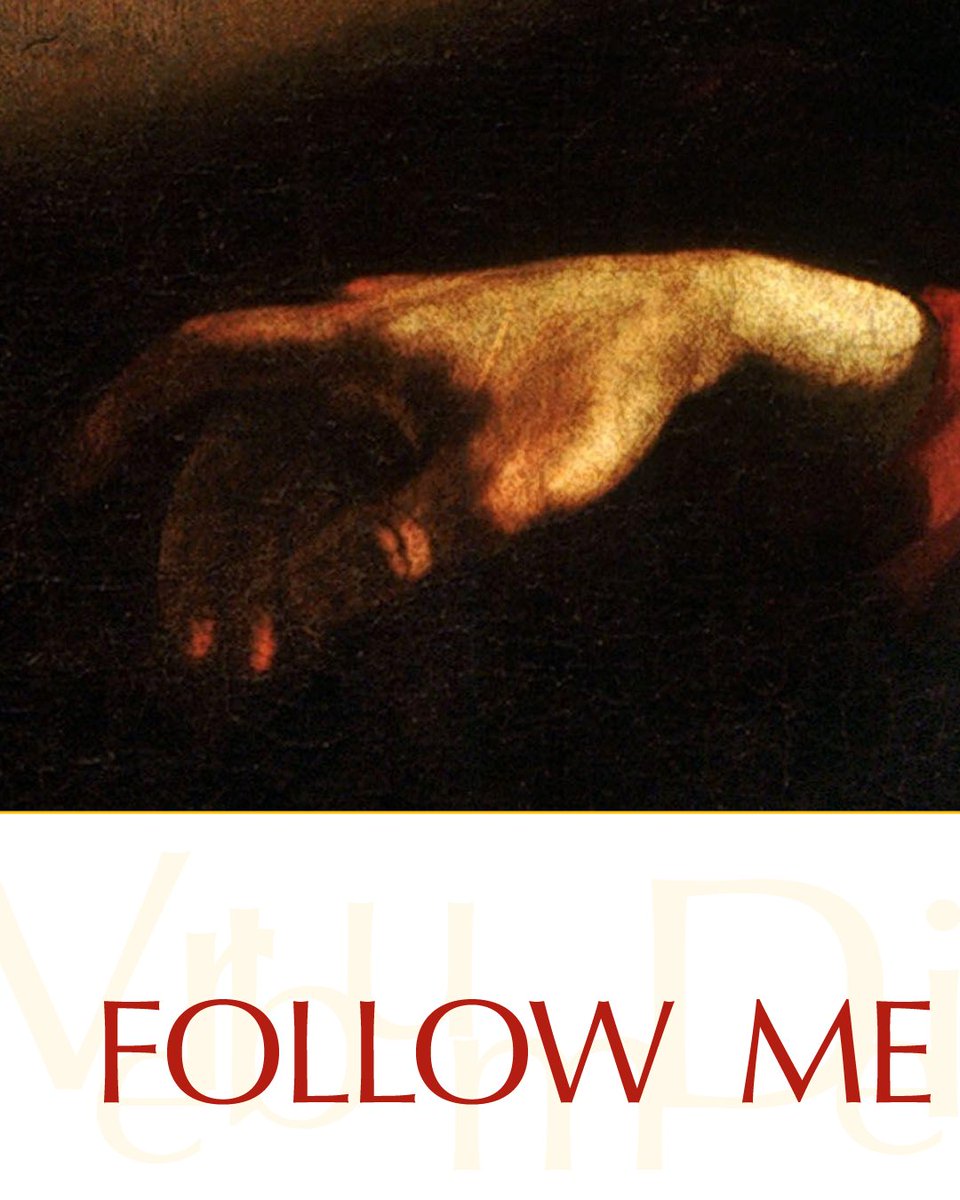
Gospel of the Day (Matthew 9:9-13)
As Jesus passed on from there, he saw a man named Matthew sitting at the customs post.
He said to him, “Follow me.” And he got up and followed him.
While he was at table in his house, many tax collectors and sinners came and sat with Jesus and his disciples. The Pharisees saw this and said to his disciples, “Why does your teacher eat with tax collectors and sinners?”
He heard this and said, “Those who are well do not need a physician, but the sick do.
Go and learn the meaning of the words, ‘I desire mercy, not sacrifice.’ did not come to call the righteous but sinners.”
vaticannews.va/en/word-of-th…
34
277
1,089
16,771
We are delighted to announce that Reverend Stephen Baxter, will be ordained to the priesthood by Bishop Donal McKeown on Sunday, 14th June at 3.00pm in St Columb’s Church. watersideparish.net/ordinati…
4
93
Waterside Parish retweeted
Jun 6
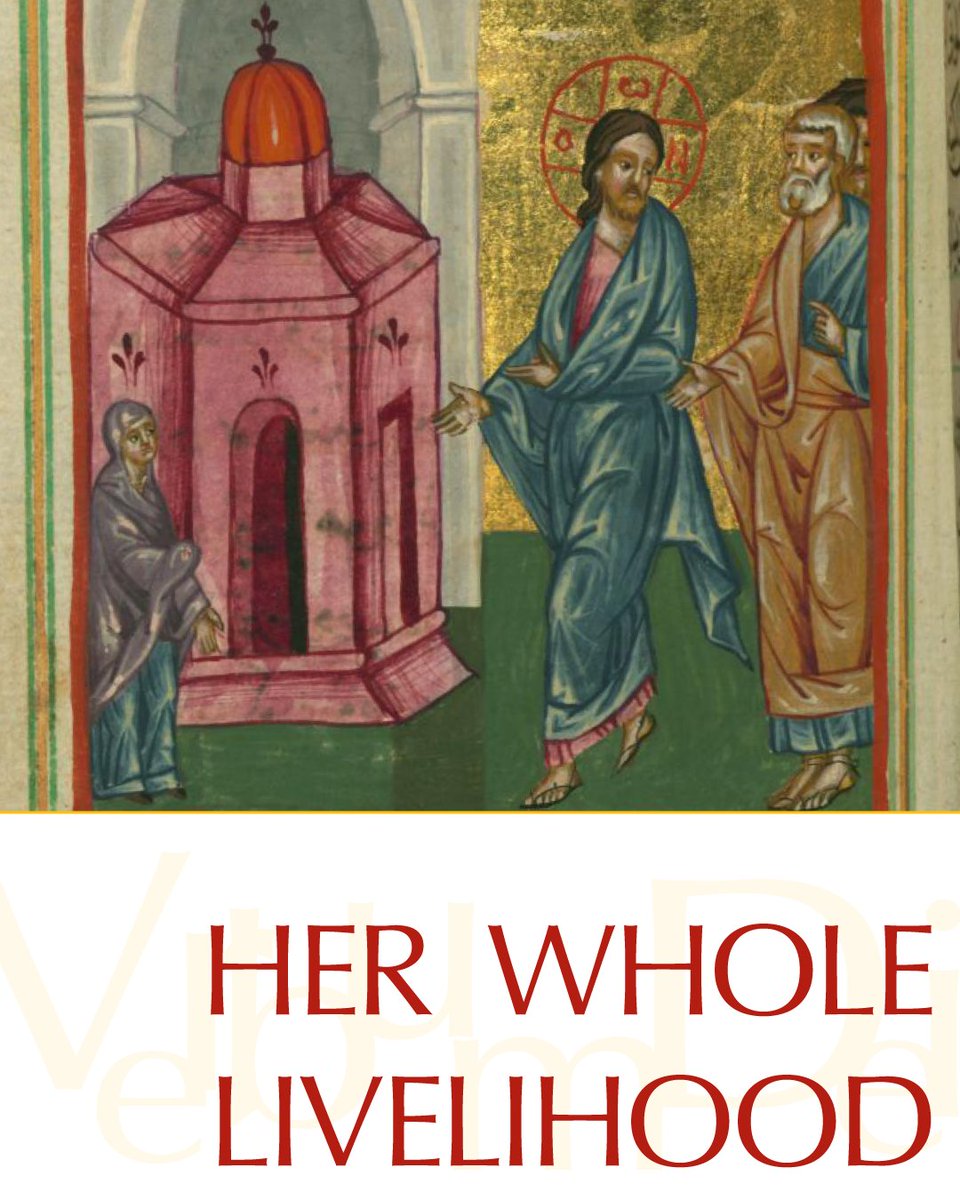
Gospel of the Day (Mark 12,38-44)
In the course of his teaching Jesus said, "Beware of the scribes, who like to go around in long robes and accept greetings in the marketplaces,
seats of honor in synagogues, and places of honor at banquets.
They devour the houses of widows and, as a pretext, recite lengthy prayers. They will receive a very severe condemnation."
He sat down opposite the treasury and observed how the crowd put money into the treasury. Many rich people put in large sums.
A poor widow also came and put in two small coins worth a few cents.
Calling his disciples to himself, he said to them, "Amen, I say to you, this poor widow put in more than all the other contributors to the treasury.
For they have all contributed from their surplus wealth, but she, from her poverty, has contributed all she had, her whole livelihood."
vaticannews.va/en/word-of-th…
37
282
1,161
16,490