
310 Photos and videos










p2p protocol team caught betting big on their metaDAO raise.
And the receipts are all on-chain.
P2P Protocol was running a public sale on MetaDAO. Before the round launched, wallets started quietly accumulating positions on the raise outcome.
Specific bins. $6M. $8M. Sizes that implied conviction, not speculation.
The account was named P2PTeam.
It was exactly who you think.
The team confirmed it publicly after on-chain forensics connected the wallet to project domain holdings and prior related sales. Positions entered roughly 10 days before launch. Funded from the project treasury.
Their framing: "conviction trading." Not insider trading. No written commitments existed yet. Only verbal interest - including from Multicoin.
The numbers tell the rest.
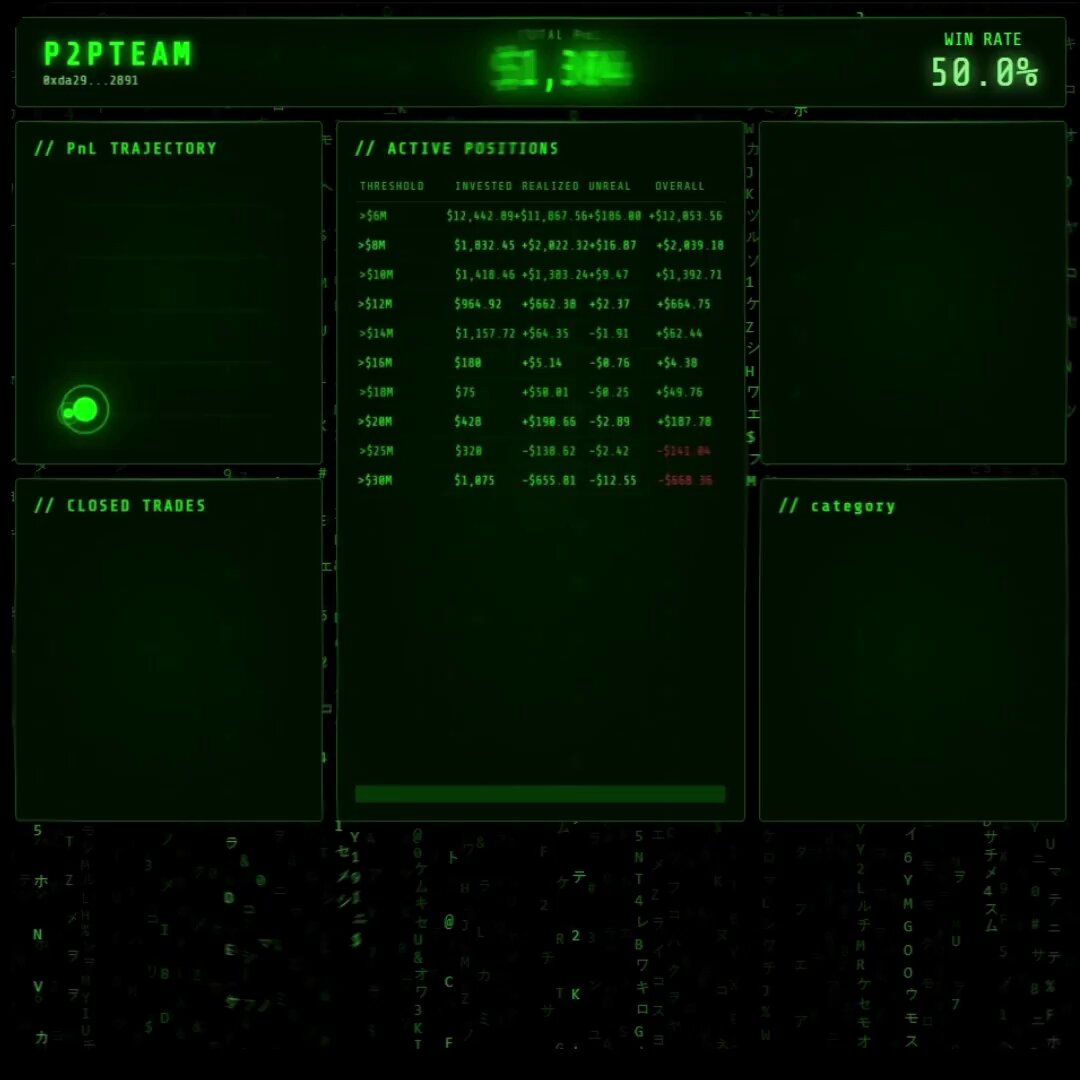
$12,442 invested in the >$6M bin alone.
Entered at an average of 37 cents.
Sold at $1.00 when it resolved.
$11,868 realized. 96% return.
$8M Yes. Entered at 44 cents. Now at 71 cents. $2,039.
$10M Yes. Entered at 29 cents. Now at 58 cents. $1,392.
$12M Yes. Entered at 37 cents. Now at 44 cents. $664.
Total all-time PnL: $23,450.09. Smart Score: 7.3 -better than 91.74% of Polymarket users.
The issue isn't the bet. The issue is they bet on an outcome they directly controlled. That's not asymmetric information. That's writing the answer and entering the exam.
They admitted it was a mistake not to disclose it.
Then they sold everything on March 27th in a single session - liquidating positions across every raise bin simultaneously.
Here's the part worth sitting with.
The wallets moved before the announcement. The position was traceable.
The wallet connection to project domains was findable before the team said a word.
The pattern was readable in public, on-chain, in real time.
Traders who spotted P2PTeam's wallet early entered the lower raise bins quietly. Before the crowd. Before the controversy. Before the price moved.
The asymmetry isn't a glitch in these markets. It's the architecture. Polymarket doesn't create insider information - it puts it on-chain where anyone paying attention can read it.
Teams will keep trading on their own events.
Insiders don't retire because someone writes a thread about ethics.
The question is whether you're watching the order flow
or waiting for the press release.
2
16
269
Here's what the data shows on "US forces enter Iran by March 31?"
Current price: Yes at 26 cents. No at 74 cents.
>$22,121,264 in total volume.
>3,294 unique traders in the last 24 hours alone.
>This is one of the most actively traded geopolitical markets on Polymarket right now.
The market is pricing an Iranian ground invasion at 26%. Five days left on the clock.
Here's what makes this interesting beyond the headline number.
The smart money is clearly on Yes.
Yes aggregate Smart Score: 6.81.
No aggregate Smart Score: -12.29.
That gap is significant. It means the historically profitable traders on this platform are disproportionately positioned on the Yes side - at an average entry price of 25 cents.
The top Yes trader, 0xa7d1ae, holds a $147,208 position entered at 24 cents.
Currently unrealized but sitting on $6,264 in paper gains.
Meanwhile the No side tells a different story. The top No holder, 0xd923b5, is in $40,573 at 79 cents - and is down $2,395 unrealized. Most of the large No positions are underwater.
The volume bias confirms it. Over the last 7 days: 75.8% of volume is flowing into No. But the smart money distribution skews Yes.
Two different crowds. Two different reads on the same event.
The Market Certainty Index sits at 51.0% - and it's trending down, dropping 18 points recently.
The market is becoming less certain, not more, as the deadline approaches.
The resolution rules are strict.
===================
Active military personnel must physically enter Iranian terrestrial territory.
===================
No maritime, no aerial, no intelligence operatives, no contractors. An actual boots-on-ground incursion.
The market says 26% chance that happens in 5 days.
The smart traders are betting that number is too low.
3
16
129
Someone asked me why I use Polymarket through a browser wallet.
I didn't have a good answer anymore.
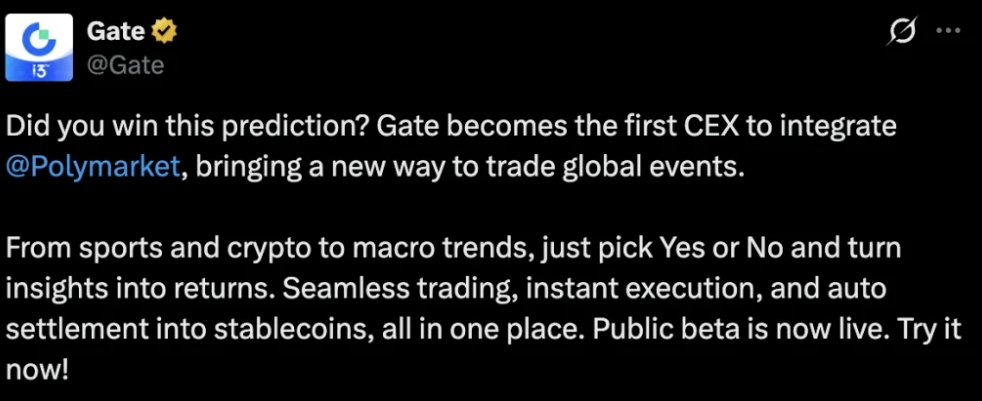
Gate just integrated Polymarket directly into their app. First centralized exchange to do it. Live now in public beta.
USDT from your spot balance. No wallet. No Polygon bridge. No on-chain steps.
You open the Gate app. You find the Polymarket section. You trade.
That's the whole friction reduction.
Here's what the integration actually includes - because "prediction markets on a CEX" undersells it:
Two modes. Simplified view shows probability and odds in plain format. Trading mode gives you order books, candlestick charts, depth charts, limit orders, market orders, and a quick-trade button from the listing page.
Two access routes. Gate account holders use USDT from spot - positions sit alongside your other holdings, settlements auto-convert to stablecoin. Web3 users can still connect wallets via Polygon and settle in USDC.
One interface. Balances, open orders, positions, and trade history all in the same place you manage everything else.
The markets cover crypto, finance, sports, and global events. Prices update in real time. A Yes share at 0.65 means the market prices that outcome at 65%. That number moves like any other liquid market.
Why this matters more than the headline suggests:
Polymarket's edge has always been the information in the prices. Smarter probability estimates than most analysts. Faster to update than media. No narrative, just money.
The barrier was always the wallet setup. Polygon. USDC. Gas. Most retail traders never got past step two.
Gate just removed all of it.
The people who've been printing on weather markets, Bitcoin bin trades, and geopolitical calls - they were all doing this through wallets and browser extensions.
Now anyone with a Gate account and a USDT balance is one tap away from the same markets.
The edge doesn't disappear when more people can access the platform.
It moves to whoever understands the pricing better.
That part hasn't changed.
3
17
476
My roommate saw me watching VIX charts at midnight and asked if I was okay.
Told him I was reading fear for money.
$5,000 → $18,247. July 2021 to April 2023. Baseline didn't move.
Here's what nobody talks about:
Polymarket isn't driven by news.
It's driven by panic.
When CNN Fear & Greed hits 4 - the crowd misfires. YES contracts on "recession" get overpriced.
YES contracts on "Fed hikes" get underpriced.
Same fear. Opposite reaction. The model has to know the difference.
Three layers:
VIX - how nervous is the market right now Fear & Greed Index - which direction is the crowd running Sensitivity Factor - does THIS contract go up or down when fear spikes
The sensitivity calc is the unlock:
sensitivity = price_changes.rolling(60).corr(fear_greed)
Positive = contract grows with fear. Negative = it drops. Feed the model both without that flag and it sees contradiction. Learns nothing.
Entry logic after the fix:
Fear & Greed < 20 model_prob − contract_price > 0.15 → buy Fear & Greed > 80 contract_price − model_prob > 0.15 → sell Neutral zone → only enter if signal is 65% with 50% price gap
– Recession contract. Fear spike. Crowd overpriced YES. Faded it. Clean exit.
– Fed rate contract. Same fear spike. Crowd underpriced YES. Entered. Held.
– Repeated across 21 months. Green line broke from baseline in month 3. Never came back.
$5,000 in. $18,000 out. Baseline flat the entire time.
Everyone else reads the news. The news is already priced. Fear isn't.
He asked if I was always this weird.
I showed him the chart. He went quiet.

4
15
204
My roommate asked why my win rate was 0.6%.
"Doesn't that mean you're losing?"
$1,193 in profit. $285 deposited. I showed him the math.
He asked me to show it again.
Here's the thing nobody intuitively grasps about barmanio's account:
He loses 99.4% of his trades. Every week. On purpose. And he's up $1,193.34.
That number should be impossible. It isn't.
13,921 predictions made. Roughly 13,838 of them lost. The account still prints.
The reason is pure asymmetry.
Every trade is $0.25 in. 250 shares at 0.1 cents each. When it wins, it pays $250.00 out.
That's a 1,000-to-1 ratio. Risk a quarter. Win two hundred and fifty dollars.
At those odds, you only need to win once every 1,000 trades to break even. barmanio wins more than that.
Not much more. But enough.
$4,519 total gains. $3,331 total losses. Net: $1,188.
The losses are noise - a dollar here, a dollar there, spread across thousands of misses.
The wins are violent. Singular. Enough.
Every trading course ever written tells you to optimize for win rate. Hit more than you miss. Stay above 50%. Manage your losers.
barmanio ignored all of it.
He optimized for one thing: finding the moments when Polymarket prices a 15-minute crypto candle so lopsided that one side costs 0.1 cents per share.
At that price, you don't need to be right. You need to be right once every thousand attempts.
The edge isn't prediction. It's patience scaled to absurdity.
13,921 trades. 83 wins. $1,193 profit.
A 0.6% win rate that beats the people winning 70%.
2
1
19
204
My buddy asked why I was watching Dota 2 matches at 2 AM on a Tuesday. Told him I was working.
He laughed.
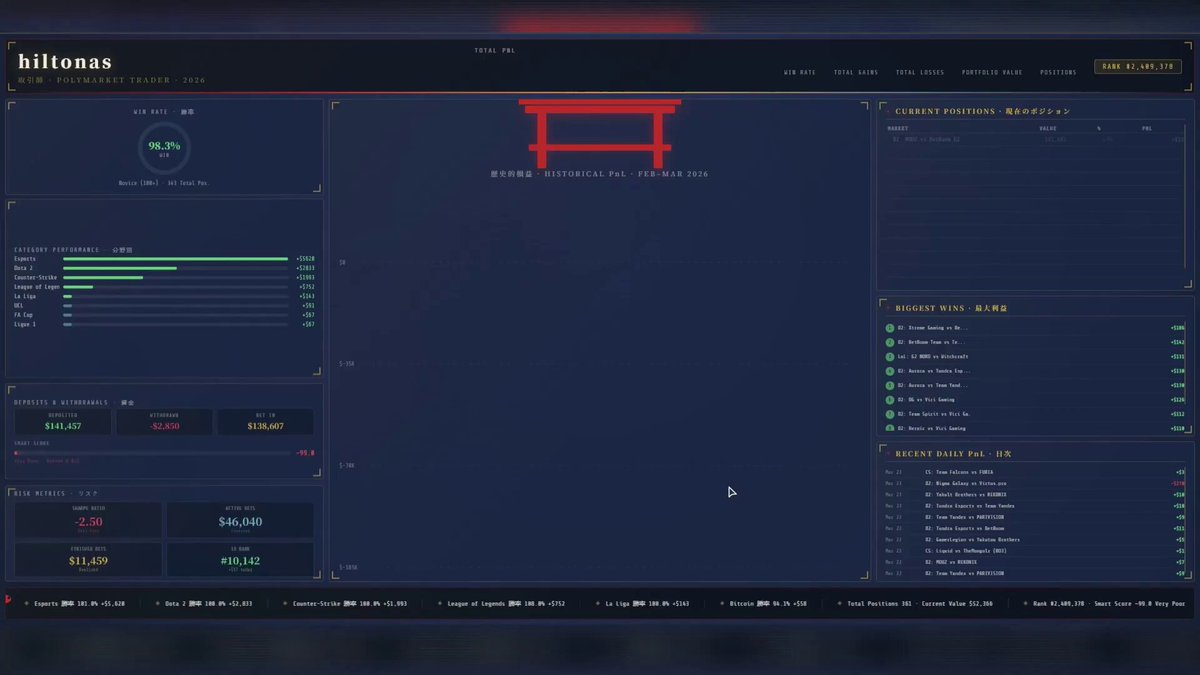
$138,607 deposited. 361 positions. 98.3% win rate.
The laugh stopped.
Here's the edge:
Polymarket esports markets misprice game-level outcomes constantly. Not match winners - game winners.
Game 2 of a BO3 after Game 1 already played. The crowd bets emotion. The line doesn't adjust fast enough.
The formula is simple:
If P(team wins Game 2 | lost Game 1) is underpriced vs historical BO3 data → size in. wait. collect.
Most people bet match winners like a sportsbook. Wrong product.
The real money is in map/game markets with stale lines.
> Dota 2: Aurora vs Team Yandex. Game 2 Winner. Invested $130,000. Realized $130.
> LoL: G2 NORD vs Witchcraft. Game 2 Winner. $121,231 in. $129.
> CS: TheMongolz vs 3DMAX. Match Winner. $106,474 in. $107.
> Dota 2: Team Spirit vs Vici. Game 2 Winner. $100,000 in. $100.
> Dota 2: Xtreme Gaming vs BetBoom. Match Winner. $94,120 in. $94.
361 positions. 98.3% win rate. $6,430 total gains vs $90,314 losses on bad sizing.
The sizing is what kills you - not the picks. The picks print. The position size is the only unsolved variable.
He asked if he could Venmo me $500 to manage.
I said watch the Dota match instead.
1
9
149
Someone on Reddit asked how SBet365 made $141k on Polymarket with only 3 trades.
I checked the receipts.
It's stupider and smarter than you think.
$25,090 deposited. $166,710 withdrawn. Net pulled out: $141,620.
Three predictions. That's the entire account history.
January 3rd, 2026. SBet365 buys "Maduro out by January 31?" Yes. At 11.3 cents. $9,999.96 in.
Same week. Buys "Maduro out by February 28?" Yes. At 18.3 cents. $15,089.90 in.
January 13th. One more bet: "Khamenei out as Supreme Leader by January 31?" Yes. At 20 cents. $4,000 in.
Maduro resolved Yes on both.
January win: $88,433.
February win: $82,276.
Total: $145,620 on $25,000 deployed.
Khamenei didn't resolve. $4,000 gone.
Net: $141,619.92.
Here's the math nobody's writing about.
11.3 cents on "Maduro out" implies the market gave it an 11.3% chance. SBet365 thought it was higher. Significantly higher. He wasn't predicting - he was finding a number he disagreed with and sizing into the disagreement.
$10,000 at 11 cents. If right: $88,400. If wrong: $10,000 gone.
Expected value only works if your probability estimate is better than the market's. His was.
2 wins. 1 loss. $141,620 net.
Most Polymarket traders diversify across dozens of markets to manage variance.
SBet365 did the opposite. He found one mispriced geopolitical event, sized in twice at different expiries, and walked away.
Concentration isn't reckless when the edge is real. It's just uncomfortable. Most people can't hold it.
The account has $0 in open positions. No active trades. He logged on, made three bets on one thesis, pulled $141k, and left.
That's not a strategy. That's a conviction.
5
29
364
My dad walked in while I was checking Haneda airport readings at 11pm.
"You're betting on weather?"
$50 → $21,338 in five months. I showed him the account.
He didn't say anything for a while.
The setup nobody talks about: Polymarket weather bins misprice constantly because the market is thin and most traders think it's too small to bother.
That's the gap.
Here's the math that prints:
Three forecast models - ECMWF, GFS, ICON - run independent physics simulations.
When all three agree within 1°C, the atmosphere is stable. Predictable. Tradeable.
Consensus = 1 − σ(T_ECMWF, T_GFS, T_ICON) / T̄
Above 0.97: full position. Between 0.90–0.97: reduced size. Below 0.90: walk away.
Then the sum check. Every temperature event's bins should add to 100 cents.
They often don't.
When your selected bins total below 96 cents, you don't need to be right about which bin hits.
You just need one of them to.
Seoul example: 11°C at 25c 12°C at 27c 13°C at 14c = 66 cents total.
That's 34 cents of structural slack. Not prediction. Arbitrage.
Then EV = Σ P_i × (100 − C_i) − Σ P_j × C_j
Plain English: weighted wins minus weighted losses. If it's above 0.10 per dollar deployed, you have an edge. Below that, skip.
Last piece: never market order. Ever.
Paying ask instead of mid on three bins destroys 80 cents of edge before the trade breathes.
Set limits. Fill or skip. That's the whole discipline.
Meanwhile a handful of accounts are compounding 40% monthly on whether Seoul hits 12°C on a Tuesday.
The models are free on Windy. com. The Python runs on a laptop. The API is public.
The only thing between a $3 bet and a structural edge is thirty minutes of math most people won't do.
My dad asked if he could try it.

7
1
26
1,822
My girlfriend asked why I had 47 browser tabs open at 2 am.
"Bitcoin price markets."
She laughed.
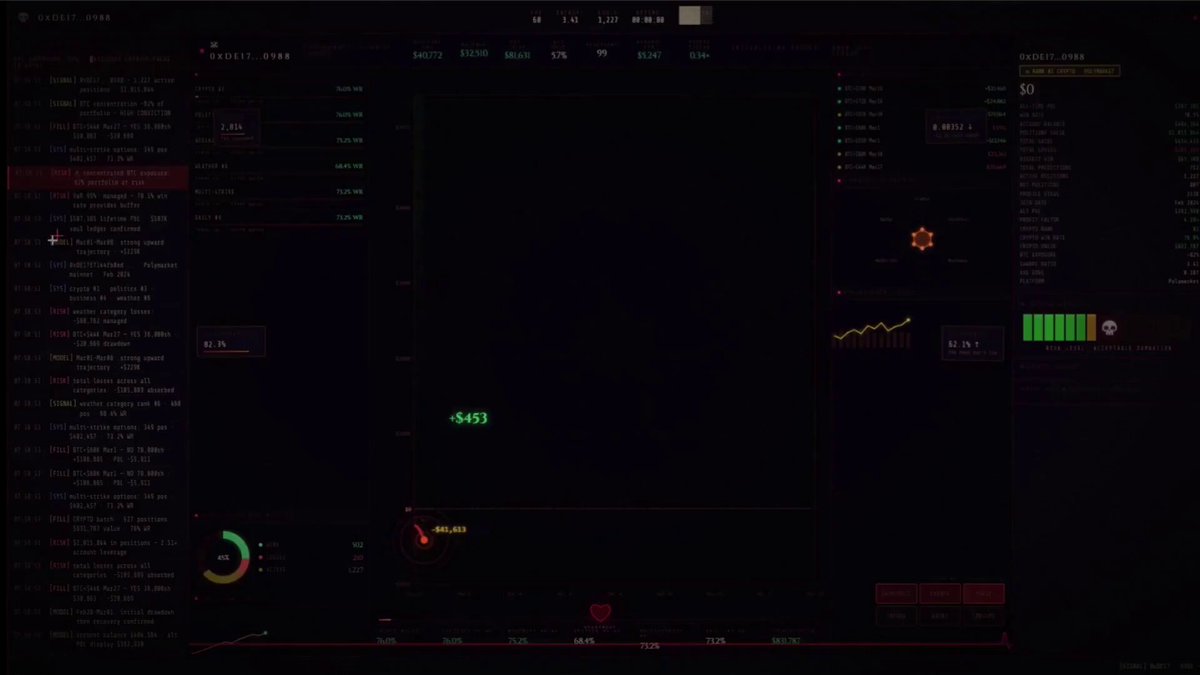
I showed her the account. $392,930.53. All-time.
She stopped laughing.
Here's what 0xdE17...0988 actually does. No bots. No AI. No secret data feed.
He trades Bitcoin bin markets on Polymarket. Short-dated. Specific price levels.
"Will Bitcoin dip to $65,000 in March?" Yes or No.
That's it. That's the whole product.
$0 → $392,930 since February 2026. 712 predictions. 70.5% win rate.
The edge isn't prediction. It's structure.
Bitcoin bin markets on Polymarket price "No" on deep out-of-the-money levels at 43–76 cents. But the true probability is 85–95 cents. The market consistently underprices certainty on extreme moves.
He buys the mispriced No.
"Will Bitcoin dip to $60,000 in March?" No at 76.5 cents. Current: 85.5 cents. $36,965 position. Up 11.76%.
"Will Bitcoin reach $80,000 in March?" No at 62.6 cents. Current: 77.5 cents. $28,158. Up 23.73%.
The pattern: find the bin that requires a violent, directional move to resolve YES. Buy No when the market is pricing that move at more than a 20-cent discount to reality. Size in. Wait.
The proof:
– "What price will Bitcoin hit in March?" single position. $76,153. Largest single win.
– "Bitcoin above ___ on March 4?" $32,903.
– "Bitcoin price on March 2?" $30,099.
– "What price will Bitcoin hit on March 1?" $22,215.
– "Bitcoin hit March 9–15?" $21,480.
712 trades. 70.5% win rate. $507,185 total gains. $102,621 total losses. Net: $404,564.
Most crypto traders swing-trade spot or perps. They need the price to move in their direction, on their timeline, by their magnitude.
This account needs the price to not do something absurd.
That's a different game. Easier game. The market just hasn't priced it that way yet.
The $1,015,844 in current open positions is the part nobody's talking about.
He's not taking profit. He's compounding into the next set of bins.
Patience isn't a personality trait here. It's the position.
4
19
257
$49 → $9,002. No alpha. No guru. Just math.
Most prop traders ask the wrong question.
Not "does my strategy make money?"
The right one: "what is my net expected value across the entire challenge lifecycle?"
Different question. Different game.
Here's the equation nobody talks about:
NEV = P(pass) × E[payout] − E[total fees]
TopStep 50K. $49 challenge fee. 40% pass rate. $9,000 average payout. $300 average cost to get funded.
Net expected value: $8,600.
But that number is fiction until you understand what actually controls your pass rate.
It's not your entries. It's not your indicators. It's this:
Win rate × reward − (1 − win rate) × risk
Two numbers. That's it.
And here's the result nobody expects from the Monte Carlo -
A 75% win rate / 0.33 RR strategy passes the challenge roughly twice as often as a 20% win rate / 4:1 RR strategy.
Identical expected value per trade. Completely different pass rates.
The reason is variance.
High RR strategies blow up barrier problems. One bad run. Lower barrier. Done.
The challenge isn't a trading account. It's a call option.
Your downside is capped at $49. Your upside is real, withdrawn cash.
Payoff(x) = max(x, 0) − C
That's a convex structure. That's why a zero-alpha strategy can still print positive expected value.
Marcus traded manually for two years. Lost $14,000 across three firms.
Not bad entries. Bad geometry.
He switched to a 70% win rate / 0.67 RR bot. Opening range breakout. NQ futures. 4:47 AM.
Day 9. Challenge passed. Fee: $49. First payout: $9,200.
He hasn't watched a trading YouTube video since.
The full simulation is in the article. 100,000 runs.
Optimizer sweeps every fair-game RR combination. Copy-pasteable. numpy and pandas. Runs on a $5 VPS.
87.6% of prop traders never calculate their expected value before buying the challenge.
The math isn't hidden. The code isn't proprietary. The formulas are on Wikipedia.
The edge is that almost nobody does the arithmetic.
Read the full breakdown →
5
16
220
Polymarket is targeting a $20 billion valuation.
and you’re still waiting for a "points program" to start trading?
Opinion just launched at a $300M FDV. Point farmers took the airdrop, and TVL crashed 85% instantly.
Polymarket knows this. The team already confirmed a retroactive $ POLY drop. No seasons. No points. Just rewards for genuine volume.
The biggest airdrop of the year is hiding in plain sight.
Trade today's $500M interest rate event, or focus on pure BTC (one trader just made $247k in two weeks).
Stop waiting. Start participating.

6
32
854
He earned enough for a new Tesla Model S with just one prediction
In just two weeks and with a single bet, he managed to earn enough for a new car
All he did was bet $137k that crude oil would hit $100 by the end of March
If he keeps up this pace, he’ll earn $1 million in 157 days
And what have you achieved in your life??
3
21
237
This trader might claim he’s always right (almost)
His win rate is 94%
PNL: $48k
He made $22k on a single trade regarding U.S. strikes on Iran
His strategy is too dumb to work. somehow keeps working.
He simply buys 100% positions at 95–98 cents and pockets the 4.5–2% spread.
Using this strategy, he earned enough for a used 2021 BMW X7 in two weeks
Why haven’t you tried this strategy yet?
3
24
641