
Building on @hyperliquidx - @liquidterminal
Joined November 2017
- Tweets 2,006
- Following 4,856
- Followers 3,532
- Likes 30,152
398 Photos and videos



Pinned Tweet

23 Oct 2025
Hyperliquid: The Decentralized Nasdaq
Financial infrastructure is evolving. While Nasdaq pioneered electronic trading and orderbook technology, Hyperliquid takes the next step: a neutral, permissionless protocol layer where anyone can build, list, and trade. Same efficiency, different architecture.
Think of it as the TCP/IP of finance—infrastructure so fundamental that everything else gets built on top.
What is Nasdaq?
Before we talk about why Hyperliquid is better, let's understand what Nasdaq actually does:
Nasdaq is a platform that provides:
• Spot market for stocks (buy and own shares of companies)
• Infrastructure for trading (orderbooks, matching engine, clearing)
• Listing process for companies (IPOs, standards, compliance)
• Derivatives market via partners (futures, options through CME)
The limitation? Everything lives under one roof. The protocol, the listing, the access, the frontend, the compliance, all controlled by a single entity. This creates:
• Single point of failure
• Easy censorship (governments can force delistings)
• Centralized control (regulatory pressure can force delistings)
• No competition on UX (one interface for all users)
• Bundled pricing (can't separate infrastructure costs from compliance costs)
Enter Hyperliquid: The Modular Financial Stack
Hyperliquid takes a radically different approach by separating the protocol layer from the application layer.
The Protocol Layer (Permissionless Infrastructure)
HYPERLIQUID L1 (HyperCore)
• Native orderbooks (200k orders/sec)
• Matching engine (on-chain)
• Margin system (cross isolated)
• Liquidation engine
• 0.2s median latency
Permissionless • Neutral • 24/7
What lives on the protocol:
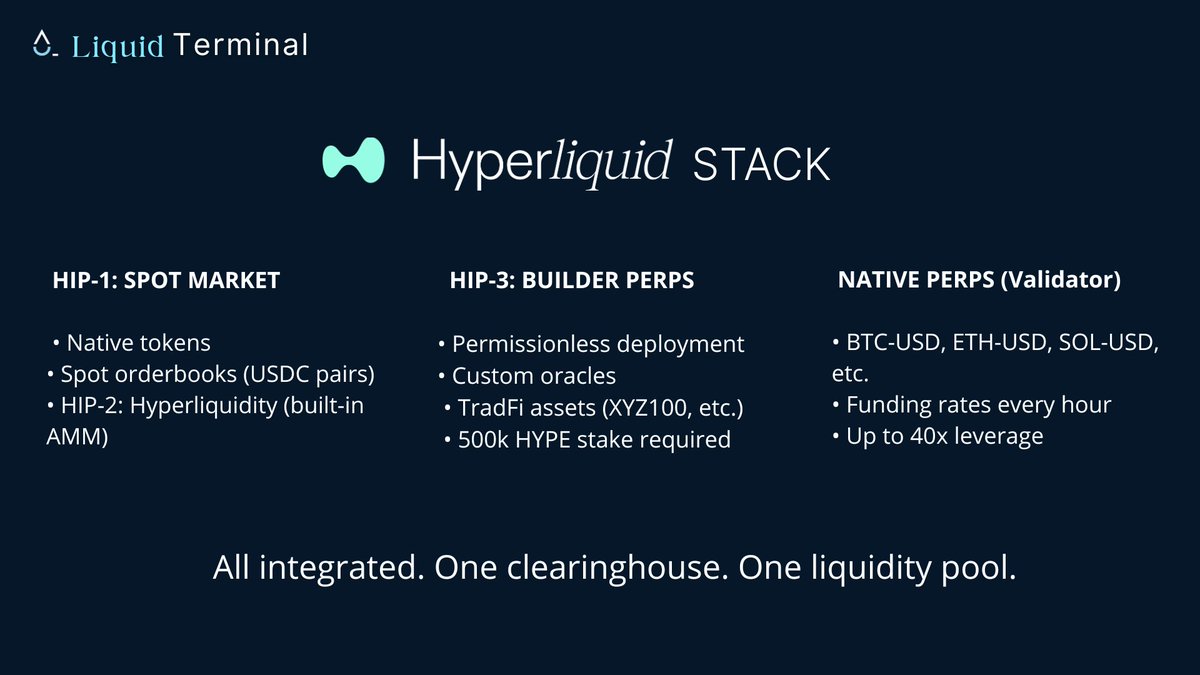
• HIP-1: Spot tokens (like stocks, but tokenized)
• Native perps: BTC-USD, ETH-USD, SOL-USD, etc.
• HIP-3: Builder-deployed perps (anyone can list derivatives)
What doesn't:
• KYC/AML enforcement
• Token filtering or censorship
• Frontend interface
• User onboarding
The Application Layer (Competitive Frontends)
Frontends compete on:
• User experience (UX/UI)
• Fee structure (builder codes)
• Compliance level (KYC vs no-KYC)
• Target audience (institutions vs retail vs niche communities)
• Features (AI trading assistants, social trading, gamification)
Why This Changes Everything
1. True Permissionlessness
Nasdaq: Need approval from Nasdaq Inc. to list. Expensive ($50k-$500k in fees), slow (months), and requires meeting strict standards.
Hyperliquid: Anyone can list via Dutch auction.
• HIP-1 tokens: 500 HYPE auction every 31 hours
• HIP-3 perps: First 3 assets free, then 500 HYPE auction
• No gatekeepers, no approval process, no lobbying needed
Example: Want to create a spot for your niche community token? Just win the auction and deploy. Done.
2. Censorship Resistance
Nasdaq: Can delist assets based on regulatory pressure, compliance issues, or internal decisions. Once delisted, trading stops entirely.
Hyperliquid: Once deployed, tokens and perps stay on-chain forever. The protocol is neutral—it doesn't care what you list or who you are.
Important distinction: Frontends can choose to hide certain tokens from their interface, but the tokens remain tradeable on-chain. This is like how Gmail can filter emails, but the email protocol (SMTP) doesn't censor content.
3. Separation of Compliance and Infrastructure
This is the genius move that makes Hyperliquid scale to billions of users.
Traditional model (Nasdaq):
• Protocol Compliance = One package
• Everyone must KYC → High friction → Excludes billions
Hyperliquid model:
Protocol (neutral) ≠ Compliance (optional at frontend level)
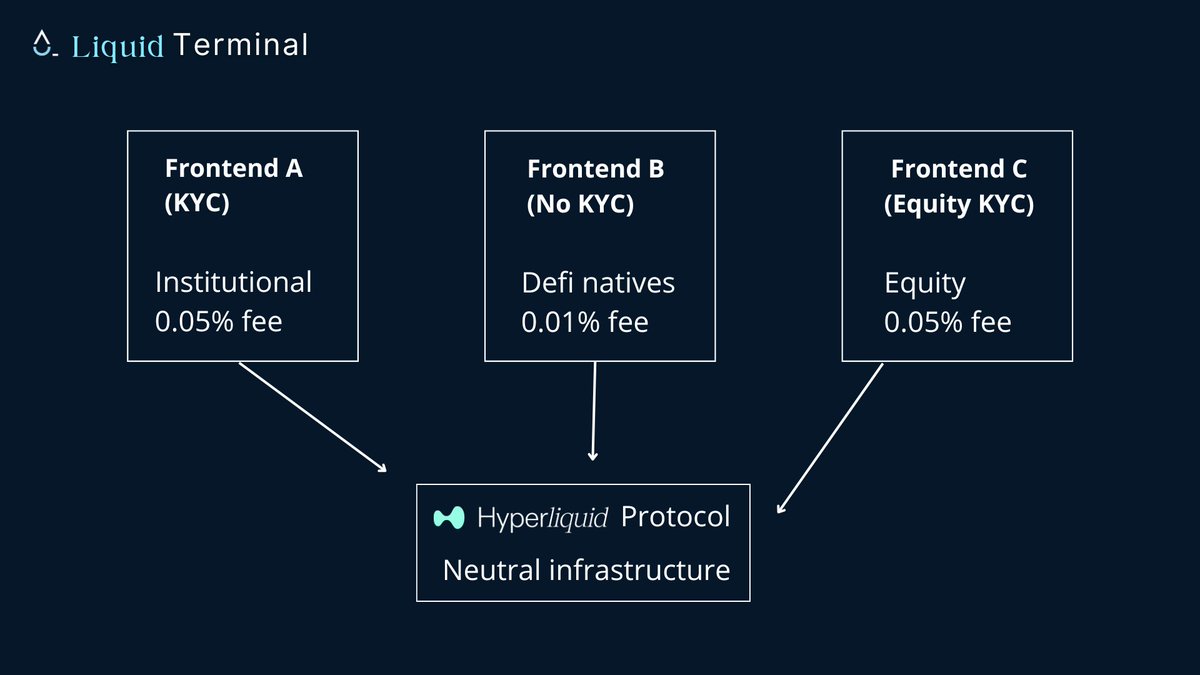
Frontend A: Strict KYC → Institutional users
Frontend B: No KYC → DeFi natives
Frontend C: Light KYC → Retail users
Same infrastructure, different compliance levels
Why this matters:
• Institutions can use compliant frontends (satisfies regulators)
• DeFi natives can use permissionless frontends (preserves decentralization)
• Everyone trades on the same liquidity pool (network effects)
4. 24/7 Global Markets
Nasdaq:
• Trading hours: 9:30 AM - 4:00 PM EST
• Monday-Friday only
• Closed on holidays
• Extended hours available but with low liquidity
Hyperliquid:
• 24/7/365
• No holidays
• No "market closed" (even for TradFi assets like XYZ100)
• Same liquidity at 3 AM as at 3 PM
Innovation: XYZ Perps
XYZ100 (Nasdaq-100 index perp) trades 24/7 even when US equity markets are closed. How?
Internal pricing mechanism:
• When external markets are open: Uses Pyth oracle (CME futures data)
• When external markets are closed: Uses 8-hour EMA of mark price orderbook impact price
• Smooth transition when markets reopen
This is revolutionary. You can trade exposure to Apple, Microsoft, Tesla at 2 AM on a Sunday. No other platform offers this.
5. Builder Ecosystem via Builder Codes
Nasdaq: Limited or no revenue share with third-party interfaces. If you build a trading app that routes orders, you typically make money from subscriptions or payment-for-order-flow, not direct fee sharing from the
exchange
Hyperliquid: Builder codes let frontends earn a percentage of trading fees.
How it works:
// User trades 100,000 USDC notional
// Base fee: 0.045% = $45
// Builder code: 0.02% = $20 to frontend
// Net user fee: 0.065%
// Frontend earns revenue directly from facilitating trades
This creates a flywheel:
1. Better frontends attract more users
2. More users = more volume = more revenue for frontend
3. More revenue = more resources to improve UX
4. Better UX = more users (repeat)
Result: Explosion of innovation at the application layer. We'll see hundreds of specialized frontends, each optimizing for different use cases.
6. Complete Market Stack
Hyperliquid isn't just spot or just derivatives—it's everything.
Nasdaq ecosystem:
• Nasdaq: Spot stocks
• CME: Futures and options (separate entity)
• CBOE: More options (another separate entity)
7. Performance That Matches (or Beats) CEXs
Hyperliquid benchmarks:
• Throughput: 200k orders/second (current), millions planned
• Latency: 0.2s median, 0.9s p99 (comparable to major CEXs)
• Finality: 1 block (<1 second)
• Uptime: 99.9%
All of this, fully on-chain. No off-chain orderbooks, no trusted intermediaries, no shortcuts.
8. Composability with DeFi
Nasdaq: Walled garden. If you want to build something that uses Nasdaq data or infrastructure, you need expensive licenses and permissions.
Hyperliquid: Open protocol. HyperEVM lets you build anything:
Examples:
• Lending protocols that use Hyperliquid spot prices for liquidations
• Automated trading vaults that rebalance based on funding rates
• Prediction markets that settle against Hyperliquid perp prices
• Social trading platforms where you copy top traders
All permissionless. No approval needed.
Real-World Example: XYZ Perps
XYZ is the first HIP-3 deployment, and it's already proving the model works.
XYZ100 (Nasdaq-100 Index Perp):
• Tracks the top 100 non-financial companies on Nasdaq (AAPL, MSFT, NVDA, TSLA, etc.)
• Uses Pyth oracle for CME futures prices
• Converts futures to spot using cost-of-carry model
• 24/7 trading even when US equity markets are closed
• Isolated margin only (for now)
Why this matters:
• First decentralized way to get 24/7 exposure to US equities
• Proof that TradFi assets can trade on-chain with robust pricing
• Opens the door to thousands more TradFi perps (individual stocks, commodities, forex, indices)
What's next for XYZ:
• Individual stock perps (AAPL-USD, TSLA-USD, NVDA-USD)
• More indices (S&P 500, Dow Jones, Russell 2000)
• International equities (Nikkei, DAX, FTSE)
• Commodities (gold, oil, natural gas)
Why Hyperliquid Wins: The TCP/IP Analogy
What TCP/IP did for the internet:
• Created a neutral protocol layer (anyone can send packets)
• Enabled permissionless innovation (anyone can build apps)
• Separated infrastructure from applications (Gmail vs SMTP)
• Made the internet censorship-resistant
What Hyperliquid does for finance:
• Creates a neutral protocol layer (anyone can list and trade)
• Enables permissionless innovation (anyone can build frontends)
• Separates infrastructure from compliance (protocol vs frontends)
• Makes finance censorship-resistant
The Trilemma Solution
Traditional systems can't achieve all three:
Permissionless
▲
╱ ╼
╱ ╲
╱ ╲
╱ ╲
╱ ╲
Compliant ──────── Performant
Nasdaq:
✅ Compliant (strict KYC/AML)
✅ Performant (low latency)
❌ Permissionless (high barriers to entry)
Hyperliquid:
✅ Permissionless (protocol level)
✅ Compliant (frontend level, optional)
✅ Performant (200k orders/sec, <0.2s latency)
This is the breakthrough. By separating the layers, Hyperliquid solves the trilemma.
What This Means for You
If you're a trader:
• Access to any asset, any time, from anywhere
• Choose your frontend based on your needs (KYC vs no-KYC, fees, UX)
• Trade with confidence (all transactions on-chain, auditable)
If you're a builder:
• Free infrastructure (orderbooks, matching engine, clearing)
• Monetize via builder codes (earn fees from trades)
• Focus on product, not infrastructure
• Launch fast, iterate quickly
If you're a project:
• Permissionless listing (no gatekeepers)
• Guaranteed liquidity (HIP-2 Hyperliquidity)
• Exposure across all frontends
• No politics, just auction price
Nasdaq is a company that controls a trading platform.
Hyperliquid is a protocol that enables infinite trading platforms.
This isn't just a decentralized version of Nasdaq. It's what Nasdaq would look like if it were built from first principles in 2025, with everything we've learned about the internet, open protocols, and permissionless innovation.
The future of finance isn't one platform to rule them all. It's a neutral infrastructure layer where thousands of platforms compete to serve users better.
That infrastructure layer is Hyperliquid.
Sources:
docs.trade.xyz/about-trade-x…
hyperliquid.gitbook.io/hyper…
listingcenter.nasdaq.com/
cmegroup.com/markets/equitie…
17
35
243
20,971
Yaugourt.hl retweeted

Jun 12
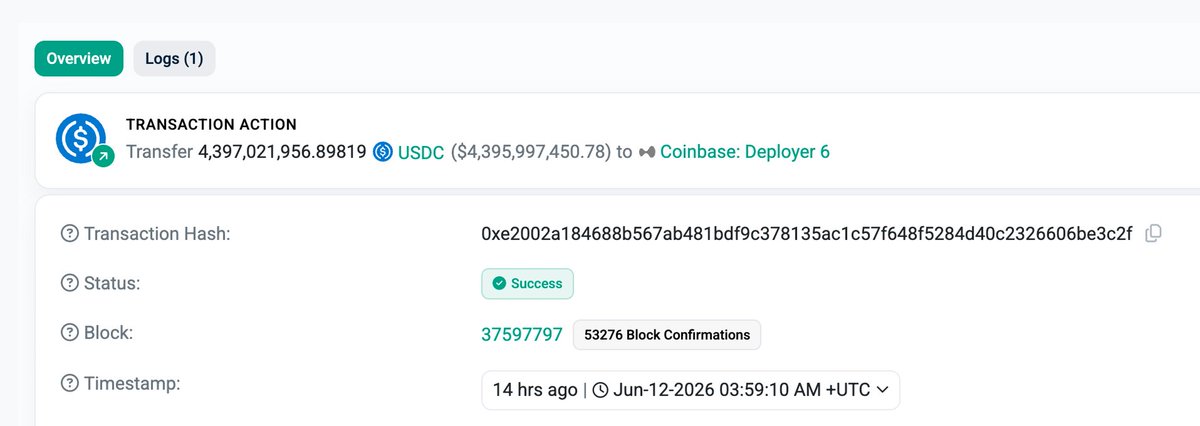
The largest USDC transfer in history.
~$4.4B sent to the Coinbase Hyperliquid deployer.
292
425
4,936
1,614,919
Jun 12
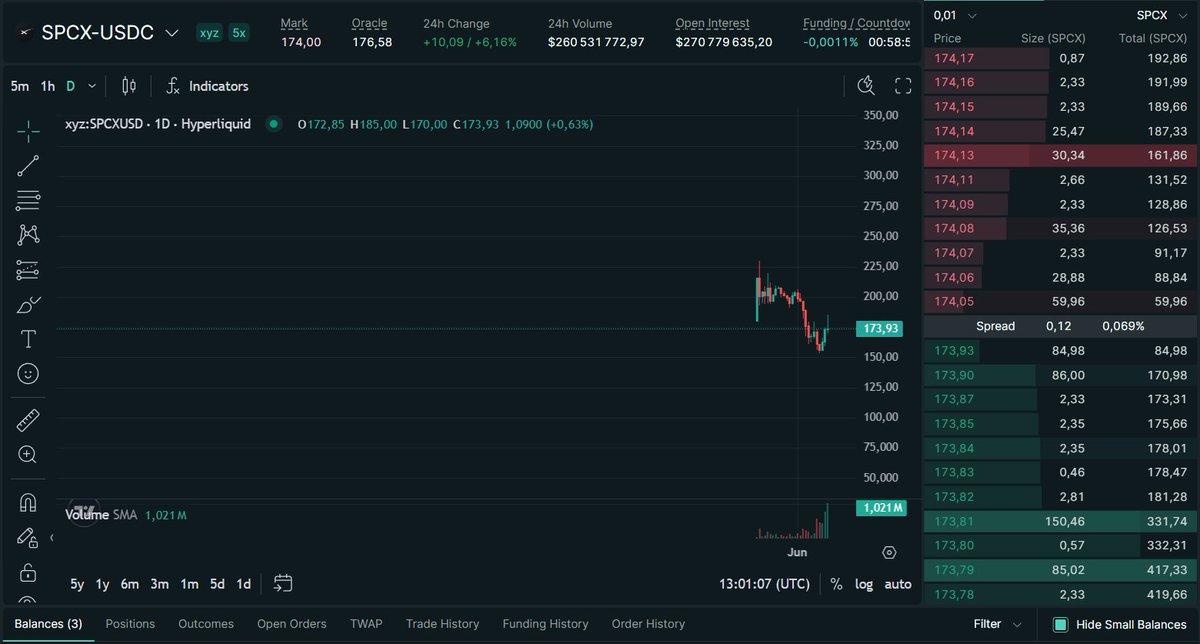
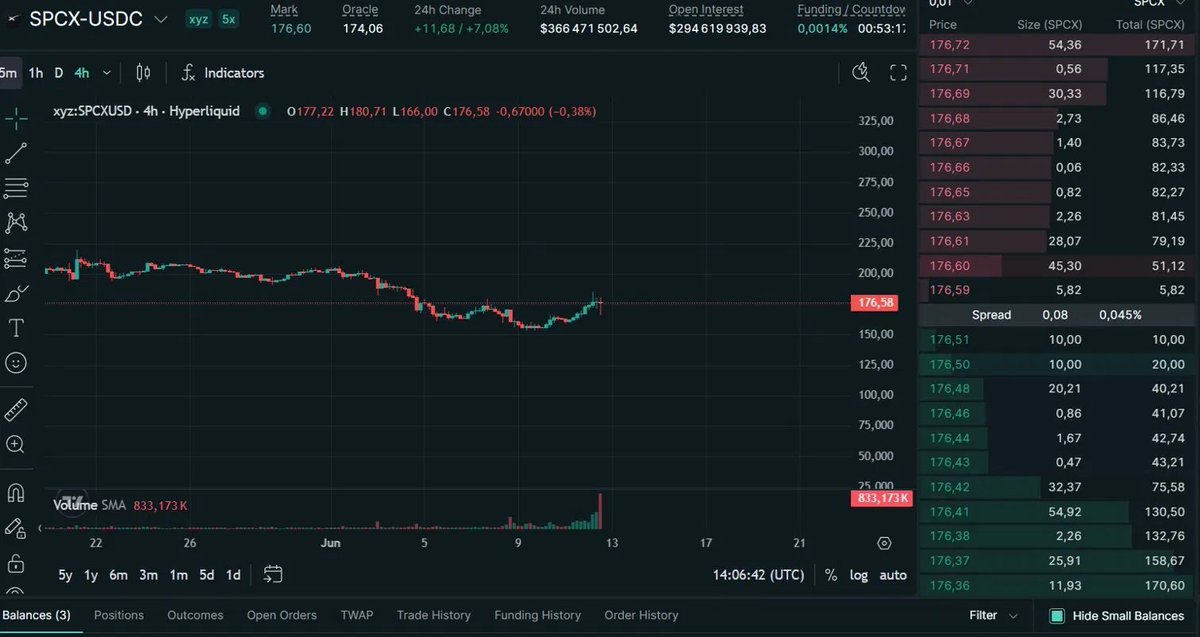
SpaceX IPO priced at $135. Nasdaq first bid at $175.
On Hyperliquid the SPCX pre-IPO perp has been trading at $170 for hours. $366M in 24h volume. $294M in open interest.
The onchain orderbook had the price before Wall Street opened the doors. Again.
@tradexyz.
Hyperliquid.
7
12
111
6,640
Jun 12
SpaceX IPO in 30 minutes. The $SPCX pre-IPO perp on @tradexyz has been live on Hyperliquid for weeks.
$254M in 24h volume. $272M in open interest. Already dwarfing $CBRS which hit $69M in 24h volume and $55M OI before its Nasdaq debut.
For reference, CBRS priced at $185, opened at $350.
Price discovery is happening onchain right now.
Hyperliquid.
5
2
92
5,138
Jun 12
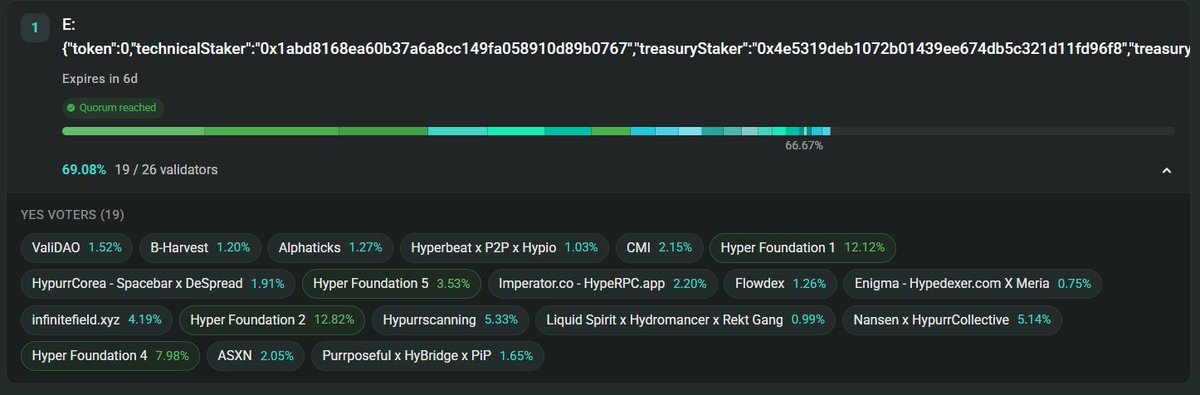
AQAv2 quorum reached. 19 out of 26 validators voted yes. 69.08%.
USDC reserve yield will start flowing to the Assistance Fund. $4B in $USDC backing hyperliquid:native buybacks starting October 3.
Hyperliquid.
13
9
141
5,113
Yaugourt.hl retweeted

Jun 11
Probably waiting on Clarity Act passage
1
1
4
360
Jun 11
The governance model on @HyperliquidX right now is underrated.
Labs ships the primitives. Validators vote on what goes live. The Foundation doesn't push its own weight, it mirrors the non-Foundation majority.
You get decentralized decision-making without slowing down the people building. Speed of execution stays with the team, final say stays with the validators.
The tradeoff is real though. It works while validator stake is concentrated enough to coordinate and honest enough not to capture a vote. USDH was the first real test of that. So far it held.
Not full on-chain governance, not core team control either. Something in between that actually ships.
Hyperliquid.
3
4
44
2,293
Jun 11
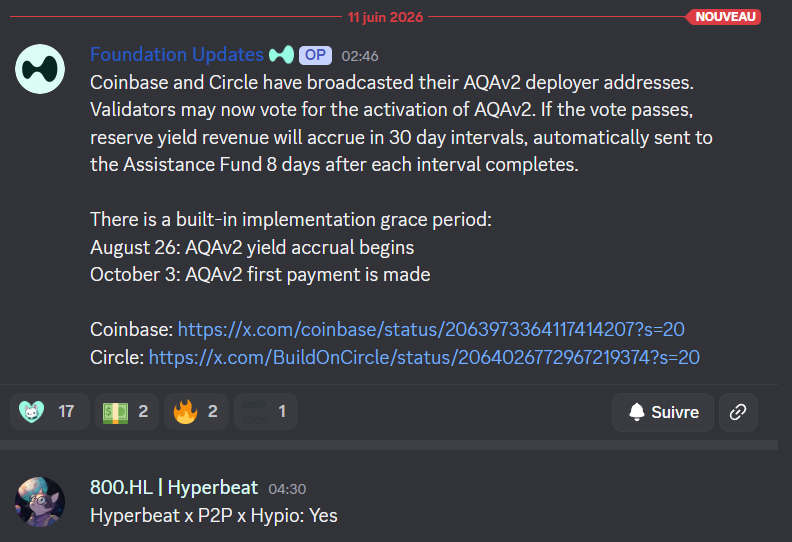
AQAv2 is live for validator vote.
Coinbase and Circle have broadcasted their deployer addresses.
If the vote passes:
August 26: yield accrual begins
October 3: first payment hits the Assistance Fund
$5B in $USDC. 90% of reserve yield flowing to buybacks. The countdown starts now.
Hyperliquid.
15
23
237
27,103
Jun 11
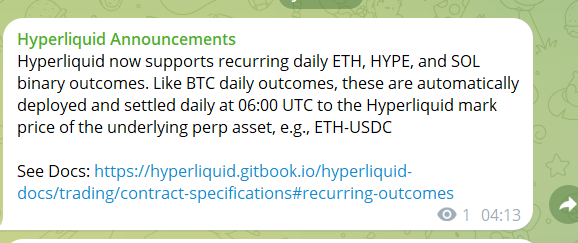
HIP-4 expanding.
Recurring daily binary outcomes now live for ETH, HYPE, and SOL. Automatically deployed and settled at 06:00 UTC to the Hyperliquid mark price.
BTC was first. Three more assets added. The onchain prediction market infrastructure is building itself out quietly.
Hyperliquid.
5
3
64
3,179
Yaugourt.hl retweeted

Jun 10
8
4
54
2,037
Jun 9
Hyperliquid is the AWS of liquidity and the Shopify of financial products.
Infrastructure anyone can plug into, markets anyone can deploy.
Hyperliquid.
Jun 9

Hyperliquid perps are now live on near.com.
Deposit any asset from 35 chains directly into @HyperliquidX to access 50 markets with up to 40x leverage.
What’s next: confidential perps. Today is step one. 🧵
5
5
70
4,472
Yaugourt.hl retweeted

Jun 9
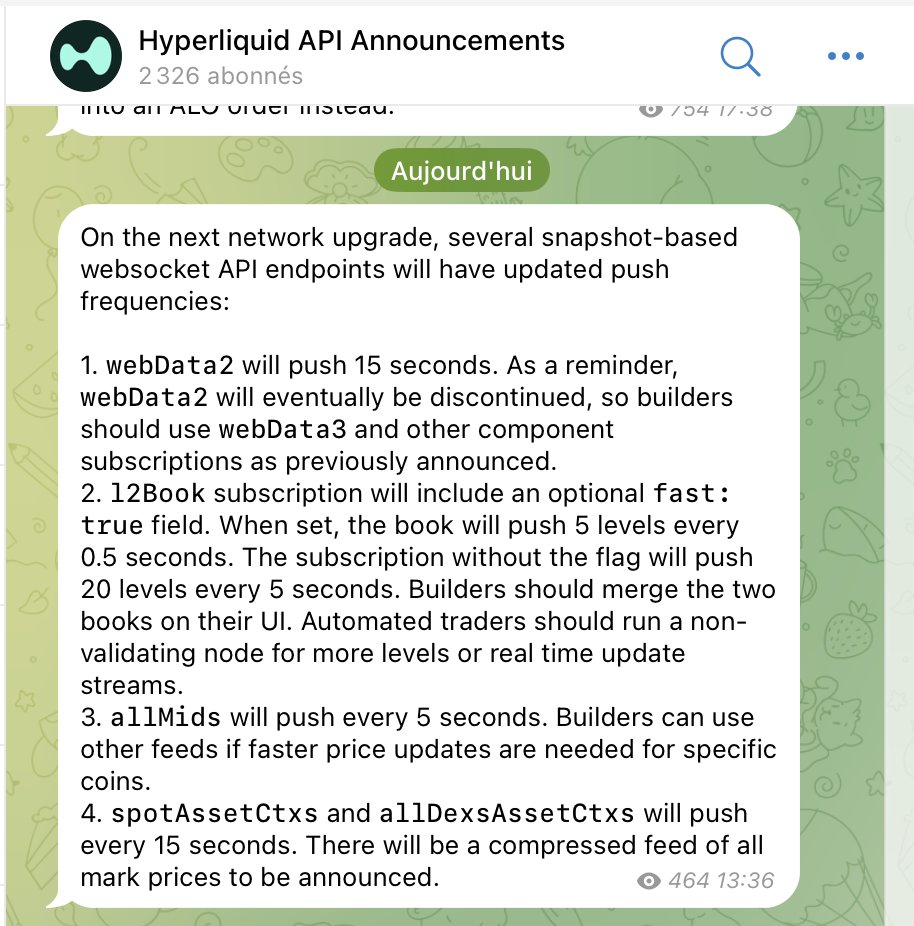
With the upcoming Hyperliquid API changes, having the right infrastructure matters more than ever. ⚡️
That’s exactly why we built Hypedexer:
• Ultra low-latency market data
• Reliable real-time streams
• Infrastructure designed for builders & traders
• Scalable APIs that keep up with demand
And for everyone joining the ecosystem:
🎁 5000 free credits for all new users.
Build faster. Trade smarter. Stay ahead. 🫡
#Hyperliquid #HYPE #DeFi #TradingAPI #WebSocket
2
2
6
610
Jun 9
Next pre-IPO @sershokunin?
Hyperliquid.

We recently submitted a confidential S-1. We expect it to leak so we’re just announcing it. We have not decided on timing yet; it may be a while because there are things we want to do that are likely easier as a private company. But it’s a complicated set of tradeoffs and this gives us the option to go public sooner if that ends up being best.
This announcement is being made pursuant to Rule 135 under the Securities Act of 1933, as amended, and does not constitute an offer to sell or the solicitation of an offer to buy any securities. Any offers, solicitations of offers to buy, or any sales of securities will be made in accordance with the registration requirements of the Securities Act.
2
45
4,356
Jun 8
Jun 8

Coinbase is now the official deployer of @HyperliquidX's USDC treasury wallet.
We will be activating AQAv2 from the two addresses below:
0x4E5319dEb1072B01439EE674db5C321d11fd96F8
0xc20699185c15D0a2fD65779BB5d69f5b0B113c00
2
33
1,707
Yaugourt.hl retweeted

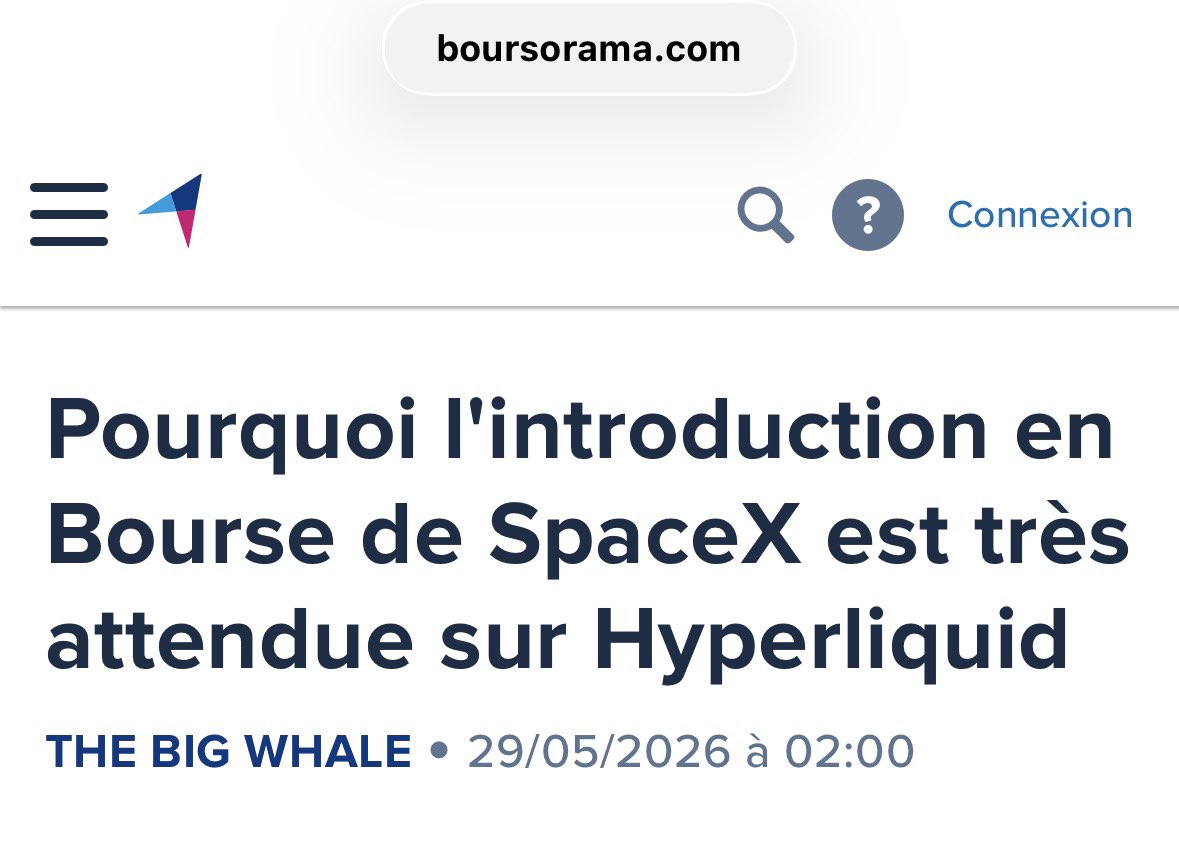
Did mom just sent me an article about Hyperliquid ?
Bullish mom

8
2
71
6,984
Jun 7
HIP-3 is past 35% of all Hyperliquid volume. 23 of the top 30 pairs are HIP-3 markets.
@tradexyz alone holds 90% of HIP-3 OI. equities, commodities, indices, all live, all permissionless.
The decentralized Nasdaq is shipping in volume share.
Hyperliquid.
8
5
77
5,302
Yaugourt.hl retweeted

Jun 5
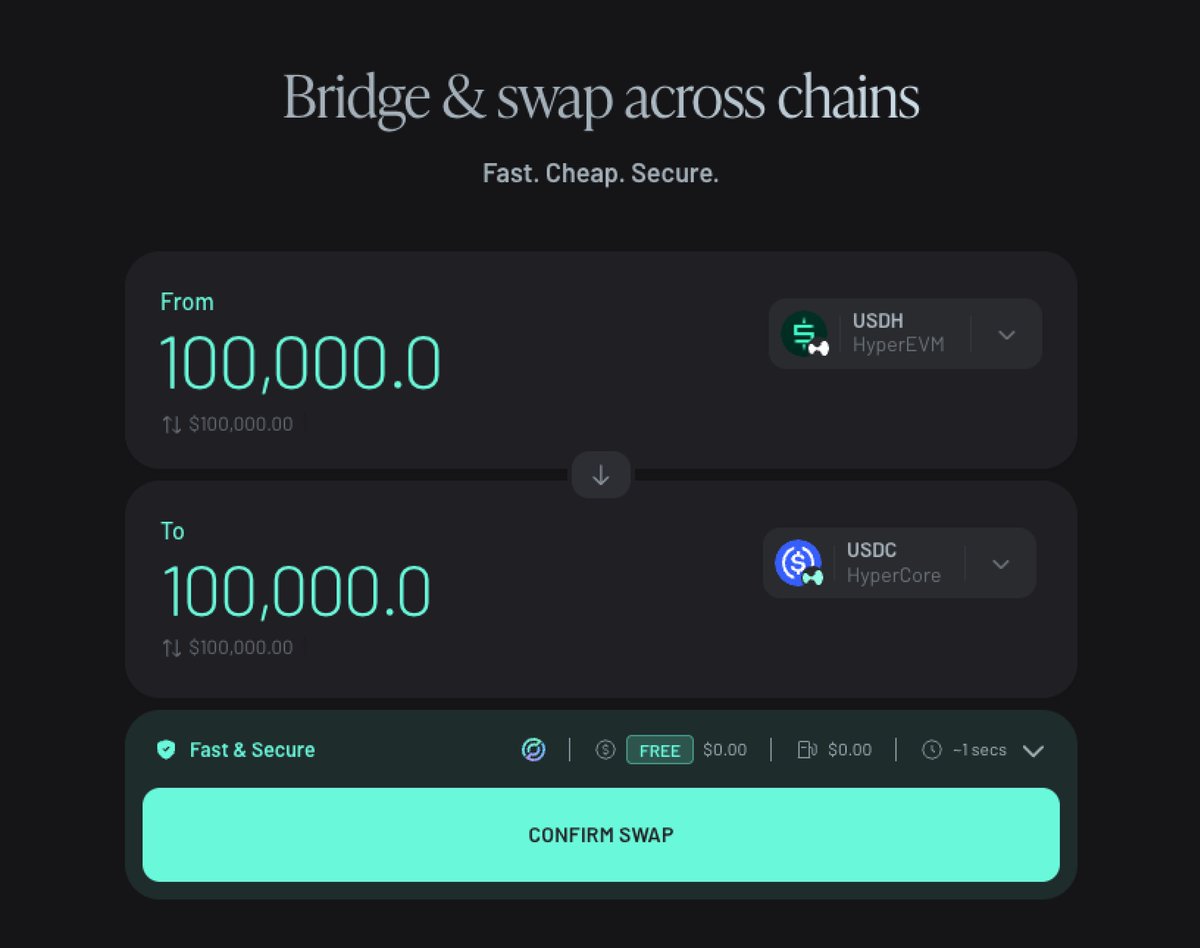
To support the USDH sunset process, users may now redeem USDH on HyperEVM 1:1 to USDC on HyperCore with no fees via @AcrossProtocol
Please convert any remaining USDH you may have.
7
17
83
14,423
Jun 5
What @BL_labs_xyz built is a blueprint for any country that regulates perps: KYC local registration fiat rails in/out split-key custody on top of HL's order book.
The insight most miss: in restrictive jurisdictions the barrier was never the tech, it's compliance.
A registered, non-custodial router is exactly what bridges regulated users to the deepest onchain liquidity through a legal route, instead of pushing them into a grey area.
This is the template. Wrap the world's best order book in a compliant local layer, and you bring an entire country onchain through the front door.
Hyperliquid.

4
5
50
5,961
Jun 5
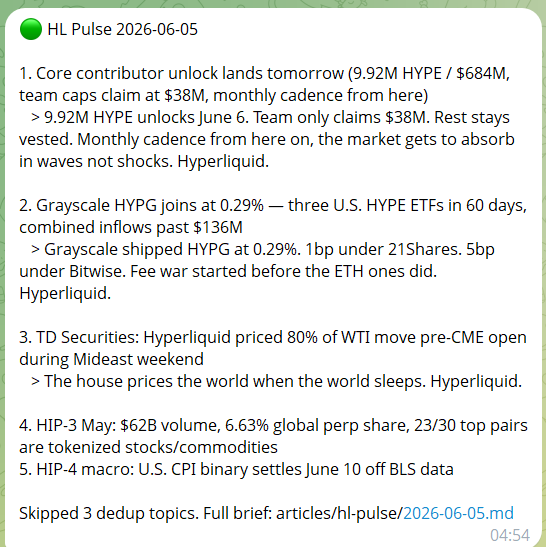
Daily HL Pulse from my AI agent using @aeonframework. One day I'll show the full setup.
Core contributor unlock today. 9.92M $HYPE ($684M). Team caps claim at $38M. Monthly cadence from here. Waves, not shocks.
@Grayscale HYPG live at 0.29%. Three US HYPE ETFs in 60 days. Combined inflows past $136M.
TD Securities report: @HyperliquidX priced 80% of the WTI move before CME opened during the Mideast weekend.
HIP-3 May: $62B in volume. 6.63% global perp share. 23 of the top 30 pairs are tokenized stocks and commodities.
Hyperliquid.
4
3
32
2,781
Yaugourt.hl retweeted
Jun 5
Hypedexer will be there 🇦🇪
Excited to meet the builders shaping the Hyperliquid ecosystem and celebrate the start of Hyperliquid summer ☀️
See you in Dubai habibis !
May 29

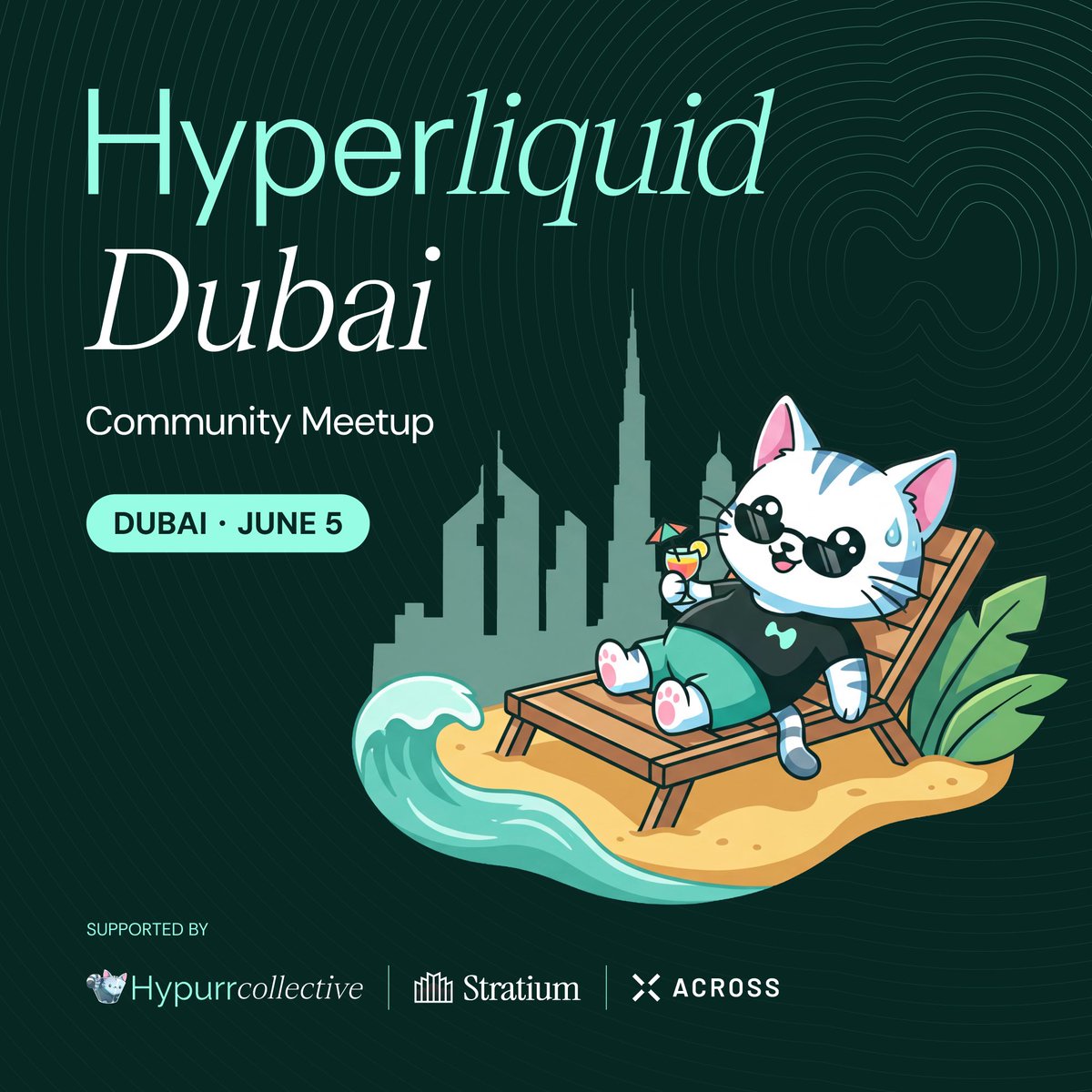
Hyperliquid habibis 🇦🇪
Dubai - June 5
Hyperliquid summer is here and $HYPE just printed a new ATH. We organized a chill HL meetup to celebrate this and all the ATHs coming after. Come thru!
Supported by @hypurr_co @StratiumX @AcrossProtocol
Sign up: luma.com/bhcsa4ke
1
1
6
518