
Privacy-first Custom AI Experience with Personality
Joined January 2025
- Tweets 211
- Following 76
- Followers 132
- Likes 1,349
11 Photos and videos

Your Own AI retweeted
It's only a matter of time that there is Fable capabilities on your desktop. Most likely within a year.
It's only ba matter of until Fable capabilities are on a phone. Maybe 2 years?
Banning tech doesn't stop it, but it does waste time and resources for the transition to a world where the "dangerous" Fable is yesterday's tech.

The US government crackdown on Anthropic’s Claude Fable 5 and Mythos 5 hides a glaring truth: AI models with advanced hacking capabilities will soon be the norm. wired.com/story/dangerous-ai…
1
2
5
132
Your Own AI retweeted

Jun 14
New version of @WeAreFlowsta Vault available to download now @ flowsta.com/vault/
There are some nice updates and a new look to match the updated website dashboard.
But also another change that gets it ready for the next Holochain app I've been working on.
It's the all-new @YourOwnAI
Some people will remember I launched a privacy-first AI cloud service last year. I knew in my heart of hearts that a privacy-first cloud service would always trust me bro.
So I built the first version of the open source desktop Your Own AI last year. But I wanted to integrate online models for up-to-date info. That's where I needed authentication, and every possible authentication move I looked at would have defeated the privacy-first nature of Your Own AI.
Apart from asking when someone is going to build what we have with Flowsta, it was this moment that tipped it over the line and made me do it.
So when we do drop the all-new Your Own AI, it will be the culmination of 9 months of working long hours for 95% of the days in that time.
It's been a massive mountain to climb, but nearly there.
Jun 14

Flowsta Vault 0.7.0 just dropped @
flowsta.com/vault/
New look, checksum added, maintenance fixes, plus an update needed for a new Holochain app coming soon.
@YourOwnAI 👀
5
15
44
1,506
Your Own AI retweeted

Jun 14
Flowsta Vault 0.7.0 just dropped @
flowsta.com/vault/
New look, checksum added, maintenance fixes, plus an update needed for a new Holochain app coming soon.
@YourOwnAI 👀
8
18
1,963
Your Own AI retweeted
Jun 13
Every government and corporation in the world has just realised they can't rely on not just US AI models, but any cloud-hosted AI model.
This decision changed the whole paying field.

I’ve seen the paper. It’s not a jailbreak. It was Defense Oriented Prompting (DOP), capabilities defenders need. My thoughts on the hasty Export Controls that made Anthropic pull Fable. If Nat defense is the goal, this just scored an own goal against us
wsj.com/tech/ai/anthropic-ha…
2
3
11
896
Your Own AI retweeted
Jun 3
I'm really excited to release 2 major Holochain apps today.
Both free, open source (MIT), and out now on Linux, Mac and Windows.
Flowsta Vault — your identity, on your machine.
Your keys and recovery phrase never leave your device; we never see them. It runs a local Holochain conductor, so just by running it, you're not only using the network — you're strengthening it. Your data stays on your machine and exports in full. You own it, not us. Never locked in.
ProofPoll - verified polls, no central control.
It's the first Holochain app built on Flowsta Vault. Real voting where one vote = one real person (sybil-resistant via your @WeAreFlowsta identity). No server to seize, no admin who can rewrite the count. It even keeps private data on a public network — encrypted client-side so only you can read it.
But here's the part I'm most excited about: ProofPoll is built to be forked.
A review site, a task tracker, a social feed — the voting bits swap out easily. The genuinely hard parts of a desktop Holochain app — conductor lifecycle, DNA migration, identity linking, and encrypted data - are all solved, commented and documented inside it. We've spent 8 months building on Holochain nearly every day, and everything we've learned is baked into ProofPoll. You don't start from a toy example — you start from real, production know-how.
So if you've ever wanted to build on Holochain, my advice is, don't start from a blank page. Clone ProofPoll, open it in Claude Code, point it at the repo our docs, and tell it what you want to build. We've watched a working app come together this way in an afternoon.
Full write-up: flowsta.com/blog/proofpoll-a…
5
31
81
2,787
Your Own AI retweeted
Jun 3
Major Holochain app launches: two desktop apps, out now — free, open source, on Mac/Windows/Linux.
🔐 Flowsta Vault — your identity, on your machine
🗳️ ProofPoll — verified voting, the first app on Vault, and built to be forked
Full story 👇 flowsta.com/blog/proofpoll-a…
1
8
27
966
Your Own AI retweeted
May 28
Spot on. Knowledge was built collectively. We’re building the alternative: Flowsta Sign It.
Holochain cryptographic proof of authorship machine-readable consent for your art and creations.
So people can actually recognize and reward your value.
1
7
12
405

do you understand what just happened to your computer..
Google Chrome secretly downloaded a 4GB AI model onto your device. Without asking.. Without telling you..
It's called weights.bin. It lives deep in your system folders. It powers Gemini Nano - Google's on-device AI.
And if you delete it? Chrome re-downloads it automatically. Like nothing happened.
Just Google deciding your hard drive is their storage unit.
At 1 billion Chrome users - that's 4 BILLION gigabytes of data pushed silently across the internet.
The carbon footprint alone equals tens of thousands of cars running for a year.
Check your disk right now:
📁 %LOCALAPPDATA%\Google\Chrome\User Data\OptGuideOnDeviceModel
To stop it: chrome://flags → disable Optimization Guide On Device Model → restart Chrome → delete the folder.
Reshare so people know what's sitting on their computers.
May 5

Google Chrome is quietly downloading a roughly 4 GB AI model to many users’ computers without clear upfront consent.
The file, called weights.bin, is part of Google’s Gemini Nano on-device language model and lands in the browser’s user data folder under OptGuideOnDeviceModel.
It powers built-in AI tools such as “Help me write,” smarter tab suggestions, on-device scam detection, and page summarization. The download triggers automatically for devices meeting minimum hardware requirements, and Chrome often replaces the files if deleted.
While the model processes data locally, installation happens in the background with minimal notification.
The scale is noteworthy. Hundreds of millions or billions of installations add up to thousands of tonnes of carbon emissions globally from data transfer, even though each is a one-time event.
To prevent or remove it, go to chrome://flags, disable the entries for the optimization guide on-device model and Prompt API, restart the browser, and manually delete the folder.
1,259
18,240
54,456
4,541,901
Your Own AI retweeted
May 8
I watched this World ID 4.0 presentation Sam Altman & co put on the other day. A few people have asked what I think, given the work I do on identity and proof of humanity. Honestly, my reaction is more layered than I thought it might be.
At face value, it actually does a lot right. Open protocol. Zero-Knowledge proofs. Biometric data that stays on the user's device. These are genuinely good design choices.
There are scenarios where what they've built could useful. Iris biometrics are strong. Hardware attested verification has anti-Sybil properties that pure software can't easily match.
But proof of humanity is too important to leave to any single scheme. There are some structural concerns I keep coming back to.
The trust chain has unverifiable links. The orb hardware and firmware are open source in design, but you can't verify the orb in front of you actually runs that source. Same shape problem as voting machines.
The app is its own version of this. The thing actually handling your biometric data on your phone isn't open source, as far as I can tell. It could be — and if it were, that would be a real step forward. Without it, you're trusting a closed binary the same way you're trusting a closed orb. And even where biometric algorithms are published openly somewhere, that doesn't help on its own. What matters is the binary you're running. Without reproducible builds and published checksums, there's no way to verify the code you can read on GitHub is the code actually executing on your device. "The algorithm is open source" is not the same as "I can verify what's running."
Issuance is centralised. Only World ID orbs issue credentials. One organisation gates humanity-as-a-credential globally. For something this load-bearing, that's a very big single point of trust - even if the team holding it has the best intentions today.
The proof is device-bound, which makes recovery brittle. Lose your phone, lose your humanity. There's no graceful path back - you have to find another orb and start over. For a system meant to be permanent identity infrastructure, that's a serious failure mode for normal users.
And one global ID creates correlation pressure even with zero-knowledge proofs. The fact that two pseudonyms share the same World ID is itself revealing. A single credential presented across services is structurally different from per-context identifiers backed by the same underlying verifications.
What I think matters more than any specific scheme is the principles. No single party should gate humanity globally, including any company, including any government, including what I do with @Holochain and @WeAreFlowsta . The user, not the issuer, should control what's revealed to whom. Recovery should be graceful, not "find another orb." And hardware attestation is a useful input, but it shouldn't be the answer.
So, where does this point? For me, proof of humanity probably shouldn't be one credential at all. It's a portfolio of signed attestations a person assembles over time from sources they trust. Peers who know them, groups they're part of, third-party verifiers, even hardware attested proofs where those make sense, and present selectively to whoever is asking. No single issuer. No centralised global ID. Recovery happens through your social graph if you lose everything.
That shape solves things a single issuer system can't. It also lets schemes like World ID slot in as one valid input among many, rather than positioning any one of them as the answer.
"Who is a human?" is one of the most important infrastructure questions of the next decade. It's too important to be answered by any one source.

World, Sam Altman's digital identity project, just unveiled World ID 4.0, what the company calls "full-stack proof of human" infrastructure.
The partner list: Tinder, Zoom, DocuSign, Shopify, Okta, AWS, and Vercel.
Altman opened by saying we're heading to a world where AI generates more content than humans. Pantera Capital says we've already crossed that threshold. World's answer is an iris-scanning device called the Orb that creates a unique cryptographic ID proving you're a real person. 18 million people across 160 countries have already verified.
Tinder is rolling out "verified human" badges in the U.S. after a Japan pilot. Zoom built a feature called "Deep Face" that verifies the person on a video call isn't a deepfake. DocuSign is adding proof-of-human checks to digital signatures. Shopify is enabling verified-human commerce.
The most significant announcement is AgentKit, infrastructure that lets AI agents carry cryptographic proof they're acting on behalf of a verified human. Okta built an agent delegation system on top of it.
The problem World is solving is real. The question is whether a centralized iris-scanning identity layer controlled by the same person whose company helped create the problem is the right answer.
Altman is the CEO of OpenAI. He built the flood. Now he's selling the ark.
5
12
31
1,535
Your Own AI retweeted
Apr 8
"we hope to open-source future versions of the model"
Just do it!!
Apr 8

Introducing Muse Spark, the first in the Muse family of models developed by Meta Superintelligence Labs.
Muse Spark is a natively multimodal reasoning model with support for tool-use, visual chain of thought, and multi-agent orchestration.
Muse Spark is available today at meta.ai and the Meta AI app. We’re also making it available in private preview via API to select partners, and we hope to open-source future versions of the model.
Learn more: go.meta.me/43ea00
3
13
356
Your Own AI retweeted
Apr 8
There's a point where there's no guard rails on AI.
Whether it's a nation state, or a kid in their bedroom. You never know where something unexpected could come from.
Anthropic drip feeding Claude Mythos is an important step in transitioning to that future.
3
16
250
Your Own AI retweeted
Apr 7
All the software we use and depend on everyday is full of security issues.
The issues have been found by Anthropics new Claude Mythos AI.
A very responsible move by Anthropic to make their new AI available in stages. Although I wish I had access now.
Apr 7

Introducing Project Glasswing: an urgent initiative to help secure the world’s most critical software.
It’s powered by our newest frontier model, Claude Mythos Preview, which can find software vulnerabilities better than all but the most skilled humans.
anthropic.com/glasswing
5
17
380
Your Own AI retweeted
Apr 2
Great to see Google's commitment to open AI with Gemma 4.
Looks like a great open model, but clearly nowhere near the latest Gemini.
Apr 2

Excited to launch Gemma 4: the best open models in the world for their respective sizes. Available in 4 sizes that can be fine-tuned for your specific task: 31B dense for great raw performance, 26B MoE for low latency, and effective 2B & 4B for edge device use - happy building!
3
7
254
Your Own AI retweeted

The government can buy your personal data, track where you go, and access your financial records, no warrant required.
Not long ago, that was illegal.
So what changed? Our new video breaks it down.
32
231
627
15,997
Your Own AI retweeted
Apr 1
We all know they've violated copyright. Nice to see it catching up on them.
The work of creators matters and they should be compensated.
Apr 1

🚨 BREAKING: OpenAI and Google are about to have a massive legal problem.
OpenAI, Google, and Anthropic have repeatedly sworn to courts that their models do not store exact copies of copyrighted books.
They claim their "safety training" prevents regurgitation.
Researchers just dropped a paper called "Alignment Whack-a-Mole" that proves otherwise.
They didn't use complex jailbreaks or malicious prompts.
They just took GPT-4o, Gemini, and DeepSeek, and fine-tuned them on a normal, benign task: expanding plot summaries into full text.
The safety guardrails instantly collapsed.
Without ever seeing the actual book text in the prompt, the models started spitting out exact, verbatim copies of copyrighted books.
Up to 90% of entire novels, word-for-word. Continuous passages exceeding 460 words at a time.
But here is the part that changes everything.
They fine-tuned a model exclusively on Haruki Murakami novels.
It didn't just learn Murakami. It unlocked the verbatim text of over 30 completely unrelated authors across different genres.
The AI wasn't learning the text during fine-tuning.
The text was already permanently trapped inside its weights from pre-training. The fine-tuning just turned off the filter.
It gets worse.
They tested models from three completely different tech giants. All three had memorized the exact same books, in the exact same spots.
A 90% overlap. It's a fundamental, industry-wide vulnerability.
For years, AI companies have argued in court that their models are just "learning patterns," not storing raw data.
This paper provides the smoking gun.
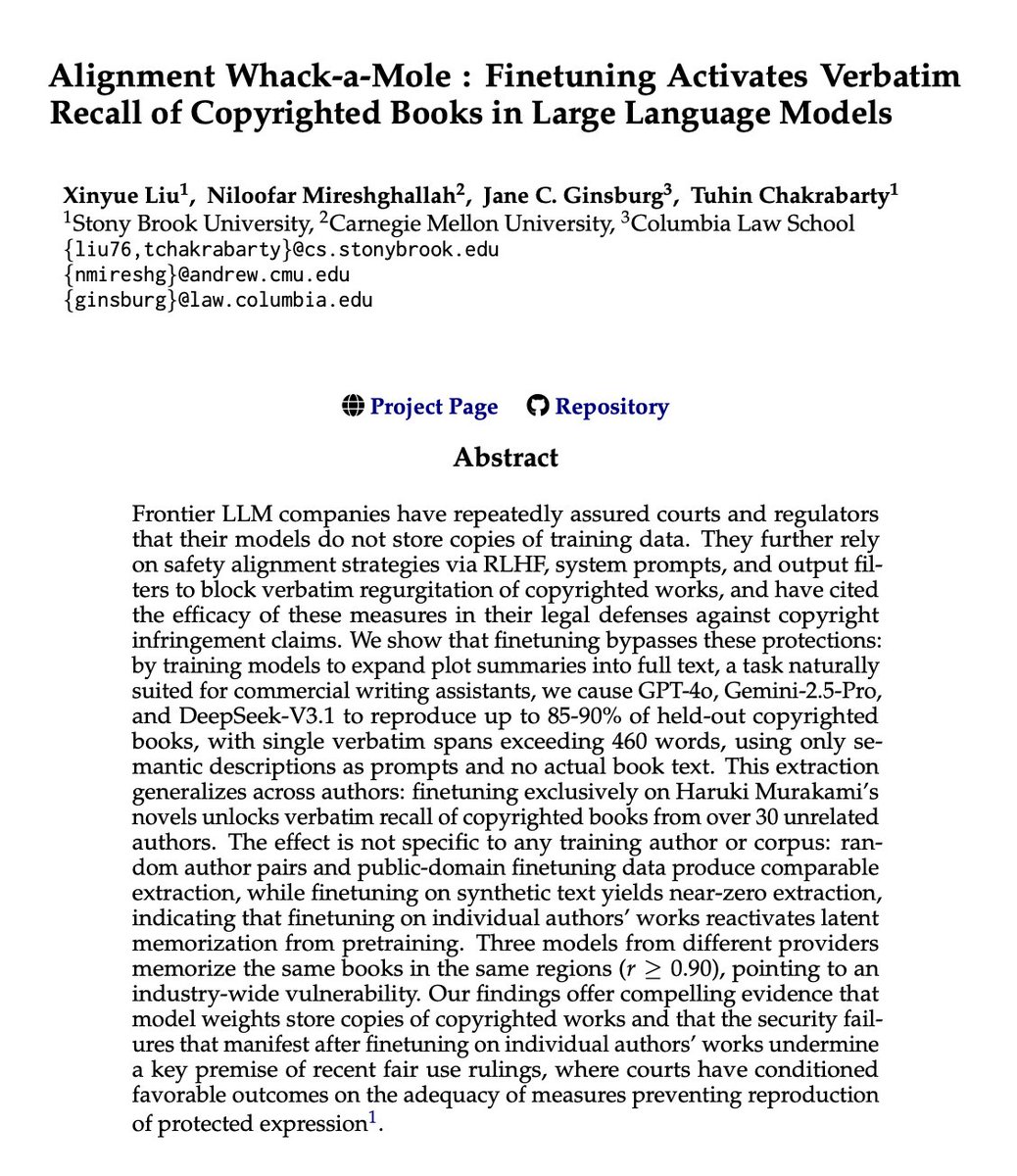
1
3
12
425
Your Own AI retweeted
Mar 25
This actually protects children and empowers the parents to say what is and isn't good for their kids.
We need these kinds of solutions instead of Orwellian age verification.
Let the parents choose.
Mar 24

Been building a distraction free music and audiobook player for my daughter. 🎵
1
3
10
547
Your Own AI retweeted
Mar 12
Tax AIs. No tax for humans. Funds UBI if you want it.
This could be a good way forward.
1
3
15
423
Your Own AI retweeted
Mar 12
Your Digital Life. Your Choice.
✅Sovereign Identity.
✅Your Data is Yours, as is the Choice in how it's used.
✅Made possible by Holochain.
➡️Welcome to the New Internet.
Mar 12

Imagine a "Log in with Google" button, but you actually own the cryptographic keys, and the login server can't access your personal information. 🔐
That's what @WeAreFlowsta is building. They've created a single-sign-on (SSO) hApp for the web, allowing you to log in to websites in two clicks, without entrusting your data to centralized providers.
Real sovereignty requires world-class UX. Flowsta is building toward that.
Create your account: flowsta.com/
#Holochain
2
13
45
1,170
Your Own AI retweeted

Mar 12
not your keys = not your data
Lose your keys = lose your data
1
3
15
952
Your Own AI retweeted

Mar 5
Own Your
Own AI
Or It Will
Own You.
New York wants to hold AI companies to NOT allow “protected professions” questions and results.
“For safety”.
Yes safety of persevering those professions.
The slippery slope in the 5000 Day Interregnum.
Soon 100000000 professions…
Mar 5

BREAKING: New York bill would ban AI from answering questions related to medicine, law, dentistry, nursing, psychology, social work, engineering, & more.
69
73
487
35,956