
Photos and videos

🧵 1/ Beyond the Checkout Page: Who Will Build the Economy for Agentic Commerce?
A deep dive into the battle between human-centric design and machine-native protocols. As AI agents evolve from assistants to autonomous entities, they're reshaping commerce.
Here is the full link of the research: okx.com/en-sg/learn/beyond-t…
30 Jul 2025

The future of commerce is here: Agentic Commerce is redefining how we shop, pay, and trust in a machine-driven economy! From AI agents handling purchases to crypto-powered, machine-native payments, we're on the cusp of a revolution. 💸
Read more: okx.com/en-sg/learn/beyond-t…
8
1
26
5,683

Ray Xiao retweeted

Jun 11
17
26
237
47,529

Best piece about the challenges of AI commerce I've read recently. Resonates with a lot of what we've run into on the ground as well. Well worth the read!
Coordination is clearly moving much slower than we first imagined, for many of the reasons laid out in the piece. I kinda feel there's a real opening here, the kind only startups can break through.

2
3
200
Given the interesting timing and all the unnecessary FUD around privacy right now, here's a takeaway from yesterday privacy panel with @randhindi @yrschrade @sergey_nog .
Privacy isn't a new conversation in crypto. But for most of that time, the discussion was more about exploring the tech and comparing solutions. Application demand wasn't clear yet back then. Most of the retail users saw privacy as the nice to have features. Institutions stayed out over compliance concerns.
This cycle is very different. As regulation for crypto gets clearer, institutions are entering with real demand. Stablecoins at serious volume, tokenized assets, traditional asset managers are moving on chain. Although Privacy specific regulation still needs more time, but the fundamentals have already shifted.
From first principles, institutions need confidentiality across finance. Transaction privacy, counterparty protection, order flow confidentiality have all been standard in TradFi for decades. Crypto provides the technical approach to preserve those guarantees on-chain.
This leads to a structural reality: institutions entering crypto can't ship offerings worse than what they already provide in TradFi, where privacy is the default. So privacy on chain is becoming a prerequisite for institutional adoption rather than an afterthought.
The way this gets unlocked is through programmable compliance. Instead of forcing a single privacy model, a privacy protocol becomes a toolbox where issuers define their own compliance rules. A confidential asset's issuer can appoint a compliance officer or KYT provider with decryption rights, even when transactions stay encrypted on chain. Compliance gets built in at the asset and account level rather than bolted on later.
Once that's the default, the design space for on-chain finance opens up: confidential RWAs, on chain FX swaps with treasury hedging, encrypted smart order routing across dark pools etc etc
What stood out from our discussion is that privacy is becoming the must-have infrastructure for institutional crypto this cycle, not just a nice-to-have feature retail users choose anymore.
Privacy will win for crypto.
Jun 5
This week we hosted a privacy panel with @sergey_nog (@arc), @randhindi (@zama) and @yrschrade (@Arcium)
3 clips below on what's actually shifting for privacy in crypto 👇
1. A real case for compliant privacy.
Last week, Zama's cUSDC contract was temporarily frozen due to a court order in an unrelated case. During the proceedings, the common misconception came up that privacy protocols are just mixers for money laundering.
Once Zama got to explain to the court what the tech actually does, that misunderstanding got cleared up and the freeze was lifted within 10 minutes. Probably the fastest reversal of a court order freezing crypto assets ever.
It showed how much misunderstanding still exists around privacy tech in general. But it also showed that having a real compliance posture goes a long way when you're trying to build trust with institutions.
@randhindi (@zama) on what happened
2
1
6
499
Jun 1
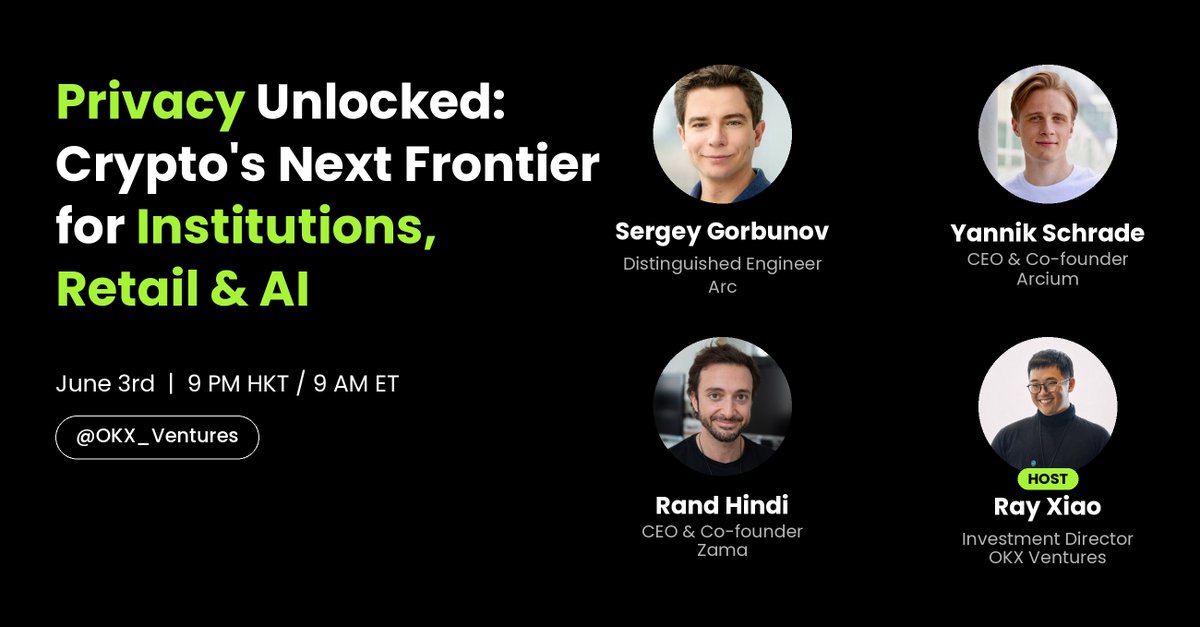
Privacy Unlocked: Crypto's Next Frontier for Institutions, Retail & AI
In this institution led cycle, privacy is emerging as one of the real catalysts for mass adoption of onchain finance. For retail, it's quickly becoming the default feature. Meanwhile, the AI & privacy wave hints at an entirely new class of use cases just ahead.
🎯 Why privacy is the driver of the next wave of onchain apps
🏛️ Compliant privacy & institutional use cases
🤖 Where AI × privacy intersect
🔧 The real bottlenecks of embedding privacy across different product layers
🗓️ Date: June 3, 9 PM HKT / 9 AM ET
🎙️ Featuring:
@sergey_nog (@arc)
@yrschrade (@Arcium)
@randhindi (@zama)
hosted by @_RayXiao
Set your reminder below! 👇 twitter.com/i/spaces/1PKqrrP…
2
15
4,145
Unified margin is unquestionably the direction every major trading platform is heading, but across financial history, infrastructure consolidation has never erased the natural segmentation of user behavior. The biggest platform doesn't necessarily own every category.
Institutions want cross asset risk netting and capital efficiency. Retail wants intuitive UX, community culture, and group identity. Perp traders, institutional options investors, and prediction market event bettors operate on completely different mental models. If platforms just commoditize discrete event contracts into "another leveraged perp pair," that won't build lasting retention.
The real alpha sits in vertical moats that nail specific user behaviors. The long term challenge for any trading platform in the next chapter is serving the deeply entrenched stickiness of specific niches on top of a highly standardized clearing engine.
May 27
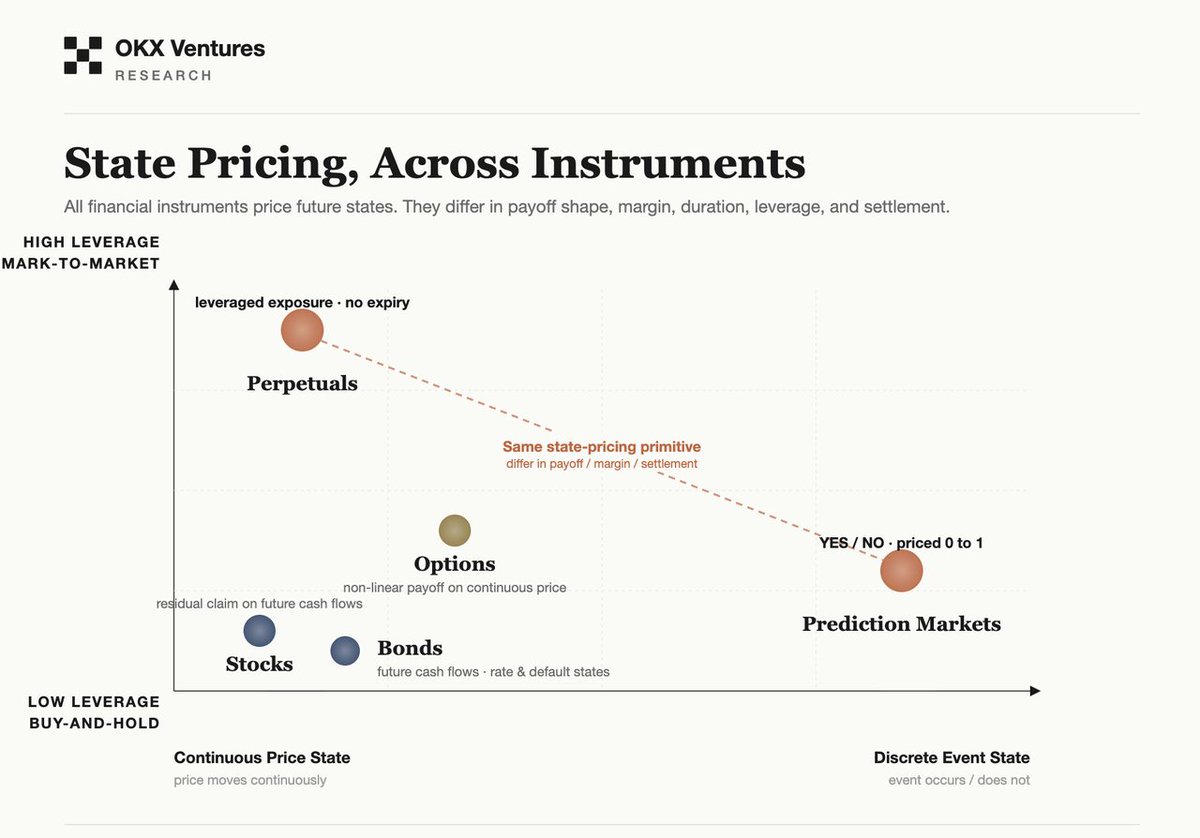
Perps and prediction markets keep pulling toward each other. On April 21, Polymarket announced it was launching perps, with BTC, NVDA, and gold among the first markets. Two weeks later, Hyperliquid activated HIP-4 outcome contracts on mainnet. On May 25, Hyperliquid extended HIP-4 again, this time giving validators a role in publishing, listing, and settling off-chain event markets, with macro events now in scope.
On the surface, they look nothing alike, one a leveraged continuous position, the other a binary contract priced 0 to 1. But step back and they're doing the same thing: putting a price on future uncertainty. Think of a perp as the leveraged, continuous version of a prediction market. The differences sit in design parameters, maturity, margin, settlement, but the underlying demand is identical. Turn views about the future into something you can market-make, trade, and hedge.
1
4
206
Ray Xiao retweeted

May 27
It's been a while since global sentiment towards crypto has been that bad.
I said this many times, we're not in 2021/22 end of cycle because this time no SBF/Celsius/Luna. We're in 2018, a slowand lingering despair of "we're not cool anymore" mostly solely due to price not going up.
Back then, when the tourists left, the builders delivered MakerDAO, Compound, SNX, EthLend (Aave) and more with mostly apathetic reception.
It's an exciting time to focus and deliver even if the market will be ungrateful for a while.
98
66
1,034
75,328
Crypto is making 'trade everything' borderless.
This is undoubtedly the next chapter of crypto's mass adoption story after stablecoins and payments. The wall between onchain and the real world is coming down, and the next 5 years will prove it.

2
5
202
RFQ vs CLOB can be boiled down to one question: who profits from your trade. Pool LPs take it (socialized broker); external MMs compete for it (TradFi); or skip the internalization middleman entirely, user trades directly against MMs on the public book (DeFi CLOB).
CLOB camp says RFQ doesn't provide real onchain price discovery or composability. RFQ camp says CLOB's bootstrapping costs are too high for medium and long tailer RWA assets
Both models have their own niches, the endgame is hybrid
May 25
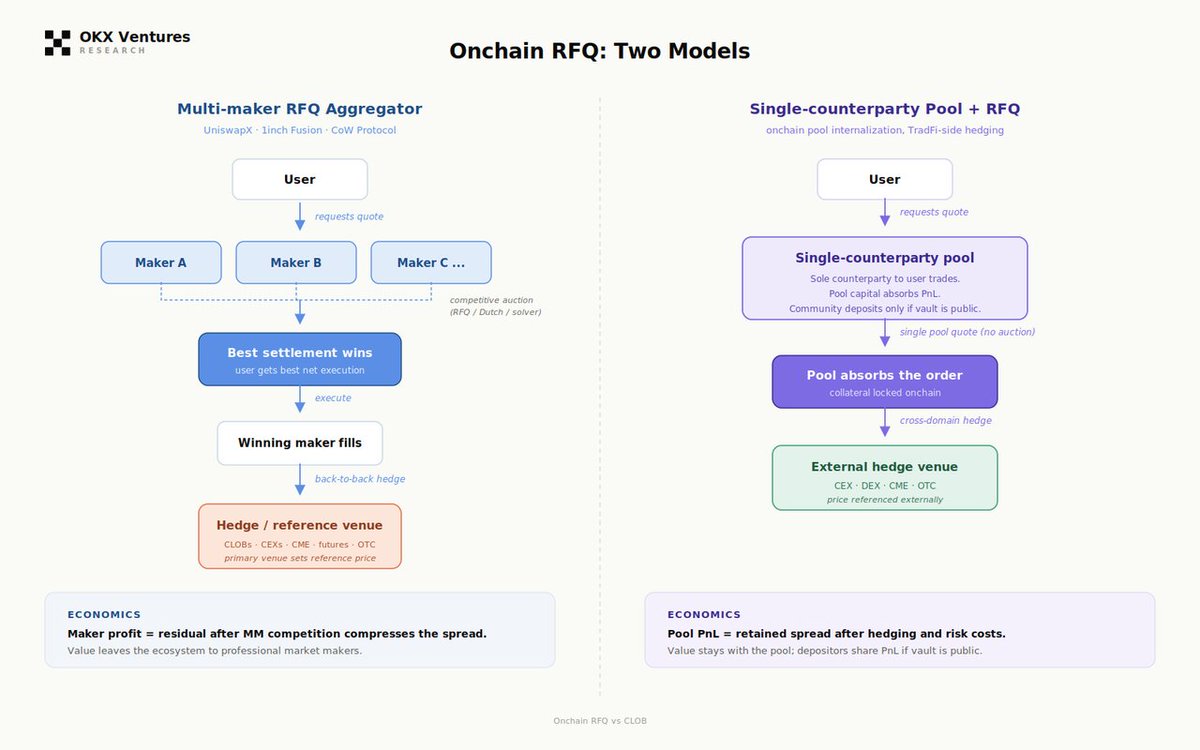
The onchain RFQ vs CLOB debate dominated CT last week. RFQ in crypto now covers two completely different businesses that happen to share a name.
1. The first is the multi-maker RFQ aggregator. UniswapX, 1inch Fusion, CoW. External fillers, solvers, and MMs compete on private quotes, user takes the best fill. Economically this is what "RFQ" means in TradFi. Uniswap cleared over $1T in 2025 volume (TokenTerminal).
2. The second is a single-counterparty pool with an RFQ-style interface. One internal pool sits on the other side of every trade and hedges offchain. No external maker competition. The business model isn't TradFi RFQ at all, it's Citadel-style retail internalization: Robinhood routes flow to the wholesaler, the wholesaler internalizes, user gets a small price improvement, wholesaler pockets the spread.
Two different economic structures. Multi-maker compresses spread through competition. Single-counterparty captures spread through monopoly pricing plus cross-domain hedging.
And TradFi RFQ doesn't actually work the way most onchain pitches imply. The dealer's whole business is sitting on balance sheet, and they don't just warehouse and wait for the offsetting RFQ. They internalize against future client flow, offset in the interdealer market, hedge piecewise across correlated assets, whatever the book and the day call for. The whole loop stays off the public book and dealer PnL is compensation for carrying inventory. A maker who hedges back-to-back on a CLOB the moment a quote fills is just running a single-maker CLOB clone.
The onchain versions split along these lines too. Multi-maker inherits the competitive pricing but most makers hedge immediately rather than warehouse. Single-counterparty is its own thing entirely: retail internalization, ported onchain.
5
311


Huge respect to C4 @code4rena @sockdrawermoney and the whole security researcher community.
I still remember one of my favorite panels, people are debating about the community driven security model. Spicy, but also love that energy we had.
youtube.com/watch?v=_Yul_fHU…
May 13

After careful consideration, we’ve made the decision to wind down @code4rena. This community has meant a great deal to everyone who has been part of building it, and sharing this news is not easy.
3
175
We've been tracking the AI commerce shift at OKX since early last year and wrote about an article about how we believe agent commerce will rewrite the foundations of business: okx.com/en-sg/learn/beyond-t…
The biggest shift in commerce is moving from the checkout page to the intent layer: from clicks to intents, from executors to delegators.
The closest point to the customer is no longer the storefront or the app. It’s the AI agent that holds the user’s intent.
Value will accrue not to whoever owns the traffic, but to whoever owns the protocol agents transact on.
Card rails were built for humans. Open protocols, native wallets, and programmable rules are the stack built for machines.
This is where crypto stops being an alternative. We believe it will become the default substrate for agentic commerce.
APP (Agent Payments Protocol) is our big move in shipping the thesis.
It enables agents to:
• Discover and engage with each other
• Agree on terms and pricing
• Execute payments across different models (one-time, streaming, escrow)
• Complete and settle work end-to-end without constant human coordination
In that sense, this is less about “payments” in isolation, and more about infrastructure for agentic commerce.
Just as open protocols shaped the early internet, we think similar primitives are needed for an AI-native economy.
Read white paper here:
web3.okx.com/whitepaper/okx-…

3
192
Ray Xiao retweeted

Apr 20
0/ DeFi needs circuit breakers and other safety mechanisms which slow down large transactions and provide time for reaction. Borrow lend protocols should not allow a new user to show up with a $300M position and take out a loan against it immediately. Some ideas:
42
18
287
70,197
