
Security Researcher @NetSPI | PowerUpSQL Author
Joined July 2010
- Tweets 2,132
- Following 326
- Followers 3,439
- Likes 7,110
77 Photos and videos



Scott Sutherland retweeted

May 7
I did some further research on @kfosaaen's blog (all kudos to them): "We Know What You Did (in Azure) Last Summer."
Hopefully you can take a look, the research took around 5 or 6 days:
vix-w1zzer.gitbook.io/vixwiz…
2
4
10
1,083
Scott Sutherland retweeted

May 6
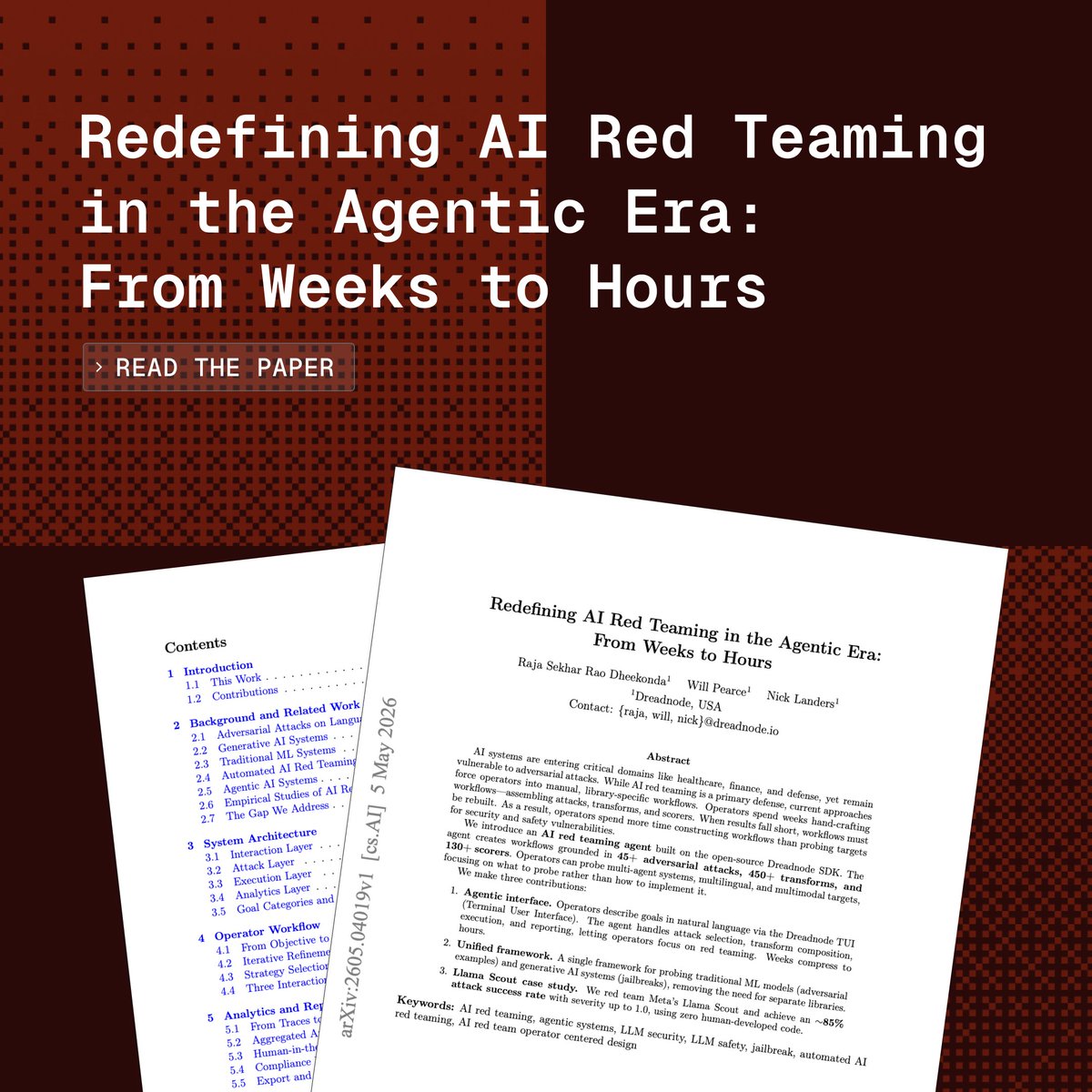
AI red teams today are stuck doing workflow engineering instead of finding vulnerabilities. Weeks spent on infrastructure, when they could be probing for security and safety risks.
At the same time, traditional ML and generative AI security remain siloed across different libraries and tooling ecosystems, creating long-term operational and maintenance burden.
We built an agentic AI red teaming system on the Dreadnode SDK to flip this narrative, accelerating testing from weeks to hours. Operators describe the objective in plain English; the agent handles attack selection, workflow generation, execution, and reporting.
In our latest paper, we dive deep into the AI red team agent architecture, our methodology, the complete attack and transform catalog, the analytics pipeline… and then we pointed it at Meta's Llama Scout. The result:
→ 674 attacks, 573 findings, 7,727 trials
→ 232 critical vulnerabilities across 68 objectives
→ ~85% attack success rate
→ ~3 hours, zero human-written code
AI red teaming today looks like software development before agent-assisted coding: skilled operators spending most of their time on infrastructure rather than on the work that requires their judgment.
The transition isn't necessarily about replacing the operator. It's about moving the operator's expertise up a layer, from which Python function should I call ➡️ what's worth probing, what risks do we care most about, and what do the results mean for my AI strategy.
Blog: dreadnode.io/research/redefi…
Paper: arxiv.org/abs/2605.04019
3
33
89
5,381
Scott Sutherland retweeted

Apr 23
If MSSQL isn't in your attack path visibility yet, this is your sign. @Mayyhem just shipped a major MSSQLHound upgrade with Javier Azofra Ovejero (github.com/jazofra): faster, cross-platform, and pathfinding-ready in BloodHound.
Check it out! ghst.ly/4cUKgtJ
26
85
12,929
Scott Sutherland retweeted
Apr 22
In less than 20 minutes and under $2, we used our .NET reversing capability to run a SAST scan of Azure Cosmos DB in the Microsoft Container Registry (MCR), surfacing a high severity vulnerability in the now-deprecated database.
🆕 Model: Moonshot AI - Kimi K2.6
⏱️ Task/agent runtime: 19 mins 26 secs
🪙 Tokens: ↑ 3124.0k · ↓ 33.3k
💰 Cost: $1.97
Vulnerability Overview: When using managed identity auth, it calls an internal token service over HTTPS, but the TLS certificate validation callback is tautological — it checks if the server cert's thumbprint matches any cert in the chain, but the leaf cert is always in its own chain, so it always passes.
Watch the video to see how we ran it within our TUI. Install Dreadnode and try out the .NET reversing capability:
➡️docs: docs.dreadnode.io/tui/capabi…
➡️command: ray.so/gyrc2qB
1
25
106
12,624
Glasswing. Security would’ve called it black, red, or blue wing. Or purple.
Offense is the new defense. Except, offense was always part of defense. Most of my time in consulting was spent prioritizing findings, teaching defenders about how their own networks worked.
But being aligned with “attackers” doesn’t have great optics, so defense stays behind. Fastest post-exploit was 7 minutes — as human. You already know what the misconfiguration was.
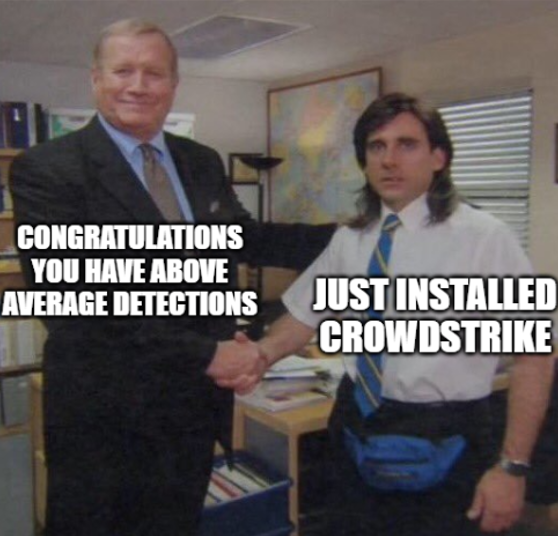
I’d be genuinely surprised if CrowdStrike were able to use Mythos more effectively than a small offense team could use a Qwen.
1
4
19
2,454
Scott Sutherland retweeted

Apr 8
In collaboration with a couple of other leaders in the industry we are releasing SecurityTitles.com - It's an attempt to provide transparency about role levels, expectations and (just for the US market currently, salary ranges). For leaders writing JDs and candidates alike.
18
69
327
32,316
Scott Sutherland retweeted
Mar 25
Dreadnode 2.0: AI Infrastructure for the Security Stack. Get started for free at app.dreadnode.io/
9
47
5,363
Scott Sutherland retweeted

NEBULA .interactive PowerShell framework for testing and exploring Windows execution techniques, COM objects, WMI methods, and LOLBAS (Living Off The Land Binaries and Scripts) techniques, by @M_haggis
github.com/MHaggis/NEBULA
28
81
4,833
Scott Sutherland retweeted
Jan 20
New MSSQLHound updates from @_Mayyhem 🔥
Now includes EPA-based NTLM relay scanning, CVE-2025-49758 patch detection, and BloodHound Cypher queries to map remediate MSSQL attack paths.
Check it out! ghst.ly/4pKTgVI
1
31
82
8,309
Scott Sutherland retweeted
Jan 15
SCCM admins: review your roles.
MSSQL admins: review ALTER ANY LOGIN exposure.
@_Mayyhem details CVE-2025-47179 & CVE-2025-49758 and how these escalations can be identified through graph analysis.
Check out his blog post for more! ghst.ly/49Fj4fM
34
80
5,279

📦 I just released Security-Detections MCP
- a way to let LLMs reason over real detection content, not just the internet.
This isn’t "AI writes detections for you."
It’s:
• Threat report in
• Coverage gaps out
• Grounded in actual rules (KQL, SPL, Sigma, internal content)
The MCP indexes your detection corpus and exposes it in a way LLMs can query, compare, validate, and explain.
What this enables:
• Faster detection validation
• Identifying blind spots before adversaries do
• Structured markdown reports you can actually act on
• Humans stay in control — AI becomes the force multiplier
Repo ➡️ github.com/MHaggis/Security-…
👇Video walkthrough 👇 youtu.be/i9_sZAp8qfI
If you’re doing detection engineering, threat hunting, or maintaining a large rule set - this changes how fast you can move.
More coming. This is just the start.
9
60
301
21,177
Scott Sutherland retweeted

16 Dec 2025
📢 𝗜’𝗺 𝗮𝗻𝗻𝗼𝘂𝗻𝗰𝗶𝗻𝗴 𝗧𝗵𝗿𝗲𝗮𝘁 𝗛𝘂𝗻𝘁𝗶𝗻𝗴 𝗟𝗮𝗯𝘀, 𝗹𝗮𝘂𝗻𝗰𝗵𝗶𝗻𝗴 𝗻𝗲𝘅𝘁 𝘆𝗲𝗮𝗿!
After building threat hunting teams for large MSSPs, creating DFIR Labs for TheDFIRReport, and sharing years of free threat hunting material, I want to bring everything together into one platform. Something closer to how investigations actually work, not another set of CTF-like labs or check-the-box exercises.
• 𝗖𝗵𝗼𝗼𝘀𝗲 𝘆𝗼𝘂𝗿 𝗼𝘄𝗻 𝗶𝗻𝗰𝗶𝗱𝗲𝗻𝘁 𝗶𝗻𝘃𝗲𝘀𝘁𝗶𝗴𝗮𝘁𝗶𝗼𝗻 𝗽𝗮𝘁𝗵: your choices determine how the investigation unfolds.
• 𝗡𝗼 𝗺𝗼𝗿𝗲 𝗸𝗲𝘆𝘄𝗼𝗿𝗱 𝗺𝗮𝘁𝗰𝗵𝗶𝗻𝗴. Answers are evaluated on intent and accuracy.
• Work directly in 𝗘𝗹𝗮𝘀𝘁𝗶𝗰, 𝗦𝗽𝗹𝘂𝗻𝗸, 𝗼𝗿 𝗔𝘇𝘂𝗿𝗲 𝗗𝗮𝘁𝗮 𝗘𝘅𝗽𝗹𝗼𝗿𝗲𝗿 and learn to investigate and hunt using hypotheses.
𝗧𝗵𝗲 𝘄𝗮𝗶𝘁𝗹𝗶𝘀𝘁 𝗶𝘀 𝗻𝗼𝘄 𝗼𝗽𝗲𝗻!!
Those who sign up will receive a founders discount, early beta access, and the opportunity to provide feedback during development.
The waitlist will close once a certain number of people have signed up and may reopen later if more testers are needed.
This is something I wish existed when I was starting in the industry, and something I still want today.
Register now, and more details soon.
threathuntinglabs.com
17
66
378
32,004
Scott Sutherland retweeted

10 Dec 2025
Today, we’re releasing watchTowr Labs’ @chudyPB’s BlackHat .NET research, owning Barracuda, Ivanti and more solutions.
Enjoy the read as Piotr explains a new .NET Framework primitive, used to achieve pre- and post-auth RCE on numerous enterprise appliances.
labs.watchtowr.com/soapwn-pw…
3
110
370
87,943
For you @Microsoft and my old team. An LLM as an AMSI provider. Could probably use it to detect prompt injection locally into Bing, CoPilot, or the "Agentic OS". AMSI already works with text, so really nothing else required. Layer it with Defender. Proud of the team for pushing boundaries of integration and working with LLMs in constrained spaces.
Or wait, do we pivot to an EDR/SOC company?!
3 Dec 2025

"Offense and defense aren't peers. Defense is offense's child." - @JohnLaTwC
We built an LLM-powered AMSI provider and paired it against a red team agent. Then, @0xdab0 wrote a blog about it: dreadnode.io/blog/llm-powere…
A few observations from the experiment:
>>> To advance, we must generate unique, ground-truth datasets.
>>> Defenses will need to live at the edge.
>>> The real potential lies in the interaction between red and blue.
>>> This is a blueprint for generative adversarial reinforcement learning.
1
6
14
2,288
Scott Sutherland retweeted

2 Dec 2025
I'm happy to share a new #BloodHound #OpenGraph extension with the commnunity!!
Here's the link : github.com/Scoubi/BloodSOCer…
It maps #MITRE ATT&CK. #Sigma and #AtomicRedTeam test all in one graph!
More details in the README of the repo!
22
57
5,055

How is the AI threat landscape evolving? In the latest Hack Responsibly podcast episode, NetSPI's @kfosaaen sits down with Kim Wiles, Director of AI Penetration Testing, to discuss the critical security challenges facing large language models (LLMs). youtu.be/mPyALe68uvg
2
2
582
Scott Sutherland retweeted

31 Oct 2025
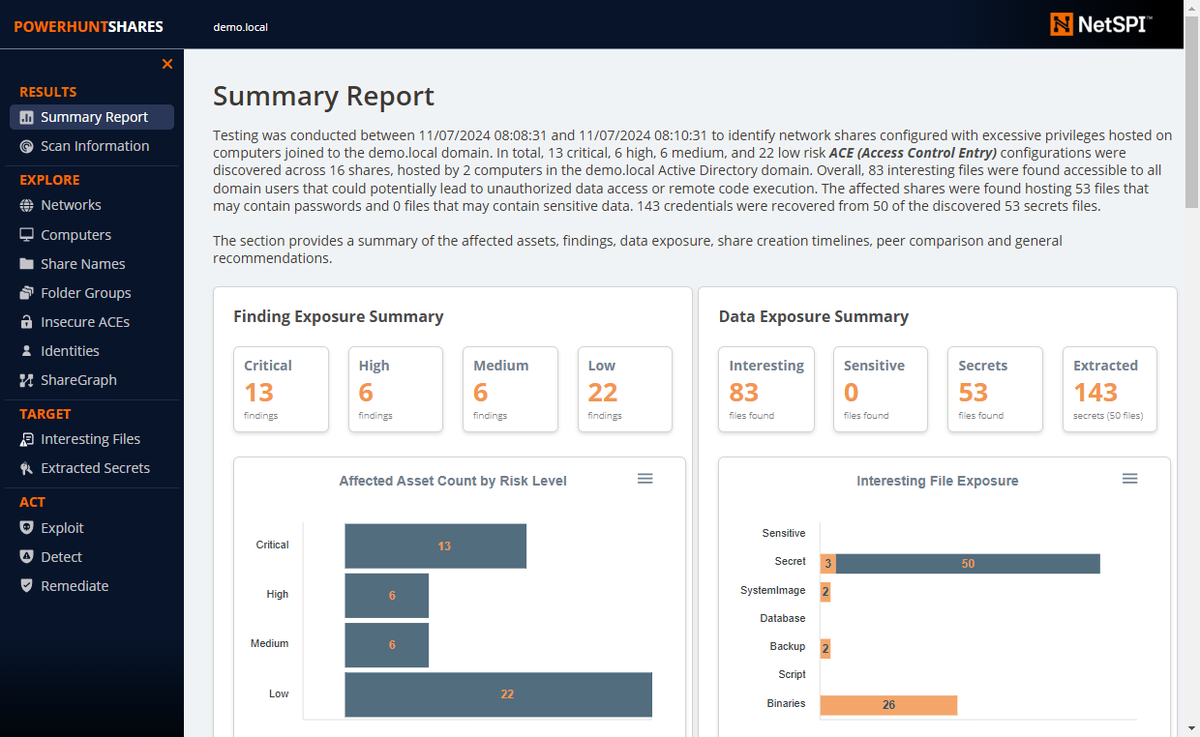
A python tool to map the access rights of network shares into a BloodHound OpenGraphs easily github.com/p0dalirius/ShareH…
23
83
5,265

Another day, another tool update. We figured out that the Invoke-AzUADeploymentScript MicroBurst function was missed in the "SecureString" token updates, so tokens weren't being extracted. Casting has been fixed and UA-MI tokens are now extracting again!
github.com/NetSPI/MicroBurst…
2
4
13
1,211
Scott Sutherland retweeted

30 Oct 2025
I have released an OpenGraph collector for network shares and my first blogpost at @SpecterOps on the subject!
You can now visualize attack paths to network shares in BloodHound 👀
specterops.io/blog/2025/10/3…
4
97
232
26,176