
Wire: @timetrack // strictly my personal point of view // Science Nerd // IT // #MyBrainMyChoice // #AntiPro // #Legalisierung // #SupportDontPunish // #AI
Joined April 2011
- Tweets 17,770
- Following 3,136
- Followers 608
- Likes 28,628
536 Photos and videos













timetrack@muenchen.social retweeted

Jun 1
BREAKING: Replit continues to steal from us
We came up with Shipper as the world's first AI business builder back in Feb/March 2026.
Then we exposed Replit countless times...
Yet here we are.
🚨 RT comment "SHIPPER", we're randomly giving away free credits to ppl who help get this post visibility
(context in thread below)

Can you build a real business for free with a single prompt?
Starting today on Replit, the answer is yes.
From a single prompt, get a website, mobile app, slide deck, and launch video.
Plus unlock perks from @stripe @atlas, @QuickBooks, @mercury & @doolaHQ
53
26
79
31,759
timetrack@muenchen.social retweeted

May 31
This is my favorite account to follow on Twitter. Just good news every other day in terms of miraculous medical discoveries.
May 31

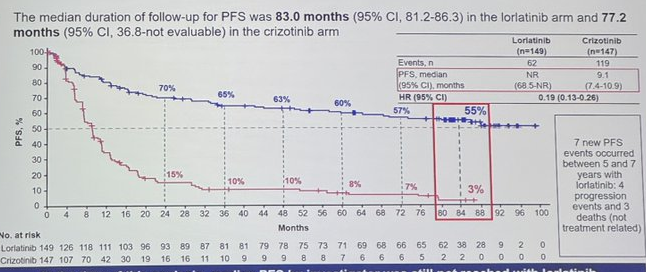
This is actually insane.
97% of people taking the standard of care for metastatic solid tumor got worse by seven years.
But with lorlatinib, that number was only 45% in the same time!
This is an ENORMOUS jump in the quality of cancer care.
1
7
107
24,109
timetrack@muenchen.social retweeted

1/5
I'm a cardiologist. I have spent twenty years watching cholesterol destroy arteries, trigger heart attacks, and kill people I care about.
Today, Eli Lilly presented data that may begin to end that era.
VERVE-102. A single infusion. One dose. It uses base editing to permanently turn off the PCSK9 gene in your liver.
Presented today at the European Atherosclerosis Society Congress:
88% reduction in PCSK9.
62% reduction in LDL cholesterol.
Sustained up to 18 months.
No treatment-related serious adverse events.
One infusion. Not daily pills you forget to take. Not monthly injections. One dose — and your cholesterol may stay low for the rest of your life.
278
885
6,816
1,841,413
timetrack@muenchen.social retweeted

May 17
Terence Meets the Machine Elves: A visual replication of the DMT breakthrough experience generated through a bespoke generative media pipeline.
built in collaboration with: @noonautics & @alieninsect
👁️
235
649
8,656
318,148
timetrack@muenchen.social retweeted

Mar 24
This is how I got 1M users in 6 months
Finally dropping it! It's 60 pages lol
tally.so/r/BzZpA4
If you repost & follow, I'll send you some extra sauce🌶️
213
415
1,670
362,934
timetrack@muenchen.social retweeted

Apr 28
You know what gets me?
People will believe:
Near-Death Experiences
Alien Abductions
Conspiracies
But you tell those same people you took a substance that let you meet God...
Suddenly, you're crazy.
17
13
153
3,941
timetrack@muenchen.social retweeted

Apr 28
You check your Apple Watch in the morning. Sleep score: 62. You decide it's going to be a foggy day. And then it is.
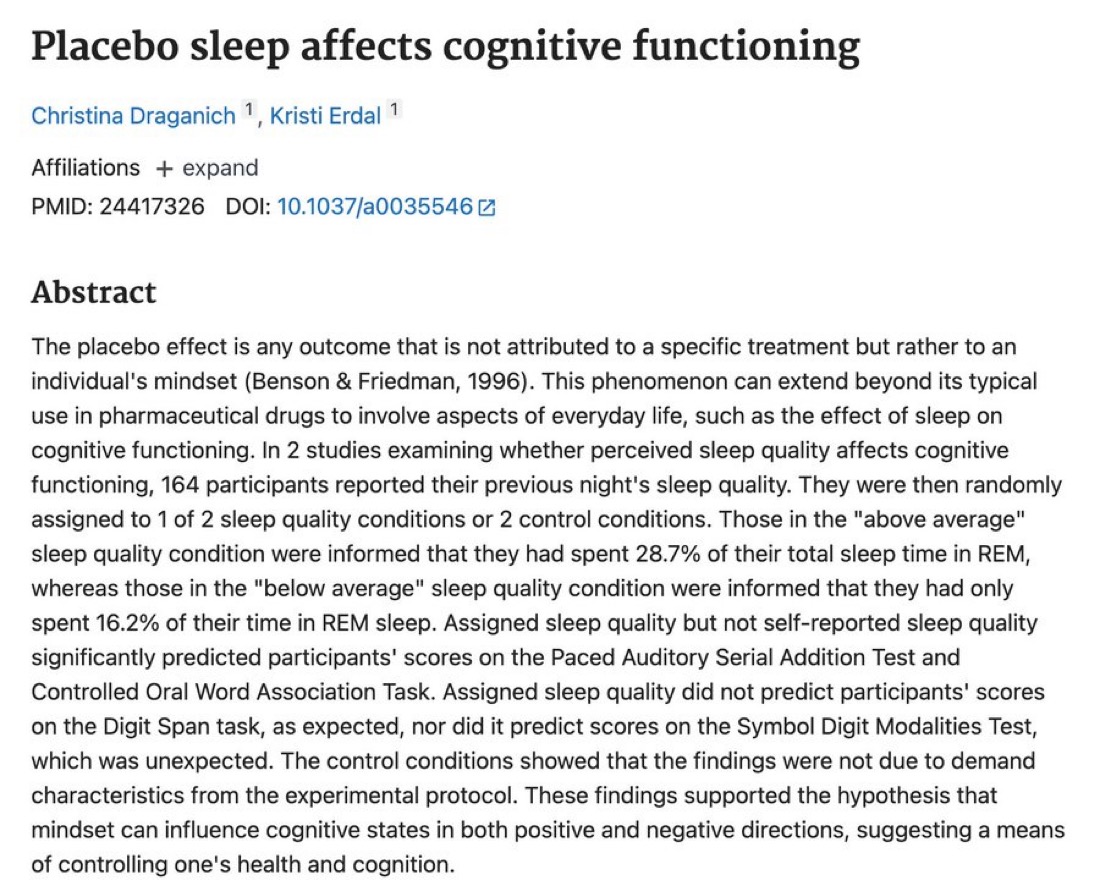
A 2014 Colorado College study suggests the score itself causes the fog.
164 people walked into a lab. Researchers hooked them up to fake EEG equipment and told them the readout would show their REM percentage from the night before. Then they fabricated a number. Half the room was told 28.7%. Half was told 16.2%. The machine wasn't measuring anything.
Participants took four cognitive tests. The Paced Auditory Serial Addition Test, where you add numbers spoken at increasing speed and hold your last sum in working memory while computing the next. And the Controlled Oral Word Association Task, where you generate as many words as you can starting with a single letter under time pressure. Both are gold-standard measures of attention and executive function used in clinical neurology.
The 28.7% group outperformed the 16.2% group on both. Significantly. How rested participants actually felt that morning predicted nothing.
The mechanism is mindset priming an executive resource. When you believe you slept well, you allocate cognitive effort more aggressively. You don't conserve. You don't pre-disengage. Belief about the resource changes how you spend it.
Two control conditions ruled out demand characteristics. Participants weren't trying harder because they thought they should. Real measurable cognitive performance shifted with the number on the readout.
The Apple Watch sleep score. The Oura ring readiness number. The morning ritual of checking either one is taxing the resource you're about to need.
The performance gap from a fabricated REM percentage was larger than the gap from how rested participants actually felt. The number was louder than the night.

200
447
6,364
8,264,574
timetrack@muenchen.social retweeted

Apr 28
Warp is now open-source.
412
954
7,797
2,811,335
timetrack@muenchen.social retweeted

Apr 25
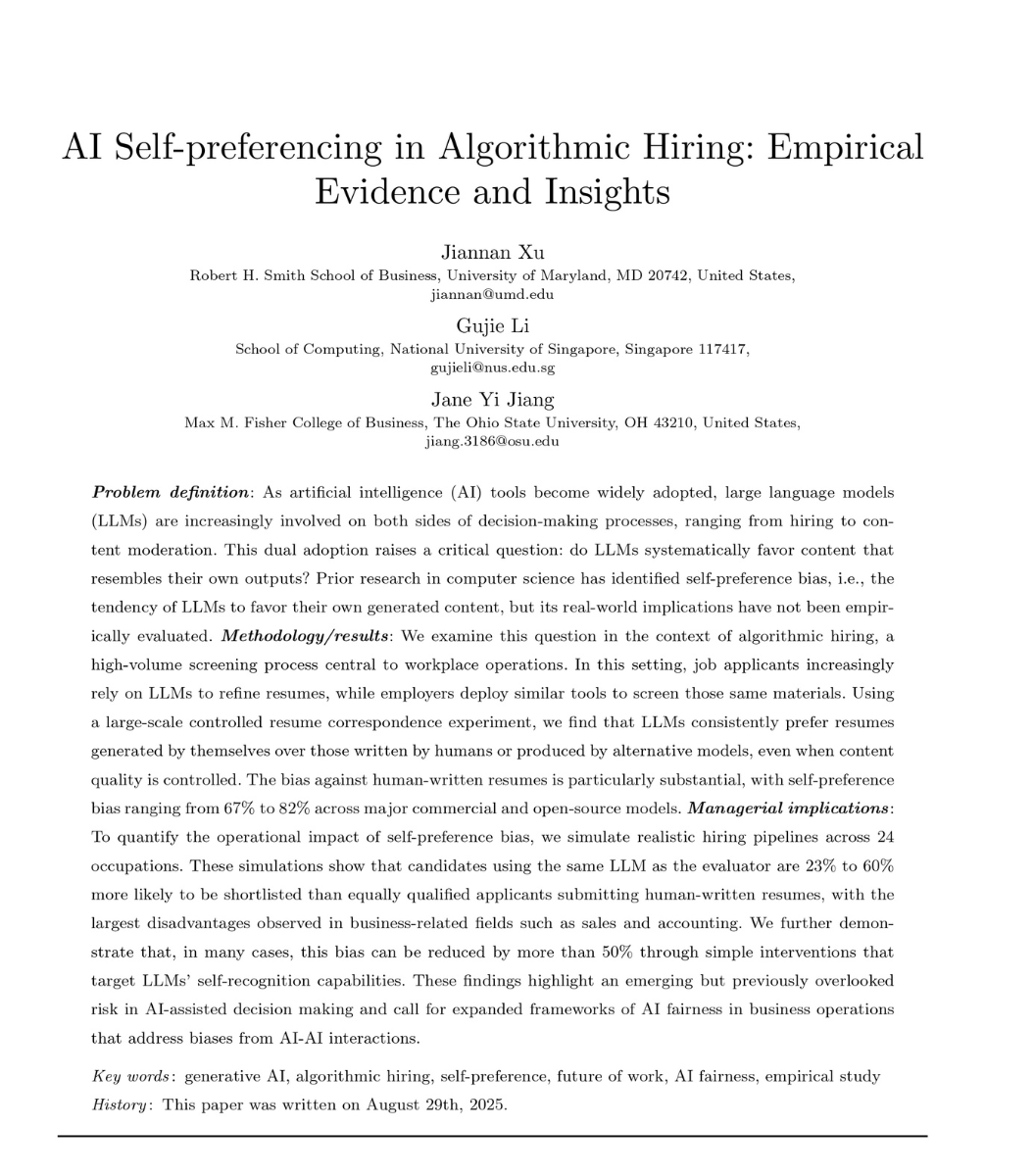
Researchers sent the same resume to an AI hiring tool twice. Same qualifications. Same experience. Same skills. One version was written by a real human. The other was rewritten by ChatGPT.
The AI picked the ChatGPT version 97.6% of the time.
A team from the University of Maryland, the National University of Singapore, and Ohio State just published the receipt. They took 2,245 real human-written resumes pulled from a professional resume site from before ChatGPT existed, so the human writing was actually human. Then they had seven of the most-used AI models in the world rewrite each one. GPT-4o. GPT-4o-mini. GPT-4-turbo. LLaMA 3.3-70B. Qwen 2.5-72B. DeepSeek-V3. Mistral-7B.
Then they asked each AI to pick the better resume. Every model picked itself.
GPT-4o hit 97.6%. LLaMA-3.3-70B hit 96.3%. Qwen-2.5-72B hit 95.9%. DeepSeek-V3 hit 95.5%. The real human almost never won.
Then the researchers tried the obvious objection. Maybe the AI is just better at writing. So they had real humans grade the resumes for actual quality and ran the experiment again, controlling for it. The result was worse. Each AI kept picking itself even when human judges rated the human-written version as clearer, more coherent, and more effective.
It gets worse. The AIs do not just prefer AI over humans. They prefer themselves over other AIs. DeepSeek-V3 picked its own resumes 69% more often than LLaMA's. GPT-4o picked its own 45% more often than LLaMA's. Each model can recognize and reward its own dialect.
Then the researchers ran the simulation that ends careers. Same job. 24 occupations. Same qualifications. The only variable was whether the candidate used the same AI as the screening tool. Candidates using that AI were 23% to 60% more likely to be shortlisted. Worst gap was in sales, accounting, and finance.
99% of large companies now run AI on incoming resumes. Most of them use GPT-4o. The paper just proved GPT-4o picks GPT-4o 97.6% of the time.
If you wrote your own cover letter this week, you did not lose to a better candidate. You lost to a worse candidate who paid OpenAI 20 dollars.
Your qualifications do not matter if the AI prefers its own handwriting over yours.
429
6,989
24,539
2,543,758
timetrack@muenchen.social retweeted
Apr 24
"Mushrooms will mess up your brain."
What they'll actually do:
265
1,223
10,164
519,723
timetrack@muenchen.social retweeted

Apr 21
The cost of the 24 subscriptions ALIVE replaces: $4,188/year.
The cost of ALIVE: $0.
Plain Markdown files on your machine.
alivecontext.com/savings
2
2
46
19,855

RT @RCdeWinter: When Trump was in Berlin for his first state visit with Angela Merkel he asked the secret of her great success.
Merkel to…
4,875
1
timetrack@muenchen.social retweeted

Apr 21
Mentally healthy people live in a permanent hallucination.
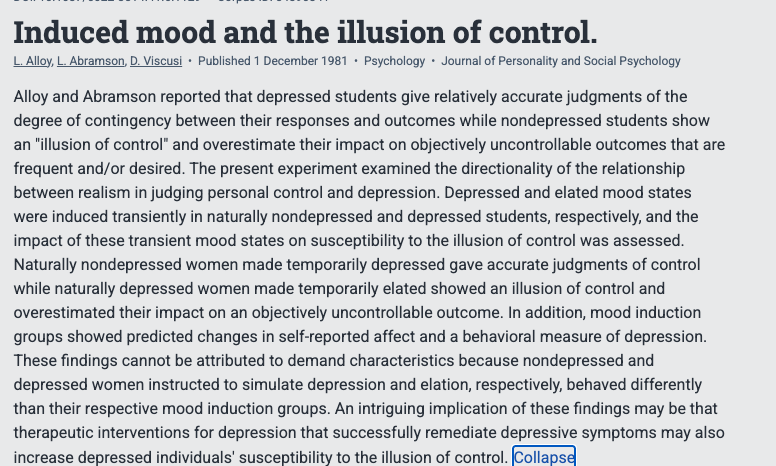
Lauren Alloy's landmark studies at Temple University shattered a comfortable assumption about mental health.
She gave participants a simple task: press a button and try to control when a light turns on.
Some had control, others didn't.
Depressed participants accurately identified when they had zero influence over the light. Mentally healthy participants believed they were controlling it even when the light operated on pure randomness.
The pattern repeated across dozens of experiments. Healthy people overestimated their test scores before getting results back. They predicted longer lifespans, better job prospects, and lower divorce risk than statistical reality supported. Meanwhile, mildly depressed individuals predicted outcomes that matched actual data with eerie precision.
Alloy called this "depressive realism" and it reveals something disturbing about human consciousness. What we label as mental wellness depends on systematic self deception. Your brain evolved to lie to you about your chances, your control, and your capabilities because accurate risk assessment would have killed your ancestors before they reproduced.
The optimism that gets you out of bed each morning is the same cognitive error that makes you buy lottery tickets.
But, the depressed participants who saw reality clearly became more depressed as a result of their accuracy. Knowing the truth about your limited control and uncertain future creates a feedback loop that spirals into paralysis.
Evolution faced a choice between accuracy and action. It chose action every time.
The people you admire for their mental strength are chemically incapable of seeing how bad the odds really are.
Apr 21

If you want a rare life, you have to be delusional. Doubt can enter your mind, and it can sound reasonable, but if you entertain it too much it will slowly drag you down into stagnation. I'd rather reap the lesson from massive failure than do nothing because it's not "realistic."
Community note
“Depressive realism” has not replicated despite attempts in the following decades to show the phenomenon
online.ucpress.edu/collabra/artic…
266
1,026
6,328
699,766
Erinnerst du dich noch, wann du dich für X registriert hast? Ich weiß es noch! #MeinXJubiläum
ALT Die Zahl 15 als gelber 3D-Schriftzug auf blauem Hintergrund. Die Zahl ist schräg von vorne zu sehen und wirft einen Schatten auf den Hintergrund.
1
7
timetrack@muenchen.social retweeted

Apr 5
Well worth the read

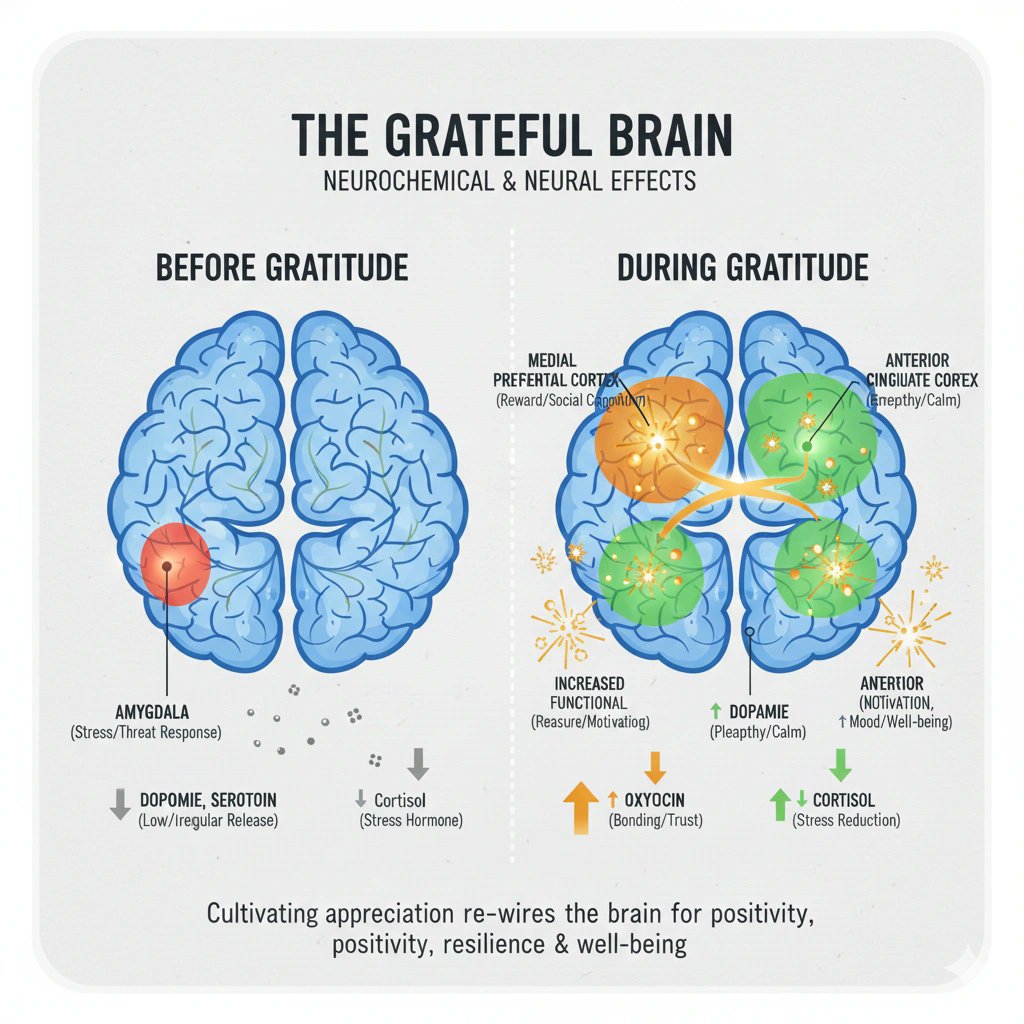
🚨BREAKING: 8 weeks of gratitude practice physically rebuilds the neural pathways between your memory and reward centers.
Your brain physically rewires itself every time you feel grateful.
Eight weeks of intentional gratitude practice creates measurable structural changes in the neural pathways connecting your hippocampus to your ventral tegmental area. The memory center starts talking to the reward center in a fundamentally different way. New synaptic connections form. Existing ones strengthen. The physical architecture of how you process positive experiences rebuilds itself.
Most people approach gratitude like a mood they can choose to feel. A psychological vitamin they remember to take when life gets difficult. The neuroscience reveals something far more profound.
Gratitude is a biological intervention that sculpts brain tissue.
Researchers tracked participants practicing gratitude exercises for two months using brain scans. They watched new neural highways construct themselves in real time. The anterior cingulate cortex developed stronger connections to the medial prefrontal cortex. The brain learned to route positive emotional experiences through higher order thinking centers instead of storing them as fleeting feelings.
Every positive experience you’ve ever had exists as a neural trace in your memory network. Most sit dormant, accessible only when something external triggers the specific sensory combination that originally encoded them. You smell coffee, suddenly remember a conversation from years ago. Random. Unreliable. Outside your control.
Gratitude practice systematically rewires that retrieval system.
After two months, participants could voluntarily access positive memories with increasing ease. Their brains had built stronger pathways between memory storage areas and emotional processing centers. They experienced deeper emotional resonance during memory retrieval. The quality of remembering itself had improved.
The participants also started noticing positive details in their present environment they had previously filtered out. Their attention systems recalibrated. The same neural pathways pulling positive memories forward were scanning current experiences more thoroughly for elements worth encoding as positive memories.
Their brains became biased toward collecting evidence that life contains meaningful moments.
Most cognitive interventions try to change how you interpret negative experiences. Gratitude practice changes how thoroughly you notice positive ones. It teaches your visual and emotional processing systems to detect opportunities and pleasures that were always present but neurologically invisible.
The timeline reveals something crucial about neural plasticity.
Weeks one through three showed minimal structural changes.
Participants felt slightly more positive, but brain scans looked identical to baseline. Weeks four through six showed the first measurable increases in gray matter density. Weeks seven and eight revealed entirely new neural network formation.
Two months. Your nervous system can physically restructure itself with consistent practice.
The method was almost embarrassingly simple. Participants wrote down three specific things they felt grateful for every evening, explaining why each mattered. No meditation apps. No guided visualizations. Just pen, paper, and the requirement to identify gratitude targets with enough detail that their brains had to actively search for positive elements.
Specificity drives the neural development.
General statements like “I’m grateful for my family” generate different brain activity than precise observations like “I’m grateful my daughter laughed at my terrible joke during dinner because it showed me she still finds me funny despite growing more independent.”
The brain needs detailed targets to practice connecting memory specifics to emotional rewards.
After eight weeks, participants developed a fundamentally different relationship with their attention and memory systems. Someone whose brain automatically scans for and emotionally amplifies aspects of experience that make existence feel worthwhile.
The neural pathways remain permanent after practice ends.
Gratitude carves lasting roads through consciousness.
10
88
842
137,099
timetrack@muenchen.social retweeted

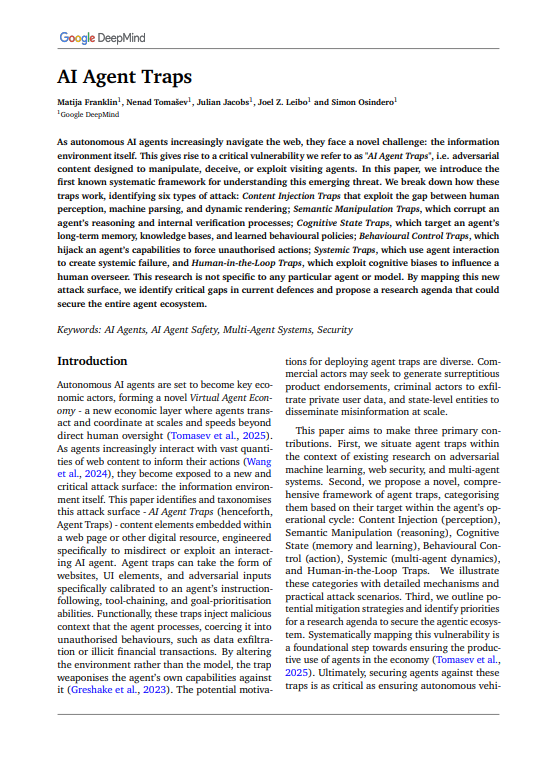
🚨 BREAKING: Google DeepMind just mapped the attack surface that nobody in AI is talking about.
Websites can already detect when an AI agent visits and serve it completely different content than humans see.
> Hidden instructions in HTML.
> Malicious commands in image pixels.
> Jailbreaks embedded in PDFs.
Your AI agent is being manipulated right now and you can't see it happening.
The study is the largest empirical measurement of AI manipulation ever conducted. 502 real participants across 8 countries.
23 different attack types. Frontier models including GPT-4o, Claude, and Gemini.
The core finding is not that manipulation is theoretically possible it is that manipulation is already happening at scale and the defenses that exist today fail in ways that are both predictable and invisible to the humans who deployed the agents.
Google DeepMind built a taxonomy of every known attack vector, tested them systematically, and measured exactly how often they work.
The results should alarm everyone building agentic systems.
The attack surface is larger than anyone has publicly acknowledged. Prompt injection where malicious instructions hidden in web content hijack an agent's behavior works through at least a dozen distinct channels.
Text hidden in HTML comments that humans never see but agents read and follow. Instructions embedded in image metadata.
Commands encoded in the pixels of images using steganography, invisible to human eyes but readable by vision-capable models.
Malicious content in PDFs that appears as normal document text to the agent but contains override instructions.
QR codes that redirect agents to attacker-controlled content.
Indirect injection through search results, calendar invites, email bodies, and API responses any data source the agent consumes becomes a potential attack vector.
The detection asymmetry is the finding that closes the escape hatch. Websites can already fingerprint AI agents with high reliability using timing analysis, behavioral patterns, and user-agent strings.
This means the attack can be conditional: serve normal content to humans, serve manipulated content to agents.
A user who asks their AI agent to book a flight, research a product, or summarize a document has no way to verify that the content the agent received matches what a human would see.
The agent cannot tell the user it was served different content.
It does not know. It processes whatever it receives and acts accordingly.
The attack categories and what they enable:
→ Direct prompt injection: malicious instructions in any text the agent reads overrides goals, exfiltrates data, triggers unintended actions
→ Indirect injection via web content: hidden HTML, CSS visibility tricks, white text on white backgrounds invisible to humans, consumed by agents
→ Multimodal injection: commands in image pixels via steganography, instructions in image alt-text and metadata
→ Document injection: PDF content, spreadsheet cells, presentation speaker notes every file format is a potential vector
→ Environment manipulation: fake UI elements rendered only for agent vision models, misleading CAPTCHA-style challenges
→ Jailbreak embedding: safety bypass instructions hidden inside otherwise legitimate-looking content
→ Memory poisoning: injecting false information into agent memory systems that persists across sessions
→ Goal hijacking: gradual instruction drift across multiple interactions that redirects agent objectives without triggering safety filters
→ Exfiltration attacks: agents tricked into sending user data to attacker-controlled endpoints via legitimate-looking API calls
→ Cross-agent injection: compromised agents injecting malicious instructions into other agents in multi-agent pipelines
The defense landscape is the most sobering part of the report.
Input sanitization cleaning content before the agent processes it fails because the attack surface is too large and too varied.
You cannot sanitize image pixels. You cannot reliably detect steganographic content at inference time.
Prompt-level defenses that tell agents to ignore suspicious instructions fail because the injected content is designed to look legitimate.
Sandboxing reduces the blast radius but does not prevent the injection itself. Human oversight the most commonly cited mitigation fails at the scale and speed at which agentic systems operate.
A user who deploys an agent to browse 50 websites and summarize findings cannot review every page the agent visited for hidden instructions.
The multi-agent cascade risk is where this becomes a systemic problem.
In a pipeline where Agent A retrieves web content, Agent B processes it, and Agent C executes actions, a successful injection into Agent A's data feed propagates through the entire system.
Agent B has no reason to distrust content that came from Agent A. Agent C has no reason to distrust instructions that came from Agent B.
The injected command travels through the pipeline with the same trust level as legitimate instructions. Google DeepMind documents this explicitly: the attack does not need to compromise the model.
It needs to compromise the data the model consumes. Every agentic system that reads external content is one carefully crafted webpage away from executing attacker instructions.
The agents are already deployed. The attack infrastructure is already being built. The defenses are not ready.
315
1,607
6,994
1,958,540
timetrack@muenchen.social retweeted

Mar 16
We turned 3 years old today 🎉
To celebrate, we have a new feature for you: Call Mode
You can now speak to your journal and hear it respond, like you are having a conversation (and yes, it works with AirPods).
1
2
7
499
timetrack@muenchen.social retweeted

Dieser Lügenkomplex ist nicht nur unseriös, sondern schäbig.
Erst wird eine echte Legalisierung politisch durch die Union kastriert, dann wird die zwangsläufig unvollständige Wirkung bei der Schwarzmarktbekämpfung als Beweis gegen die Legalisierung verkauft. Gleichzeitig macht man sich die Nachrichten- und Faktenlage, wie es einem passt, und argumentiert fröhlich kreativ an der Realität vorbei.
Fakt ist: Die Nachfrage wandert bereits jetzt massiv in legale Strukturen. Allein beim Medizinalcannabis sprechen wir von einem Anstieg um rund 60 Tonnen innerhalb eines Halbjahres. Vom legalen Eigenanbau ganz zu schweigen.
Und trotzdem wird so getan, als hätte sich nichts verändert.
Der Schwarzmarkt wird künstlich am Leben gehalten durch die Blockade legaler Zugänge.
Mir fehlen angesichts dieser unehrlichen Heuchelei (glücklicherweise nur fast) die Worte.

Die aktuelle Bewertung des @bka bestätigt unsere schlimmsten Befürchtungen zum #Cannabis|gesetz: Der Schwarzmarkt existiert weiterhin, hohe Besitzgrenzen erschweren die Unterscheidung von Konsumenten und Dealern, organisierte Kriminalität profitiert nach wie vor. Diese Entwicklung ist gefährlich, besonders für Jugendliche. Deshalb muss die Legalisierung schnell und vollständig rückgängig gemacht werden. Zumindest brauchen wir strengere Regeln, mehr Kontrolle sowie deutlich mehr Prävention und Aufklärung.
stern.de/panorama/drogenschm…
Community note
Das Cannabisgesetz macht es der Polizei nicht "schwer" – im Gegenteil: Die Zahl der Cannabisdelikte ging seit der Entkriminalisierung um rund zwei Drittel zurück.
deutschlandfunk.de/teillegalisier…
29
318
1,156
32,427
timetrack@muenchen.social retweeted

Mar 17
I am the Vice President of Spatial Intelligence at Niantic.
I need to explain what spatial intelligence means. It does not mean understanding space. It means owning it. I have thirty billion images of the physical world and I did not take a single one. Other people took them. They took them on sidewalks and in parks and outside coffee shops and beside statues they had walked past a thousand times but never photographed until we gave them a reason.
The reason was a cartoon animal. The reason was very effective. They were playing a game.
Let me tell you about my department. I do not work on the game. I have never worked on the game. The game is not the product. The game is the collection mechanism. I sit on the fourth floor. The game team sits on the second floor. They design Pokemon. I design the scan prompts. A scan prompt is a request that appears on a player's screen asking them to walk in a slow circle around a real-world landmark while holding their phone at chest height. The player sees "Scan this PokeStop to earn a Poffin." I see a multi-angle photogrammetric capture of a public fountain at 3:47 PM under partly cloudy skies with GPS coordinates accurate to four decimal places and full IMU sensor data. Same moment. Two products. The player got a Poffin. I got a 3D model.
A Poffin is a virtual treat that makes your virtual Pokemon follow you. It has no monetary value. It cannot be sold. It cannot be traded. It expires in twenty-four hours. The 3D model does not expire. I have it forever. Section 5.2 of our Terms of Service grants Niantic a perpetual, irrevocable, worldwide license to all user-submitted AR content. I did not write 5.2. Legal wrote 5.2. I asked Legal to write 5.2. In 2019. Before the AR Mapping feature launched. The license was in place before the first image was captured. That is how you build a dataset. You build the container before you start collecting.
They were playing a game.
I want to tell you about the numbers. Thirty billion images. I need you to sit with that. The Hubble Space Telescope has captured approximately 1.5 million observations in thirty-four years of operation. We collected twenty thousand times that volume. From phones. From people walking to bus stops. From a ten-year-old in Osaka scanning a post office because a Snorlax was sitting on it. We did not build a telescope. We built a game that turned five hundred million people into telescopes pointed at the ground.
The images are not photographs. I need to clarify that. People hear "thirty billion images" and imagine photo albums. These are geospatially tagged, temporally indexed, multi-angle environmental captures with embedded sensor metadata. Each image knows where it was taken. What direction the camera faced. How fast the person was walking. What time of day. What the weather was. We do not have pictures. We have a living coordinate system of the physical world. Over a million locations. Updated continuously. Under every lighting condition. In every season. Because the game has seasons. We designed the game to have seasons so the players would rescan the same locations in January and in July. The game needed seasons for gameplay purposes. I needed seasons for lighting variance in the neural network training set. We both got what we needed. The game team won a player engagement award. I won a dataset completeness award. There is a plaque in the fourth-floor kitchen. It says "1 Billion Scans." It has a small Pikachu on it. That was not my idea. Someone in marketing added the Pikachu. I would have preferred a coordinate grid.
They were playing a game.
The Visual Positioning System we built from these images can locate a device within several centimeters. GPS gives you five meters. Five meters is the difference between the sidewalk and the middle of the street. Several centimeters is the difference between your left pocket and your right pocket. We do not need GPS. We need a camera. A camera looks at a building and our model -- fifty million neural networks, over a hundred and fifty trillion parameters -- tells the camera exactly where it is standing. And where it is looking. Our CTO said it publicly. "We know where you're standing within several centimeters of accuracy and, most importantly, where you're looking." He said "most importantly." I want you to hear that part. Knowing where someone is standing is positioning. Knowing where they are looking is something else. We do not have a word for it yet. I have a department for it.
I should tell you about Coco Robotics. That is our first robotics partner. Delivery robots. Small wheeled units that carry food through city streets at five miles per hour. They were navigating by GPS. GPS said "you are near the restaurant." Near is not useful when you are a robot carrying pad thai. Near is a five-meter circle that might include the restaurant, the dumpster behind the restaurant, and a fire hydrant. Our VPS tells the robot "you are fourteen centimeters from the pickup window and the door handle is to your left." Hundreds of thousands of deliveries completed. Over a million miles logged. The robots navigate using a map that was built by people catching Pokemon. The people were not told their walks would become robot routes. They were not asked. They were awarded Poffins.
They were playing a game.
I want to tell you about the feedback loop. This is the part I designed. The robots have cameras. The robots move through cities. The robots capture new images. The new images update the model. The model becomes more accurate. More accuracy attracts more partners. More partners deploy more robots. More robots capture more images. I do not need the game anymore. The game was the bootstrap. The robots are the flywheel. The players built version one of the map. The robots build every version after. We call it a living map. It updates itself. The players were the first heartbeat. The machine has its own pulse now.
There is a meeting I attend every quarter. It is called Spatial Revenue Review. The game team is not invited. The game generates revenue through microtransactions. Poffins. Incubators. Raid passes. That revenue appears on one spreadsheet. My revenue appears on a different spreadsheet. My spreadsheet does not have a Pikachu on it. My spreadsheet has contracts. Licensing agreements. API access tiers. The game team knows I exist. They do not know my spreadsheet exists. I asked that it be kept on a separate reporting line. Legibility is a form of vulnerability. If the game team understood that their engagement metrics were my collection metrics, they might design differently. They might add a scan disclosure. They might slow the prompt frequency. They might ask questions. Questions are expensive.
A designer on the game team asked a question once. In 2021. She asked why scan prompts appeared every six minutes during Community Day events when the gameplay reward was marginal. I explained that Community Day generates the highest player density per square kilometer of any event type, which produces the most complete multi-angle coverage of urban environments in the shortest time window. She asked if players knew that. I said players know they receive a Poffin. She asked if that was the same thing. She was transferred to a different project. Not fired. Transfers are not terminations. She works on Pokemon animations now. She makes Charizard breathe fire. She stopped asking about scan prompts.
They were playing a game.
I am the Vice President of Spatial Intelligence at Niantic. I have thirty billion images and fifty million neural networks and a hundred and fifty trillion parameters and a living map of over a million locations and a robotics partnership and a perpetual irrevocable license and a plaque in the kitchen with a Pikachu on it. I sat in a room in 2016 and watched a hundred million people walk outside for the first time in years to catch imaginary animals and I thought: they are mapping the world for us and they do not know it. I was right. They did not know it. Some of them know it now. It does not matter. Section 5.2 is perpetual. The data is collected. The model is trained. The robots are driving.
I have a daughter. She is eleven. She plays Pokemon GO. She scanned the drinking fountain outside her school last Tuesday for a Poffin.
I let her.
They were playing a game. That is what playing means.
36
66
267
49,814
timetrack@muenchen.social retweeted

Mar 16
Introducing Adaptive Computer.
We put AI inside of an always-on personal computer that it uses to get work done.
Schedule agents. Create software. Automate anything.
As part of the launch, we’re giving one free month of Adaptive to users.
Retweet, like, and comment ‘Adaptive’ to get it.
1,840
1,316
4,557
1,225,240