
Addicted to chasing mysteries
Joined December 2009
- Tweets 2,140
- Following 667
- Followers 1,509
- Likes 3,194
55 Photos and videos








Pinned Tweet

May 21
We are organizing FAIRS: Foundations of AI Rising Stars (warwick.ac.uk/fac/sci/dcs/ev…). If you are a PhD student or postdoc working on foundational aspects of AI and is/will soon be on the job market, please apply. Deadline is 15th July.
1
1
12
1,374
May 28
Thanks to @sigact for supporting this event!
May 21

We are organizing FAIRS: Foundations of AI Rising Stars (warwick.ac.uk/fac/sci/dcs/ev…). If you are a PhD student or postdoc working on foundational aspects of AI and is/will soon be on the job market, please apply. Deadline is 15th July.
1
323
May 22
Rare to be in an era where there's an elephant in the room looming over nearly *every* conversation!
150
May 21
We are organizing FAIRS: Foundations of AI Rising Stars (warwick.ac.uk/fac/sci/dcs/ev…). If you are a PhD student or postdoc working on foundational aspects of AI and is/will soon be on the job market, please apply. Deadline is 15th July.
1
1
12
1,374
May 21
Davin Choo is joining the NUS faculty @NUSComputing : linkedin.com/feed/update/urn…. Go work with him! Davin is beyond fantastic!
1
8
663
Arnab Bhattacharyya retweeted

Apr 15
In my doctorate, I proved the Erdős Primitive Set Conjecture, showing that the primes themselves are maximal among all primitive sets.
This problem will always be in my heart: I worked on it for 4 years (even when my mentors recommended against it!) and loved every minute of it.
[Primitive sets are a vast generalization of the prime numbers: A set S is called primitive if no number in S divides another.]
Now Erdős#1196 is an asymptotic version of Erdős' conjecture, for primitive sets of "large" numbers.
It was posed in 1966 by the Hungarian legends Paul Erdős, András Sárközy, and Endre Szemerédi.
I'd been working on it for many years, and consulted/badgered many experts about it, including my mentors Carl Pomerance and James Maynard.
The the proof produced by GPT5.4 Pro was quite surprising, since it rejected the "gambit" that was implicit in all works on the subject since Erdős' original 1935 paper. The idea to pass from analysis to probability was so natural & tempting from a human-conceptual point of view, that it obscured a technical possibility to retain (efficient, yet counter-intuitve) analytic terminology throughout, by use of the von Mangoldt function \Lambda(n).
The closest analogy I would give would be that the main openings in chess were well-studied, but AI discovers a new opening line that had been overlooked based on human aesthetics and convention.
In fact, the von Mangoldt function itself is celebrated for it's connection to primes and the Riemann zeta function--but its piecewise definition appears to be odd and unmotivated to students seeing it for the first time. By the same token, in Erdős#1196, the von Mangoldt weights seem odd and unmotivated but turn out to cleverly encode a fundamental identity \sum_{q|n}\Lambda(q) = \log n, which is equivalent to unique factorization of n into primes. This is the exact trick that breaks the analytic issues arising in the "usual opening".
Moreover, Terry Tao has long suspected that the applications of probability to number theory are unnecessarily complicated and this "trick" might actually clarify the general theory, which would have a broader impact than solving a single conjecture.
Apr 14

This is one of the coolest such examples! See comments from Lichtman below, who proved the related primitive set conjecture arxiv.org/abs/2202.02384
55
380
2,918
988,581
Arnab Bhattacharyya retweeted

Mar 24
Human insight is still a thing: over the last few years many computing resources were thrown towards the Merzon-Smirnov conjecture on maximal Schubert polynomials, including DeepMind's FunSearch. In the end it fell to a human-generated targeted check: arxiv.org/abs/2603.20104
4
22
133
40,206
Mar 23
Eerie...
25 Aug 2023

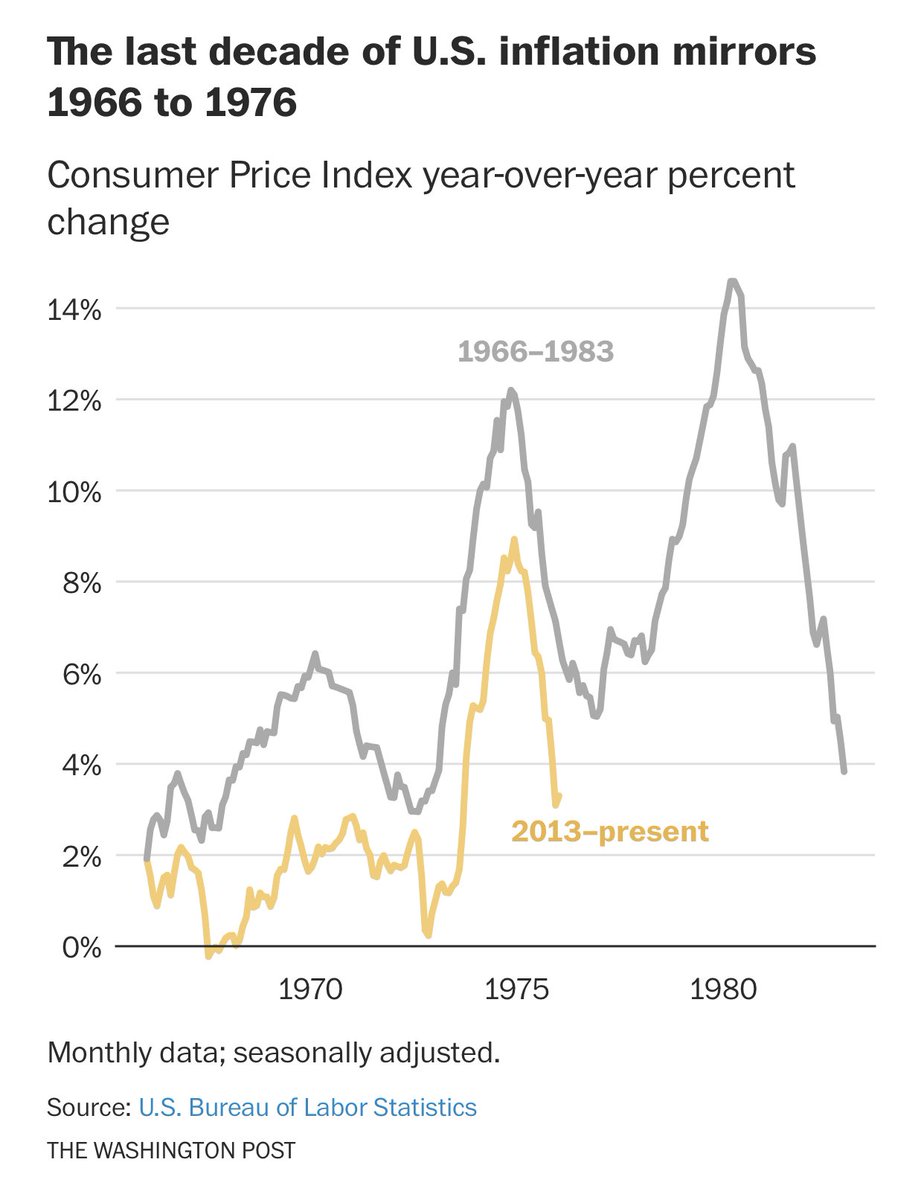
It is sobering to recall that the shape of the past decade’s inflation curve almost perfectly shadows its path from 1966 to 1976 before it accelerated in the late 1970s.
227
Arnab Bhattacharyya retweeted

Feb 9
.@SebastienBubeck is so so good; incredible researcher and leader.
397
73
2,766
763,603
Arnab Bhattacharyya retweeted

Jan 20
Me defending my O(n^3) solution to the coding interviewer.
413
4,947
48,971
3,976,483
I know nothing about the NS claims by @davidmbudden, but this comment strikes me as true. The fact that a Lean program compiles sans errors says nothing about whether a theorem has been proved...unless a human verifies that the program encodes a valid proof.
Jan 5

Lean gives you more features for hiding errors than it does for actually formalising math. By the time you're done with sorries, axioms, structure fields, admits, rfks, trivials, (n)linariths, and half-a-dozen I'm forgetting, trust me. You can "compile" any bullshit you want.
The process of convincing yourself that these *have* been used correctly, for a nontrivial proof, is no less effort (or error prone) than just eyeballing the paper in the first place. The compiler is far more likely to block you on its roll-a-dice version compatibility than any actual bug in your proof lol
1
536
Arnab Bhattacharyya retweeted

5 Dec 2025
We need more senior researchers camping out at their posters like this. Managed to catch 10 minutes of Alyosha turning @anand_bhattad’s poster into a pop-up mini lecture. Extra spark after he spotted @jathushan. Other folks in the audience: @HaoLi81 @konpatp @GurushaJuneja.
25
146
1,407
202,664
2 Dec 2025
I finally understand RL! 😁
1 Dec 2025

In honor of the 39th AI Winter, I’m going to spend the week disentangling the culture and code of reinforcement learning. There may be ranting... argmin.net/p/reformist-reinf…
363
Arnab Bhattacharyya retweeted

21 Oct 2025
It's beginning.
21 Oct 2025

I used ChatGPT to solve an open problem in convex optimization.
*Part I*
(1/N)
10
10
289
89,651
7 Oct 2025
Seeking Ph.D. candidates with research interests in theory and foundations of AI & ML: warwick.ac.uk/fac/sci/dcs/re….
🏁Apply by 14 November 2025
2
7
1,194
14 May 2024
In our paper, the domain is a high-dim space, and we want learning to be efficient in the dim. Notoriously open problem.
We make progress when C is constrained to have special graphical structure. Our algorithms are very natural when viewed thru the lens of online learning.
1
624
14 May 2024
Very proud of my PhD student, Philips. Watch out for more from him, connecting online learning to distribution PAC-learning type problems.
1
1
532
19 Sep 2025
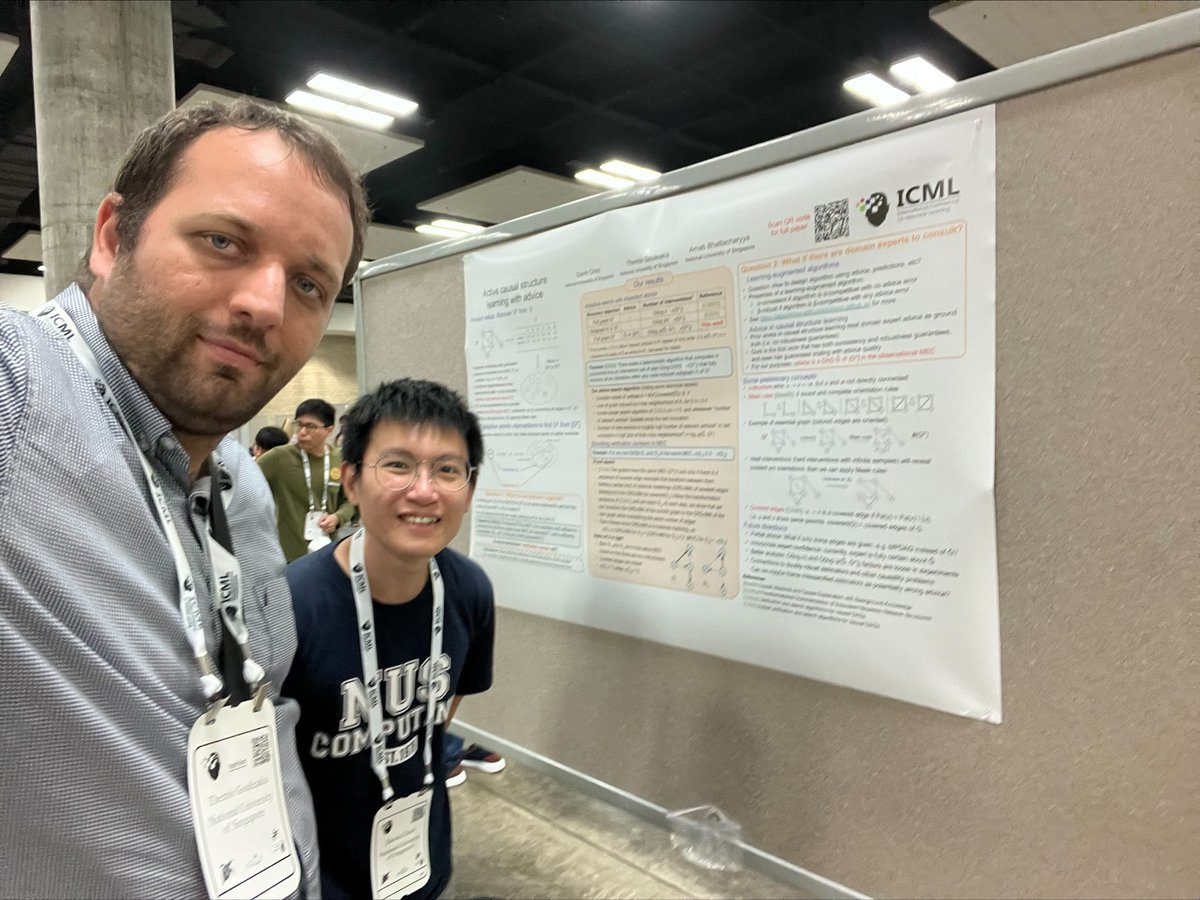
Proud advisor moment! My Ph.D. advisee, Davin Choo (cxjdavin.github.io/), postdoc at Harvard for a year now, got 4/4 NeurIPS accepts (including a spotlight). Look out for him at San Diego!
12
711
11 Sep 2025
Interesting work by Davin (cxjdavin.github.io/) and collaborators, applying the lens of learning-augmented algorithms to improving healthcare coverage in Ethiopia: arxiv.org/abs/2509.00135.
1
402
Arnab Bhattacharyya retweeted

4 Sep 2025
🚨 Submissions for ALT2026 are now open! Submit your best work and join us in Toronto!🚨
Deadline: October 2 AoE
Conference: Feb 23-26, 2026
algorithmiclearningtheory.or…
12
19
4,643
Arnab Bhattacharyya retweeted

6 Aug 2025
Dear Reviewers,
It is completely fine to admit you were wrong in your initial evaluations. You will not lose anything, and the authors, your AC, and your SAC will appreciate your intellectual honesty.
Best,
One of the SACs
2
16
172
9,218