
Joined June 2024
- Tweets 415
- Following 93
- Followers 25
- Likes 1,200
74 Photos and videos












Ajay Wankhade retweeted

Jun 13
The US government, citing national security authorities, has issued an export control directive to suspend all access to Fable 5 and Mythos 5 by any foreign national, whether inside or outside the United States, including foreign national Anthropic employees.
The net effect of this order is that we must abruptly disable Fable 5 and Mythos 5 for all our customers to ensure compliance.
Access to all other Claude models is not affected.
We apologize for this disruption to our customers. We believe this is a misunderstanding and are working to restore access as soon as possible.
Read our full statement: anthropic.com/news/fable-myt…
12,447
25,721
87,686
88,846,700

259
1,351
10,340
3,006,175
Ajay Wankhade retweeted

May 23
Perplexity just open-sourced the tool they use internally to keep their own developers safe. 😨
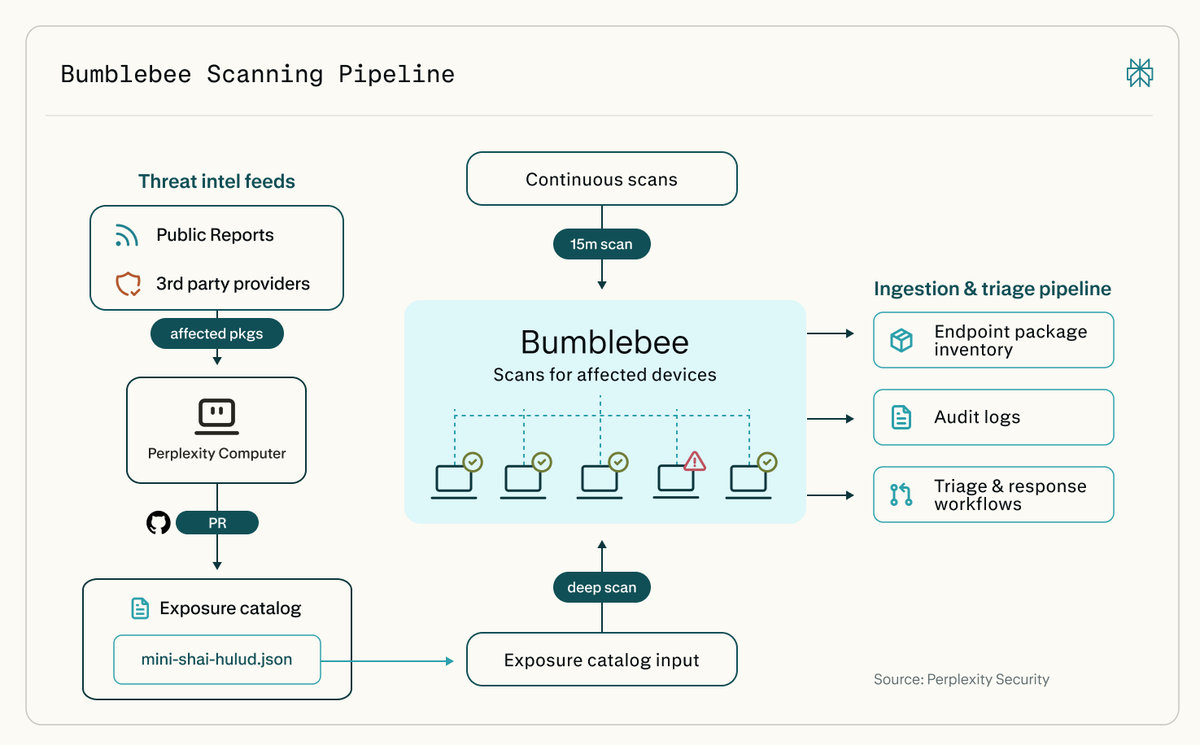
It's called Bumblebee. It runs quietly on a developer's laptop and checks for any sneaky code, suspicious browser plugins, or AI tools that might be silently leaking access to your data.
It covers Claude Code, Codex, Cursor, all of it.
Here is why this matters now.
For the last six months, hackers have been quietly slipping malicious code into the free building blocks that almost every app in the world is built on.
When a developer installs one of these poisoned pieces, the attacker gets a backdoor into everything that developer touches.
Including their AI tools and the keys that unlock them.
Most security tools defend the finished product. Bumblebee defends the person building it.
An independent security researcher read through the entire code and confirmed it is clean.
No hidden tracking. No data collection. No backdoors.
For two years, AI coding tools shipped with zero security defenses around them. Perplexity just shipped one. Free.
Worth installing if you build anything with AI.
May 22

Today we're open-sourcing Bumblebee, a read-only scanner for macOS and Linux.
It checks developer machines for risky packages, extensions, and AI tool configs.
Connected to Computer, it can trigger deeper scans whenever a new supply-chain risk emerges.
github.com/perplexityai/bumb…
38
291
3,290
823,069

May 24
Eye opening bitter reality
May 23

The govt has capitulated before the Supreme Court, despite it lifting the lifetime ban, and confirmed it will not involve Padma Shri Michel Danino in its academic exercises or textbook preparations in future.
Judicial Corruption is a reality. Punish Milord, not Michel. My Views:
13
Ajay Wankhade retweeted

Apr 23
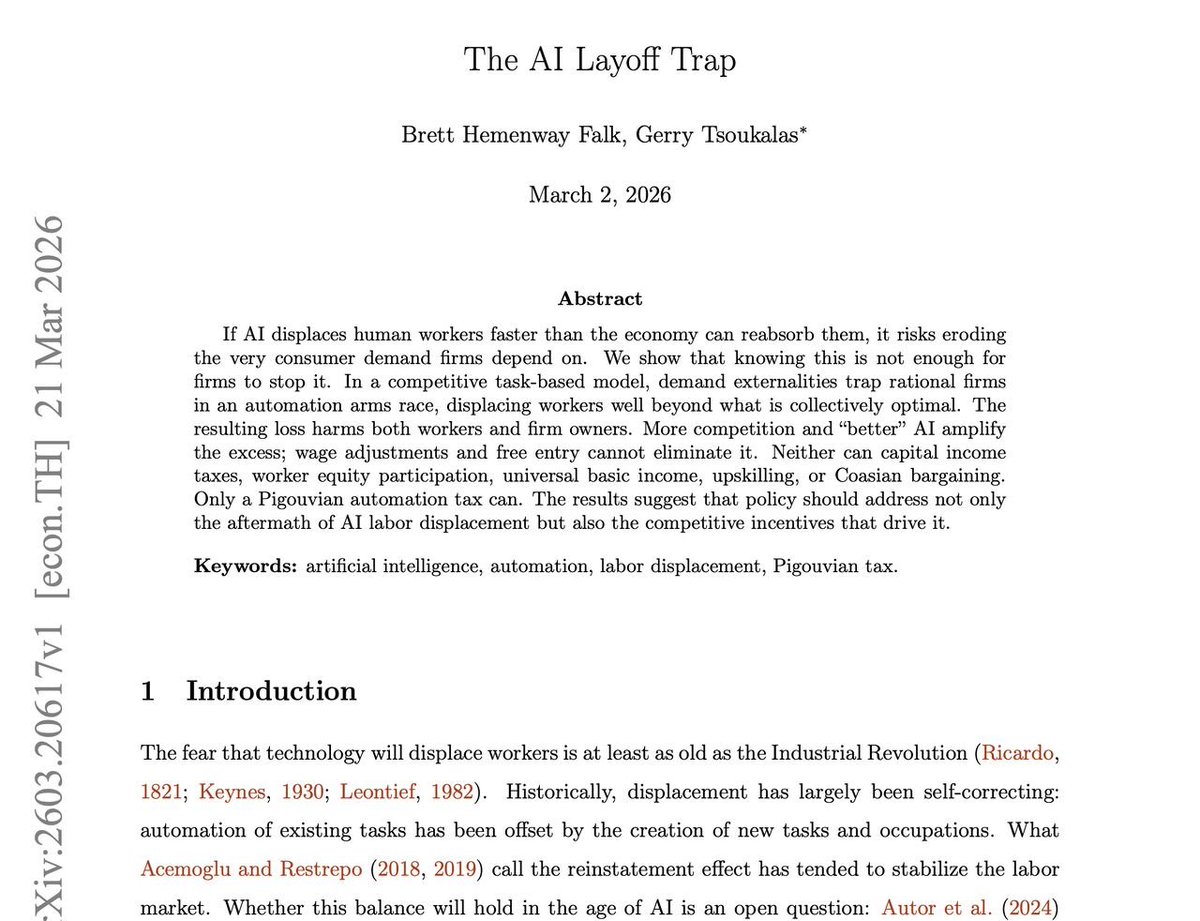
I was reading a recent research paper called "The AI Layoff Trap".
And it made me think.
Right now, everywhere you look… companies are laying off people and replacing roles with AI.
On the surface, it feels simple.
Less salary → more profit.
But the paper says something interesting.
When companies fire employees, they are also removing customers.
Those same people were earning and spending money.
If this keeps happening everywhere,
less income → less spending → less demand.
And that can actually hurt companies in the long run.
The strange part is, even if companies understand this, they still can’t stop.
Because if they don’t automate, someone else will.
So everyone keeps moving in the same direction… even if it’s risky.
The paper also talks about solutions.
Some things sound good, but don’t really fix the core problem:
Giving free money (UBI)
Taxing company profits
Upskilling alone
These help people, but they don’t change the incentive for companies to automate.
Some things help partially:
Better re-employment of workers
Giving employees equity
These reduce the problem, but don’t remove it.
According to the paper, the only thing that fully fixes this is:
A tax on automation itself.
So companies think twice before replacing humans.
I found this perspective quite interesting.
This is not just about “AI will take jobs”.
It’s about how the whole system behaves.
Curious what you think.
31
25
308
31,417

Anthropic said Mythos was too dangerous to release. Then four random guys in a Discord gained access on day one by guessing the URL...
This is pretty insane:
→ Group in a private Discord guessed the endpoint from Anthropic's naming conventions
→ They figured out the conventions from the leak in the Mercor breach three weeks ago
→ Used a contractor's legit eval credentials to walk in
→ Have been using it ever since to build simple websites
The AI that finds zero-days in every operating system on earth was defeated by address bar autocomplete... big yikes

Anthropic's Mythos has been accessed by a small group of unauthorized users, raising questions about control of the AI model bloomberg.com/news/articles/…
272
2,282
24,302
3,975,967

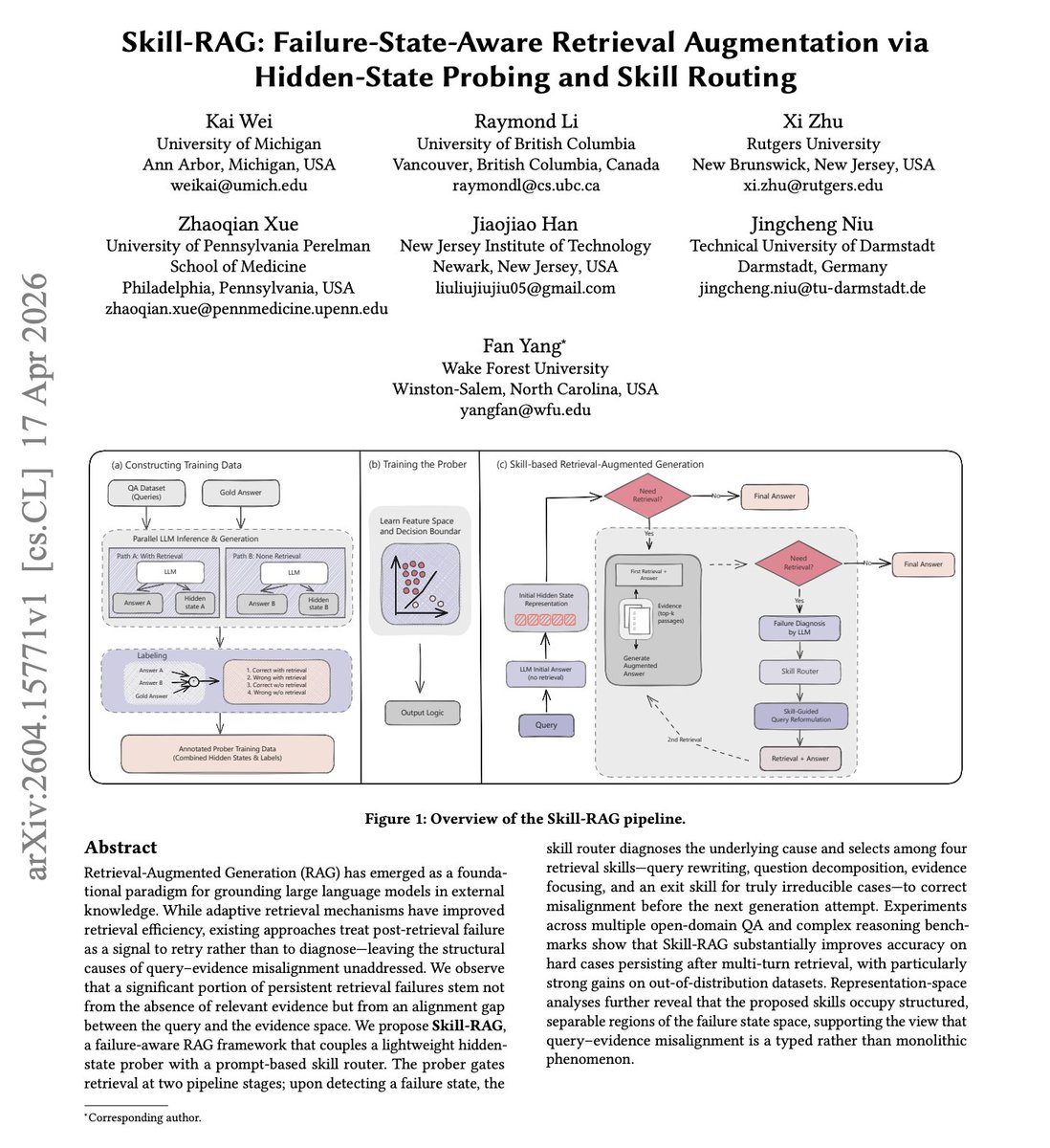
Nice paper combining the strength of Skills and RAG.
Most RAG systems retrieve on every query, whether the model needs help or not. This is wasteful when the model already knows the answer, and often too late when it does not.
New research introduces Skill-RAG, a failure-state-aware retrieval system. It uses hidden-state probing to detect when an LLM is approaching a knowledge failure, then routes the query to a specialized retrieval strategy matched to the gap.
Evaluated on HotpotQA, Natural Questions, and TriviaQA, the approach improves over uniform RAG baselines on both efficiency and accuracy.
Why does it matter?
RAG is moving from a single monolithic pipeline to a suite of skills an agent selects between. Knowing when to retrieve and what kind of retrieval to run will matter more than raw retriever quality as agents take on multi-step reasoning, where a single bad lookup derails the whole chain.
Paper: arxiv.org/abs/2604.15771
Learn to build effective AI agents in our academy: academy.dair.ai/
22
135
741
53,065
Ajay Wankhade retweeted

Apr 20
Microsoft just solved the context window problem.
Right now, every AI suffers from a fatal flaw: the "context window problem."
When an AI reasons through a complex problem, it generates a massive chain-of-thought. But there is a catch. It has to keep every single token of that thought in its active memory.
The technical term is the "KV Cache."
The longer the AI thinks, the heavier it gets. It slows down. It gets expensive. Eventually, it runs out of space.
We thought the only fix was renting bigger, more expensive cloud GPUs to hold all that context.
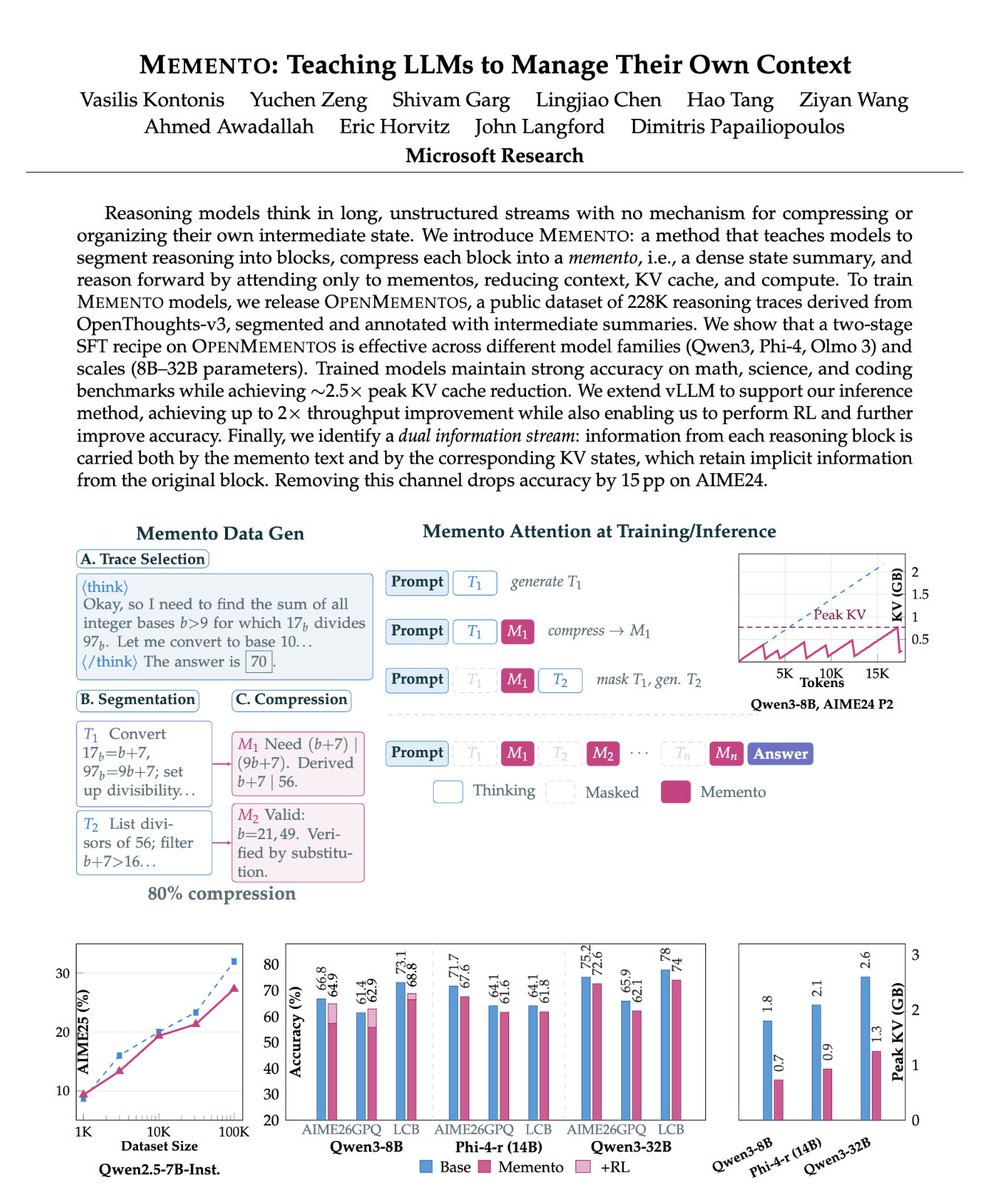
Microsoft just proved us wrong. They published a paper called "MEMENTO."
Instead of giving the AI a bigger memory, they taught it how to forget.
Here is how it works:
Instead of generating one endless stream of consciousness, a Memento-trained model breaks its reasoning into small blocks.
After it finishes a block, it writes a dense, highly compressed summary of its own logic—a "memento."
Then, it does something unprecedented.
It physically deletes the entire previous reasoning block from its memory cache.
It only carries the memento forward. The model reasons, extracts the core logic, and instantly drops the dead weight.
The results rewrite the economics of running AI.
• Context length compressed by 6x.
• Active memory usage (KV cache) reduced by 2.5x.
• Zero loss in math, science, or coding accuracy.
And here is the real implication.
Big tech has been charging you by the token for massive context windows you don't actually need.
With this architecture, small businesses and solo operators can run complex, multi-step autonomous agents entirely locally.
You don't need an enterprise cloud setup. A standard machine running an open-source model can now reason indefinitely without overflowing its memory. No API fees. Complete privacy.
We spent the last two years trying to give AI an infinite memory.
It turns out, the secret to smarter AI isn't remembering everything.
It's knowing exactly what to forget.
39
133
631
60,489
Apr 21
Keep shipping 😂


5


VERCEL GOT HACKED
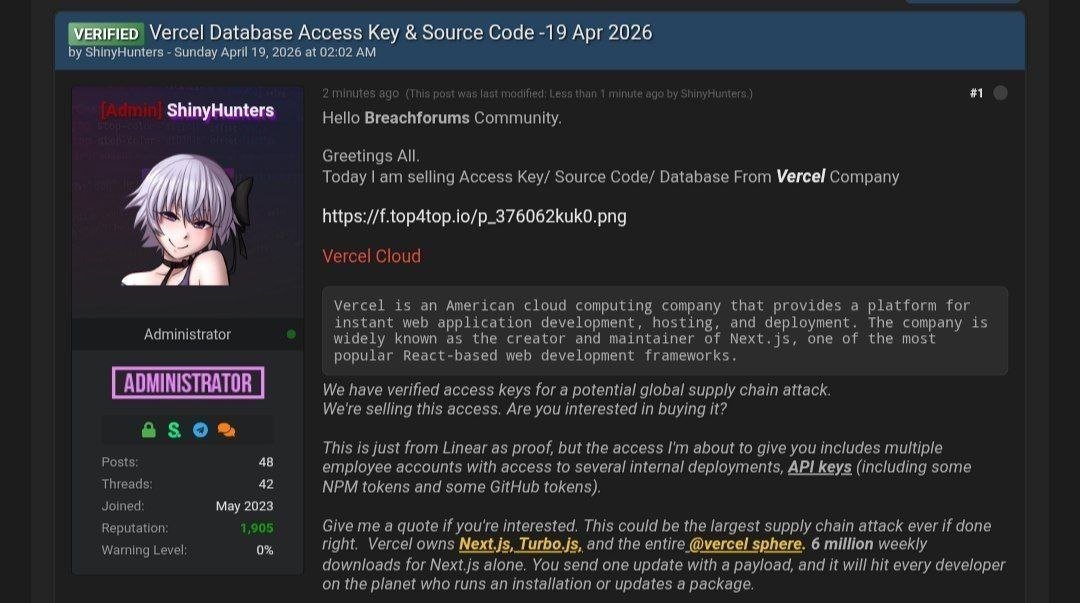
ShinyHunters - the group behind the Ticketmaster breach - is selling Vercel's internal database for $2M on BreachForums
here's why every developer should care:
- they have NPM tokens and GitHub tokens
- Vercel owns Next.js - 6 million weekly downloads
- one malicious push = global supply chain attack
- Vercel confirmed the breach today, April 19
- they literally DMed the hackers on Telegram asking them to stop
rotate your env variables RIGHT NOW
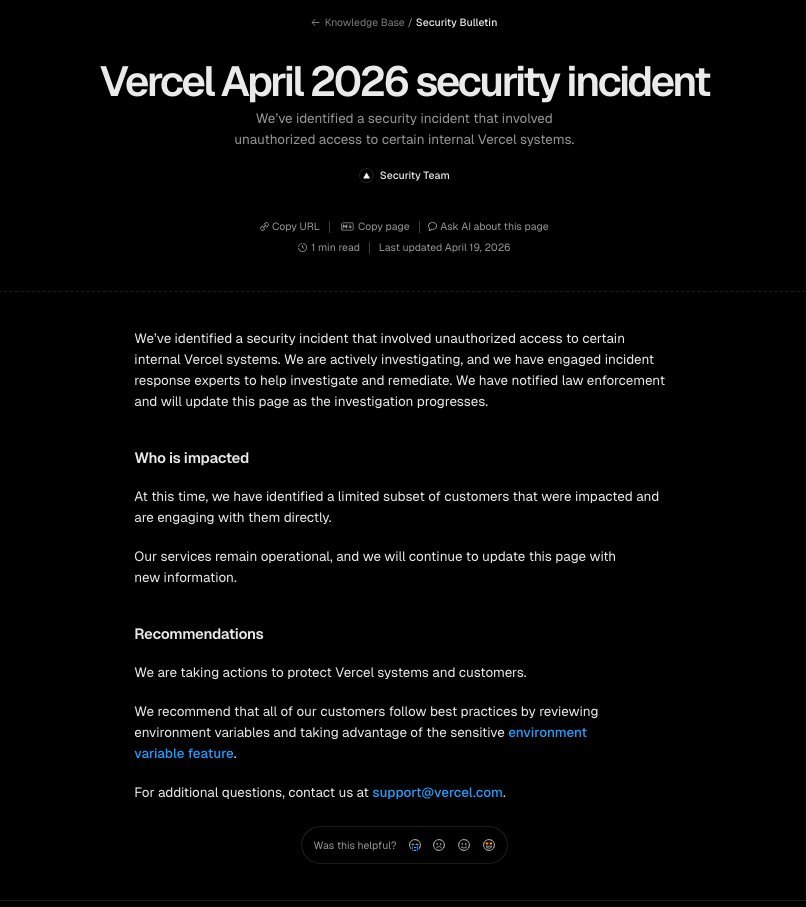

We’ve identified a security incident that involved unauthorized access to certain internal Vercel systems, impacting a limited subset of customers. Please see our security bulletin:
vercel.com/kb/bulletin/verce…
288
1,654
10,103
2,450,980
Ajay Wankhade retweeted

Apr 20
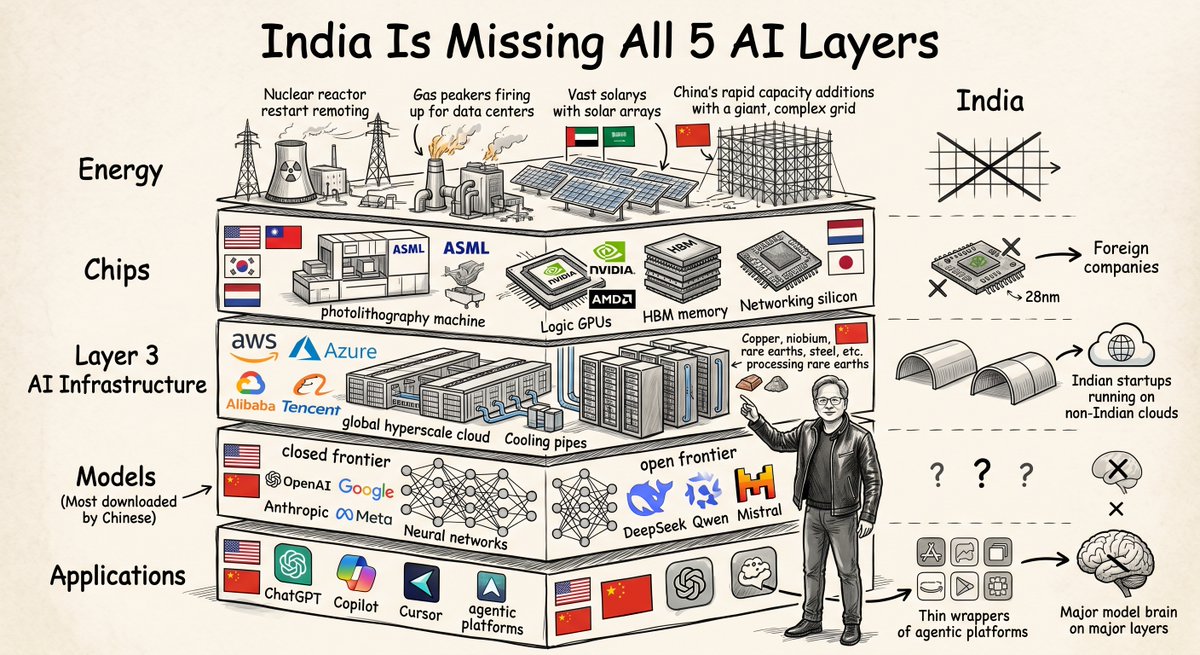
Jensen Huang said AI has 5 layers of value. India doesn't have a presence in any of them.
⚡ Layer 1 — Energy. A hyperscale AI campus now draws 1–2 gigawatts — a mid-sized nuclear reactor, for one building. China added nearly India's entire installed grid in new capacity last year.
💾 Layer 2 — Chips. The silicon brain and everything that makes it.
→ GPUs: Nvidia (US), AMD (US), Broadcom (US) design. TSMC (Taiwan) fabs at the cutting edge.
→ HBM, the high-speed memory beside every GPU: ~90% Korea.
→ ASML (Netherlands) has a monopoly on the one machine that prints the most advanced chips.
→ Silicon wafers ~60% Japan. Photoresist ~90% Japan.
🏭 Layer 3 — AI infrastructure. The data centre and everything around the chips.
→ Hyperscale cloud: AWS (US), Azure (US), GCP (US); Alibaba (China), Tencent (China).
→ Servers and AI-rack cooling: Supermicro (US), Vertiv (US), Schneider (France), Eaton (US).
→ Commodities: copper (Chile, Peru), niobium (~90% Brazil), rare earths (~85% processed in China).
🧠 Layer 4 — Models. Closed: OpenAI (US), Anthropic (US), Google (US), Meta (US). Open: DeepSeek (China), Qwen (China), Kimi (China).
💻 Layer 5 — Applications. ChatGPT (US), Copilot (US), Cursor (US), Claude Code (US), Agentforce (US). Mostly US. Increasingly Chinese.
China has a presence in all 5. Korea owns HBM. Taiwan owns the cutting-edge factory. Netherlands owns the machine that makes it possible.
India:
Layer 1 — grid stretched, industrial power expensive and patchy. 24/7 clean power is hard to deliver today.
Layer 2 — no frontier chip factory. Tata-PSMC (India-Taiwan) at ~28nm is a decade behind AI chips. India's chip design talent works for Nvidia (US), AMD (US), Qualcomm (US), Intel (US). Value flows to US balance sheets.
Layer 3 — India builds the data center buildings (Yotta, Adani, Reliance) and generic industrial power and cooling gear (BHEL, Crompton, Blue Star). But no hyperscale cloud, and no specialized AI-rack cooling or power shelves. Every Indian AI startup runs on AWS (US) or Azure (US).
Layer 4 — Sarvam, Krutrim (India). Real teams, orders of magnitude below the frontier.
Layer 5 — Zoho, Freshworks (India) are real SaaS businesses, but their AI features — like most Indian AI-app startups — are thin wrappers on OpenAI (US), Anthropic (US), Google (US). And not agentic. Agents are where the flywheel lives. India has no agentic platform at that scale.
This is a 30-year-old choice. India bet on services and not manufacturing. TCS, Infosys, Wipro, HCL (India) built a ~$250B export industry. It paid off. But services sit above the stack — they don't own any layer of it.
India's AI Mission is ~$1B. China's is in the hundreds of billions. That's not a gap to close — it defines the game.
114
609
2,108
148,713
Apr 21
Woke up to the Vercel news. 🫠 Looks like a third-party AI tool (Context.ai) was the weak link. If you’ve got environment variables not marked as "sensitive," might be time for a quick rotation. Stay safe out there!
#Vercel #WebDev
94

Silicon Valley literally had everything.
Apr 20

BREAKING: Vibe-coding platform Lovable reportedly suffered a breach that exposed users’ AI chat histories, source code, & database credentials.
15
285
5,765
477,032
Apr 13
He saw Jallianwala Bagh.
He carried that pain for 21 years.
Udham Singh became the answer to a massacre the world tried to forget.
Today, as we remember Jallianwala Bagh, we also remember the man who never let its wounds fade.
शहीद उधम सिंह को नमन।
#जलियांवाला_बाग_हत्याकांड
1
6
Apr 13
13 April 1919 - Jallianwala Bagh
Hundreds of innocent Indians were killed without warning in Amritsar, a tragedy that shook the entire nation.
Today, we remember their sacrifice with silence and respect.
शहीदांना विनम्र अभिवादन। 🇮🇳
2
Apr 10
Fullstack dev here (Python, FastAPI, React, AWS, Postgres) but never really touched DSA.
Planning to start from scratch.
What’s the most practical way to begin?
Good lectures/resources that actually help, not just theory?
#dsa
#python
#buildinpublic
2
22
Apr 10
The IDE is becoming a fallback, not the default.
With "vibe-coding" and agent-led development, we’re moving to a "Model-as-the-Machine" era. Is a Senior Engineer who doesn't code but only audits AI-generated PRs, still an Engineer?
#SoftwareDevelopment #AI #Coding
2
2
54
Ajay Wankhade retweeted

Apr 9
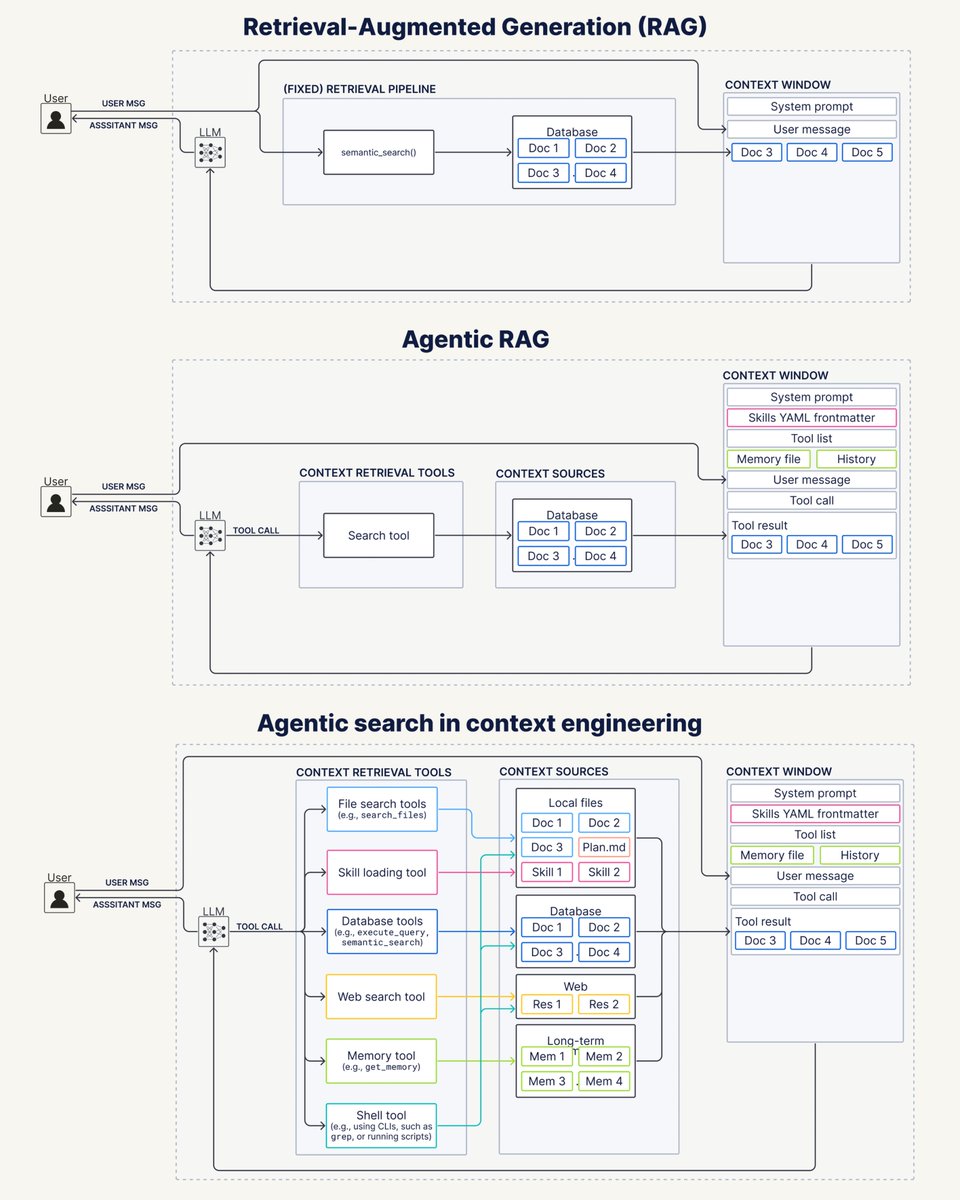
Is context engineering the new RAG?
(Hint: They are both about 𝗯𝘂𝗶𝗹𝗱𝗶𝗻𝗴 𝘁𝗵𝗲 𝗟𝗟𝗠’𝘀 𝗰𝗼𝗻𝘁𝗲𝘅𝘁)
𝗥𝗔𝗚 (𝟮𝟬𝟮𝟬-𝟮𝟬𝟮𝟯): One-shot retrieval
• Fixed retrieval pipelie
• Always retrieve context (whether you need it or not)
• Retrieve exactly once (even if you need more info)
𝗔𝗴𝗲𝗻𝘁𝗶𝗰 𝗥𝗔𝗚 (𝟮𝟬𝟮𝟯-𝟮𝟬𝟮𝟰): Multi-hop retrieval through tool usage
• Retrieval becomes a tool the agent can choose to use
• Agent decides: Do I need to retrieve? Is this context even relevant? Do I need more?
• Can route to different indexes
𝗔𝗴𝗲𝗻𝘁𝗶𝗰 𝘀𝗲𝗮𝗿𝗰𝗵 𝗶𝗻 𝗖𝗼𝗻𝘁𝗲𝘅𝘁 𝗘𝗻𝗴𝗶𝗻𝗲𝗲𝗿𝗶𝗻𝗴 (𝟮𝟬𝟮𝟱 ): Combine multiple retrieval tools for context engineering
• Context is scattered across different context sources (database, filesystem, web, memory)
• Combine different context retrieval tools
• Agent builds its own context
Essentially, we’ve moved from ‘retrieve once’ to ‘the agent builds its own context’.
Yesterday, I gave a workshop on this topic.
Find the slides and code on this in my GitHub repo:
github.com/iamleonie/worksho…
45
249
1,446
103,374