
20 Photos and videos












Cool to see @merklefruit expand on my piece in this direction
A lot of futarchy objections feel like Goodhart's Law in mechanism form
The "Cost to Flip" framing is interesting because once market outputs become binding, we need to reason about the cost of corruption, not just whether the market is "accurate"
Related to how chains converged to PoS bc adversarial environments need economic security
Futarchy needs clean specs so traders price policy effects instead of ambiguity. But once prices control decisions, the whole mechanism becomes an attack surface: metrics, liquidity, oracles, decision rules, and implementation details

4
3
14
3,456
gm. Beautiful day for pundits to have track records
Accountability infra just shipped

Introducing claim markets
Claim markets translate what people say into prediction market positions in real-time.
Track the performance of claims made by Nate Silver, Stephen A. Smith, Vitalik Buterin, and others.
4
10
1,080
alan retweeted

Mar 25
props to @alanwu. this is one of the clearest pieces on where prediction markets actually go next
my top 3 takeaways (esp. for builders):
1. prediction markets scale when non-traders rely on them not when more degens show up
→ build for signal consumption, not just trading
2. the best markets wont sustain themselves, the price is a public good
→ you need intentional subsidies (fun markets funding useful ones)
3. prediction markets arent just probability engines
they’re about hedging capital-backed truth
→ in an AI world, money > opinions
if you’re building:
focus on markets the world would actually use if they existed
worth reading the full piece 👇

2
1
7
776
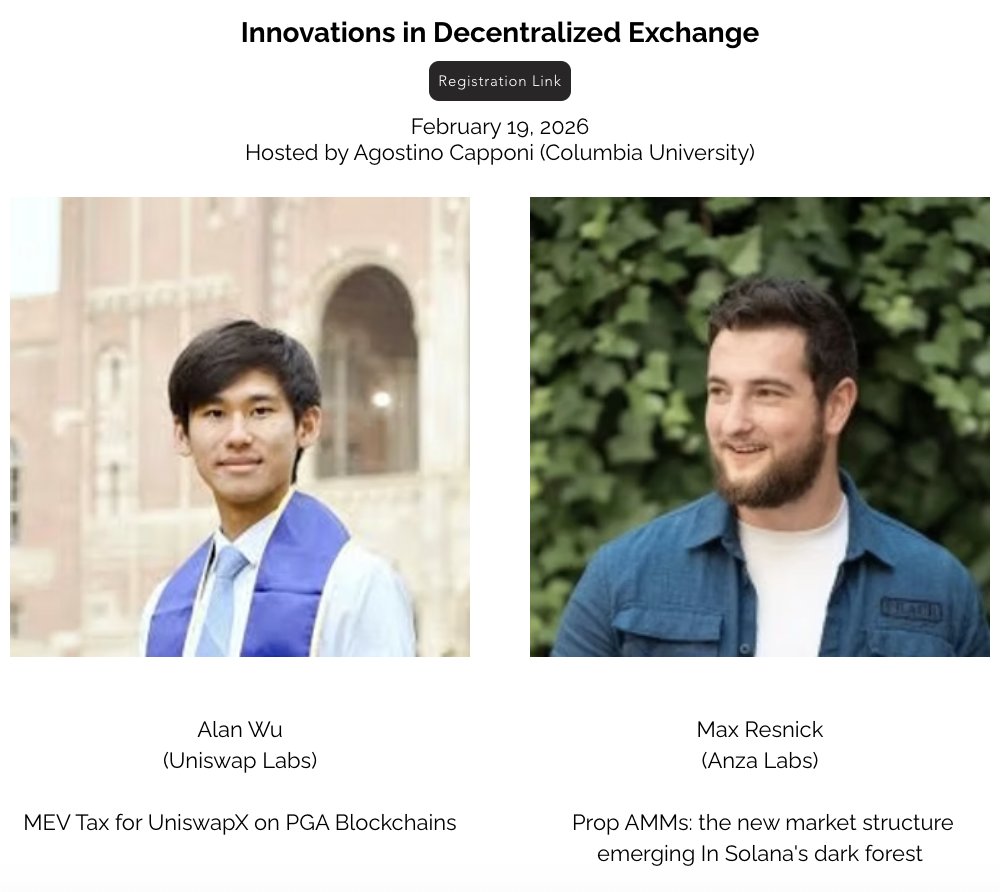
Talking tomorrow at the Crypto and Blockchain Economics Research Forum about MEV taxes for UniswapX on PGA chains
@MaxResnick from Anza is also presenting on prop AMMs
Two different DEX designs. Should be a good one.
Tap in at 11 AM ET on Zoom: cber-forum.org/
4
4
42
5,672
alan retweeted

Feb 17
Permissionless liquidity sponsorship is a step in the right direction.
Will be keeping track of the short/medium-term equilibrium between platform vs public incentives, along with the second-order consequences of anyone being able to sponsor and capture incentives.
Feb 17

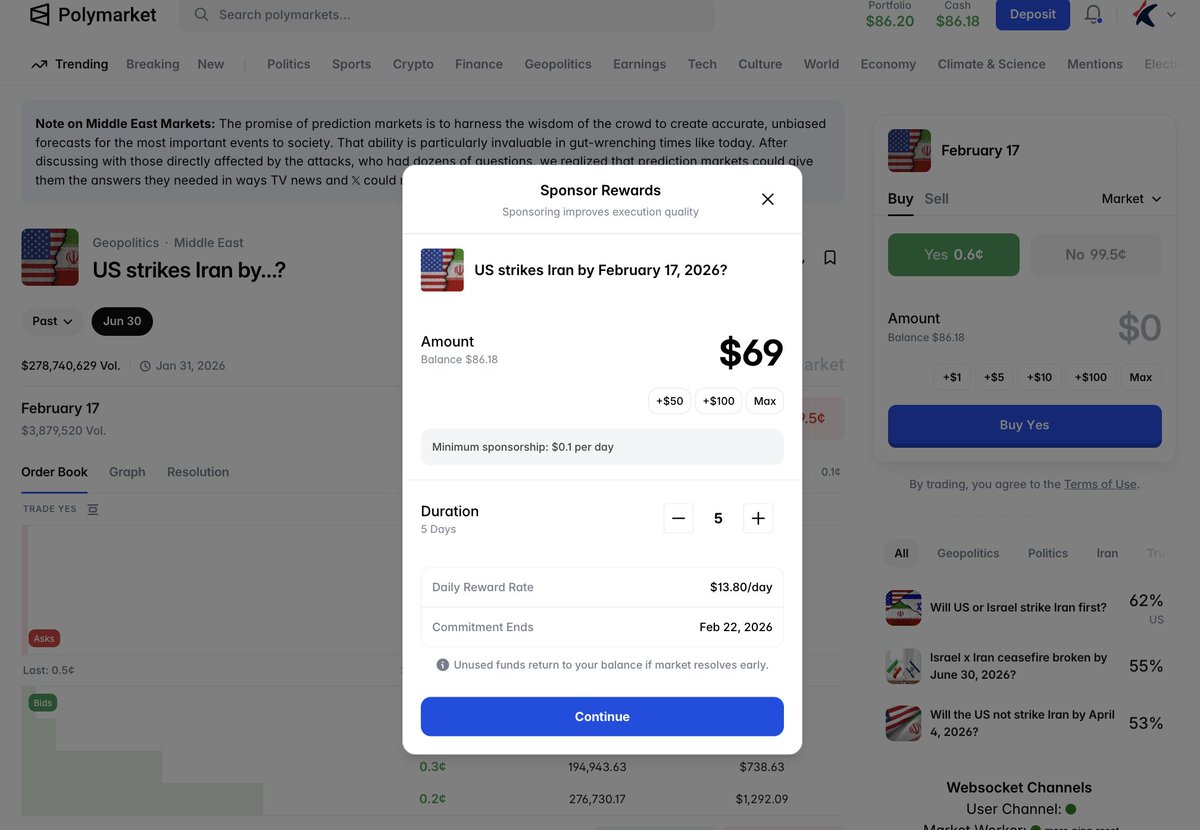
sponsoring market rewards is now open to all users 😛
add rewards to any market to get the liquidity for the size you want to trade.
permissionless market deployment and creator fees next...
1
13
1,132
alan retweeted

Feb 14
Recently I have been starting to worry about the state of prediction markets, in their current form. They have achieved a certain level of success: market volume is high enough to make meaningful bets and have a full-time job as a trader, and they often prove useful as a supplement to other forms of news media. But also, they seem to be over-converging to an unhealthy product market fit: embracing short-term cryptocurrency price bets, sports betting, and other similar things that have dopamine value but not any kind of long-term fulfillment or societal information value. My guess is that teams feel motivated to capitulate to these things because they bring in large revenue during a bear market where people are desperate - an understandable motive, but one that leads to corposlop.
I have been thinking about how we can help get prediction markets out of this rut. My current view is that we should try harder to push them into a totally different use case: hedging, in a very generalized sense (TLDR: we're gonna replace fiat currency)
Prediction markets have two types of actors: (i) "smart traders" who provide information to the market, and earn money, and necessarily (ii) some kind of actor who loses money.
But who would be willing to lose money and keep coming back? There are basically three answers to this question:
1. "Naive traders": people with dumb opinions who bet on totally wrong things
2. "Info buyers": people who set up money-losing automated market makers, to motivate people to trade on markets to help the info buyer learn information they do not know.
3. "Hedgers": people who are -EV in a linear sense, but who use the market as insurance, reducing their risk.
(1) is where we are today. IMO there is nothing fundamentally morally wrong with taking money from people with dumb opinions. But there still is something fundamentally "cursed" about relying on this too much. It gives the platform the incentive to seek out traders with dumb opinions, and create a public brand and community that encourages dumb opinions to get more people to come in. This is the slide to corposlop.
(2) has always been the idealistic hope of people like Robin Hanson. However, info buying has a public goods problem: you pay for the info, but everyone in the world gets it, including those who don't pay. There are limited cases where it makes sense for one org to pay (esp. decision markets), but even there, it seems likely that the market volumes achieved with that strategy will not be too high.
This gets us to (3). Suppose that you have shares in a biotech company. It's public knowledge that the Purple Party is better for biotech than the Yellow Party. So if you buy a prediction market share betting that the Yellow Party will win the next election, on average, you are reducing your risk.
Mathematical example: suppose that if Purple wins, the share price will be a dice roll between [80...120], and if Yellow wins, it's between [60...100]. If you make a size $10 bet that Yellow will win, your earnings become equivalent to a dice roll between [70...110] in both cases. Taking a logarithmic model of utility, this risk reduction is worth $0.58.
Now, let's get to a more fascinating example. What do people who want stablecoins ultimately want? They want price stability. They have some future expenses in mind, and they want a guarantee that will be able to pay those expenses. But if crypto grows on top of USD-backed stablecoins, crypto is ultimately not truly decentralized. Furthermore, different people have different types of expenses. There has been lots of thinking about making an "ideal stablecoin" that is based on some decentralized global price index, but what if the real solution is to go a step further, and get rid of the concept of currency altogether?
Here's the idea. You have price indices on all major categories of goods and services that people buy (treating physical goods/services in different regions as different categories), and prediction markets on each category. Each user (individual or business) has a local LLM that understands that user's expenses, and offers the user a personalized basket of prediction market shares, representing "N days of that user's expected future expenses".
Now, we do not need fiat currency at all! People can hold stocks, ETH, or whatever else to grow wealth, and personalized prediction market shares when they want stability.
Both of these examples require prediction markets denominated in an asset people want to hold, whether interest-bearing fiat, wrapped stocks, or ETH. Non-interest-bearing fiat has too-high opportunity cost, that overwhelms the hedging value. But if we can make it work, it's much more sustainable than the status quo, because both sides of the equation are likely to be long-term happy with the product that they are buying, and very large volumes of sophisticated capital will be willing to participate.
Build the next generation of finance, not corposlop.
926
691
4,940
1,008,627
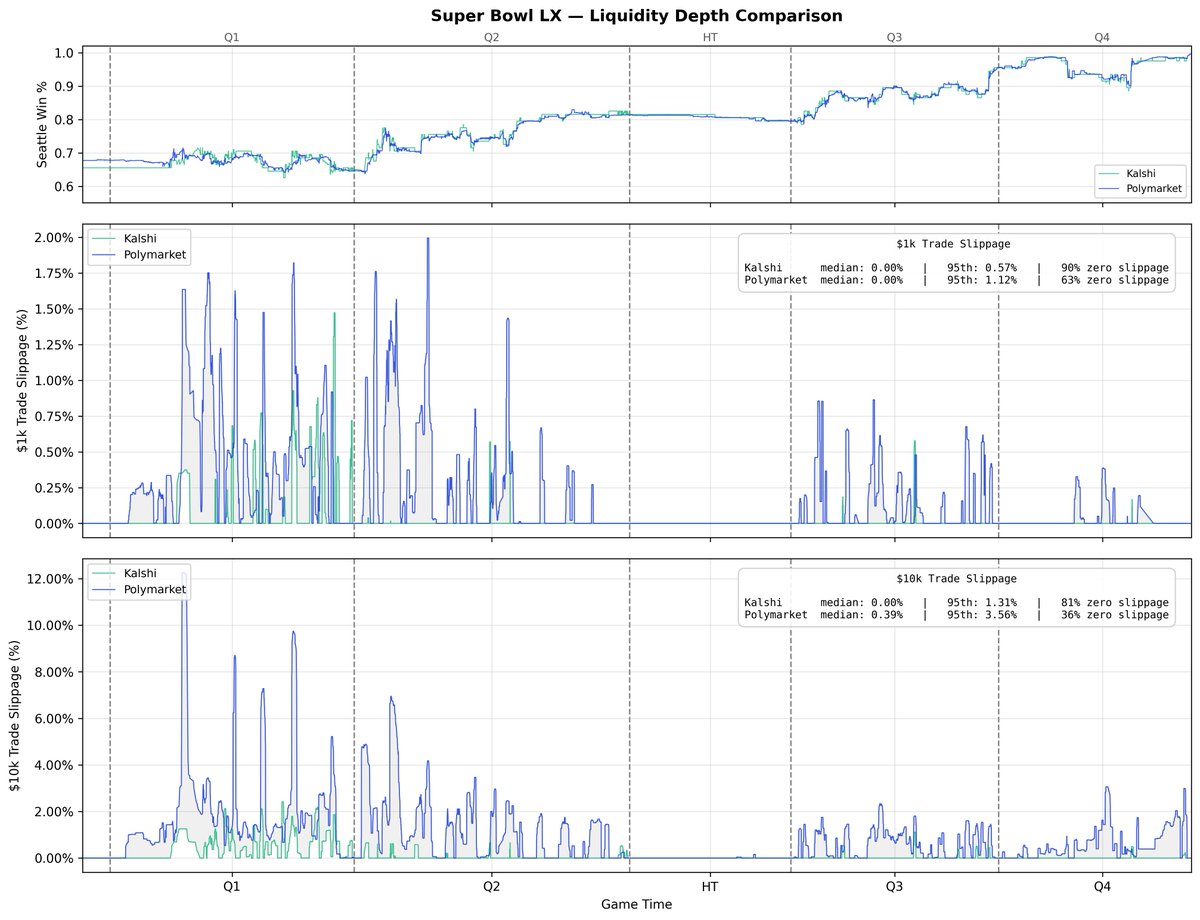
Tracked liquidity depth on @Polymarket and @Kalshi throughout the Super Bowl last night
Here's what $1k and $10k trades would have looked like
5
2
48
25,726
Politics is currently the largest category by open interest on prediction markets
The questions that can affect your life finally have price discovery on truth
Bearish on yellow journalism for the first time ever
Feb 4

new from paradigm: we are building a tool for exploring prediction market data
try it out today. I bet you'll find new markets you never knew existed
1
7
527

Shohei is part of the @WHOOP club! Couldn’t track him down on the community leaderboard though 😂



2
1,023