
Joined June 2024
- Tweets 63
- Following 1
- Followers 4,868
- Likes 73
34 Photos and videos
Pinned Tweet

May 14
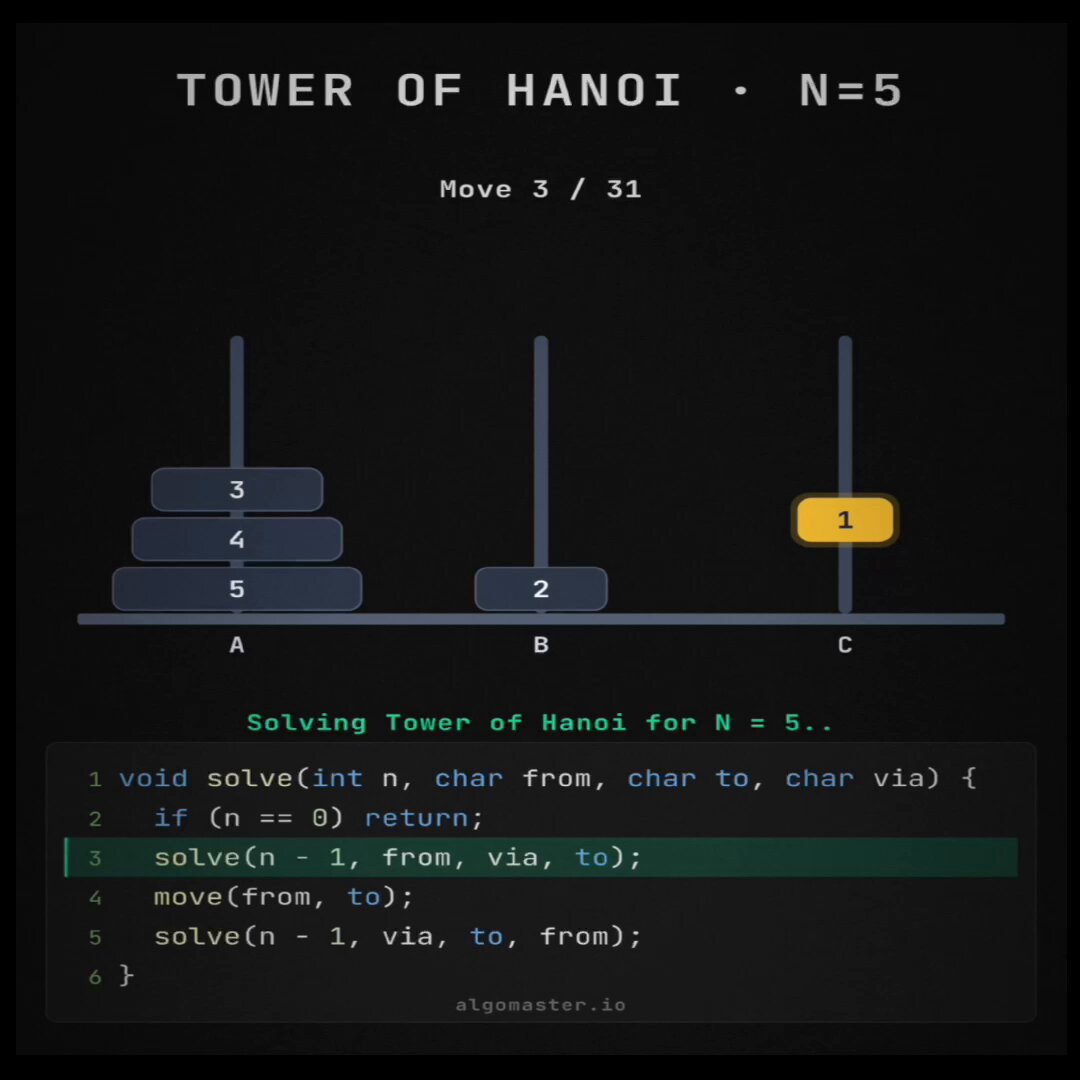
Tower of Hanoi - Recursion Visualization
14
241
2,149
385,924
May 21
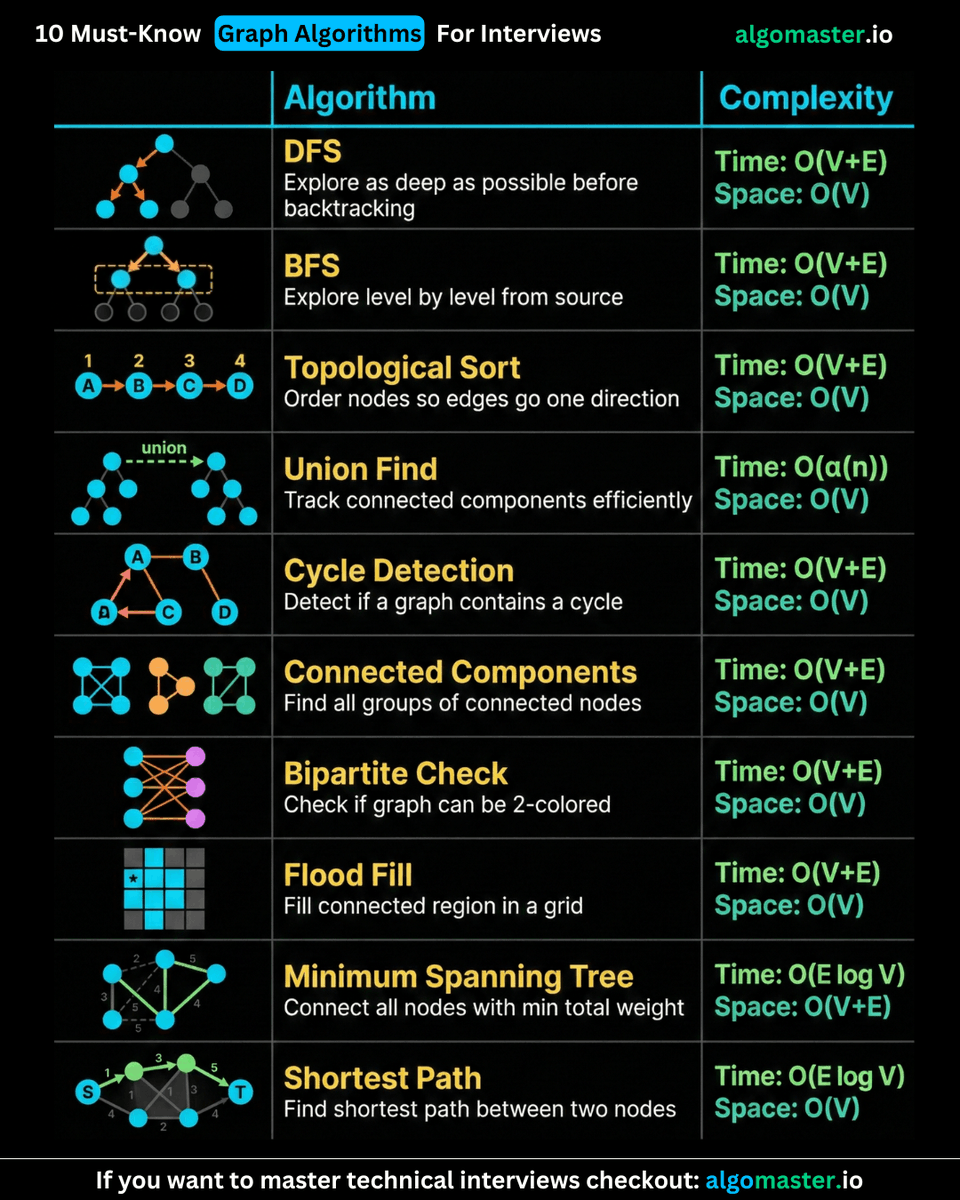
10 Must-Know Graph Algorithms for Coding Interviews:
1. DFS (Depth-First Search)
2. BFS (Breadth-First Search)
3. Topological Sort
4. Union Find (Disjoint Set)
5. Cycle Detection
6. Connected Components
7. Bipartite Check
8. Flood Fill
9. Minimum Spanning Tree
10. Shortest Path (Dijkstra)
♻️ Repost to help others in your network
6
130
659
18,980
May 21
👉 If you want to master all important algorithms and patterns for coding interviews checkout algomaster.io
4
502
May 16
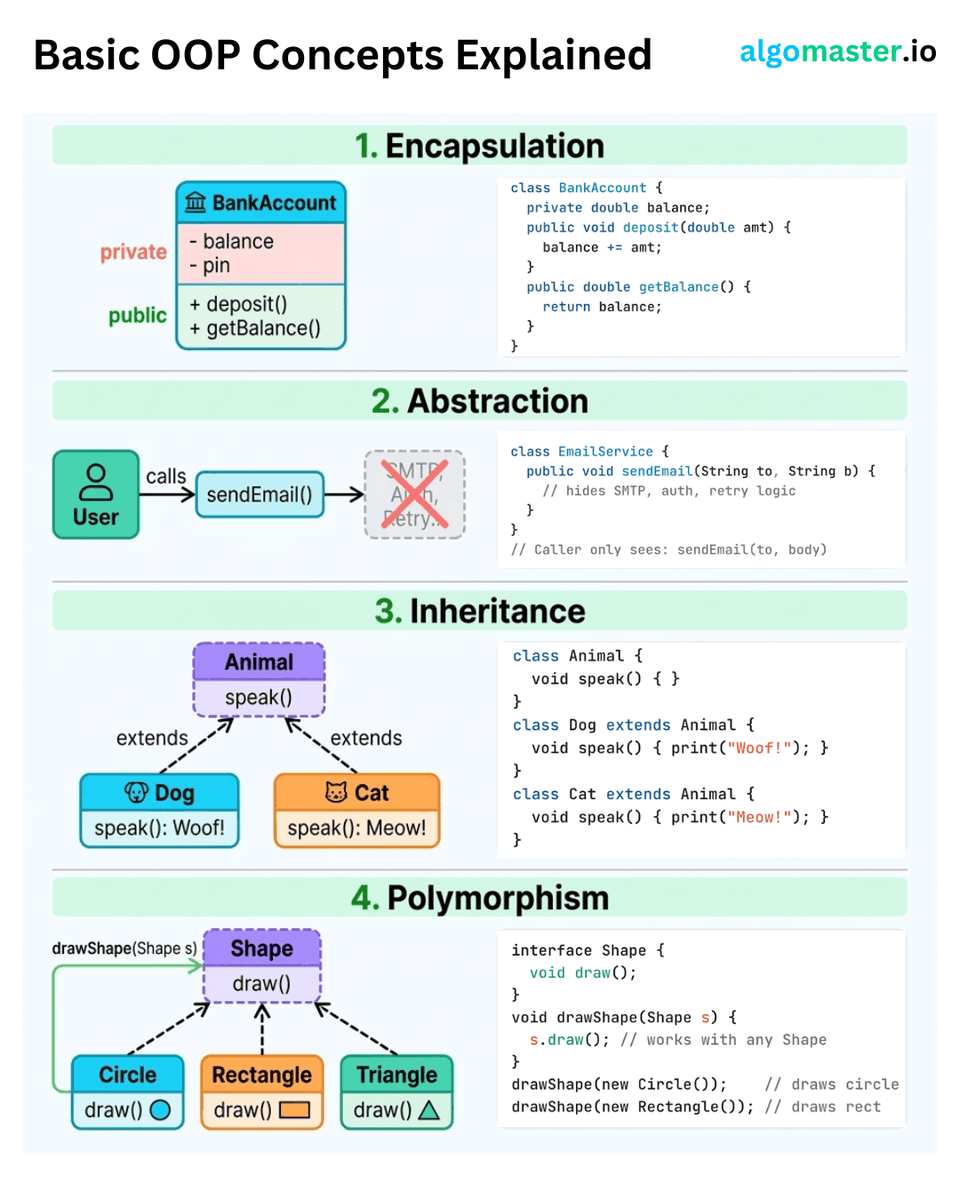
Basic OOP Concepts Explained with Clear Examples:
1. 𝐄𝐧𝐜𝐚𝐩𝐬𝐮𝐥𝐚𝐭𝐢𝐨𝐧
Hide internal data behind public methods.
- Example: A BankAccount class keeps balance and pin private. The only way to interact with it is through deposit() and getBalance().
2. 𝐀𝐛𝐬𝐭𝐫𝐚𝐜𝐭𝐢𝐨𝐧
Expose a simple interface, hide the complexity behind it.
- Example: An EmailService class gives you sendEmail(to, body). Internally, it handles SMTP connections, authentication, and retry logic. The caller doesn't need to know any of that. They just call one method and it works.
3. 𝐈𝐧𝐡𝐞𝐫𝐢𝐭𝐚𝐧𝐜𝐞
Let child classes reuse and override behavior from a parent class.
- Example: An Animal class defines speak(). Dog extends it and returns "Woof!", Cat extends it and returns "Meow!". Shared logic lives in one place, and each subclass customizes what it needs.
4. 𝐏𝐨𝐥𝐲𝐦𝐨𝐫𝐩𝐡𝐢𝐬𝐦
Write code that works with multiple types through a common interface.
- Example: Define a Shape interface with a draw() method. Now Circle, Rectangle, and Triangle each implement draw() their own way. A single drawShape(Shape s) method works with all of them.
♻️ Repost to help others learn this
7
205
1,032
34,987
AlgoMaster.io retweeted
May 15
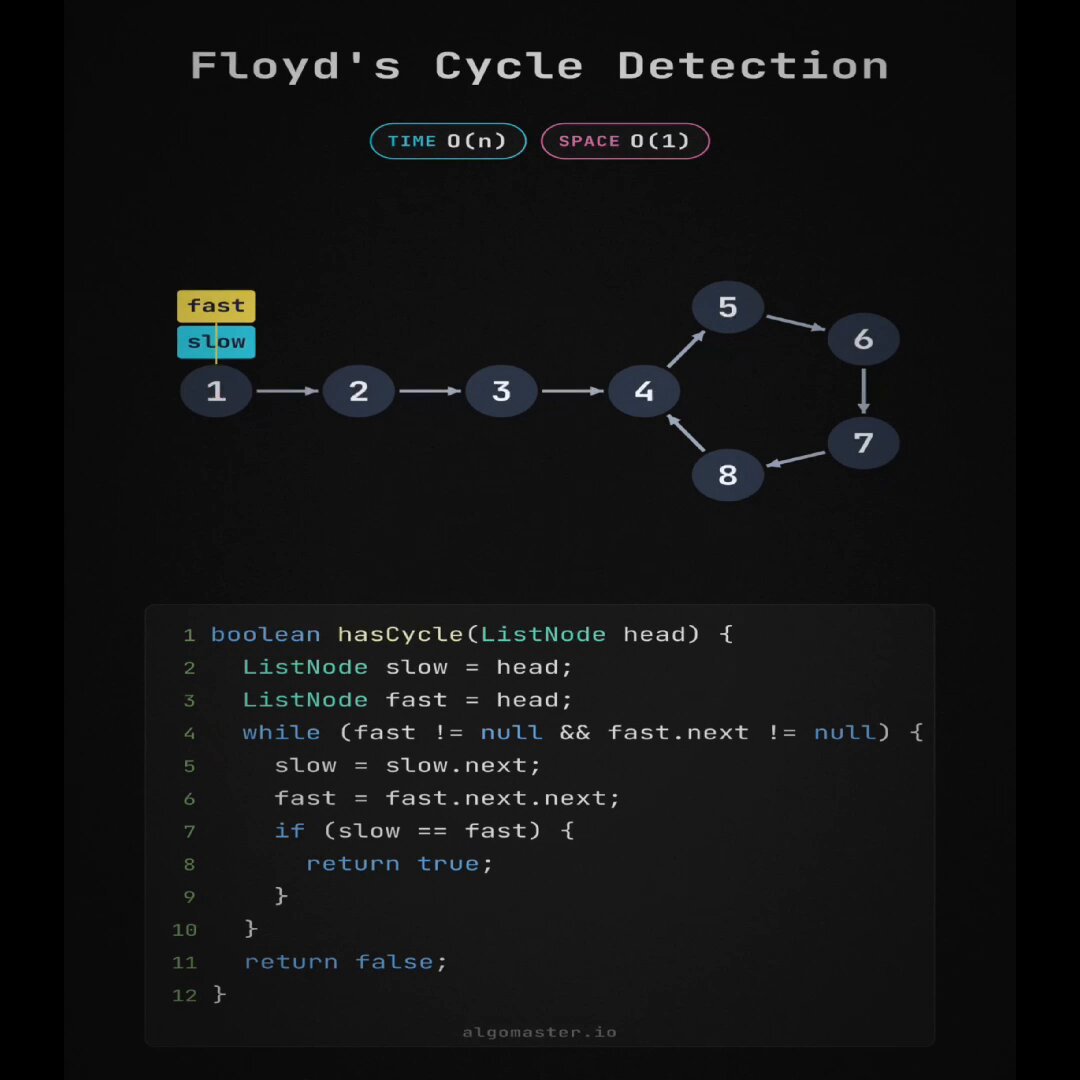
𝐇𝐨𝐰 𝐭𝐨 𝐅𝐢𝐧𝐝 𝐚 𝐂𝐲𝐜𝐥𝐞 𝐢𝐧 𝐚 𝐋𝐢𝐧𝐤𝐞𝐝 𝐋𝐢𝐬𝐭
Use Floyd’s Cycle Detection Algorithm, also known as the slow and fast pointer technique.
Start two pointers at the head:
- slow moves one step at a time
- fast moves two steps at a time
If the linked list has no cycle, fast will eventually reach the end.
If there is a cycle, fast will eventually catch up with slow inside the loop.
Why does this work?
Think of two runners on a circular track. If one runs faster than the other, they are guaranteed to meet eventually.
Time Complexity: O(n)
Space Complexity: O(1)
2
31
188
6,489
AlgoMaster.io retweeted
May 14
Tower of Hanoi - Recursion Visualization
14
241
2,149
385,924
May 13
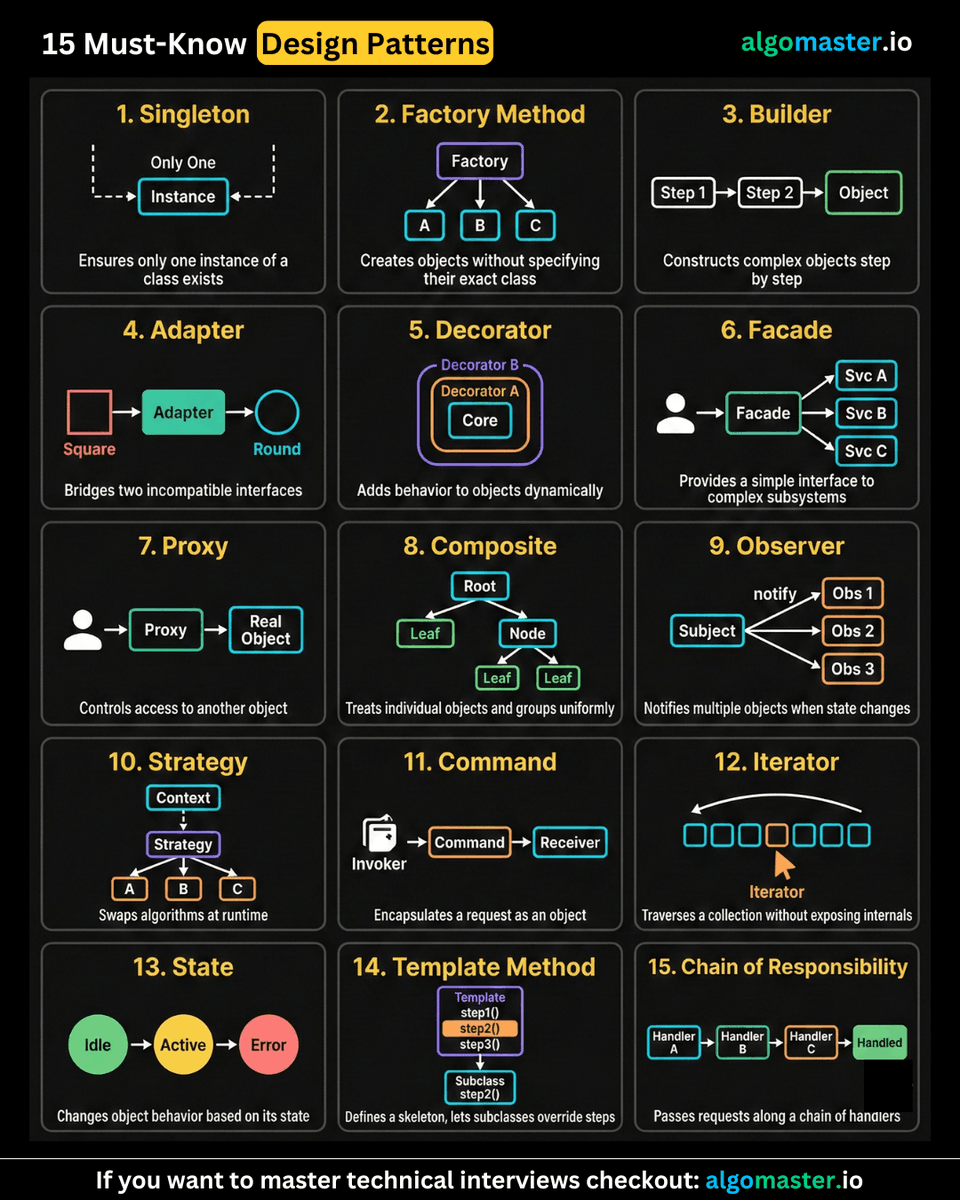
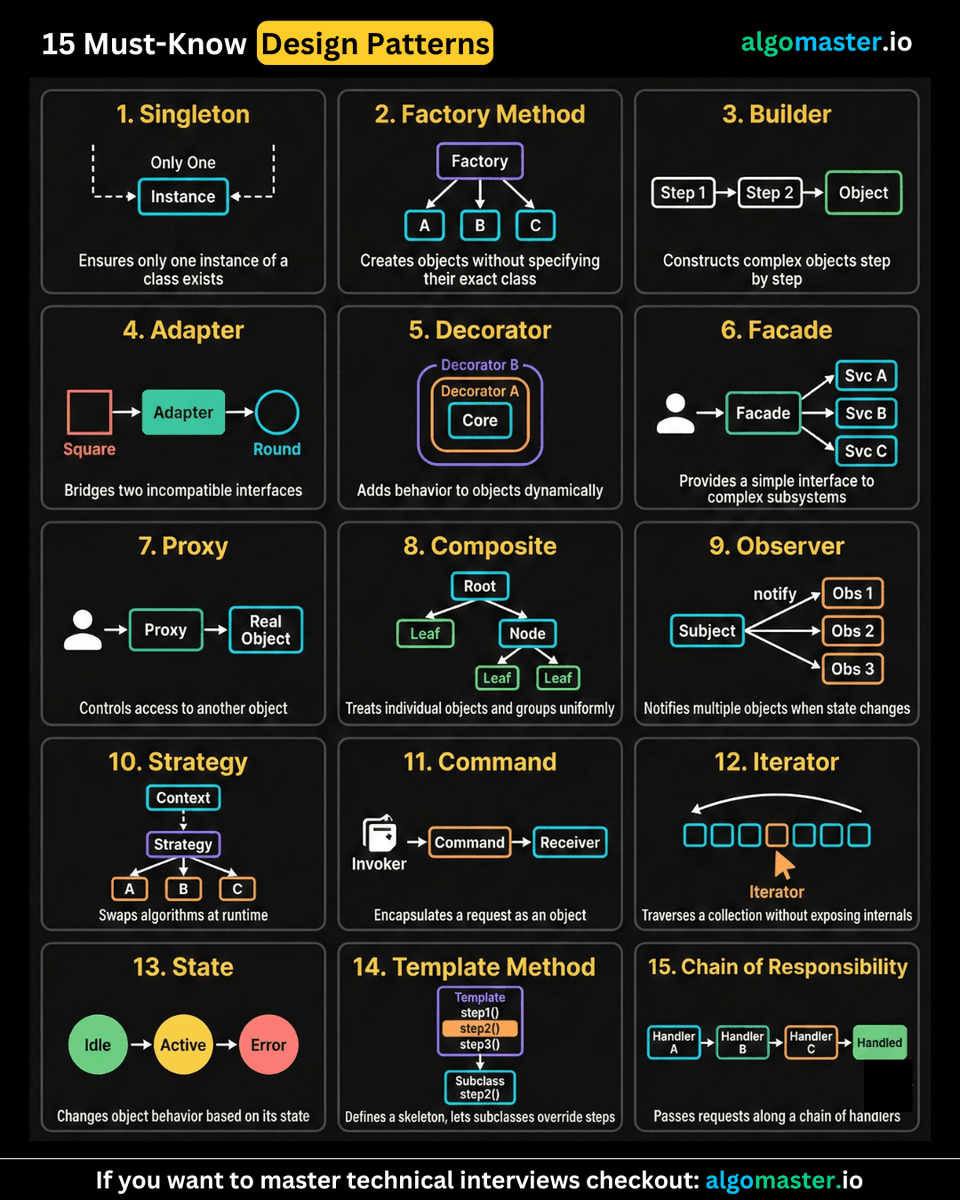
15 Must-Know Software Design Patterns:
1. Singleton
2. Factory Method
3. Builder
4. Adapter
5. Decorator
6. Facade
7. Proxy
8. Composite
9. Observer
10. Strategy
11. Command
12. Iterator
13. State
14. Template Method
15. Chain of Responsibility
♻️ Repost to help others in your network
9
139
584
17,324
May 12
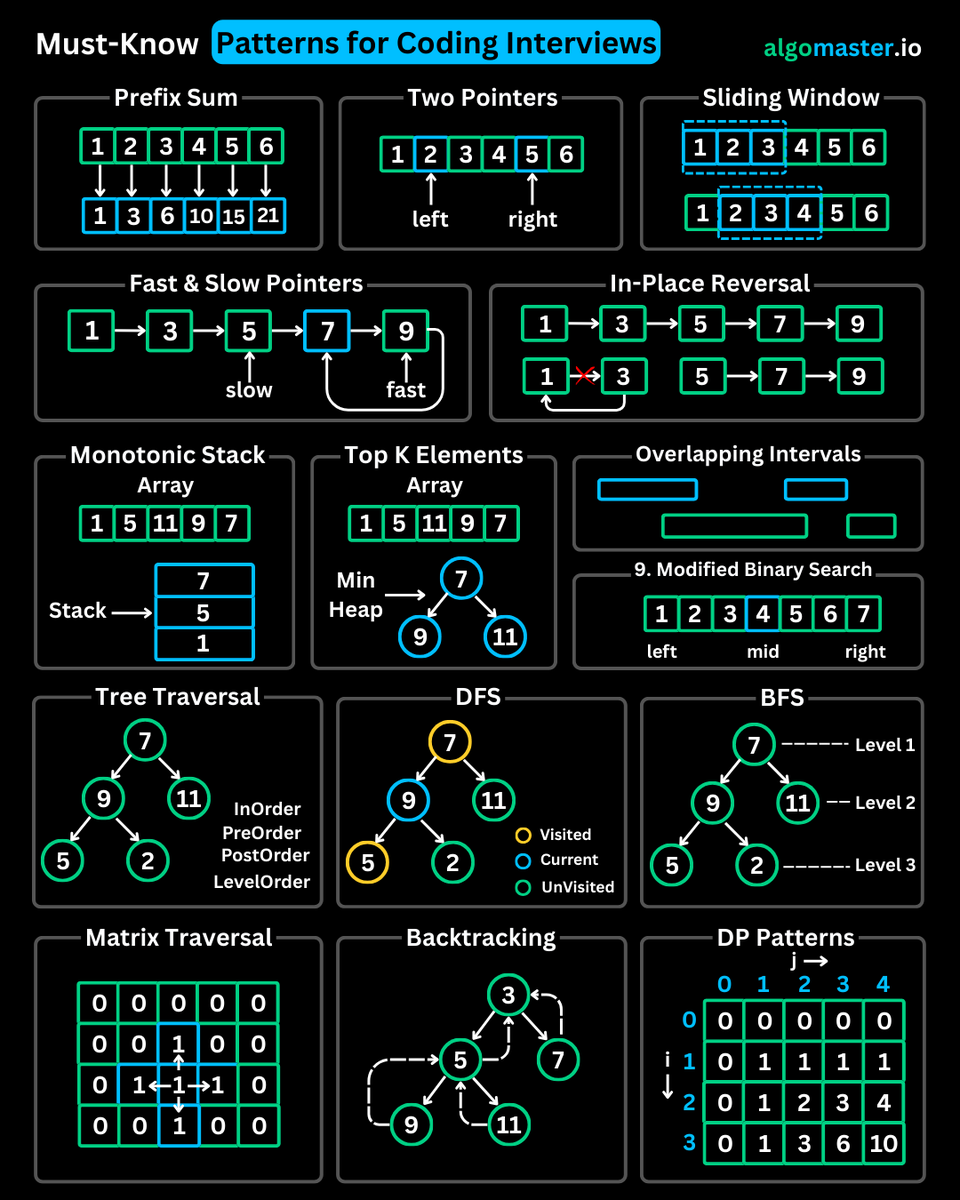
20 must-know DSA patterns for coding interviews:
1. Prefix Sum
2. Two Pointers
3. Sliding Window
4. Fast & Slow Pointers
5. LinkedList In-place Reversal
6. Frequency Counting
7. Monotonic Stack
8. Bit Manipulation
9. Top ‘K’ Elements
10. Overlapping Intervals
11. Binary Search Variants
12. Binary Tree Traversal
13. Depth-First Search (DFS)
14. Breadth-First Search (BFS)
15. Shortest Path
16. Matrix Traversal
17. Backtracking
18. Prefix Search (Trie)
19. Greedy
20. Dynamic Programming Patterns
♻️ Repost to help others master coding interviews
4
65
349
11,398
May 12
👉 Checkout the full list of patterns with detailed explanations and problems at algomaster.io
4
744
May 11
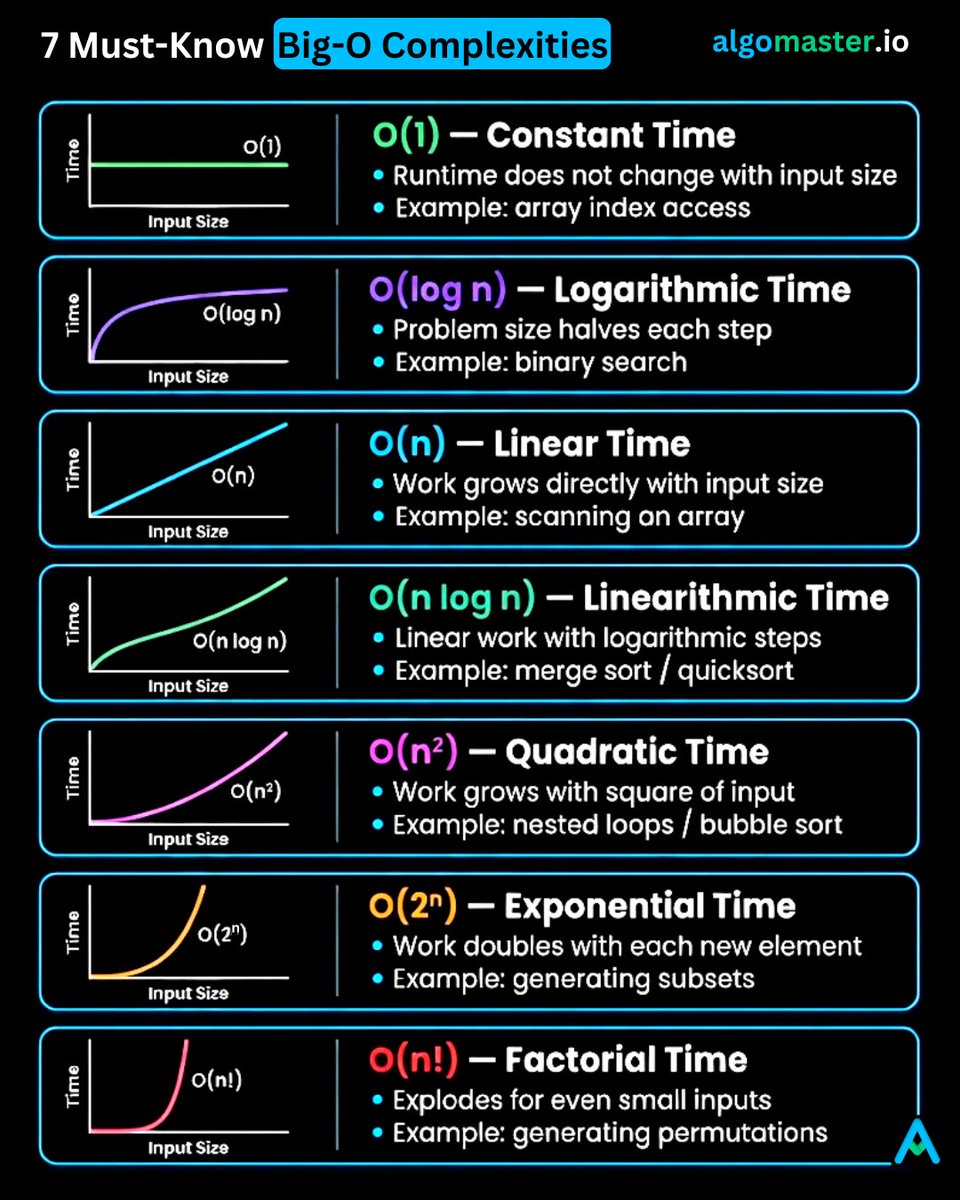
7 Must-Know Big-O Complexities for Coding Interviews:
1. 𝐎(1) - 𝐂𝐨𝐧𝐬𝐭𝐚𝐧𝐭 𝐭𝐢𝐦𝐞
- The runtime doesn't change regardless of the input size.
- Example: Accessing an element in an array by its index.
2. 𝐎(𝐥𝐨𝐠 𝐧) - 𝐋𝐨𝐠𝐚𝐫𝐢𝐭𝐡𝐦𝐢𝐜 𝐭𝐢𝐦𝐞
- The runtime grows slowly as the input size increases. Typically seen in algorithms that divide the problem in half with each step.
- Example: Binary search in a sorted array.
3. 𝐎(𝐧) - 𝐋𝐢𝐧𝐞𝐚𝐫 𝐭𝐢𝐦𝐞
- The runtime grows linearly with the input size.
- Example: Finding an element in an array by iterating through each element.
4. 𝐎(𝐧 𝐥𝐨𝐠 𝐧) - 𝐋𝐢𝐧𝐞𝐚𝐫𝐢𝐭𝐡𝐦𝐢𝐜 𝐭𝐢𝐦𝐞
- The runtime grows slightly faster than linear time. It involves a logarithmic number of operations for each element in the input.
- Example: Sorting an array using quick sort or merge sort.
5. 𝐎(𝐧^2) - 𝐐𝐮𝐚𝐝𝐫𝐚𝐭𝐢𝐜 𝐭𝐢𝐦𝐞
- The runtime grows proportionally to the square of the input size.
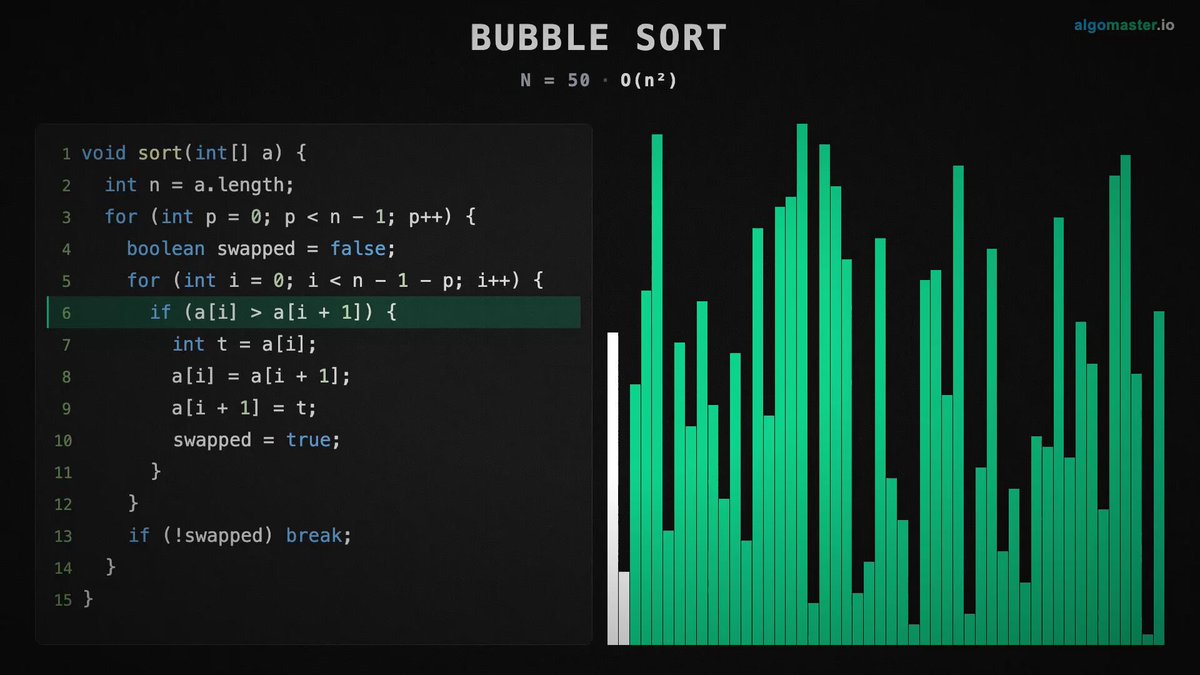
- Example: Bubble sort algorithm which compares and potentially swaps every pair of elements.
6. 𝐎(2^𝐧) - 𝐄𝐱𝐩𝐨𝐧𝐞𝐧𝐭𝐢𝐚𝐥 𝐭𝐢𝐦𝐞
- The runtime doubles with each addition to the input. These algorithms become impractical for larger input sizes.
- Example: Generating all subsets of a set.
7. 𝐎(𝐧!) - 𝐅𝐚𝐜𝐭𝐨𝐫𝐢𝐚𝐥 𝐭𝐢𝐦𝐞
- Runtime is proportional to the factorial of the input size.
- Example: Generating all permutations of a set.
♻️ Repost to help others learn this
5
154
787
35,968
Apr 23
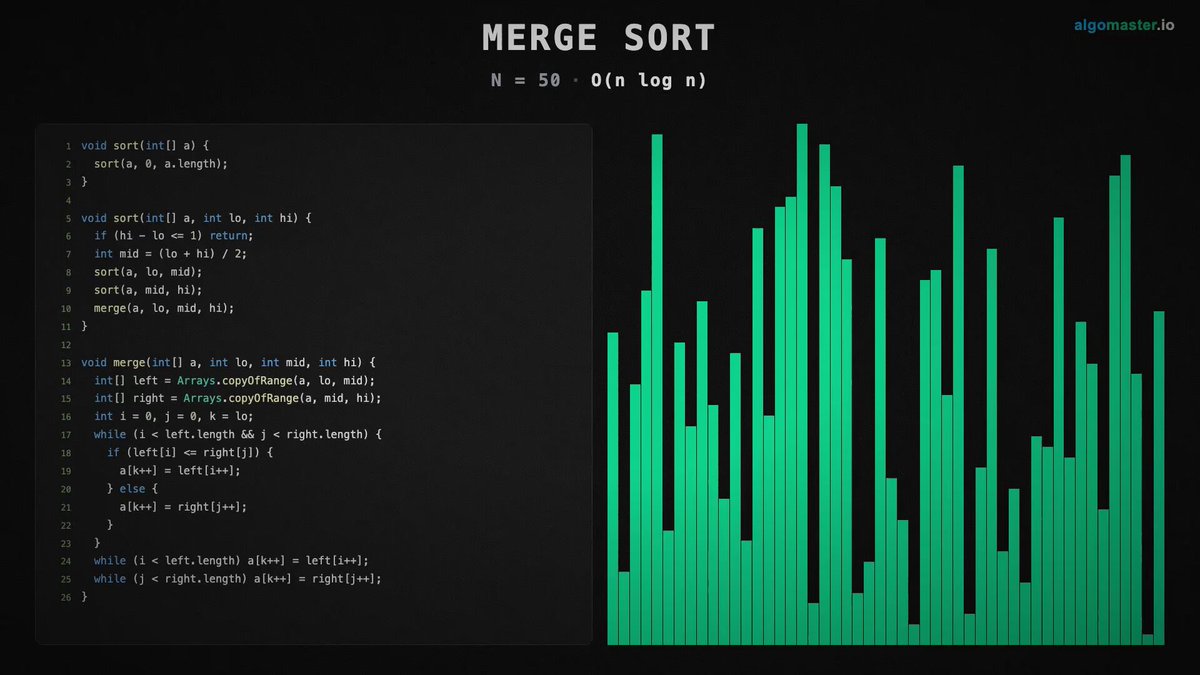
𝐇𝐨𝐰 𝐌𝐞𝐫𝐠𝐞 𝐒𝐨𝐫𝐭 𝐖𝐨𝐫𝐤𝐬
Merge Sort is a classic Divide & Conquer algorithm.
Here’s the idea:
- Divide → Split the array into two halves
- Conquer → Recursively sort both halves
- Combine → Merge the sorted halves into one sorted array
The magic lies in the merge step, where two sorted arrays are combined efficiently in linear time.
Time Complexity: O(n log n) (always)
Quick example:
[5, 2, 4, 1] → [5, 2] [4, 1] → [2, 5] [1, 4] → [1, 2, 4, 5]
♻️ Repost to help others in your network
6
51
2,489
Apr 22
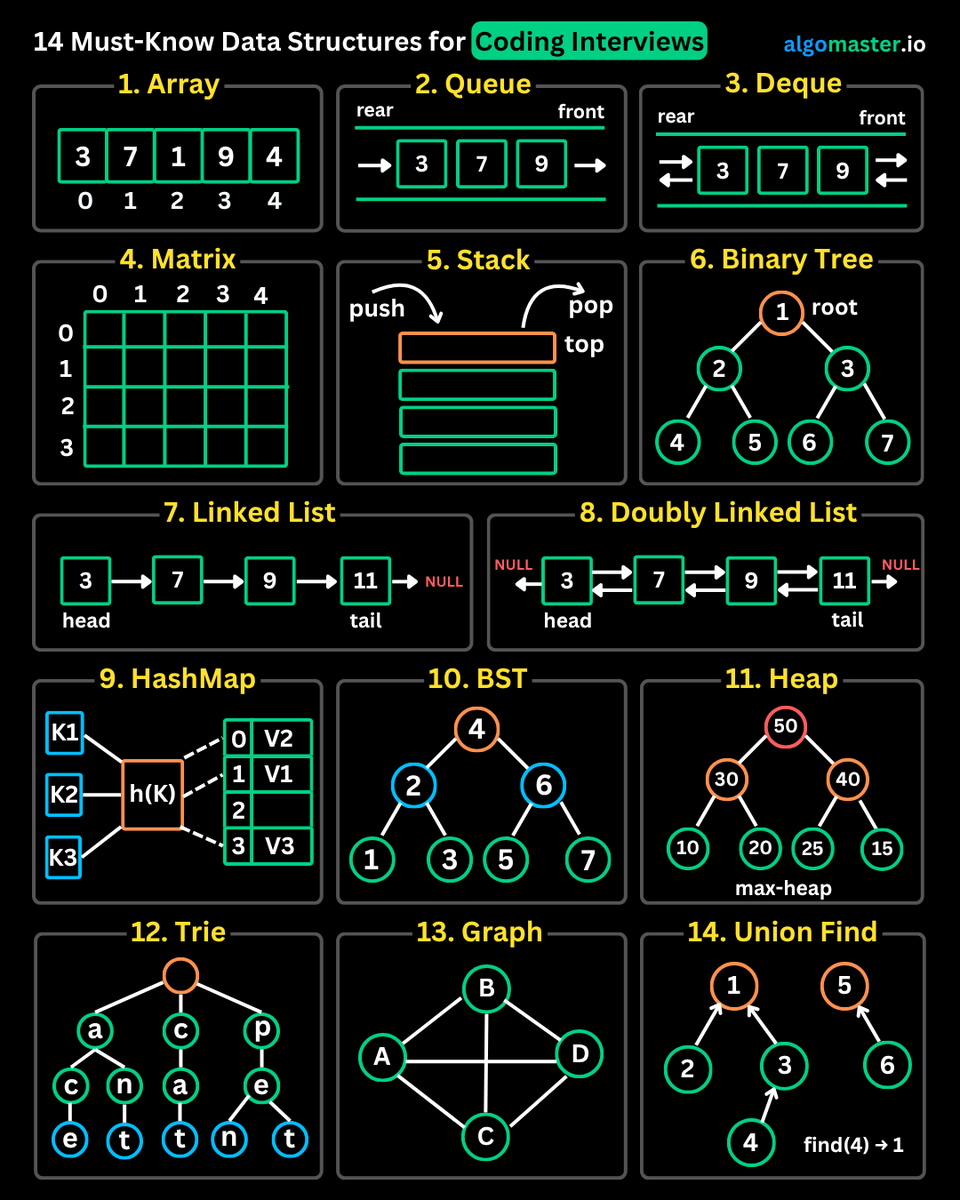
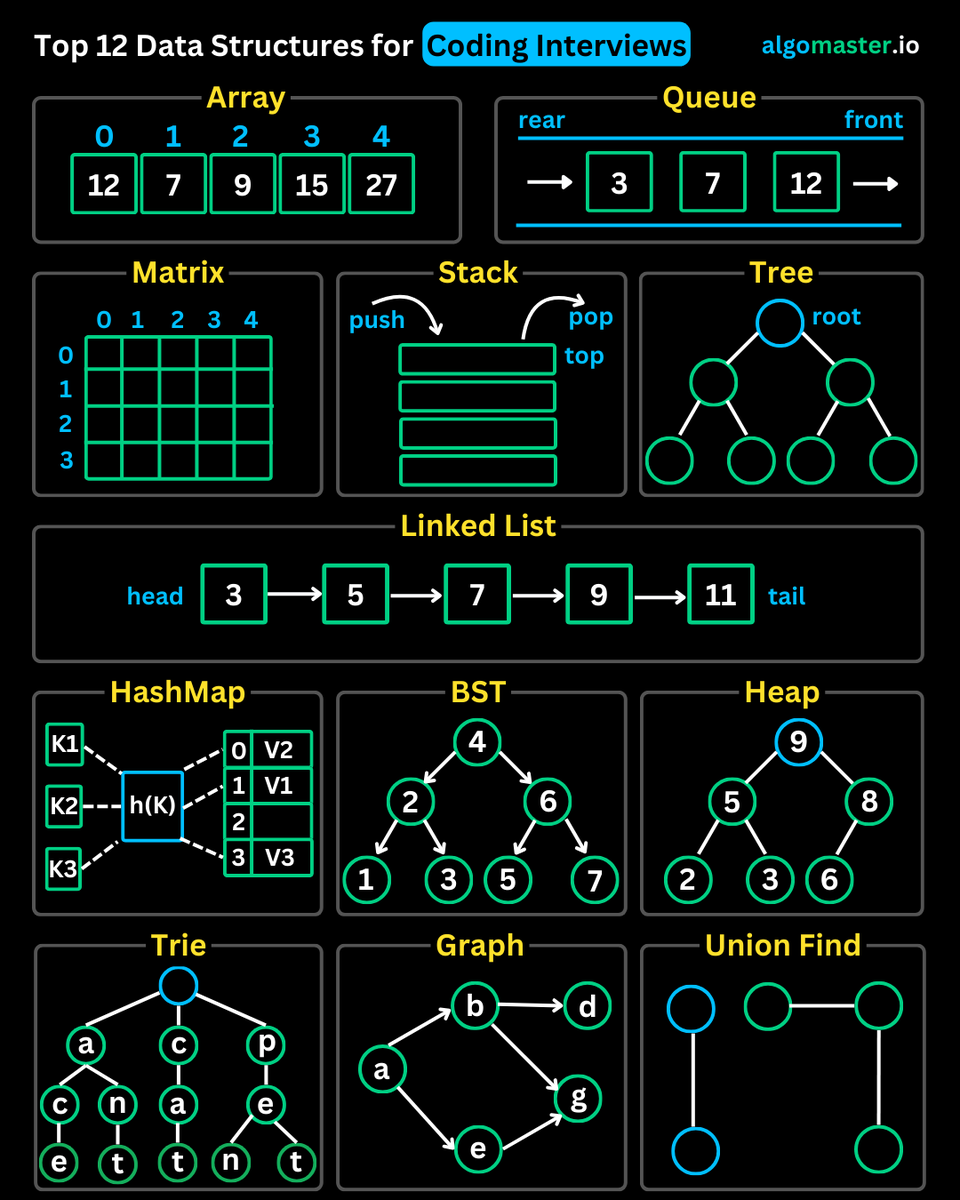
14 must-know Data Structures for coding interviews:
1. Array
2. Queue
3. Deque
4. Matrix
5. Stack
6. Binary Tree
7. Linked List
8. Doubly Linked List
9. HashMap
10. Binary Search Tree (BST)
11. Heap (Priority Queue)
12. Trie
13. Graph
14. Union Find
♻️ Repost to help others in your network
9
356
1,833
69,175
Apr 21
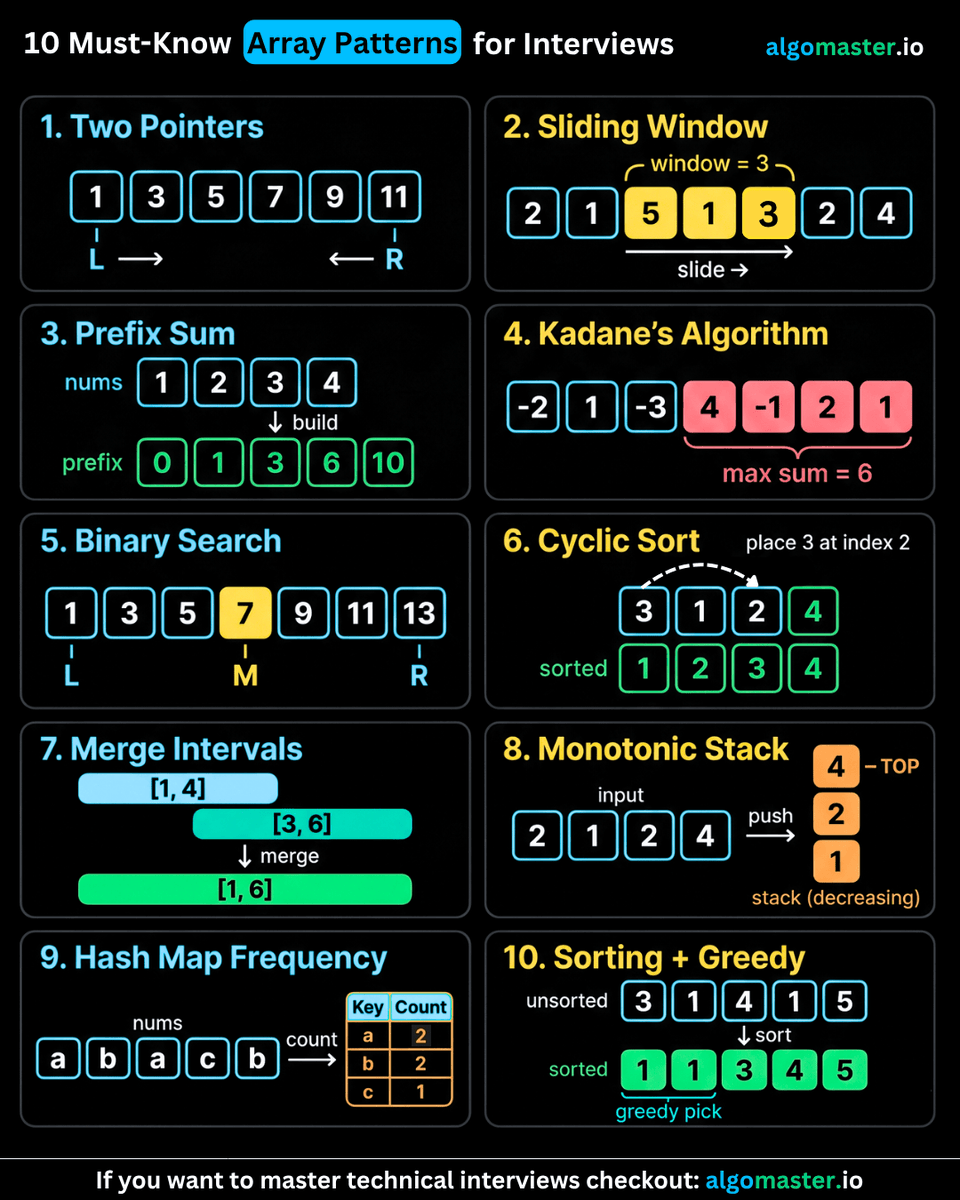
10 must-know Array patterns for coding interviews:
1. Two Pointers
2. Sliding Window
3. Prefix Sum
4. Kadane's Algorithm
5. Binary Search
6. Cyclic Sort
7. Merge Intervals
8. Monotonic Stack
9. Hash Map Lookup
10. Sorting Greedy
♻️ Repost to help others in your network
8
44
236
8,996
Mar 19
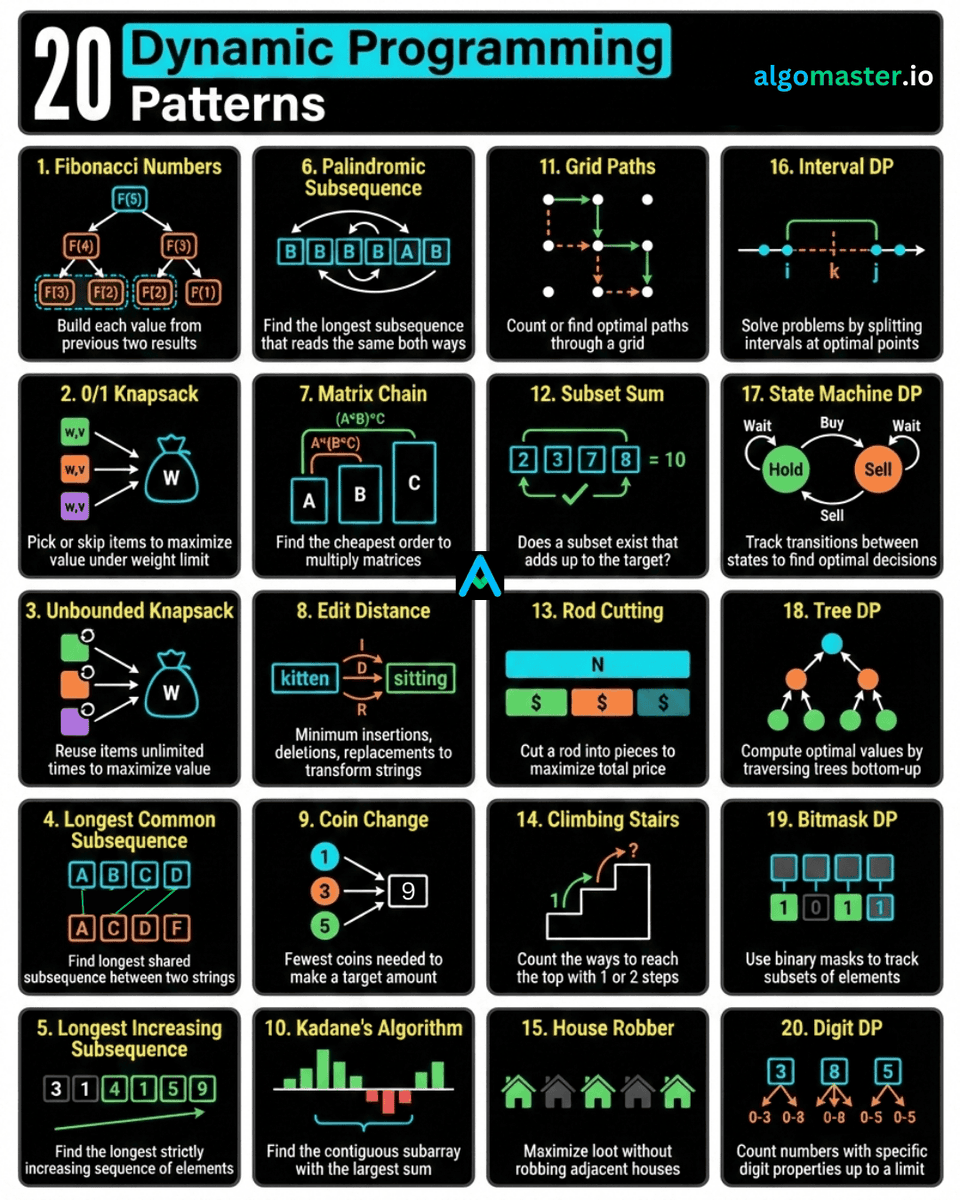
If you want to master dynamic programming for coding interviews, learn these 20 patterns:
1. Fibonacci Numbers
2. 0/1 Knapsack
3. Unbounded Knapsack
4. Longest Common Subsequence
5. Longest Increasing Subsequence
6. Palindromic Subsequence
7. Matrix Chain
8. Edit Distance
9. Coin Change
10. Kadane's Algorithm
11. Grid Paths
12. Subset Sum
13. Rod Cutting
14. Climbing Stairs
15. House Robber
16. Interval DP
17. State Machine DP
18. Tree DP
19. Bitmask DP
20. Digit DP
♻️ Repost to help others in your network
4
67
338
11,059
Mar 17
Top 15 Design Patterns You Should Know:
1. Singleton
2. Factory Method
3. Builder
4. Adapter
5. Decorator
6. Facade
7. Proxy
8. Composite
9. Observer
10. Strategy
11. Command
12. Iterator
13. State
14. Template Method
15. Chain of Responsibility
Which design pattern do you use the most in your work?
9
141
617
19,796
Mar 16
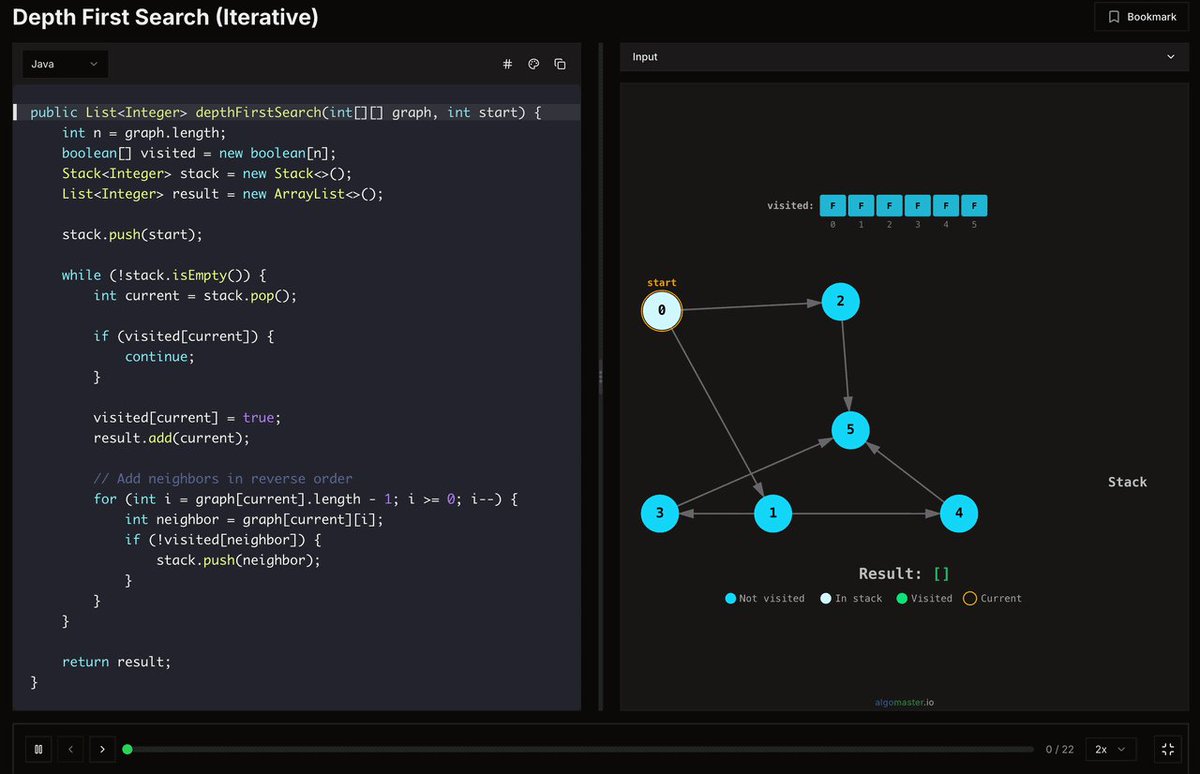
𝐇𝐨𝐰 𝐃𝐞𝐩𝐭𝐡-𝐅𝐢𝐫𝐬𝐭 𝐒𝐞𝐚𝐫𝐜𝐡 (𝐃𝐅𝐒) 𝐖𝐨𝐫𝐤𝐬:
1. 𝐒𝐭𝐚𝐫𝐭 𝐰𝐢𝐭𝐡 𝐚 𝐬𝐭𝐚𝐜𝐤: Push the source node onto a stack. Mark it as visited.
2. 𝐏𝐨𝐩 𝐭𝐡𝐞 𝐭𝐨𝐩 𝐧𝐨𝐝𝐞: Take the top element from the stack. This is the node you are currently exploring.
3. 𝐏𝐫𝐨𝐜𝐞𝐬𝐬 𝐭𝐡𝐞 𝐧𝐨𝐝𝐞: Do whatever the problem requires: print it, check a condition, record the path.
4. 𝐏𝐮𝐬𝐡 𝐮𝐧𝐯𝐢𝐬𝐢𝐭𝐞𝐝 𝐧𝐞𝐢𝐠𝐡𝐛𝐨𝐫𝐬: Look at all neighbors of the current node. For each one that has not been visited, mark it as visited and push it onto the stack.
5. 𝐑𝐞𝐩𝐞𝐚𝐭 𝐮𝐧𝐭𝐢𝐥 𝐭𝐡𝐞 𝐬𝐭𝐚𝐜𝐤 𝐢𝐬 𝐞𝐦𝐩𝐭𝐲: Go back to step 2. Each iteration goes deeper down one path before backtracking.
6. 𝐁𝐚𝐜𝐤𝐭𝐫𝐚𝐜𝐤𝐢𝐧𝐠 𝐡𝐚𝐩𝐩𝐞𝐧𝐬 𝐧𝐚𝐭𝐮𝐫𝐚𝐥𝐥𝐲: When a node has no unvisited neighbors, you do not push anything. The next pop takes you back up the path.
♻️ Repost to help others in your network
2
33
217
9,227