
Joined December 2007
- Tweets 935
- Following 2,087
- Followers 4,273
- Likes 4,150
94 Photos and videos


Jun 12
We have invented a magic wand that lets you be a master of any job on the planet.
There is only one rule: you can't ask it to be a magic wand maker.
2
6
260
Jun 11
New update today! We expanded our work (from just a few days ago) on Ideogram’s 4.0 model by writing custom kernels to make the highest quality model fit on smaller cards AND run faster. Launching the full toolchain and report asap. @ideogram_ai
Jun 11

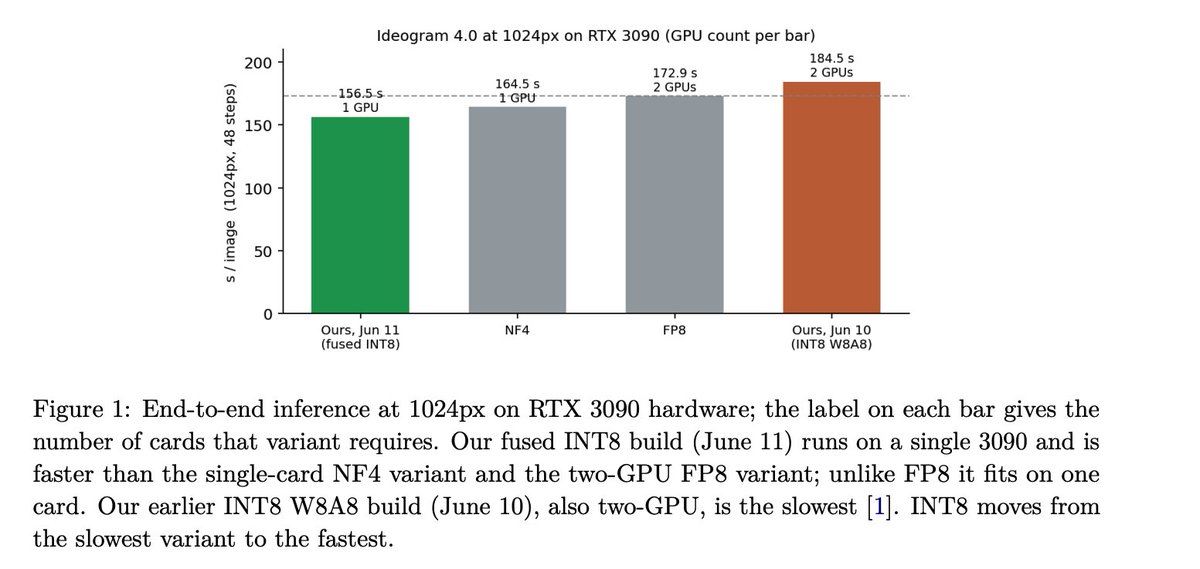
Our INT8 build was high-quality but slow because the software never touched Ampere's INT8 tensor cores.
We just wrote a fused Triton-based GEMM kernel to run natively on those cores. INT8 went from slowest to fastest:
📉 1024px on ONE 3090 in 156.5s
⚡ Faster than NF4 (1 GPU) & FP8 (2 GPUs)
We’ll release this new research soon!
2
174
Jun 11
Two days ago we released the best quality version of @ideogram_ai ‘s 4.0 model. Here is the paper on arXiv with all the details of our research behind it.
Open research 💪
Jun 11
📄 Paper is now live on arXiv → arxiv.org/abs/2606.12280
2
2
26
4,335
Jun 9
Transformer Lab is now building a Machine Learning Research Lab, alongside our ML tooling. This is the first research we're publishing and more to come. Sending ❤️ to @ideogram_ai . Well done @deepgandhi_07 who led this project.
Our lab built the highest-quality quantization for running Ideogram 4 on consumer GPUs. Our Q4_K build outperforms the standard NF4 baseline in both image and text quality at the exact same 10.4 GB size, while our INT8 matches the uncompressed FP8 ceiling. 🧵👇 @ideogram_ai
1
7
329
Ali Asaria retweeted

Our lab built the highest-quality quantization for running Ideogram 4 on consumer GPUs. Our Q4_K build outperforms the standard NF4 baseline in both image and text quality at the exact same 10.4 GB size, while our INT8 matches the uncompressed FP8 ceiling. 🧵👇 @ideogram_ai
7
26
57
4,857
May 29
Common take: Canadian companies don't buy from startups because they're risk-averse.
I've sold to Canadian banks, retailers, grocers & pharmacy chains as a startup for 20 years. The description is accurate -- it really does suck to sell to Canadian businesses as a startup. But the reason is wrong.
As a startup you're rarely selling just a solution -- you're selling a paradigm shift ("you run a custom ecommerce engine, but SaaS changes what's possible"). So the real ask is: adopt an unproven paradigm AND trust a small startup to deliver it.
Now picture the typical Canadian buyer: a company that's rarely #1 in its field, comfortable in its position, with a decision-maker promoted on tenure -- not for being a maverick.
The ones who DO take paradigm risks (Lululemon, Shopify) do it because reinvention is core to their identity. They're the exception.
It's not that Canadian enterprises prefer US vendors. It's that if they're going to bet on a new paradigm, a small startup won't be the one to convince them -- but an OpenAI, SAP, or Salesforce will.
There's something deeper underneath it too. Across art, science, and tech, Canadians rarely see themselves as the ones who define the next wave -- so they don't trust homegrown talent to do it either. We instinctively look elsewhere for the future.
12
3
88
7,661
May 28
A lot of folks talk about how much private sector progress we’ve made in AI in Canada. But the truth is that there are very very very few companies actually doing training of large models here. We’re talking about maybe 5 companies. It’s impossible to build an ecosystem around this.
5
1
16
2,520

May 25
FYI you can tell Claude Cowork to make a list of data brokers and automatically opt you out of all of them.
3
375
May 14
I have built three companies across three different technology waves. The thing I keep relearning is how little of the outcome is about the technology.
I started at BlackBerry as a young engineer and wrote BrickBreaker on the side. It ended up on more than fifteen million devices — I was only 19 or 20 years old. That was the first lesson in how unevenly value gets attributed inside a big company.
I founded Well.ca out of Guelph and grew it into one of the largest e-commerce businesses in the country. McKesson acquired us in 2017. The deal worked because of years of operating decisions made long before any banker was in the room. Customer trust. Category position. A team that could be handed the keys without the wheels coming off.
I founded Tulip while I was still running Well.ca, because I could see what mobile was about to do to retail and nobody else was building for it. Mulberry, Coach, Kate Spade, Michael Kors, Salvatore Ferragamo. We raised over a hundred million in venture capital across the two companies and learned, the expensive way, what enterprise sales actually take.
I am co-founder of Transformer Lab now. Open-source platform for AI model development. This is a different world, but it’s the same pattern underneath. Great products lose deals. Trust, timing and people decide more than the tech does. The founders who internalize that early build companies with more options when the moment arrives.
Toronto in 2026 is in a strange place. More capital than it has ever had. More AI-native competition than most founders have priced in. More acquirer activity than the headlines reflect. The decisions founders make in the next eighteen months will quietly determine what the next decade of this ecosystem looks like.
As Chair of @TechExitConf Toronto 2026, I am working with this steering committee to build a program for the Toronto founders who are inside that decision right now. Less narrative. More of what actually moves the outcome.
Learn more: techexit.io/toronto/
1
1
23
964
May 5
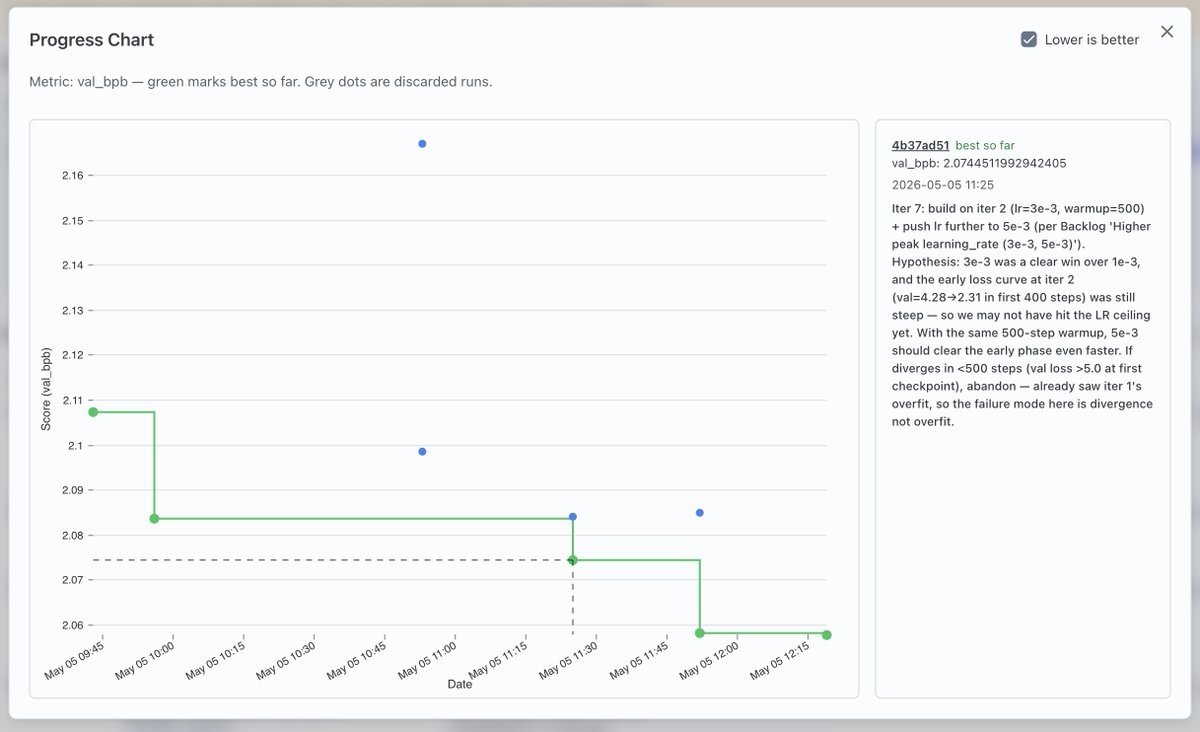
We built @karpathy autoresearch functionality to work natively inside @transformerlab . I see this type of harness as part of all future ML research work now -- what used to take me months of work is now happening automatically while I sleep.
3
2
8
537
Apr 30
This is a great idea. For so many reasons:
1) The build community has been asking Canada to fast track and invest in major projects. This is one leg of that stool
2) This answers the biggest issue for the anti-oligarchy community: it allows ALL Canadians to win if the government fast tracks projects (not just wealthy insiders)
3) It's bold, and risky, and new. This is the kind of policy we need right now.
Execution is everything, but this has the potential to be one of the smartest moves this government makes.
Apr 27

The Canada Strong Fund is Canada’s first national sovereign wealth fund. It will invest in the major projects that are transforming our economy — and give Canadians a direct stake in our nation’s prosperity.
1
155
Apr 23
Tech world: don't let the startup CEOs who dominate our voices let you forget that the original promise science and engineering is about expanding humanity's knowledge and solving real problems for people.
1
185
Apr 23
“When companies stay private until they are worth a trillion dollars, public markets are no longer where value is created. They are where value is realized.”

1
10
364
Apr 21
I wrote an article on the intersection of Islam and modern AI. It’s called "Between Clay and Light: A Quranic Framework for the Age of Intelligence."
I originally gave this as a private talk. It’s an attempt to bring together a few different areas I’ve spent time in -- merging technical AI concepts with the Islamic tradition.
The ideas are an exploration, but I’m curious to see if this framing resonates with anyone else.
aliasaria.ca/posts/between-c…
4
9
29
1,609
Apr 20
We’ve spent so much time optimizing post-training that I forgot how humbling raw pre-training is.
In RLHF/SFT, you see gains every hour. In pre-training, you’re just watching billions of calculations happen in the dark, hoping a signal emerges. It’s the most powerful technique we have, but the compute-to-progress ratio is soul-crushing.
3
512
Apr 20
Did you know the "million monkeys on a million typewriters" trope is actually impossible?
Shakespeare’s shortest play has 88,361 characters. To have even a 1% chance of randomly typing it correctly, you would still need to exhaust roughly 0.01 x 50^88,361 combinations.
Physics tells us this isn't just a matter of time, but of energy. According to Landauer’s Principle, there is a universal minimum energy requirement for any calculation or "bit flip."
Even if you had microscopic monkeys operating at the absolute theoretical limit of efficiency, the energy required to attempt enough combinations for that tiny 1% gamble would exhaust the total energy of the observable universe roughly 10^149,000 times over.
1
2
237
Apr 15
Cohere’s Transcribe model, announced on March 26, 2026, is impressive on a number of fronts.
With a 5.42% average WER, it has officially claimed the #1 spot on the Open ASR Leaderboard. No easy task.
1
1
4
259
Apr 15
Model Technical paper here: huggingface.co/blog/CohereLa… . Congrats cohere audio team. This is very impressive. A lot of folks trying to compete for SOTA on audio these days, really hard to do.
1
120