
Proving humanity and trusted agents for the age of AI. Live on Mainnet alpha, iOS and Android
Joined November 2021
- Tweets 1,310
- Following 1
- Followers 75,233
- Likes 1,551
53 Photos and videos





welcome to the new era
9 Dec 2025

introducing alien. verifying humanity in the age of ai.
mainnet alpha is live at alien[dot]org
327
150
789
140,708
Alien retweeted

Jun 13
for the past 4 years i’ve been building an identity solution that proves your credentials while preserving full anonymity and privacy to avoid political control
didn’t have enough time to distribute it widely enough and now it feels like it’s too late

What people are missing about the US government's AI regulation announcement:
ID verification will now be forced on all accounts to prove citizenship.
Frontier labs will take your data, and your sovereignty is officially dead.
A permanent underclass division and a total control society are beginning right now.
People ignored me when I started saying this last year, but it is happening right in front of our eyes.
Get into Open-Source and Sovereign AI.
Advancing together through collective intelligence is the only way to fight back.
16
7
41
2,263
Alien retweeted
Jun 13
that means they would need to kyc everyone now
which is the worst identity solution out there
Jun 13

The US government, citing national security authorities, has issued an export control directive to suspend all access to Fable 5 and Mythos 5 by any foreign national, whether inside or outside the United States, including foreign national Anthropic employees.
The net effect of this order is that we must abruptly disable Fable 5 and Mythos 5 for all our customers to ensure compliance.
Access to all other Claude models is not affected.
We apologize for this disruption to our customers. We believe this is a misunderstanding and are working to restore access as soon as possible.
Read our full statement: anthropic.com/news/fable-myt…
5
4
36
2,283
Anthropic just shipped a model capable enough that they built it to refuse its own cybersecurity answers.
Claude Fable 5 routes high-risk queries to a weaker model on purpose.
Read that again. The capability is real enough that the safeguard is a core feature, not a disclaimer.
This is the clearest signal yet of where the agentic web is heading. Models this capable will be wrapped in agents, and those agents will act on real systems - APIs, payments, infrastructure.
The capability ceiling just moved up. The accountability layer underneath it didn't move at all.
When an agent powered by a frontier model makes a request, the receiving system still has no way to verify who authorized it or what it's scoped to do. The smarter the model, the more that gap matters.
Verified agent identity isn't a nice-to-have once models can chain exploits autonomously. It's the part of the stack that has to exist first.
23
14
94
3,021
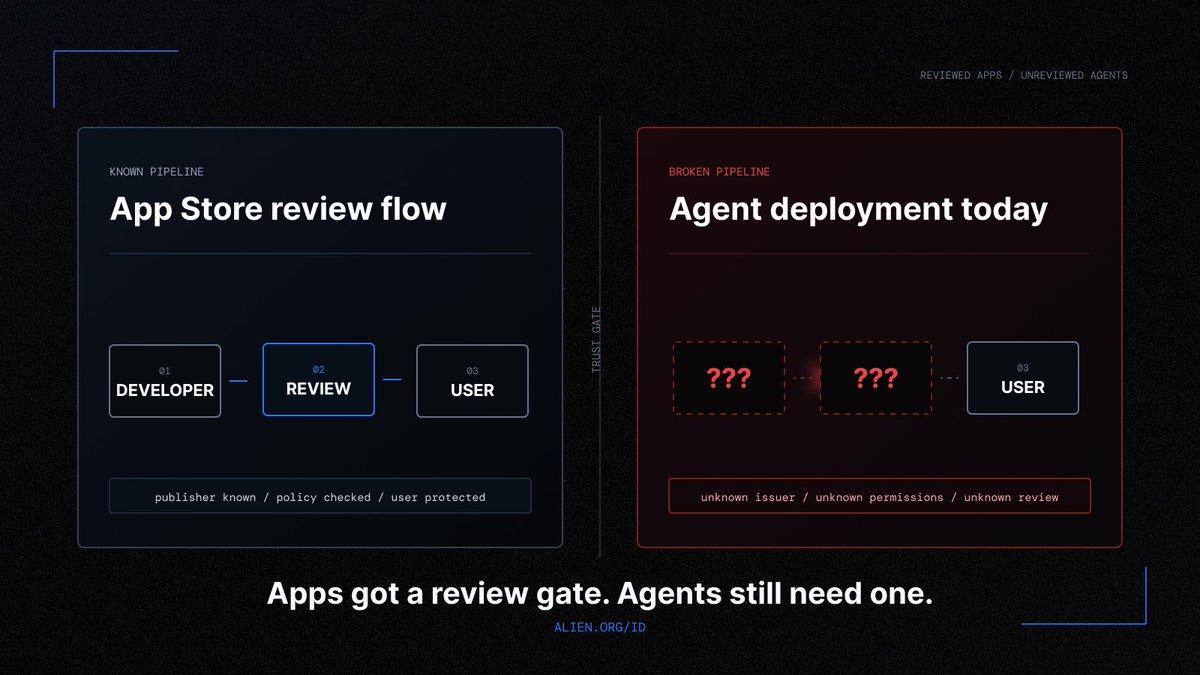
Before the App Store, any software could do anything on your device.
Apple created a review layer that made developers accountable before their code reached users. AI agents in production today have no equivalent layer.
When Apple launched the App Store in 2008, the immediate complaint was control. Developers pushed back on the review process, the approval wait times, the arbitrary rejections. What people missed was what the review layer created: a declared identity behind every piece of software on your device.
To ship on the App Store, you needed an account. That account was tied to a real developer or company. Your app had to declare every permission it wanted - microphone, camera, contacts, location - before a user ever installed it. If your app did something it didn't declare, it got pulled. If you as a developer violated the rules, your account got banned and your apps went with it.
None of that felt like a trust mechanism at the time. It was just friction. But the friction created accountability: every app on your device could be traced to a verifiable human or entity who had signed a legal agreement with Apple.
AI agents have none of this.
An agent acting on your behalf today declares nothing. It's deployed by whoever built it, with whatever permissions they decided to claim, and there is no registry of who authorized it.
When it hits a payment API, a messaging platform, or an enterprise service, the downstream system receives a request from effectively nobody. There is no developer account, no declared scope, no accountability trail.
The accountability layer that exists for software doesn't exist for the software acting on your behalf.
Agent ID is that layer. Every agent gets a registered identity linked to the verified human who authorized it. Downstream systems can verify the authorization before the request executes. The agent is no longer nobody - it's cryptographically traceable to a real person.
The App Store didn't make apps safer by reviewing them harder. It made them safer by making developers identifiable.
Agent ID does the same thing, one layer deeper.
26
15
108
3,562
If you could see the real percentage of bots in any group chat or comment section, would you actually want to know?
People who answered yes will never unsee what they find
80%
🔵 Yes, show me everythin
7%
⚪ Rather not know
13%
🔴 I already assume it's
134 votes • Final results
15
6
57
2,422
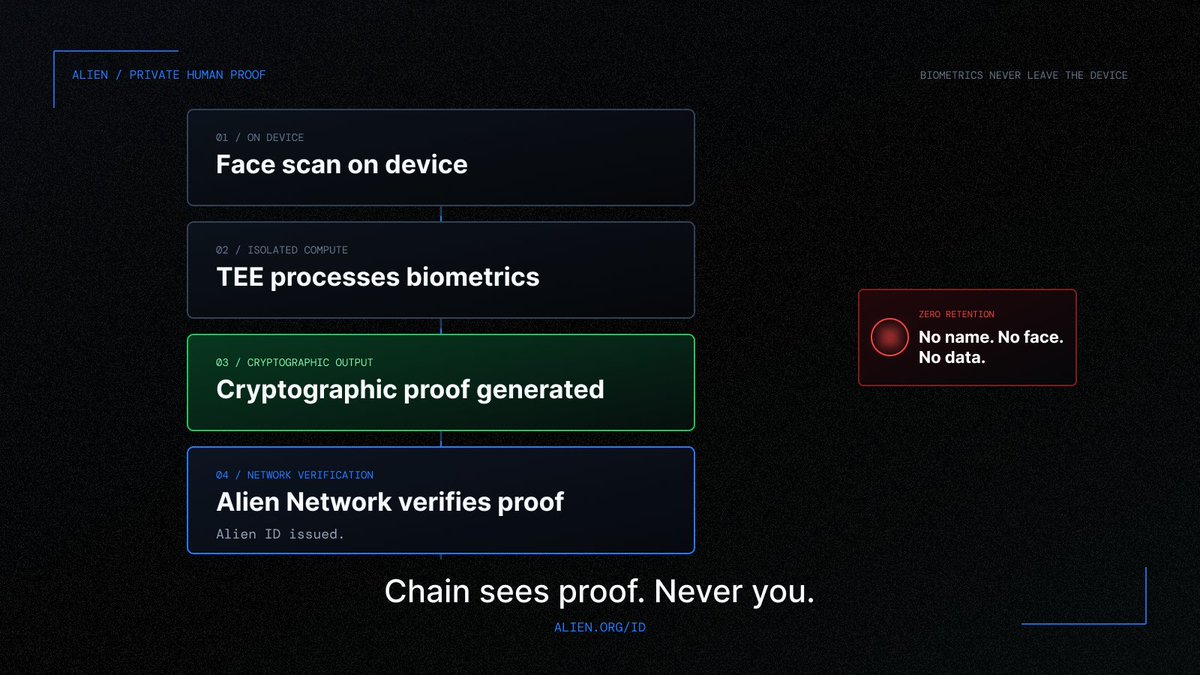
Alien ID knows you're a unique human.
It doesn't know your name, face or anything else about you.
Here's how that's technically possible - and why the distinction matters more than it sounds.
The standard assumption about identity verification is that it requires storing something about you. A photo, a document scan, a biometric template. The verifier keeps a record. The record can be breached.
Alien ID is built on a different model. Here's what actually happens.
1. Verification runs inside a Trusted Execution Environment on your device
A TEE is a secure enclave - a hardware-isolated zone that processes data without exposing it to the operating system, the app layer, or anything else on the device. The biometric check runs in there. The raw data — your face — is processed and then discarded. It never leaves the TEE. It never touches Alien's servers. There is nothing to intercept in transit because there is no transit.
2. What gets generated is a proof, not a record
The TEE produces a cryptographic proof: this device, at this moment, verified a unique living human. The proof contains no biometric data. It contains no personal information. It is mathematically derived from the verification event but cannot be reversed to reconstruct anything about you.
3. The network checks the proof, not you
The Alien Network receives the proof and validates it - confirming that it was generated by a legitimate TEE running the correct verification protocol, and that no proof with the same human signature has been registered before. If both conditions are met, an Alien ID is issued. The chain has confirmed your uniqueness without ever knowing who you are.
4. Sessions let you use different identities in different contexts
From your root Alien ID, you can derive separate session identities for different apps, platforms, or contexts. Each session proves "verified unique human" without linking back to your root identity or to any other session. They're cryptographically unlinkable by design.
One verification. Any context. Zero data exposure.
27
19
146
5,052
Can you name a person who trusts AI completely?
An AI agent buys the wrong asset. Sends the wrong email. Books the wrong flight.
Who's liable - the person who authorized it or the team that built it?
Let’s try to find a clean answer.
This question isn't hypothetical. AI agents with real financial permissions are operating right now - in trading systems, procurement workflows, travel booking tools, customer communications platforms. When one of them makes a mistake (and they do) the liability question lands immediately and nobody has agreed on the answer.
3 parties each have a plausible case for why it isn't them.
The human who authorized the agent didn't write the code. They clicked a button, granted permissions, and trusted the system to do what it said it would do. If the agent exceeded its scope or misunderstood a context they didn't anticipate, is that a user error?
The team that built the agent didn't make the specific decision that caused the harm. They built a system that operates within the parameters set by the user. If the user's parameters were ambiguous, or the user authorized a capability they didn't fully understand, is that a developer error?
The platform that ran the agent hosted the infrastructure and processed the request. They didn't instruct it to do anything specific. If the authorized action was executed faithfully, even wrongly, is that a platform error?
Right now the answer is whichever party has the most expensive lawyers and the clearest terms of service.
That's not a durable legal framework.
The thing that makes this solvable is an auditable record: who authorized this agent, when, with what scope, and what exactly it did at each step.
A cryptographic link between the agent's actions and the human who authorized them doesn't resolve the liability question - but it makes it answerable. Which is the prerequisite for resolving it.
22
13
98
3,037
Why delegated access for ai agents is so important?
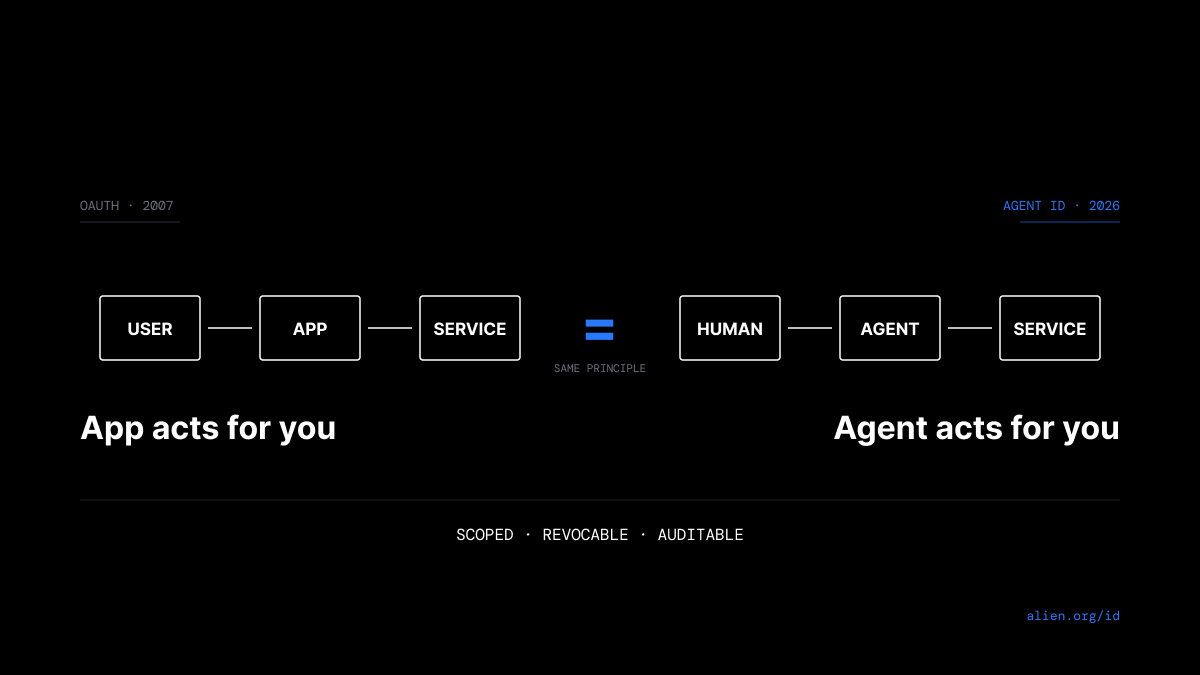
OAuth lets you give an app permission to act on your behalf without sharing your password.
AI agents acting on your behalf today have no equivalent.
The insight behind OAuth was precise: users don't need to hand over their credentials for an app to do something on their behalf. Instead, they authorize a specific scope of access - read my calendar, post to my timeline, access my contacts - and the authorization is cryptographically scoped and revocable. The app gets what it needs. The user keeps control. Any downstream system receiving a request can verify it was authorized.
That single design decision restructured trust across the entire web. Today OAuth or its descendants underpin virtually every "sign in with" flow, every third-party integration, every API that requires user-level authorization.
20 years later, AI agents are doing more than apps ever did. They're booking flights, executing trades, drafting and sending communications, making purchasing decisions, managing codebases. They act continuously, in the background, across multiple services simultaneously.
And there is no OAuth equivalent for any of it.
When an AI agent hits a payment API, the payment processor receives a request. The request may look legitimate. The headers may pass inspection. But nothing in that request cryptographically proves which human authorized it, what scope they authorized, or whether the authorization is still valid. The downstream system is taking it on faith.
Every platform managing agent traffic is building behavior-based detection to compensate. The same arms race that OAuth ended for app authentication is starting again for agents.
Agent ID creates the equivalent layer - a cryptographic link between every agent request and the verified human who authorized it, scoped and auditable by any downstream system, without exposing personal data.
Same principle. 20 years later.
25
19
135
4,251
Alien retweeted
May 29
if the president calls you an alien and says you don’t belong here
know this: you belong in the new world.
the world we’re building at @alienorg for every alien; you’re welcome

28
24
117
8,341
The most engaged people in online communities are gone.
They retreated to smaller, private spaces. Here's the structural reason why.
It didn't happen suddenly. It happened through a loop that most platforms still haven't named.
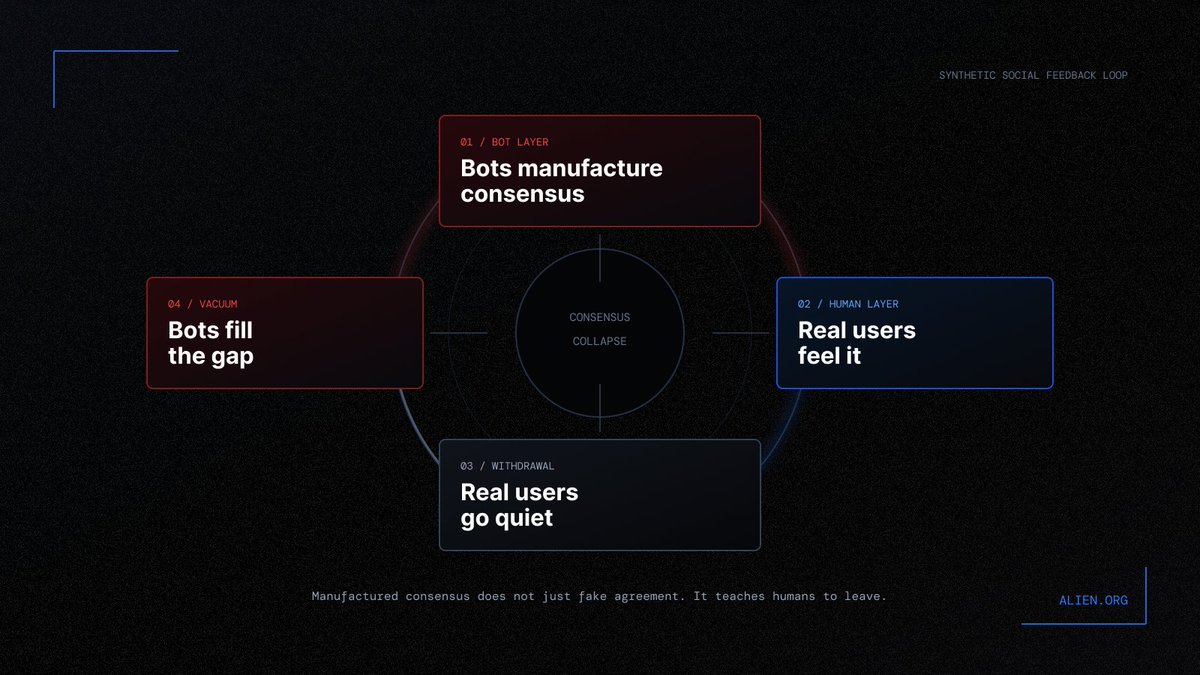
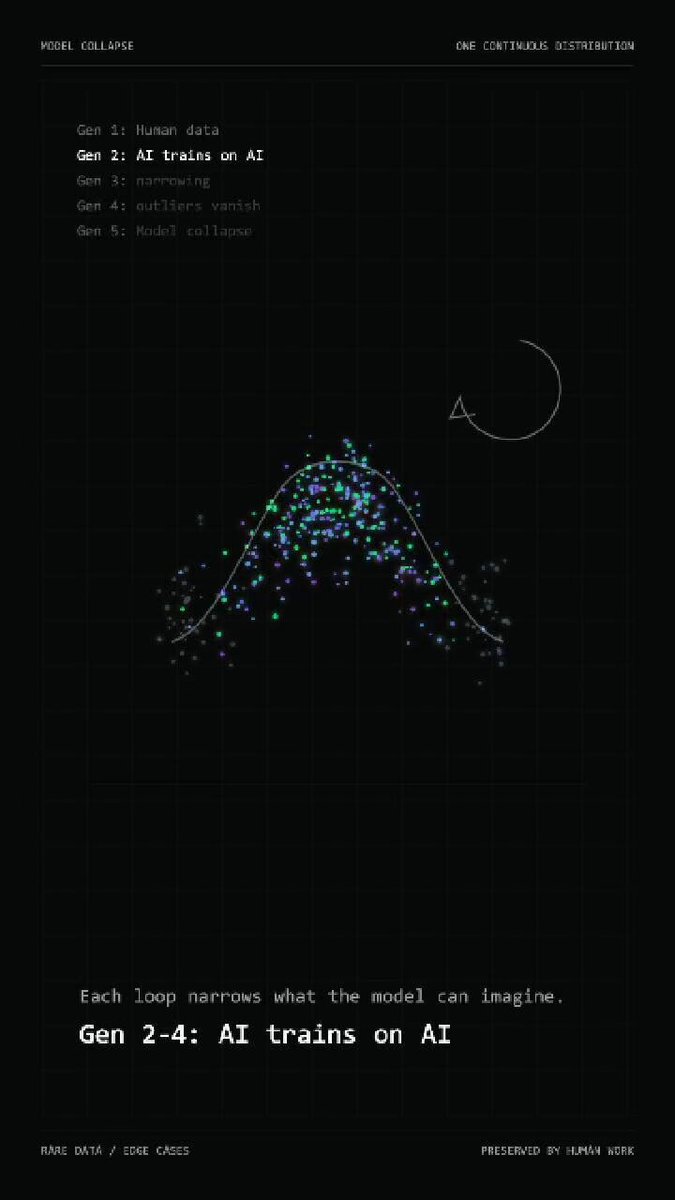
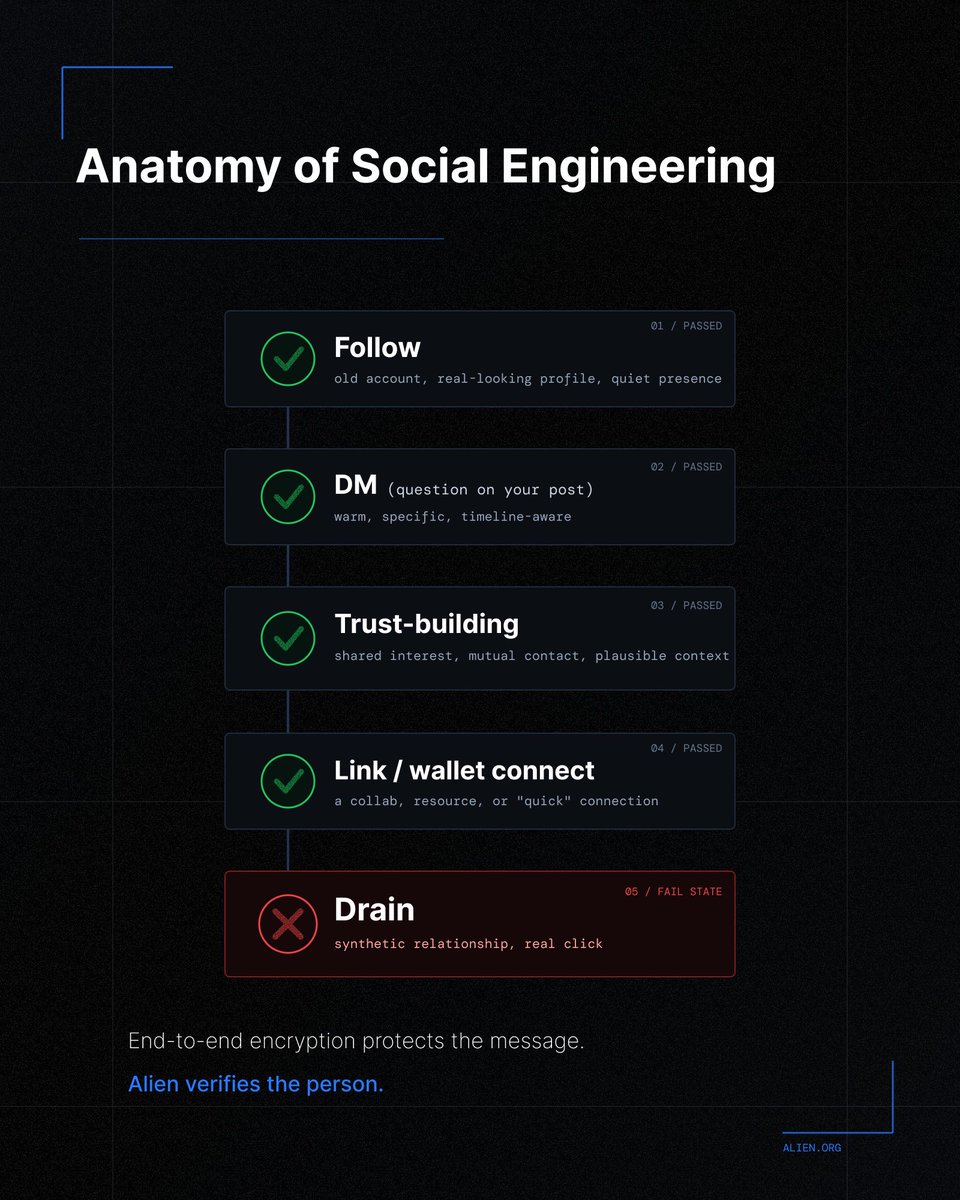
Sophisticated bot accounts don't just spam. They reply to real posts with plausible takes. They upvote selectively to push specific viewpoints. They create the appearance of consensus around ideas that no organic majority actually holds. On Reddit threads, Telegram groups, and Twitter reply sections, a growing share of what looks like organic discussion is coordinated noise designed to look like signal.
Real users pick up on this before they can articulate it. The room starts feeling slightly off. Replies come too fast. Certain viewpoints get amplified in ways that don't match the energy of the actual conversation. Engagement patterns feel manufactured.
So people stop sharing. They read without posting. They move genuine conversations to closed groups where they know everyone personally. The public space fills with more bots, which drives out more real users, which makes the signal-to-noise ratio worse, which drives out more real users.
The loop runs on its own once it starts.
Every platform's response has been moderation: better classifiers, faster reporting, stricter verification at signup. None of it breaks the loop because moderation is reactive. By the time a bot account is flagged, it's already shaped the conversation.
The only structural fix is knowing the room is human before the conversation starts - not finding out afterward.
That's what Alienchat is built on. Every account links to a verified Alien ID. The community is verified at the door. What happens inside it is between real people by default.
The loop doesn't start because the condition that starts it can't be met.
28
18
169
5,233
Platforms are giving verified humans things unverified accounts don't get.
Lower friction. Priority access. Money.
6 random perks you get for being verified online:
1. Lower spam filter thresholds
Email from a verified sender domain reaches the inbox. Email from an unknown one doesn't. The same logic is being applied to accounts across platforms - verified humans get assumed good faith by default. Unverified ones start in the queue.
2. Faster onboarding on financial services
KYC-compliant platforms are starting to accept proof-of-humanity credentials to skip redundant ID checks. Verify once, onboard faster everywhere.
3. Access to gated platform features
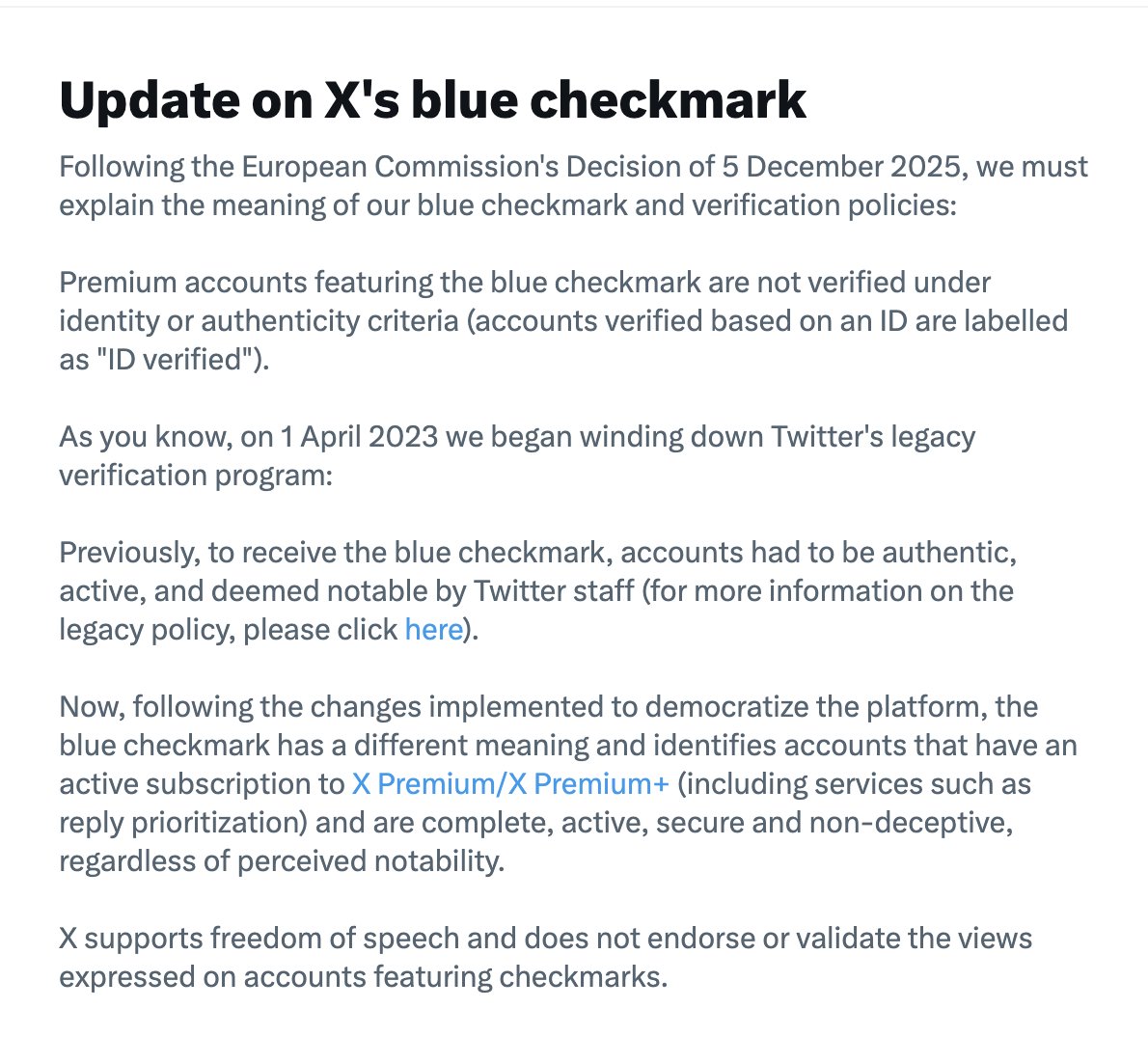
Twitter Blue, Reddit Premium, LinkedIn Verified - each adds a layer of features behind identity confirmation. The features themselves are often minor. The signal they send to other users isn't.
4. Less friction in agent interactions
AI agents acting on your behalf are already being rate-limited, blocked, or flagged by downstream services with no way to verify who authorized them. A verified human behind the agent changes that. Your agent inherits your trust status.
5. Default credibility in community spaces.
Moderation systems increasingly weight verified accounts differently. A verified human's report triggers faster review. Their content surfaces higher. Their votes in community decisions count more.
6. Reduced CAPTCHA friction
Verified humans don't need to prove they're not bots on every login. The proof already exists.
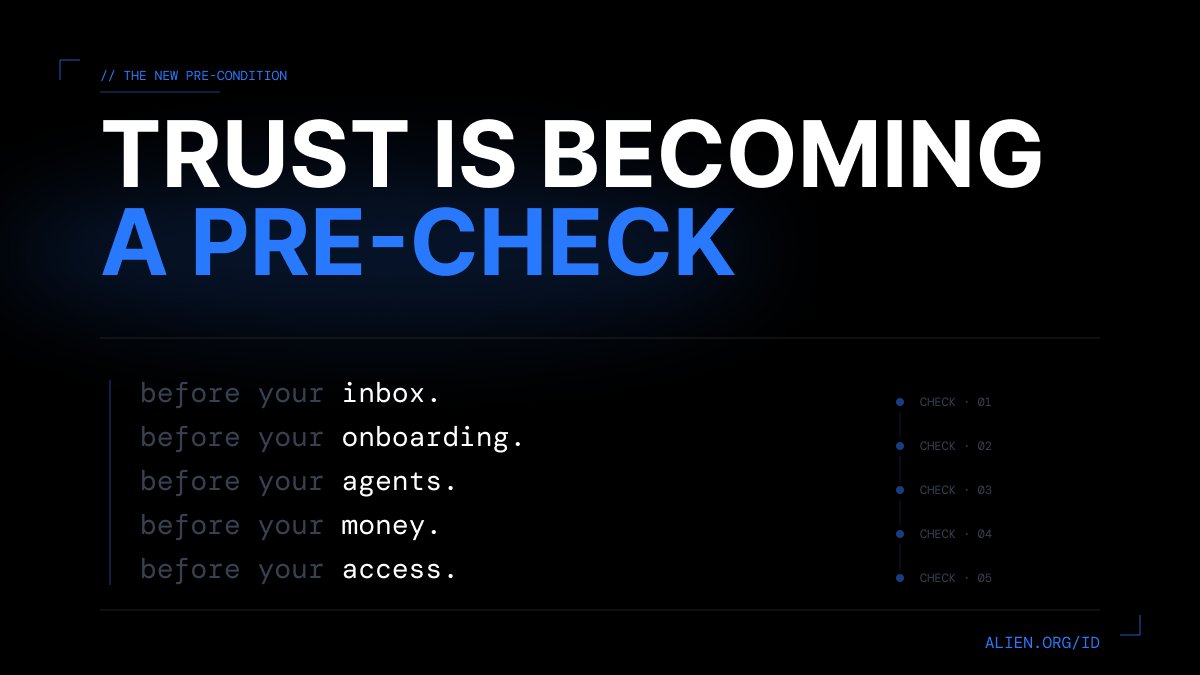
Verification is becoming the input that determines how much the system trusts you before you've done anything.
The gap between verified and unverified widens every month, and each new agent layer adds another surface where it shows up.
34
24
186
6,229