
Joined January 2021
- Tweets 7,962
- Following 279
- Followers 224
- Likes 38,774
96 Photos and videos
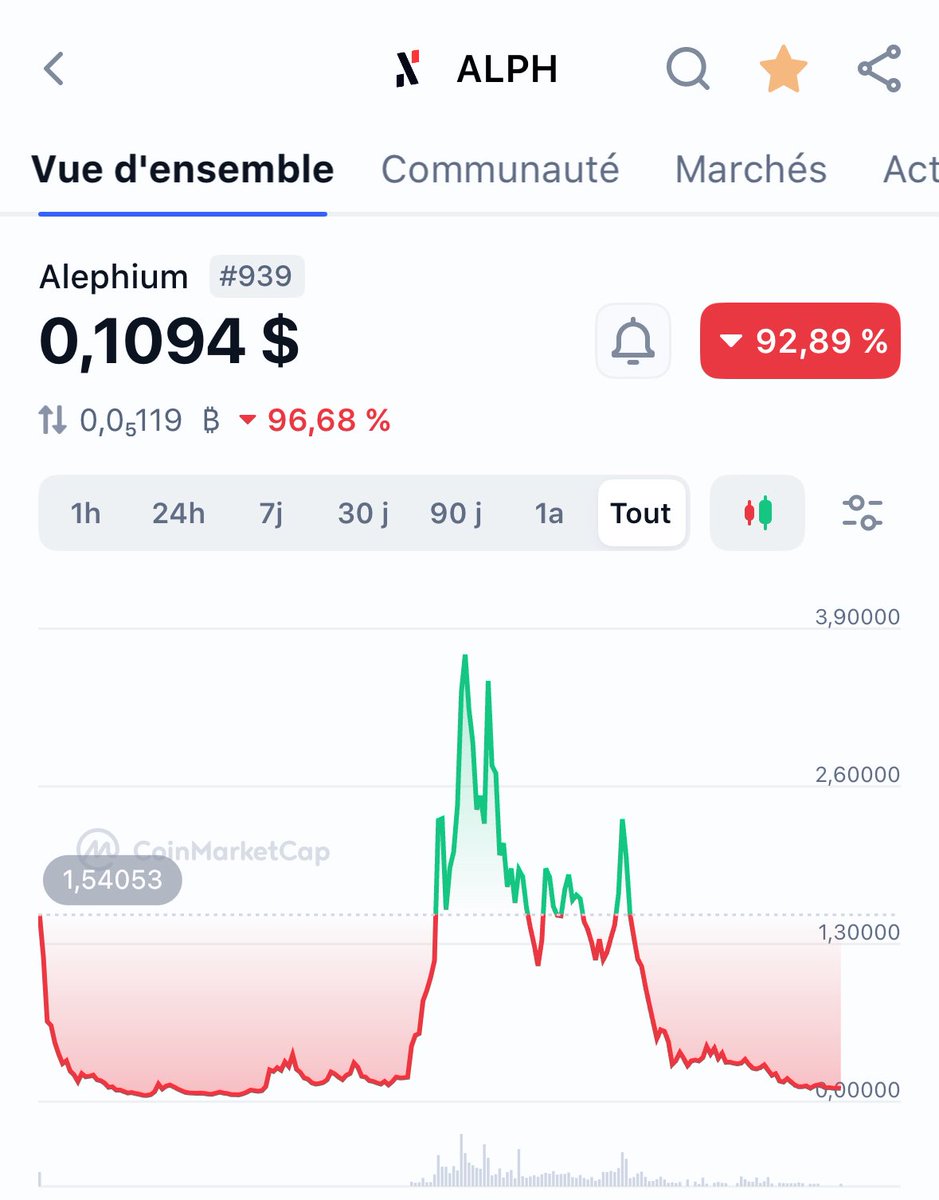
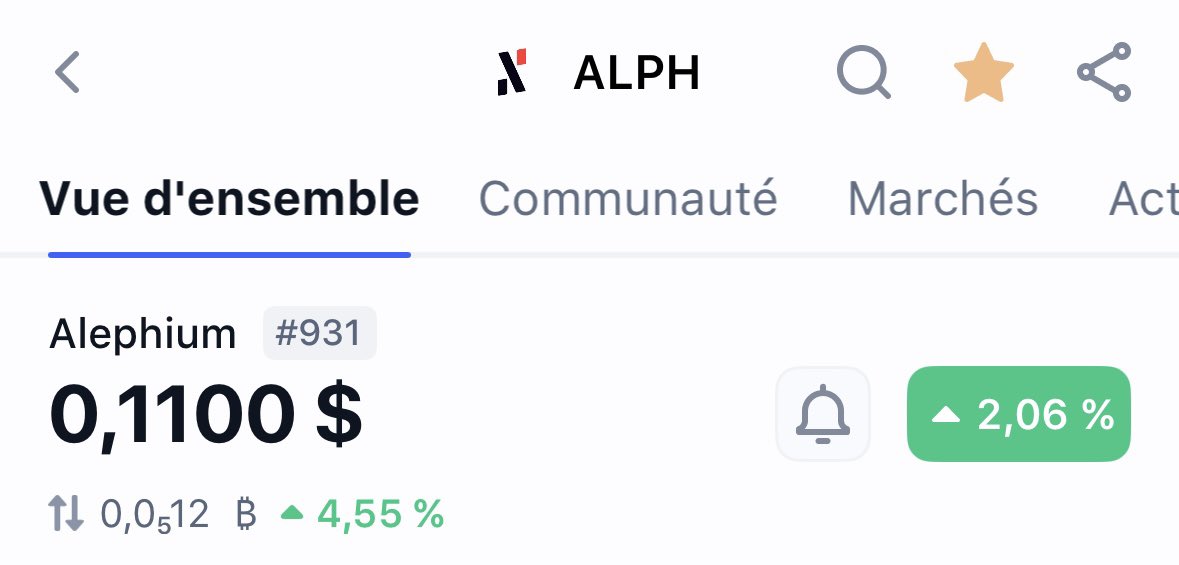











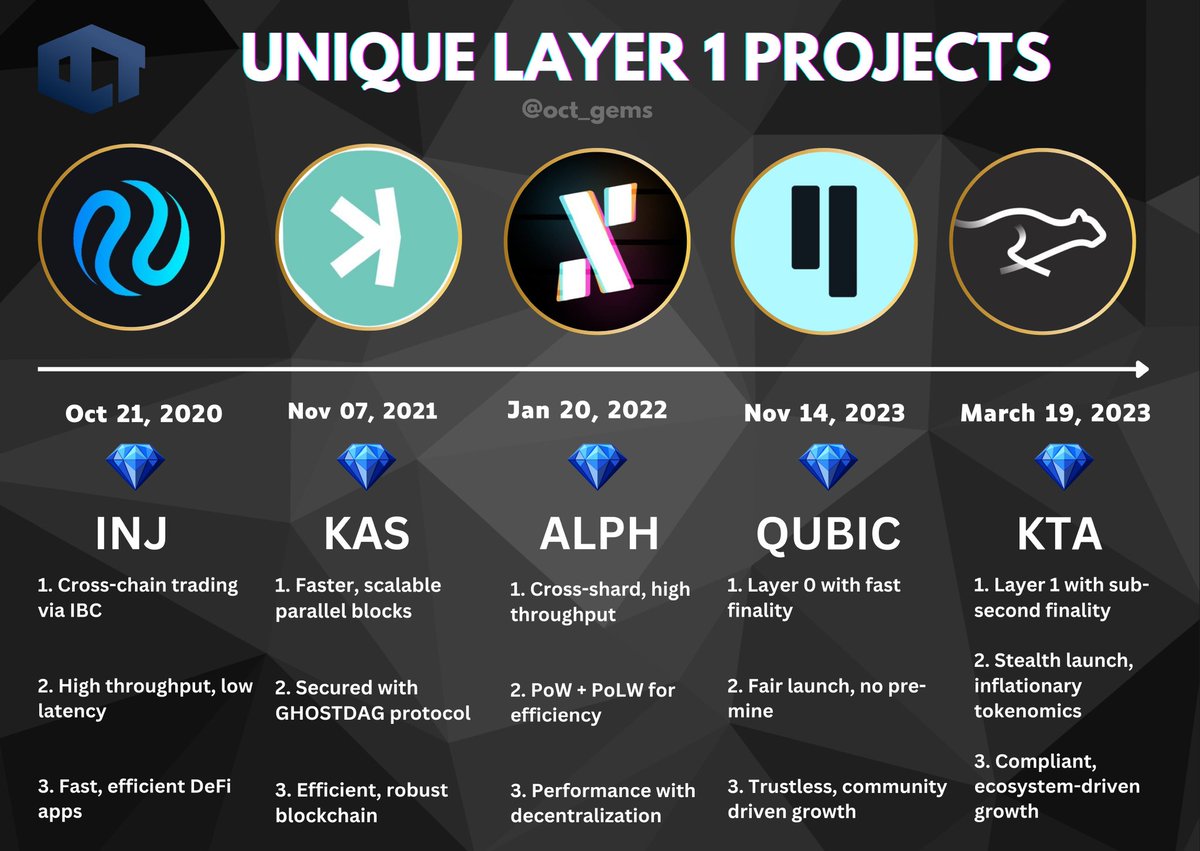
𝐔𝐧𝐢𝐪𝐮𝐞 𝐋𝐚𝐲𝐞𝐫-𝟏 𝐩𝐢𝐜𝐤𝐬 𝐲𝐨𝐮 𝐬𝐡𝐨𝐮𝐥𝐝 𝐝𝐞𝐟𝐢𝐧𝐢𝐭𝐞𝐥𝐲 𝐜𝐡𝐞𝐜𝐤 𝐨𝐮𝐭 👀
💎 $INJ 💎 ( @injective )
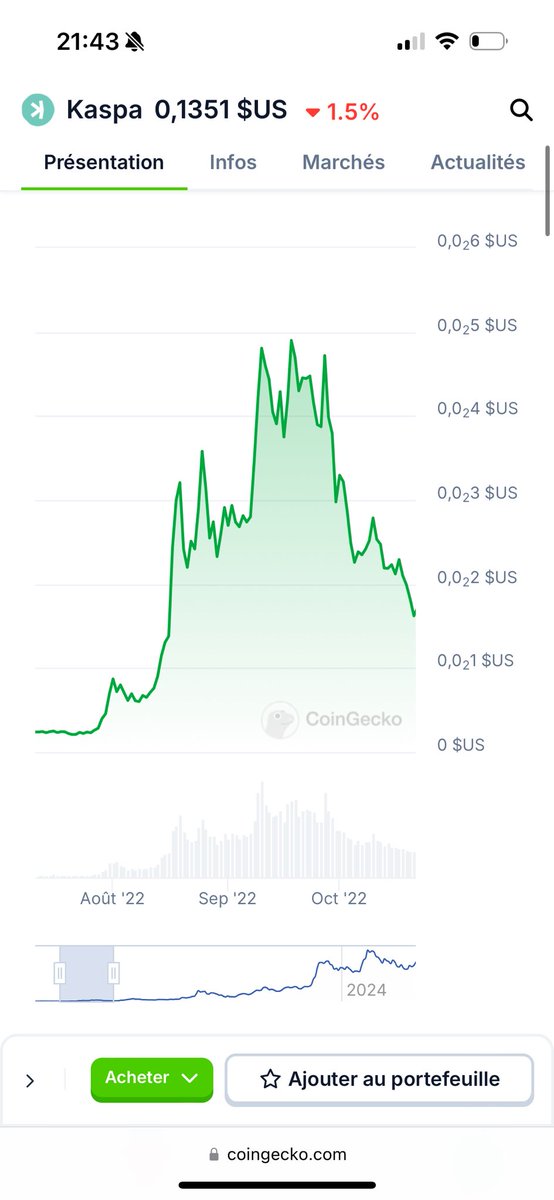
💎 $KAS 💎 (@KaspaCurrency )
💎 $ALPH 💎( @alephium )
💎 $QUBIC 💎 (@_Qubic_)
💎 $KTA 💎( @KeetaNetwork )
Which ones do you back for this cycle?
13
8
44
1,812

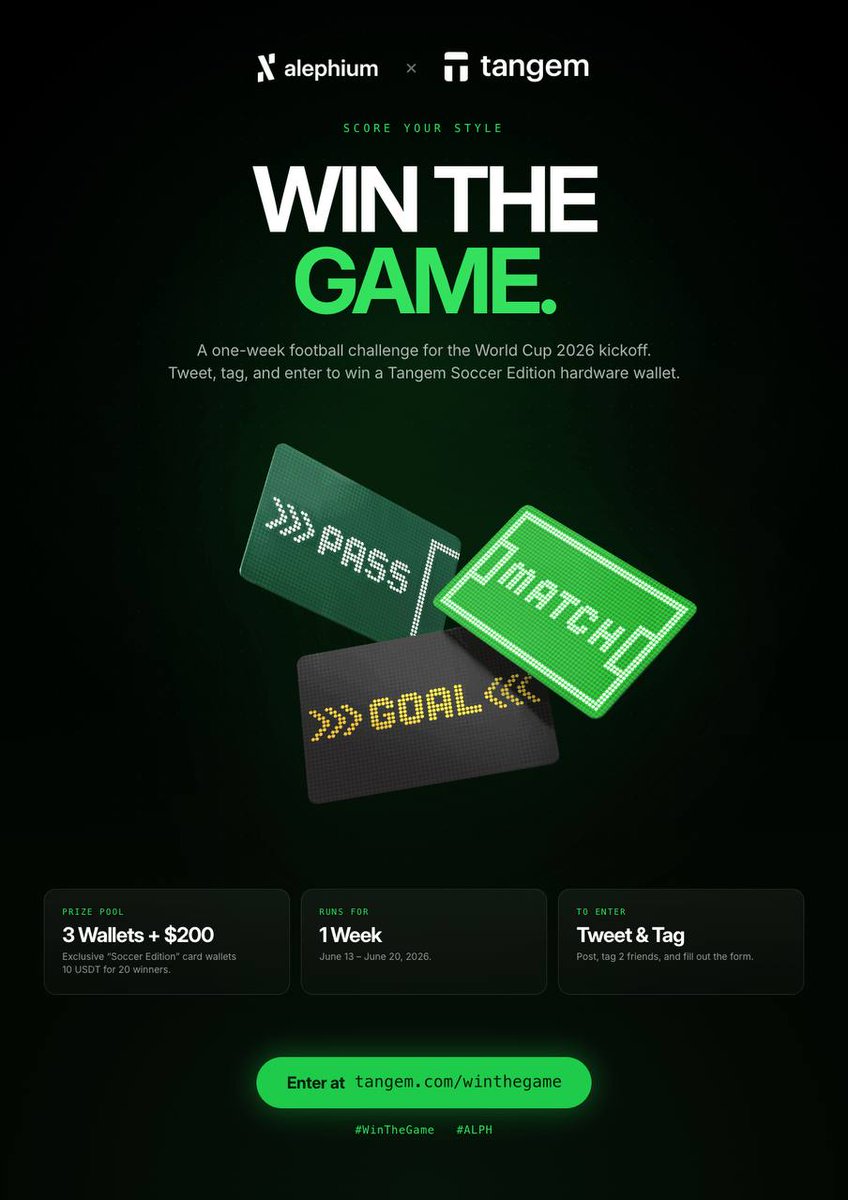
🏆⚽️ World Cup 2026 is here and we're celebrating with @Tangem!
Up for grabs:
- 3x Limited Tangem "Soccer Edition" hardware wallets
- A share of $200 in USDT rewards
To enter:
→ Follow @Alephium & @Tangem here on X
→ Describe the team you're rooting for at the WC26 - no country names, just vibes (e.g. 🇨🇭🧀🏔️)
→ Tag @Alephium & @Tangem 2 friends
→ Fill out the form at forms.gle/37SaGHifZnaebuS88
Final whistle: June 20th.
Good luck!
63
54
117
11,929
March to Mainnet 12/06 🏃
This week, our Core Contributors have been pushing Powfi closer toward mainnet, maintaining key Alephium infrastructure, and continuing Bridge audit and remediation work in parallel.
We are working to relaunch an improved Bridge as soon as possible, once all relevant measures are complete.
Here’s your weekly dev update:
<Powfi>
💥 Continuing internal smart contract audit work
💥 Finalising the referral system design proposal
💥 Completed Powfi and Crowdin integration
💥 Fixed Powfi SDK npm homepage GitHub URLs
<Backend>
⚙️ Upgrading all Alephium dependencies
⚙️ Running a full audit of the entire codebase
⚙️ Reducing Explorer Backend database size
⚙️ Improving node WebSocket support
<Wallets>
✅ Hardened in-app browser security
✅ Team sync on Explorer Backend data validity
✅ Improved transaction sending speed across both wallets
✅ Submitted mobile wallet v2.5.1 to both app stores, including:
1️⃣ Improved cold start performance
2️⃣ Improved perceived transaction confirmation speed
3️⃣ Fixed spinner animation position on data refresh
<Misc>
📸 Took snapshots of all wALPH holder addresses and LP providers on Uniswap and PancakeSwap
📚 Researched referral program designs, contract requirements, key considerations, and integration needs for channel partners (see the Powfi update from earlier this week)
🔎 Reviewed current grant applications
⬆️ Upgraded Alphland nodes
🔒 Researched improvements to security monitoring for the Alphland Alert System
🙅 Removed /admin path from production website
Our conviction and resilience are rock solid.
Alephium’s core contributors have continued to deliver through all of it, and that has not gone unnoticed by the community. Your continued support is priceless 👏
Keep an eye out for upcoming Bridge and Powfi updates.
More to come.
10
18
60
1,695

alphmax🔥 ℵ retweeted

Jun 11
Excited to share that we have joined the @circle Alliance Program, a global community of teams focused on bringing the world on-chain, powered by USDC!
1
4
6
312
alphmax🔥 ℵ retweeted

Jun 11
Lets play fifa fantasy football with a prize pool of 6 000 ALPH
Como uma força
3
5
15
787
alphmax🔥 ℵ retweeted

Jun 10
Aura’s audit process is officially underway.
The audit is expected to take around 3–4 weeks, with mainnet launch coming soon after once the review is complete and everything is finalized.
While the audit progresses, we’re continuing to polish the frontend, make final improvements, and prepare the platform for launch.
Things are moving very well. Aura mainnet is getting close.
1
6
17
284
Bridge Exploit Update
Work on bridge remediation progresses.
Over the past few days, the team has been focused on reviewing, testing, and hardening the updated bridge infrastructure. We are currently finalizing our internal review and preparing for an additional external security review before relaunching the bridge.
In parallel, we are reviewing the broader bridge architecture and identifying additional improvements. Our intention is to further strengthen the system beyond the specific vulnerability involved in this incident.
As of today, relaunching the bridge remains our preferred recovery path for affected users. We currently believe this is the fastest and most straightforward way to allow legitimate wrapped ALPH (wALPH) holders to redeem their assets, while also supporting the broader recovery process. This approach remains subject to the outcome of the ongoing reviews.
On the investigation side, following coordination with legal counsel, a criminal complaint has now been formally filed with the competent prosecutor's office in Switzerland. We also continue to cooperate with security and investigation partners regarding asset tracing and recovery efforts.
We will continue sharing updates during this process.
5
13
69
2,360

Alephium has been turning into the builders chain here. easy to build on, easy to learn, and ai understands it's smart contract language well.
the team has shown that they can execute on their roadmap, and given the current crypto climate it's cheap here.
2
7
176


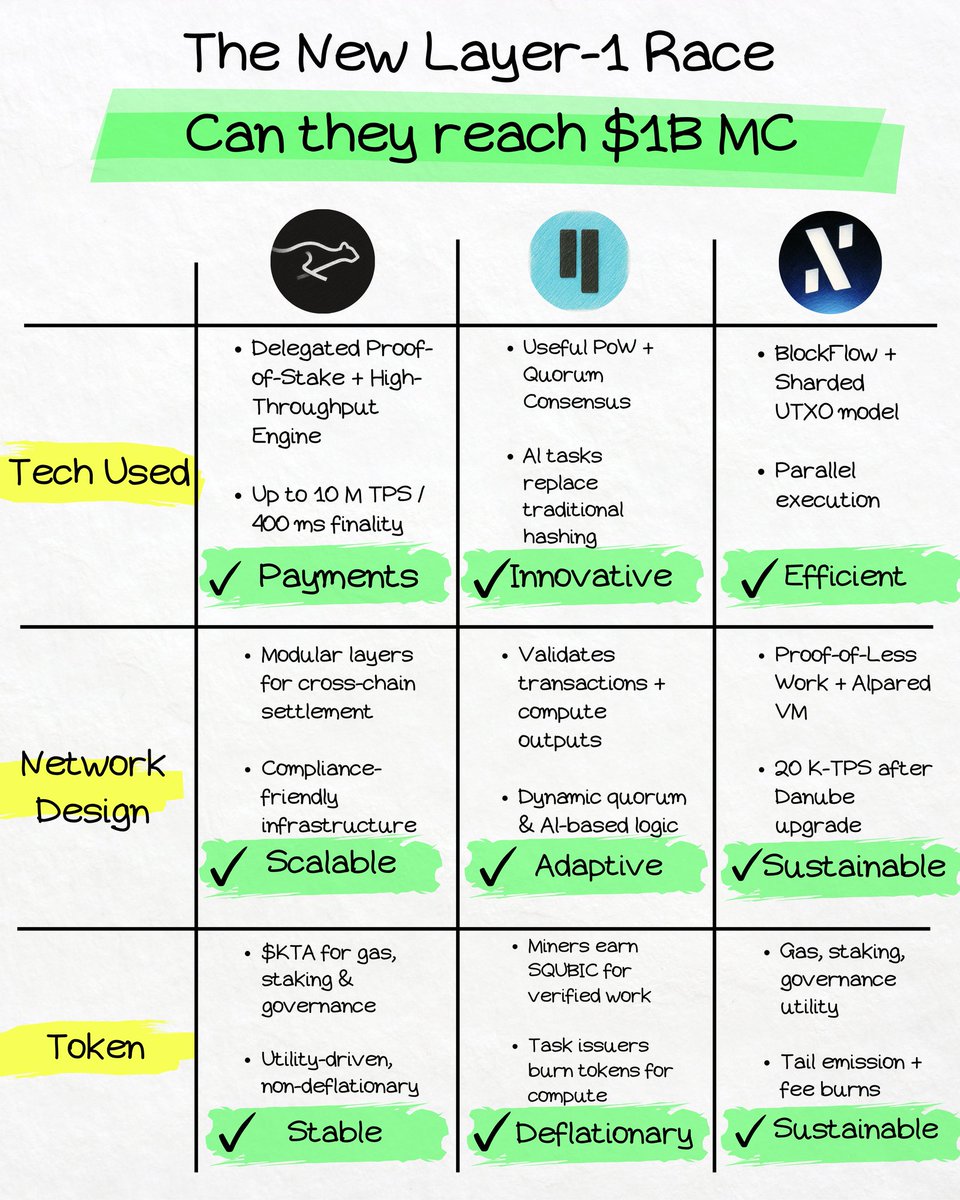
The New Layer-1 Race
Every cycle, new L1s emerge promising faster speeds, smarter consensus, and real-world adoption.
But can these projects reach $1B market cap?
→ @KeetaNetwork ( $KTA )
→ @_Qubic_ ( $QUBIC )
→ @alephium ( $ALPH )
Let’s dive in👇
⚫ Keeta ( $KTA ): The Scalable Payments & Compliance Layer
✦ Tech Used → Delegated Proof-of-Stake (dPoS) High-Throughput Engine
Custom dPoS consensus delivering 10M TPS with 400 ms finality (public stress test hit 11.2M TPS in June 2025, independently verified).
Built-in KYC/AML, digital identity certificates, tokenization rules engine, and on-chain FX - purpose-built for regulated, high-volume transfers.
Keeta is not a DeFi yield farm.
It’s the payment rail connecting TradFi rails (banks, SWIFT/ACH/SEPA) with crypto (BTC, ETH, USDC, ERC-20s).
Think Visa-grade blockchain for institutions.
Mainnet launched 22 September 2025.
Cross-chain anchors (including Ethereum integration) went live with mainnet; fiat anchors, Keeta Pay, Keeta Card, and high-frequency DEX are now on the active roadmap.
✦ Network Design → Permissionless Modular Anchors
Base layer handles consensus and security.
Upper-layer “anchors” manage smart-payment logic, bridges, compliance, and fiat on/off-ramps.
Designed for real-world liquidity, banking integration, and regulatory compliance from day one.
✦ Token / Economy → $KTA Utility & Governance
Total supply capped at 1 billion.
Used for gas fees, staking/delegation to validators (“representatives”), and governance.
No confirmed burn or deflationary mechanism - long-term emissions focused on security and throughput.
Vesting schedules for team/investors/community are transparent and staggered.
👉 My take: Keeta is the self-custodial, compliance-first, high-speed payment infrastructure institutions could actually adopt. Pure utility play, not a yield platform.
🔵 Qubic ( $QUBIC ): Useful Proof-of-Work for AI & Decentralized Compute
✦ Tech Used → Useful PoW (UPoW) Quorum Consensus
Miners perform verifiable AI/compute tasks (training Aigarth neural networks) instead of random hashing.
Certified fastest mainnet blockchain - peak 15.52 million TPS (CertiK audit). Smart contracts can exceed 55 million transfers/sec.
Tick-based system with dynamic quorum (676 Computors; 451-of-676 required for instant finality). Feeless base transfers.
Qubic turns “wasted” mining energy into productive work: real AI training external compute (e.g., merge-mining other chains).
It proved the concept with a live 51% hashrate takeover of Monero (Aug 2025) and expanded to Dogecoin mining integration (March 2026).
✦ Network Design → Quorum Model Self-Sustaining Smart Contracts
Nodes validate both transactions and computation results.
Oracles feed real-world data into AI-powered smart contracts.
QBridge (direct Ethereum connection) launched March 2026.
Smart contracts launched via IPO model with built-in prepaid reserves and real-time execution-fee burns (activated Jan 2026).
✦ Token / Economy → $QUBIC Utility Deflationary Mechanics
Miners/Computors earn $QUBIC for verified useful work.
Task issuers and smart-contract execution burn $QUBIC.
Fair launch (no premine/VC allocation). Halvings consistent weekly burns.
Target: never reach the 200 trillion theoretical cap - net deflationary pressure as usage grows.
👉 My take: Qubic remains the high-risk, high-reward wildcard.
It is the only L1 turning PoW energy directly into decentralized AI and rentable compute at massive scale.
⚪ Alephium ( $ALPH ): The Scalable, Energy-Efficient UTXO Chain
✦ Tech Used → BlockFlow Sharded Stateful UTXO
DAG-style parallel block production with Bitcoin-level security model.
Native sharding single-step cross-shard transactions - scales cleanly without sacrificing determinism.
Danube upgrade (activated 15 July 2025) delivered the leap: block time halved to 8 seconds, throughput now >20,000 TPS, plus major UX improvements (passkeys, groupless addresses, optimistic execution).
✦ Network Design → Proof-of-Less-Work (PoLW) Alphred VM
PoLW cuts energy consumption by >87% vs. standard PoW while keeping full decentralization and ASIC resistance.
Alphred VM offers Ethereum-like programmability with UTXO security and deterministic execution.
Post-Danube: feels like a single chain despite sharding.
Alephium proves you can scale the UTXO model for DeFi without abandoning Bitcoin-style security or energy efficiency.
✦ Token / Economy → $ALPH (Gas Security Sustainable Emissions)
Pre-Danube: emission curve toward ~1B cap over 81 years.
Post-Danube (July 2025): hard cap removed; replaced with sustainable tail emission model (Monero-style). First 81 years unchanged - long-term miner incentives preserved.
Used for gas fees, staking, and governance.
Transaction fees contribute to deflationary pressure; staking aligns participants.
👉 My take: Alephium is the developer-first, engineering-disciplined chain - energy-efficient, scalable, and built on rock-solid fundamentals.
🔚 Conclusion: The L1 Edge
Tech Used:
$QUBIC > $ALPH > $KTA
→ Qubic’s UPoW 15.5M TPS redefines mining for AI. Alephium’s BlockFlow PoLW scales PoW cleanly. Keeta’s dPoS powers payments/compliance at 10M TPS.
Network Design:
$ALPH > $KTA > $QUBIC
→ Alephium’s mature sharded UTXO Danube optimizations win on elegance. Keeta’s modular anchors are production-ready for finance. Qubic is ambitious and fast but more experimental.
Token / Economy:
$QUBIC > $ALPH > $KTA
→ Qubic’s built-in burns usage-tied deflation create the strongest demand flywheel. Alephium’s tail emissions ensure long-term security. Keeta’s pure utility is solid but lacks explicit deflation.
💡 My Takeaway:
Want high-speed payment TradFi infrastructure exposure → Keeta ( $KTA ).
Want AI decentralized compute speculation → Qubic ( $QUBIC ).
Want scalable UTXO fundamentals with real engineering discipline → Alephium ( $ALPH ).
The race is still wide open.
But these three have shipped real upgrades in the last 12 months. DYOR, always.
9
9
52
3,108
alphmax🔥 ℵ retweeted

Jun 5
Season 2 is locked 🔒
TGE is close, and every point you earned is about to become $LINX.
Check your total and share your results 👉 app.linxlabs.org/rewards
9
22
375
alphmax🔥 ℵ retweeted

Future of DeFi!
x.com/alephium/status/206217…
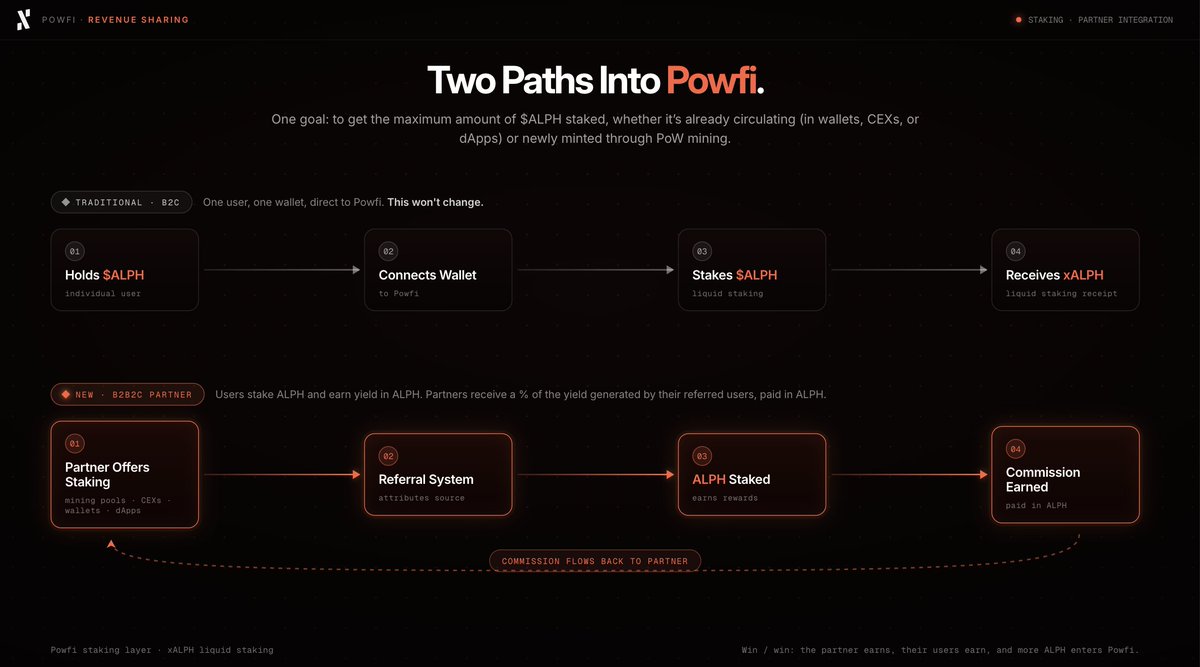
Powfi Update 💥
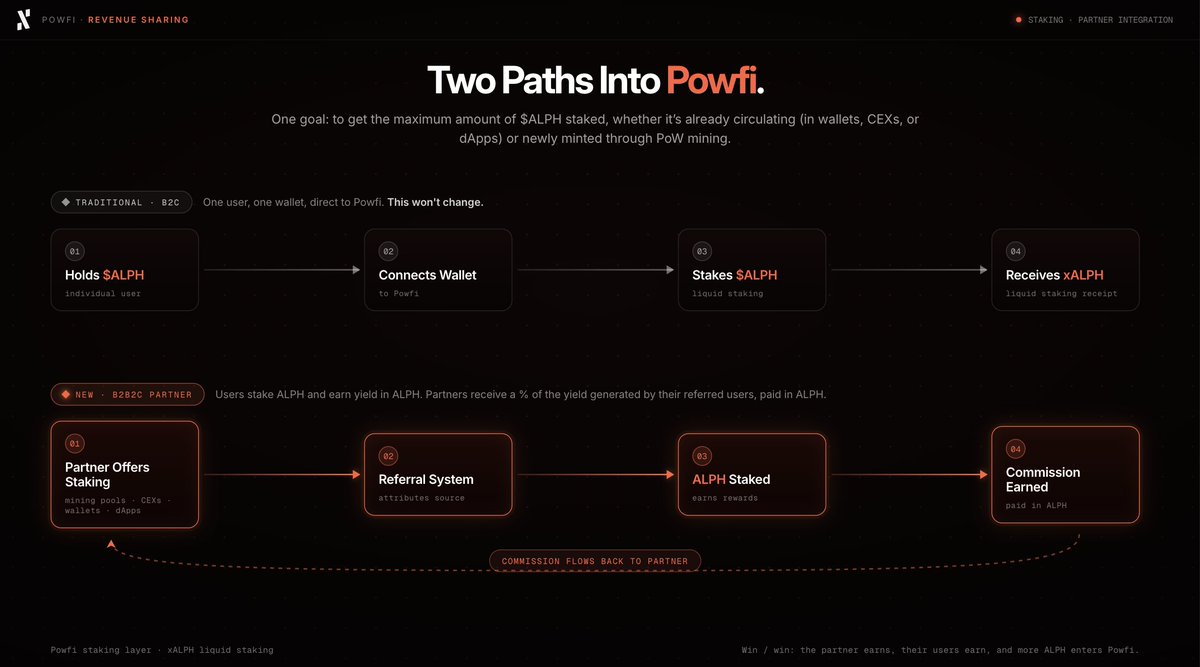
Following very positive discussions with several partners, the Powfi codebase has been upgraded to support direct integrations with our $ALPH Staking Layer through a referral-based framework.
How it works:
Traditional B2C Workflow
▪️ A user holds ALPH
▪️ Connects their wallet to Powfi
▪️ Stakes their ALPH
▪️ User starts earning rewards
New B2B2C Partner Workflow
▪️ An integration partner offers ALPH staking to its users
▪️ The yield offered is the same as staking natively on Powfi
▪️ Staking is attributed to the partner via an on-chain referral tag
▪️ ALPH is staked via the Powfi Staking Layer
▪️ The partner earns a commission
One example from our recent discussions is a mining pool offering ALPH Staking to its users.
Other potential integration partners include: wallets, centralized exchanges, and of course dApps.
This is how the Powfi staking layer scales and maximizes locked circulating supply, strengthening $ALPH and the broader ecosystem.
We'll share more updates as these conversations progress and integrations begin to materialize.
2
6
85
🧵How the Attacker's wALPH Was Burned
“As part of the bridge incident remediation, the bridge guardians, with support from our security partners, executed an authorized recovery procedure to invalidate the unbacked wrapped ALPH held in the attacker's wallet.”
The Bridge Guardians coordinated through the bridge’s multi-signature governance mechanism to temporarily upgrade the bridge’s wrapped asset contract implementation.
This temporary implementation introduced functionality that allowed the attacker-controlled unbacked wALPH to be permanently burned. Immediately after execution of the burn, the contract was reverted to its original implementation.
This action required approval from the full Guardian set, which is why the process took several days to organize and execute. Note that the guardians are separate and independent from each other.
Alephium’s bridge wrapped asset contracts, like those used by many cross-chain bridge systems, are deployed behind upgradeable proxy contracts. This architecture allows contract implementations to be modified through Guardian-approved governance actions when required.
It is important to note that the burn capability used in this remediation did not exist in the bridge’s normal operating implementation. It was introduced through a temporary governance-approved upgrade specifically to remediate the unbacked supply created by the exploit and was rolled back once the action was completed.
This approach has precedent in previous DeFi security incidents.
Following the pxETH exploit involving Yearn Finance, unbacked tokens were invalidated by the token issuer directly from the attacker's wallet.
After the Echo Protocol incident, attacker-controlled eBTC was burned once administrative control had been recovered.
The tokens burned in our case were exclusively the unbacked wALPH that remained in the attacker’s wallet at the time of the action. Any wALPH that had already left the attacker’s wallet prior to the burn was not affected.
The recovery action was intentionally limited to assets that remained under the attacker’s direct control and did not affect third-party holders who acquired wALPH through ordinary market activity without involvement in the exploit.
The action had no effect on assets held by legitimate users and did not affect any assets on the Alephium Layer 1 blockchain.
The bridge itself remains disabled while remediation, review, and security assessment work continue.
11
18
68
4,852
On Decentralization and immutability
Governance actions and decentralization are often discussed as though they are incompatible concepts, when in reality, decentralization and immutability are distinct properties.
A decentralized system can still change state when the relevant participants reach the required level of consensus. The defining question is not whether a change is possible, but who is authorized to approve that change and what consensus threshold must be met.
Bitcoin, Ethereum, Alephium, and other decentralized networks have all coordinated protocol changes throughout their histories.
Network upgrades, hard forks, and governance actions are all examples of decentralized participants collectively agreeing to modify a system’s state or rules.
The Ethereum DAO fork is perhaps the most widely known example of a highly decentralized network coordinating a state change in response to an exploit. The Ethereum community reached consensus around a protocol change that effectively invalidated the outcome of the attack and restored the affected funds.
The same principle applies here.
The action was not the result of a unilateral administrative decision. The Bridge Guardians collectively approved a temporary upgrade that enabled the unbacked wALPH remaining in the attacker’s wallet to be burned. Approval from the full Guardian set was required.
The bridge governance model differs from that of a Layer 1 blockchain and relies on a substantially smaller guardian set. This governance structure is similar to that used by many cross-chain bridge systems, where upgrades require approval from the designated guardians or validators responsible for securing the bridge.
1
8
36
1,148
Bridge Update
The unauthorized wrapped ALPH held in the attacker's wallet was burned yesterday. 500,000 unbacked wrapped ALPH had already been sold on Uniswap prior to the burn. Alephium will supply the native ALPH required to back these tokens.
For users affected by the drained bridge assets, we remain committed to making them whole and are working on the best path forward.
Following the burn, the most likely path forward is now a relaunch of bridge operations. We currently believe this is the fastest, safest, and simplest solution. Once the bridge is safely restored, users would be able to redeem through the bridge as originally intended. A separate redemption process for wALPH holders remains a fallback option if needed.
The vulnerability has been fixed. We're conducting extensive review and security assessments before any relaunch, as we prioritize security over speed.
This is our most likely path, though it may evolve as reviews progress.
Full postmortem and further updates to follow.
7
6
65
2,553
Powfi Update 💥
Following very positive discussions with several partners, the Powfi codebase has been upgraded to support direct integrations with our $ALPH Staking Layer through a referral-based framework.
How it works:
Traditional B2C Workflow
▪️ A user holds ALPH
▪️ Connects their wallet to Powfi
▪️ Stakes their ALPH
▪️ User starts earning rewards
New B2B2C Partner Workflow
▪️ An integration partner offers ALPH staking to its users
▪️ The yield offered is the same as staking natively on Powfi
▪️ Staking is attributed to the partner via an on-chain referral tag
▪️ ALPH is staked via the Powfi Staking Layer
▪️ The partner earns a commission
One example from our recent discussions is a mining pool offering ALPH Staking to its users.
Other potential integration partners include: wallets, centralized exchanges, and of course dApps.
This is how the Powfi staking layer scales and maximizes locked circulating supply, strengthening $ALPH and the broader ecosystem.
We'll share more updates as these conversations progress and integrations begin to materialize.
9
25
98
4,569