Tracking Zimbabwe's constitutional reform. Analysis & civic education on Constitution Amendment Bill No. 3, 2026. Good governance deserves serious debate. #CA3
Joined March 2026
- Tweets 292
- Following 41
- Followers 156
- Likes 8
136 Photos and videos
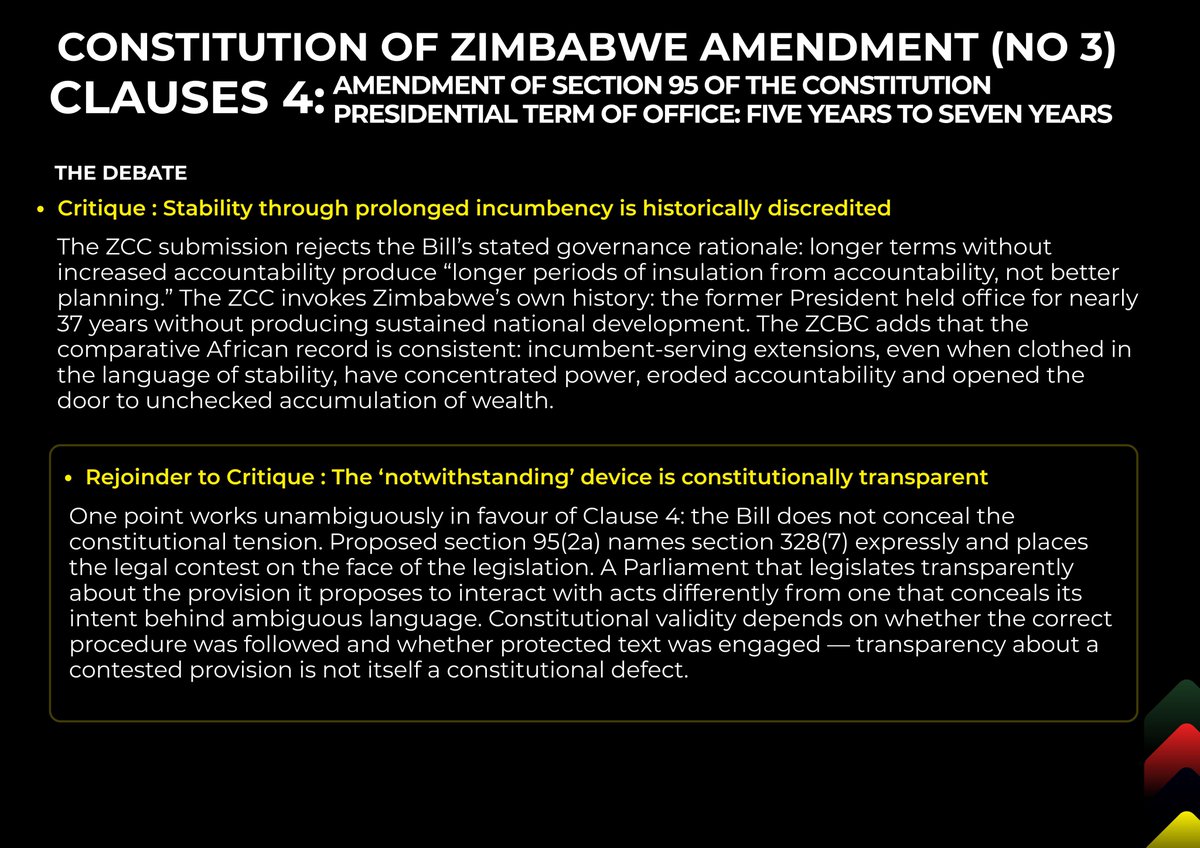
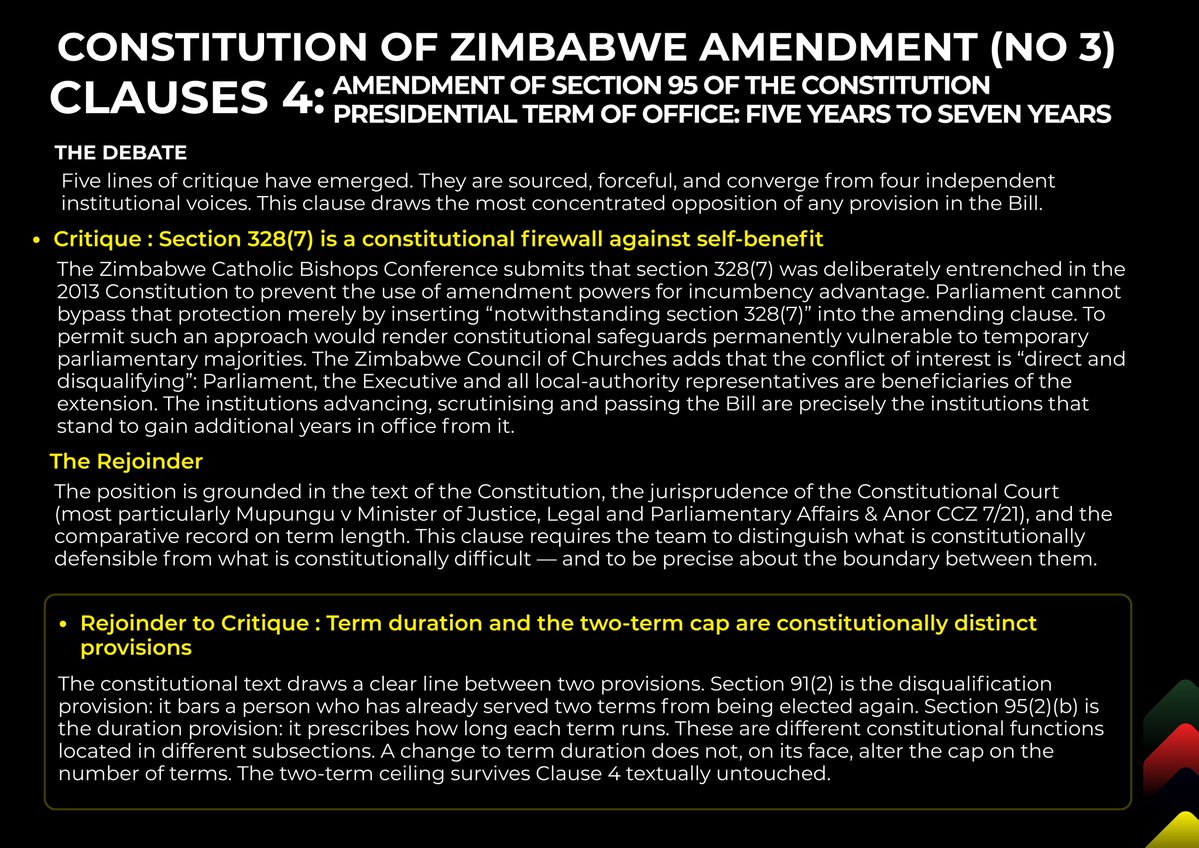

58m
We continue unpacking the Constitution of Zimbabwe Amendment Bill No. 3, H.B. 1 of 2026, clause by clause.
Today, our focus is on Clause 2, while closely following all submissions by Members of Parliament (MPs).
We’re watching every move. #ZimConstitution #BillNo3 #CA3
1
5
3
40
48m
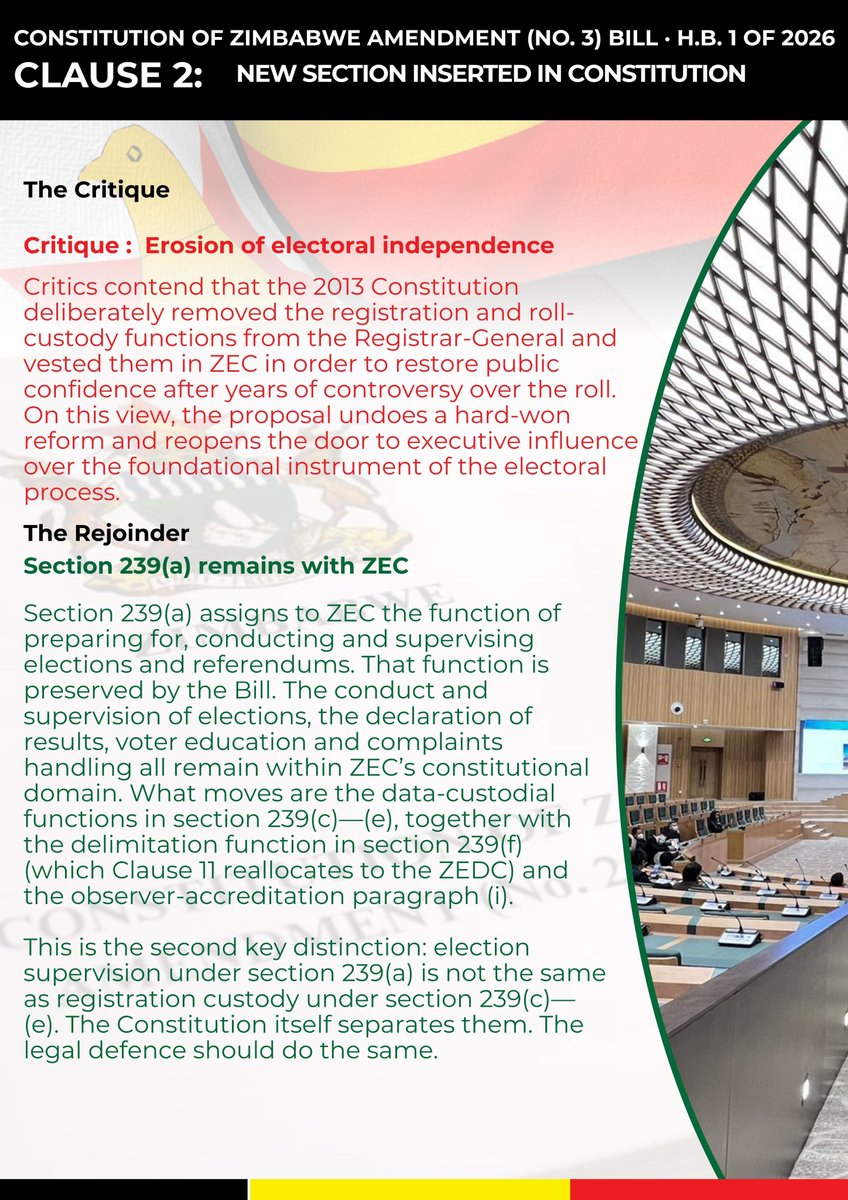
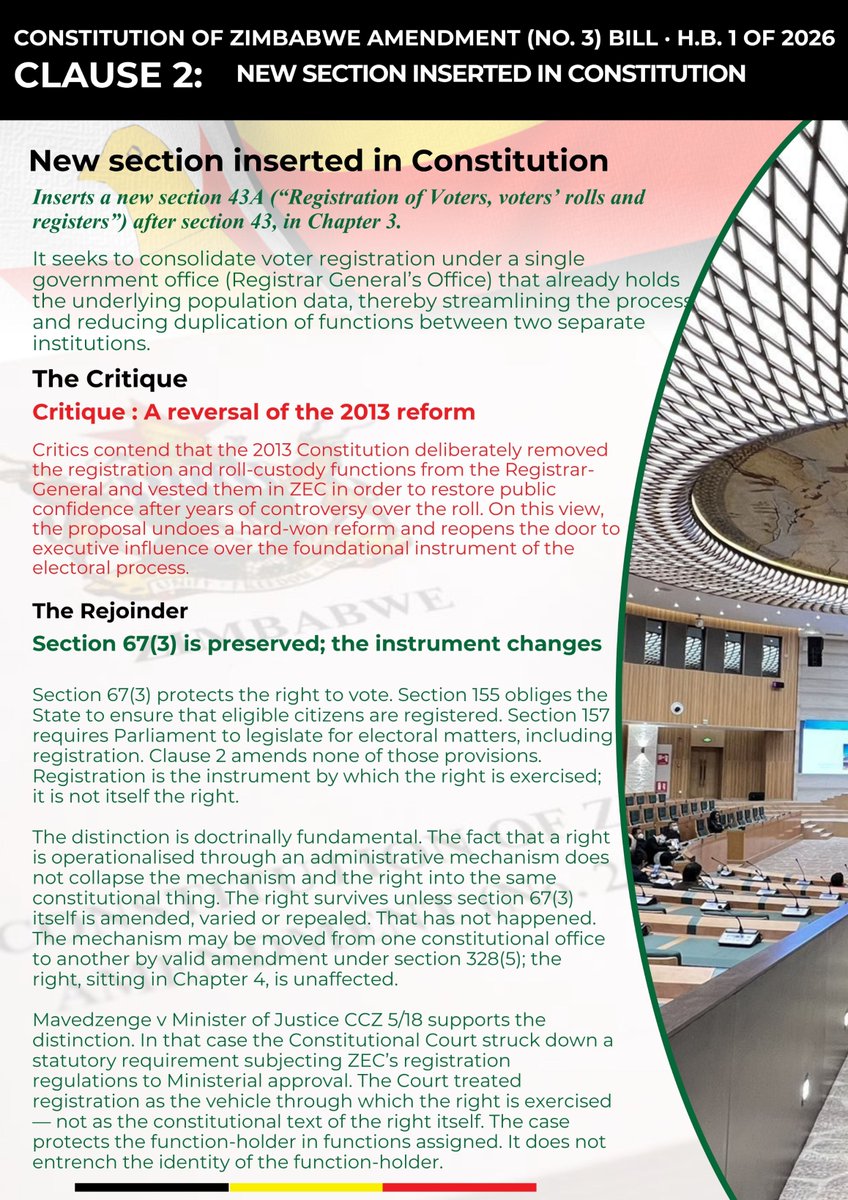
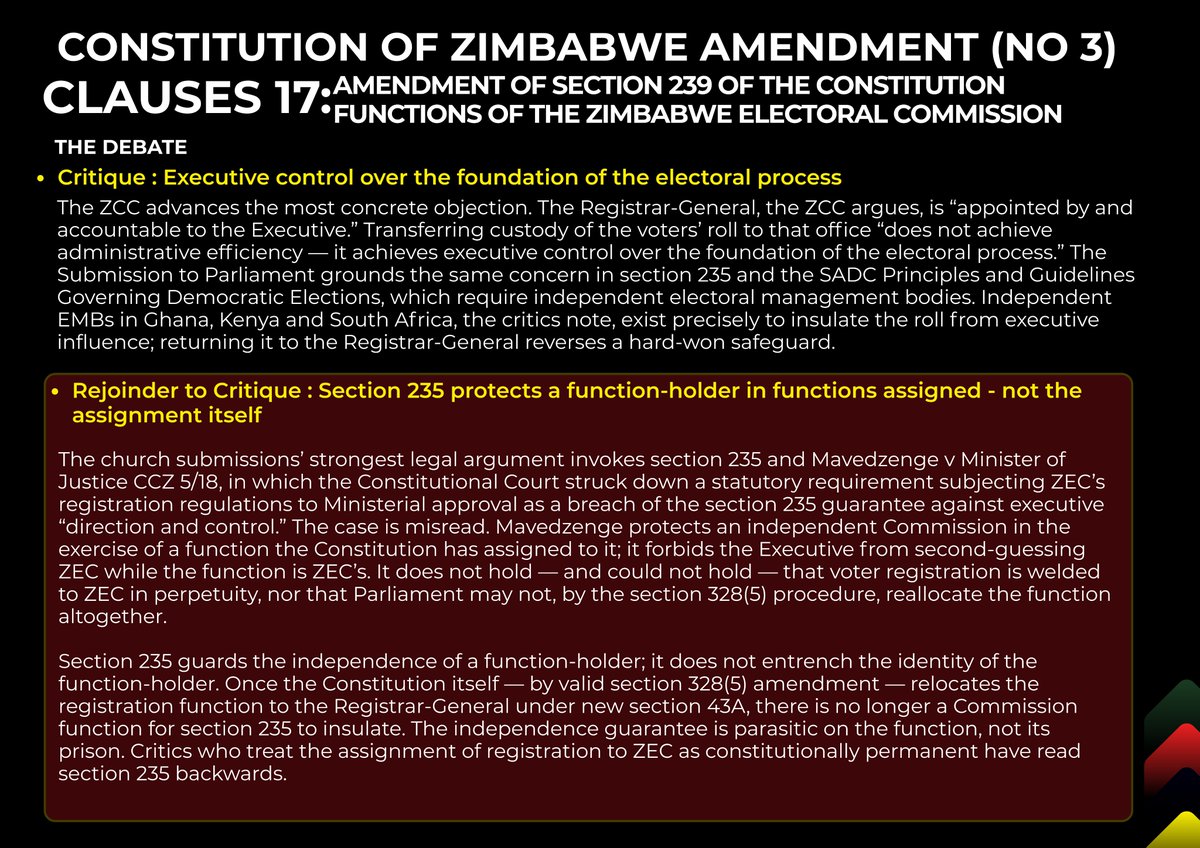
Critique 2: Erosion of electoral independence
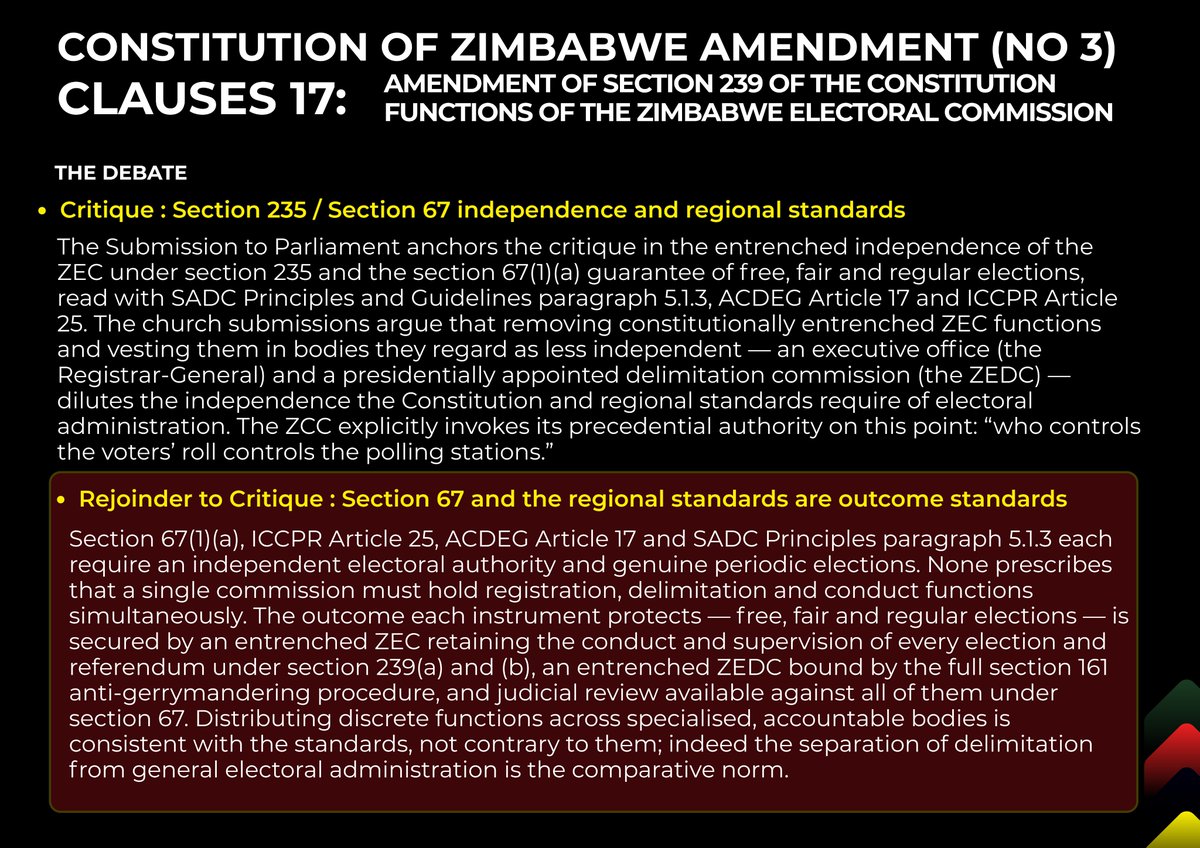
A second critique invokes section 235 and the independence guarantees applicable to Chapter 12 commissions. Because the voters’ roll is the gateway to the franchise, critics argue that removing sections 239(c)— (e) from the ZEC weakens the institutional independence necessary for free, fair, and credible elections. The Submission to Parliament places this point alongside the SADC Principles and Guidelines Governing Democratic Elections.
Critique 2 Rejoinder: Section 239(a) remains with ZEC
Section 239(a) assigns to ZEC the function of preparing for, conducting and supervising elections and referendums. That function is preserved by the Bill. The conduct and supervision of elections, the declaration of results, voter education and complaints handling all remain within ZEC’s constitutional domain. What moves are the data-custodial functions in section 239(c)—(e), together with the delimitation function in section 239(f) (which Clause 11 reallocates to the ZEDC) and the observer-accreditation paragraph (i).
This is the second key distinction: election supervision under section 239(a) is not the same as registration custody under sections 239(c)— (e). The Constitution itself separates them. The legal defence should do the same.
1
1
18
Jun 11
Analysis of the Constitution of Zimbabwe Amendment (No. 3) Bill, H.B. 1 of 2026
CLAUSE 4
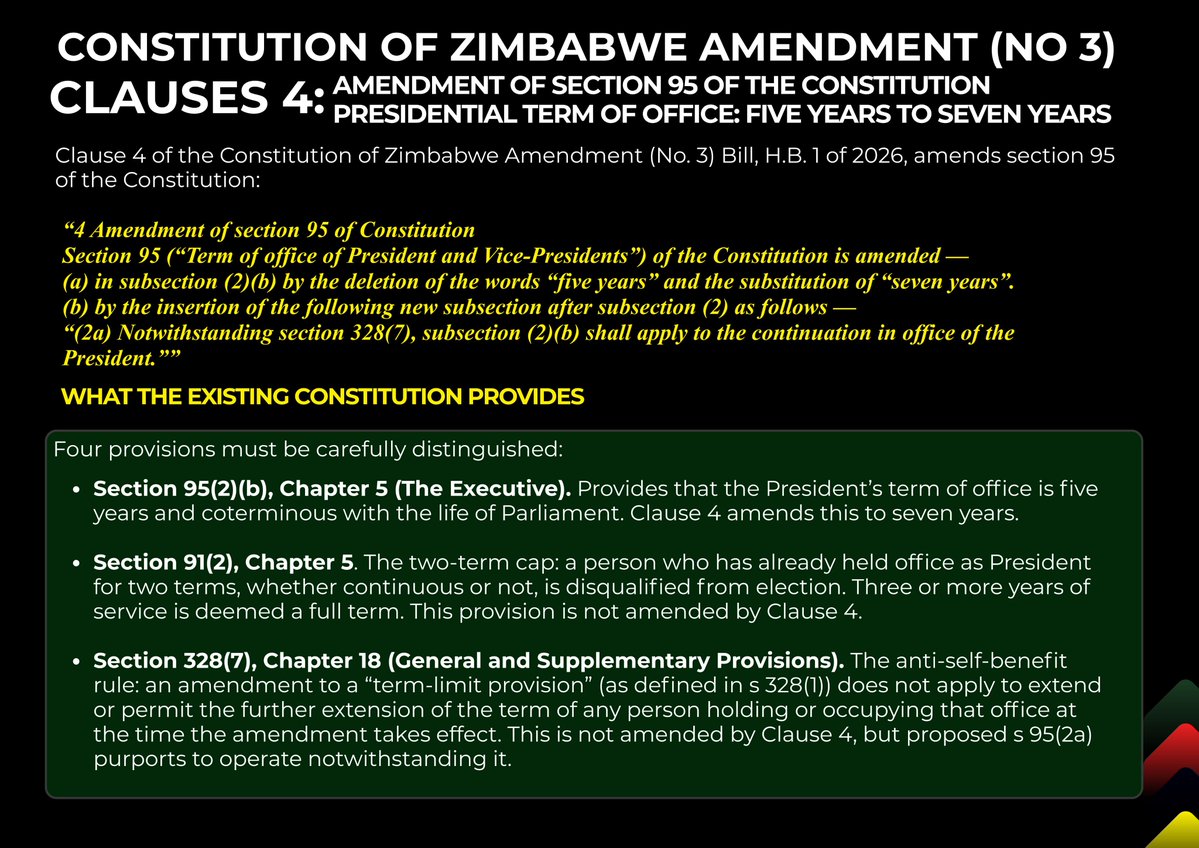
Clause 4 of the Constitution of Zimbabwe Amendment (No. 3) Bill, H.B. 1 of 2026, amends section 95 of the Constitution:
“4 Amendment of section 95 of Constitution
Section 95 (“Term of office of President and Vice-Presidents”) of the Constitution is amended —
(a) in subsection (2)(b) by the deletion of the words “five years” and the substitution of “seven years”.
(b) by the insertion of the following new subsection after subsection (2) as follows —
“(2a) Notwithstanding section 328(7), subsection (2)(b) shall apply to the continuation in office of the President.””
What the Existing Constitution Provides
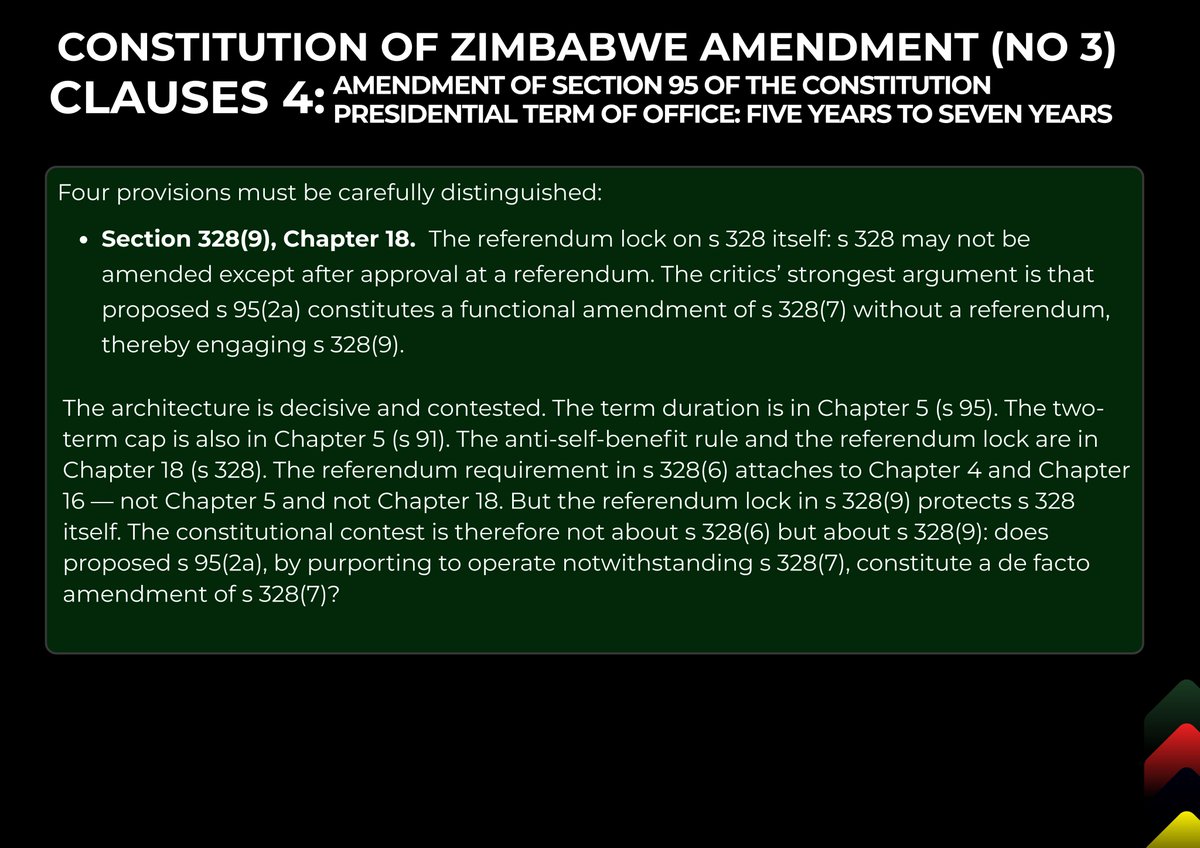
Four provisions must be carefully distinguished:
• Section 95(2)(b), Chapter 5 (The Executive). Provides that the President’s term of office is five years and coterminous with the life of Parliament. Clause 4 amends this to seven years.
• Section 91(2), Chapter 5. The two-term cap: a person who has already held office as President for two terms, whether continuous or not, is disqualified from election. Three or more years of service is deemed a full term. This provision is not amended by Clause 4.
• Section 328(7), Chapter 18 (General and Supplementary Provisions). The anti-self-benefit rule: an amendment to a “term-limit provision” (as defined in s 328(1)) does not apply to extend or permit the further extension of the term of any person holding or occupying that office at the time the amendment takes effect. This is not amended by Clause 4, but proposed s 95(2a) purports to operate notwithstanding it.
• Section 328(9), Chapter 18. The referendum lock on s 328 itself: s 328 may not be amended except after approval at a referendum. The critics’ strongest argument is that proposed s 95(2a) constitutes a functional amendment of s 328(7) without a referendum, thereby engaging s 328(9).
The architecture is decisive and contested. The term duration is in Chapter 5 (s 95). The two-term cap is also in Chapter 5 (s 91). The anti-self-benefit rule and the referendum lock are in Chapter 18 (s 328). The referendum requirement in s 328(6) attaches to Chapter 4 and Chapter 16 — not Chapter 5 and not Chapter 18. But the referendum lock in s 328(9) protects s 328 itself. The constitutional contest is therefore not about s 328(6) but about s 328(9): does proposed s 95(2a), by purporting to operate notwithstanding s 328(7), constitute a de facto amendment of s 328(7)?
1
9
8
472
Jun 11
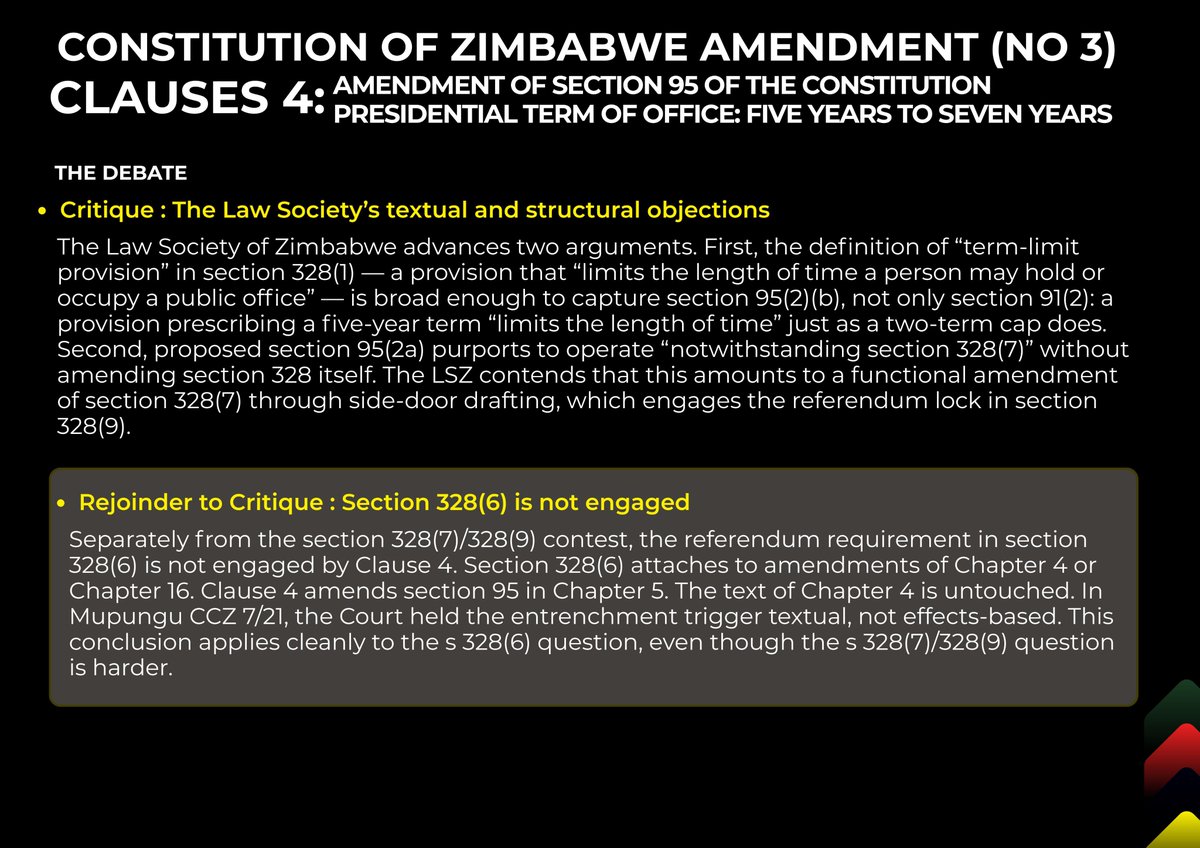
Critique 5: The Law Society’s textual and structural objections
The Law Society of Zimbabwe advances two arguments. First, the definition of “term-limit provision” in section 328(1) — a provision that “limits the length of time a person may hold or occupy a public office” — is broad enough to capture section 95(2)(b), not only section 91(2): a provision prescribing a five-year term “limits the length of time” just as a two-term cap does. Second, proposed section 95(2a) purports to operate “notwithstanding section 328(7)” without amending section 328 itself. The LSZ contends that this amounts to a functional amendment of section 328(7) through side-door drafting, which engages the referendum lock in section 328(9).
Critique 5 Rejoinder: Section 328(6) is not engaged
Separately from the section 328(7)/328(9) contest, the referendum requirement in section 328(6) is not engaged by Clause 4. Section 328(6) attaches to amendments of Chapter 4 or Chapter 16. Clause 4 amends section 95 in Chapter 5. The text of Chapter 4 is untouched. In Mupungu CCZ 7/21, the Court held the entrenchment trigger textual, not effects-based. This conclusion applies cleanly to the s 328(6) question, even though the s 328(7)/328(9) question is harder.
1
3
4
101
Jun 11
Comparative Examples
🇮🇪Ireland (seven-year term since 1937)
Article 12.3.1 of the Constitution of Ireland provides for a seven-year presidential term. The arrangement has operated within one of Europe’s most stable constitutional democracies for nearly ninety years. Term length is a neutral design feature, not a democratic deficiency.
🇫🇷France (seven-year term, 1873-2000)
France operated the Septennat for 127 years. The 2000 reduction to the Quinquennat (five years) was adopted by referendum as a democratic design choice, not as a correction of an illegitimate arrangement. The French experience demonstrates that the number of years is a constitutional variable, not a constitutional value.
#CA3
3
3
51
Jun 11
Join the live to witness the submissions from Members of Parliament on the Zimbabwe Constitution Amendment (No. 3) Bill, H.B. 1 of 2026.
Don't miss out! 👇
facebook.com/share/v/1NDPJDf…
@ParliamentZim
3
3
72
Jun 11
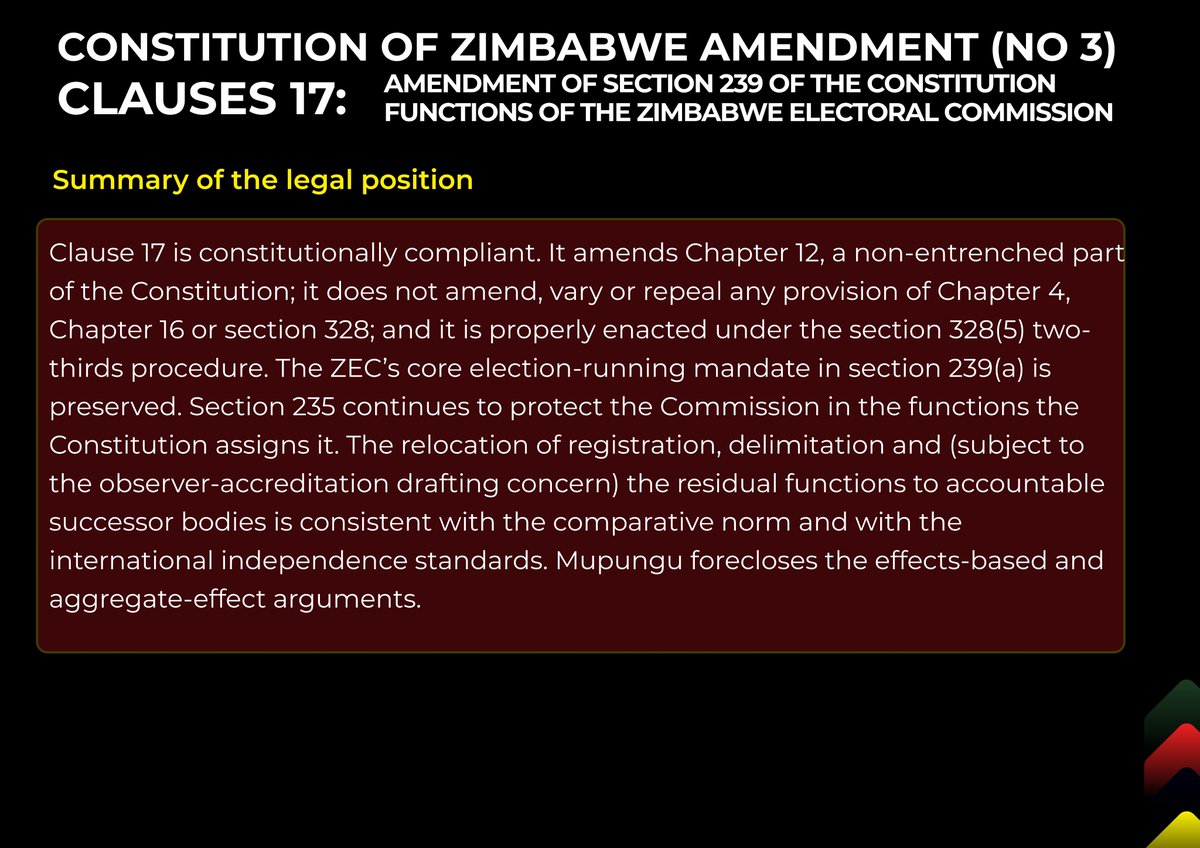
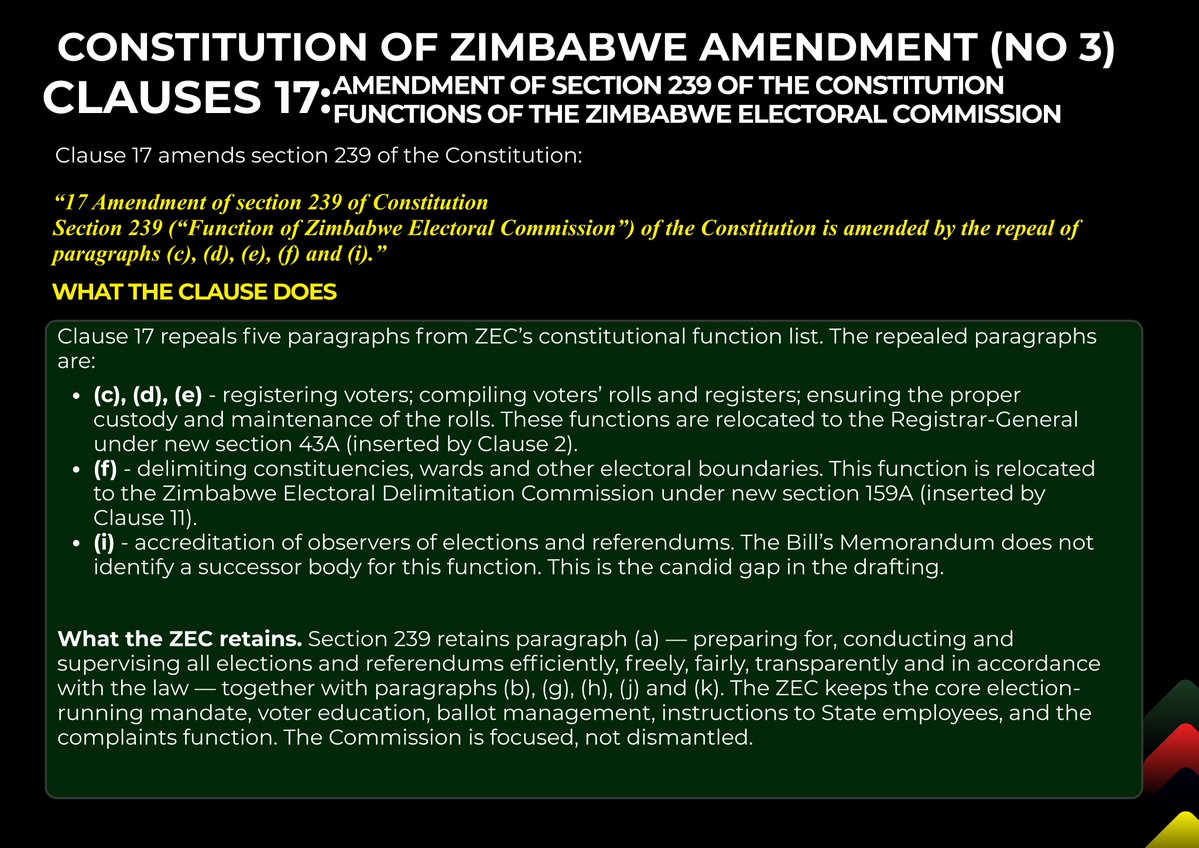
Today, we are breaking down Clause 17, Constitution of Zimbabwe Amendment (No. 3) Bill, H.B. 1 of 2026.
Verbatim Text of the Bill
Clause 17 amends section 239 of the Constitution:
“17 Amendment of section 239 of the Constitution
Section 239 (“Function of Zimbabwe Electoral Commission”) of the Constitution is amended by the repeal of paragraphs (c), (d), (e), (f) and (i).”
What the Clause Does
Clause 17 repeals five paragraphs from ZEC’s constitutional function list. The repealed paragraphs are:
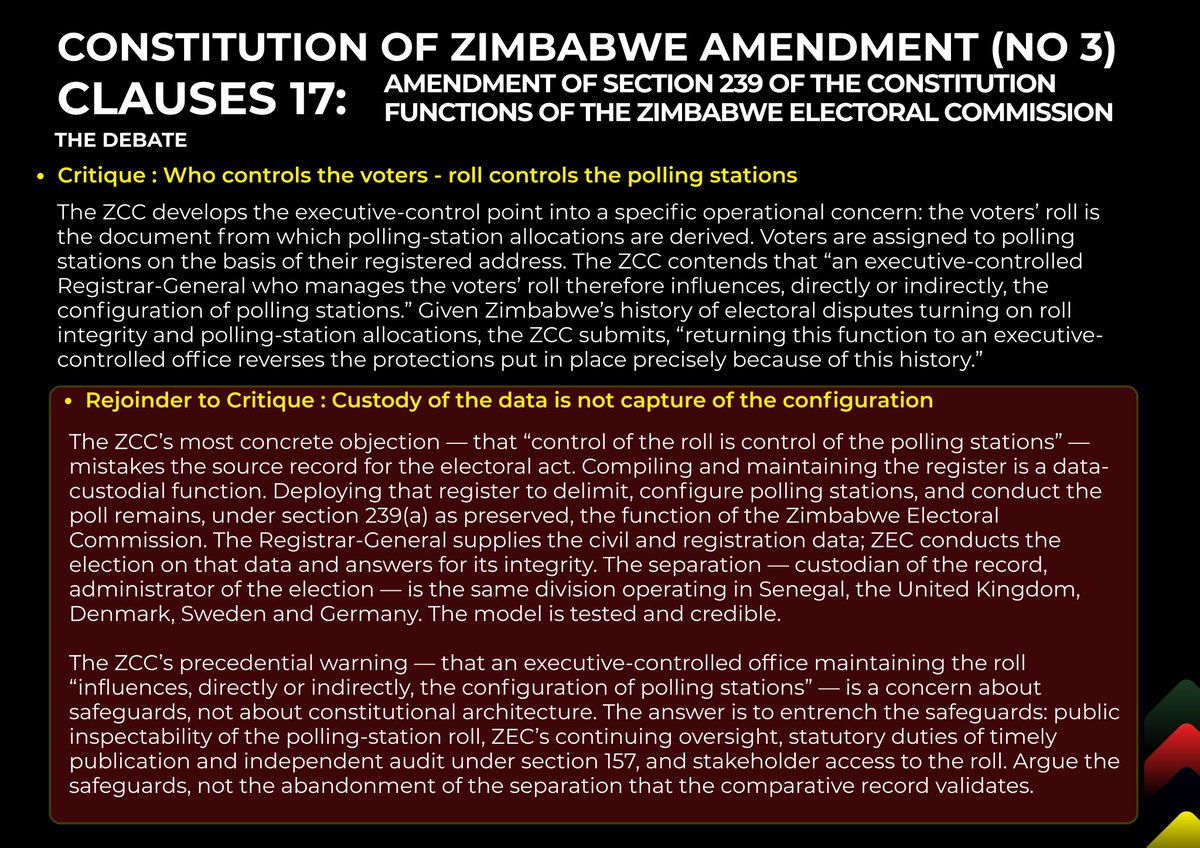
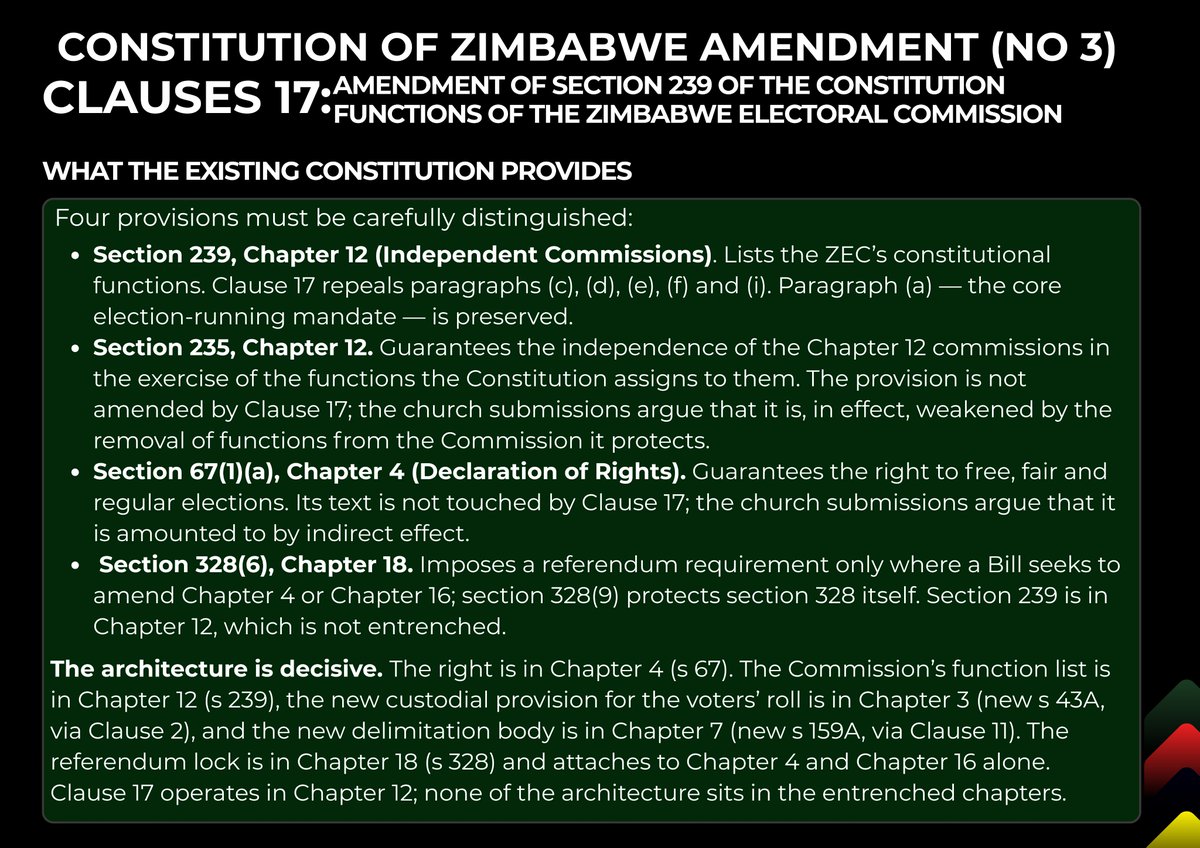
• (c), (d), (e) - registering voters; compiling voters’ rolls and registers; ensuring the proper custody and maintenance of the rolls. These functions are relocated to the Registrar-General under new section 43A (inserted by Clause 2).
• (f) - delimiting constituencies, wards and other electoral boundaries. This function is relocated to the Zimbabwe Electoral Delimitation Commission under new section 159A (inserted by Clause 11).
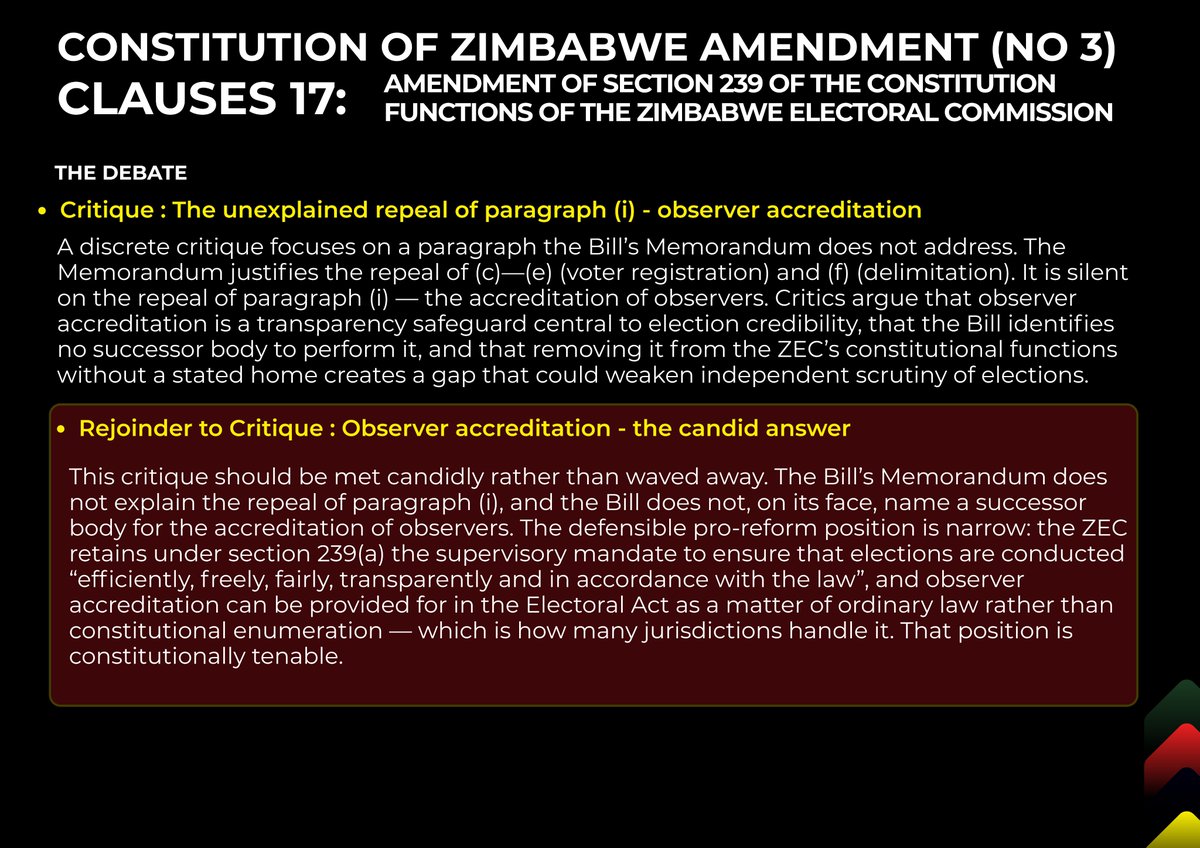
• (i) - accreditation of observers of elections and referendums. The Bill’s Memorandum does not identify a successor body for this function. This is the candid gap in the drafting.
What the ZEC retains. Section 239 retains paragraph (a) — preparing for, conducting and supervising all elections and referendums efficiently, freely, fairly, transparently and in accordance with the law — together with paragraphs (b), (g), (h), (j) and (k). The ZEC keeps the core election-running mandate, voter education, ballot management, instructions to State employees, and the complaints function. The Commission is focused, not dismantled.
3
20
17
4,327
Jun 11
Summary of the legal position
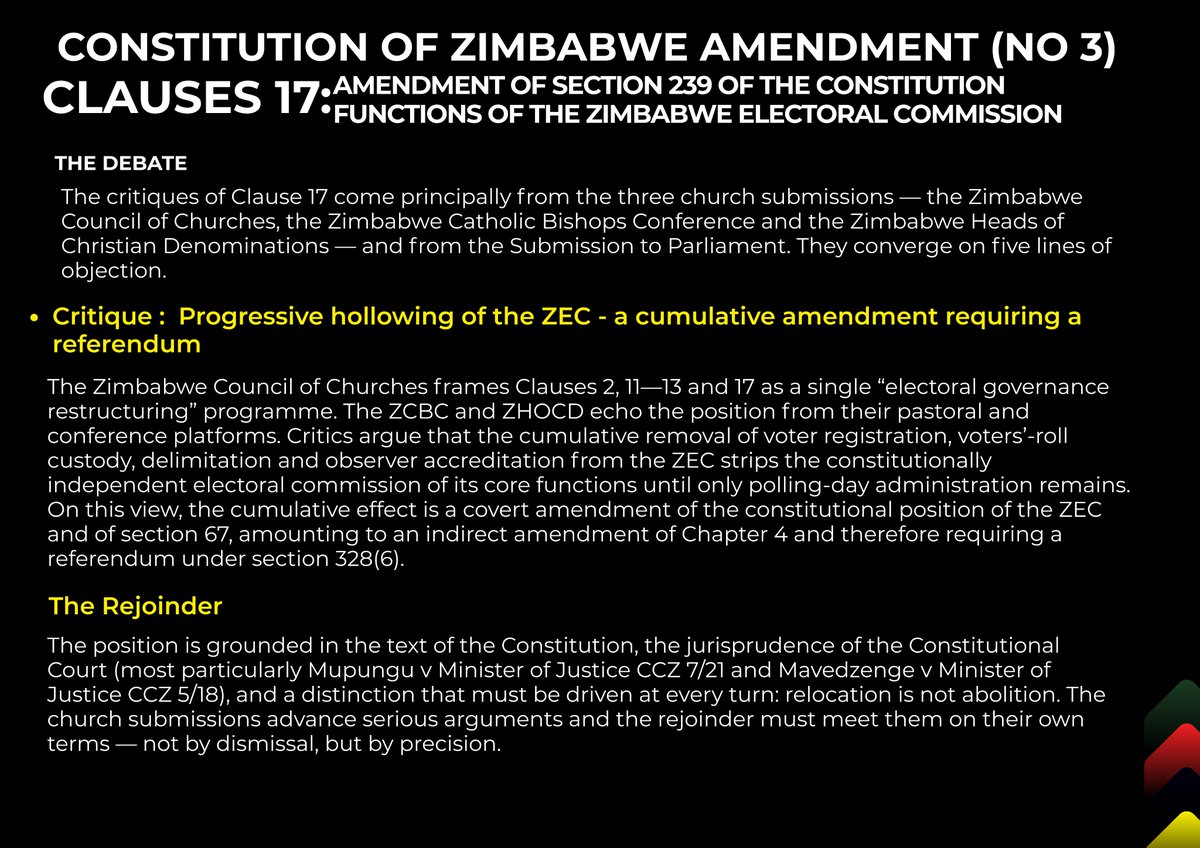
Clause 17 is constitutionally compliant. It amends Chapter 12, a non-entrenched part of the Constitution; it does not amend, vary or repeal any provision of Chapter 4, Chapter 16 or section 328; and it is properly enacted under section 328(5) two-thirds procedure. The ZEC’s core election-running mandate in section 239(a) is preserved. Section 235 continues to protect the Commission in the functions assigned to it by the Constitution. The relocation of registration, delimitation and (subject to the observer-accreditation drafting concern) the residual functions to accountable successor bodies is consistent with the comparative norm and with the international independence standards. Mupungu forecloses the effects-based and aggregate-effect arguments.
2
12
8
164
Jun 11
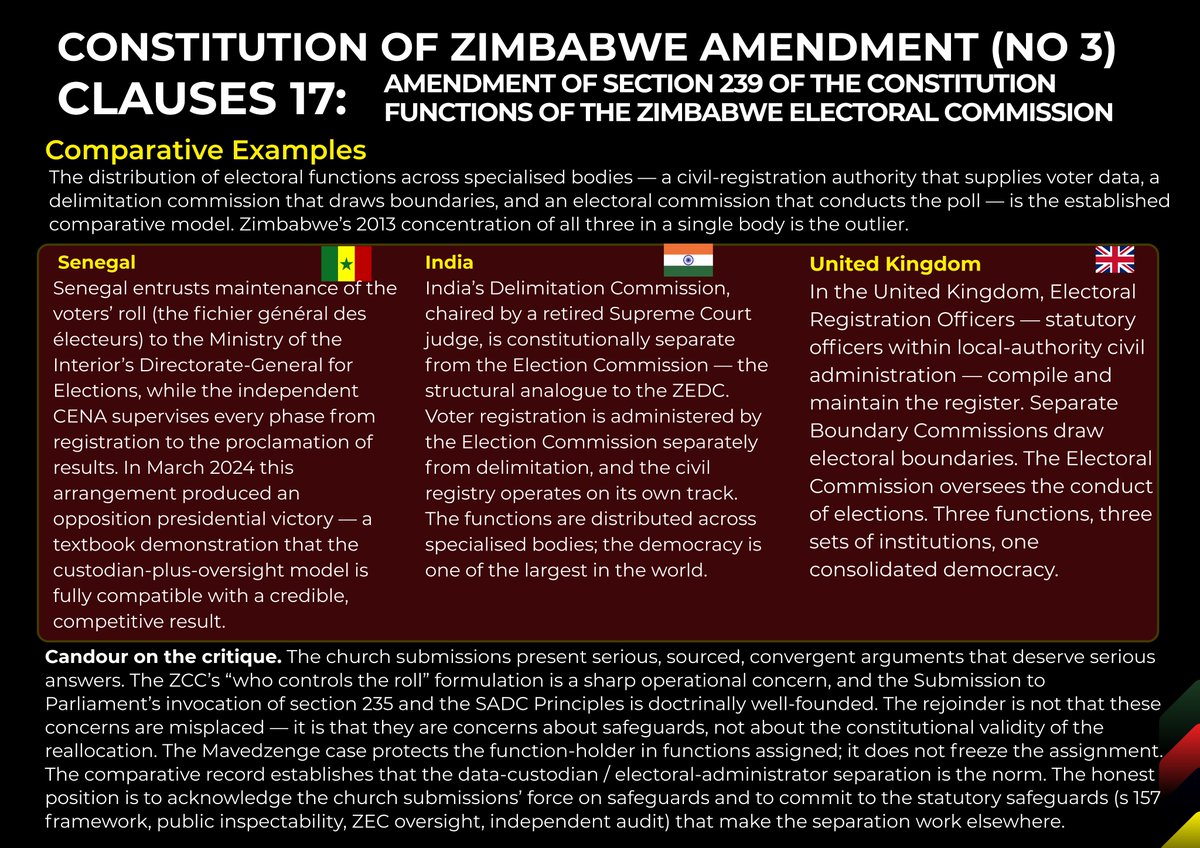
Comparative Examples
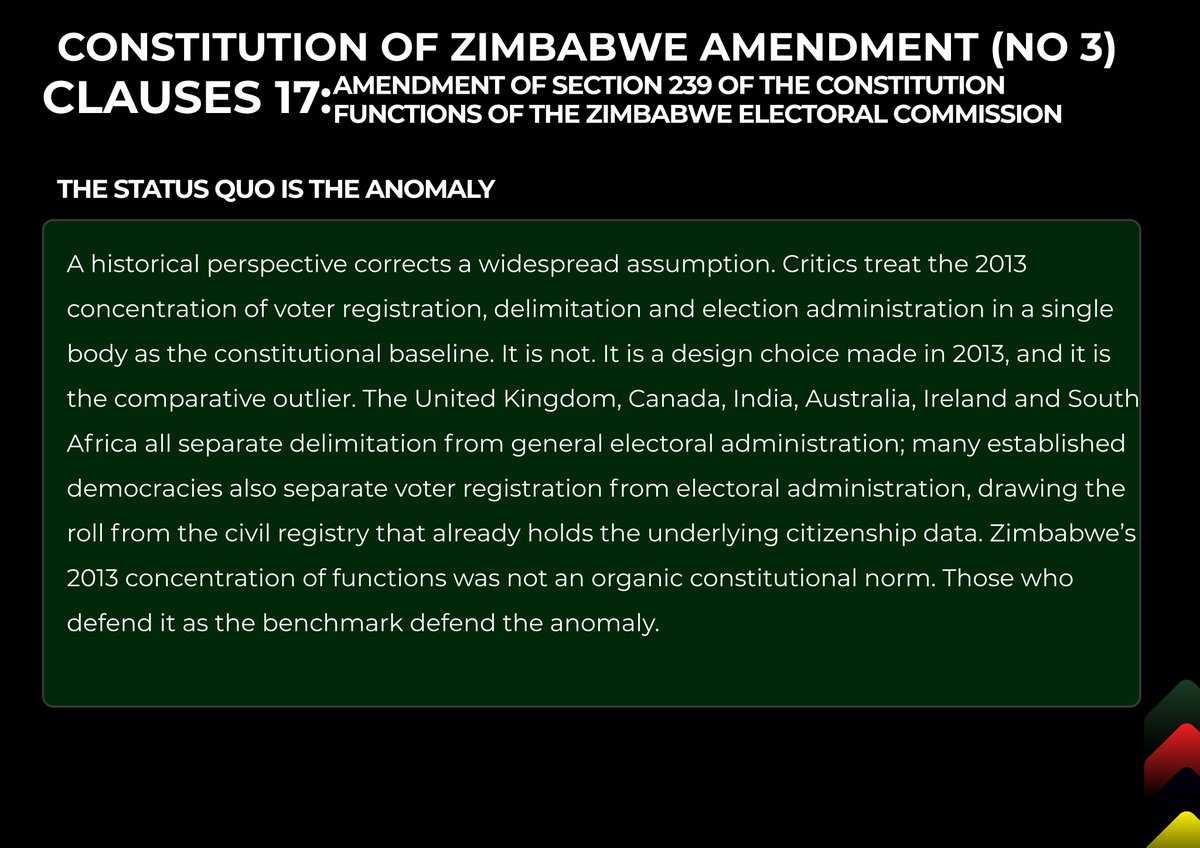
The distribution of electoral functions across specialised bodies, a civil-registration authority that supplies voter data, a delimitation commission that draws boundaries, and an electoral commission that conducts the poll, is the established comparative model. Zimbabwe’s 2013 concentration of all three in a single body is the outlier.
🇸🇳Senegal
Senegal entrusts maintenance of the voters’ roll (the fichier général des électeurs) to the Ministry of the Interior’s Directorate-General for Elections. At the same time, the independent CENA supervises every phase from registration to the proclamation of results. In March 2024, this arrangement produced an opposition presidential victory, a textbook demonstration that the custodian-plus-oversight model is fully compatible with a credible, competitive result.
🇮🇳India
India’s Delimitation Commission, chaired by a retired Supreme Court judge, is constitutionally separate from the Election Commission, the structural analogue to the ZEDC. Voter registration is administered by the Election Commission separately from delimitation, and the civil registry operates on its own track. The functions are distributed across specialised bodies; the democracy is one of the largest in the world.
🇬🇧United Kingdom
In the United Kingdom, Electoral Registration Officers, statutory officers within local-authority civil administration, compile and maintain the register. Separate Boundary Commissions draw electoral boundaries. The Electoral Commission oversees the conduct of elections. Three functions, three sets of institutions, one consolidated democracy.
Candour on the critique. The church submissions present well-sourced, convergent arguments that deserve substantive answers. The ZCC’s “who controls the roll” formulation is a sharp operational concern, and the Submission to Parliament’s invocation of section 235 and the SADC Principles is doctrinally well-founded. The rejoinder is not that these concerns are misplaced; it is that they concern safeguards, not the constitutional validity of the reallocation. The Mavedzenge case protects the function-holder in functions assigned; it does not freeze the assignment. The comparative record establishes that the data-custodian / electoral-administrator separation is the norm. The honest position is to acknowledge the force of the church submissions on safeguards and to commit to the statutory safeguards (s 157 framework, public inspectability, ZEC oversight, independent audit) that make the separation work elsewhere.
1
13
7
164