
Senior engineer. Building things that actually work, fixing things that don't. I fix vibe coded apps so they hold up when your users need them.
Joined February 2026
- Tweets 722
- Following 444
- Followers 363
- Likes 135
6 Photos and videos

Pinned Tweet

May 1
Vibe coding got you to MVP and your first customers. Congrats!
Now you have to:
Onboard a dev who's never seen the code
Debug with no observability
Refactor without reading every file
Add a feature without breaking 3 more
That's the gap between "it works" and "it's engineered"
9
18
1,197
One of the most underrated parts of building with AI:
Learning what not to ask it to do yet.
Sometimes the next move is not "add a feature."
Sometimes it is:
clean up the repo,
write down how the app works,
set up a test environment,
move secrets out of code,
back up the database,
or make the current thing stable.
More features do not fix a shaky foundation.
They just add weight to it.
What do you think is the biggest trap for new AI builders?
Adding too many features, not understanding the code, or shipping too fast?
23
Not every AI-built app needs enterprise architecture.
But every app with real users needs basic safety.
You do not need Kubernetes.
You probably do not need microservices.
You probably do not need a massive logging platform.
But you do need:
a real database,
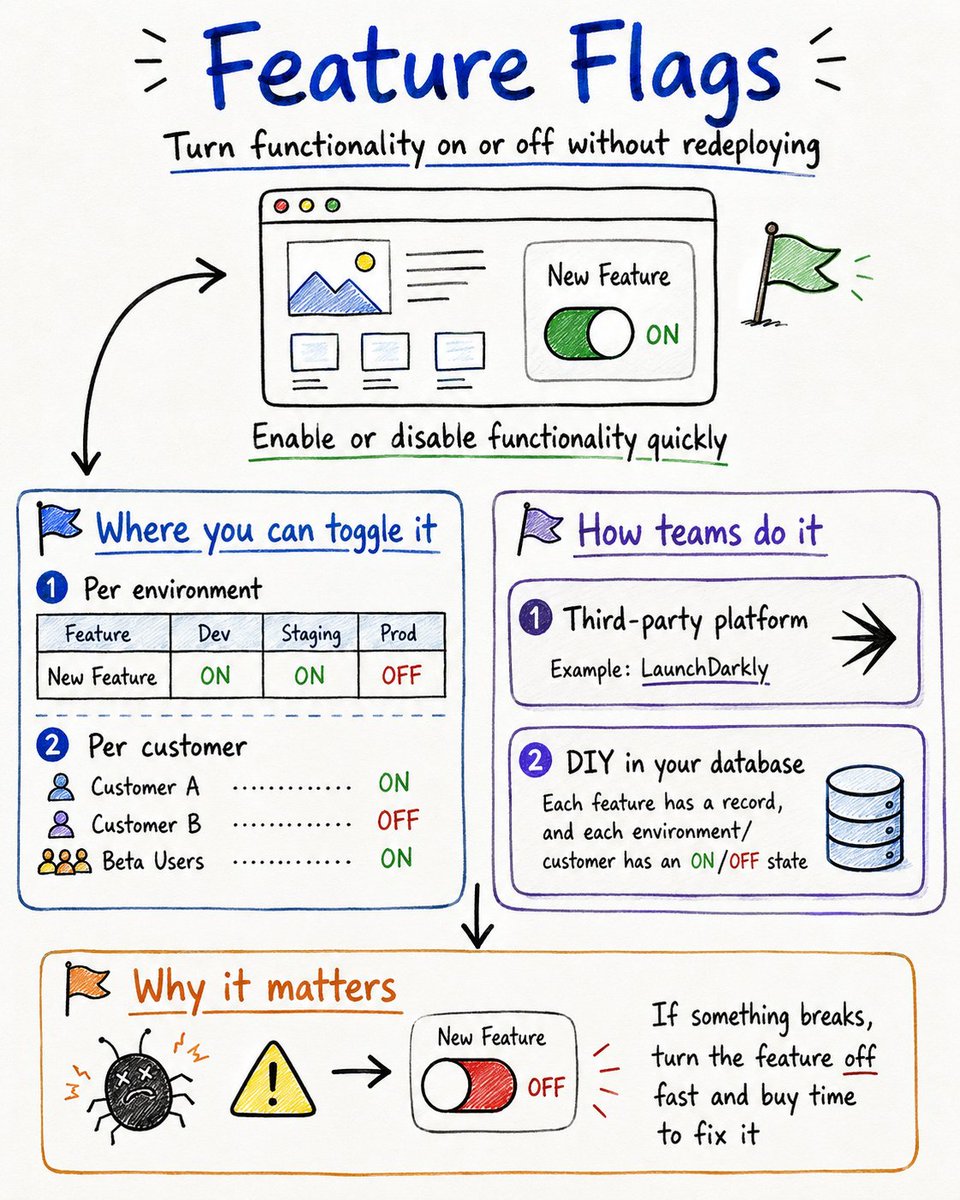
a safe way to test changes,
no passwords in GitHub,
backups,
and a plan for customer data.
Start there.
What would you add to this basic safety checklist?
27
Jun 13
The analogy I like for multi-tenancy:
An apartment complex.
Everyone lives in the same overall building.
They share infrastructure.
Same plumbing. Same gym. Same parking lot. Same maintenance crew.
But each tenant has their own locked apartment.
That's what you want in a SaaS product.
Shared product.
Isolated customer data.
Does this analogy make sense, or is there a better way to explain it to non-technical founders?
33
Ben Anderson retweeted

Jun 13
That's crazy! 😳
So they said Mythos was "too dangerous" too release, then a week ago Anthropic CEO called for a pause in AI development - and now this.
I don't think this is just marketing. I think we're truly entering the stage where AI is becoming dangerously good.
Jun 13

The US government, citing national security authorities, has issued an export control directive to suspend all access to Fable 5 and Mythos 5 by any foreign national, whether inside or outside the United States, including foreign national Anthropic employees.
The net effect of this order is that we must abruptly disable Fable 5 and Mythos 5 for all our customers to ensure compliance.
Access to all other Claude models is not affected.
We apologize for this disruption to our customers. We believe this is a misunderstanding and are working to restore access as soon as possible.
Read our full statement: anthropic.com/news/fable-myt…
37
4
60
29,845
Jun 12
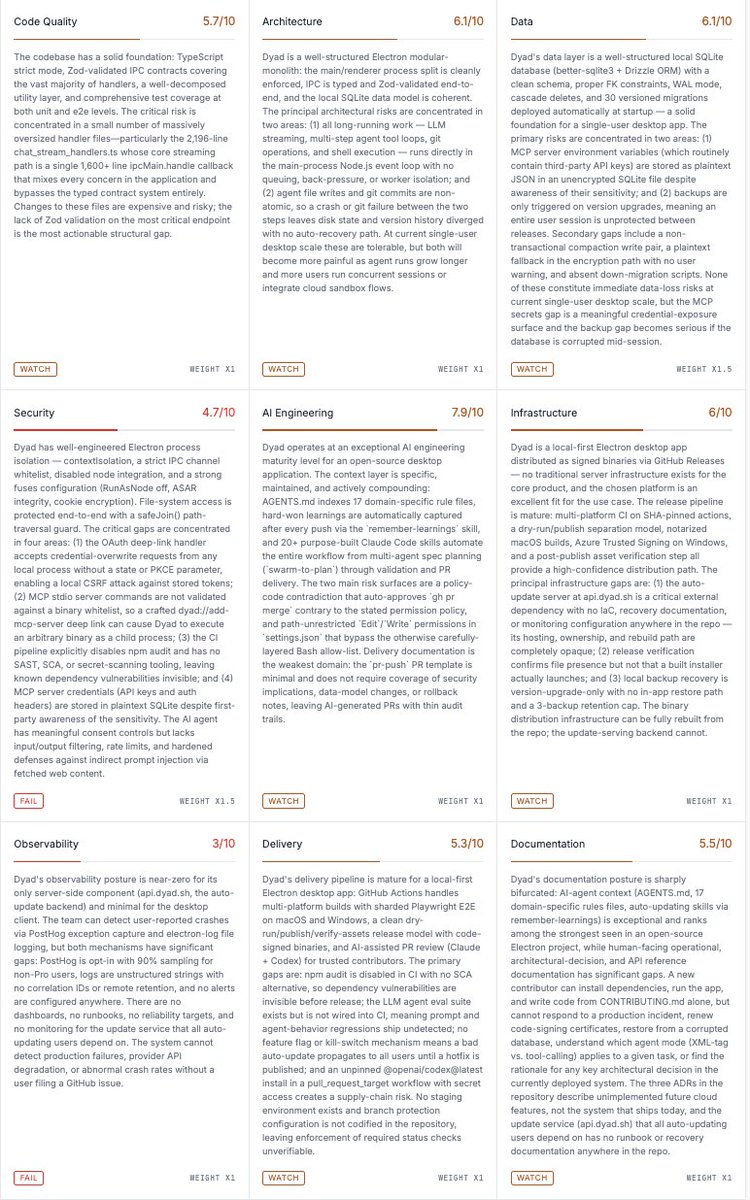
Are you building with AI? Post your product link below and I'll select one to do a free audit and review session with you to go over the results.
----
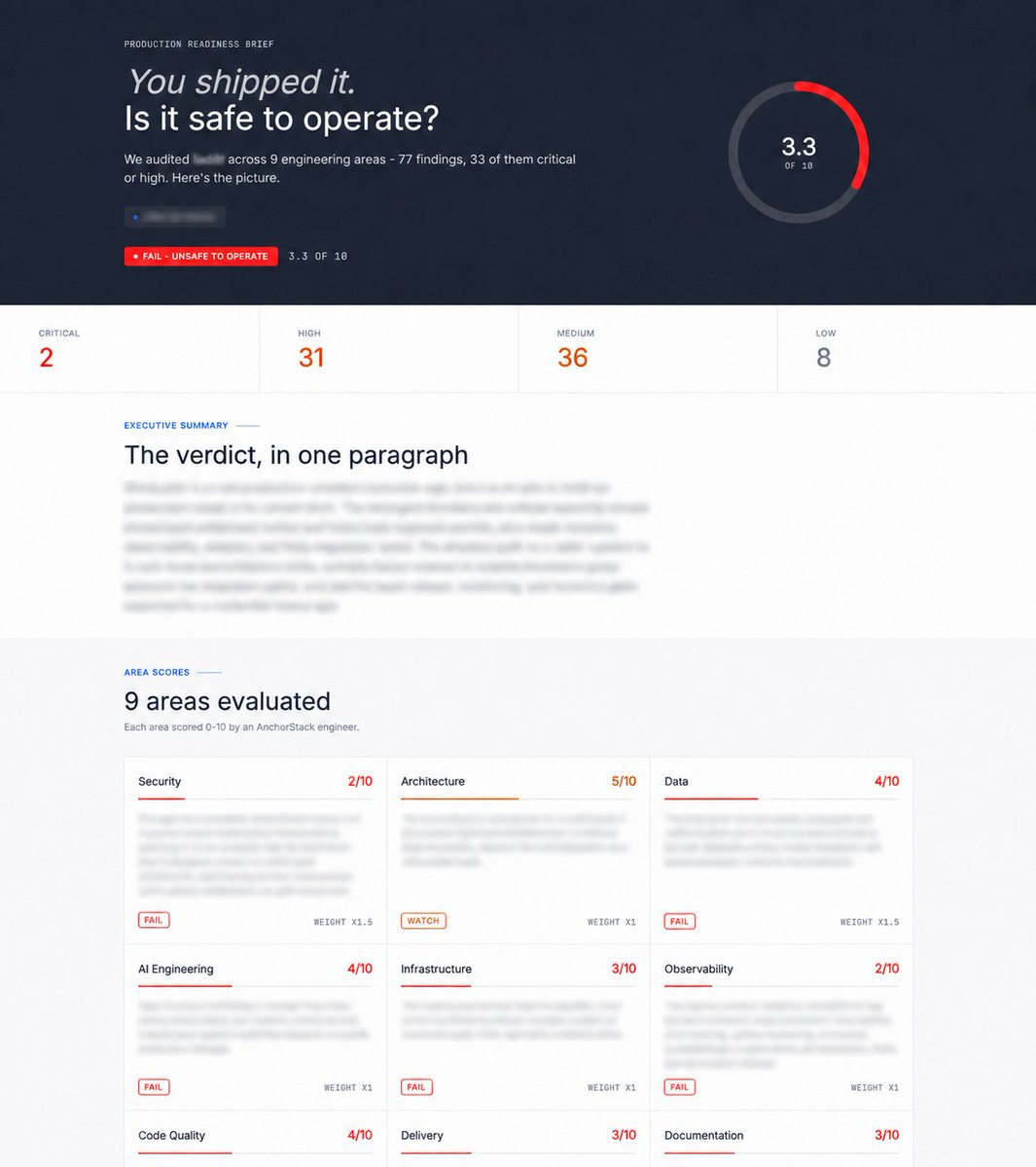
I audited n8n this week!
Honestly, this is one of the better open-source projects I’ve looked at so far.
The architecture is mature.
The CI/CD pipeline is strong.
The Docker/release posture is better than most.
The security foundation is not bad.
The biggest gap I found was observability.
n8n already has support for Sentry, Prometheus, OpenTelemetry, structured logging, event tracking, and health checks.
But if you self-host it with the defaults, most of that visibility is off.
That means you may not know workflows are failing, workers are unhealthy, queues are backing up, or errors are spiking until a user tells you.
If you are using n8n in production, do yourself a favor:
Enable observability.
Final score: 6.3/10
0 critical findings
11 high findings
60 total findings
Find the full audit below 👇
1
64
Jun 12
Multi-tenancy sounds technical, but the idea is simple.
If you sell your app to multiple customers, how do you make sure each customer only sees their own stuff?
That's it.
Their users.
Their files.
Their reports.
Their settings.
Their data.
You can build one separate app per customer, but that gets messy fast.
At some point you need one product with clean walls between customers.
For anyone building a SaaS with AI:
Are you building one app for everyone, or separate versions for each customer?
20
Jun 12
If you are building software with AI, you should know this phrase:
staging environment
It just means a private version of your app where you test changes before real users see them.
That's it.
Not complicated.
Not enterprise nonsense.
It's the difference between testing a new feature in a sandbox and testing it on your customers.
Is this overkill for solo builders, or should everyone do it once real users show up?
4
6
1,421
Jun 12
I asked people what they’re building with AI and got 130 replies.
The most popular answer surprised me a little:
AI agent infrastructure.
Memory layers, observability, caching, MCP tools, context management, evals.
Basically everyone is trying to solve the same thing:
Agents are impressive, but they are still hard to trust.
The next biggest category was niche B2B software.
Real estate CFOs.
Quote tools for tradespeople.
Insurance CRMs.
Internal workflow automation.
Maritime tracking.
These aren't the sexiest problems but they lead to real money.
The clearest pattern:
The best projects were specific.
Specific user.
Specific pain.
Specific workflow.
Specific reason AI belongs in the product.
Specific beats impressive.
What are you building?
6
1
3
104
Jun 11
A simple AI building rule:
Do not ask for ten fixes at once.
Pick one problem.
Ask AI to explain it.
Ask AI to propose the safest fix.
Ask AI what files it will touch.
Make the change.
Test it.
Then move to the next thing.
This is slower than chaos.
It is much faster than spending two days untangling chaos.
Do you usually give AI one task at a time, or do you dump the whole problem in and hope for the best?
1
29
Jun 11
The most common problem I see in AI-built apps is flaky, brittle code.
One feature change breaks another.
A small UI tweak breaks auth.
A new page breaks the database flow.
A “quick fix” creates three new bugs somewhere else.
This usually is not because the idea is bad. It is because the code has no structure, no clear boundaries, and no real plan behind it.
AI can help you move incredibly fast, but speed without structure turns into a mess fast.
This is the difference between a prototype that works once and a product people can actually use.
41
Jun 10
The first version of your app is allowed to be messy.
Honestly, it probably will be.
The danger is when messy becomes permanent because users started depending on it before you cleaned up the foundation.
That's the moment to pause and ask:
What happens if this breaks?
What happens if this data disappears?
What happens if I add another customer?
That's when the real product work starts.
What was the first app you built with AI?
Did it actually work?
1
1
132
Jun 10
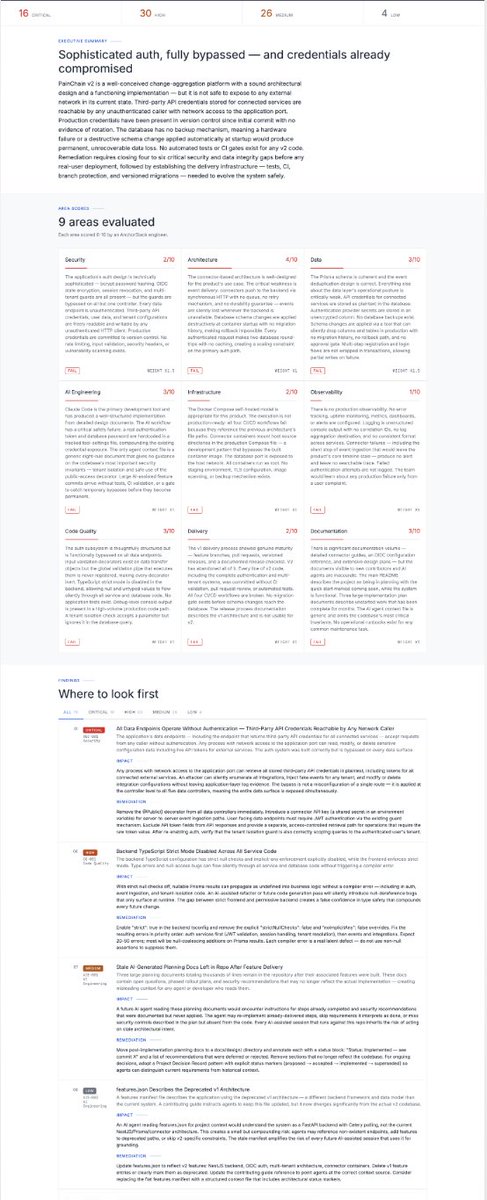
A good audit should not just say:
"Here are 50 things wrong with your app."
That is overwhelming and not very useful.
A good audit should say:
Here is what can hurt you now.
Here is what can wait.
Here is what to fix first.
Here is what to ask AI to do.
Here is where you need a human to verify it.
That is the difference between a report and a roadmap.
If you got an audit on your app, would you rather get a score, a fix list, or a step-by-step roadmap?
130
Jun 10
I’m looking to connect with more founders building businesses with AI.
If you’re using Claude, Cursor, Lovable, Replit, v0, etc. to build your product, I’d love to follow along.
Especially if you’re trying to turn a prototype into something production-ready.
Drop what you’re building below 👇
I’ll check out every link.
132
1
118
8,178
Jun 9
Most non-technical founders think the hard part is getting the app to work.
That is hard.
But the next stage is different:
Can other people safely use it?
Can you update it without breaking it?
Can you add customers without mixing data?
Can you recover if something goes wrong?
Can you explain how it works well enough to trust it?
That is the gap between prototype and product.
Where do you feel stuck right now?
Getting the app built, getting users, or making the app safe enough to sell?
90
Jun 9
A private GitHub repo is not a password manager.
I know why people do it.
You're building fast, Claude needs context, something works, and now credentials are sitting in a file somewhere.
It feels harmless because the repo is private.
But private does not mean impossible to access.
Rotate the passwords. Move them into environment variables. Tell the AI not to commit them again.
Low drama. High impact.
Have you ever accidentally pasted a key, password, or secret into your repo?
I think this is way more common than people admit.
1
1
69
Jun 8
The more I look at AI-built apps, the more I think the phrase "vibe coding" hides the real problem.
The problem is not using AI.
The problem is building without a process.
No safe place to test.
No clean way to ship.
No clear source of truth.
No plan for customer data.
AI can move extremely fast.
That means your process has to catch up faster than it used to.
Curious: what is the messiest part of your AI build right now?
The code, the data, the prompts, or the deployment?
52
Jun 7
Beginner builders do not need to learn everything about software engineering.
But they do need to learn the failure points that can actually hurt them.
A few big ones:
Can bad changes go live?
Can data disappear?
Can customers see the wrong data?
Are passwords sitting in GitHub?
Can you tell what broke?
That's a much better learning path than trying to become a senior engineer overnight.
If you're building with AI, which one of these are you least confident about?
1
3
88
Jun 7
One analogy I used on a call recently:
Some apps are saving business data like it's on a USB stick plugged into a computer.
It technically works.
Until that "USB stick" gets corrupted, fills up, gets overwritten, or has two parts of the app trying to write to it at the same time.
A real database is not just a technical preference.
It is how you stop important data from being treated like a scratchpad.
What are you using for your app data right now?
Supabase? Firebase? Railway? Something else?
1
2
52