
Engineering at @xgeeksio | thinking about where machines should end and humans should begin.
Joined September 2009
- Tweets 326
- Following 1,198
- Followers 176
- Likes 427
10 Photos and videos







Pinned Tweet

May 25
same model. different architecture. different output.
12 pieces shipped:
11 on a personal blog.
1 enterprise piece split into 5 linkedin posts as "AI leaders that ship."
same source file. different containers per channel.
1
21
May 28
generic ai content is a commodity. anyone with a claude subscription can prompt the same model and get fluent output.
first-party data isn't a commodity.
neither is the operator's voice.
an ai-native engine compounds on both. that's the architecture.
1
13
May 27
five design choices make an engine ai-native:
1. agentic memory (4-layer context)
2. distilled structure (not pre-designed)
3. multi-tool deployment (non-git ok)
4. feedback-accumulating rules
5. source decomposition
none are emergent. all are design decisions.
1
75
May 26
"ai-assisted" and "ai-native" are not synonyms.
ai-assisted: bolt ai onto traditional publishing. structure unchanged.
ai-native: architect publishing as an agentic system from first principles.
different categories. different outputs. different moats.
7
May 25
same model. different architecture. different output.
12 pieces shipped:
11 on a personal blog.
1 enterprise piece split into 5 linkedin posts as "AI leaders that ship."
same source file. different containers per channel.
1
21
May 25
voice is a second moat.
persona file drafting skill editorial pass enforce one specific voice. swap the persona, same model, same data, different engine.
ai-native content resists replication on two axes at once: the data and the operator identity.
1
13
May 25
models keep getting better. the specific data and the specific voice don't get replaced by better models.
they compound alongside them.
full writeup: buff.ly/gpaXAEg
4
May 23
one of the best pieces i've read this year on AI and work. the core idea that automation drives up demand for experts instead of killing it. that's the thing people keep getting wrong. the louvre gets more visitors every year and the mona lisa has been free online for a decade.
May 21

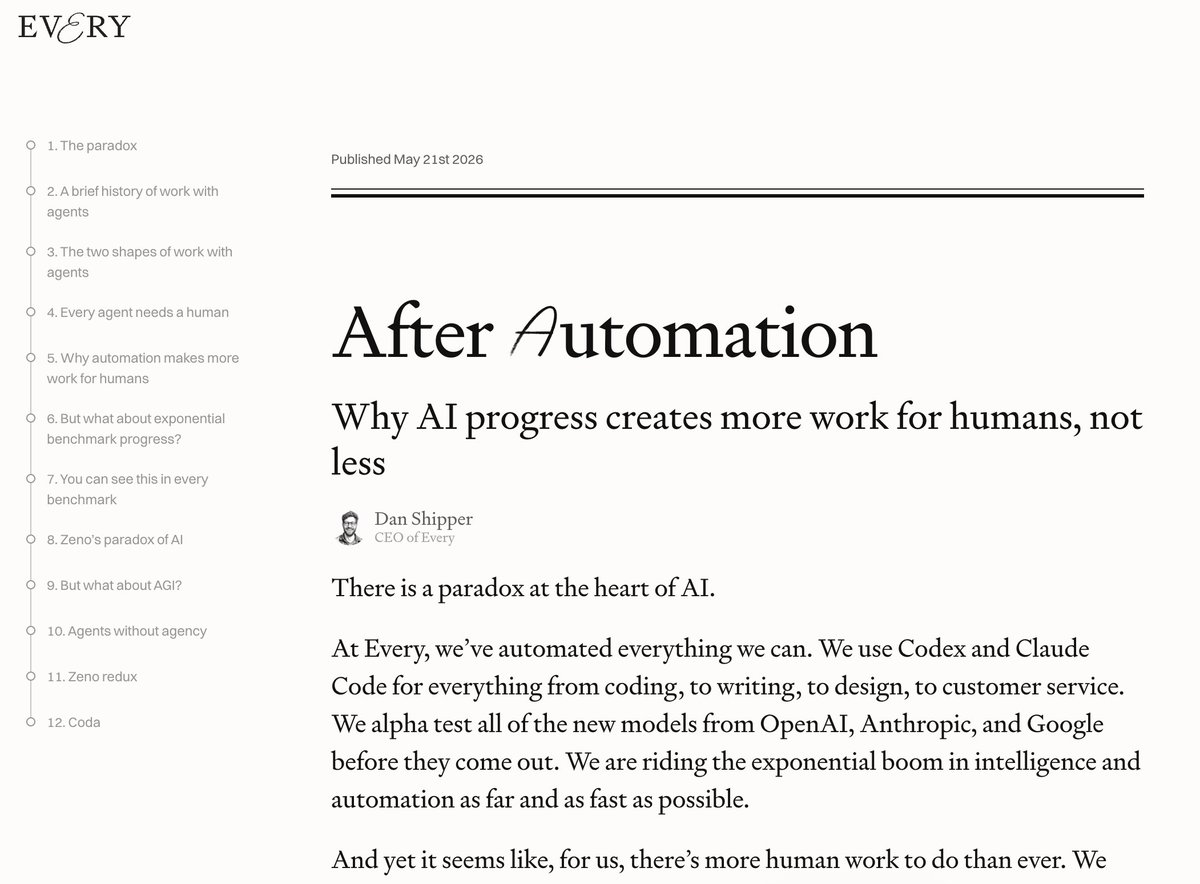
We’ve automated every single thing we can @every with AI agents.
And yet there’s way more human work to do than ever. We’ve gone from 4 -> 30 human employees since GPT-3.
I wrote a report on the structural reasons: how AI makes expert competence cheap, why that drives up demand for experts, and why the dynamic only intensifies as we approach AGI.
After Automation: every.to/p/after-automation
59
Apr 17
9 articles in 5 weeks. Two series. Same problems, different domains.
Engineering: what AI does to code.
Writing: what AI does to content.
The parallel that kept showing up:
1
25
Apr 17
In code: the prompt evolves. 919 lines, every one a production failure.
In writing: the system outgrew the series. One file became 23. The brain is the skill graph the code articles predicted.
Same mechanism. Process knowledge compounds.
1
18
Apr 17
All 9 articles: goncalves.me/posts
Data from real repos, real commits, real articles, real revision passes.
7
Apr 16
The AI-assisted writing series is complete. 5 articles. 20 revision passes. A content brain with 250 rules.
Here's the full arc:
1
18
Apr 16
Part 4: The System Outgrew the Series.
47 rules became 250 . The one file became 23. Three predictions broke. The boundary moved.
buff.ly/shGuG64
1
2
Apr 16
Part 5: I Gave My AI a Brain. Here's What Changed.
A CLAUDE dot md tells AI what. A brain tells AI how. The difference showed up as 8 corrections that would have shipped without it.
buff.ly/iAAVouJ
Both series together: goncalves.me/posts
5