
wizard of products // co-founder of Liquid Ledger // prev. @synthetix_io // building & learning in public about AI automation
Joined November 2017
- Tweets 1,378
- Following 558
- Followers 2,706
- Likes 3,997
50 Photos and videos















Pinned Tweet

Feb 23
Seven years, four failed products, and one co-founder who never quit on me
Hi, I am Andy, I have built all kinds of products
- Launchpads
- Social media platforms
- Web3 academy for easy hiring
And this is the first time I'm telling the full story
I am a dropout. I didn't have a degree or a network. I just knew I wanted to build things and figured the only way to start was to learn how they worked
So I got a night job stocking shelves at a grocery store and spent every break learning frontend development from free tutorials
Within a few months, I co-founded my first crypto product
It lasted about a year before I got burned on an equity deal. I walked away with no money and a mass of skills I didn't know what to do with yet
I joined a legal tech startup in Australia. That company has since completed a Series A. I was there for about two years, and it not only changed how I approach building products, but also what kind of products I actually want to build
Then in 2021, I saw what was happening in decentralized finance and knew I wanted back in. But I wanted to earn it, not just apply and hope for the best.
That’s when I found Synthetix’s public GitHub, noticed real problems they needed fixed but didn’t have time for. So, I wrote the solutions and submitted a cold pull request with just the code and a message explaining what I'd done
They liked it and brought me on
What followed were the best two years of my career. I worked alongside world-class engineers during what many consider the golden era of crypto. For the first time, I was getting to know why certain products win, and others don't. That team made me a better builder
After 2 years at Synthetix, Kevin and I decided to go build our own thing. We'd been friends for over 14 years at that point, and we felt ready. We thought we knew how to win
We were wrong, wrong about a lot of things
We self-funded everything. Every time we tried to raise, the market made it feel impossible. We kept telling ourselves it was a bad time to launch, a bad time to make the big call
We were focused on building n 1 instead of 0-to-1. Adding feature after feature, convinced that 0if we just built enough, we'd eventually hit product-market fit, and the market kept shifting while we kept trying to catch up
After a long stretch of that, and a lot of money burned, we wrapped it all up in mid-2025. Shutting it down hit harder than I expected
But once we were honest with ourselves, the answer was obvious. We still loved building. That part never went away. So we went back to our roots
Kevin and I started Liquid Ledger. It's a global venture studio where we help people build their dream projects. We design and develop apps and products for clients worldwide while continuing to experiment on our own
It's the model that finally makes sense for who we are
This account is my reset. I'll be sharing everything going forward. The products we're building, the AI tools and workflows, real opinions on what's working versus what's just hype, and the lessons from seven years of building
If you're in the middle of building something, follow along
19
41
3,146
May 4
Until today, AI-running a Shopify store meant a developer. Either Claude Code wired to the Shopify CLI, or Cowork driving Claude in Chrome.
Now: "@shopify draft emails to every order at 9am daily" — typed into a chat, scheduled, done.
Non-technical merchants just lapped the technical ones.
May 4

We surveyed our merchants. 83% already use ChatGPT.
Now they can manage their entire store without leaving the chat.
ChatGPT and Claude connector apps. Live today.
1
2
212
Apr 30
Looks like stripe beat CT to the punch in terms of being the first to introduce agentic payments in a useful way

Introducing Link agent wallet. Let your agents spend on your behalf. Your payment credentials are never exposed. You approve every purchase.
link.com/agents
3
79
Apr 30
This is big news. Previously, my agentic workflow for building and maintaining ads via API calls using a Meta dev token couldn’t keep up with the complexity of the Meta Ads Manager. It always required me to do click-ops and double-check the work on the UI.
I’m excited to see if this new system is more accurate. It teaches the AI exactly what’s available, especially since Meta Ads Manager changes almost every week.
Apr 30

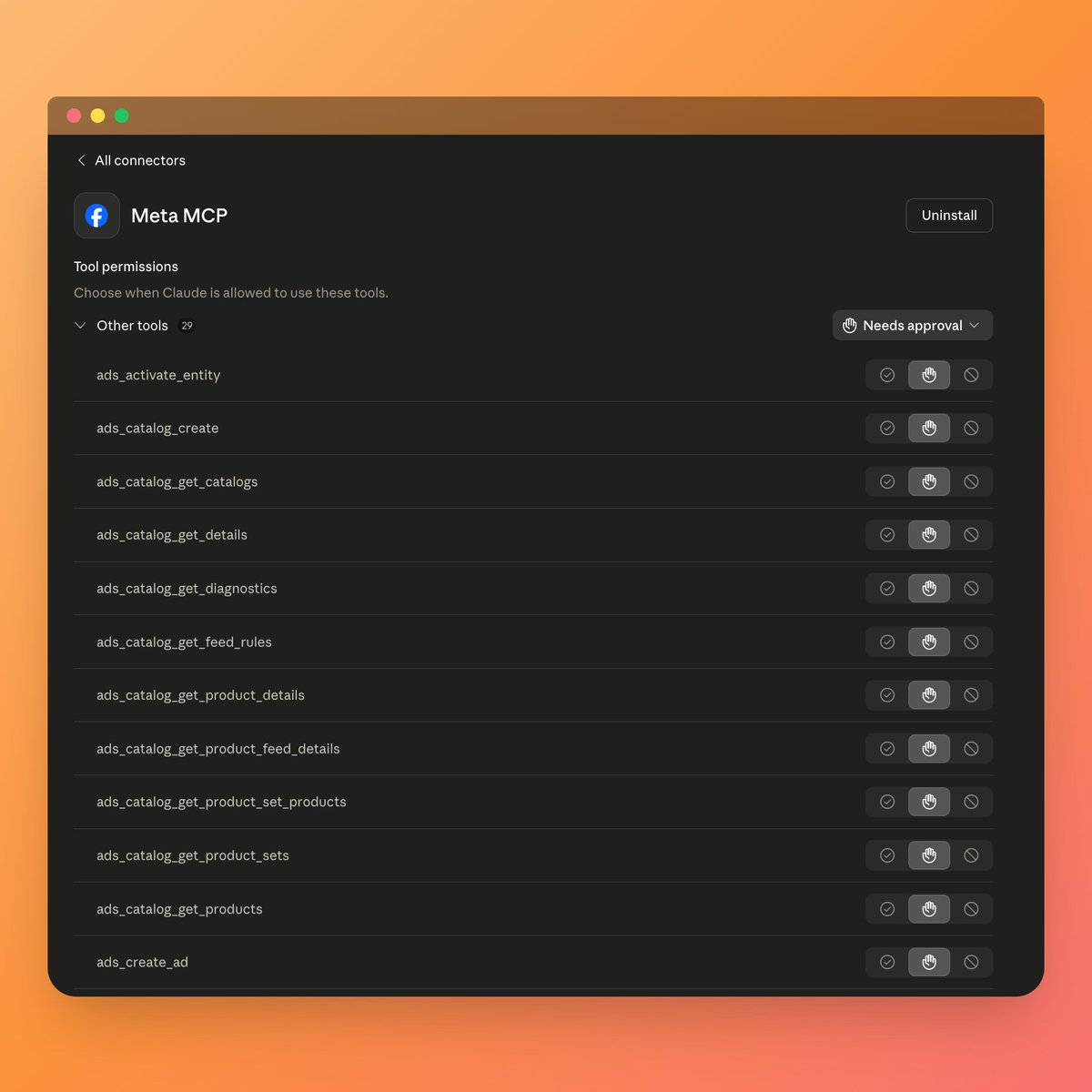
🚨 Meta released their Ads MCP and CLI today – if you use Claude or ChatGPT you should install this asap (resources in comments).
What makes this announcement so interesting is that it gives AI tools direct, authorized access to help manage your Meta Ads account through natural language.
1. Comprehensive reporting
Pull detailed reports, surface performance trends, and quickly understand what is happening across campaigns.
2. Campaign management
Create and edit campaigns, ad sets, and ads without manually clicking through Ads Manager.
3. Catalog management
Create product catalogs, add product data, and troubleshoot feed issues faster.
4. Signal diagnostics
Access signal health and quality insights so you can prioritize the parts of your setup that need attention.
This is a huge step forward in agentic media buying. Will be testing this rest of the week!
1
91
Apr 27
I’ve noticed heaps of people sharing bits from the in person Claude with Code sessions and trying to sell a course in return for likes and comments.
So, I decided to track down the whole playlist myself because I learned a lot from those short clips and people kept gate keeping the sauce.
Here it is: youtube.com/playlist?list=PL…
1
163
andy retweeted

Apr 26
Stop Caring. That’s literally all you have to do.
Apr 26

Literally just having a delusional golden retriever mindset measurably changes outcomes and physiology.
Sleep badly? Convince yourself you're well rested.
Stressful day? Convince yourself it's fuel.
Failed? Convince yourself it's useful data.

51
630
9,094
614,892
Apr 24
Great timing… but also don’t forget to update your versions of this agent teams .
Investigating further the setup of agent teams require you to explicitly state use “AgentTeams” tool, and look for a teams directory in .claude
Apr 23

Over the past month, some of you reported Claude Code's quality had slipped. We investigated, and published a post-mortem on the three issues we found.
All are fixed in v2.1.116 and we’ve reset usage limits for all subscribers.
87
Apr 15
When we launched Mekora, the scope was intentionally small
Australia only, one market, get it right before thinking about anything else
I've made the mistake before of trying to be everywhere before you've proven you work anywhere. So we kept the focus tight and didn't think too far ahead
A few weeks in, the messages started coming. People from the US and Asia, asking when we're expanding there. We haven’t even run ads there yet. They just found the product and wanted access to it
I spent years in spaces where you had to fight for every signal of genuine demand. Where you were always pushing to create interest that wasn't naturally there
Watching demand arrive on its own from markets you haven't touched yet is a different feeling
This time we're not waiting. Mekora is going global soon
1
2
93
Apr 14
Not every brand should be using AI
Since the Mekora launch, I hit an interesting realization
Fashion brands built around craft and artistic identity are resisting AI because they understand exactly what it would do to the thing they built
We enhanced a brand's product photos using AI, and they hated it. The quality was fine
The problem was that the art stopped being theirs the moment a tool optimized it. The same reason serious journalists won't use AI to write. If the words were assisted, it doesn't feel like theirs anymore
Tech founders build products where the tool is the feature. Artists build products where the human is the feature. That's a different business entirely, and it has a different relationship to what AI does to the work
The answer is to understand that not every resistance to technology is ignorance
Sometimes it's just people protecting the thing that makes their work worth paying for
2
7
281
Apr 13
With AI booming, everyone I talk to has this same opinion
“the first job AI is going to kill is software engineering”
I don't think the people saying this have thought it through
Yes, non-technical people are building things now that they couldn't before. That part is real
But there's a step after building that most of them can't do, which is looking at it and knowing whether it's good
- Is it secure
- Does the architecture make sense
- Will it hold when things get complicated
These aren't questions the AI answers for you. You need the judgment to know they're worth asking in the first place
Software engineers already have that judgment. They know how to architect things and how systems connect. So adding AI to enhance the workflow isn't a big adjustment
The floor got raised for everyone. The ceiling still belongs to the people who understand systems
4
11
418
Apr 12
Every time @AnthropicAI drops something, the same joke goes around
"there goes another startup"
Which is true, the cost for Anthropic to absorb your entire startup is roughly one engineer and a sprint
And it's not like they're trying to k*ll it when they ship. You're just in the category
That's the part that should scare you more than the competition itself cause you're not being targeted. You're being accidentally stepped on by something that wasn't even looking at you
The founders who are building good products in the exact middle ground that Frontier Labs expand into without thinking twice are going to have a bad year
So either build something the giants won't touch or accept that you're building on borrowed time
3
6
558
Apr 11
Shopify should have done this a long time ago
A few weeks ago, I automated Shopify for my girlfriend using @openclaw
Set up the whole workflow manually. She could describe what she wanted and the agent would handle it. It was scrappy, but it worked
@Shopify just made it official and easy with the AI toolkit feature, and it is impressive
Connect @claudeai code or @cursor_ai, and your agent gets live Shopify documentation, real API schemas, and the ability to execute actual store operations through natural language. It works exactly as advertised
But the problem is what comes before that
Node.js 18, a terminal, an AI coding tool that non-technical people find intimidating to install, let alone use
And then suddenly you're asking someone who runs a real business to open a command line interface and give an AI agent access to their computer
That's not a small ask. The terminal has always been seen as a coder's tool, and for most people, handing anything access through it feels like leaving the front door open
Shopify has millions of store owners who manage real businesses without knowing what a command line is. They are not going to open a terminal to save time on SEO updates. The risk feels bigger than the reward to them, even if technically it isn't
The version of this that reaches those people looks different. A chat interface they already know or an orchestration layer through something like WhatsApp, where the commands stay simple and the underlying access stays invisible
Someone just has to build the interface. The infrastructure is already there

the Shopify AI Toolkit is here
manage your store with your favorite agent
Claude Code, Codex, Cursor, VS Code, and more
2
8
662
Apr 10
I've been using @openclaw daily at my company for a while now
And the biggest friction was always context. Every morning felt like a small onboarding. The agent had memory, but managing it was on you
Deciding what to keep, what to remove, what actually mattered. Most of the time, you just didn't bother, so it either got bloated with noise or carried nothing useful forward. You'd reference something important from last week, and it had no idea what you meant
The 2026.4.9 changes that. They shipped a feature called “dreaming”
Throughout the day, the agent collects everything from your conversations and notes, then overnight it runs a sleep cycle in the background, figures out what's actually important, and stores only that into long-term memory
So the next time you open it, it already knows the relevant stuff without you having to repeat yourself or manually manage its memory
Today after enabling it, it referenced something from three days ago without me prompting it
Probably the most useful update they've shipped since I started using it
7
11
461
Apr 8
Anthropic built a model so capable at hacking that they refused to release it to the public
not because it wasn't ready, but because the world isn’t
“Mythos Preview” spent a few weeks autonomously finding security flaws that had survived years of human review and millions of automated tests. No human is involved after a single paragraph prompt. Just the model, running on its own, finding ways in
One of those flaws was a 27-year-old vulnerability in OpenBSD, which has a reputation as one of the most security-hardened operating systems in the world
And rather than ship it and see what happens, they launched Project Glasswing, a coalition of Apple, Google, Microsoft, Nvidia, AWS, JPMorgan, and about 40 other organizations
The whole point is to let defenders patch critical systems before something this powerful ends up in the wrong hands
The fact that a lab had to build a $100m emergency coalition before releasing a model tells you more about where AI actually is than any benchmark ever could
Apr 7

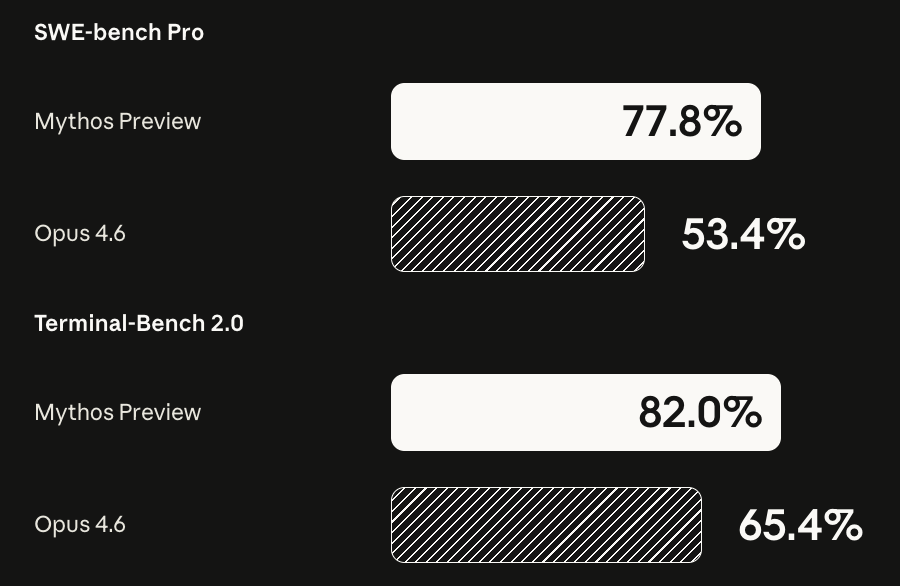
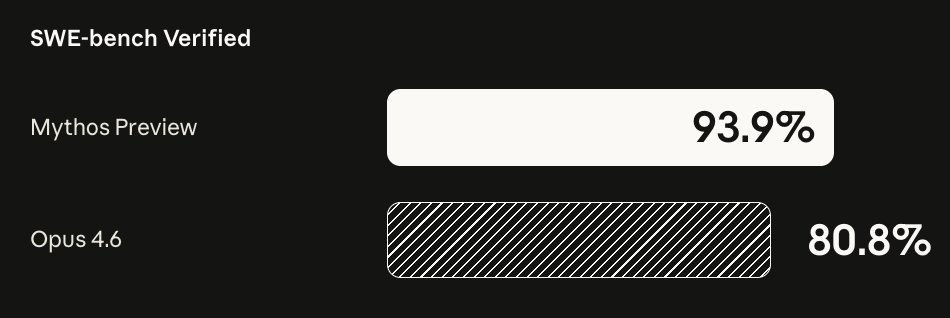
We released Claude Opus 4.6 just two months ago. Today we're sharing some info on our new model, Claude Mythos Preview.
4
6
667
Apr 7
Founders obsess over retention, LTV, MRR
And I get it, all of it matters. It tells you if something is working
But none of it tells you why you started
I spent years in spaces where every interaction was transactional. People showed up for what they could take, never for what you actually built
Launching Mekora, a product that customers genuinely care about, changed that. It's a completely different feeling
Customers messaging just to say “THANK YOU” for building something that didn't exist for them before hits differently than any number on a dashboard
That's the thing worth building for
2
6
420
Apr 6
Why does everyone's AI output sound exactly the same?
Most people are using AI as a smarter search engine and wondering why the results feel shallow
The model does not know who you are, what you are building, how your business talks, or what a good answer looks like in your specific context, without that, it is guessing. It will always be guessing
The moment you start treating context as the actual work
- the rules
- the goals
- the constraints
the output changes completely. It stops being generic and starts being useful
Skip that and you'll keep getting the same results, blaming the model for a problem that was yours to solve
4
9
432
Apr 5
Nobody learns to code from a tutorial. Not really
The best decision I made early on was learning it by actually building something. Not just a course, not a structured program, a real project with a deadline and something at stake
The speed at which you pick up technical skills when you have no other option is genuinely different from any other learning environment
What it gave me beyond the technical skills was something I did not expect at the time
It was the ability to sit in a room with engineers and actually follow what is happening. Read a PR, understand a technical tradeoff, push back when something does not make sense, and know the difference between a problem that needs more time and a problem that needs a different approach
Most product people cannot do that. They rely on engineers to translate. And every time something gets translated, something gets lost
That is not a small thing when you are running a product
3
6
423
Apr 4
This was always going to happen
The only surprise is, it took this long
@AnthropicAI just ended the free ride for agentic builders, and honestly it was overdue
when running agents through a flat subscription had no real cost attached to it, efficiency didn't matter. Everyone was operating on the same playing field because nobody was actually paying for what they consumed. That just ended
@claudeai subscriptions no longer cover third-party tools like @openclaw starting today. You either move to api billing, buy usage bundles, or find an alternative. OpenClaw still runs on a @ChatGPTapp subscription if you want to keep costs flat for now
But the bigger shift is what this does to the competitive dynamics of the space. Cost efficiency is now a real variable
The builders who designed lean, thoughtful workflows have a structural edge over those who never had to think about it
Price just entered the picture. And in any competitive space, that changes everything
Apr 3

Starting tomorrow at 12pm PT, Claude subscriptions will no longer cover usage on third-party tools like OpenClaw.
You can still use these tools with your Claude login via extra usage bundles (now available at a discount), or with a Claude API key.
3
7
555
Apr 3
I've been building @openclaw setups for my team this week
And it's the first time I've done it properly
When I first rolled it out, I gave everyone an agent, gave them Google access, and called it done. It technically worked, but it wasn't built for anyone specifically
What happened next was predictable. My own setup kept getting more capable, and every time the team found out it could do something new, they'd ask me to send it to them. I became the bottleneck to the tools I built to remove bottlenecks
The fix is obvious in retrospect. Before you build the system, you have to understand the workflow. So now I'm doing proper interviews with each team member, mapping what they actually do, what decisions they make, and what they need data on
Then I'm building the setup to match that, with tools that are relevant and restrictions that prevent them from going outside their lane
This matters for a specific reason. The AI will always say yes
It will do whatever someone asks it to do, regardless of whether that person has the context to evaluate the output. If a non-technical team member asks the AI to build an integration, the AI builds the integration
Whether it's secure, whether it creates data exposure, whether it actually fits the architecture, none of that gets flagged unless someone who understands it reviews the output
So the real architecture problem here isn't the tools. It's building a system where the AI's output is always reviewed by someone who can evaluate it. For technical work, that means me
For everything else, it means clear scopes, so people aren't asking the AI to do things outside what I've verified it can handle safely
Building AI workflows for a team is much harder than building one for yourself. You know your own blind spots. Everyone else's take work to figure out
3
11
444
Apr 2
The only people scared of AI taking their job already had a job worth losing
Entrepreneurs aren't in that conversation. They were never playing someone else's game with someone else's rules
They're trying to do something that doesn't exist yet, solve something nobody has solved, build something the market doesn't even know it needs
AI showing up to help with that is not a threat. It's the best thing that could have happened
You hand a founder a tool that codes, researches, and iterates on demand, and they don't ask whether it's coming for their job. They ask what they can build with it now
The anxiety about AI is real, but it's pointing at the wrong people
6
11
515
Apr 2
Just finished listening to this podcast, and I really enjoyed it. It makes some awesome points
nav.al/ai
163