Historian, writer, documentary presenter in Rome. 🏳️🌈 Even less serious than I appear. 📸 mine unless otherwise accredited. Read the ALT text!
- Tweets 17,326
- Following 263
- Followers 3,510
- Likes 131,949
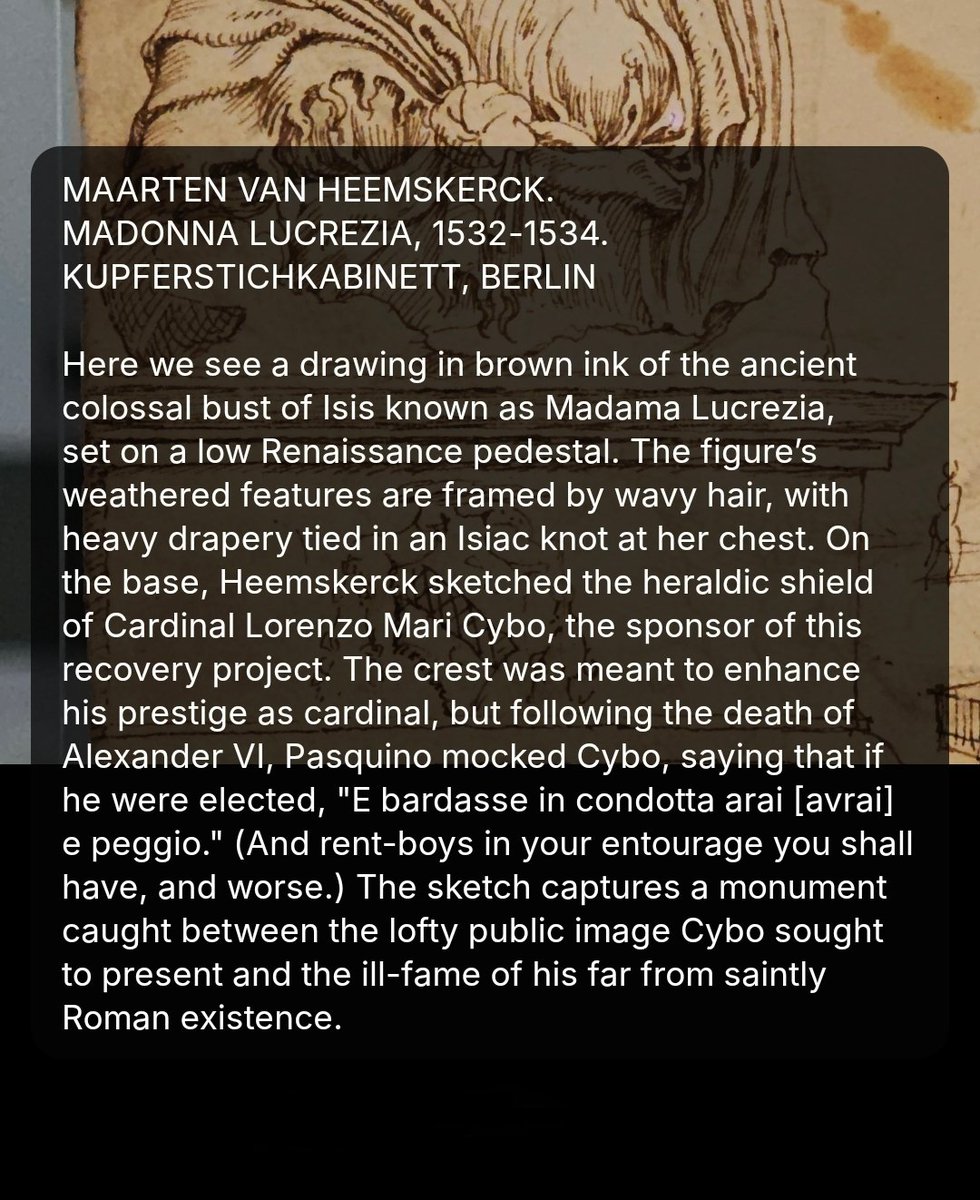

ALT MAARTEN VAN HEEMSKERCK. MADONNA LUCREZIA, 1532-1534. KUPFERSTICHKABINETT, BERLIN Here we see a drawing in brown ink of the ancient colossal bust of Isis known as Madama Lucrezia, set on a low Renaissance pedestal. The figure’s weathered features are framed by wavy hair, with heavy drapery tied in an Isiac knot at her chest. On the base, Heemskerck sketched the heraldic shield of Cardinal Lorenzo Mari Cybo, the sponsor of this recovery project. The crest was meant to enhance his prestige as cardinal, but following the death of Alexander VI, Pasquino mocked Cybo, saying that if he were elected, "E bardasse in condotta arai [avrai] e peggio." (And rent-boys in your entourage you shall have, and worse.) The sketch captures a monument caught between the lofty public image Cybo sought to present and the ill fame of his far from saintly Roman existence.

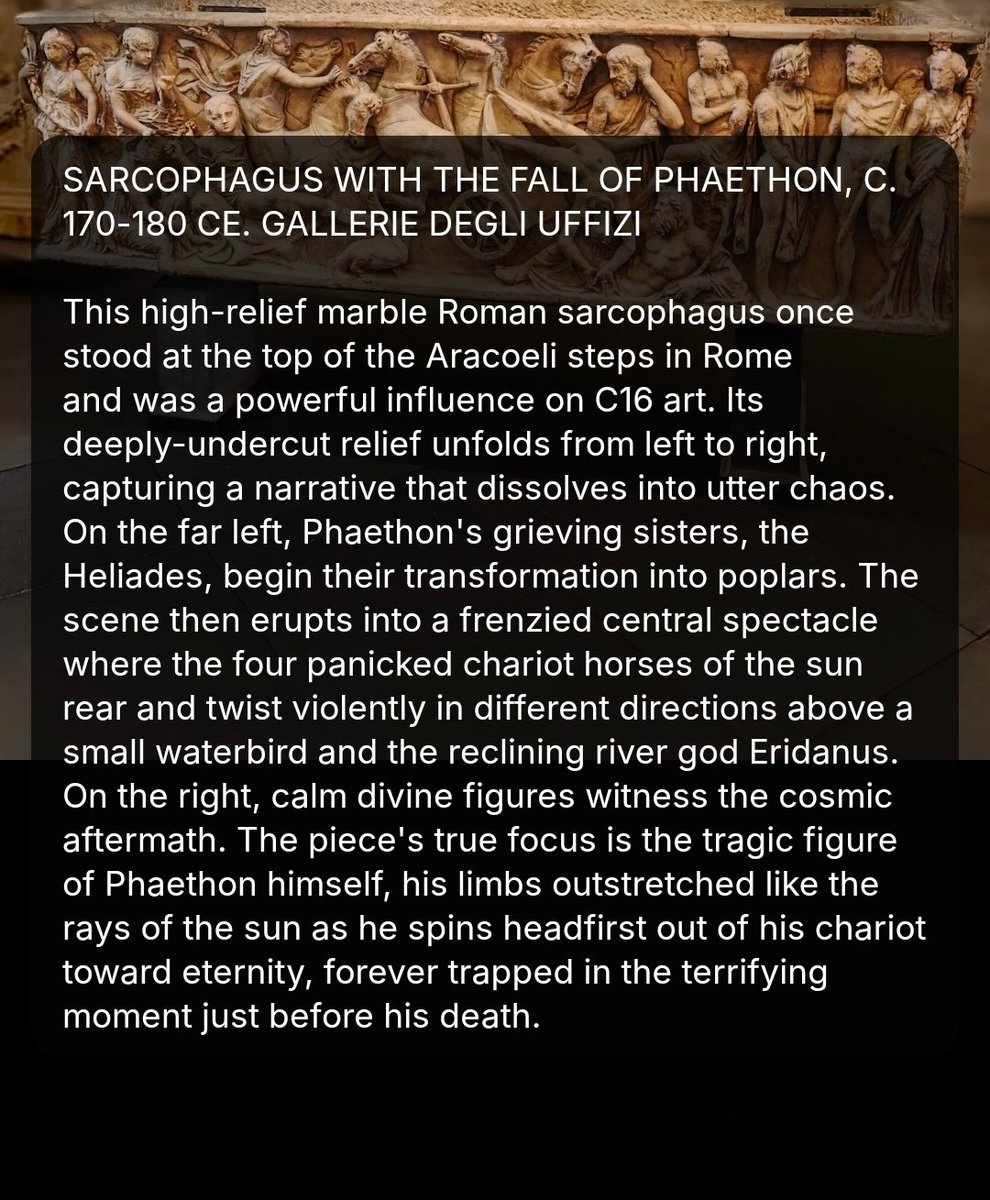
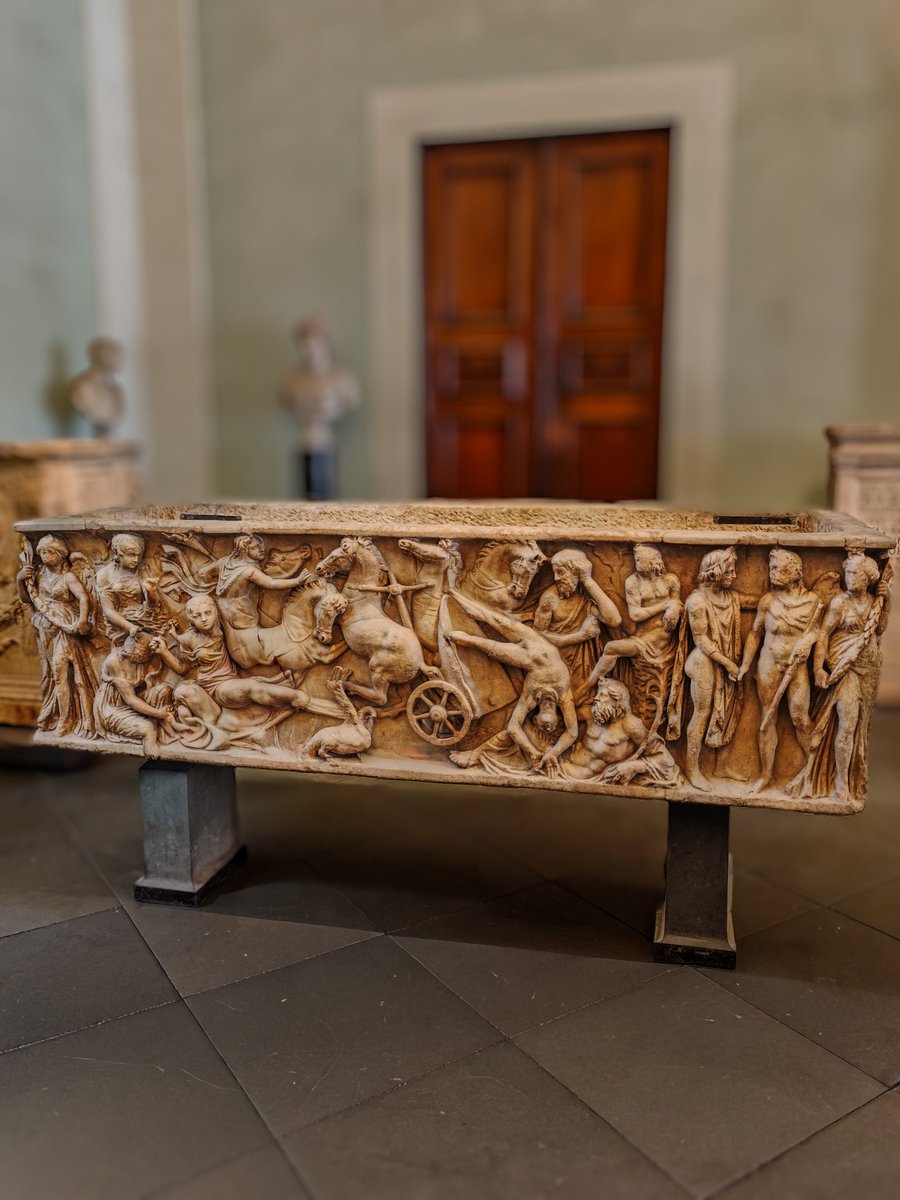
ALT SARCOPHAGUS WITH THE FALL OF PHAETHON, C. 170-180 CE. GALLERIE DEGLI UFFIZI. This high-relief marble Roman sarcophagus once stood at the top of the Aracoeli steps in Rome and was a powerful influence on C16 art. Its deeply-undercut relief unfolds from left to right, capturing a narrative that dissolves into utter chaos. On the far left, Phaethon's grieving sisters, the Heliades, begin their transformation into poplars. The scene then erupts into a frenzied central spectacle where the four panicked chariot horses of the sun rear and twist violently in different directions above a small waterbird and the reclining river god Eridanus. On the right, calm divine figures witness the cosmic aftermath. The piece's true focus is the tragic figure of Phaethon himself, his limbs outstretched like the rays of the sun as he spins headfirst out of his chariot toward eternity, forever trapped in the terrifying moment just before his death.
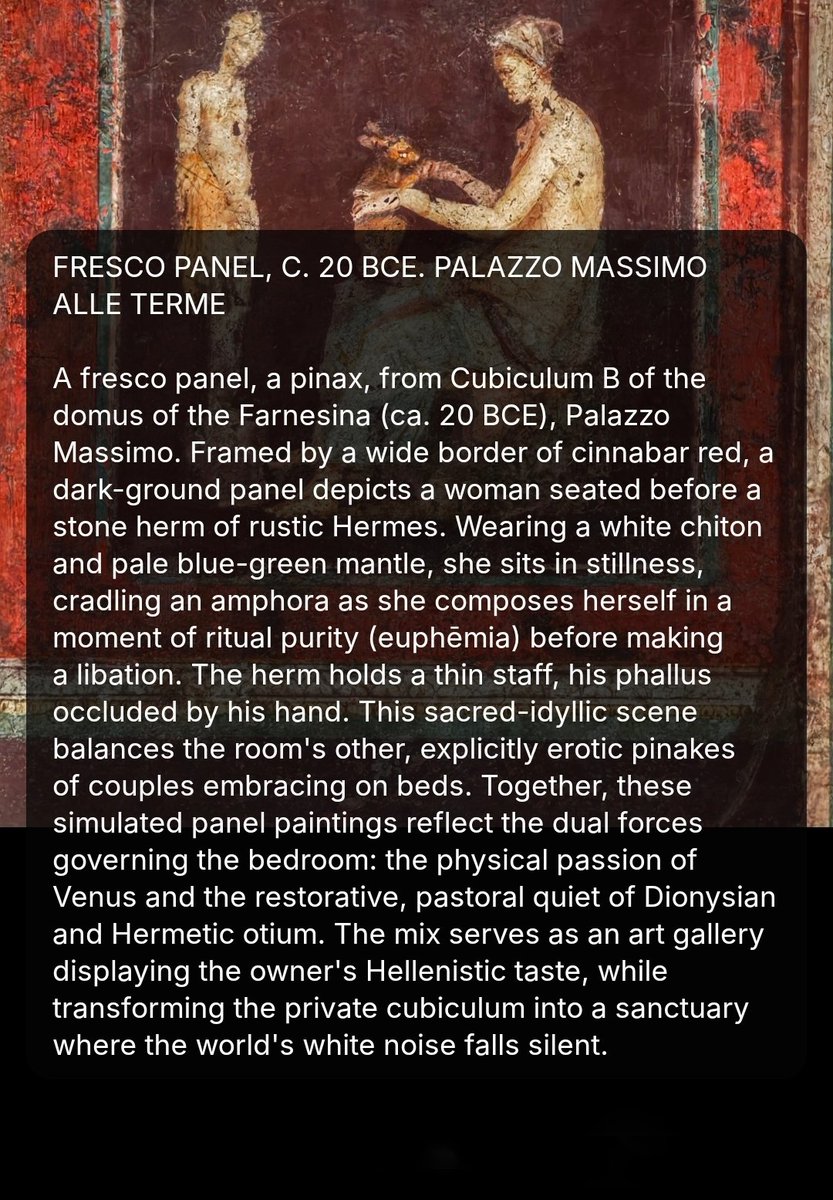
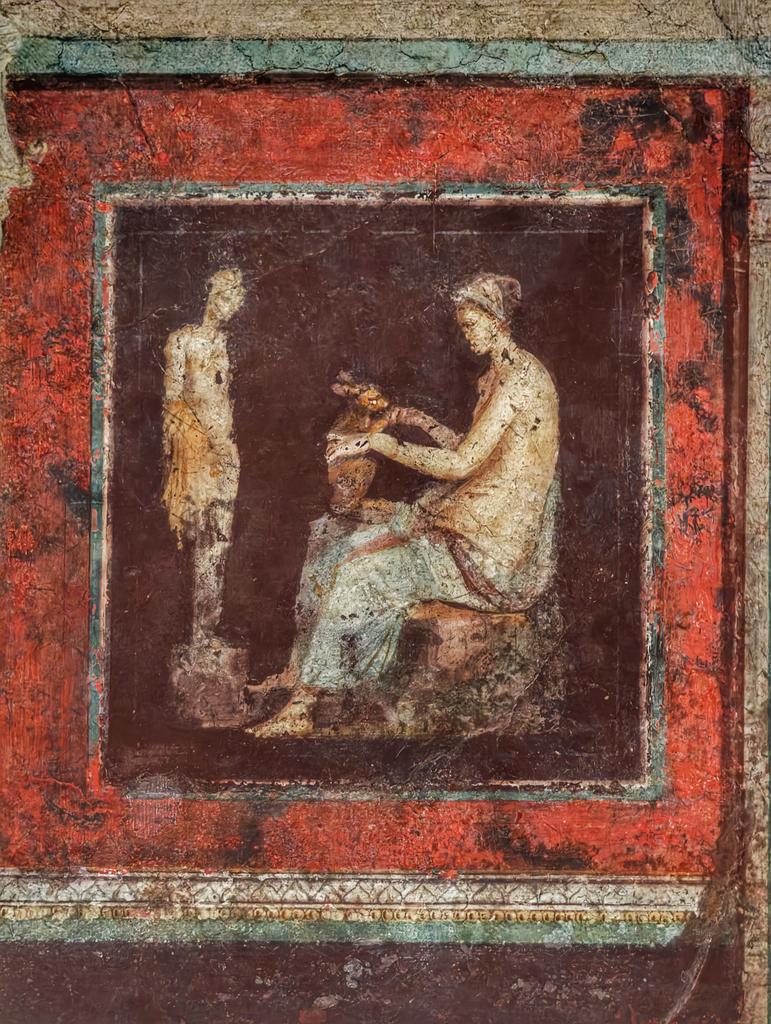
ALT FRESCO PANEL, C. 20 BCE. PALAZZO MASSIMO ALLE TERME A fresco panel, a pinax, from Cubiculum B of the domus of the Farnesina (ca. 20 BCE), Palazzo Massimo. Framed by a wide border of cinnabar red, a dark-ground panel depicts a woman seated before a stone herm of rustic Hermes. Wearing a white chiton and pale blue-green mantle, she sits in stillness, cradling an amphora as she composes herself in a moment of ritual purity (euphēmia) before making a libation. The herm holds a thin staff, his phallus occluded by his hand. This sacred-idyllic scene balances the room's other, explicitly erotic pinakes of couples embracing on beds. Together, these simulated panel paintings reflect the dual forces governing the bedroom: the physical passion of Venus and the restorative, pastoral quiet of Dionysian and Hermetic otium. The mix serves as an art gallery displaying the owner's Hellenistic taste, while transforming the private cubiculum into a sanctuary where the world's white noise falls silent.
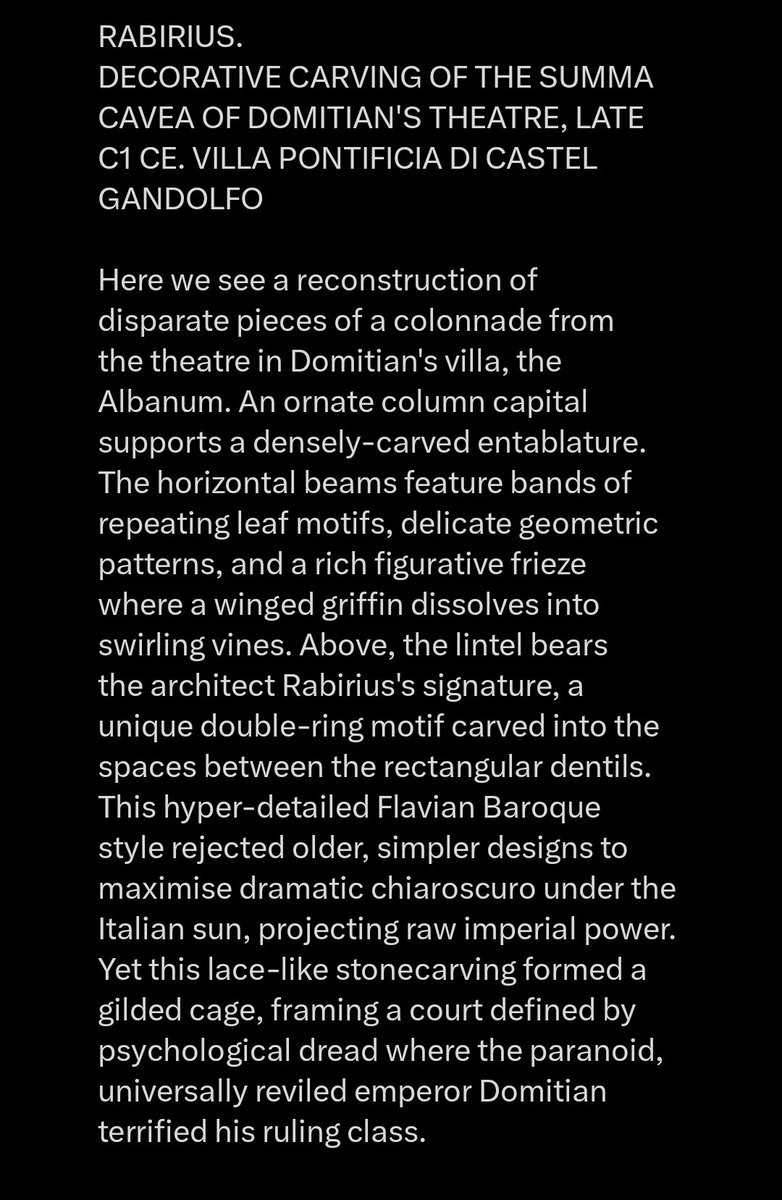
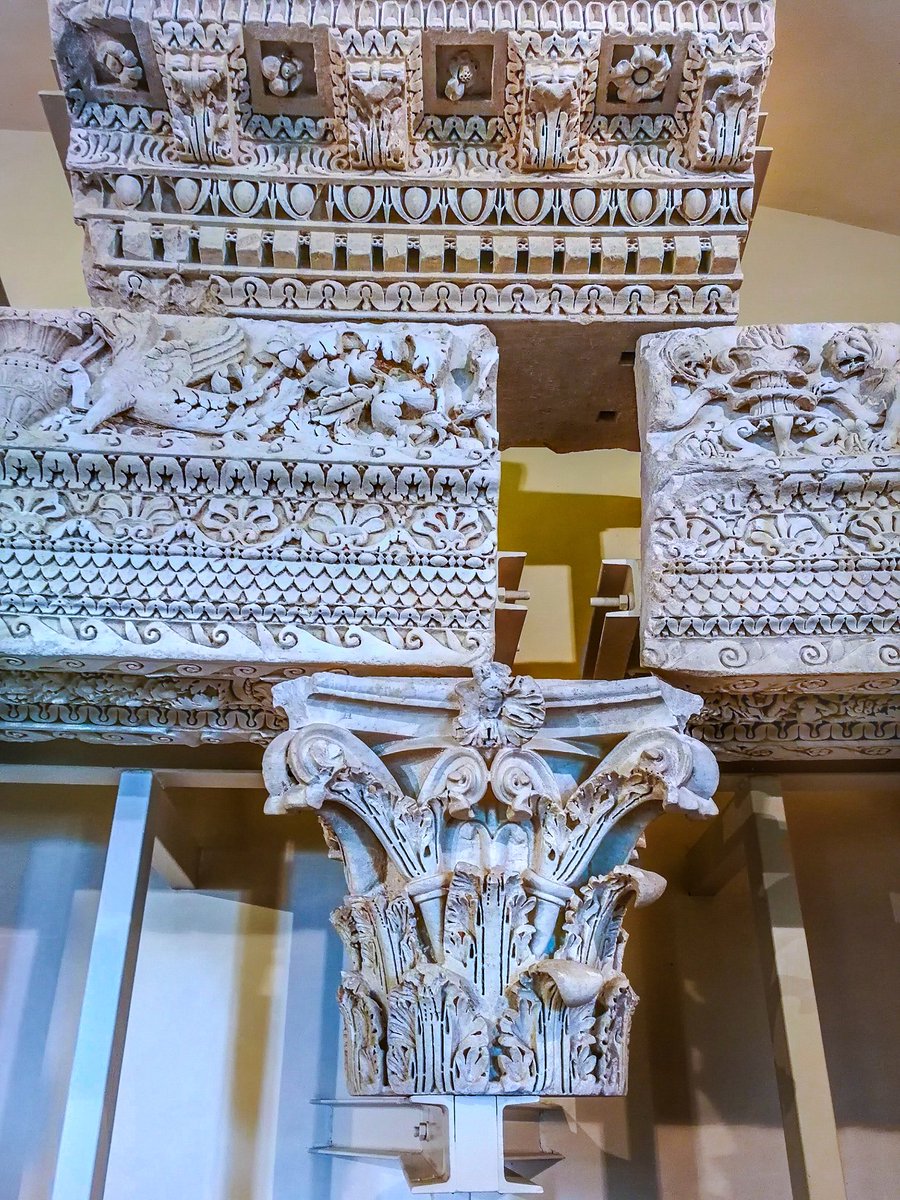
ALT RABIRIUS. DECORATIVE CARVING OF THE SUMMA CAVEA OF DOMITIAN'S THEATRE, LATE C1 CE. VILLA PONTIFICIA DI CASTEL GANDOLFO Here we see a reconstruction of disparate pieces of a colonnade from the theatre in Domitian's villa, the Albanum. An ornate column capital supports a densely-carved entablature. The horizontal beams feature bands of repeating leaf motifs, delicate geometric patterns, and a rich figurative frieze where a winged griffin dissolves into swirling vines. Above, the lintel bears the architect Rabirius's signature, a unique double-ring motif carved into the spaces between the rectangular dentils. This hyper-detailed Flavian Baroque style rejected older, simpler designs to maximise dramatic chiaroscuro under the Italian sun, projecting raw imperial power. Yet this lace-like stonecarving formed a gilded cage, framing a court defined by psychological dread where the paranoid, universally reviled emperor Domitian terrified his ruling class.
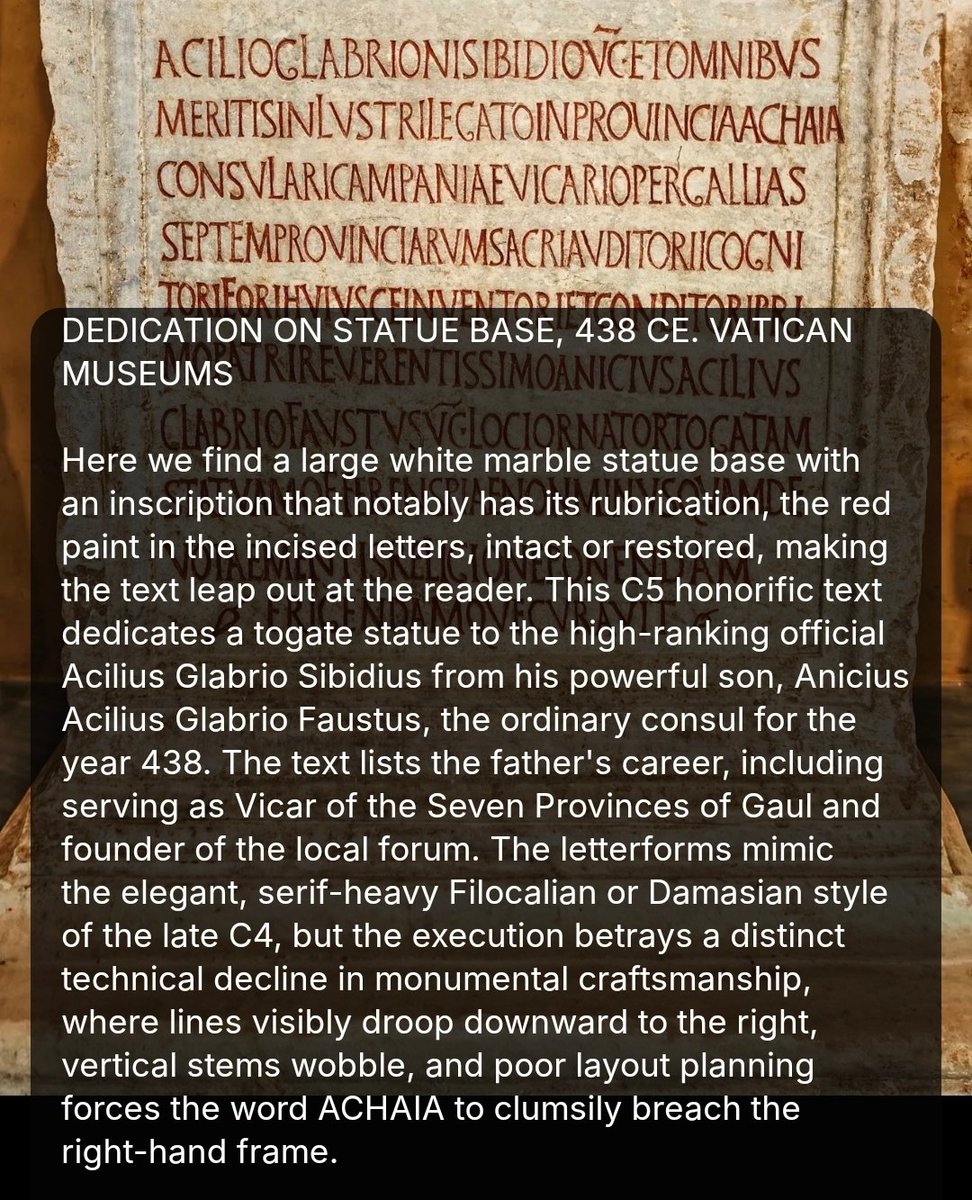
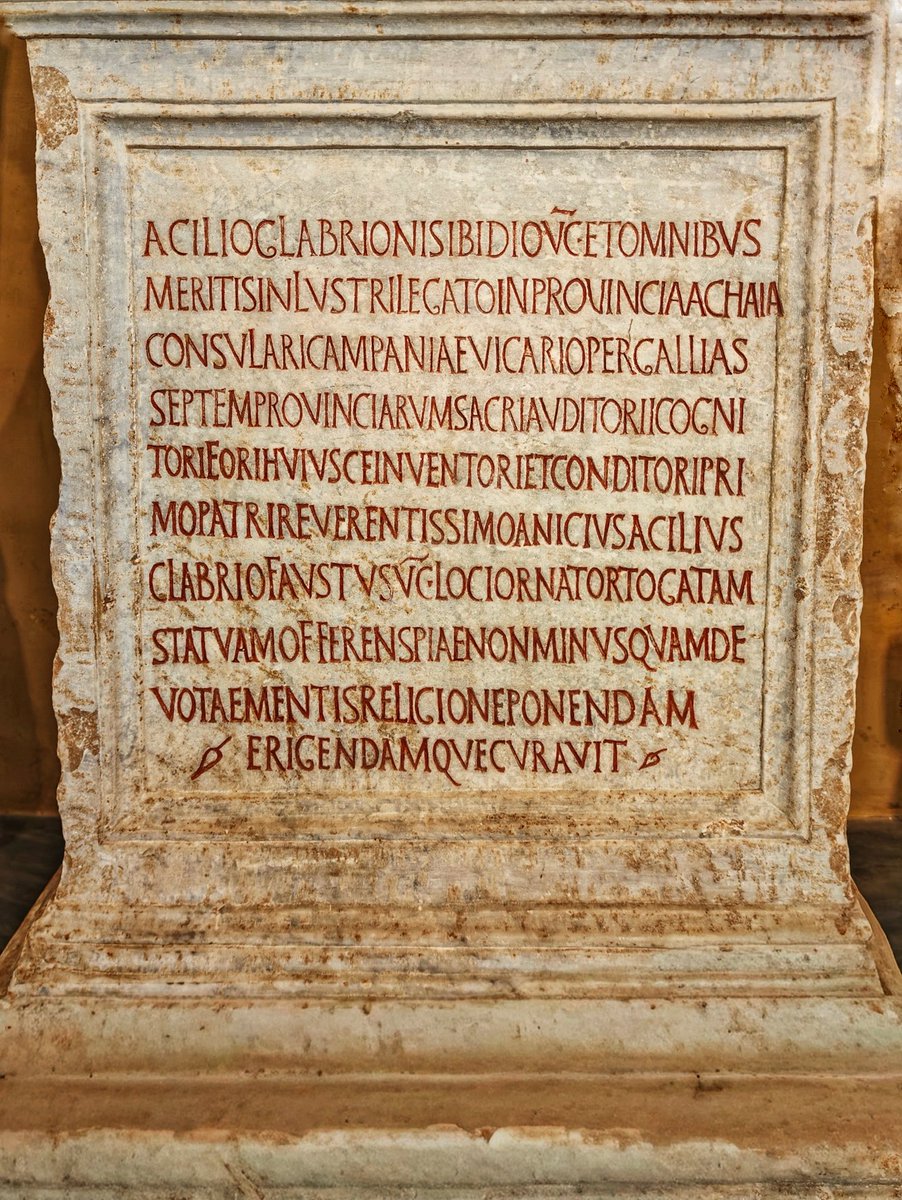
ALT DEDICATION ON STATUE BASE, 438 CE. VATICAN MUSEUMS Here we find a large white marble statue base with an inscription that notably has its rubrication, the red paint in the incised letters, intact or restored, making the text leap out at the reader. This C5 honorific text dedicates a togate statue to the high-ranking official Acilius Glabrio Sibidius from his powerful son, Anicius Acilius Glabrio Faustus, the ordinary consul for the year 438. The text lists the father's career, including serving as Vicar of the Seven Provinces of Gaul and founder of the local forum. The letterforms mimic the elegant, serif-heavy Filocalian or Damasian style of the late C4, but the execution betrays a distinct technical decline in monumental craftsmanship, where lines visibly droop downward to the right, vertical stems wobble, and poor layout planning forces the word ACHAIA to clumsily breach the right-hand frame.
ALT The "Forum of Sibidius" mentioned here is entirely absent from narrative histories and the C4 Regionary Catalogues. Instead, topographers believe it was a late antique urban renewal project that repaved and monumentalized the old C2 wine market, the Forum Vinarium, which sat in this pocket of the northern Campus Martius. When the base was discovered near Piazza di Sant'Apollinare, right by Palazzo Altemps, it was found clustered alongside two other bases dedicated to Faustus's maternal great-grandfather and his father-in-law. Far from just a public square, this lost forum was functioning as a dynastic monumental space where the great late-antique Acilii and Anicii families could display their familial pride and political dominance before the forum faded into medieval obscurity.
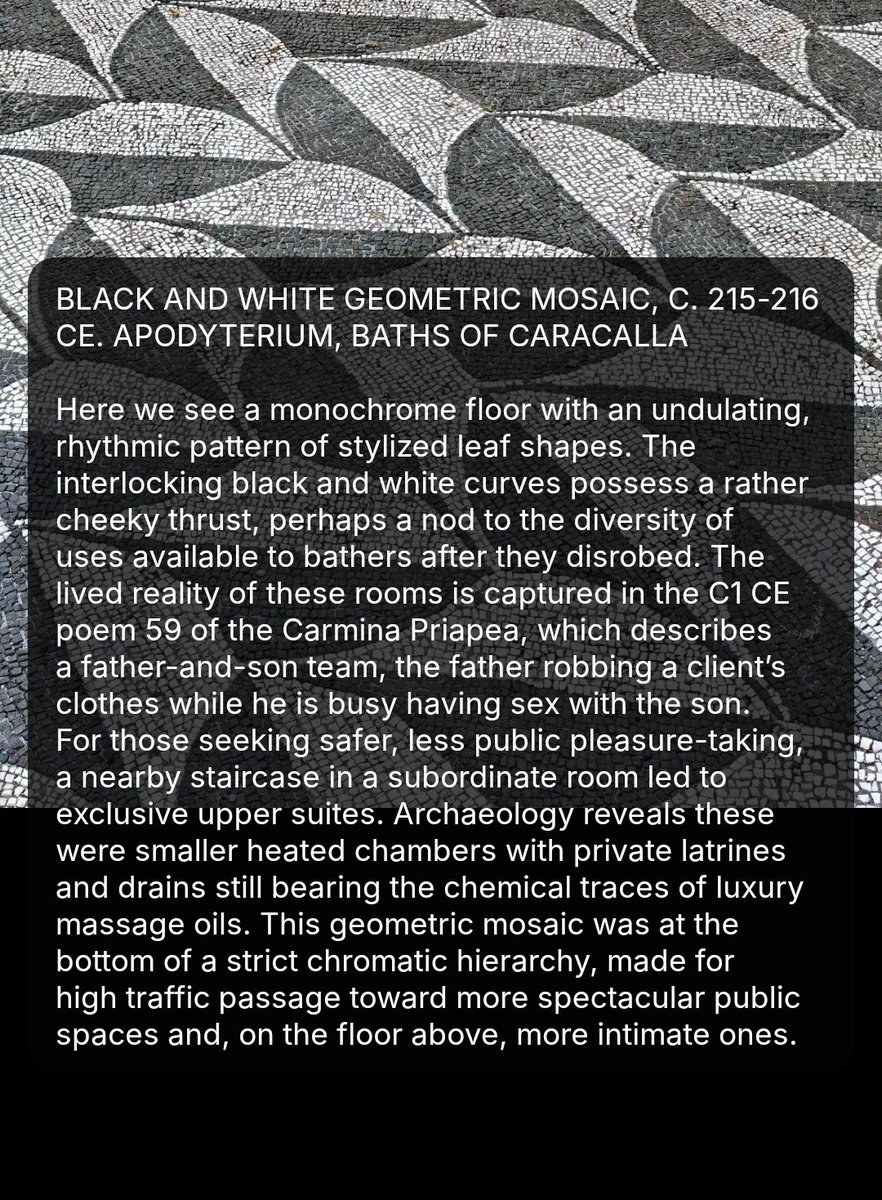
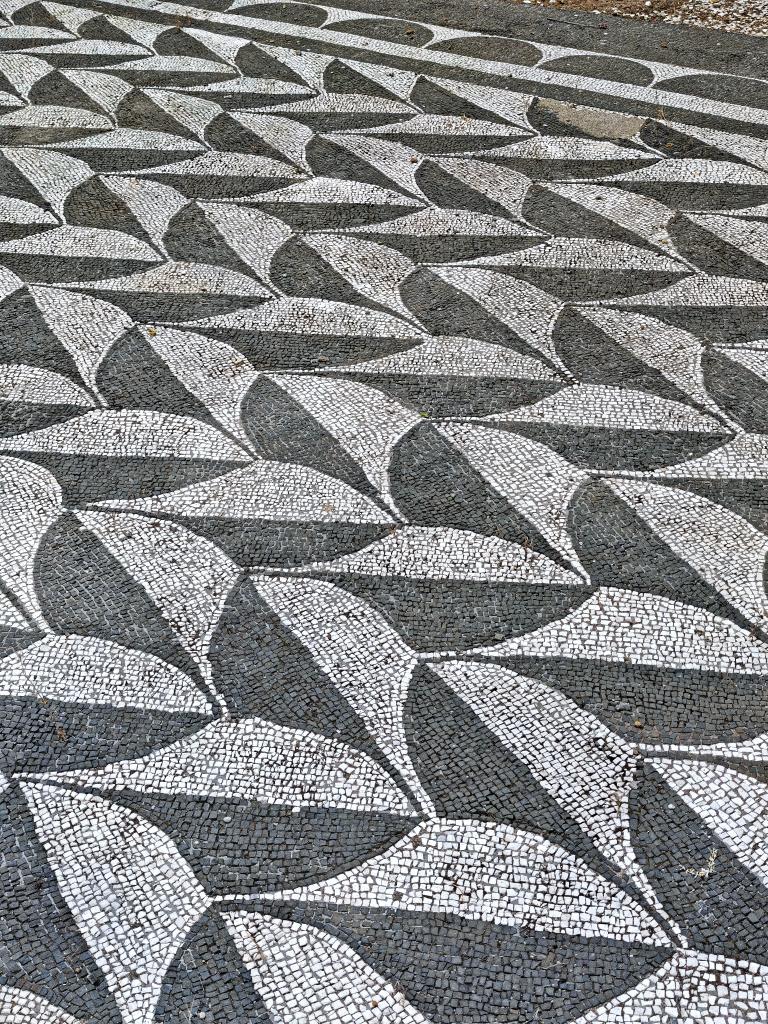
ALT BLACK AND WHITE GEOMETRIC MOSAIC, C. 215-216 CE. APODYTERIUM, BATHS OF CARACALLA Here we see a monochrome floor with an undulating, rhythmic pattern of stylized leaf shapes. The interlocking black and white curves possess a rather cheeky thrust, perhaps a nod to the diversity of uses available to bathers after they disrobed. The lived reality of these rooms is captured in the C1 CE poem 59 of the Carmina Priapea, which describes a father-and-son team, the father robbing a client’s clothes while he is busy having sex with the son. For those seeking safer, less public pleasure-taking, a nearby staircase in a subordinate room led to exclusive upper suites. Archaeology reveals these were smaller heated chambers with private latrines and drains still bearing the chemical traces of luxury massage oils. This geometric mosaic was at the bottom of a strict chromatic hierarchy, made for high traffic passage toward more spectacular public spaces and, on the floor above, more intimate ones.
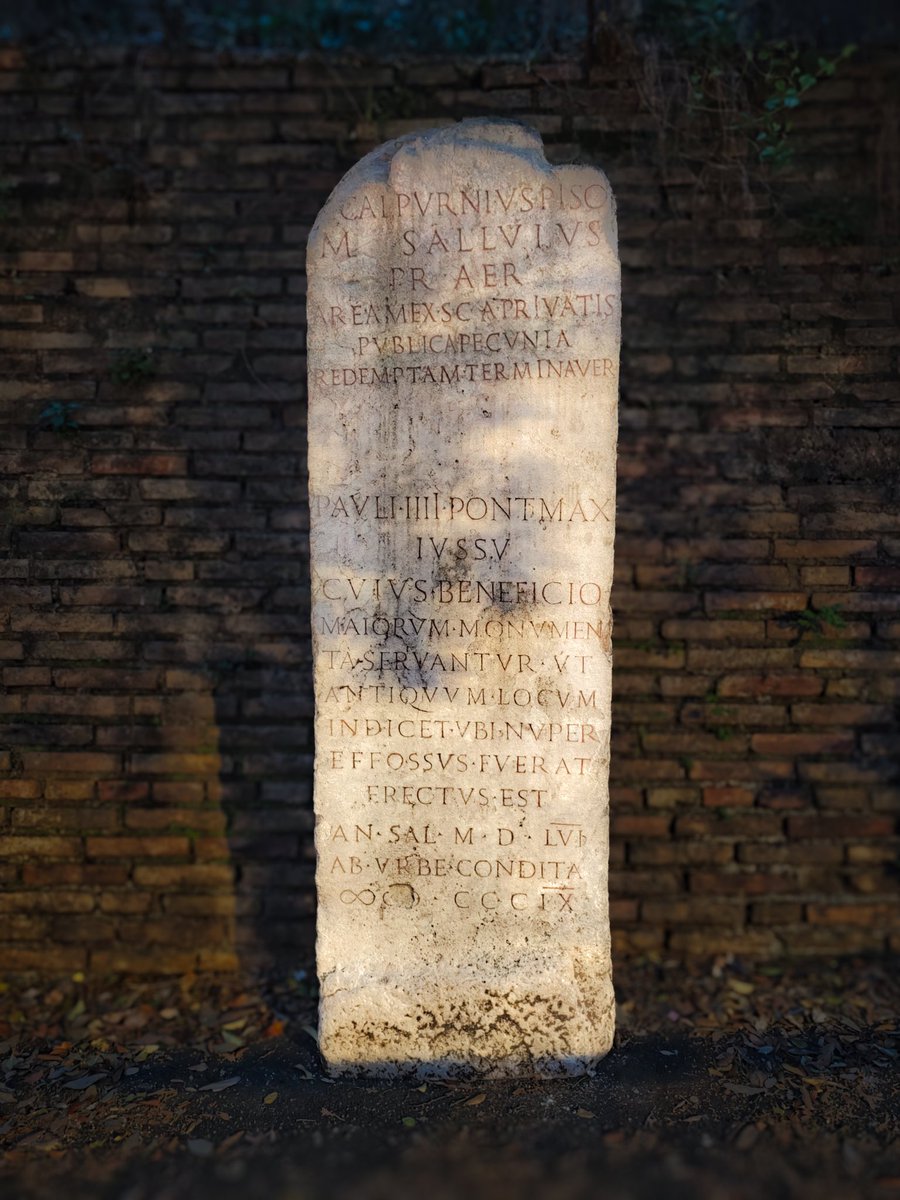
ALT REPUBLICAN CIPPUS, MID-C1 BCE, REUSED BY PAUL IV, 1557. VICO JUGARIO Standing by a wall below the Capitoline cliff, this vertical block of weathered cream travertine bears two eras of text on its flat face. At the top, Republican treasury prætors note using public funds to buy back private land to secure a road. Beneath, Pope Paul IV carved a text in 1557 during a destabilising war with Spain. With an invading army at the gates and Rome panicking over a second sack, the austere Carafa pope hijacked this stone. Though he loathed classical statues, hiding the Vatican collection from public view, he loved Roman law. He used this legal marker to graft papal authority onto ancient Republican civic jurisdiction, projecting absolute control while his pontificate descended into riot, starvation, and corruption. Remarkably, this text survived the violent riots and systemic erasure of the Carafa name that erupted immediately after his death in 1559, enduring quietly on a street corner.
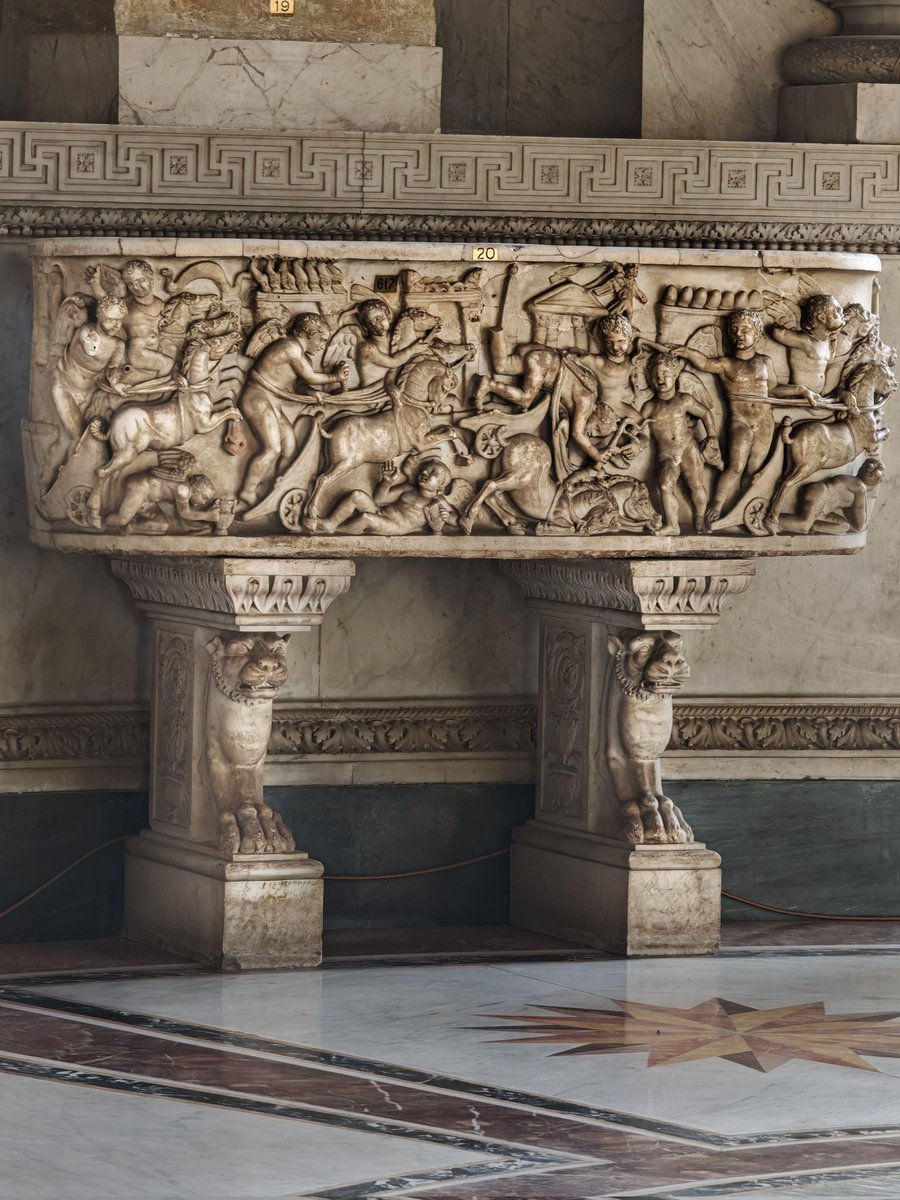
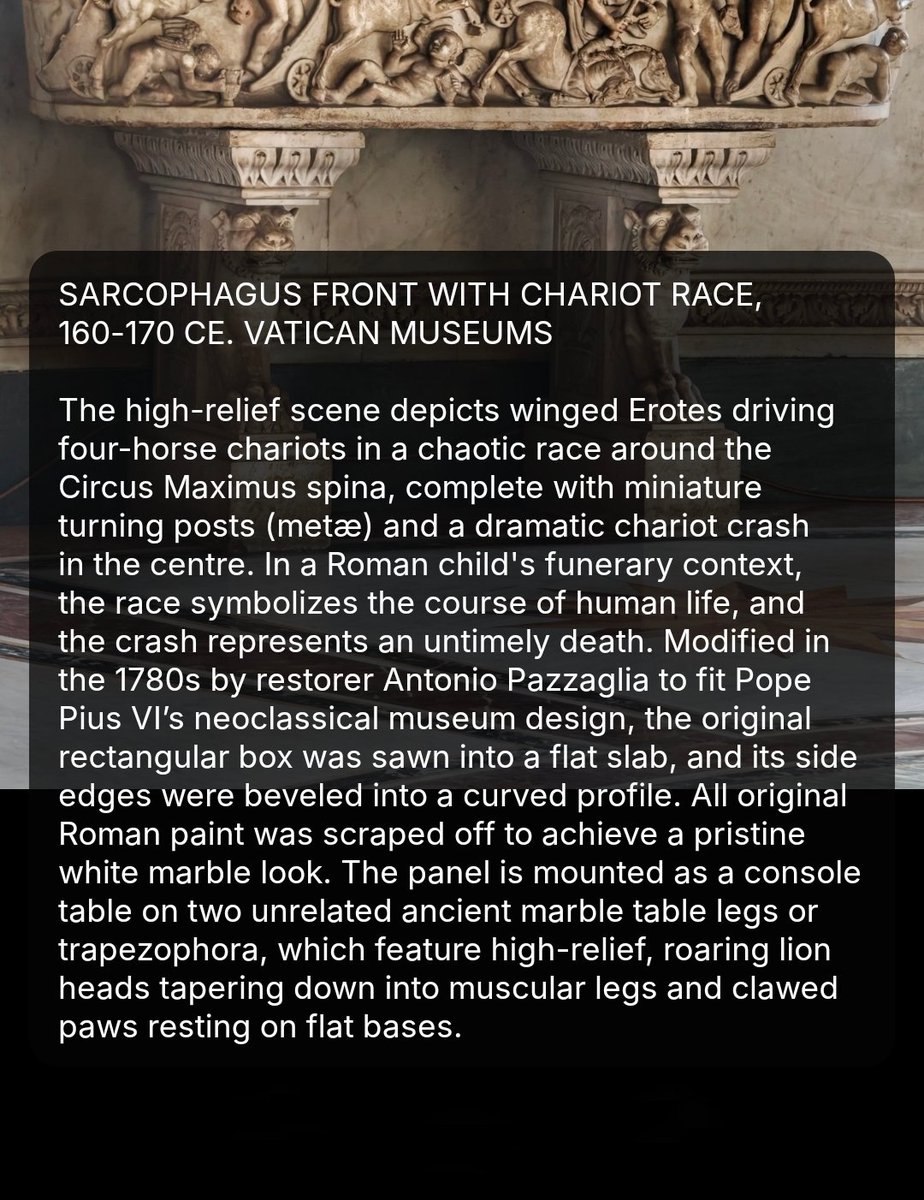
ALT SARCOPHAGUS FRONT WITH CHARIOT RACE, 160-170 CE. VATICAN MUSEUMS The high-relief scene depicts winged Erotes driving four-horse chariots in a chaotic race around the Circus Maximus spina, complete with miniature turning posts (metæ) and a dramatic chariot crash in the centre. In a Roman child's funerary context, the race symbolizes the course of human life, and the crash represents an untimely death. Modified in the 1780s by restorer Antonio Pazzaglia to fit Pope Pius VI’s neoclassical museum design, the original rectangular box was sawn into a flat slab, and its side edges were beveled into a curved profile. All original Roman paint was scraped off to achieve a pristine white marble look. The panel is mounted as a console table on two unrelated ancient marble table legs or trapezophora, which feature high-relief, roaring lion heads tapering down into muscular legs and clawed paws resting on flat bases.
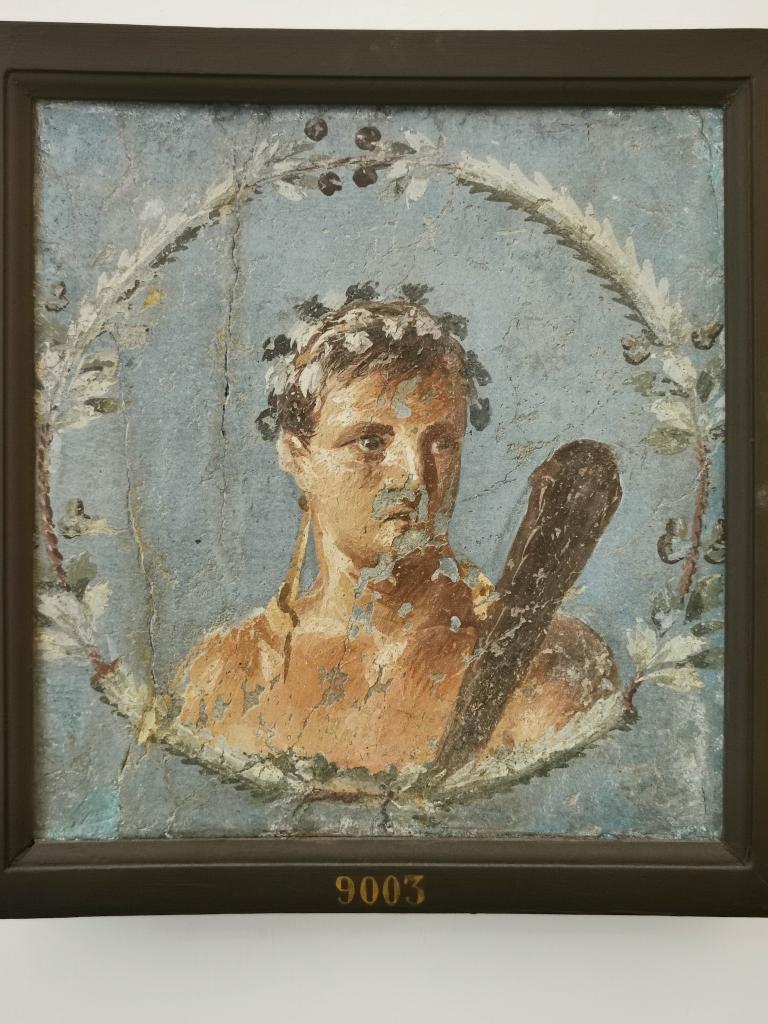
ALT FRESCO WITH A CLIPEATE PORTRAIT OF HERAKLES ANTHIOS, 45-79 CE, FROM HERCULANEUM. MUSEO ARCHEOLOGICO NAZIONALE DI NAPOLI. Here we have a handsome young Herakles, beardless but identifiable thanks to his clava or club. He is shown within a painted circular wreath against a brilliant blue background. Rather than the traditional laurel, his short, tousled hair is crowned with a delicate wreath of ivy leaves and dark corymbi or berry clusters, a specific iconographical detail that characterises him as Herakles Anthios, the flowered or youthful hero. This version of Herakles was closely linked to festive celebration and the theatre, a fitting patron for a town that claimed the hero as its mythical founder. Discovered during the disordered, unscientific Bourbon-era tunnelings of Herculaneum, the fresco was brutally hacked from its structural context, leaving its exact findspot a mystery. However, the use of exceptionally expensive Egyptian blue pigment strongly points to an elite setting.
