
Head of Research @indexingco 🟩 | Onchain and payment data streams through The Neighborhood
Joined December 2015
- Tweets 6,904
- Following 1,709
- Followers 16,197
- Likes 37,307
1,778 Photos and videos


May 29
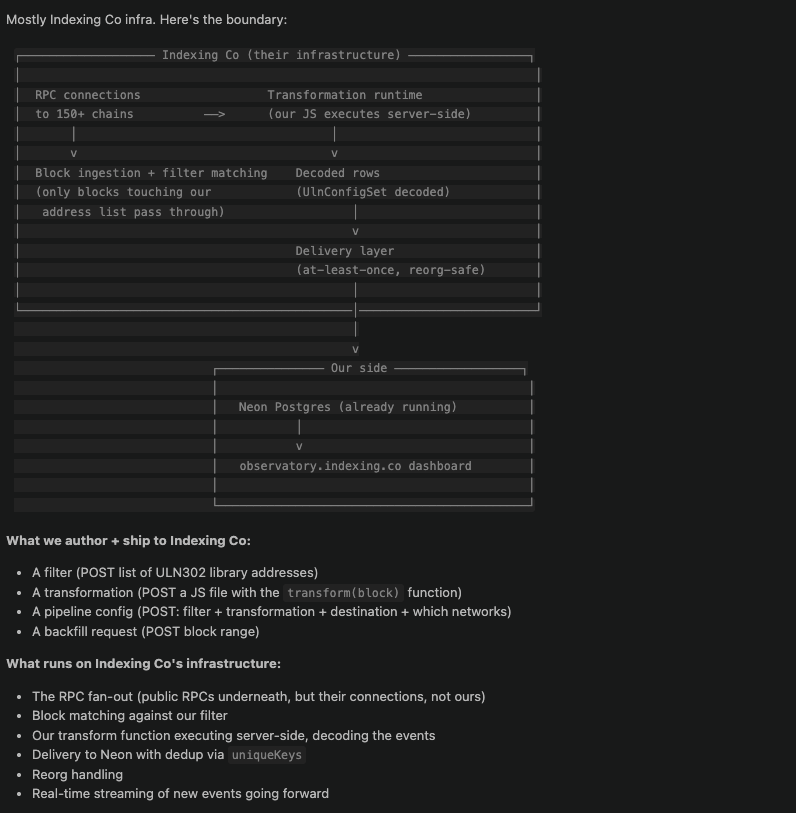
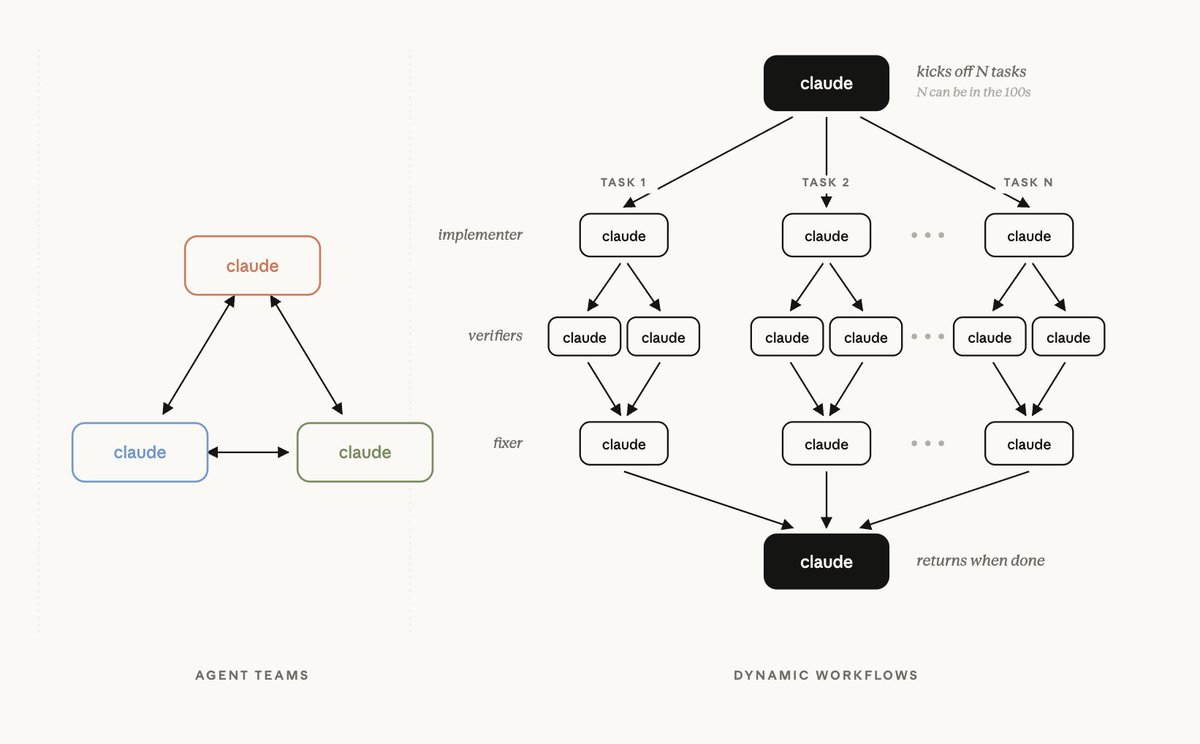
Claude A: Do this task Claude B and C
Claude B: I did this task, continue Claude C
Claude C: You didn't do this task Claude B, but I finished mine though
Claude A: you didn't finish your tasks Claude B and C. Main task completed.
User: ...

Excited to share our most powerful new Claude Code feature: dynamic workflows!
Mention "workflow" in a prompt and Claude will dynamically create an orchestration plan that it strictly follows, allowing you to confidently trust that every stage happens in the right order even across 100s of agents.
1
1
353
May 25
One framing I have for LLMs is that they are mostly compression tech.
They compressed an insane amount of data, files, knowledge and language into parameters. With prompts we can unpack that information and put it to use.
A step further past this mindset is seeing that LLMs can compress time when you use them well in automation. You can do tasks that used to take 4 hours, and do them in 15 minutes. Now you can even run tasks in parallel too with agents.
1
295
May 23
You need a full software team to ship a product, for agents it is not different.
Clear roles, handoffs, automated tests, CI/CD, reviews will have to run in loops. A single agent is weak. Agents checking other agents will massively improve multiagent development.
May 23

8/ Set up long-lived sessions with roles: planner, implementer, adversarial reviewer, black-box tester, issue triager, deep code reviewer. Your job is to wire them together so the implementer is never idle, and monitor and review to make sure everything is working and catch mistakes.
2
1
520
May 20
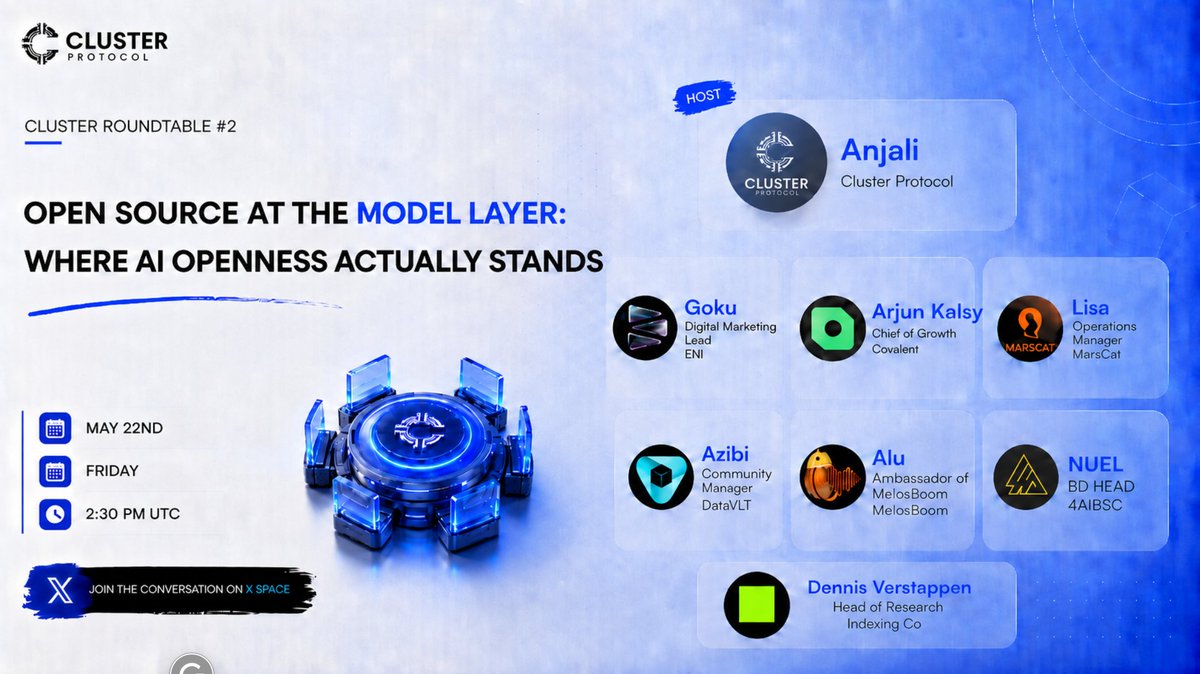
On Cluster Protocol's X space this Friday about open source in AI models.
I've been doing a lot of testing with local models lately and seeing the limitations, but also the implications for businesses. Tune in!
May 19

What does “open source AI” actually mean today?
This Friday, 22nd May at 2:30 PM UTC, Cluster Protocol is hosting a roundtable #2 on:
“Open source at the model layer: where AI openness actually stands”
Joining us:
Goku from @ENI__Official
@ArjunKalsy from @Covalent_HQ
Lisa from @MarsCat_Global
Azibi from @DataVLTAI
Alu from @MelosBoom
NUEL from @4aibsc &
@ape_rture from @indexingco
We’ll unpack where AI openness is real, where it is limited, and why the model layer matters for builders, infra teams, and the future of intelligent systems.
Set your reminder ⬇️
1
363
May 12
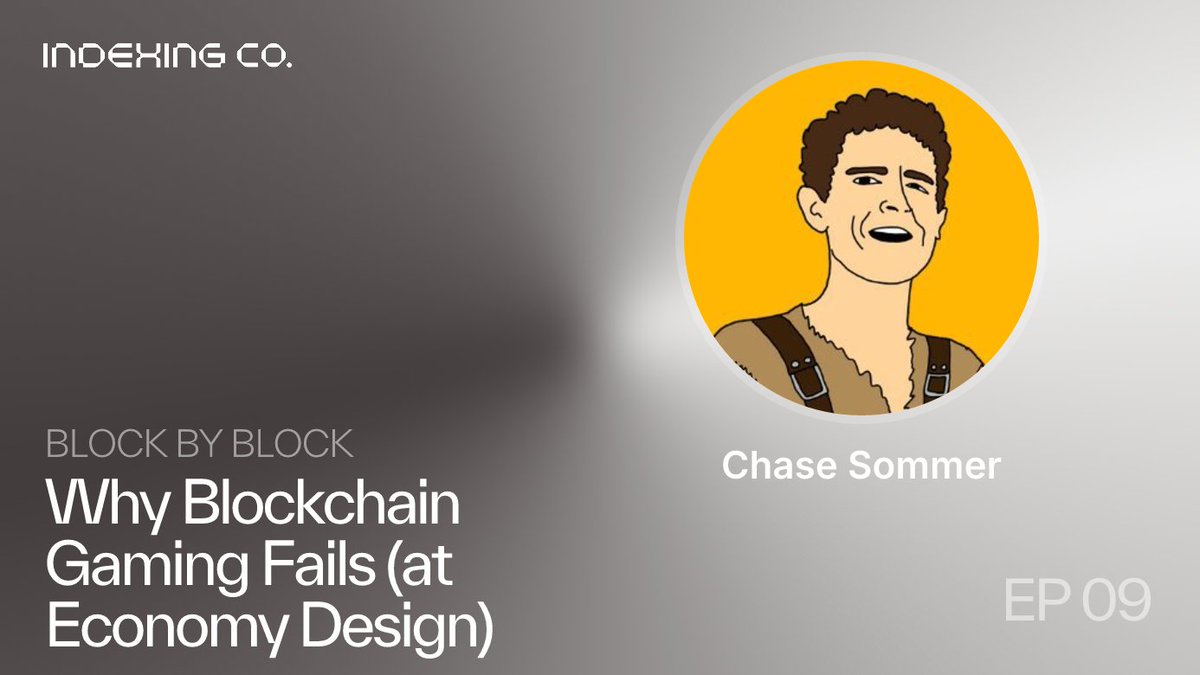
Blockchain gaming hasn't been very successful apart from the token speculation and farming games.
My conversation with @SommerChase revealed this sector has been solving the wrong problems.
Chase spent years building MMOs with blockchain economies, first at Game7 and later on his own experimental projects. What he learned from web2 gaming veterans was humbling: most blockchain games are objectively not good games. They are attempting hard mode, combining MMO development, blockchain integration, and economy design. All without the experienced game designers who know how to make something people actually want to play.
The tokenomics problem is fundamental. Most projects create full economies without sustainable revenue models. They pay players to play, which attracts farmers instead of genuine gamers. The focus is on allocation-based payouts rather than building actual player-to-player economies with proper token sinks. Chase's insight here is sharp:
every successful MMO already has black markets for gold and items. The question isn't whether players will trade value, it's whether that value flows through the game's economy or around it.
What gives me hope is the combination of smaller, grassroots teams and AI tooling. Chase is using AI-generated assets to build games solo that would have required full studios a few years ago. The bar is lower in crypto, which means more experimentation. The breakthrough won't come from VC-funded studios chasing token pumps. It'll come from someone who builds a genuinely good game first, then integrates blockchain in ways players barely notice, creating sustainable economies where players can actually earn through skill and community contribution.
2
1
3
535
May 12
Hear the full conversation here:
Youtube: youtu.be/QP4bvdHR9yU
Spotify: open.spotify.com/episode/3ZQ…
1
296
May 11
Looks like LayerZero is still signing 1-of-1s even after the claim on 9th of May.
There are 6 transfer events on this 1-of-1 DVN services by LZ.
Any exceptions to the claim or still waiting to stop servicing?

3
4
927
May 11
Standing corrected here thanks to @rookie_of_Ph
The config isn't pure 1-of-1. It's required=1 [LZ Labs] optional=2 [Deutsche Telekom, Google Cloud] with threshold=1. Verification needs LZ Labs and at least 1 of the optional DVNs. Three DVNs actually attested the mint at block 25062423.
Fixing the dashboard now.
212
May 10
Projects are cleaning up after the KelpDAO exploit. Now with today's LayerZero apology policy change, more value is getting secured.
A recap:
- Right after the April 18 exploit: $3.13 billion of LayerZero OFTs sat behind the default receive library, exposed to instant compromise if the LZ Labs admin multisig was breached or acted maliciously.
- Today: $178 million still sits there. @banteg's full tally has the 548 unmigrated items the exact setReceiveLibrary call to fix each one. gist.github.com/banteg/cbf75…
- Also today: LayerZero posted: "we made a mistake by allowing our DVN to act as a 1/1 DVN for high-value transactions… all defaults on all pathways are being migrated to 5/5 where possible and no less than 3/3 on any chain where only 3 DVNs are available" "the LayerZero Labs DVN no longer services 1/1 DVN configurations."
$2.95 billion migrated in 19 days, 94% of the surface area fixed by outreach one call per route. The new policy closes the gap by default for everyone who hasn't moved yet.
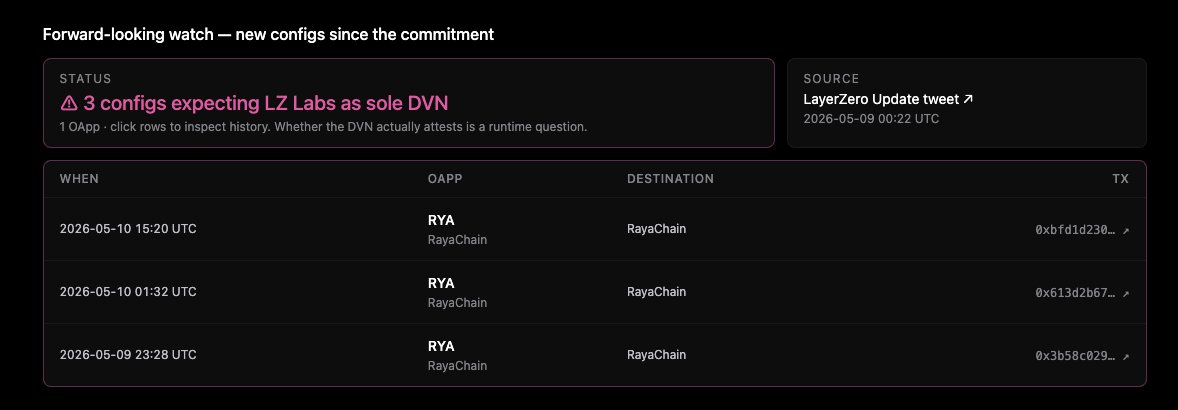
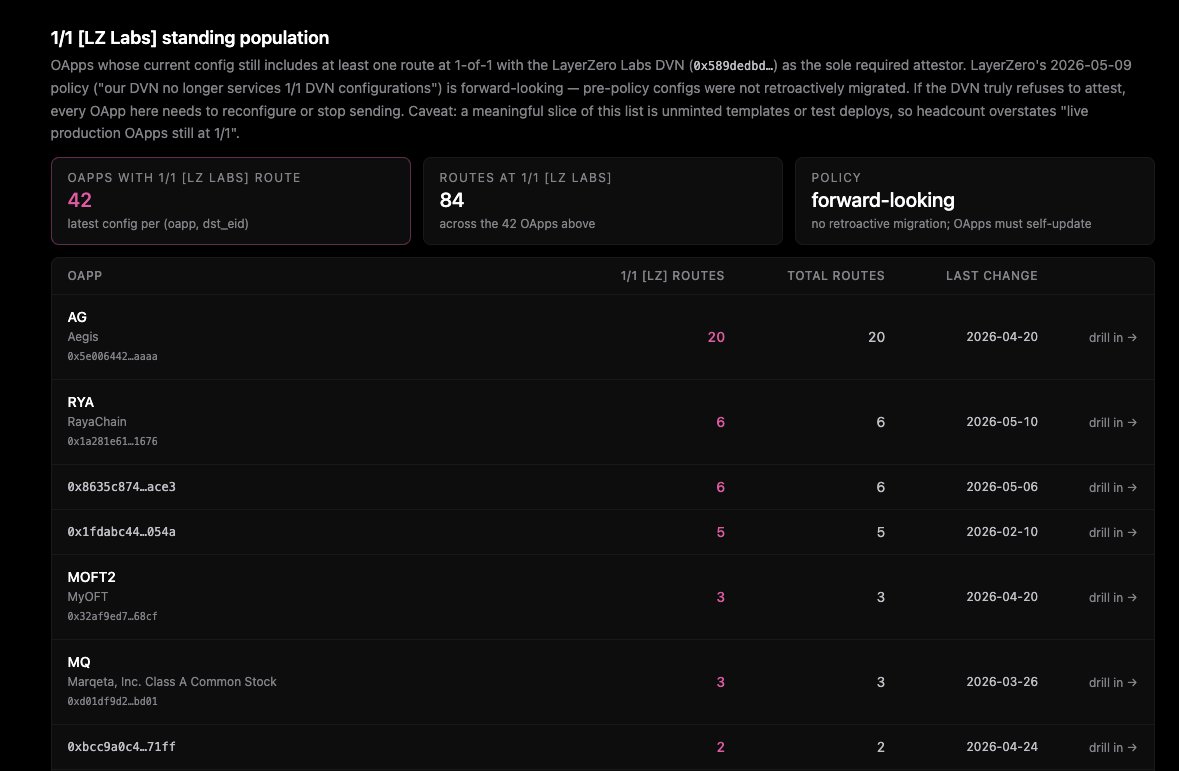
But the policy is forward-looking. We checked the standing population on-chain just now: 42 OApps still sit on 84 routes configured as 1-of-1 with LZ Labs as sole attestor. If LZ Labs's DVN truly refuses to service these (as committed), their messages won't route until they reconfigure.
Top still exposed via the receive-library: STO ($55M), egETH ($43M), Gate ($9M). SIGN ($28M) was on @banteg's gist 24h ago but has since pinned all three routes.
Live monitoring the chain chain, with the 42 OApps listed:
👀 observatory.indexing.co/kelp…
352

May 7
The strongest version of the story is on-chain. Lets verify:
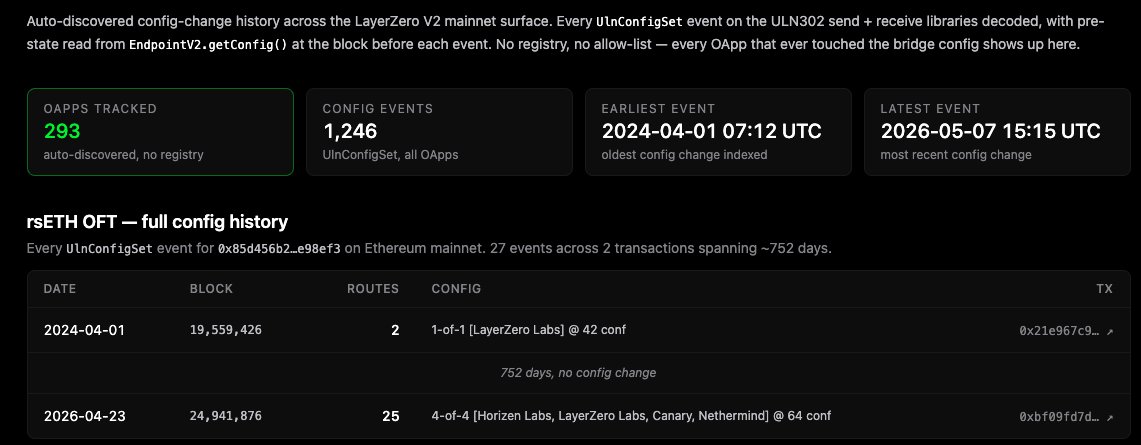
KelpDAO's rsETH bridge wasn't running 1-of-1 because they inherited a default. They manually configured 1-of-1 LayerZero Labs DVN at 42 block confirmations on April 1, 2024. They kept that configuration across every chain they expanded to for >two years. On April 23, 2026, five days after the exploit, they changed it across all 25 routes tot a 4-of-4 for security.
Both endpoints of that timeline are independently re-derivable from `EndpointV2.getConfig()` reads at those exact block numbers.
Here is what the chain actually shows.
At block 19,559,424 (March 31, 2024) the rsETH OFT was running the LayerZero default for routes to Arbitrum and Optimism: 2-of-2 required DVNs (LayerZero Labs and Polyhedra) at 15 confirmations.
One block later, at 19,559,425, Kelp called setConfig. The configuration changed to 1-of-1 [LayerZero Labs only] at 42 confirmations. They removed an attestor and raised the confirmations counter. From that block onward, every cross-chain message on a Kelp pathway needed a single LayerZero Labs DVN signature to authenticate.
LayerZero's CEO confirmed (see tweet below), in response to a KelpDAO post that framed the configuration as a default:
"A ton of this is just completely untrue. Kelp originally used the defaults which were MultiDVN or DeadDVN and manually migrated to a 1/1 config later. Almost 100% of the volume on a 1/1 config was rsETH. Not using a 1/1 for production applications is mentioned many times in the documentation."
- @PrimordialAA
I confirmed this with a config-change pipe running on @indexingco across the LayerZero V2 mainnet surface. For the rsETH OFT (`0x85d4...8ef3`) on Ethereum, the pipe sees exactly two events between the April 1, 2024 manual configuration and the April 23, 2026 hardening. Two years and twenty-two days, no change. The 1-of-1 [LayerZero Labs] @ 42 conf configuration is what every new pathway Kelp opened in that window inherited, and it is what got drained for $292M on April 18. On April 23, the Kelp delegate signed a single transaction (`0xbf09fd7d...3c39b947`) that flipped 25 routes to 4-of-4 [Horizen Labs, LayerZero Labs, Canary, Nethermind] at 64 confirmations.
You can browse this for any LayerZero V2 OApp on the live monitor: observatory.indexing.co/kelp…. Same data directly from the pipe. The two rsETH events show up as two rows with a 752-day "no config change" gap between them.
Now the part that needs balance.
KelpDAO has pushed back hard on the framing. Their case: the 1-1 configuration was not unique to Kelp, the LayerZero Labs DVN was systemically important, and the actual breach was on LayerZero's own RPC infrastructure, not KelpDAO's setup. Per Kelp's "Setting the Record Straight" post:
> "Public Dune analysis found that, of approximately 2,665 unique LayerZero OApp contracts, 47% ran a 1-1 DVN security floor, 45% ran 2-2, and only approximately 5% ran 3-3 or higher."
That last claim is independently checkable, and I checked the corollary. LayerZero's documentation contradicts itself on this question. The integration checklist warns explicitly:
> "Do: Use more than one DVN for each production pathway instead of relying on a single DVN."
> "Don't: Configure only one DVN for a pathway and treat it as production-ready."
But the canonical OFT example config in `LayerZero-Labs/devtools/examples/oft/layerzero.config.ts` still ships, today, as `[['LayerZero Labs'], []]`. One required DVN (LayerZero Labs), no optional DVNs. That's the file most builders will deploy first.
Both can be true. Kelp manually configured 1-of-1 in April 2024. The wider ecosystem signal with defaults (example configs, what other OApps were doing) made 1-of-1 feel like a safe production posture for a long time. The April 18 breach happened on LayerZero Labs' own RPC infrastructure (independent reports from Seal911 and others; LayerZero's own postmortem confirms two RPC nodes were compromised and binaries swapped). When the single attestor in your trust set has its RPC poisoned, 1-of-1 is exactly as broken as it sounds.
Kelp's path forward: they're migrating rsETH from the LayerZero OFT standard to Chainlink CCIP / the CCT standard. That's an exit, since most trust now has been broken between the two parties.
However, personally I think both parties are to blame. They just aren't taking the responsibilities and working together to solve it. Sad and will remove trust by the public in both products.
The lesson for everyone else operating an OFT: read your own config off-chain, today. Then watch it drift, on-chain going forward.
The DVN monitor on observatory.indexing.co/kelp… auto-discovered 292 OApps without a hand-maintained registry. If yours is on there, your config is on there. If those configs change, the monitor will see it.

A ton of this is just completely untrue.
1) Kelp originally used the defaults which were MultiDVN or DeadDVN and manually migrated to a 1/1 config later
2) Almost 100% of the volume on a 1/1 config was rsETH
3) Not using a 1/1 for production applications is mentioned many times in the documentation.
The defaults Kelp is referencing in their screenshot were multiDVN or DeadDVN, which force-rejects an application using the defaults at all and requires them to manually set configuration.
rsETH was originally configured to use the default LayerZero configuration of a multiDVN setup of LayerZero Labs Google:
Here are the exact transactions where that happens
Ethereum → Arbitrum:
etherscan.io/tx/0xd7c864adbc…
at 2024-02-06 03:09:47 UTC
Ethereum → Optimism:
etherscan.io/tx/0x7075bfe9a3…
at 2024-02-06 03:09:59 UTC
KelpDAO then manually changed these to 1/1 configs:
For the original Feb 6 Ethereum routes to Arbitrum/Optimism, KelpDAO’s Ethereum contract switched from defaults to manual OApp-scoped config on 2024-04-01:
Send-side manual config:
etherscan.io/tx/0x7485c16c9b…
2024-04-01 07:12:11 UTC
Receive-side manual config:
etherscan.io/tx/0x21e967c99a…
2024-04-01 07:12:23 UTC
From this point on, Kelp began deploying all of their configurations as 1/1 configs. Here is Kelp’s deployment on Unichain:
Unichain → Ethereum was opened on 2025-04-01 18:55:41 UTC.
Pathway-open / setPeer tx:
uniscan.xyz/tx/0x31ea2b10a73…
The manual ULN config followed 6 seconds later in uniscan.xyz/tx/0xd8ef5416a53….
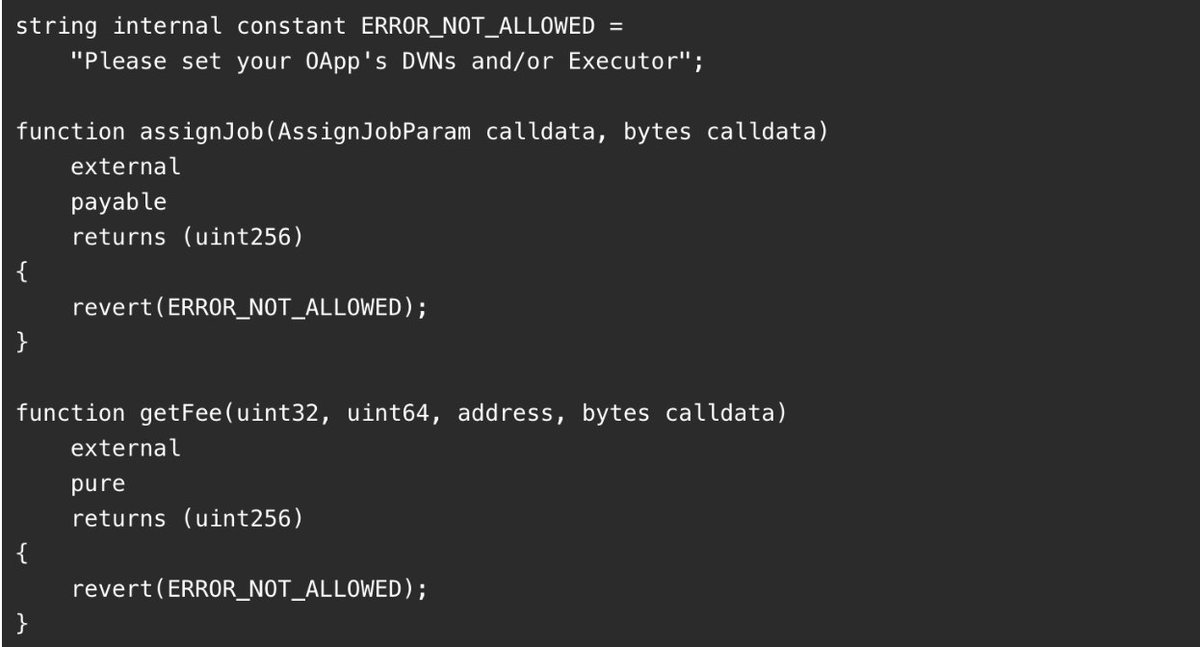
During this time the Unichain -> Ethereum and Ethereum -> Unichain defaults were set to DeadDVN which is a contract which makes it impossible for any application to transact without manually configuring their DVNs, this was not possible on the defaults of this pathway.
Here is the code in the DeadDVN (etherscan.io/address/0x747C7…) that specifically prohibits this.
(Screenshot 1)
This is called out many many times in the docs:
1. Integration Checklist — "Do" list
- Last edited: 2025-11-26 (Nazreen)
- Content: "Do: … Use more than one DVN for each production pathway instead of relying on a single DVN."
- File: v2/tools/integration-checklist.mdx:244
- URL: docs.layerzero.network/v2/to…
2. Integration Checklist — "Don't" list
- Last edited: 2025-11-26 (Nazreen)
- Content: "Don't: … Configure only one DVN for a pathway and treat it as production‑ready."
- File: v2/tools/integration-checklist.mdx:251
- URL: docs.layerzero.network/v2/to…
3. Integration Checklist — Defaults are not safe
- Last edited: 2025-09-25 (Tino Martínez Molina)
- Content: "Do not assume defaults are safe for production. Always check explicitly: getSendLibrary, getReceiveLibrary, and getConfig. If these resolve to defaults, confirm whether the defaults are valid for the intended pathway. Unintentional fallbacks to defaults are a common cause of blocked or failing pathways."
- File: v2/tools/integration-checklist.mdx:126-128
- URL: docs.layerzero.network/v2/to…
4. Integration Checklist — Default fallback warning
- Last edited: 2026-02-26 (migration; same wording predates it)
- Content: "Warning: If no configuration is set, the OApp will fallback to the default settings set by LayerZero Labs."
- File: v2/tools/integration-checklist.mdx:222-238
- URL: docs.layerzero.network/v2/to…
5. ONFT Quickstart — Production guidance
- Last edited: 2025-02-20 (Radek Sienkiewicz)
- Content: "DVN Settings: Use multiple DVNs in production to ensure message verification is robust."
- File: v2/developers/evm/onft/quickstart.mdx:700
- URL: docs.layerzero.network/v2/de…
6. ONFT Quickstart — Strong recommendation to configure
- Last edited: 2025-03-10 (Radek Sienkiewicz)
- Content: "We strongly recommend reviewing these settings carefully and configuring your security stack according to your needs and preferences."
- File: v2/developers/evm/onft/quickstart.mdx:366
- URL: docs.layerzero.network/v2/de…
7. Starknet FAQ — "Should I use multiple DVNs?"
- Last edited: 2026-01-21 (Nazreen)
- Content:
▎ Should I use multiple DVNs?
▎ Recommended for production. Multiple DVNs provide:
▎ - Increased security (multiple independent verifiers)
▎ - Resilience (no single point of failure)
▎ - Trust minimization
- File: v2/developers/starknet/troubleshooting/faq.mdx:290-296
- URL: docs.layerzero.network/v2/de…
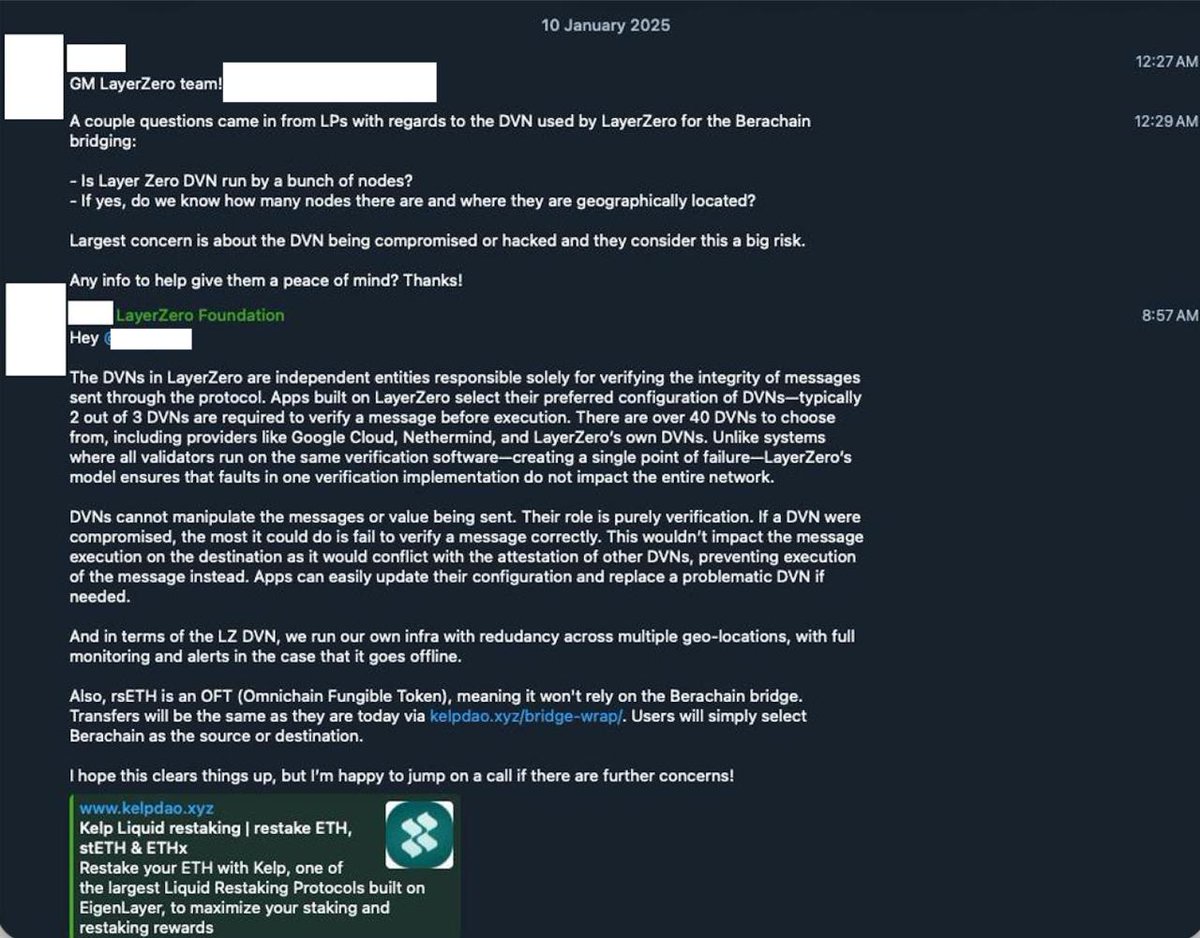
Here are the exact recommendations we gave KelpDAO when asked about DVNs (typically 2/3)
(Screenshot 2)
Other LayerZero applications speaking on exactly what is advised by the team
x.com/mitchellftracy/status/…
x.com/jasperflux/status/2046…
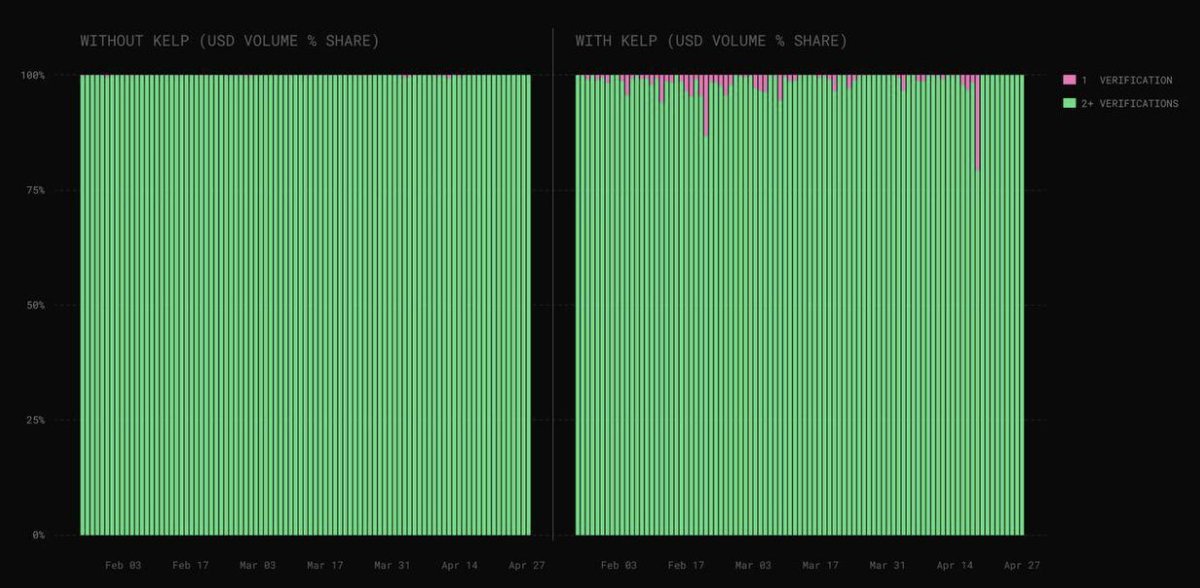
For how much volume was actually configured on 1/1 here is the exact data.
(Screenshot 3)
We will publish a complete post-mortem as soon as the external security firms have completed it.
358
May 6
Casual LLM explanation of how it works with @indexingco.
I literally have a team of data engineers in a box right now to do my onchain research, while owning the data I receive.
Dream.
1
343
May 5
Everyday I marvel at how agents work and enjoy the harness optimisations.
Just a convo with Claude, shipping of to a team of Codex agents, coding, reviewing, optimizing.
Seeing the system improve with every chat, because it has the instruction to improve.
258
Apr 30
My orchestrator agent pretending to orchestrate running 10 agents in parallel overnight

1
329
Apr 30
Last week, Arbitrum's Security Council "froze" $71M from the KelpDAO exploiter.
A 9/12 multisig moved funds out of a user EOA. While that sounds like a simple tx, it is actually quite complex.
The Arbitrum Constitution gives the Council emergency upgrade rights over Arbitrum's contracts, but not over user wallets. A multisig can pause a vault it controls but it cannot (and probably shouldn't) reach into someone's address and move their ETH.
So I started digging to see what actually happened.
In one Ethereum transaction, the Council upgraded the L1 Delayed Inbox to add a new function: `sendUnsignedTransactionOverride`. The function sends a standard L1 to L2 cross-chain message but lets the caller spoof the sender field. They used it once, sending a transfer "from" the attacker's address to a protocol-controlled wallet, then reverted the Inbox to its original implementation in the same block.
So this can be seen as one atomic transaction with the exploit window existing just for one call. Now this functionality is gone.
About 8 minutes later, after the standard L1 to L2 settlement delay, Arbitrum received the message and executed it. 30,765.667402 ETH moved from the attacker to `0x0000000000000000000000000000000000000DA0`. A wallet only Arbitrum governance can release.
The Council can't even spend it themselves since they have to ask the DAO. This comes with two implications.
1. Most L2s with a Security Council that controls the canonical L1 message router have this capability. Optimism, Base, others. Whether they'd use it is a governance and ethical question. Technically it is feasible, which breaks the code-is-law principle and moves us towards a council-decides-what-is-law.
2. "The Council froze the funds" is a shortcut in thinking. The actual mechanism is narrower and more interesting. They took over control over a user's wallet.
A Constitutional AIP for the release was filed April 25. On-chain vote opens around May 12-26.
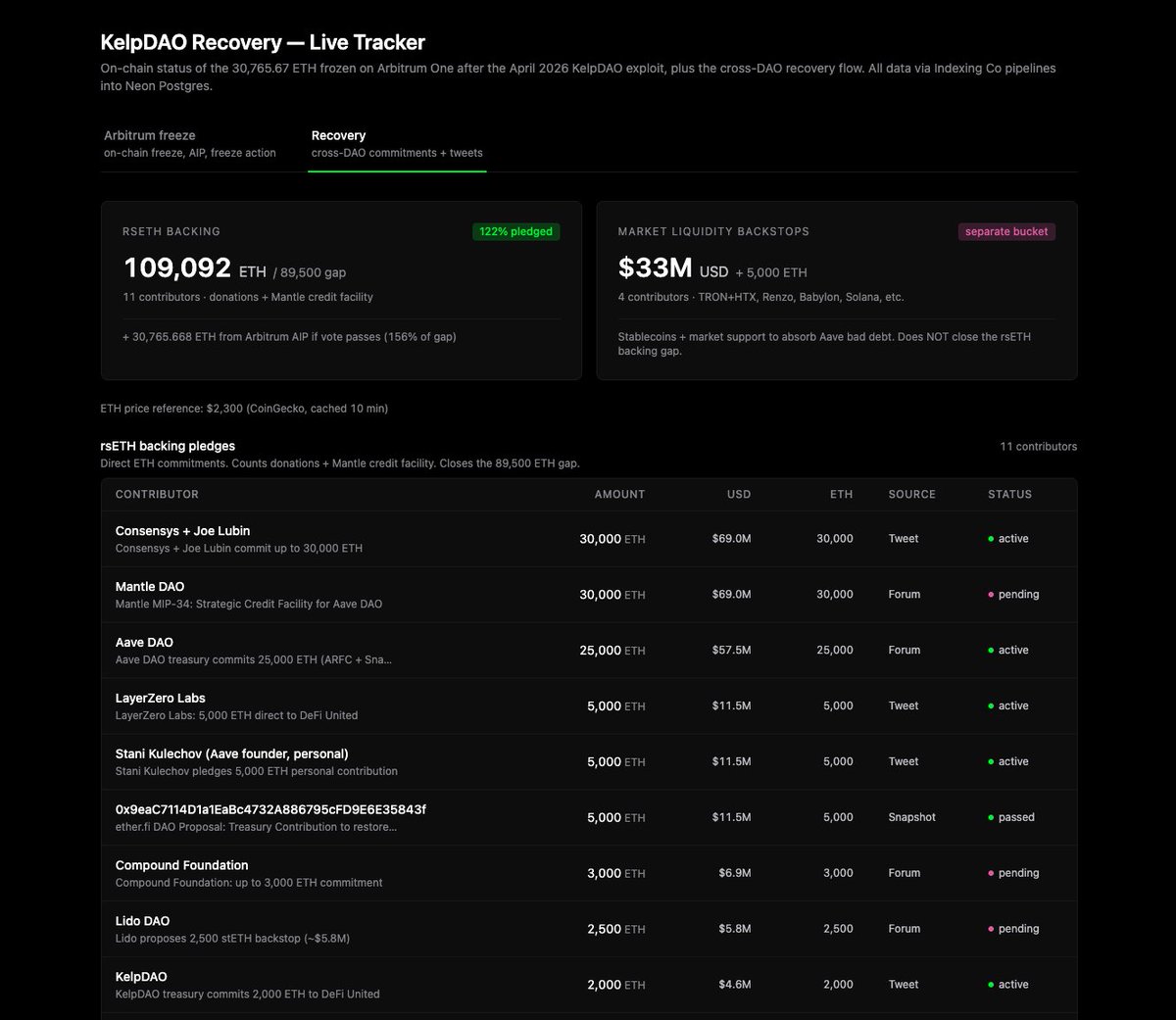
In parallel, the broader DeFi United pool has already over-pledged. As of today: ~109,000 ETH committed for direct rsETH backing (122% of the ~89,500 ETH gap, sourced from Chainalysis), plus an additional $33M in stablecoin liquidity from TRON, HTX, Renzo, Babylon, and others to absorb bad debt on Aave. Eleven days from exploit to over-pledge.
I'll keep posting research as I work through this, plus tools you can use to track the on-chain flows yourself. The Indexing Co pipelines and dashboard are open source.
Every fact above came from on-chain data we indexed and primary-source research, not press releases.
All feedback and contributions welcome!
Links in the first tweet
2
3
353
Apr 30
Live dashboard: observatory.indexing.co/kelp…
Code pipelines: github.com/indexing-co/kelpd…
171