
"Intrigued by crypto's complexities, sculpting the future of finance with blockchain mastery."
Joined January 2013
- Tweets 36
- Following 79
- Followers 38
- Likes 50
13 Photos and videos












"Meme coins: where 'moon' is not just a financial term but a daily expectation. To the moon and beyond! 🚀🌕 #CryptoMoonshots #MemeCoinGalaxy"
31
22
417
The Role of Patience in cypto maket:
Waiting for Market Confirmation:
Successful futures traders understand the importance of waiting for clear market confirmations. Patience comes into play when traders resist the urge to act impulsively based on initial price fluctuations. Waiting for a confirmed trend or pattern helps in making more informed decisions.
Dealing with Market Delays:
Crypto markets, being 24/7, can experience delays in reacting to news or events. Traders must exercise patience during these delays, avoiding premature reactions. A patient trader acknowledges that the market may take time to fully absorb and respond to external stimuli.
Avoiding Emotional Decision-Making:
Patience acts as a buffer against emotional decision-making. In the face of unexpected market movements, impulsive decisions driven by fear or greed can lead to significant losses. Patience allows traders to step back, reassess the situation, and make decisions based on logic rather than emotion.
30
22
1,042
Tokens: Bridging the Gap Between Blockchain and the Real World
Tokens serve as the linchpin that seamlessly integrates the capabilities of blockchain technology with real-world applications, extending from copyright protection to supply chain management. This convergence opens up a spectrum of opportunities for industries seeking enhanced efficiency, transparency, and security.
1. Copyright Protection:
Tokens revolutionize the landscape of intellectual property by providing an innovative solution for copyright protection. Artists, writers, and creators can tokenize their work, creating a unique digital representation of their intellectual property on the blockchain. This not only establishes indisputable ownership but also enables transparent and traceable royalty payments through smart contracts.
2. Supply Chain Management:
Tokenization brings a paradigm shift in supply chain management, enhancing traceability, and transparency. By tokenizing products and their relevant data, each step in the supply chain becomes immutable and verifiable on the blockchain. This ensures authenticity, mitigates the risk of counterfeit goods, and allows stakeholders to trace the provenance of products seamlessly.
3. Anti-Counterfeiting Measures:
In industries where counterfeiting poses a significant threat, such as luxury goods or pharmaceuticals, tokens play a crucial role in implementing anti-counterfeiting measures. Tokenized product information, combined with blockchain's immutable ledger, provides consumers and businesses alike with the assurance of the authenticity of the goods they interact with.
4. Digital Identity Management:
Tokens facilitate secure and decentralized digital identity management. Individuals can have a tokenized representation of their identity on the blockchain, granting them control over who accesses their personal information. This mitigates the risks associated with centralized databases and enhances privacy and security in identity verification processes.
5. Loyalty Programs and Rewards:
In the realm of marketing and customer engagement, tokens are employed to tokenize loyalty programs and rewards. This not only streamlines reward distribution but also enables users to trade or redeem their loyalty tokens across different platforms, creating a more dynamic and user-centric loyalty ecosystem.
6. Real Asset Tokenization:
Beyond digital assets, tokens extend their influence to the tokenization of real-world assets such as real estate or fine art. This democratizes access to traditionally exclusive markets, allowing fractional ownership and enabling a more diverse range of investors to participate in asset classes that were once difficult to access.
7. Smart Contracts for Automation:
The integration of tokens with smart contracts brings automation to various processes. Smart contracts, powered by tokens, automatically execute predefined conditions, streamlining contractual agreements. This is particularly relevant in areas such as escrow services, where tokens ensure that contractual obligations are met without the need for intermediaries.
10
10
806
Asset Variety and Innovation in Reputable Cryptocurrency Exchange maket is importance:
Well-regarded exchanges often support a wide array of cryptocurrencies and trading pairs. Additionally, they are more likely to integrate innovative features and stay abreast of technological advancements in the crypto space. This adaptability ensures that users have access to diverse investment opportunities and cutting-edge trading tools
20
10
851
Data Sovereignty in Web3: Embracing Digital Independence
In the realm of Web3, the concept of data sovereignty takes center stage, fundamentally reshaping the dynamics of user control and ownership over personal information. Bid farewell to data vulnerability as Web3 pioneers a new era of digital sovereignty, where privacy is not merely a right but a foundational aspect of the decentralized web. Let's delve into the critical facets of this transformative paradigm:
1. User Control and Ownership:
Web3 places paramount importance on user control and ownership of personal data. Unlike traditional models where centralized entities often control and monetize user data, Web3 empowers individuals to have full agency over how their information is utilized.
2. Decentralized Data Storage:
In Web3, data is not stored in centralized servers vulnerable to breaches. Instead, decentralized and distributed storage systems, often based on blockchain technology, provide enhanced security and resilience against unauthorized access. Users retain cryptographic control over their data.
3. Permissioned Data Access:
Web3 introduces the concept of permissioned data access, where users grant explicit consent for specific entities to access their information. This granular control ensures that personal data is shared only in situations where users have willingly authorized such sharing.
4. Cryptographic Privacy Measures:
The decentralized nature of Web3 is fortified by cryptographic privacy measures. Techniques like zero-knowledge proofs and homomorphic encryption enable data transactions without revealing the underlying information, preserving privacy while facilitating secure interactions.
5. Monetizing Personal Data:
Web3 redefines how personal data is monetized. Instead of third-party intermediaries profiting from user data, individuals have the potential to directly monetize their information. Decentralized finance (DeFi) models, for instance, enable users to earn rewards by sharing data on their terms.
6. Data Portability and Interoperability:
Web3 promotes data portability and interoperability, allowing users to seamlessly transfer their information across different platforms. This flexibility empowers individuals to choose services based on merit, fostering a more competitive and user-centric digital landscape.
7. Challenges and Regulatory Considerations:
Despite the promising aspects of data sovereignty in Web3, challenges such as regulatory uncertainties and the need for robust governance mechanisms persist. Addressing these challenges is crucial to ensuring a balanced and secure environment for data management.
8. Privacy as a Fundamental Right:
In Web3, privacy is not treated as an option but as a fundamental right. The decentralized web seeks to redefine digital interactions by embedding privacy principles at its core, acknowledging the inherent value and sensitivity of personal data.
In conclusion, the era of Web3 brings forth a paradigm shift in data sovereignty, placing control back into the hands of users. Digital independence, cryptographic privacy measures, and the acknowledgment of privacy as a fundamental right collectively propel Web3 towards a more secure, transparent, and user-centric digital future. #DataSovereignty #Web3PrivacyRevolution
10
9
536
💡 Beyond the buzz, understand Bitcoin's essence. A decentralized ledger, scarce supply, and borderless nature make it a beacon in the evolving financial landscape. Knowledge is power in the crypto realm. #BitcoinBasics #CryptoEducation
9
8
126
The provided statement delves into the core concept of arbitrage trading, emphasizing the importance of exploiting market inefficiencies for successful outcomes. Let's conduct a deeper analysis:
1. **Identification of Core Concept:**
- The essence of arbitrage trading is succinctly identified as the exploitation of market inefficiencies. This aligns with the fundamental principle of arbitrage, where traders aim to capitalize on price differentials between various markets.
2. **Emphasis on Market Inefficiencies:**
- The term "market inefficiencies" underscores the idea that prices across different exchanges may temporarily deviate from their equilibrium values. Arbitrageurs seek to identify and leverage these inefficiencies for profit.
3. **Strategic Components:**
- The statement highlights two strategic components crucial to arbitrage trading success:
- **Swift Execution:** Implies that timing is critical in arbitrage. Traders must act quickly to capitalize on fleeting opportunities before market conditions normalize.
- **Keen Eye on Price Variations:** Stresses the importance of vigilance in monitoring and understanding price movements. Successful arbitrageurs need to be adept at recognizing subtle variations across platforms.
4. **Keys to Success:**
- The phrase "keys to success" implies that swift execution and a keen eye on price variations are not just advantageous but essential for positive outcomes in arbitrage trading.
5. **Conciseness and Clarity:**
- The statement is concise yet clear in conveying the fundamental principles of arbitrage trading. It succinctly communicates the strategy's essence and the critical factors contributing to success.
6. **Applicability Beyond Crypto:**
- While the context is not explicitly specified, the principles discussed are applicable not only to crypto but also to arbitrage trading in various financial markets. This universality enhances the broader relevance of the statement.
7. **Educational Value:**
- The statement can serve as an educational snippet, providing a concise introduction to individuals interested in understanding the core principles of arbitrage trading.
8. **Potential Improvement:**
- While the statement is effective, it could benefit from a brief example or illustration to enhance clarity, especially for individuals new to the concept of arbitrage trading.
In conclusion, the statement effectively captures the essence of arbitrage trading, emphasizing the strategic aspects of swift execution and a keen understanding of price variations as integral to achieving success in this trading approach.
12
8
744
"🔍 The SEC's scrutiny on Binance.US echoes the regulator's commitment to maintaining integrity within the crypto space. Vigilance is paramount in ensuring investor protection and market stability. 🕵️♂️🌐 #SEC #CryptoIntegrity"
7
5
395
💻 Blockchain, the disruptor of centralized models. Its decentralized nature transforms power dynamics, giving individuals control over their digital assets and identities. 🔒🌐 #DecentralizedPower #BlockchainEmpowerment
8
5
315
"The $2K milestone isn't just a number; it's a testament to Ethereum's resilience and utility. As more dApps and projects leverage its capabilities, we're witnessing a paradigm shift in decentralized finance and beyond. 🌐💡 #DeFi #EthereumRevolution"
4
4
588
🌍 As Fidelity ventures into the world of crypto, their Ethereum ETF application echoes BlackRock's move, signaling a significant shift in traditional finance. 📊 Both giants eye the growing potential of Ethereum, sparking optimism among investors. 🌐 Will regulators grant the green light? 🚦 Stay tuned for the next chapter in the crypto evolution! 🚀 #CryptoNews #Ethereum #ETFApproval
12
9
2,607
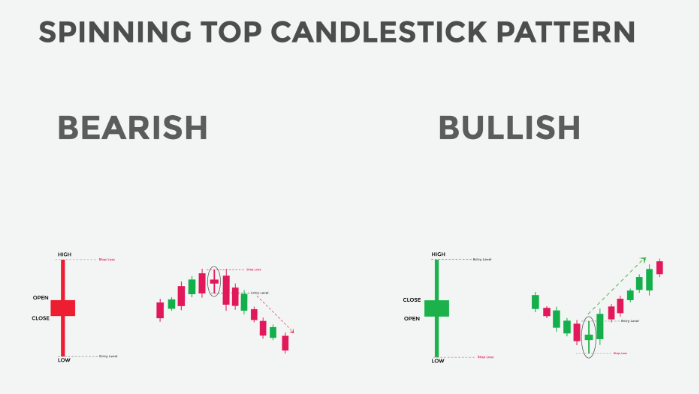
Analyzing Spinning Tops Candlesticks in Crypto Trading
Cryptocurrency markets are dynamic and volatile, presenting traders with a myriad of opportunities and challenges. One essential aspect of technical analysis in crypto trading is understanding candlestick patterns. Among these, the "Spinning Tops" pattern holds particular significance.
Introduction: Understanding Spinning Tops
A Spinning Top is a candlestick pattern characterized by a small body and long upper and lower wicks. Visually, it resembles a spinning top toy, where the body represents the opening and closing prices, while the wicks show the high and low prices during the given time frame.
Interpreting Spinning Tops: Market Indecision
Spinning Tops signal market indecision and a potential shift in the balance between buyers and sellers. The small body indicates that neither bulls nor bears have gained full control, resulting in a tug-of-war between market forces.
Key Features of Spinning Tops:
Small Body: The small body indicates a tight trading range, reflecting uncertainty and a lack of conviction among market participants.
Long Upper and Lower Wicks: The extended wicks signify that prices fluctuated significantly throughout the trading period, with neither buyers nor sellers dominating.
Variations of Spinning Tops:
Long-legged Doji: A variation with longer wicks, suggesting increased volatility and potential for a more significant market move.
Dragonfly Doji: Characterized by a long lower wick and little to no upper wick, indicating that sellers were dominant during the session but failed to maintain control.
Gravestone Doji: The opposite of the Dragonfly Doji, with a long upper wick and little to no lower wick, suggesting that buyers lost control.
Trading Implications:
Indecision Points: Spinning Tops often occur at key support or resistance levels, signaling indecision in the market. Traders should look for confirmation from other technical indicators before making decisions.
Volatility Warning: Long-legged Dojis indicate potential increased volatility, serving as a warning for traders to be cautious and employ risk management strategies.
Incorporating Spinning Tops into Trading Strategies:
Confirmation Signals: Combine Spinning Tops with other technical indicators such as Moving Averages or Relative Strength Index (RSI) to confirm potential trend reversals.
Pattern Recognition: Use Spinning Tops as part of a broader pattern recognition strategy, looking for clusters or sequences of these patterns to identify potential trend changes.
Conclusion: A Valuable Tool in Crypto Trading
In conclusion, understanding the nuances of Spinning Tops can provide traders with valuable insights into market sentiment and potential trend reversals. While this pattern alone may not guarantee success, when used in conjunction with other technical analysis tools, it becomes a powerful instrument in the crypto trader's toolkit. As with any analysis, prudent risk management and continuous learning are essential for navigating the complexities of the cryptocurrency market.
12
5
2,804
"The upcoming Bitcoin halving signals a pivotal moment for crypto businesses. It's prudent to acknowledge the potential challenges ahead. Some may falter, others adapt. Stay informed, assess risk, and position yourself wisely in this evolving landscape. #CryptoOutlook #BitcoinHalving"
3
4
2,723
📷 SEC (U.S. Securities and Exchange Commission) is currently at a pivotal juncture with a looming deadline that could significantly impact the fate of Bitcoin Exchange-Traded Funds (ETFs). The decision awaiting approval has stirred considerable speculation within the crypto community, as its outcome could play a pivotal role in shaping the regulatory landscape for digital assets.
The anticipation revolves around whether the regulatory gears at the SEC will finally turn in favor of widespread crypto adoption. The potential approval of Bitcoin ETFs is perceived by many as a critical milestone that could legitimize and integrate digital currencies into the traditional financial system.
Bitcoin, as the leading cryptocurrency, has been a focal point of discussions surrounding its acceptance as a mainstream investment vehicle. The ETFs, if approved, could open the floodgates for institutional investors to enter the crypto market, further bolstering its legitimacy and potentially driving substantial market growth.
However, the SEC's cautious approach, borne out of concerns related to market manipulation, investor protection, and overall market stability, has been a stumbling block in the past. The impending deadline adds an element of suspense to whether the regulatory body will provide the necessary green light for Bitcoin ETFs to enter the market.
The crypto community is closely monitoring this development, as it could be a turning point for Bitcoin and other digital assets. A positive decision from the SEC might catalyze a surge in interest and investment, potentially propelling Bitcoin to new heights.
Conversely, a rejection could lead to temporary setbacks, but the resilient nature of the crypto market suggests that alternative avenues for adoption and innovation would likely emerge.
As the deadline approaches, the crypto space is holding its breath, eagerly awaiting the SEC's decision and the potential implications it holds for the future of Bitcoin
24
16
2,931
Certainly, the recent reports of a breach in the defunct crypto ATM provider, Coin Cloud, have sent shockwaves throughout the crypto landscape. The alleged data heist, boasted about by hackers, highlights a critical concern not only about the vulnerability of cryptocurrency service providers but also about the security and privacy of user data within the digital currency sphere. Such breaches pose a substantial threat to user trust and confidence in the security measures employed by crypto services. They create a ripple effect across the entire digital landscape, instilling doubt and apprehension among users who rely on these platforms for their financial transactions and investments. The implications of this breach are far-reaching. They not only undermine the specific provider but also cast a shadow on the entire industry. It brings to the forefront the pressing need for heightened security protocols and stringent measures to safeguard user data in the realm of cryptocurrency. The incident serves as a stark reminder of the potential risks and vulnerabilities inherent in digital financial systems. User privacy and data security are fundamental pillars on which trust in these systems is built. When breaches occur, the aftershocks reverberate across the broader community, potentially impacting adoption rates and the reputation of the entire crypto sector. It’s not merely a single breach; it's a warning sign for the industry to reevaluate and fortify security measures. The need for robust, proactive security frameworks is now more critical than ever, as breaches of this nature not only compromise sensitive user information but also erode the trust that is essential for the sustainable growth and acceptance of cryptocurrencies. The fallout from such a breach extends beyond the immediate realm of the affected provider. It reverberates in the minds of all users and potential adopters of digital currencies, questioning the safety and reliability of their financial interactions within the crypto space. Regulatory bodies, too, may heighten their scrutiny and oversight in response to such incidents. They may seek to establish and enforce more stringent security standards to protect users and prevent future breaches, potentially influencing the regulatory landscape for the entire industry. In response to this breach, it's imperative for crypto service providers to not just react but proactively implement more advanced security measures. This involves not only upgrading technological safeguards but also enhancing user education and awareness about cybersecurity best practices. While this breach may cast a temporary shadow on the industry, it also presents an opportunity for growth and improvement. By learning from such incidents, the industry can evolve, fortify its security infrastructure, and emerge stronger and more resilient. In conclusion, the breach at Coin Cloud serves as a stark reminder of the vulnerabilities within the cryptocurrency sphere. It necessitates a collective effort from service providers, regulators, and users to fortify security measures, enhance awareness, and rebuild trust. These actions are pivotal for the sustained growth and credibility of digital currencies in the broader financial landscape.
11
2,764
🚀 Solana's upward momentum signals a significant high, hitting above $63, marking a remarkable milestone. Yet, the subsequent retracement implies market volatility and potential adjustments.
Solana's impressive upward trajectory, breaching the $63 threshold, marks a substantial milestone for the cryptocurrency. This surge signals a remarkable high and demonstrates the ongoing strength and potential of the Solana network. However, the subsequent retracement from this peak signifies the presence of market volatility and hints at potential adjustments within the cryptocurrency space.
The surge beyond $63 showcases a significant investor interest and confidence in Solana's underlying technology, network, and its associated assets. It serves as a testament to the growing relevance and adoption of Solana, positioning it as a strong contender within the competitive cryptocurrency landscape.
The achievement of this milestone also points to the expanding utility and value proposition of Solana. The project's technological capabilities, including its high throughput and relatively low transaction costs, have been instrumental in driving investor interest, leading to this surge in valuation.
Yet, the subsequent retracement that follows such a surge is a common occurrence within the cryptocurrency market. It signifies a phase of market correction or adjustment after a notable high. This retracement isn't necessarily indicative of a fundamental flaw within Solana but rather a natural response to the rapid price escalation, reflective of market dynamics and investor behavior.
Market volatility is inherent in the cryptocurrency realm, and such fluctuations are not uncommon. They can be influenced by a myriad of factors, including market sentiment, external economic indicators, regulatory developments, or even technical factors within the Solana network itself.
The retracement post a significant high might indicate profit-taking by investors who capitalized on the surge, leading to a temporary decline in the token's value. Additionally, it might trigger market participants to reassess their positions, prompting a period of consolidation or adjustment.
This retracement, rather than being a cause for concern, can often present an opportunity. It allows the market to stabilize, find new support levels, and create a more sustainable growth trajectory for Solana. It also offers an entry point for new investors who missed the initial surge, enabling them to participate in the project's potential growth.
The ebb and flow of cryptocurrency prices, including Solana's, are part of the larger market cycle. Such movements serve as a reminder of the volatile nature of the crypto market, highlighting the importance of understanding market dynamics and conducting thorough research before making investment decisions.
The subsequent steps for Solana would involve observing its market behavior, the response to this retracement, and how it re-establishes its footing. The project's ongoing developments, network upgrades, and strategic partnerships will also play a significant role in its future trajectory.
In conclusion, Solana's recent surge above $63 denotes a significant achievement, demonstrating investor confidence and market strength. However, the subsequent retracement showcases the inherent volatility of the cryptocurrency market. This retracement phase could pave the way for stability, new opportunities, and a recalibration for Solana's sustained growth.
#CryptoMarket #Volatility
6
3
1,314
"Exciting times in the world of DeFi! In 2023, these top crypto DEX aggregators are set to revolutionize the game. 🚀🌐 Stay ahead of the curve with my recommendations: @AggregatorX - Seamless integration and enhanced liquidity. @CryptoFusionPro - Unparalleled yield optimization. @DEXConnect - Cross-chain excellence, now even better! @TokenSwapKing - Your one-stop shop for decentralized trading. Keep an eye on these platforms, they're reshaping the DeFi landscape! 🔥💱 #Crypto #DeFi #DEX #2023CryptoTrends"
5
4
565
🚀 "Want Crypto Adoption? Give Consumers What They Really Want." Magalena Kala's wisdom emphasizes the importance of catering to consumers' core desires: money, status, and functionality. By aligning with these intrinsic motivations, the crypto industry can bridge the gap to broader adoption. Exciting times ahead! 📢💎 #CryptoInsights #ConsumerFocus
3
7
584