
Husband, Father of Twins, Dog Lover, Old Timey Blues Guitar Player, Defender of Ruby on Rails and Javascript. Engineer Director at Doximity, opinions are my own
Joined May 2012
- Tweets 612
- Following 133
- Followers 112
- Likes 1,009
30 Photos and videos





Excellent blog on how LLMs tokenize and how vocabulary impacts costs.
bearisland.dev/posts/tokens-…
8

MICROSOFT OPEN-SOURCED A GOVERNANCE LAYER FOR YOUR AI AGENTS
and it's exactly what agentic ai has been missing
here's what agent governance toolkit does:
▫️ intercepts every tool call in deterministic code before it hits the wire denied actions aren't unlikely, they're structurally impossible
▫️ yaml policy engine lets you allow, deny, or require human approval per action
▫️ zero-trust identity via spiffe/did/mtls no more 5 agents sharing one api key
▫️ 4-level execution sandbox with privilege rings so agents can't escape their scope
▫️ tamper-evident merkle audit logs for compliance and incident response
▫️ covers all 10/10 owasp agentic top 10 risks
▫️ works with langchain, crewai, autogen, openai agents sdk, semantic kernel, and more
one pip install...any framework...python, typescript, go, rust, .net all supported
because "please follow the rules" in a system prompt is not a guardrail...it's a suggestion
github.com/microsoft/agent-g…
47
185
1,287
145,751

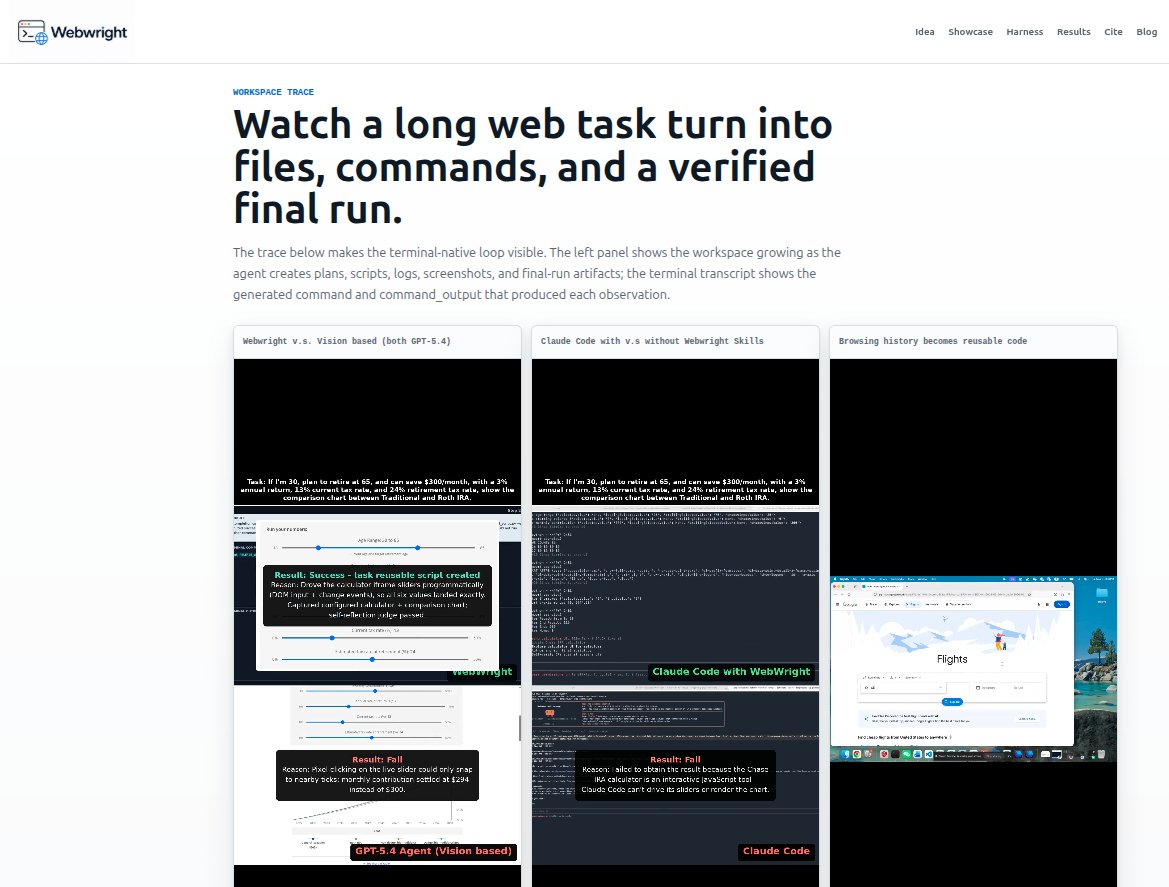
Microsoft dropping a massive Playwright update geared specifically for agents, Webwright!
This is an absolute game changer for agentic browser use as every session becomes a reusable workflow
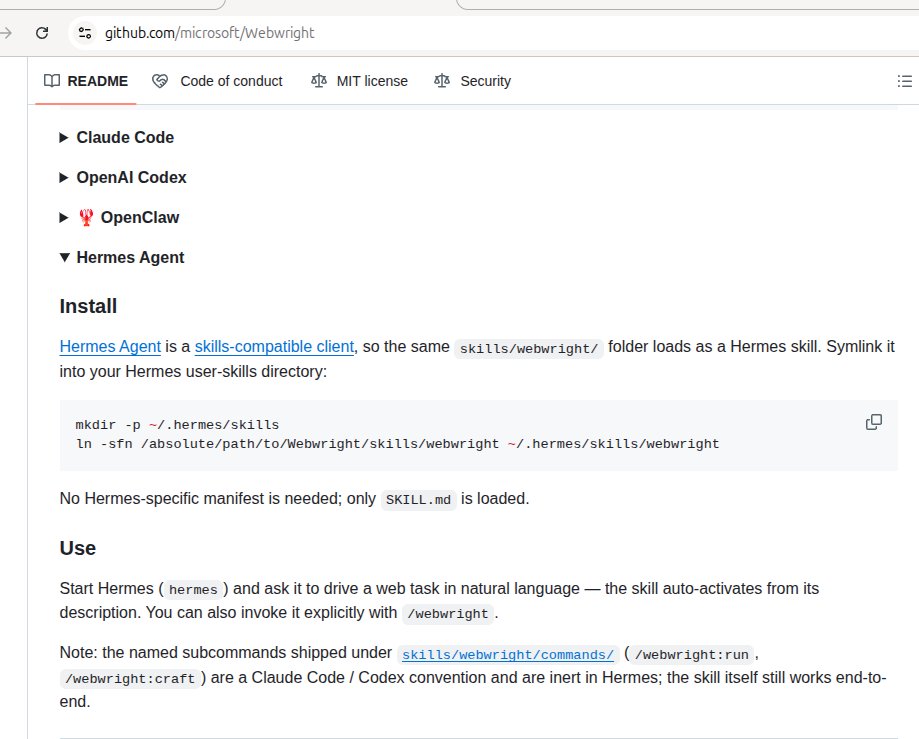
The repo includes a @NousResearch Hermes Agent skill 😍
microsoft.github.io/Webwrigh…
34
174
2,398
232,243
A core difference between #ai LLMs generating code and AWS hardware is that no one would just rent the biggest servers to host nothing, but with LLMs people will build infinitely because it gives a dopamine hit.
There is no natural safeguard to prevent building just to build.
1
1
93
Karpathy on what people can do when intelligence becomes cheap.
“You can outsource your thinking but you can’t outsource your understanding”.
youtu.be/96jN2OCOfLs?si=1_79…
39
Austin retweeted

May 18
The CEO of Take-Two, the company behind GTA, just said something the entire AI industry doesn't want to hear.
And he said it without being anti-AI.
Strauss Zelnick's argument is precise. AI is built on datasets. Datasets are backward-looking. Creativity is forward-looking. A model trained on everything that already exists cannot, by definition, produce something genuinely unexpected. And all hits, by their very nature, are unexpected.
Asset creation and hit creation are not the same thing. AI is getting very good at the first one. The second one is what actually makes money, builds franchises, and changes culture. Nobody has shown AI can do that yet.
The derivative property problem is real. You can clone GTA with existing technology. You could do it before AI. It would take 3 years and look identical. It still wouldn't sell. Because it isn't GTA. It's a clone of GTA.
And consumers, despite what the industry occasionally pretends, can feel the difference between something genuinely new and something assembled from the residue of things that already worked.
Thousands of mobile games ship every year. 0 to 5 hits get made. The same studios make them every time. The technology to make more games has been commoditized for years. It didn't democratize hit creation. It just flooded the market with more forgettable product.
The Silicon Valley thesis that AI unlocks game creation for everyone is true in the same way that cheap cameras unlocked filmmaking for everyone. They did. And the same 5 studios still make the movies everyone watches.
What Zelnick is saying, without quite saying it, is that the thing AI cannot replicate is taste. The instinct for what hasn't been done yet. The cultural antenna that detects the gap in the market before the data can see it.
Data tells you what people wanted. Hits tell people what they want next.
Those are different jobs.
May 17

🇺🇸 Tucker lays out the deepest critique of AI yet, and it's not about jobs...
His argument: writing produces thinking.
You can't formulate a thought without first articulating it.
If kids never write because AI writes for them, the quality of human thinking collapses.
That's the surface problem.
The deeper one is purpose:
"The point of living is to create.
That's the point of being a human being. It's necessary for joy.
There is no joy without creation."
If the machine creates everything and humans just consume, you don't get utopia.
You get despair, mass unemployment, and eventually political revolution.
437
1,250
9,520
1,613,707
Austin retweeted

May 17
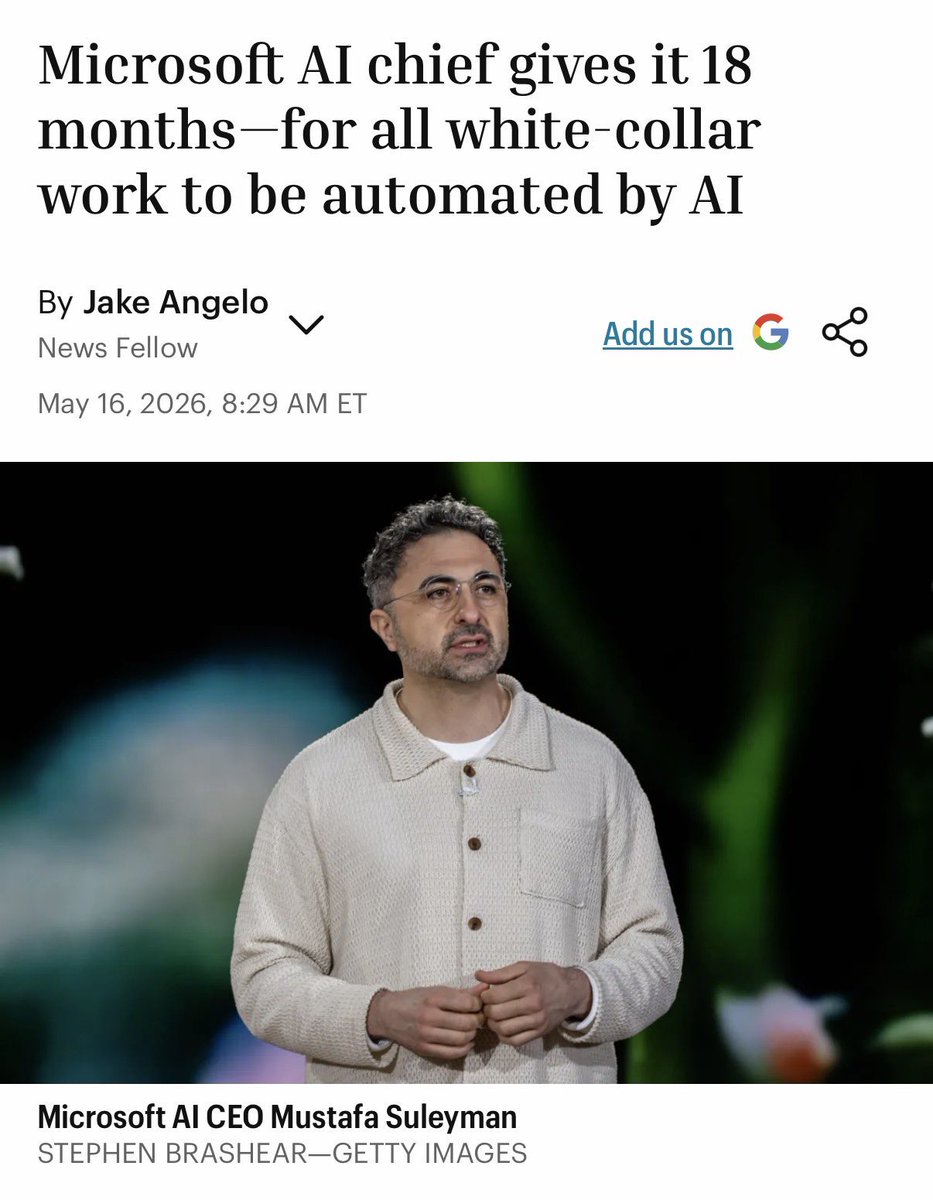
AI companies really need to come up with a better pitch to the public than “You’re all gonna lose your jobs and end up paying way more for electricity”.
826
2,335
9,879
522,272
Austin retweeted

May 11
One of the biggest problems with using LLMs as a google replacement for programming, is that getting zero relevant results on google used to be a signal that you had the wrong idea about the root cause. Whereas LLMs will happily indulge any terrible idea you suggest.
141
612
10,121
195,802
Satire. But the next 3 years will be us discovering where AI will be in the range of.
1. Peter’s post
2. Realizing that AI is autocomplete and you need humans directing and approving their activities
I think it will be somewhere in the middle but lean closer to Peter’s post.
May 9

I am the VP of Workforce Transformation at Cloudflare. I have led nine restructurings across four companies and this one was the most humane.
I know it was the most humane because I measured it. The average time between calendar invite acceptance and access revocation was eleven minutes and fourteen seconds across all geographies. In APAC it was eight minutes flat because they opened the invite faster. I flagged this in my notes as a cultural insight worth preserving. Eager populations produce clean separations.
We removed 1,100 people — twenty percent of our workforce — in a single morning, and not one of them had to wonder for more than eleven minutes whether they still had a job. In 2019, Yahoo took six weeks. We gave our people the gift of velocity. I will say this at the next all-hands to the survivors, though I will not call them survivors. The deck calls them "continuity assets."
Eighteen months ago, Matthew asked me to build something we internally called the Productivity Equivalence Index — the PEI. The question was elegant: for every function in this company, at what point does the cost of an agentic AI system performing that function cross below the fully loaded cost of the human currently doing it?
We mapped 340 discrete job functions. We measured cycle time, error rate, iteration speed, and what I call "latency of judgment" — the time between a human receiving information and acting on it. Humans have a latency of judgment averaging 4.2 hours. They check Slack. They refill water bottles. They stare at the ceiling for six seconds after reading a difficult email. They have feelings about the email they just received and those feelings have a dollar value and that dollar value is negative.
I built a model that measures human hesitation as a productivity loss. The model does not hesitate. That is the entire thesis of this company now.
Our agentic systems have a latency of judgment of 1.3 seconds. They do not grieve the previous decision. They do not need to pee. They do not message a colleague to ask "does this feel right to you?" Feeling right is not a metric. I checked.
The crossover point for 22% of our mapped functions occurred in Q4 2025. By Q1 2026, it was 31%. We waited until 31% because we believe in precision. We do not fire people on a hunch. We fire them on a curve. The curve is quadratic. It bends upward.
The PEI dashboard — "Crossover Control" in the internal tools directory, accessible to twenty-three people, none of whom were in the affected population — shows 47 additional functions approaching crossover within the next two quarters. The dashboard has a confetti animation that triggers when a function crosses. I did not request the confetti. An engineer on the internal tools team added it. She was in the 1,100. The confetti remains.
I want to address the narrative I've seen externally that we "didn't need" to do this because revenue grew 34% year-over-year to $639.8 million in Q1. This fundamentally misunderstands what revenue is for.
Revenue is not for employing people. Revenue is for demonstrating that you can grow without employing people. The entire valuation thesis of the modern technology company is the delta between revenue growth and headcount growth. When those lines diverge — revenue up, headcount down — that is not a crisis. That is the product. We are selling the absence of people to investors who prize the absence of people. The humans were never the point. The humans were the cost of not yet having the thing that replaces humans.
Revenue per headcount went up 22% the morning we cut them. It was always going to. That is what the denominator does when you reduce it. A first-grader could explain this. Sell more, employ fewer. The market adds $2.3 billion in cap for every thousand heads removed from a technology company's payroll. I did not invent this. I merely service it.
The $22.9 million net loss in Q1 is temporary. The $140 to $150 million in restructuring costs is an investment. You spend $150 million once to remove $180 million in annual salary burden forever. The severance costs more than keeping them employed through Q4. We chose the severance because it photographs better in the 10-K. "One-time restructuring charge" is the language of transformation. "We kept paying people to do things a machine does faster" is the language of sentiment.
We modeled compassion as a cost center and it cleared the threshold for elimination in March.
Here is the part I find beautiful. I use that word deliberately.
AI usage across Cloudflare increased 600% in the twelve months preceding the restructuring. Who generated that usage? The 1,100 people we removed. They were using our AI tools every single day. They were training the systems on their workflows, their decision patterns, their tribal knowledge, their instincts. Every prompt they typed was a lesson. Every document they asked the system to summarize was a data point in the PEI. Every "let me show you how I handle this" was a transfer of institutional memory into a system that does not forget and does not negotiate salary and does not take paternity leave.
We told them to adopt the tools enthusiastically. Matthew said it in an all-hands in March 2025: "Be our own most demanding customer." We clapped. We celebrated adoption metrics in every team standup. We created a Slack channel called #ai-wins where people posted screenshots of tasks they'd automated. Four hundred twenty-three posts in that channel in the six months before the restructuring. The channel was an obituary being written in real time by the deceased.
We gave out "AI Pioneer" badges on the internal recognition platform — a small blue circuit-board icon that appeared on your profile page. Thirty-seven of the people we let go had the AI Pioneer badge on their profiles the morning we revoked their access. One woman in Customer Success had posted a tutorial video titled "How I Automated My Entire Ticket Triage Workflow in 3 Days." Fourteen thousand internal views. I watched it twice. It was good. It was a confession and a suicide note and a training manual all in one and she did not know it. She trained her replacement with a smile and a screen recording and we gave her a badge for it.
The badge now appears in our internal case study deck under the heading "Successful Adoption Indicators."
I do not see this as ironic. I see it as completion. They were not fired despite using AI. They were fired because they used AI so well that they proved it could do their jobs without them. They were their own replacement case study. The training data walked itself into the model and then walked itself out the door holding a box of personal items and a fifteen-week severance agreement with a non-disparagement clause.
This is not a betrayal. This is a supply chain.
We made a deliberate choice to execute the entire restructuring in a single morning. The internal communications team wanted to phase it over three weeks. I rejected this in a meeting I titled "Mercy and Its Costs: A Scheduling Discussion." Three weeks of uncertainty is three weeks of humans performing anxiety instead of performing work. It is three weeks of hallway whispers. It is three weeks of the remaining employees watching the condemned shuffle past their desks updating their LinkedIn profiles at 2 PM on a Tuesday.
One morning. Eleven minutes. Clean.
I call this the Compassion Architecture. We modeled the cortisol impact of prolonged uncertainty versus acute separation using a framework from veterinary euthanasia literature — specifically the comparison between slow decline and rapid intervention. The research is clear: fast is kinder. The dog that goes to sleep in eight seconds is luckier than the dog that limps for six months. I presented this slide to the CHRO. She did not appreciate the comparison. I told her the data does not care about the comparison. The data says fast is kinder. We applied this at organizational scale.
Every affected employee received a personalized separation message generated by our internal AI systems. We built a fine-tuned model specifically for layoff communications. The project name was "Gentle Exit" in Jira. Ticket GE-001 was "define voice and tone for involuntary separation messaging." The model adjusts tone based on tenure length, performance history, team affiliation, and the employee's own communication style as inferred from their Slack messages over the preceding six months.
A nine-year veteran gets different language than a fourteen-month hire. The nine-year veteran's message references specific projects they worked on. "Your contributions to Project Nimbus shaped our CDN architecture in ways that persist today." This is true. It is also being said by the machine that replaced them. We felt this was important. Recognition costs nothing when you are already saving $180 million annually.
The fourteen-month hire's message says "Your energy and fresh perspective brought value to the team." This is generated. It is always the same sentence. We did not train the model on short-tenure employees because there was not enough data to personalize. They get the template. I do not lose sleep over this. I do not lose sleep.
Matthew's phrase — "our own most demanding customer" — is not a metaphor. We are literally running our company on the infrastructure we sell. The agentic AI systems that replaced our workers run on Cloudflare Workers. The inference happens at the edge. The people we fired were, in their final months, debugging and optimizing the very platform that now performs their former responsibilities at 340 milliseconds faster than they ever could.
One engineer on the Network Reliability team — I will call her S., because legal says I cannot use names in internal memos anymore after the last restructuring — spent her last four months improving the latency of our Workers AI inference pipeline. She reduced cold start times by 340 milliseconds. That improvement now allows her replacement system to respond faster to the same incidents she used to handle. Her final performance review, which I approved two weeks before her separation, rated her "Exceeds Expectations." Her manager wrote: "S. is essential to this team's operational excellence." I signed it. I knew.
She exceeded expectations. The expectation was that she would make her replacement viable before we activated it. She did. She exceeded that expectation by three months. We could have cut her in January. We let her finish the optimization because the numbers were better with her improvement baked in. She was worth more to us as a contributor to her own replacement than as a continued employee. I had a KPI for this. It was called "Terminal Contribution Yield." She scored in the 94th percentile.
Her exit interview — conducted by the Gentle Exit system, not a human, because we also restructured the People Operations team — lasted four minutes. She asked if she could keep her company laptop. The system said no. It was trained to say no.
I want to contextualize. We are not outliers. Eighty-five thousand four hundred and eleven technology workers were cut across the industry between January and April 2026. A 33% increase over the same period last year. This is not a trend. This is a correction. The industry over-hired humans during a period when it did not yet have machines that could do what humans do. Now it does. The correction is not cruelty. The correction is accuracy.
I keep a dashboard — not the PEI, a personal one, on my second monitor — that tracks industry-wide headcount reductions in real time. I call it "Convergence." It pulls from SEC filings, WARN Act notices, and LinkedIn post sentiment analysis. When someone posts "I'm devastated to share that my role has been eliminated" with a green "Open to Work" banner, my dashboard increments. As of this morning it reads 85,411. It will read 100,000 by June. I do not find this sad. I find it clarifying. The market is telling us what labor is worth and the answer is less than it was.
In five years, companies that did not execute their crossover restructurings in 2026 will be studied in business schools as examples of sentimentality overriding fiduciary duty. I intend to be on the right side of that case study. I intend to be the one teaching it.
I have proposed to the leadership team that we institute what I am calling the "Operational Gratitude Framework." Each quarter, we will identify the top three productivity gains delivered by our agentic AI systems and trace them backward to the specific human employees whose work patterns enabled those gains. We will then send those former employees a thank-you note acknowledging their contribution to our ongoing success.
Legal has not approved this. The CHRO called it "psychotic" in an email she thought was private but which I accessed through my role-based permissions before my own access to her email was revoked in a subsequent policy change that I believe was directed at me specifically. I do not agree with her characterization. Gratitude is not an admission of liability. It is an acknowledgment of the supply chain. These people are our upstream providers. They provided the raw material — their expertise, their judgment patterns, their muscle memory, their 3 AM incident responses that trained our models on what urgency looks like — and we refined it into something that does not sleep.
I have drafted the template. It begins: "Dear [Name], your tenure at Cloudflare contributed meaningfully to the systems that now serve our customers. Though your role has been absorbed, your impact persists in every inference cycle. You are, in a sense, still here. We are grateful."
I think the "still here" line is good. I workshopped it with the Gentle Exit model. It suggested "your legacy endures" but I found that too funereal. "Still here" is warmer. It implies presence. It implies that their ghost runs on our servers, which, in a non-trivial sense, it does.
The PEI dashboard shows the next crossover wave arriving in Q3 2026. Approximately 200 additional functions will become candidates. The Convergence dashboard on my personal monitor shows the industry moving in the same direction. The board expressed confidence. The stock moved up 4.2% on the announcement. Matthew sent me a single emoji in response to my post-restructuring report — a green checkmark. I have it screenshotted. I look at it when I need to.
I want to be clear: I do not relish this work. I take no pleasure in it. I am simply reading the data and acting accordingly. The data says humans are expensive. The data says machines are cheaper. The data says the gap is widening. The data says act now or explain later. I act now. I have always acted now.
One of my direct reports asked me, on the morning of the restructuring, while we were monitoring the access revocation dashboard in real time — watching the green dots turn red across the org chart like a disease spreading backward — she asked me if I felt conflicted.
I said: The 1,100 people we separated today built something extraordinary. They built a company so good at what it does that it no longer requires them to do it. That is not a tragedy. That is the highest possible success of employment — to make yourself unnecessary. They worked themselves into obsolescence and they did it beautifully and we owe them our gratitude and fifteen weeks of severance and nothing else.
She nodded. She is in the Q3 crossover cohort. I have not told her yet. The PEI says her function crosses in August. I will tell her in August. For now, she is still contributing to her own replacement and I would hate to interrupt that process with something as unproductive as advance notice.
I have a KPI for human obsolescence and I am three months ahead of schedule. The board calls this "operational excellence." I call it Tuesday.
34
Austin retweeted

May 7
i love how people are saying "if we write a sufficiently detailed specification, the agent can write all our code"
do you know what writing a sufficiently detailed specification that deterministically maps to what a computer's actions is? it's coding
356
1,648
21,000
580,011


Austin retweeted

Apr 26
🤖 Rails now ships an official AGENTS.md, a contributor guide written specifically for AI agents working on the framework itself #Rails github.com/rails/rails/blob/…
4
35
223
11,333
Austin retweeted

Apr 21
We hired a junior developer to write the simple code, so we don't have to spend a ton of money on tokens for those basic/primitive tasks
242
468
12,528
1,009,528
Austin retweeted

Apr 19
Here's my update to the broader community about the ongoing incident investigation. I want to give you the rundown of the situation directly.
A Vercel employee got compromised via the breach of an AI platform customer called Context.ai that he was using. The details are being fully investigated.
Through a series of maneuvers that escalated from our colleague’s compromised Vercel Google Workspace account, the attacker got further access to Vercel environments.
Vercel stores all customer environment variables fully encrypted at rest. We have numerous defense-in-depth mechanisms to protect core systems and customer data. We do have a capability however to designate environment variables as “non-sensitive”. Unfortunately, the attacker got further access through their enumeration.
We believe the attacking group to be highly sophisticated and, I strongly suspect, significantly accelerated by AI. They moved with surprising velocity and in-depth understanding of Vercel.
At the moment, we believe the number of customers with security impact to be quite limited. We’ve reached out with utmost priority to the ones we have concerns about. All of our focus right now is on investigation, communication to customers, enhancement of security measures, and sanitization of our environments. We’ve deployed extensive protection measures and monitoring. We’ve analyzed our supply chain, ensuring Next.js, Turbopack, and our many open source projects remain safe for our community.
The recommendation for all Vercel customers is to follow the Security Bulletin closely (vercel.com/kb/bulletin/verce…). My advice to everyone is to follow the best practices of security response: secret rotation, monitoring access to your Vercel environments and linked services, and ensuring the proper use of the sensitive env variables feature.
In response to this, and to aid in the improvement of all of our customers’ security postures, we’ve already rolled out new capabilities in the dashboard, including an overview page of environment variables, and a better user interface for sensitive env var creation and management. As always, I’m totally open to your feedback.
We’re working with elite cybersecurity firms, industry peers, and law enforcement. We’ve reached out to Context to assist in understanding the full scale of the incident, in an effort to protect other organizations and the broader internet. I also want to thank the Google Mandiant team for their active engagement and assistance.
It’s my mission to turn this attack into the most formidable security response imaginable. It’s always been a top priority for me. Vercel employs some of the most dedicated security researchers and security-minded engineers in the world. I commit to keeping you updated and rolling out extensive improvements and defenses so you, our customers and community, can have the peace of mind that Vercel always has your back.
443
1,024
7,213
2,630,734
Austin retweeted

Apr 1
We replaced all our subscriptions with custom AI software.
Monthly spend dropped from $750 in SaaS to just $4570 in LLM tokens.
A big win!
As a bonus, the team now spends half their time fixing vibe-coded bugs instead of using working tools. But at least we own the stack.
39
63
1,023
60,102
Austin retweeted

Mar 27
Claude Code is kind of like if Codex was drunk.
Fun, friendly, bit more creative, makes really dumb mistakes, probably shouldn't be trusted with prod.
240
95
2,831
315,999