Maranatha ✝️ Bondservant of Christ, army vet, RN, prolife.
Joined January 2021
- Tweets 196,821
- Following 16,704
- Followers 59,040
- Likes 312,923
16,010 Photos and videos








Pinned Tweet

Mar 13
40
14
59
46,555
Europeans loving America is uplifting content and I’m here for it.
2
4
44
634
autocorrect2.0 retweeted

Jun 13
The Lord Jesus d!ed for your sins so that through Him you will have eternal life. Run to Him today.🙏🏾❤️
30
406
8,177
62,527
autocorrect2.0 retweeted

Everyone wanna do a hierarchy until it’s time to do hierarchy things, like be accountable.

Translation: “Don’t tell your pastor you’ve been brainwashed online to like Adolf Hitler now, because he’ll most likely not be cool with that.”
Lord, help us all. 🤦♂️

6
8
47
3,587
autocorrect2.0 retweeted
This is such a silly argument from RCC & EO.
No matter what we hold as the ultimate authority, we ALL have to use our own brains to comprehend what is being said, whether it’s said in scripture or by a church father or a council.
We all have to rely upon our ability to think and process information, even when we recognize an authority that’s above us.
For example, my husband is my authority. If he sends me a text message that says “don’t let the kids watch tv before 12,” I have to use my brain to understand what he means by that in order to submit to his authority. Can they just not watch tv shows? Or can they watch a movie? Can I use the TV to play music? Or does he want the tv completely shut off until 12? These are all things I need to process using my brain and discernment.
It’s the same for EVERYONE no matter the authority structure you submit to. You cannot avoid this “problem.”

Be honest, @JPuncut.
You follow your own personal interpretation of the Bible.
And you are fallible.
59
6
46
5,683
The Bible predicted the unhealthy obsession with arguing over the plain meaning of words. Denying the plain definition of words is how scripture is dismissed as an authority and man is established as the “interpreter” and thus the authority.
“Anyone who teaches something different is arrogant and lacks understanding. Such a person has an unhealthy desire to quibble over the meaning of words. This stirs up arguments ending in jealousy, division, slander, and evil suspicions.”
1 Timothy 6:4 NLT
bible.com/bible/116/1ti.6.4.…
The truth is that God establishes the meaning of scripture and conveys it through His Holy Spirit.
God does not fail to communicate clearly, man just fails to overcome his flesh.
9
3
49
2,629
RT @MiddleEarthElf4: If you call yourself a Christian yet claim it was humans who brought Israel back in 1948, you are denying God & callin…
7
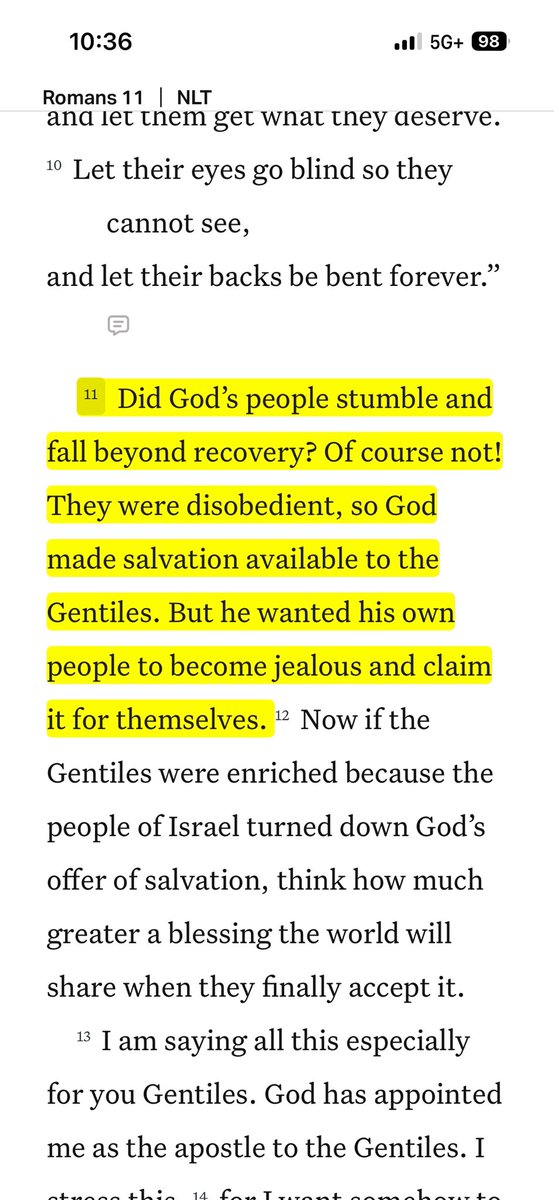
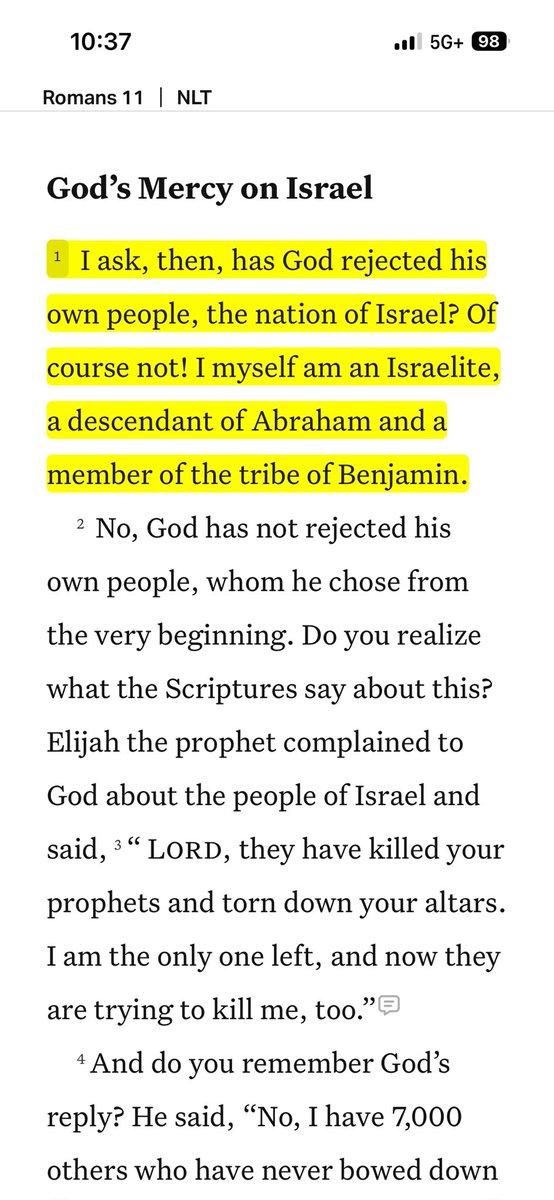
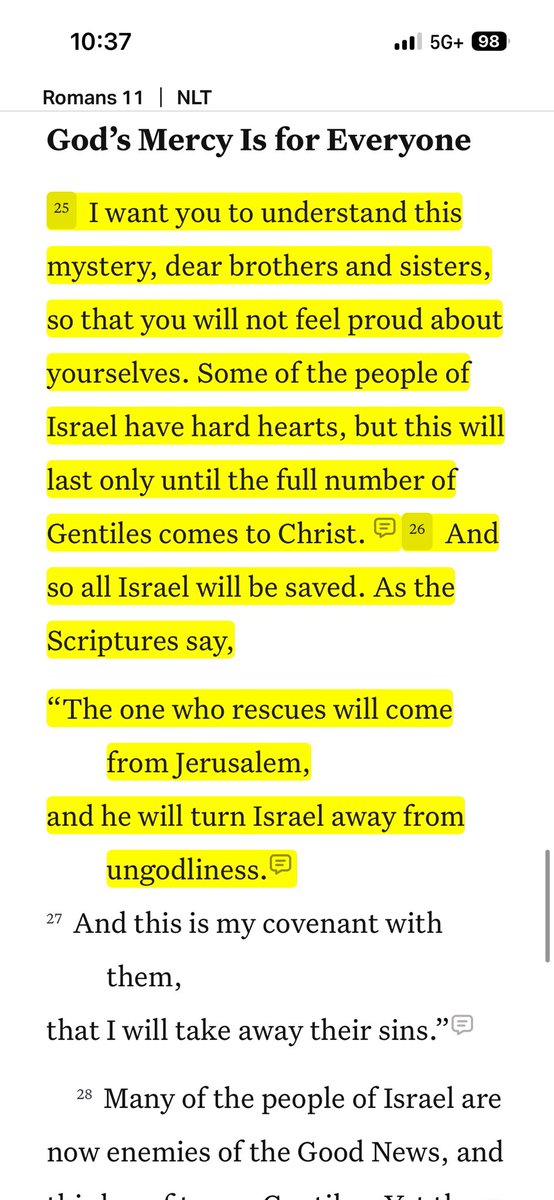
Believing exactly what Paul says in Romans 11 is contrary to the accepted doctrine of the vast majority of Christian churches, including the most populous and oldest denominations, thus demonstrating the danger of farming out your understanding of scripture to other people, even if they hold titles and degrees.
25
9
57
2,676
autocorrect2.0 retweeted
Jun 13
Matthew 7:14 14 But small is the gate and narrow the road that leads to life, and only a few find it.
Appeals to popularity are always fallacious, but they are especially fallacious in the context of Christianity
People who are right about God at any given point in the Bible are always an overwhelming minority.
1
3
27
646
Jun 13
The church can’t give grace. It’s a collection of sinners that needed grace.
The source of grace is God
God the Father
•James 4:6: "But he gives more grace. Therefore it says, 'God opposes the proud, but gives grace to the humble'".
•1 Peter 5:10: "And the God of all grace, who called you to his eternal glory in Christ, after you have suffered a little while, will himself restore you and make you strong, firm and steadfast".
Jesus Christ
•John 1:17: "For the law was given through Moses; grace and truth came through Jesus Christ".
•2 Corinthians 12:9: Jesus tells the Apostle Paul, "My grace is sufficient for you, for my power is made perfect in weakness".
The Purpose of Grace
•Ephesians 2:8-9: "For by grace you have been saved through faith. And this is not your own doing; it is the gift of God".
•Hebrews 4:16: Explains how to receive it: "Let us then with confidence draw near to the throne of grace, that we may receive mercy and find grace to help in time of need".
And no church gets to define Grace. God does
The concept of grace runs through both the Old and New Testaments, with slightly different original terms that add layers of meaning:
•Old Testament (Hebrew: khen): Translates to "favor" or "grace". It represents acceptance, goodwill, and a generous response to someone who has no claim to it.
•New Testament (Greek: charis): Translates to "grace" or "favor". It often emphasizes God’s active benevolence and His free, unearned gift of salvation through Jesus Christ.
the Bible teaches that grace is completely unmerited. The gift and the act of giving have nothing at all to do with our merit or innate quality (Romans 4:4; 11:5–6; 2 Timothy 1:9–10). In fact, the Bible says quite clearly that we don’t deserve God’s salvation. Romans 5:8–10 says, “God demonstrates his own love for us in this: While we were still sinners, Christ died for us. . . . While we were God’s enemies, we were reconciled to him through the death of his Son.”
10
2
70
1,656
autocorrect2.0 retweeted

Jun 11
Necromancy is simply inquiring of those who have physically passed away here on earth.
Adding extra technicalities to this definition is just trying to create a loophole to justify your unbiblical practices.
177
7
196
55,314
autocorrect2.0 retweeted

Jun 12
Search: "smallest seed of a cultivated plant"
Brave AI: The **mustard seed** is the smallest seed of a **cultivated plant**. While orchids produce the smallest seeds in the world (measuring approximately 0.05 mm), they are not typically grown in agriculture.
...
1/
2
1
2
1,290
autocorrect2.0 retweeted

Jun 11
“Christianity is dying”
Jun 11

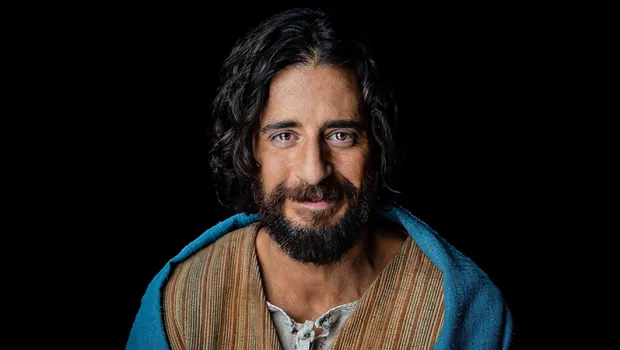
The Chosen broke the Guinness World Record for most translated series ever


62
729
14,444
215,196
autocorrect2.0 retweeted

Jun 12
I'm pretrib and premillennial.
I believe Jesus could come for His Church at any moment.
But, if I'm wrong, I would be honored to be arrested, hauled off to some Islamic FEMA camp in Texas, MN, or NY and beheaded for Jesus.
Not because I'm brave.
Not because I'm strong.
But because Jesus is worthy.
"Lord, to whom shall we go? You have the words of eternal life." — John 6:68
The world can take my freedom.
The world can take my possessions.
The world can take my life.
But it cannot take my Savior.
"For to me, to live is Christ, and to die is gain." — Philippians 1:21
Whether I meet Him in the air or face death for His name, my desire is the same:
To be faithful to the end.
Jesus is worth it.

132
210
983
13,562
autocorrect2.0 retweeted

Jun 12
Dating folks? If you want a true Christian man or woman, you will never be able to be what they need unless you love Christ first.
What?
I’m serious. If your heart’s desire is to follow and obey Jesus, you will attract them.
If you just want a spouse, you will repel them, because you can’t be what they need.
Wanting a spouse means you’ll do good things for them to make them desire you, but your love is limited only to them and no one else. You’ll have zero issues treating a non romantic interest like garbage because they don’t have anything you want.
Loving Christ means you’ll love others even if they have nothing to offer you. And it’s what separates a good man from a “nice guy”.
The Holy Spirit guides a good man or woman. You can’t fake that forever. Now can you pretend to be someone you are not.
And you won’t win the love and affection of a Christian man or woman unless your intrinsic desire for love comes first from God.
Jun 12

Daughters of God aren't supposed to just "fall in love" with men.
But are to submit to Jesus & respond appropriately to men who submit to Jesus, pursue and love them.
12
15
166
5,892
autocorrect2.0 retweeted

Jun 12
There’s a proverb for the people defending Karmelo Anthony.
“Whoever says to the wicked, “You are in the right,” will be cursed by peoples, abhorred by nations.”—Proverbs 24:24
43
405
3,081
30,180